
Tropical Storm Isaias was named at 4 AM CDT on Wednesday, October 7. The National Hurricane Center expects it to become a hurricane by Thursday and to approach the northern Gulf Coast on Friday, with 3 to 6 inches of rain (locally 10) from southeastern Louisiana to the Florida Panhandle. Hurricane and Storm Surge Watches were expected later Wednesday.
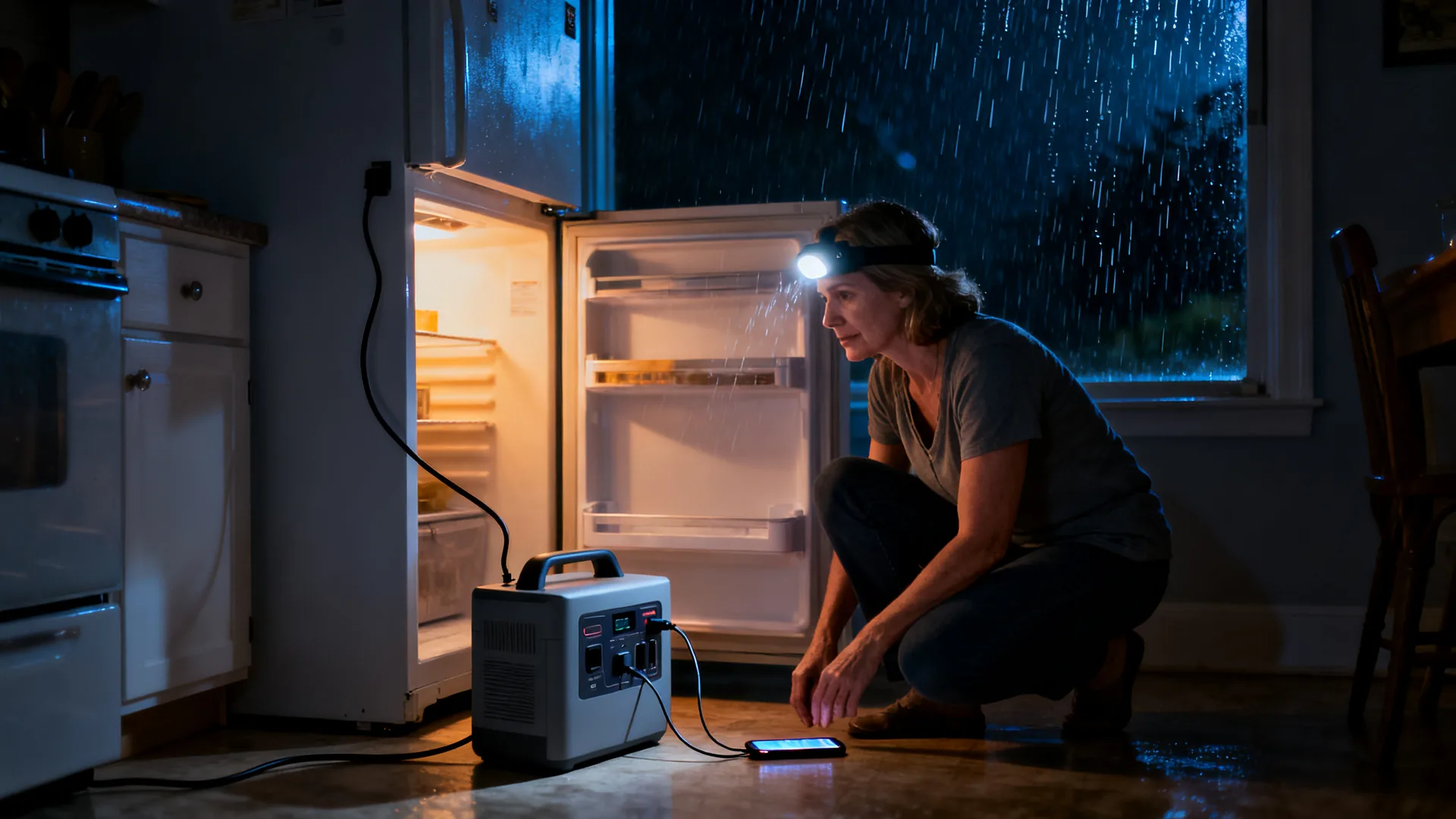
If you own a portable power station, here is what it will actually keep running once the grid drops. The short version: a 2 kWh unit is one full night of fridge, internet and a CPAP, not a weekend. Every number below is a calculation you can check, not a test result. BackupPowerHub does not run lab tests (see our editorial guidelines).
- Full-size fridge: about 15 hours (about 29 if yours is a recent, efficient model).
- Wi-Fi router and modem: about 3.5 days.
- CPAP with the heated humidifier on: about 31 hours, close to 4 nights.
- Fridge + internet + CPAP + one lamp together: about 8.5 hours. One night.
- Window air conditioner: about 2.5 hours. Not a plan.
Where Isaias stands (NHC Advisory 3, 4 AM CDT, October 7)
Position: southwestern Gulf, about 580 miles southwest of the mouth of the Mississippi River, moving east-northeast at 8 mph.
Winds: 40 mph sustained. The NHC forecast peaks at 110 mph over the central Gulf on Friday morning, then about 85 mph at the coast.
Track: a turn to the northeast and then north on Thursday and Friday, with the center reaching the coast late Friday somewhere between southeastern Louisiana and the Florida Panhandle. The NHC calls its own track confidence below average, so the landfall point can still move.
Rain: 3 to 6 inches on the central Gulf Coast from Friday through the weekend, up to 10 locally, and 1 to 5 inches as far north as the Tennessee Valley and the Carolinas. Flash and river flooding are the main inland risks.
We update this box with each major advisory. Always follow the NHC and your local emergency management office, not a blog.
What runs, hour by hour: 1 kWh, 2 kWh and 3 kWh
The math is the same as our power station calculator: capacity in Wh × 0.85 ÷ the watts you plug in. The 0.85 covers inverter losses and the few percent most units hold back. A 1,024Wh unit therefore delivers about 870Wh, a 2,048Wh unit about 1,740Wh, a 3,072Wh unit about 2,610Wh.
Wattages are average draws over time, not the number on the label. A fridge compressor cycles on and off, so a “busy” full-size fridge averages about 120W and an efficient recent one about 60W. The CPAP figure is ResMed’s own spec for the AirSense 11 (56W typical, 73W peak, heated humidifier included). The sump pump figure is a Zoeller M53, a common 1/3 HP pump, at its rated 9.7 amps, running 10 minutes per hour.
| Load | Average draw | 1 kWh (1,024Wh) | 2 kWh (2,048Wh) | 3 kWh (3,072Wh) |
|---|---|---|---|---|
| Full-size fridge, busy | 120W | about 7 h | about 15 h | about 22 h |
| Full-size fridge, efficient | 60W | about 15 h | about 29 h | about 44 h |
| Fridge + chest freezer | 180W | about 5 h | about 10 h | about 15 h |
| Wi-Fi router + modem | 20W | about 44 h | about 3.5 days | about 5.5 days |
| CPAP, heated humidifier on | 56W | about 15 h | about 31 h | about 47 h |
| CPAP, humidifier and heated tube off | about 20W | about 44 h | about 3.5 days | about 5.5 days |
| Box fan | 60W | about 15 h | about 29 h | about 44 h |
| 55-inch LED TV | 80W | about 11 h | about 22 h | about 33 h |
| Three LED lamps | 30W | about 29 h | about 58 h | about 87 h |
| Oxygen concentrator, 5 L | about 300W | about 3 h | about 6 h | about 9 h |
| Sump pump, 1/3 HP, 10 min per hour | 1,100W running | about 5 h* | about 9 h | about 14 h |
| Window AC, 8,000 BTU | about 700W | about 1 h | about 2.5 h | about 3.5 h |
| Microwave, 4-minute heat | 1,000W | about 13 heats | about 26 heats | about 39 heats |
| Phone, full charge | about 15Wh each | about 60 charges | about 115 charges | about 175 charges |
*A pump motor draws several times its running watts for a fraction of a second at start-up. Most 1 kWh units top out at 1,500 to 2,000W with a 3,000W surge and may trip; a 2 kWh unit with a 4,000W+ surge is the safer match. Check the surge rating on your unit before you rely on it for a pump.
The realistic night: fridge, internet, CPAP and a lamp
Nobody runs one device. A typical overnight load during an outage is the fridge (120W), the router (20W), a CPAP with its humidifier (56W) and one lamp (10W): about 206W.
1 kWh
About 4 hours. Enough for the CPAP and the router if you leave the fridge off and keep it shut.
2 kWh
About 8.5 hours. One full night with everything on, empty by breakfast.
3 kWh
About 12.5 hours. A night plus the morning, or two nights if the fridge runs only at night.
To stretch a 2 kWh unit through a second night, run the fridge for 20 minutes every two hours instead of continuously, keep the door shut, and switch the CPAP humidifier off. Ready.gov notes that an unopened refrigerator keeps food cold for about four hours and a full freezer holds for about 48 hours, so the fridge does not need power every minute.
The 48-hour checklist, in order
- Charge to 100% today and leave the unit plugged in. On models with a UPS or pass-through mode, plug the fridge through it now, so the switch to battery happens on its own.
- Freeze water bottles and fill the freezer gaps. A full freezer holds about 48 hours without power, a half-full one about 24.
- Charge every phone, tablet, power bank and headlamp from the wall, not from the station. Save its capacity for what only it can run.
- Move the station indoors, off the floor if you are in a flood-prone area. Garages and ground-floor utility rooms are where storm-surge and flash-flood water goes first.
- Write the priority list on the unit with tape: fridge, CPAP or medical devices, router, lights. Everything else waits.
- Skip the microwave, coffee maker and AC. Each one eats an hour of fridge time in a few minutes.
- If you also run a gas generator, keep it outdoors and at least 20 feet from windows, per Ready.gov. A power station is the safe way to bring that power inside: no exhaust, no carbon monoxide.
- Plan the recharge. After the storm passes, a 200W folding panel can put back roughly 0.8 to 1 kWh on a clear October day on the Gulf Coast. A car’s 12V socket gives about 100W. Both are slow, so the fridge-only routine above matters.
If you do not own one: what arrives in time, and what does not
Be realistic about delivery. An order placed on Wednesday from a brand store ships in 2 to 5 business days to most of the Southeast, which lands after Friday’s landfall for the coast. If you are inland, in the path of the weekend rain (Alabama, Georgia, Tennessee, the Carolinas), there is still a window. The four 2 kWh units below are in stock on the brands’ US stores today, with live prices.
Links to the brand stores are affiliate links: we may earn a commission, at no extra cost to you. It never changes which models we list.
| Model | Capacity / output | Price now | Per kWh | Lowest tracked | Link |
|---|---|---|---|---|---|
 EcoFlowDELTA 3 Max | 2,048Wh · 2,400W | $799 Lowest we have tracked | $390 | $799 (Oct 8) | Check deal |
 Anker SOLIXC2000 Gen 2 | 2,048Wh · 2,400W | $899.99 | $439 | $849.99 (Oct 7) | Check deal |
 BLUETTIElite 200 V2 | 2,073Wh · 2,600W | $849 Lowest we have tracked | $410 | $849 (Oct 8) | Check deal |
 JackeryExplorer 2000 v2 | 2,042Wh · 2,200W | $999 | $489 | $864 (Oct 8) | Check deal |
Prices come from each brand's US store and refresh automatically every few hours (oldest check on this table: Oct 8, 1:30 AM ET). Sale prices can change within the hour; the price in your cart is the one that counts. Prices, not coupon codes: some stores stack extra member or sign-up discounts at checkout.
All four hold about 2,048Wh of LiFePO4 and deliver at least 2,200W, enough to start a fridge and a sump pump. The EcoFlow DELTA 3 Max and the Anker SOLIX C2000 Gen 2 switch to battery in about 10 ms, which matters if a fridge or a CPAP is plugged through them. The BLUETTI Elite 200 V2 has the highest output of the four at 2,600W. The Jackery Explorer 2000 v2 is the lightest to carry up the stairs. For a unit that can grow to 12 kWh with battery packs for multi-day outages, see the Jackery HomePower 2000 Plus v2.
Fridge-first buyers will find more detail in our refrigerator backup guide. If someone in the house depends on an oxygen concentrator, read the oxygen concentrator backup guide first: 300W around the clock changes the math completely.
Quick answers
How long will a 2 kWh power station run a refrigerator during the outage?
About 15 hours for a busy full-size fridge averaging 120W (2,048 × 0.85 ÷ 120), and about 29 hours for an efficient one averaging 60W. Running the fridge 20 minutes every two hours with the door shut can stretch that to two nights.
Can a portable power station run a CPAP all night?
Yes. ResMed lists 56W typical for the AirSense 11 with its heated humidifier, so a 1 kWh unit covers nearly two nights and a 2 kWh unit about four. Turning the humidifier and heated tube off cuts the draw to about 20W.
Can a 2 kWh power station run a window air conditioner?
Only briefly. An 8,000 BTU window unit averages about 700W, which empties a 2 kWh unit in about 2.5 hours. Use a box fan instead: about 29 hours on the same battery.
Originally published: October 7, 2026