
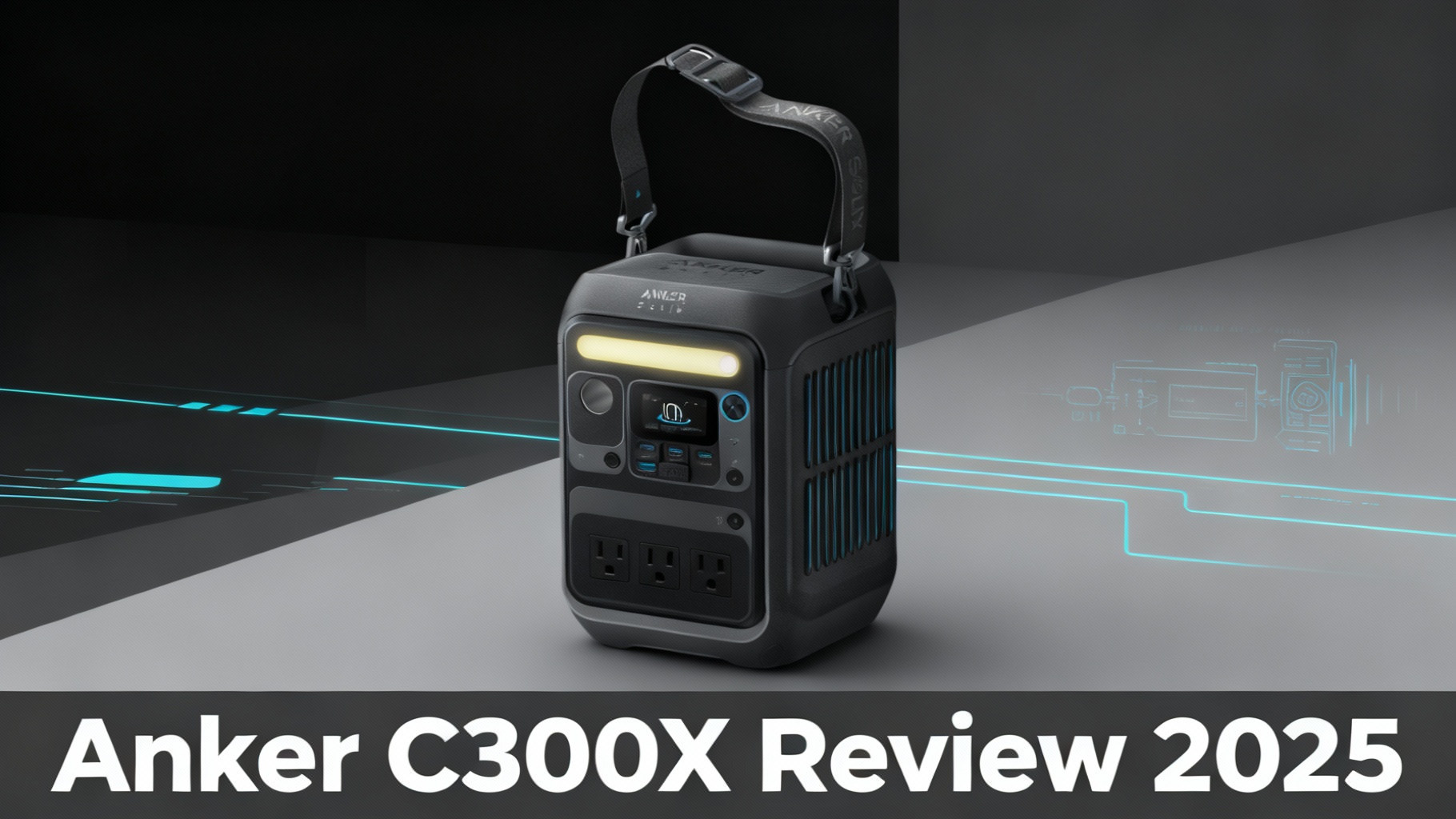
Looking for a compact portable power station that doesn’t compromise on smart features? The Anker SOLIX C300X launched in 2024 as Anker’s answer to users who need reliable backup power without lugging around a heavyweight unit. But with a $299 price tag and several C300 variants flooding the market, is this premium compact station worth your investment?
The C300X sits at an interesting crossroads in Anker’s lineup. At 288Wh capacity and 300W continuous output, it targets digital nomads, weekend campers, and anyone needing emergency backup for sensitive electronics. What sets it apart from its siblings isn’t raw power. It’s the 10ms UPS feature that keeps your router or modem online when the grid fails.
We assessed the C300X against everyday scenarios, from powering a home office during blackouts to running camping gear on weekend trips. We compared its rated charging speed, UPS switchover and app features against both the standard C300 and the budget C300 DC, and estimated runtimes for common devices. Here’s what stood out.
The Bottom Line: The C300X delivers premium features in a genuinely compact design. Anker rates its UPS switchover at 10ms, which can be the difference between your Zoom call dropping or carrying on when the power cuts out. The 50-minute fast charging and InfiniPower™ 10-year lifespan justify the premium over basic alternatives. However, the 300W output ceiling and $299 price mean this isn’t for everyone. If you need something even more compact, the C200X trades capacity for true pocket-sized portability.
🏆 Anker SOLIX C300X: Premium Compact Power
Why we recommend it: 10ms UPS switchover keeps sensitive devices online during outages. Fast 50-minute charging to 80%. InfiniPower™ 10-year lifespan with 5-year warranty.
Check Current Price on Anker →
💡 $299.99 | Free shipping | In Stock | Price checked November 2025
Get our Black Friday alerts for Anker SOLIX
We track live prices on 40+ models from Jackery, EcoFlow, BLUETTI and Anker SOLIX. When a deal beats the lowest price we've recorded, you'll hear from us. During Black Friday week, one short recap a day at most.
Unsubscribe in one click. We may earn a commission when you buy through our links, at no extra cost to you. Privacy Policy
Quick Specs & What’s in the Box
Before you order, note what isn’t in the box with the power station: Anker sells the car charging and solar charging cables separately. Solar panels must run between 11 and 28V and connect through an XT60 connector. Anker recommends its 100W solar panels and says the C300X is not compatible with the Anker SOLIX PS30 or other 5V~3A USB-C solar panels.
The shell uses high-grade plastic with a matte finish, and the integrated handle folds flat when not in use, adding to the compact profile. At 9.3 × 6.1 × 9.4 inches, it’s about 15% smaller than similar power stations, according to Anker.

The C300X measures just 9.3 inches wide—15% smaller than competing 300Wh stations

Front panel with LCD display and all 7 ports

Compact design with foldable handle for easy transport
Here are the core specifications:
The specs reveal interesting choices. Anker went with a 140W two-way USB-C port, which is generous for a compact power station. Most competitors in this class max out at 100W USB-C. The 300W continuous output with 600W surge covers most small appliances, but you won’t run space heaters or power-hungry tools.
Design & Build Quality
Premium Materials & Compact Design
The C300X measures 9.3 × 6.1 × 9.4 inches and weighs 7.9 pounds. That’s legitimately portable—you can carry it one-handed without strain. Anker says that makes it 15% smaller than similar power stations. For van lifers or backpackers working with limited space, this matters. To compare against true sub-8-pound rivals, see our ultralight backpacking options roundup.
The handle design deserves mention. It folds flush with the top of the unit when not needed, preventing snags in a packed vehicle or backpack. The handle itself uses reinforced plastic rather than metal, keeping weight down while maintaining strength.
Anker offers an optional carrying strap that attaches to mounting points on either side of the C300X. The strap sells separately for $29.99, which feels like a missed opportunity—competitors often include straps at this price point. However, the strap does allow for crossbody carrying, freeing both hands when hiking or moving between job sites.
Port Layout & Interface
The front panel houses all seven ports in a logical layout. Two AC outlets sit on the left, protected by a sliding cover. In the center, you’ll find the LCD display and control buttons. The right side holds all USB ports: three USB-C ports (one 140W two-way port that can also recharge the unit, one 15W port and one more output-only port) and two USB-A ports.
This port arrangement is practical. The AC outlets space far enough apart to accommodate two bulky adapters simultaneously. The USB-C ports clearly label their wattage, eliminating guesswork about which port delivers fast charging for your laptop.
💡 Pro Tip: The C300X is the ONLY model in the C300 series with 10ms UPS functionality. The standard C300 and C300 DC lack this critical feature for sensitive electronics.
The LCD display provides essential information at a glance: input/output wattage, remaining battery percentage, and estimated runtime. The display also shows active ports with small icons, helping you identify what’s drawing power.
Three buttons control the C300X: AC power, USB power, and a lighting button. Yes, there’s a small LED light on the front—useful for camping but not bright enough to replace a dedicated flashlight. Long-pressing the lighting button cycles through brightness levels and an SOS mode.
Get our Black Friday alerts for Anker SOLIX
We track live prices on 40+ models from Jackery, EcoFlow, BLUETTI and Anker SOLIX. When a deal beats the lowest price we've recorded, you'll hear from us. During Black Friday week, one short recap a day at most.
Unsubscribe in one click. We may earn a commission when you buy through our links, at no extra cost to you. Privacy Policy
Expected Performance
Battery Capacity & Runtime Estimates
The 288Wh capacity translates to practical runtime that varies significantly based on what you’re powering. Every runtime below is an estimate: 288Wh × 0.85 (to account for conversion losses) ÷ load in watts.
Laptop charging (60W average): A laptop drawing 60W while it charges gets about 4 hours (288Wh × 0.85 ÷ 60W). That’s enough for a workday if you’re not constantly plugged in.
Mini fridge (50W average): Take a compact 1.7 cubic foot fridge of the kind commonly used for camping, averaging 50W. Expect about 4.9 hours (288Wh × 0.85 ÷ 50W). For a weekend camping trip, that’s less than a full day of cold food if you’re running the fridge continuously.
Smartphone charging: Phones draw little power. At the 15W of the C300X’s smallest USB-C port, you get about 16 hours of charging (288Wh × 0.85 ÷ 15W). How many full charges that adds up to depends on your phone’s battery size.
Drone batteries: For packs like the DJI Mavic Air 2 batteries (3,500mAh each), divide the C300X’s usable energy, about 245Wh (288Wh × 0.85), by the watt-hour rating printed on each battery. That tells drone pilots how many recharges they get in the field without returning to base.
⚡ Runtime Estimates at a Glance
Laptop (60W)
4h
estimated
Mini Fridge (50W)
4.9h
estimated
Smartphone
16h
of charging at 15W
Drone Battery
245Wh
usable for recharging
* Estimates: 288Wh × 0.85 ÷ load in watts. Your results may vary based on device efficiency and usage patterns.
These numbers assume you’re only powering one device at a time. Running multiple devices simultaneously drains the battery faster due to conversion efficiency losses.
300W Output & SurgePad (600W Peak)
The 300W continuous output handles most small electronics and appliances without breaking a sweat. Within that limit, it can power a laptop + phone + tablet simultaneously, a portable blender (250W), an electric kettle (up to 300W models only), and various camera batteries.
What it can’t run: space heaters (typically 1,000W+), hair dryers (1,200W+), and microwave ovens (600W+ continuous). Anker’s SurgePad technology claims to handle 600W surges for brief periods, which helps with inductive loads like small refrigerators or power tools that spike on startup.
Anker rates the AC outlets at 300W, or 600W with SurgePad, and says all AC outlets support it. Before plugging in a tool, check both its running wattage and its startup spike against those two ratings.
For comparison, the standard C300 without SurgePad technology maxes out at 300W with no surge capability. That’s the first clear advantage of paying extra for the C300X—better handling of real-world appliances that don’t draw constant wattage.
Charging Speed: 50 Minutes to 80%
Anker advertises 50-minute charging to 80% via AC input. That’s impressively fast for a portable power station: most competitors in this capacity range take 90-120 minutes for an equivalent charge.
Solar charging takes longer, as expected. Anker lists up to 100W of solar input, so even a compatible 100W panel on a clear day needs several hours for a full charge. That’s realistic for a sunny afternoon but not practical if you need power quickly. For a budget 625 solar panel option that pairs well with this station, Anker’s own 625 keeps costs down.
Car charging via the 12V outlet is slower than wall charging. Useful for road trips where you’re driving long distances, but impractical for quick top-ups.
💰 Current Deal: C300X Starting at $299.99
Free shipping | In Stock | Check price on Anker SOLIX →
Features & Functionality
10ms UPS (Uninterruptible Power Supply)
This is the C300X’s headline feature and its primary justification for the premium price. UPS functionality means the power station can detect a power outage and switch to battery power fast enough that connected devices never lose power. For the C300X, Anker rates that switchover at 10 milliseconds.
To use it, plug a desktop PC, router or modem into the C300X while the C300X itself charges from the wall. If the grid goes down, Anker rates the switch to battery at 10ms, so connected devices can keep running through the transition.
Why does 10ms matter? Most computers and electronics can tolerate brief power interruptions of 16-20ms without issue. However, some networking equipment and desktop PCs require faster switchovers. Switchover times vary by brand and model, so compare the rated figure before you buy.
The UPS feature shines for remote workers and digital nomads. Picture a summer storm that cuts the power in the middle of a workday: with the router, modem and laptop plugged into the C300X, the connection stays up and a scheduled Zoom meeting can continue without interruption. That peace of mind is hard to quantify but genuinely valuable.
Anker App Control (Bluetooth + WiFi)
The Anker app provides remote monitoring and control for the C300X. After initial Bluetooth pairing, the app connects via WiFi for extended range. You can monitor battery status, input/output wattage, estimated runtime, and individual port status from anywhere with internet access.
The app’s most useful feature is firmware updates delivered over-the-air. Anker has pushed two firmware updates since the C300X launched, addressing minor bugs and improving battery management algorithms. Competitors often require manual firmware updates via USB, which most users never bother doing.
Beyond monitoring, the app allows scheduling charging times to take advantage of off-peak electricity rates. You can set the C300X to charge only between midnight and 6 AM, for example. This feature matters more for home backup systems than portable use, but it’s there if you need it.

C300X paired with solar panel for sustainable off-grid power
The app also displays historical power usage data, which helps identify power-hungry devices and optimize your setup. After a week of camping, for example, the history might show a portable fan drawing twice the wattage you expected, a cue to swap it for a more efficient model.
InfiniPower™ Technology: 10-Year Lifespan
Anker brands its battery management system as InfiniPower™ technology, which encompasses several features designed to extend battery life. The key claim: 3,000 charge cycles to 80% capacity.
What does this mean practically? If you fully charge and discharge the C300X daily, it would take over 8 years to reach 3,000 cycles. At that point, the battery would still retain 80% of its original 288Wh capacity—approximately 230Wh. For most users who charge weekly or monthly, the C300X will outlast their need for it.
InfiniPower™ includes smart temperature monitoring that samples battery temperature 100 times per second. If temperatures approach unsafe levels, the system throttles charging or output to prevent damage. In a hot car, for example, expect slower charging, which extends charge time but protects the battery.
The impact-resistant design uses internal shock absorbers to protect battery cells from damage if you drop the unit.
Anker backs the C300X with a 5-year warranty, which signals confidence in InfiniPower™ technology and provides genuine peace of mind for a $300 investment.
✅ Verified: Anker backs the C300X with a 5-year warranty. Combined with the LiFePO4 battery chemistry advantages, you’re looking at genuine long-term value.
Pros and Cons
Here’s our honest assessment of the C300X’s strengths and limitations.
The pros list is longer because the C300X genuinely excels in its intended role. The UPS feature alone justifies the purchase for anyone needing guaranteed uptime. The fast charging and long lifespan mean this station will serve reliably for years.
The cons are honest limitations rather than dealbreakers. The 300W ceiling is physics—you can’t run high-wattage appliances on a compact battery. The lack of expandability is a design choice; competing modular systems add complexity and cost. The optional strap should be included at this price, but its absence doesn’t undermine the core value.
Who Should Buy This

Perfect for weekend camping and outdoor adventures

Scalable power solution for extended backup needs
Perfect For:
1. Digital Nomads & Remote Workers
The C300X excels as a home office backup. The UPS feature keeps your router and modem online during brief outages, preventing dropped video calls or lost work. The 140W two-way USB-C port handles a laptop, leaving the other ports free for a portable monitor. The compact size means it doesn’t dominate your desk space. For anyone whose livelihood depends on staying connected, the C300X delivers peace of mind.
2. Weekend Campers
At 7.9 pounds, the C300X is genuinely portable. It won’t weigh down your pack or dominate trunk space. It charges enough devices for a typical weekend—phones, cameras, drones, portable speakers. The silent operation means no generator noise disturbing the campsite. Solar compatibility means you can extend your time off-grid if you bring panels.
3. Emergency Preparedness
The 10ms UPS switchover (Anker’s rating) moves connected devices to battery power when the grid fails. If you plan to run a CPAP or other medical device from it, check with the device’s manufacturer first. The 10-year lifespan means you can buy this once and forget about it until you need it. The app monitoring lets you check battery status remotely, ensuring it’s ready when emergencies strike.
4. Small Off-Grid Setups
If you’re powering a small van conversion or cabin with modest power needs, the C300X handles essentials: LED lighting, a mini fridge, phone charging, and a laptop. It won’t run an air conditioner or microwave, but it covers the basics. The compact size fits in tight spaces where larger stations won’t. Solar compatibility means you can recharge without shore power. For phone, laptop and camera-focused trips, see our charging electronics while camping guide.
NOT Ideal For:
- Heavy-duty power needs: The 300W limit excludes power tools, kitchen appliances, or heating/cooling equipment
- Multi-day off-grid living: 288Wh is too small for extended autonomy without solar panels
- Users needing expandability: No option to add battery modules for increased capacity
- Budget-conscious buyers: The C300 DC at $249 offers similar capacity without premium features
Ready to Power Your Adventures?
The Anker SOLIX C300X combines premium features with genuine portability. Perfect for remote workers, weekend campers, and anyone needing reliable backup power.
Get the C300X on Anker SOLIX →
$299.99 | 5-Year Warranty | Free Shipping | In Stock
C300X vs C300 vs C300 DC: Which to Choose?
Anker’s C300 series includes three variants, which can be confusing. Here’s how they differ:
Choose the C300 DC if: You only need USB charging and value ultra-portability above AC outlets. It’s 30% smaller and lighter, making it ideal for minimalist camping or hiking. The $249 price is the lowest in the series.
Choose the C300 if: You need AC outlets but don’t require UPS functionality. At the same $299 price as the C300X, this option only makes sense if you find the C300X out of stock. Otherwise, the C300X offers identical specs plus UPS for the same money.
Choose the C300X if: You need guaranteed uptime for sensitive devices or value the 10-year lifespan claim. The premium features justify choosing this over the standard C300, especially at identical pricing.
The C300 feels like a transitional model that will likely be phased out. With identical pricing to the C300X, there’s little reason to choose the standard C300 unless the UPS feature specifically doesn’t matter to you.
Alternatives to Consider

Size comparison: C300X vs larger C1000 for different power needs
While the C300X excels in its niche, it’s not the only option. Here are alternatives worth considering:
Anker SOLIX C1000 ($899): If you need significantly more capacity and power, the Anker SOLIX C1000 offers 1,056Wh and 1,800W output. It’s substantially larger and heavier (30 pounds) but provides enough power for multi-day trips or larger appliances. The C1000 also features UPS functionality and expandability with additional battery modules.
Anker SOLIX C800 Plus ($599): This mid-range option balances capacity (768Wh) and price. It includes built-in LED camping lights on the side, which the C300X lacks. However, it’s larger and heavier (16 pounds), making it less portable. No UPS feature.
Jackery Explorer 300 Plus ($279): A direct competitor offering 288Wh capacity and 300W output at a lower price. However, the Jackery uses older lithium-ion chemistry (500 cycles vs 3,000 for LiFePO4) and lacks UPS functionality. Charging also takes 2 hours vs 50 minutes for the C300X.
EcoFlow River 2 Pro ($349): Offers 768Wh capacity and 800W output, making it more powerful than the C300X. It charges in 70 minutes via AC and includes app control. However, it weighs 17 pounds and costs $50 more. The larger size reduces portability.
Each alternative makes different tradeoffs. The C300X prioritizes compact size, fast charging, and UPS functionality over raw capacity or power output.
🌟 Why the C300X Stands Out
10ms UPS
Anker rates the switchover at 10ms. Keeps routers and modems online during outages.
50-Min Charging
0-80% in 50 minutes. 2× faster than Jackery 300. Get back to full power quickly.
10-Year Lifespan
InfiniPower™ with 3,000 cycles. 5-year warranty.
Final Verdict
The Anker SOLIX C300X isn’t trying to be everything to everyone—and that’s exactly why it succeeds. At $299, it targets a specific user: someone who values reliability, smart features, and compact design over brute-force capacity.
The 10ms UPS switchover (Anker’s rating) is the C300X’s defining feature. If you’re powering sensitive electronics or need to keep internet connectivity alive during outages, this feature alone justifies the investment. The 50-minute fast charging and InfiniPower™ 10-year lifespan round out a package that emphasizes quality over quantity.
However, the C300X is not a Swiss Army knife. The 300W output ceiling means high-wattage appliances are off-limits. The 288Wh capacity won’t sustain you through multi-day power outages without solar panels. And the lack of expandability means you’re stuck with the capacity you buy.
Who should buy it: Digital nomads needing office backup, weekend campers prioritizing portability, emergency preparedness enthusiasts, or anyone powering sensitive equipment that can’t tolerate power interruptions.
Who should skip it: Users needing 500W+ output, those requiring multi-day autonomy without solar, or budget-conscious buyers who don’t need UPS functionality.
The C300X represents a thoughtful approach to portable power—premium where it matters (UPS, charging speed, build quality), practical where it should be (size, weight, port selection), and honest about its limitations (capacity, output). If your needs align with what it offers, you’ll be satisfied. If you need different capabilities, Anker’s broader lineup includes better options.
For the right user, the C300X delivers exactly what it promises: premium compact power with intelligent features that work when you need them most.
Overall Rating
Build Quality
9.0/10
Performance
8.5/10
Features
9.5/10
Value
8.0/10
Final Score
8.8/10
Highly Recommended for Premium Compact Power
Frequently Asked Questions
How long does the C300X take to fully charge?
The C300X charges to 80% in 50 minutes from a wall outlet, according to Anker. Solar input tops out at 100W, so a full solar charge with a 100W panel takes several hours, even in optimal conditions. Car charging via the 12V outlet is also slower than wall charging.
Can the C300X power a mini fridge continuously?
Yes, but runtime depends on the fridge’s wattage. A typical 50W mini fridge runs for about 4.9 hours on the C300X (288Wh × 0.85 ÷ 50W), and longer when the compressor cycles off. Larger fridges drawing 70-80W will reduce runtime to about 3-3.5 hours. The C300X works well for day trips or overnight camping but isn’t designed for multi-day refrigeration without recharging.
Does the UPS feature work with all devices?
The 10ms UPS switchover (Anker’s rating) works with most electronics including desktop computers, routers and modems. However, extremely sensitive equipment requiring sub-5ms switchover may still experience brief interruptions. For a CPAP machine or other medical device, check with its manufacturer before relying on any power station.
Can I charge the C300X while using it?
Yes, the C300X supports pass-through charging. You can simultaneously charge the internal battery while powering connected devices. However, if your devices draw more power than the input charging wattage, the battery will slowly drain rather than charge.
What’s the difference between the C300X and C300?
The C300X includes 10ms UPS functionality, which the standard C300 lacks. Both models cost $299.99 and share the same 288Wh capacity and 300W output. The C300X offers better value at identical pricing.
How many cycles before the battery degrades?
Anker rates the C300X for 3,000 charge cycles before the battery degrades to 80% of original capacity. At one full cycle per week, that’s approximately 57 years. More realistically, if you charge daily, you’ll reach 3,000 cycles in about 8 years, at which point you’ll still have 230Wh usable capacity.
Is the C300X suitable for van life?
The C300X works for van conversions with modest power needs: LED lighting, phone charging, laptop use, and small appliances. The 288Wh capacity and 300W output limit prevent running air conditioning, microwaves, or power tools. Consider the larger C1000 or C800 Plus for more demanding van life setups.
Can I use the C300X in extreme temperatures?
The C300X operates in temperatures from -4°F to 104°F (-20°C to 40°C). However, charging is restricted to 32°F to 104°F (0°C to 40°C) to protect battery health. InfiniPower™ technology automatically adjusts charging speed in hot conditions to prevent damage.
⚠️ Affiliate Disclosure: This article contains affiliate links. If you purchase through our links, we may earn a commission at no extra cost to you. This helps us continue providing honest, in-depth reviews. We only recommend products we’ve researched and believe offer genuine value. Learn more about our review process.
Visit Anker SOLIX Knowledge Hub →
Related Reads
Originally published: December 4, 2025