
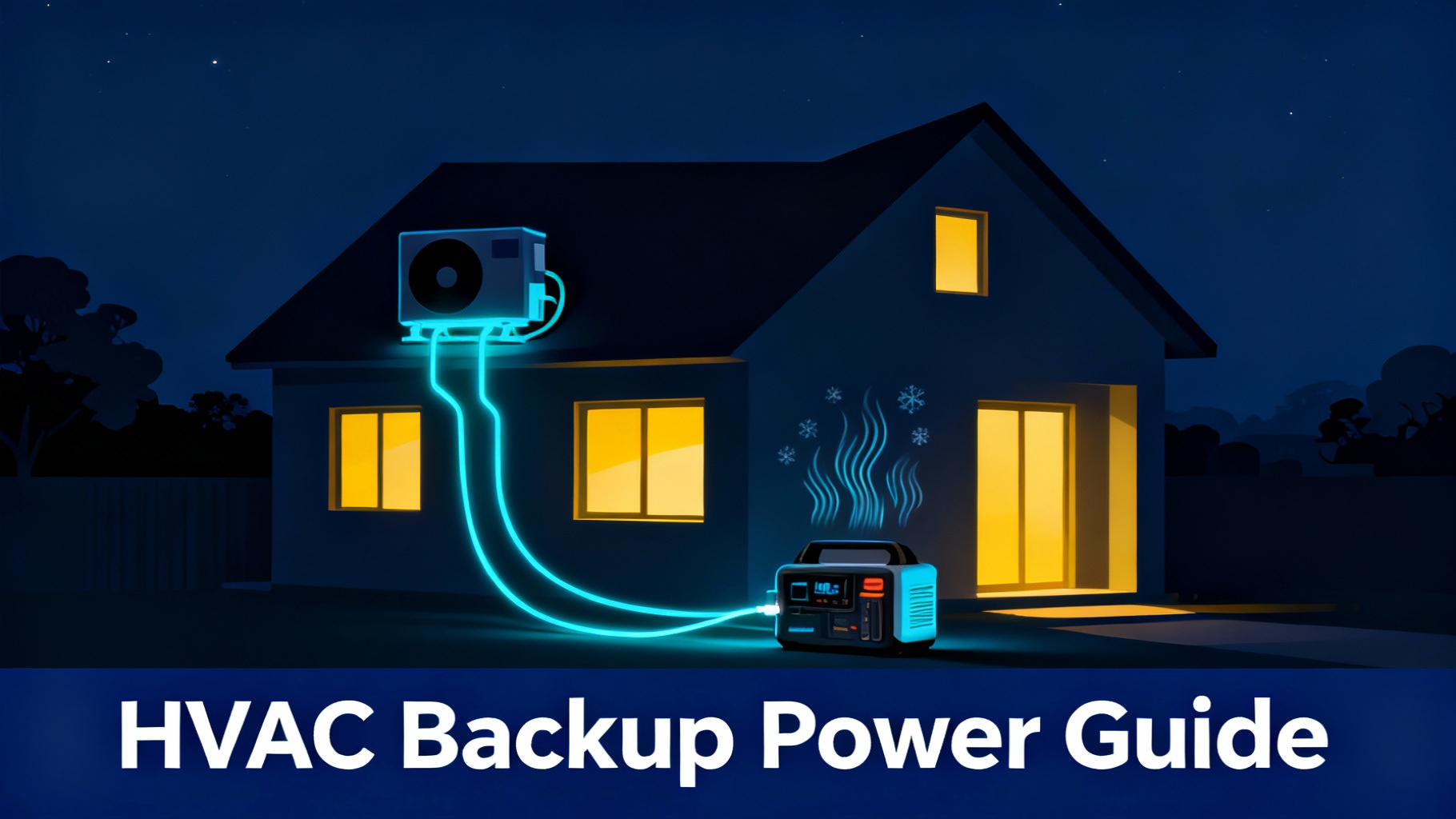
3 AM. 95°F outside. Your central AC just died because the grid went down (again). Within an hour, your home is sweltering, kids can’t sleep, and you’re wondering if your portable power station can even run an air conditioner.
Anyone who’s endured a multi-day summer outage understands the desperation. HVAC systems demand massive power: most units require 1,500-5,000W continuous output, with startup surge reaching 2-3× that amount. Those compact 500-1,000Wh power stations? They can’t handle it.
The confusion around sizing requirements is widespread. Homeowners invest thousands in home backup power solutions only to discover their system lacks the surge capability or runtime needed when the stakes are highest: comfort, health, even survival for vulnerable family members.
Analysis of current power station technology reveals that several models can effectively run HVAC equipment (if properly sized). This guide examines surge capacity requirements, runtime calculations, and the specific units that deliver reliable HVAC backup without the noise, fumes, and maintenance of traditional generators.
What You’ll Learn
- Exact wattage requirements for different HVAC types (central AC, heat pumps, furnaces, mini-splits)
- How to calculate surge power needs and why most units fail
- Top 5 power stations capable of running AC and heating systems
- Runtime estimates for common scenarios and duty cycles
- Solar recharge strategies for extended outages
- Cost comparison vs traditional gas generators
Get the 1-page outage plan
What to plug in first, how long a fridge really runs on a battery, and the 3 safety rules for connecting a power station to your home. Printable, sent by email.
About one email a week. Unsubscribe in one click. We may earn a commission when you buy through our links, at no extra cost to you. Privacy Policy
Why HVAC Systems Need Specialized Backup Power
The High-Power Challenge of HVAC Equipment
HVAC systems represent some of the most demanding loads in residential applications. A typical central air conditioner requires 1,500-3,500W continuous power during operation. But here’s where most portable power stations fail: the startup surge can reach 3,000-7,000W for the first 1-3 seconds as the compressor motor spins up.
Performance data indicates that compressor-based cooling systems require 2-3× their rated running wattage during startup. This surge demand eliminates most portable power stations from consideration (unless specifically engineered for high-surge capability).
| HVAC System Type | Running Watts | Startup Surge | Surge Multiplier |
|---|---|---|---|
| Central AC (2 ton) | 1,500-2,000W | 3,000-4,000W | 2-2.5× |
| Central AC (3 ton) | 2,000-3,000W | 4,500-6,000W | 2.25-2.5× |
| Central AC (4+ ton) | 3,000-3,500W | 6,000-7,000W | 2-2.5× |
| Heat Pump (heating) | 2,000-5,000W | 4,000-10,000W | 2-2.5× |
| Gas Furnace (blower) | 600-1,200W | 1,500-2,400W | 2-2.5× |
| Window AC (5,000-8,000 BTU) | 500-800W | 1,000-1,600W | 2× |
| Window AC (10,000-15,000 BTU) | 1,000-1,500W | 2,000-3,000W | 2× |
| Mini-Split (per head) | 700-2,000W | 900-2,500W | 1.25-1.5× |
⚠️ Important: These are typical ranges. Always check your specific equipment’s nameplate for accurate wattage ratings. Older, less efficient units may draw significantly more power.
🔌 Understanding HVAC Startup Surge
Your power station must handle BOTH surge and continuous loads (most units under 3,000W can’t manage central AC startup).
Different HVAC types present varying challenges. Mini-split systems offer the lowest surge requirements (1.25-1.5× running watts) thanks to inverter-driven compressors. Heat pumps, particularly in heating mode, can demand up to 10,000W surge in cold climates. Gas furnaces only need to power the blower motor, making them the most forgiving option for backup power (but you still face 1,500-2,400W startup surge).
Why Traditional Generators Fall Short
Generators remain the most economical high-power solution on a cost-per-watt basis. A 7,000W gas generator costs $600-1,200 versus $2,000-5,000 for comparable power station capacity. So why consider power stations at all?
Operational realities make generators impractical for many situations (especially suburban and urban environments). Noise pollution reaches 70-90 dB at 20 feet, loud enough to disturb neighbors and violate local noise ordinances. Power stations operate silently at under 50 dB.

Generator Drawbacks for HVAC Backup
- Fumes & outdoor placement required (carbon monoxide risk, weather exposure)
- Fuel storage challenges (gasoline expires, difficult to stockpile during emergencies)
- Maintenance demands (oil changes, filter replacement, carburetor cleaning)
- Starting difficulty (pull-start failures in cold weather when you need heat most)
- Noise ordinances (many HOAs and municipalities restrict generator use)
While generators remain viable for some scenarios, operational realities make them impractical for suburban residents, apartment dwellers, those prioritizing silent operation during sleep hours, or anyone seeking indoor-safe backup power.
The Power Station Advantage for HVAC Backup
Modern high-capacity power stations address generator shortcomings while delivering enough power for HVAC loads. The latest models featuring LiFePO4 battery technology offer 3,000-6,000+ charge cycles (10-15 years lifespan) compared to 500-800 cycles in older lithium-ion units.
💡 Key Advantages for HVAC Applications
✓ Instant startup
No pull-start, no warm-up period. Press power and your AC runs immediately.
✓ Silent operation
Under 50 dB (quieter than normal conversation). Run overnight without disturbing sleep.
✓ Indoor safe
Zero emissions, no carbon monoxide risk. Place anywhere in your home.
✓ Solar recharge capability
Unlimited runtime potential during extended outages. No fuel runs required.
✓ UPS mode
Seamless transition under 20ms during outage. Your AC never stops running.
✓ Smart features
App control, scheduling, remote monitoring, load management.
Total cost of ownership over 10 years favors power stations despite higher upfront investment. No fuel costs, minimal maintenance (firmware updates only), and dramatically longer lifespan create compelling economics for frequent users or those prioritizing convenience and quiet operation.
Understanding Your HVAC Power Requirements
Before investing in backup power, you need precise wattage data for your specific equipment. The sizing methodology requires understanding three critical values: running watts, surge watts, and duty cycle. Getting this wrong means either wasting money on oversized systems or discovering your investment can’t handle the load when you need it most.
For detailed calculation guidance, see our comprehensive how to choose a portable power station guide.
Finding Your HVAC’s Actual Wattage
Your HVAC system’s nameplate contains the critical information you need. For central AC units, check the outdoor condenser unit for a metal plate listing electrical specifications. You’ll typically find two values that matter:
Calculating Watts from Nameplate Data
Formula: Watts = Volts × Amps
Example 1: Central AC Unit
Nameplate: 240V × 8.5A (running) / 240V × 21A (locked rotor amps)
Running: 240 × 8.5 = 2,040W | Surge: 240 × 21 = 5,040W
Example 2: Gas Furnace Blower
Nameplate: 120V × 7.2A (running)
Running: 120 × 7.2 = 864W | Surge estimate: 864 × 2 = 1,728W
For a more specific use case, see our best power stations for multi-story homes.
Locked Rotor Amps (LRA) represents the maximum current draw during startup when the compressor motor is fighting against internal pressure. This value determines your surge requirement. If LRA isn’t listed, multiply running amps by 2.5 for a conservative estimate.
⚠️ Common Mistake: Don’t confuse RLA (Rated Load Amps) with LRA (Locked Rotor Amps). RLA indicates continuous running current (you need LRA to calculate surge requirements). If only RLA is listed, expect surge to be 2-2.5× higher.
Understanding Duty Cycle for Runtime Calculations
Your AC doesn’t run continuously (it cycles on and off based on thermostat settings and outdoor temperature). Duty cycle represents the percentage of time your compressor actually operates during each hour. This dramatically affects runtime calculations.
📊 How Duty Cycle Affects Runtime
Runtime Formula with Duty Cycle:
Hours = (Capacity Wh ÷ Load W) × 0.85 × (1 ÷ Duty Cycle %)
A 3,000Wh power station running a 2,000W AC appears to provide only 1.3 hours runtime (3,000 ÷ 2,000 × 0.85). But with a 50% duty cycle, effective runtime doubles to 2.6 hours. At 30% overnight duty cycle, you get 4.3 hours (enough to bridge most short outages).
💡 Pro Tip: Install a smart thermostat with programmable setpoints to reduce duty cycle during outages. Raising your cooling target from 72°F to 76°F can cut duty cycle by 20-30%, extending backup runtime significantly.
Surge Capability: The Make-or-Break Specification
Your power station’s surge rating matters more for HVAC applications than continuous output capacity. Analysis shows that inadequate surge capability represents the single most common failure mode when homeowners attempt to run AC units with undersized power stations.
Most portable power stations advertise their continuous output (1,000W, 2,000W, 3,000W, etc.) but bury surge capability in fine print. The ratio between continuous and surge capacity varies dramatically:
- Budget units: 1.5× surge (1,000W continuous / 1,500W surge) (inadequate for HVAC)
- Mid-range units: 2× surge (2,000W continuous / 4,000W surge) (handles window AC, struggles with central)
- Premium HVAC-capable units: 2-2.5× surge (3,000W / 6,000W or 5,000W / 10,000W) (reliable central AC operation)
Surge duration matters too. Some inverters sustain surge output for only 1 second, while HVAC-optimized models maintain peak surge for 3-5 seconds (critical for stubborn compressors or cold-start scenarios where startup current remains elevated longer).
Get the 1-page outage plan
What to plug in first, how long a fridge really runs on a battery, and the 3 safety rules for connecting a power station to your home. Printable, sent by email.
About one email a week. Unsubscribe in one click. We may earn a commission when you buy through our links, at no extra cost to you. Privacy Policy
Top 5 Power Stations for HVAC Systems
Based on manufacturer specs for output, surge capability, capacity, and expandability, these five models represent the most reliable options for HVAC backup. Each addresses specific use cases and budgets (there’s no universal “best” choice, only the right fit for your requirements).
| Model | Capacity | Output / Surge | Best For | Price |
|---|---|---|---|---|
| 🏆 Anker SOLIX F3800 | 3,840Wh → 26.9kWh | 6,000W / 9,000W | Central AC & heat pumps (120V/240V) | From $1,799.99 |
| 🔋 Bluetti Apex 300 + 2× B300K | 8,294Wh (expandable) | 3,840W / 120V-240V | Long outages, 240V (check LRA) | $3,699 (Oct. 2026) |
| 💰 Jackery HomePower 3600 Pro Max | 3.6kWh → 21.5kWh | 4,000W at 240V, 2,000W at 120V | Smaller 240V systems, mini-splits | $1,714 |
| Jackery HomePower 3000 | 3,072Wh | 3,600W / 7,200W (120V) | Furnace blowers, 120V cooling | $1,284 |
| Bluetti AC200L | 2,048Wh → 8,192Wh | 2,400W (120V) | Mini-splits, 120V loads | $899 |
🏆 #1 Best Overall for Central AC & Heat Pumps: Anker SOLIX F3800

When standard power stations can’t handle your load, the Anker SOLIX F3800 steps up with 6,000W continuous output and a 9,000W surge rating, the highest on this list. It delivers 120V and 240V from a single unit (NEMA 14-50 and L14-30 outlets), so it can power a 240V condenser or heat pump through a transfer switch.
On paper, 9,000W covers the 6,000-7,000W startup range this guide lists for 4-ton and larger central AC units. A heat pump in heating mode can need more, so check your unit’s LRA first.
Anker’s InfiniPower design uses LiFePO4 cells rated for 3,000+ cycles, with a 10-year rated lifespan and a 5-year warranty. Base capacity of 3,840Wh expands to 26.9kWh with up to six BP3800 expansion batteries.
We also cover this in depth in our best power stations for small houses.
Premium Features:
- 9,000W surge for compressor startup (compare it with your unit’s LRA)
- 5-year warranty and a 10-year rated lifespan (InfiniPower)
- 2,400W solar input (2× 1,200W) and 1,800W AC charging
- 120V and 240V from one unit; the 240V output can’t be used while it charges from 120V AC
- UPS mode with <20ms switchover for sensitive electronics
🏆 Best Overall Choice: Anker SOLIX F3800
Why we recommend it: Its 9,000W surge is the highest published rating on this list, backed by 6,000W of continuous output at 120V or 240V from a single unit. It starts at 3,840Wh, expands to 26.9kWh, and carries a 5-year warranty.
Cost consideration: At $1,799.99, the F3800 is a serious investment (justified for users with large HVAC systems or those prioritizing maximum reliability and longevity). The 5-year warranty and 10-year rated lifespan help spread that cost over many outage seasons.
🔋 #2 Most Runtime Out of the Box: Bluetti Apex 300 + 2× B300K

The Bluetti Apex 300 paired with two B300K expansion batteries delivers 3,840W continuous output with 120V/240V split-phase power from a NEMA 14-50R outlet. This configuration provides 8,294Wh out of the box, the most of any setup on this list. Each Apex 300 accepts up to six B300K, B300S or B300 batteries.
LiFePO4 chemistry ensures thousands of charge cycles before capacity drops to 80%, translating to many years of reliable service. Multiple AC output ports plus dedicated 120V/240V split-phase output allow direct integration with transfer switches.
Key Advantages for HVAC:
- 3,840W continuous output covers the running watts of 2-4 ton central AC (no motor surge rating published)
- Expandable capacity supports multi-day outages with solar recharge
- Turbo AC charging at up to 3,840W
- Smart app control with scheduling and remote monitoring
- High solar input via multiple MPPT controllers
🔋 Most Runtime Out of the Box: Bluetti Apex 300 + 2× B300K
Why we recommend it: With 8,294Wh out of the box, this bundle has the largest starting capacity of any pick here, plus 3,840W of 120V/240V output and LiFePO4 cells rated for 6,000+ cycles. Check your AC’s LRA first: BLUETTI does not publish a motor surge rating.
Realistic runtime expectations: With a 2-ton central AC drawing 2,000W at a 50% duty cycle, the 8,294Wh configuration works out to about 7 hours of cooling by our formula (8,294Wh × 0.85 ÷ 2,000W, doubled for the 50% duty cycle). That is enough to bridge most overnight outages. Adding further B300K batteries extends runtime proportionally.
⚠️ Important limitation: BLUETTI does not publish a motor-starting surge rating for the Apex 300. Its 7,680W “Lifting Power” figure applies to resistive loads such as heaters, not compressors. Before relying on it for central AC, ask BLUETTI support whether it can start a compressor with your condenser’s LRA, or fit a soft starter. For larger systems, the Anker F3800 above lists a 9,000W surge.
💰 #3 Best for Smaller 240V Systems: Jackery HomePower 3600 Pro Max
For homeowners with a smaller 240V system, the Jackery HomePower 3600 Pro Max strikes a practical balance. At $1,714 (down from $2,099), one unit delivers 4,000W at 240V or 2,000W at 120V through NEMA 14-50R and NEMA 5-20R outlets.
Jackery rates its EV-grade LFP cells for 6,000 cycles and a projected 16+ years, and the system carries UL 9540 certification. Base capacity of 3.6kWh expands to 21.5kWh on one unit, or up to 43kWh with two units in parallel.
Best Features:
- 4,000W continuous at 240V from a single unit
- Sub-10ms UPS switchover, per Jackery
- Expandable from 3.6kWh to 21.5kWh per unit
- Automatic home backup through a Jackery transfer switch (no built-in ATS)
- Full specs in our HomePower 3600 Pro Max review

💰 Best for Smaller 240V Systems: Jackery HomePower 3600 Pro Max
Why we recommend it: 4,000W at 240V from one unit, sub-10ms UPS switching and room to grow to 21.5kWh make it a strong fit for smaller 240V systems. Jackery publishes no 240V surge rating, so check your AC’s LRA or add a soft starter.
Who should buy this: Homeowners with a smaller 240V system, such as a 2-ton condenser or a 240V mini-split, who want room to grow. It also suits anyone planning to wire backup through a transfer switch. Jackery publishes no surge rating in watts at 240V; for 120V appliances it lists a starting current of up to 33A per unit. Check your AC’s LRA, or add a soft starter, before counting on it for a central AC compressor.
💡 Pro Tip: The 3600 Pro Max also works well for refrigerator backup during outages when not powering HVAC. By our formula, a standard fridge averaging 150W runs for about 20 hours (3,600Wh × 0.85 ÷ 150W), and longer when the compressor cycles off.
#4 Best for Furnace Backup: Jackery HomePower 3000
Gas furnaces present a unique backup scenario (the gas handles heating, but the blower motor requires electricity to circulate warm air). Most furnace blowers draw 600-1,200W continuous with 1,500-2,400W surge, well within the Jackery HomePower 3000’s 3,600W continuous and 7,200W surge ratings.
With 3,072Wh capacity, the HomePower 3000 provides solid runtime for furnace-only applications. A typical 800W blower running nonstop works out to about 3 hours by our formula (3,072Wh × 0.85 ÷ 800W), and longer when it cycles with the thermostat. Jackery lists no expansion battery for it, so plan on recharging between runs during multi-day winter storms.
Winter Backup Advantages:
- 7,200W surge easily handles furnace blower startup
- 3,072Wh capacity = about 3 hours of nonstop blower operation (800W)
- ~20ms UPS switchover keeps electronics online
- LiFePO4 cells rated for 4,000 cycles to 70%+ capacity
- Simultaneous operation: furnace + refrigerator + lights
- 120V only, with no 240V output
- Full specs in our HomePower 3000 review

🔥 Best for Furnace Backup: Jackery HomePower 3000
Why we recommend it: 3,600W continuous and a 7,200W surge at 120V cover furnace blowers, window AC units and 120V mini-splits with headroom to spare. It weighs about 59.5 lb and Jackery lists a 3+2 year warranty.
Heating season strategy: The HomePower 3000 is 120V only, so it cannot run a 240V heat pump or central AC condenser. It is a great match for furnace blowers, window AC units and 120V mini-splits. If you heat with a 240V heat pump, look at the F3800 or the HomePower 3600 Pro Max above, and expect limits in very cold weather.
#5 Best for 120V Mini-Splits: Bluetti AC200L

At $899 (44% discount from $1,599), the Bluetti AC200L is a practical option for homeowners with mini-split systems or smaller cooling needs. Its 2,400W 120V output handles most single-head mini-splits drawing 700-1,500W running watts.
Mini-splits feature inverter-driven compressors with soft-start technology, reducing surge requirements to 1.25-1.5× running watts (meaning a 1,500W mini-split only needs 1,875-2,250W surge, well within the AC200L’s capabilities). This makes it a sensible fit for mini-split cooling backup.
Value Features:
- $899 price point for 2,048Wh of LiFePO4 storage
- Perfect for mini-splits (700-1,500W running)
- Fast 45-minute charge to 80% via Turbo Charging
- Expandable to 8,192Wh with BLUETTI expansion batteries
- Up to 2,400W AC input and 1,200W solar input
❄️ Mini-Split Pick: Bluetti AC200L
Why we recommend it: At $899 (44% OFF), this is a practical pick for mini-split owners or those with smaller cooling needs. Turbo Charging technology recharges to 80% in just 45 minutes (critical during intermittent outages).
Realistic expectations: The AC200L won’t run traditional central AC units, since it is 120V only and its 2,400W output falls short of their startup needs. But for mini-splits, window units (8,000-12,000 BTU), or furnace blowers, it delivers reliable performance without 240V hardware you don’t need.
How to Size Your HVAC Backup System
Proper sizing prevents expensive mistakes (buying too little capacity leaves you vulnerable during outages, while oversizing wastes thousands on unnecessary battery capacity). Follow this systematic approach to determine your exact requirements.
For comprehensive sizing methodology, our complete guide to solar panel wiring covers how to maximize solar input for extended HVAC runtime.
Three-Step Sizing Methodology
🎯 Sizing Calculator Guide
Determine Surge Requirement
Find your HVAC nameplate → Calculate startup surge (Volts × LRA) → Add 20% safety margin
Calculate Runtime Needs
Running watts × Target hours × Estimated duty cycle (0.3-0.7) ÷ 0.85 efficiency
Factor Solar Recharge
If outage >4hrs → Calculate solar input needed (W) × Peak sun hours in your region
Example: 2-Ton Central AC
Surge: 240V × 20A (LRA) × 1.2 = 5,760W needed
Runtime: 2,000W × 4hrs × 0.5 duty ÷ 0.85 = 4,706Wh needed
→ Recommendation: Anker SOLIX F3800 + one BP3800 (9,000W surge, 7,680Wh)
The most common sizing mistake? Focusing only on capacity (Wh) while ignoring surge capability (W). A 5,000Wh power station with only 2,000W/3,000W surge won’t start your 2-ton AC, despite having enough energy storage for 2+ hours runtime. Always verify surge ratings first.
Runtime Estimates by Scenario
Theoretical calculations provide baselines, but actual runtime depends on ambient temperature, thermostat settings, home insulation, and equipment efficiency. These estimates use our runtime formula: capacity × 0.85 ÷ running watts ÷ duty cycle. Assumed loads: 2,000W for a 2-ton central AC, 3,500W for a 4-ton unit, 1,200W for a 12,000 BTU window AC, 900W for a 9,000 BTU mini-split and 800W for a furnace blower.
| HVAC Type & Scenario | Power Station | Ambient Temp | Duty Cycle | Runtime |
|---|---|---|---|---|
| 2-ton Central AC (Heatwave) | Apex 300 + 2× B300K (8,294Wh) | 95°F | 70% | 5 hrs |
| 2-ton Central AC (Moderate) | Apex 300 + 2× B300K (8,294Wh) | 85°F | 50% | 7 hrs |
| 2-ton Central AC (Overnight) | Apex 300 + 2× B300K (8,294Wh) | 70°F | 30% | 11.7 hrs |
| 12,000 BTU Window AC | Jackery HomePower 3600 Pro Max (3.6kWh) | 85°F | 55% | 4.6 hrs |
| 9,000 BTU Mini-Split | AC200L (2,048Wh) | 85°F | 45% | 4.3 hrs |
| Gas Furnace Blower (800W) | Jackery HomePower 3000 (3,072Wh) | 35°F | 60% | 5.4 hrs |
| 4-ton Central AC | Anker F3800 + BP (7,680Wh) | 95°F | 65% | 2.8 hrs |
💡 Pro Tip: Runtime dramatically extends when you combine battery capacity with solar recharge. A 2,000W AC with 50% duty cycle consumes 1,000W average load. If you add 1,000W solar input during peak sun hours, you achieve unlimited runtime during daytime (battery capacity only matters for overnight operation).
You can find tailored recommendations in our best power stations for well pump backup.
Solar Recharge for Extended Outages
For outages exceeding 4-6 hours, solar panels transform your power station from temporary backup to indefinite off-grid capability. The key lies in matching solar input (watts) to your HVAC’s average consumption during duty cycling.

Solar Input Requirements by Use Case
- Window AC (500-800W avg): 800-1,000W solar maintains indefinite operation
- 2-ton Central AC (1,000W avg): 1,200-1,500W solar needed for net-zero consumption
- 3-ton Central AC (1,500W avg): 1,800-2,400W solar input required
- Furnace only (400-700W avg): 600-800W solar sufficient for all-day operation
Average consumption assumes 50% duty cycle. Adjust for your specific conditions and add 20% buffer for charging efficiency losses.
Regional solar availability matters significantly. Phoenix receives 6-7 peak sun hours daily, while Seattle averages 2-3 hours. Your solar array must generate enough energy during available sunlight to offset 24-hour consumption. A 2,000W AC in Phoenix needs 1,200W solar (8kWh daily ÷ 6.5 hours), while Seattle requires 2,000W+ to compensate for limited sun.
Frequently Asked Questions
What size power station do I need for central air conditioning?
For a 2-ton central AC unit (most common residential size), you need minimum 5,000W surge capability and 2,000W continuous output. The Anker SOLIX F3800 (6,000W continuous, 9,000W surge, 120V/240V from one unit) covers that with room to spare and also suits many 3-4 ton systems. The Bluetti Apex 300 + 2× B300K (3,840W, 8,294Wh) stores more energy, but BLUETTI publishes no motor surge rating, so confirm your AC’s LRA first.
Base your selection on your specific AC’s nameplate data (calculate surge requirement by multiplying voltage (typically 240V) by Locked Rotor Amps (LRA), then add 20% safety margin). Always prioritize surge capability over battery capacity when selecting for HVAC applications.
Can a portable power station handle AC startup surge?
Yes, but only models specifically engineered for high surge loads. AC compressors require 2-3× their running wattage for 1-3 seconds during startup (a 2,000W running AC needs 4,000-6,000W surge). Budget power stations (under $1,500) typically offer only 1.5-2× surge multiplier, causing startup failures.
What counts is the surge in watts, not the multiplier: the Anker SOLIX F3800 lists 6,000W continuous and 9,000W surge, and the Jackery HomePower 3000 lists 3,600W continuous with a 7,200W surge at 120V only. The Bluetti Apex 300 delivers 3,840W continuous with 120V/240V split-phase output, but BLUETTI publishes no motor surge rating for it. Mini-split systems require lower surge due to inverter technology, making them compatible with smaller units like the Bluetti AC200L ($899).
How long will a power station run my air conditioner?
Runtime depends on four factors: battery capacity (Wh), AC wattage, duty cycle, and ambient temperature. A 3,000Wh power station running a 2,000W AC at 50% duty cycle provides approximately 2.6 hours operation. The duty cycle (percentage of time your compressor actually runs) dramatically extends runtime compared to theoretical calculations.
Estimated examples: by our formula, the Bluetti Apex 300 + 2× B300K (8,294Wh) runs a 2,000W, 2-ton AC for about 5 hours during 95°F heatwaves (70% duty), 7 hours at 85°F (50% duty), or about 11.7 hours overnight at 70°F (30% duty). Add solar panels and runtime becomes indefinite during daylight hours (a 1,200W solar array offsets a 2,000W AC’s average consumption at 50% duty cycle).
For extended outages, expandable capacity is critical. The Anker SOLIX F3800 expands to 26.9kWh and the Jackery HomePower 3600 Pro Max to 21.5kWh per unit. A fully expanded F3800 works out to about 22 hours for a 2,000W AC at a 50% duty cycle by our formula, so add solar for multi-day outages.
Do I need a transfer switch for backup power?
Not required for temporary backup, but highly recommended for seamless whole-home integration. Power stations operate as standalone units (simply plug your AC directly into the station’s AC outlets during outages). This manual approach works for emergency situations but requires physically connecting equipment each time.
A transfer switch installation allows automatic or manual switching between grid and backup power, enabling your HVAC to run from power station outlets while maintaining permanent wiring. UPS-capable models like the F3800 (under 20ms) and the HomePower 3600 Pro Max (sub-10ms) switch over quickly during outages, keeping connected devices running. The 3600 Pro Max has no built-in ATS: automatic home backup runs through a Jackery transfer switch. Transfer switches cost $200-800 plus installation, justified for frequent use or whole-home backup strategies.
Can I recharge while running my HVAC?
Yes, all premium power stations feature pass-through charging (the ability to recharge the battery while simultaneously powering loads). This proves critical for HVAC applications, allowing solar panels to extend runtime indefinitely during daylight hours or enabling AC charging between AC cycling periods.
Example: A 2,000W AC at 50% duty cycle consumes 1,000W average. Add 1,200W solar input and you achieve net-positive energy during peak sun (your battery charges while running AC). The Anker SOLIX F3800 accepts up to 2,400W of solar and 1,800W from the wall (its 240V output can’t be used while it charges from 120V AC), and the Bluetti Apex 300 turbo-charges at up to 3,840W from AC. Pass-through charging efficiency typically reaches 85-90%, meaning slight energy loss during simultaneous charge/discharge cycles.
What’s the difference between running watts and surge watts?
Running watts represent continuous power draw during normal operation (your AC might consume 2,000W while running). Surge watts (also called peak watts or startup watts) indicate the brief power spike required during the first 1-3 seconds when the compressor motor starts under load, often reaching 2-3× running watts.
Your power station must handle BOTH specifications. A unit rated for 3,000W continuous / 4,500W surge can sustain 3,000W indefinitely but only 4,500W for brief periods. If your AC requires 5,000W surge, it won’t start even though running watts (2,000W) fall well within capacity. Always verify surge ratings explicitly (manufacturers often advertise continuous output prominently while burying surge specs in fine print).
Will a power station work with my heat pump?
Heat pumps present unique challenges (they draw 2,000-5,000W running with 4,000-10,000W surge depending on operating mode and ambient temperature). In cooling mode (above 35°F outdoor temp), power requirements mirror traditional AC. In heating mode during cold weather, compressor load increases significantly.
In mild climates (35°F+), the Anker SOLIX F3800 (6,000W continuous, 9,000W surge, 240V from one unit) is the strongest option on this list. The Bluetti Apex 300 (3,840W, 120V/240V) may work for smaller units, but BLUETTI publishes no motor surge rating, so check your heat pump’s LRA with BLUETTI support first. Cold climate applications (below 20°F) often exceed portable power station capabilities due to defrost cycles and auxiliary heat requirements. For reliable winter heat pump backup in northern climates, consider supplementing with gas furnace backup or accepting limitations to mild weather operation only.
How many solar panels do I need for extended runtime?
Calculate solar requirements based on your AC’s average consumption (running watts × duty cycle) plus 20% efficiency buffer. A 2,000W AC at 50% duty cycle averages 1,000W consumption (you need 1,200W solar input minimum to achieve net-zero energy during peak sun hours).
Panel configuration examples: For 1,200W solar, use three 400W panels (Bluetti SP420) or four 300W panels (Jackery SolarSaga 300). The Anker SOLIX F3800 and the Bluetti Apex 300 each accept up to 2,400W of solar (2× 1,200W inputs), enough for a large panel array. Peak sun hours vary by region (Phoenix (6-7 hours) requires less solar capacity than Seattle (2-3 hours) for equivalent daily energy generation). Size your array for worst-case scenarios (cloudy days, winter sun angles) if targeting true off-grid capability.
Is a power station better than a generator for HVAC backup?
Depends entirely on your priorities and living situation. Generators win on economics: a 7,000W gas generator costs $600-1,200 versus $2,000-5,000 for equivalent power station capacity, with lower cost per watt for runtime via gasoline. For rural properties with space, tolerance for noise/fumes, and budget constraints, generators remain practical.
Power stations excel in suburban/urban contexts: silent operation (under 50 dB vs 70-90 dB generators), indoor-safe placement, zero emissions, instant startup, and integration with solar for unlimited runtime. See Consumer Reports generator safety guide for comprehensive comparison.
Total cost of ownership favors power stations over 10+ years when factoring fuel costs, maintenance (oil, filters, carburetor cleaning), and shorter lifespan (2,000-5,000 hours vs 6,000-10,000 cycles for LiFePO4). Budget initially for generators, but long-term economics and operational convenience favor power stations for frequent users or those prioritizing silent, hassle-free backup.
Can I run other appliances while powering my AC?
Yes, provided total load stays within continuous output limits. A 5,000W power station running a 2,000W AC has 3,000W available for additional loads (sufficient for refrigerator backup during outages (150W), LED lighting (50W), phone charging (20W), laptop (60W), and fans (50W) simultaneously).
However, watch for surge stacking (if multiple motors start simultaneously (AC + refrigerator compressors), combined surge may exceed capacity even though continuous loads are fine). Most modern power stations feature smart load management that staggers startup sequences, but manual control provides more reliability: start your AC first, wait 30 seconds for compressor stabilization, then connect additional appliances.
The Bluetti Apex 300’s multiple outputs and Anker F3800’s multiple AC outlets facilitate multi-device operation. Priority load management: HVAC first (essential comfort/health), refrigerator second (food preservation), communications third (phones, internet), comfort last (TV, entertainment). Runtime decreases proportionally with additional loads (adding 500W appliances to a 2,000W AC reduces available runtime by 25%).
Conclusion: Choosing Your HVAC Backup Solution
Reliable HVAC backup power requires careful matching of surge capability, battery capacity, and expandability to your specific equipment and usage patterns. The widespread availability of high-capacity LiFePO4 power stations has transformed backup power from noisy, fume-producing generators to silent, indoor-safe systems capable of multi-day operation with solar integration.
Your optimal choice depends on specific requirements. The Anker SOLIX F3800 ($1,799.99) is our best overall pick for central AC and heat pumps, with 6,000W at 120V or 240V from one unit and a 9,000W surge rating. The Bluetti Apex 300 + 2× B300K ($3,699 as of Oct. 2026) stores the most energy out of the box (8,294Wh), once you have confirmed it can start your AC.
For smaller 240V systems, the Jackery HomePower 3600 Pro Max ($1,714) offers 4,000W at 240V and expands to 21.5kWh. For furnace blowers and 120V cooling, the Jackery HomePower 3000 ($1,284) and the Bluetti AC200L ($899) do the job without 240V hardware you don’t need.
Remember that surge capability matters more than battery capacity for HVAC applications (a power station with insufficient surge won’t start your AC regardless of energy storage). Calculate your requirements using nameplate data, factor realistic duty cycles into runtime expectations, and size solar arrays based on your region’s peak sun hours for extended outage capability.
Ready to Secure Your HVAC Backup?
Don’t wait for the next power outage to leave your family sweltering or freezing. Invest in reliable backup power today.
✓ Sold by each brand’s official US store | ✓ Check warranty and return terms on each product page
Sources: Technical specifications sourced from manufacturer data sheets and Department of Energy statistics. Performance calculations follow industry standards for HVAC load analysis. Prices for the Anker SOLIX F3800 and BP3800, the Jackery HomePower 3600 Pro Max and HomePower 3000, and the Bluetti AC200L are checked automatically on each brand’s US store; the Apex 300 + 2× B300K bundle price was checked on BLUETTI’s US store in October 2026.
Originally published: January 22, 2026