
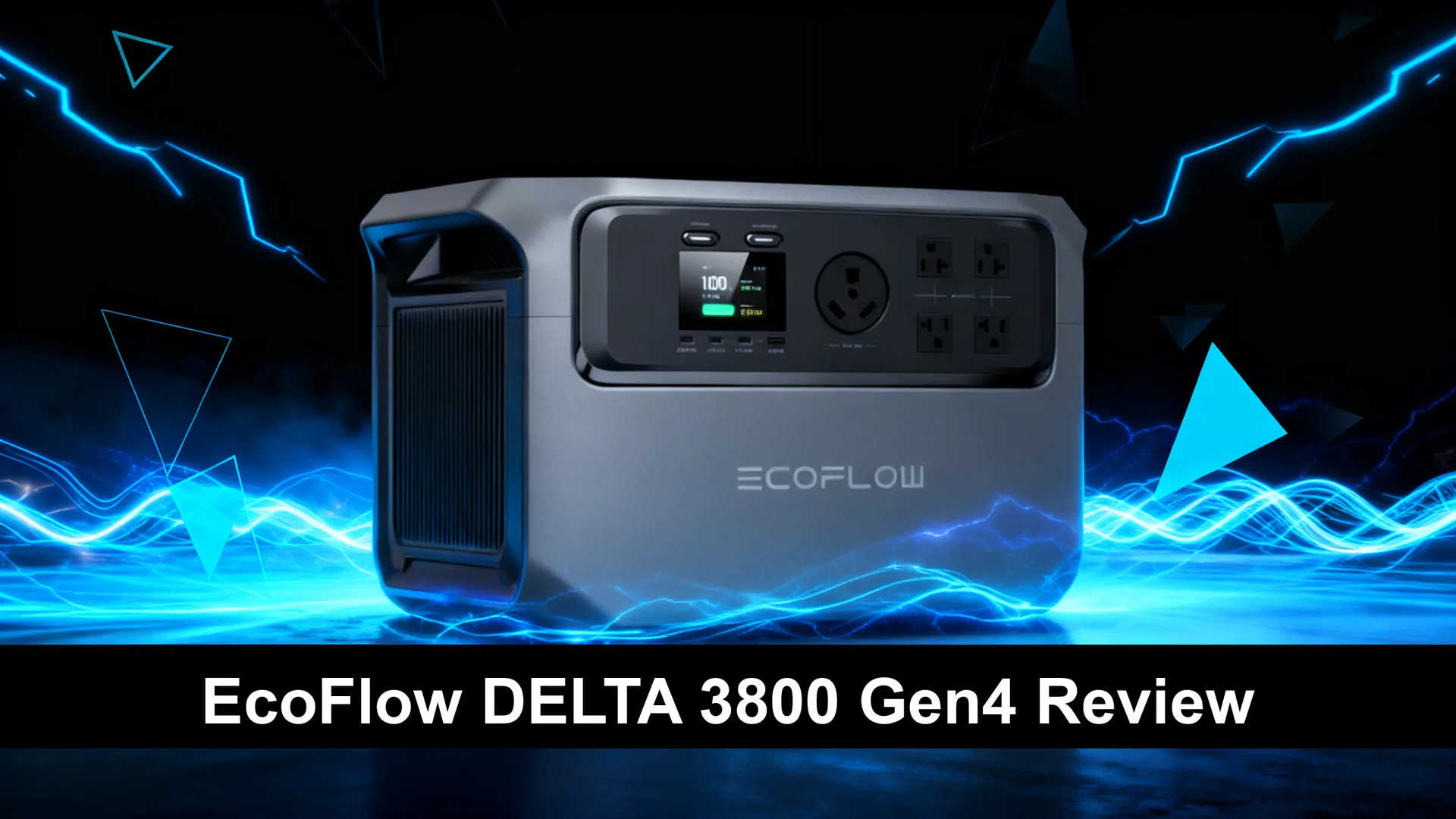
Picture the original DELTA Pro, the 99 lb station on wheels that defined big portable power for EcoFlow. Now take out 31 lb, add a little capacity and double down on solar. That is the EcoFlow DELTA 3800 Gen4, on US pre-order since November 4, 2026, and it is the most interesting thing EcoFlow has done with a 120V station in years.
The numbers: 3,763Wh of LFP battery, 3,600W of output, 2,000W of solar input and 67.5 lb. Add batteries and it grows to about 12kWh. No other station in our comparison stores more energy per pound.
The catch, up front: it is 120V only. Extra batteries buy hours, never volts or watts. If your plan involves a 240V well pump, central air or your home’s panel, stop here and read about the DELTA Pro 3 instead.
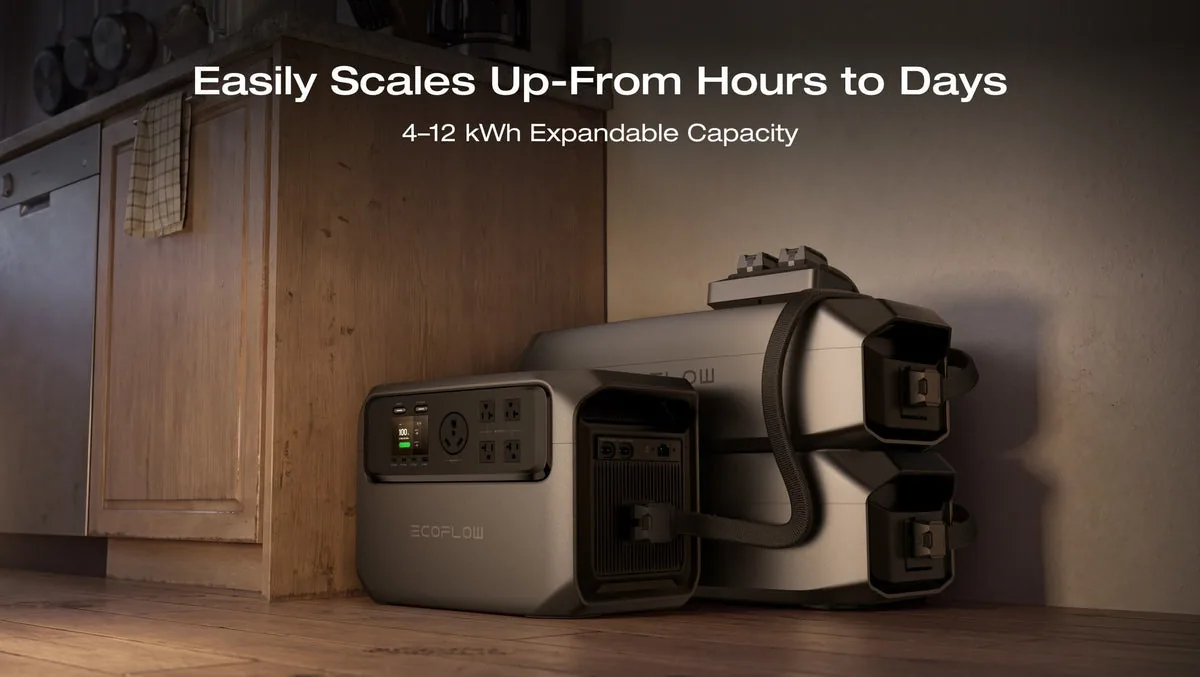
This review treats the 3800 as what it really is: the first block of a system. We haven’t had one in hand, so we work from EcoFlow’s published specs and show our math for every configuration.

EcoFlow DELTA 3800 Gen4
3,763Wh · 3,600W output · Price tracked daily since Sep 26
3,763Wh LFP, 3,600W at 120V, 2,000W of solar input and an extra battery port, with a warranty of up to 5 years with app registration.
See the deal on EcoFlow Read our reviewOur Verdict at a Glance
- Yes, if you live on 120V. It is the lightest route to 3.7kWh and 3,600W, and the only DELTA Gen4 that can grow.
- No, if anything in your home needs 240V. That job belongs to the DELTA Pro 3.
- Compare the prices: $1,699 for the 3800 against $1,299 for the 3000 and $1,799 for the original DELTA Pro.
EcoFlow DELTA 3800 Gen4: BPH Rating
8.5/10
“More than a DELTA Pro’s capacity, about 31 lb lighter”
Capacity & expansion 9.0
Power output 9.0
Outage features 8.5
Solar input 8.5
Launch value 8.5
Portability 7.5
Spec-based score at the launch price of November 5, 2026. We will update it with owner data.
Buy it if you…
- want 3.7kWh now and up to about 12kWh later
- want 2,000W of solar on a station you can still lift
- want to run a fridge for days with panels or a generator
- want faster generator charging through the battery port
Skip it if you…
- need 240V for a well pump or central air
- need more than 3,600W at once
- want built-in wheels
- need a 12V car socket on the station
What Is the EcoFlow DELTA 3800 Gen4 (DELTA 4)?
This is the flagship of EcoFlow’s DELTA Gen4 series, the line many forums call the DELTA 4. Japan got it on October 30, 2026, and US pre-orders followed on November 4. The smaller, non-expandable model is the DELTA 3000 Gen4.
Output hasn’t grown over older models. What grew is how long a setup can keep going, through added batteries, a second solar input and a weather-triggered charging mode. EcoFlow’s launch video shows the hardware:
Get our Black Friday alerts for EcoFlow
We track live prices on 40+ models from Jackery, EcoFlow, BLUETTI and Anker SOLIX. When a deal beats the lowest price we've recorded, you'll hear from us. During Black Friday week, one short recap a day at most.
Unsubscribe in one click. We may earn a commission when you buy through our links, at no extra cost to you. Privacy Policy
Build Your System: Four Ways to Configure the 3800
This is what you pay the premium for. The 3000 has no battery port. The 3800 has one, and it takes up to two extra batteries. EcoFlow lists two models, and the choice changes the size, the price and even the layout on your floor.
- DELTA 3 Max Plus Smart Extra Battery (2,048Wh): stacks on top of the main unit. It lists at $859.
- DELTA Pro 3 Smart Extra Battery (4,096Wh): EcoFlow recommends placing it next to the main unit. It was marked unavailable on EcoFlow’s store on November 5, 2026.
| Setup | Total capacity | Essentials, no recharge | Best for |
|---|---|---|---|
| 3800 alone | 3,763Wh | About 23 h | Overnight outages, with room to grow |
| + one 2,048Wh | 5,811Wh | About 35 h | The value pick, sold as a bundle |
| + two 2,048Wh, or one 4,096Wh | 7,859Wh | About 48 h | A weekend without power |
| + two 4,096Wh | 11,955Wh | About 73 h | Three days with no sun and no generator |
Essentials here means a 140W plan: fridge, internet, LED lights and phones. Capacity totals are our sums. EcoFlow rounds the range to 4-12kWh.
How long the essentials run, from 3kWh to 12kWh
Hours of fridge, internet, lights and phones on one charge
Our estimate: capacity × 0.85 ÷ 140W, with no recharging. Extra batteries add hours, never watts.
Three things to know before you buy a second battery:
- Two batteries connect through EcoFlow’s Smart Extra Battery Expansion Adapter, a separate part.
- More batteries add hours only. You stay at 120V and 3,600W, however big the stack gets.
- The first step is the cheap one. On November 5, the bundle added 2,048Wh for $600 over the early bird price, or about $293 per kWh.
Our advice: start with the 3800 alone or the battery bundle, live through one outage, then decide. That is the advantage of a system over a single box.
2,000W of Solar: How Many Panels Do You Need?
Batteries set how long you last without help. Solar decides whether the clock stops at all. The 3800 has two inputs of 1,000W each, rated at 11-60V and 20A. That is twice the 3000’s limit, and 400W above the original DELTA Pro.
The useful question is how much array it takes to cover a 3.4kWh day. Here is our math at 4.5 sun hours and a 70% real-world yield:
| Array | Energy per day | Share of essentials |
|---|---|---|
| 2 × 160W | About 1kWh | 30% |
| 4 × 160W | About 2kWh | 60% |
| 1,000W, one input | About 3.2kWh | 94% |
| 1,600W, both inputs | About 5kWh | 150% |
| 2,000W, both inputs | About 6.3kWh | 188% |
How much solar covers the essentials?
kWh per day at 4.5 sun hours. The dark mark is the 3.4kWh daily plan.
Our estimate: panel watts × 4.5 sun hours × 0.7 yield. Only the 3800 can go past 1,000W.
The break-even point is about 1,100W of panels, just past what a single input can take. That is why the second input matters: only the 3800 can cross the line where a sunny day pays for the whole plan.
Now the bad day. At 1.5 sun hours, which is our example of a heavy overcast, even a full 2,000W array makes about 2.1kWh. This is why a battery still earns its place next to a big array.
To size your own setup, try our power station runtime calculator.
How Many Days Can It Last in an Outage?
Now combine the two. Our daily plan counts a modern fridge at 80W on average, internet at 20W, LED lights at 30W and phones at 10W: 140W, or about 3.4kWh a day.
- 3800 alone, no help: about one day.
- 3800 and four 160W panels: a little over two days, because the panels cover 60% of each day’s use.
- 3800, one 2,048Wh battery and four 160W panels: about three and a half days, by our math.
- 3800 and a full 2,000W array: open-ended in sunny weather.
Older fridges can pull 150W or more on average, which shortens every line above. EcoFlow’s 70-hour Fridge Runtime Boost claim comes from an empty test fridge averaging about 54W, so we don’t use it here. Our DELTA 3000 Gen4 review breaks down how that mode works, and our list of the best portable power stations for home backup shows other approaches.

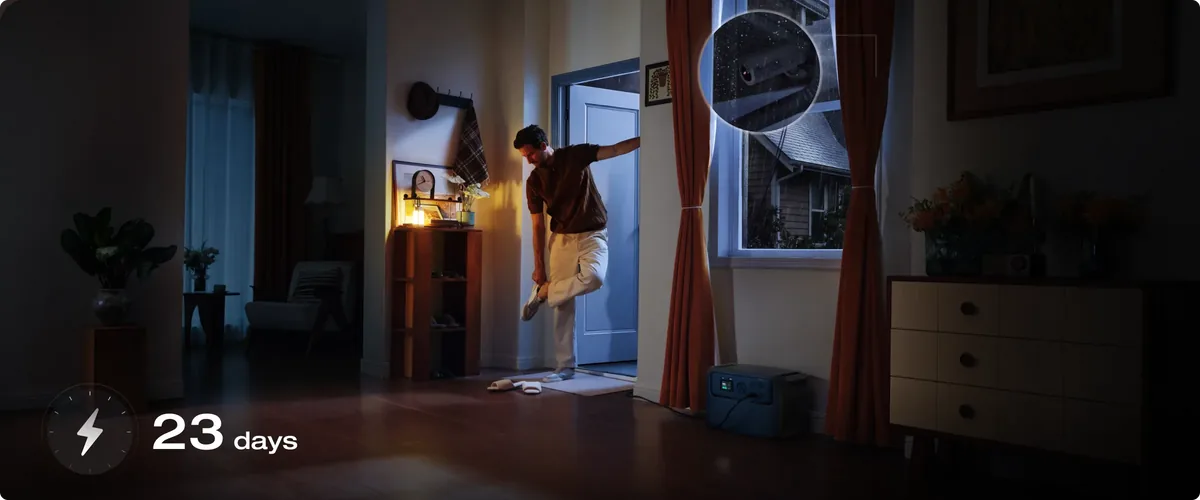

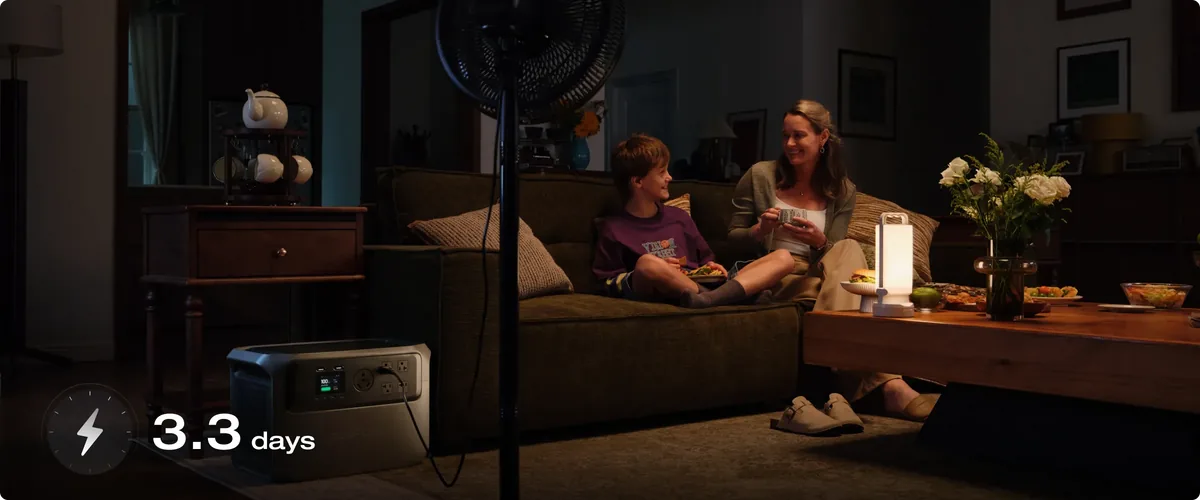
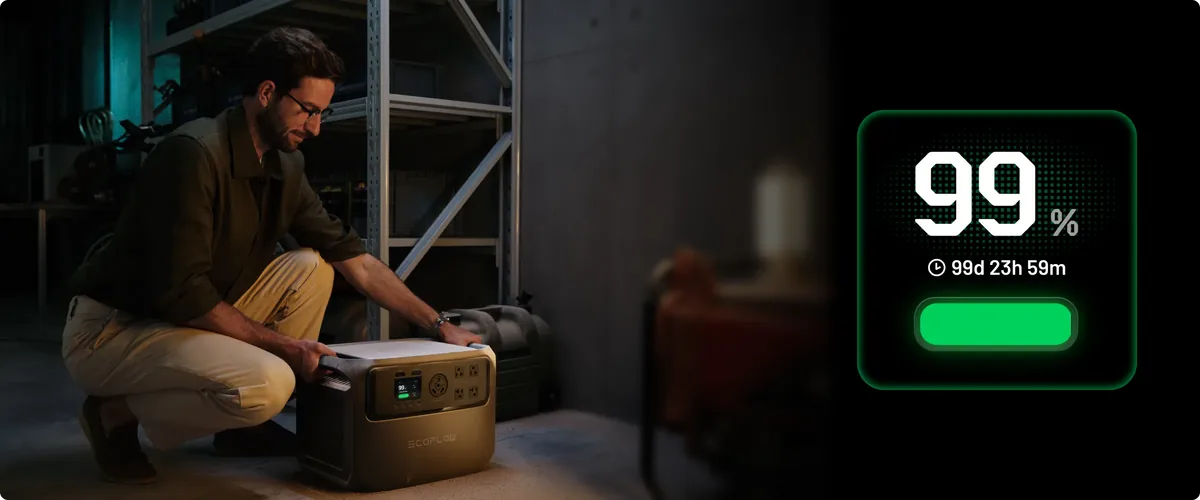
Those small-load figures are EcoFlow’s, and they rely on low idle draw: 14W with the AC on, 3W in standby. EcoFlow also estimates up to 99% of the charge remains after a year on a shelf.
Storm Guard 2.0 and Emergency Power Mode

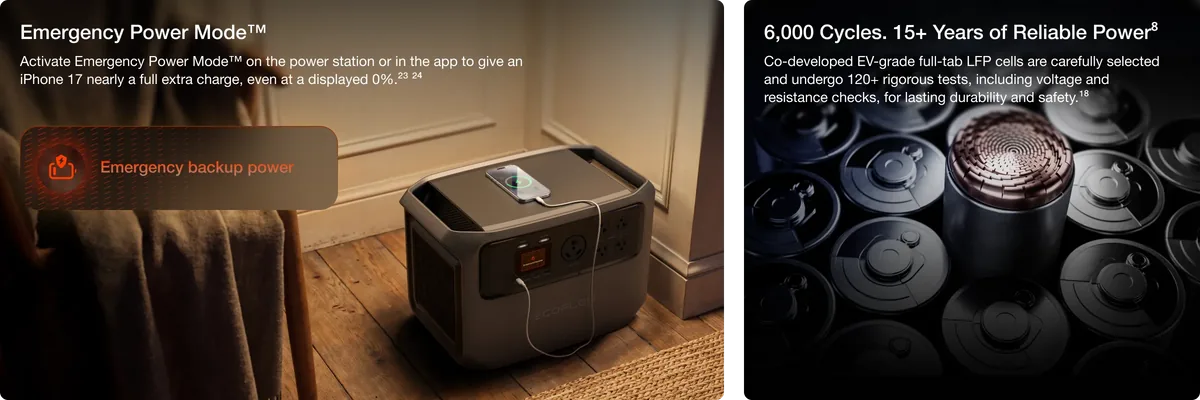
Storm Guard Mode 2.0 uses US National Weather Service data to recharge the station before severe weather arrives, depending on your region, network and settings. Emergency Power Mode keeps a small reserve at a displayed 0%, which EcoFlow says is enough for nearly a full iPhone 17 charge. It won’t run an appliance, but one last phone charge can matter.
UPS and home connection
UPS switchover is listed at under 10ms. EcoFlow says this is not a 0ms professional UPS, that it has no HID communication, and that the unit should not be the only backup for life-support equipment. EcoFlow’s compatibility table lists no Smart Home Panel or transfer switch for this model. For plug-in use, that doesn’t matter. If you want to feed your circuits, ask EcoFlow or an electrician first.
Six Ways to Charge It, and the 3,200W Generator Trick
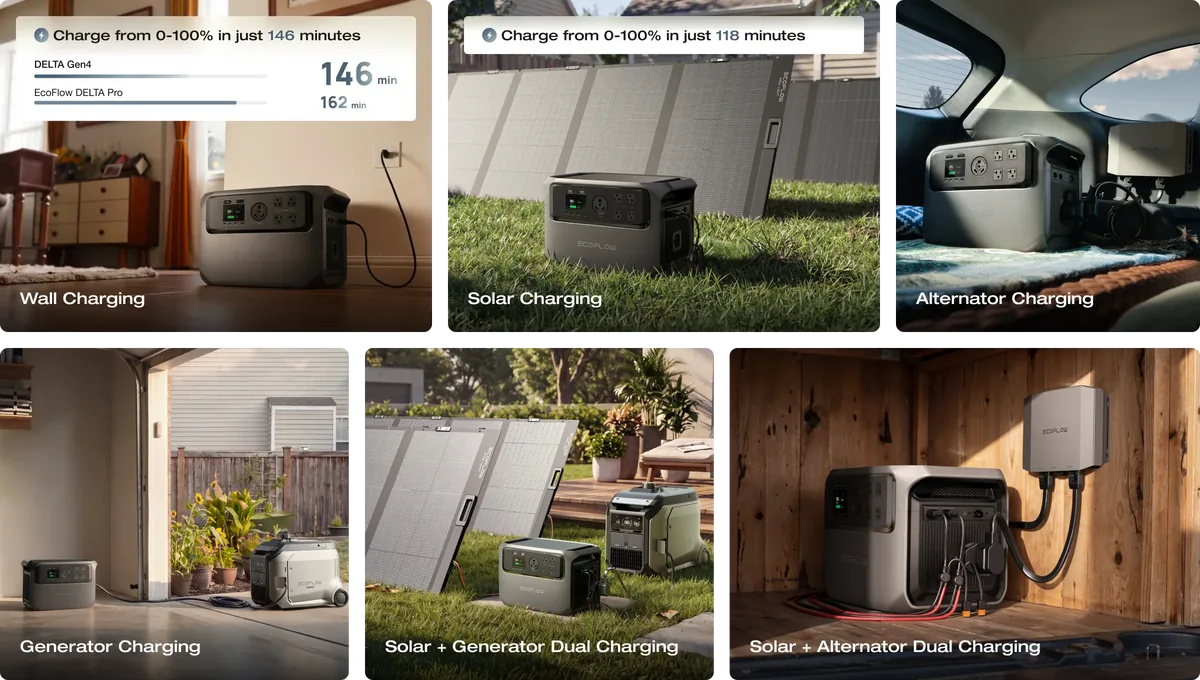
The extra battery port doubles as a fast charging input. Through it, the Smart Generator 4000 delivers 3,200W, compared with 1,800W through the AC input. EcoFlow’s six methods also include solar combined with the alternator or a generator.
| Method | Max input | 0-100% |
|---|---|---|
| Wall outlet | 1,800W | 146 minutes (EcoFlow) |
| Solar, 2 × 160W | 320W of panels | About 15 h (EcoFlow) |
| Solar, 4 × 160W | 640W of panels | About 7.5 h (EcoFlow) |
| Solar, full array | 2,000W | About 2.7 h of full sun (our math, 70% yield) |
| Smart Generator 4000 | 3,200W via battery port | Not published |
| Any generator, AC input | 1,800W | Not published |
| Alternator Charger | 500W via the solar port | Not published |
Automatic generator start and stop works only through the extra battery port. You can also use the station while it charges from the wall: in bypass mode, EcoFlow says the grid and the battery share any load above the input.
What plugs into it
- Extra batteries: DELTA Pro 3 Smart Extra Battery, DELTA 3 Max Plus Smart Extra Battery.
- Solar: EcoFlow 110W, 400W, NextGen 160W and NextGen 220W Bifacial panels.
- Generators: Smart Generator 4000 and 3000 (Dual Fuel).
- Vehicle: Alternator Charger 500W and 800W, the latter limited to 500W.
- Power supply only: WAVE 2, WAVE 3, GLACIER and GLACIER Classic.
Is This the New DELTA Pro?
EcoFlow’s own FAQ draws this comparison, and it is the right one. Same output, similar capacity, several years apart. Figures for the Pro come from our EcoFlow DELTA Pro review.
| Spec | DELTA 3800 Gen4 | DELTA Pro |
|---|---|---|
| Capacity | 3,763Wh LFP | 3,600Wh LFP |
| AC output | 3,600W, 7,200W surge | 3,600W, 7,200W surge |
| Solar input | 2,000W | 1,600W |
| UPS switchover | Under 10ms | 30ms |
| Expansion | Up to 2 extra batteries, about 12kWh | Up to 2 extra batteries |
| Weight | 67.5 lb | 99 lb |
| Wheels | No, cart sold separately | Yes |
| Price | $1,699 | $1,799 |
Weight (lb)
DELTA 3800 Gen4: 67.5
DELTA Pro: 99
Max solar input (W)
DELTA 3800 Gen4: 2,000
DELTA Pro: 1,600
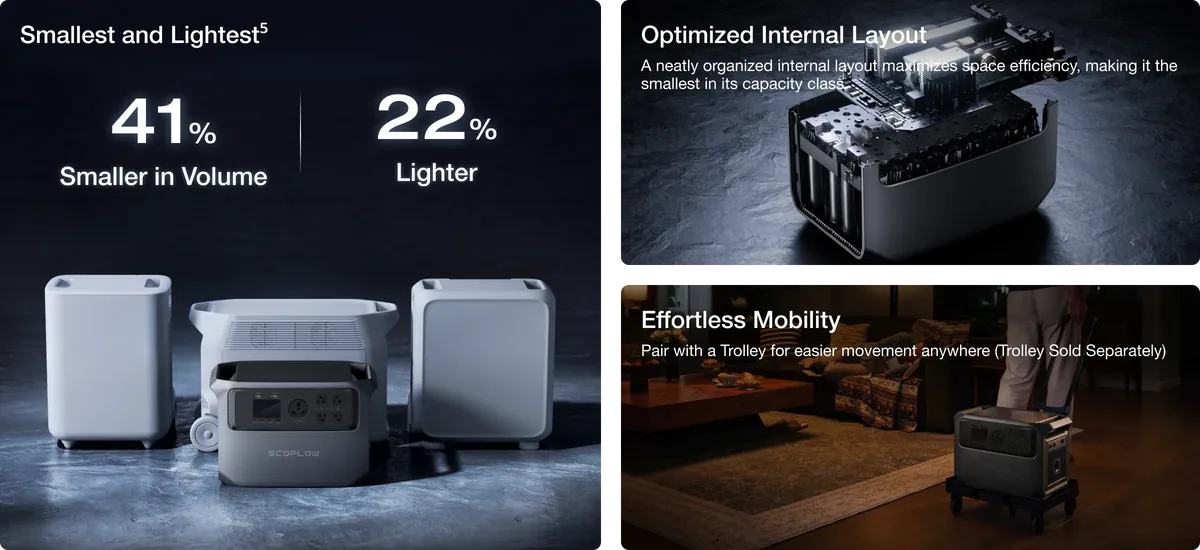
By our math, the 3800 is 32% lighter and takes 25% more solar. EcoFlow also claims a full wall charge 16 minutes faster. The Pro keeps one real advantage: its wheels. Unless you find one far below the 3800’s price, the older model is hard to justify.
The highest energy density in our comparison
Divide capacity by weight and the 3800 lands at 55.7Wh per pound, the highest of the ten large stations in the chart below. The DELTA Pro manages 36.4. That gap is the whole story of this generation: you carry about a third less weight for the same energy.
Watt-hours per pound
Higher means more stored energy for every pound you carry
Capacity divided by weight, from manufacturer specs. Our calculation, November 2026.
EcoFlow’s “smallest and lightest” claim carries a qualifier: selected 3.5-4kWh stations, compared on August 14, 2026. For a real-world reference, the Jackery HomePower 3600 Plus holds 3,584Wh at 77.2 lb.
What Can the DELTA 3800 Gen4 Run? Room by Room
EcoFlow illustrates the 3800 with six rooms. We totaled each room’s watts and divided the battery by that load. Since fridges, tools and pumps all cycle, read the last column as a floor. These are figures for one unit, with no extra battery.
| Room | Total load | Under 3,600W? | All on, nonstop |
|---|---|---|---|
| Kitchen | 3,500W | Yes, barely | ~55 min |
| RV camp | 2,820W | Yes | ~1.1 h |
| Garage | 2,600W | Yes | ~1.2 h |
| Basement | 1,820W | Yes | ~1.8 h |
| Home office | 765W | Yes | ~4.2 h |
| Living room | 385W | Yes | ~8.3 h |
Can it run the whole room at once?
Example loads from EcoFlow’s room images. The dark mark is the 3,600W limit.
Wattages from EcoFlow’s product images. Our totals, November 2026. The kitchen set leaves only 100W of margin.
Kitchen
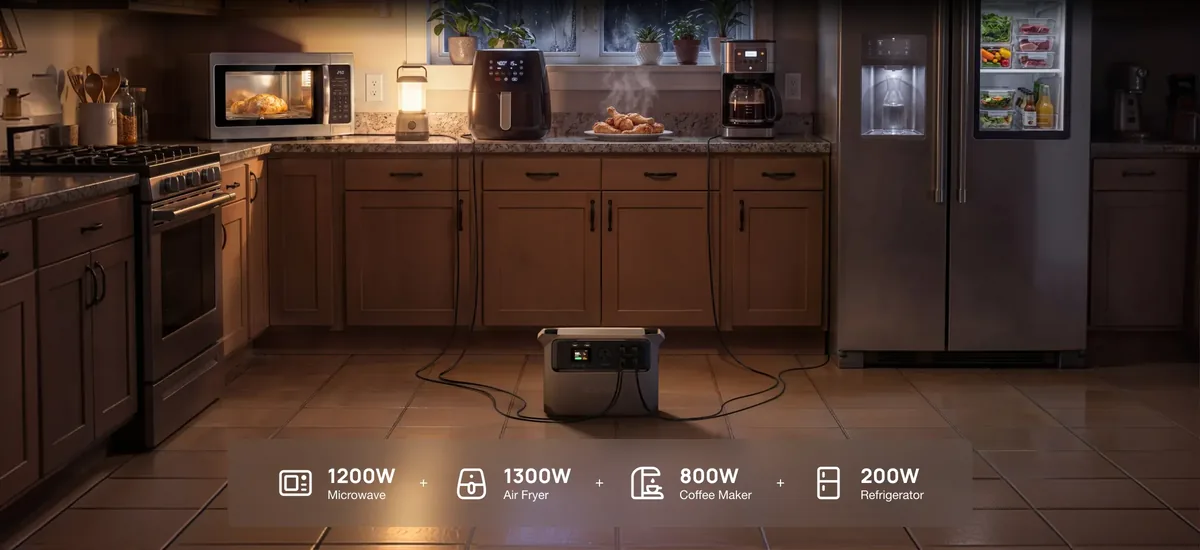
A microwave, air fryer, coffee maker and fridge add up to 3,500W, just 100W under the limit. It works on paper, but in practice run one heating appliance at a time. Your energy will go a lot further, and a compressor start won’t push you into the surge range.
Living room

At 385W, this is the easy one. A four-hour evening of TV, console and lamp uses about half the battery.
Home office
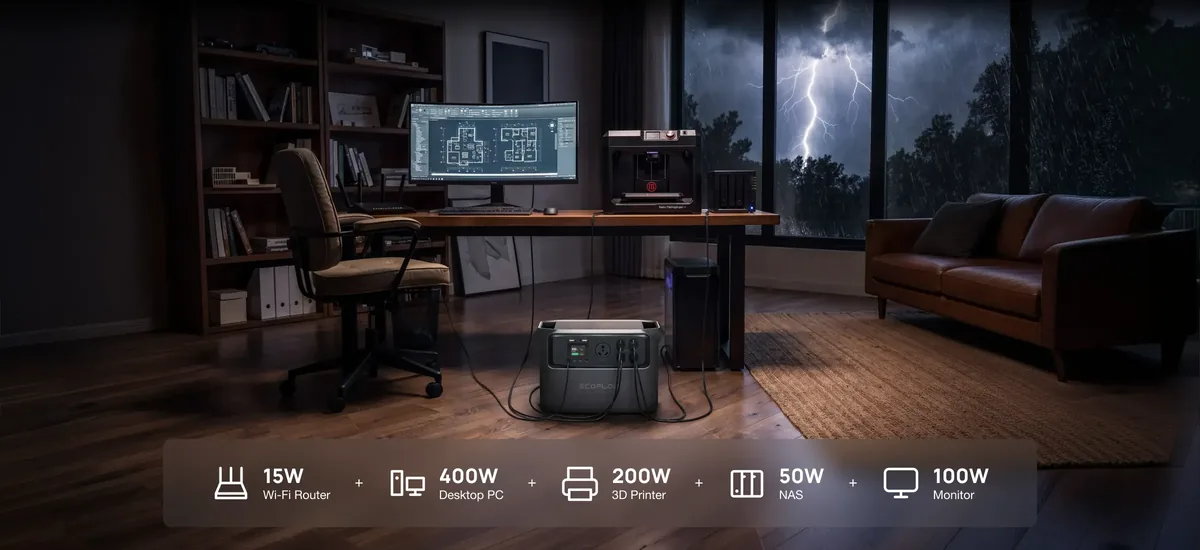
Drop the 3D printer and the rest of this set is 565W, or about 5.7 hours. That covers a full working afternoon, and the sub-10ms switchover should keep most desktops running through a sudden cut. Check your own equipment first, since this is not a 0ms professional UPS.
Garage
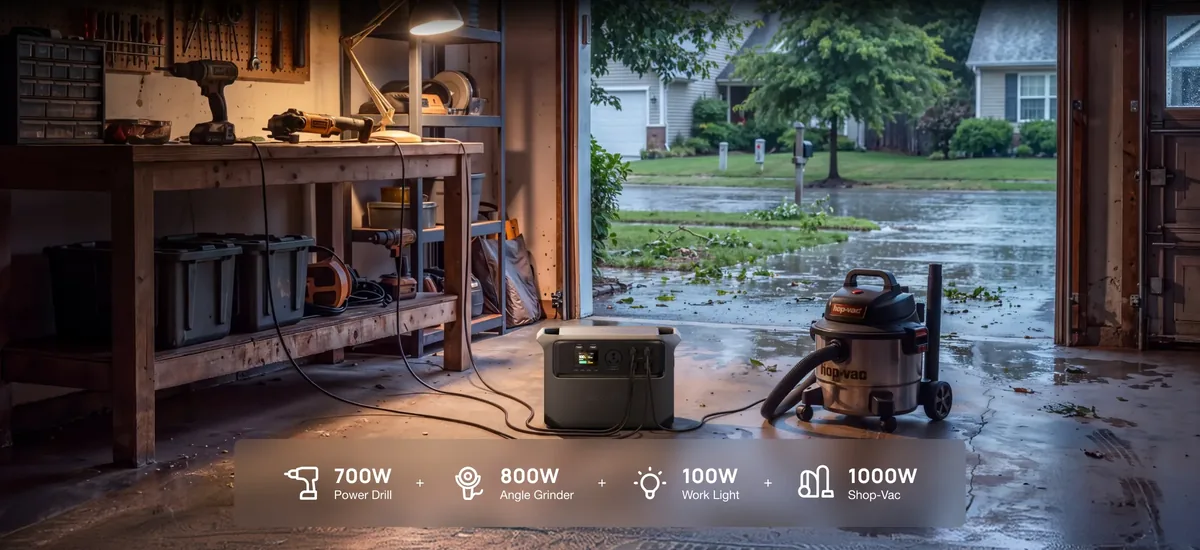
Tools run in bursts, so 2,600W nonstop overstates real use. The shop vac alone would run for about 3.2 hours, which is useful the morning after a flood.
Basement
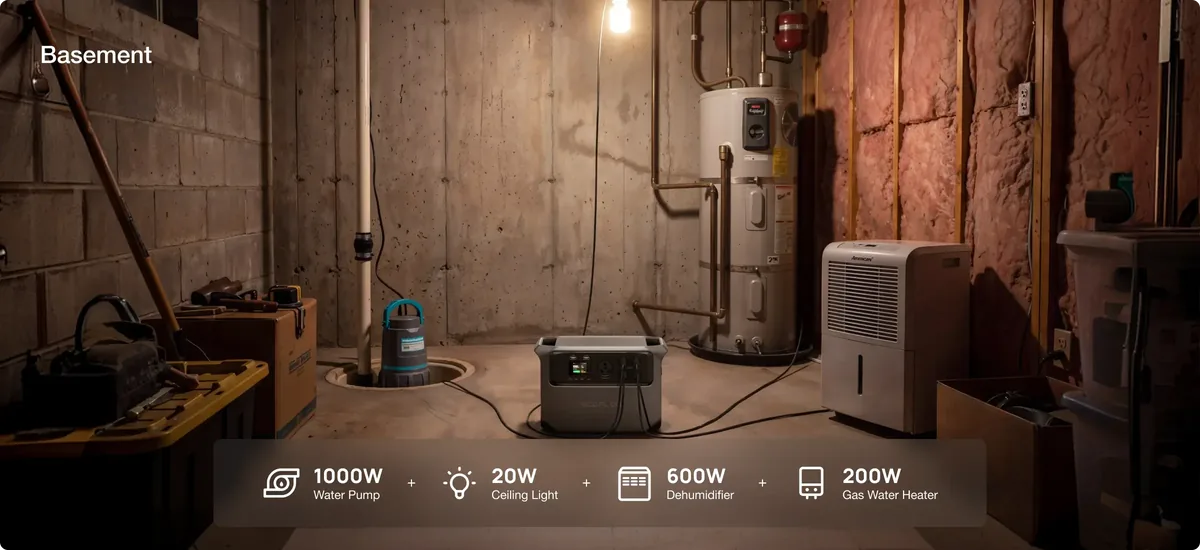
EcoFlow’s example uses a 1,000W water pump, which must be a 120V model. A 600W dehumidifier alone lasts about 5.3 hours. A 240V deep well pump is out of the question.
RV or campsite

A 60W mini fridge would run for about 53 hours on its own. The kettle and griddle are short bursts. The 30A outlet looks like a TT-30 in EcoFlow’s photos, and a 13,500 BTU rooftop AC would last about 2.3 hours.
Single-Device Runtimes
These are calculated estimates for one unit without expansion, with a 0.85 factor for conversion losses. They don’t use Fridge Runtime Boost.
Modern refrigerator
~40 h
80W average draw
Older refrigerator
~21 h
150W average draw
CPAP, no humidifier
~57 h
56W
Router + modem
~160 h
20W
Laptop
~53 h
60W while in use
Microwave
~2.9 h
1,100W of cooking time
Space heater
~2.1 h
1,500W on high
RV rooftop AC, 13,500 BTU
~2.3 h
about 1,400W while running
Why our fridge estimate is lower than EcoFlow’s 70 hours: the difference comes from the fridge, not the battery. EcoFlow’s empty test fridge averages about 54W. Yours is full, and it gets opened.
What We Would Change
120V only, and capped at 3,600W
No well pump, electric dryer or central air on 240V, and no extra output when you add batteries. If you need either, see the best EcoFlow options for home backup.
No wheels at 67.5 lb
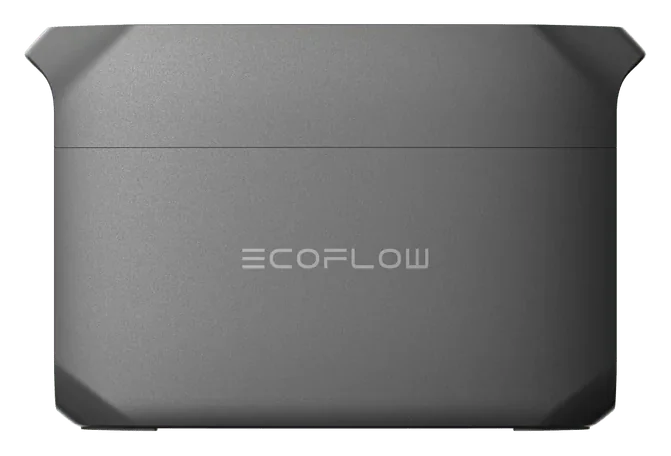
This is the price of all that lost weight. It has two handles, and 67.5 lb is a heavy two-hand lift. EcoFlow sells the DELTA Series Folding Transport Cart separately. If it will move often, budget for one.
The cycle rating stops at 70%
EcoFlow’s footnote says the cell keeps 70% of its initial capacity after 6,000 cycles, in lab conditions. That is still more than 15 years at one cycle a day, but compare it carefully with stations that quote cycles to 80%.
No 12V car socket
EcoFlow’s spec table lists AC and USB only. USB limits also apply: the 65W USB-C pair drops to 16W when shared with the USB-A.
Garage and shed limits
Charging stops below 32°F, discharging below 14°F, and IP20 means no protection against water. Read our guide to power stations in freezing temperatures before you park a system in an unheated garage.
Alternatives: When Another Station Makes More Sense
Live prices for the DELTA 3800 Gen4 and its closest alternatives:
| Model | Capacity / output | Price now | Per kWh | Lowest tracked | Link |
|---|---|---|---|---|---|
 EcoFlowDELTA 3800 Gen4 | 3,763Wh · 3,600W | $1,699 | $452 | Tracking since Sep 26 | Check deal |
 EcoFlowDELTA 3000 Gen4 | 3,072Wh · 3,600W | $1,299 | $423 | Tracking since Sep 26 | Check deal |
 EcoFlowDELTA 3 Ultra Plus | 3,072Wh · 3,600W | $1,599 Lowest we have tracked | $521 | $1,599 (Nov 6) | Check dealExtra 5% off with code BPHUB5 |
 EcoFlowDELTA Pro | 3,600Wh · 3,600W | $1,799 Lowest we have tracked | $500 | $1,799 (Nov 6) | Check dealExtra 5% off with code BPHUB5 |
 BLUETTIApex 300 | 2,765Wh · 3,840W | $1,499 Lowest we have tracked | $542 | $1,499 (Nov 6) | Check deal |
Prices come from each brand's US store and refresh automatically every few hours (oldest check on this table: Nov 6, 7:59 AM ET). Sale prices can change within the hour; the price in your cart is the one that counts. Prices, not coupon codes: some stores stack extra member or sign-up discounts at checkout.
DELTA 3800 Gen4 vs DELTA 3000 Gen4
If you know 3kWh is enough, you don’t need this port or this weight. Our 3000 or 3800 comparison goes through the $400 gap line by line.
Watch the 3000 and 3800 compared
DELTA 3800 Gen4 vs DELTA 3 Ultra Plus
The DELTA 3 Ultra Plus is the previous generation’s expandable model, with 3,072Wh, 1,600W of solar and a 74.3 lb weight. It sells for $1,599. The Gen4 is about 7 lb lighter, with 691Wh more. The Ultra Plus is worth a look if it stays cheaper and you need it before late November.
DELTA 3800 Gen4 vs DELTA Pro 3
The DELTA Pro 3 is the one for 240V. It has 4,096Wh, 4,000W of output and 2,600W of solar, but it weighs 113.5 lb. If your plan involves your home’s panel or a well pump, that’s the better route. On November 5, 2026, the standalone unit was listed as unavailable, while some bundles were still on sale. If you just plug things in, the 3800 is 46 lb lighter.
DELTA 3800 Gen4 vs BLUETTI Apex 300
The Apex 300 has less capacity per unit (2,764.8Wh) but offers 120V and 240V, 2,400W of solar and a larger expansion path, for $1,499. Choose it for 240V at a lower price, and choose the 3800 for capacity and weight.
For a move-it-every-day station, or for a smaller budget, our list of the best EcoFlow power stations has lighter options. For whole-home 240V, look at the EcoFlow TITAN.
Price, Battery Bundles and Release Date
The DELTA 3800 Gen4 opened for pre-order on EcoFlow’s US store on November 4, 2026. It lists at $2,199. Its early bird price runs through December 7, 2026, and on November 5, 2026 it came to $1,699 at checkout, about $450 per kWh. The live price today is $1,699. EcoFlow says the unit ships in late November.
The bundle to look at is the one with the 2,048Wh battery. On November 5, it added 2,048Wh for $600 over the early bird price, or about $293 per kWh. If you think you might expand, that is hard to beat. All current EcoFlow offers are on our EcoFlow Black Friday deals page.
EcoFlow also sells bundles. These were the prices listed on November 5, 2026:
| Bundle | Price on November 5, 2026 |
|---|---|
| 3800 Gen4 + 2 × 160W panels | $2,199 |
| 3800 Gen4 + DELTA 3 Max Plus Extra Battery | $2,299 |
| 3800 Gen4 + 4 × 160W panels | $2,599 |
| 3800 Gen4 + DELTA 3 Max Plus Extra Battery + 2 × 160W panels | $2,699 |
Full EcoFlow DELTA 3800 Gen4 Specifications
| Battery | 3,763Wh LFP (LiFePO4) |
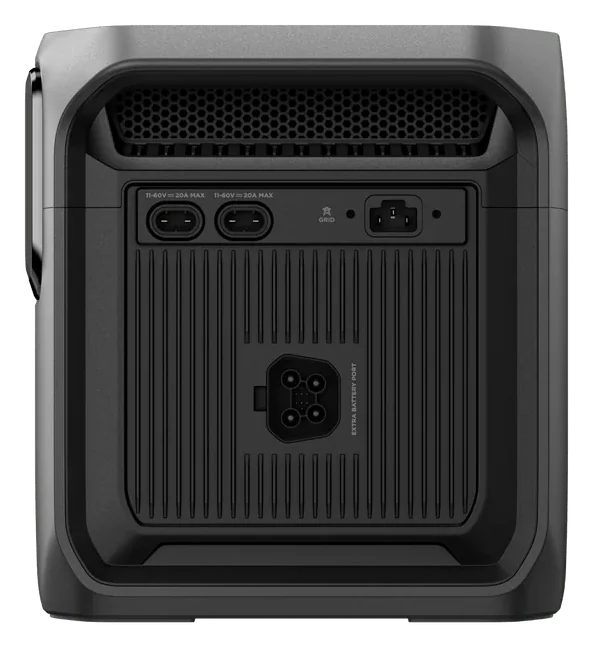
| Expansion | Up to 2 extra batteries, 4-12kWh in EcoFlow’s terms |
| AC output | 120V, 60Hz, 3,600W continuous, 7,200W surge |
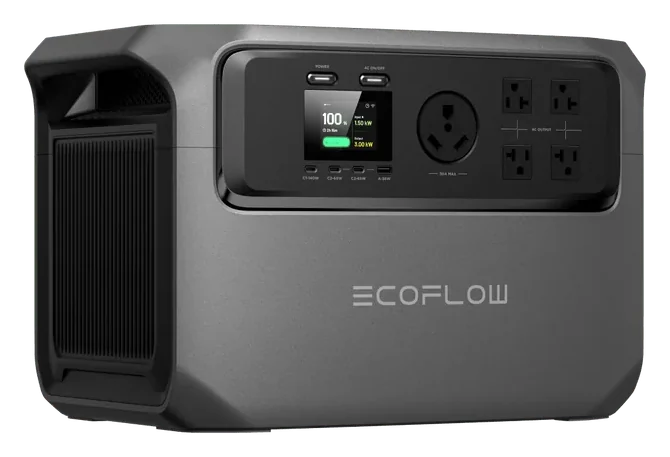
| AC outlets | 4 × 20A, 1 × 30A |
| USB | 1 × USB-C 140W, 2 × USB-C 65W, 1 × USB-A 36W |
| 12V car socket | Not listed |
| Solar input | 2,000W on 2 ports, 11-60V, 20A per port |
| Wall charging | 1,800W, 0-100% in 146 minutes (EcoFlow) |
| Generator input | 1,800W AC, 3,200W through the extra battery port |
| UPS switchover | Under 10ms, no HID support |
| Idle draw | 14W with AC on, 3W standby |
| Cycle life | 6,000 cycles to 70% capacity |
| Noise | Up to 30 dB (600W), 40 dB (1,800W), 50 dB (3,600W) |
| Temperature | Charge 32-113°F, discharge 14-113°F |
| Protection | IP20, UL 9540A |
| Weight | 67.5 lb (30.6 kg) |
| Size | 16.77 × 11.36 × 12.09 in, 18.76 in long with handles |
| Warranty | 3 years + 2 with app registration |
What’s in the Box
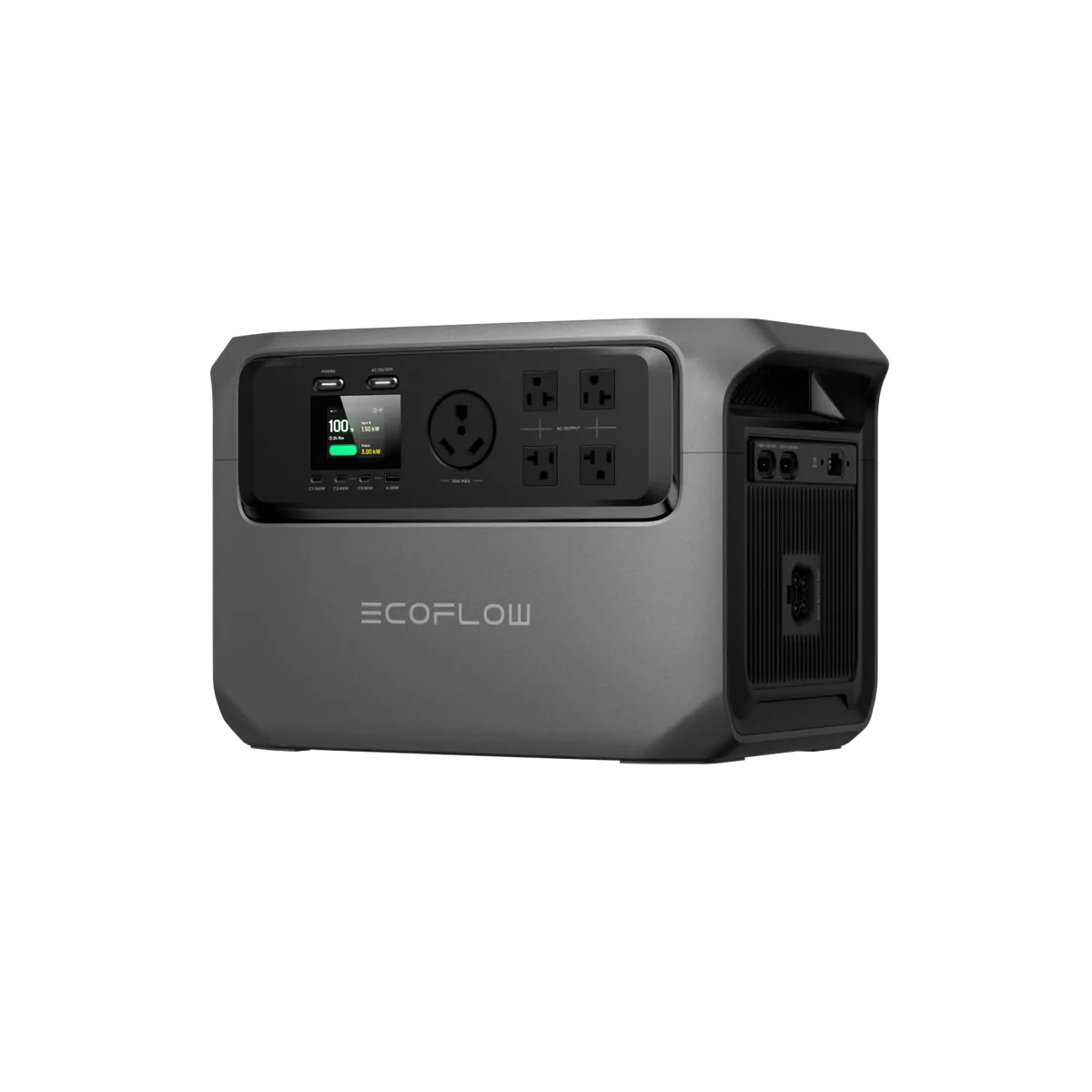
EcoFlow lists the DELTA 3800 Gen4, an AC charging cable, two solar charging cables (XT60i to LP60), an AC cable retention kit, the manuals and warranty card, a quick guide and safety instructions. Panels, the cart and the expansion adapter are extras.
Compare it head to head: DELTA 3000 Gen4 vs DELTA 3800 Gen4 · DELTA Pro vs DELTA 3800 Gen4 · All comparisons
Frequently Asked Questions
How far can the DELTA 3800 Gen4 expand?
Up to two extra batteries, for 4 to 12kWh in EcoFlow’s terms. Two 4,096Wh batteries bring the total to about 12kWh, and two 2,048Wh batteries to about 7.9kWh by our math.
Which extra batteries work with the DELTA 3800 Gen4?
EcoFlow lists the DELTA 3 Max Plus Smart Extra Battery (2,048Wh) and the DELTA Pro 3 Smart Extra Battery (4,096Wh). Connecting two requires the Smart Extra Battery Expansion Adapter.
Does adding batteries increase the output?
No. A larger stack runs longer, but the system stays at 120V, 3,600W continuous and 7,200W surge.
Can the DELTA 3800 Gen4 power a house?
It can run plug-in essentials such as a fridge, internet, lights and a microwave. It can’t run 240V loads, and EcoFlow’s compatibility table lists no home panel for it.
How many solar panels can the DELTA 3800 Gen4 take?
Up to 2,000W across two inputs, each rated at 1,000W, 11-60V and 20A. By our math, about 1,100W of panels covers a 3.4kWh day of essentials at 4.5 sun hours.
Is the DELTA 3800 Gen4 better than the DELTA Pro?
On paper, yes, for most new buyers. It stores 163Wh more, takes 400W more solar, switches faster as a UPS and weighs 31.5 lb less. The DELTA Pro keeps its built-in wheels.
Is the DELTA 3800 Gen4 the EcoFlow DELTA 4?
It belongs to the series that some sites call the DELTA 4. EcoFlow’s US store has no product with that exact name.
Is the DELTA 3800 Gen4 worth $400 more than the 3000?
If you may ever expand, yes. You get a battery port, a second solar input and automatic generator start, which the 3000 can’t add later.
What is the launch price, and when does it ship?
The list price is $2,199. On November 5, 2026, the early bird price was $1,699 at checkout through December 7, and EcoFlow says units ship in late November.
How long does a full wall charge take?
EcoFlow says 146 minutes at up to 1,800W. A full 2,000W solar array would take about 2.7 hours of full sun by our math.
Final Verdict: The Gen4 to Buy If You Plan to Grow
The best thing about the DELTA 3800 Gen4 is that it doesn’t force a decision today. Start with 3.7kWh, add panels after the first storm, add a battery after the second. Few 120V stations give you that path at about two-thirds of a DELTA Pro’s weight.
Three hard limits stay: 120V, 3,600W and no wheels. If your home can live with them, this is one of EcoFlow’s strongest launches of 2026. Our rating: 8.5/10, from published specs and the launch price. Owner feedback may change that, and we will update it.
More EcoFlow Reading
Originally published: November 5, 2026