
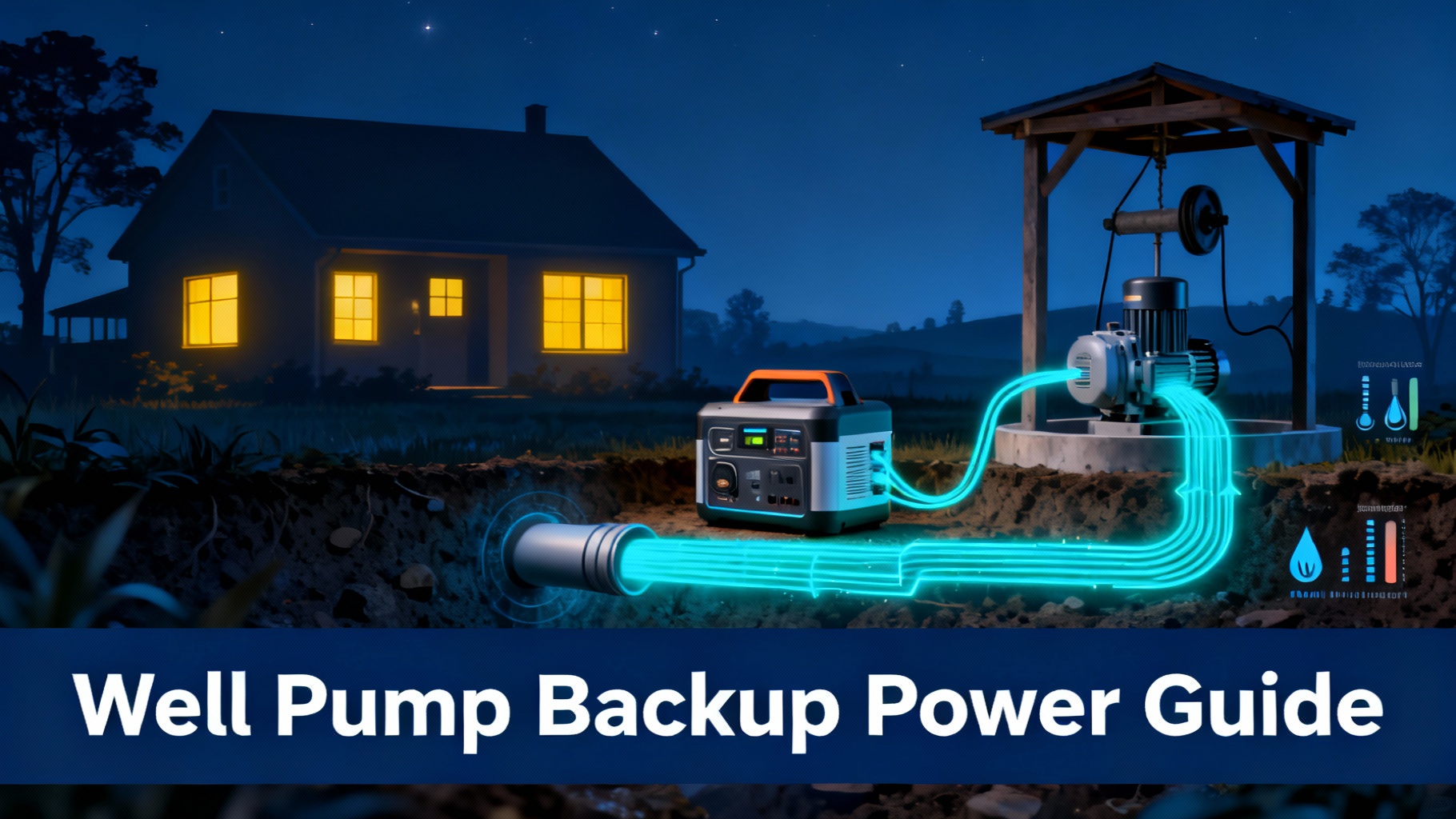
Looking for a reliable backup solution when the power goes out and your well pump stops? If you rely on well water for your home, losing electricity means more than just dark rooms: it means no running water for drinking, cooking, bathing, or flushing toilets.
⚠️ Important before you buy: Most standard residential well pumps run on 240V split-phase power. The majority of portable power stations, including popular models like the Jackery Explorer 2000 v2 and Bluetti Elite 200 V2, output 120V only and cannot run a 240V pump. Check your pump’s nameplate before purchasing any unit. If your pump requires 240V, start with our top three picks: each has a 240V outlet. Picks #4 and #5 are for 120V pumps only.
We compared portable and home backup power stations specifically for their ability to handle well pump backup. After examining manufacturer specifications, calculating runtime estimates for different pump sizes, and comparing output voltage and surge ratings across three major brands (Jackery, Anker SOLIX, and Bluetti), we picked five: three for 240V pumps and two for 120V pumps, from 1/3 HP to 1 HP.


The challenge with well pumps isn’t just continuous power, it’s the massive surge watts required during startup. For 12V camping water pumps specifically, see our water pump systems for camping guide. A 1/2 HP pump that runs at 1,000W can demand 3,000W or more for those critical first seconds. Get that calculation wrong, and your power station shuts down before the pump even starts.
Here’s what we found: for a standard 240V well pump, the Anker SOLIX F3800 offers the best overall combination of 240V output (6,000W), surge capacity (9,000W), runtime (about 19 cycles of a 1/2 HP pump per charge), and expandability (up to 26.9kWh). But depending on your pump’s voltage and size, your well depth, and how long your outages last, other models might suit your needs better.
🏆 Our #1 Pick: Anker SOLIX F3800
Why we recommend it: 6,000W of true 120V/240V output runs standard 240V pumps, a 9,000W surge rating handles pumps up to 1 HP, 3,840Wh provides about 19 cycles of a 1/2 HP pump, and it expands to 26.9kWh with six BP3800 batteries.
$1,799.99 | 3,840Wh | 5-year warranty
⚡ Quick Picks: Top 5 Power Stations for Well Pumps
Surge shown in green covers the 4,500-6,000W start of a 3/4 HP pump. Not published: the brand lists no surge rating for motor loads.
Planning to buy on Black Friday? Home backup units get the biggest dollar discounts of the year. Our live Black Friday power station prices cover every home backup model from the four big brands.
Get the 1-page outage plan
What to plug in first, how long a fridge really runs on a battery, and the 3 safety rules for connecting a power station to your home. Printable, sent by email.
About one email a week. Unsubscribe in one click. We may earn a commission when you buy through our links, at no extra cost to you. Privacy Policy
How We Compared & Ranked These Power Stations
Comparison Methodology
Our comparison focused on what well pumps actually demand. We checked each power station’s published specifications against the voltage, running watts, and starting surge of submersible and jet pumps.
For each model, we estimated runtime from the manufacturer’s watt-hour capacity, assuming 85% usable capacity after inverter losses. We compared published surge ratings against the starting requirements of common well pump motors (which typically demand 3-4× their running wattage).
The analysis also covered output voltage (120V only, or 120V and 240V), battery chemistry (LiFePO4 vs standard lithium-ion), cycle life expectations, solar recharging capabilities, and expandability options, all critical factors when your water supply depends on backup power.
Key Evaluation Criteria
⚠️ Important: Check the voltage first: a 240V pump needs a 240V outlet. After that, surge capacity is the single most important factor. We looked for at least 3,000W of starting power for 1/2 HP pumps, and 6,000W+ for 3/4 HP pumps. When a brand publishes no surge rating for motors, we only counted its continuous output. Many cheaper units advertise high continuous output but fall short on surge capacity.
Runtime Per Charge: We calculated cycles based on typical 10-minute pump runs. A family of four uses roughly 300 gallons daily, or about 5 pump cycles from a 6 gpm well (see Step 4 below). The power station needs enough capacity for at least one full day of rationed water use.
Battery Technology: LiFePO4 (lithium iron phosphate) batteries in our picks are rated for 3,000 to 6,000+ cycles, versus 500-1,000 for standard lithium-ion. For a backup system you’ll rely on annually (or more frequently in storm-prone areas), longevity matters.
Expandability: Can you add battery packs for extended outages? Some of our picks scale past 20kWh, while others remain fixed capacity.
Solar Recharge Rate: How quickly can you recharge from solar panels during daylight hours? This determines whether you have truly unlimited runtime or just a larger battery. For more details on optimizing your solar panel wiring configuration, check out our complete guide.
Pure Sine Wave Output: Non-negotiable for well pump motors. Modified sine wave inverters damage motor windings over time.
Price Per Watt-Hour: The comparison table shows each model’s live price per watt-hour, so you can compare cost efficiency at each capacity level.
Well Pump Types Covered
Common Well Pump Types & Power Requirements
Submersible Pumps
Most common, sits at bottom of well
1/2 HP typical:
Running: 1,000-1,200W
Surge: 3,000W
Shallow Jet Pumps
For wells under 25 feet
1/3 HP typical:
Running: 700-900W
Surge: 2,250W
Deep Well Pumps
For wells 150-400 feet
3/4 HP typical:
Running: 1,500-2,000W
Surge: 4,500-6,000W
Our recommendations account for all three types based on horsepower rating
Our recommendations account for all three types, but the surge requirements remain consistent across categories based on horsepower rating.
Understanding Well Pump Power Requirements
Before choosing a power station, you need to know what you’re actually powering. Many homeowners buy undersized units because they only consider running watts, then watch helplessly as the unit shuts down when the pump tries to start.
Typical Well Pump Wattages by Type
⚡ Power Requirements by Pump Size
1/3 HP Pump
Running watts:
700-900W
Surge watts:
2,100-2,700W
Shallow jet pumps
1/2 HP Pump ⭐
Running watts:
1,000-1,200W
Surge watts:
3,000-3,600W
Most common residential
3/4 HP Pump
Running watts:
1,500-2,000W
Surge watts:
4,500-6,000W
Deep wells, large homes
1 HP Pump
Running watts:
2,000-2,500W
Surge watts:
6,000-7,500W
Very deep wells, farms
💡 Pro Tip: These numbers assume 240V pumps, which are standard for residential wells. Check your pump’s nameplate for exact specifications.
Starting (Surge) vs Running Watts
Here’s where most people go wrong: they see “1/2 HP = 373 watts” and think a 500W power station will work. It won’t.
We also cover this in depth in our best power stations for small houses.
Electric motors require a massive surge of power during the first 2-3 seconds of operation. The motor windings create electromagnetic fields to start rotation, demanding 3-5 times the running wattage. This is called “locked rotor amps” or LRA on pump specifications.
A 1/2 HP pump with 1,000W running consumption needs 3,000W minimum for reliable starting, many manufacturers recommend 3,600W to account for voltage drop and ensure clean starts.
❌ Critical: The surge duration is brief (under 3 seconds), but if your power station can’t deliver that peak power, the protection circuit trips and nothing happens. You’ll see an error code, the pump stays silent, and you’re left manually hauling water from elsewhere.
Pure sine wave output becomes critical here too. Modified sine wave creates harmonic distortion that makes motors work harder, increasing both running watts and surge requirements while damaging windings over time.
How to Calculate Your Exact Needs
Step 1: Find Your Pump Specifications
Check the metal nameplate on your pressure tank or pump unit. Look for:
- HP (horsepower): Usually 1/3, 1/2, 3/4, or 1 HP
- Voltage: 120V or 240V
- Amps: Running amperage
- LRA or Starting Amps: Surge requirement
Step 2: Calculate Running Watts
For 240V pumps: Watts = Voltage × Amps
Example: 240V × 5 amps = 1,200W running
Step 3: Calculate Surge Watts
If LRA is listed: Surge Watts = Voltage × LRA
Example: 240V × 15 LRA = 3,600W surge
If LRA isn’t listed: Multiply running watts by 3-4
Example: 1,200W × 3 = 3,600W surge (minimum safe estimate)
Step 4: Calculate Runtime Requirements
Average daily water usage (family of 4): 300-400 gallons
Well recovery rate: 5-10 gallons per minute (varies by well)
Pump cycle length: Water usage ÷ recovery rate
Example: 300 gallons ÷ 6 gpm recovery = 50 minutes of total daily pumping
At 10 minutes per cycle = 5 cycles per day (normal use)
Conservative backup estimate: 10 cycles per day (rationed use)
Step 5: Calculate Required Capacity
Watt-hours needed = (Running watts × total runtime) ÷ inverter efficiency
Example for 1/2 HP pump (1,200W running):
Daily requirement = 1,200W × 50 minutes ÷ 60 ÷ 0.85 efficiency = 1,176Wh minimum
For 10 cycles (emergency rationing): 1,200W × 10 cycles × 10 min ÷ 60 ÷ 0.85 = 2,353Wh needed
💡 Key Insight: This calculation tells you that a 2,000Wh power station provides roughly 8-10 cycles for a 1/2 HP pump, or one full day of careful water use. For a more comprehensive approach, our off-grid sizing calculator guide walks through multi-load scenarios beyond just the pump.
Common Sizing Mistakes to Avoid
❌ Mistake #1: Only considering running watts
“My pump uses 1,000W, so a 1,500W power station should work fine.”
Reality: The 3,000W surge requirement exceeds the 1,500W continuous rating. The pump won’t start.
❌ Mistake #2: Forgetting inverter efficiency
“I have 2,000Wh capacity, that’s two full hours at 1,000W.”
Reality: Inverter losses mean you get 1,700Wh usable. Plus, discharging below 20% shortens battery life.
❌ Mistake #3: Underestimating water needs
“We’ll just use a few gallons for drinking.”
Reality: Toilets use 1.6-7 gallons per flush. Showers use 2 gallons per minute. Plan for at least 50 gallons per person per day.
Get the 1-page outage plan
What to plug in first, how long a fridge really runs on a battery, and the 3 safety rules for connecting a power station to your home. Printable, sent by email.
About one email a week. Unsubscribe in one click. We may earn a commission when you buy through our links, at no extra cost to you. Privacy Policy
#1. Anker SOLIX F3800: Best Overall for 240V Well Pumps
Need more guidance? Our best power stations for HVAC systems has you covered.
The F3800 is Anker’s flagship home backup solution, and the only 240V pick in this guide with a published surge rating. With 3,840Wh capacity and 6,000W of continuous output at 120V and 240V (9,000W surge), it handles standard 240V pumps up to 1 HP.
✅ Key Specs:
- Capacity: 3,840Wh (expandable to 26.9kWh)
- Output: 6,000W at 120V and 240V
- Surge: 9,000W
- Battery: LiFePO4 (3,000+ cycles)
- Solar input: 2,400W maximum
- Warranty: 5 years
Why It’s Our Top Pick
True 240V from one unit. Most residential well pumps run on 240V. The F3800 has a NEMA 14-50 and a NEMA L14-30 outlet, each rated up to 6,000W, plus six 120V outlets. Well pumps are usually hardwired, so plan on a transfer switch or power inlet installed by an electrician.
Surge headroom for bigger pumps. Anker rates the F3800 at 9,000W of surge. That clears the 4,500-6,000W starting range of a 3/4 HP pump in this guide, and even the 6,000-7,500W range of a 1 HP pump.
Expandability to 26.9kWh. Start with 3,840Wh and add up to six BP3800 expansion batteries at $1,799.99 each (3,840Wh per battery). Two F3800 units can also be linked for 12kW and up to 53.8kWh.
One catch with 240V. Anker notes that the 240V output can’t be used while the F3800 is charging from 120V AC. If you top it up from a 120V generator or wall outlet, schedule that charging between pump runs.
🏆 Best Overall for 240V Well Pumps: Anker SOLIX F3800
Perfect for: Standard 240V pumps up to 1 HP, about 19 cycles of a 1/2 HP pump per charge, expandable for extended outages
Check Current Price on Anker →
$1,799.99 | 3,840Wh | 5-year warranty
Runtime Estimates with Common Pumps
These estimates use 10-minute pump cycles and the F3800’s 3,840Wh at 85% usable capacity (3,264Wh). Five cycles a day matches normal use for a family of four on a 6 gpm well (Step 4 above); ten a day is the conservative backup estimate.
Runtime Estimates: Anker SOLIX F3800
1/3 HP Pump
750W running
about 26 cycles
about 5 days at 5 cycles a day
about 2.5 days at 10 cycles a day
1/2 HP Pump ⭐
1,000W running
about 19 cycles
nearly 4 days at 5 cycles a day
nearly 2 days at 10 cycles a day
3/4 HP Pump
1,750W running
about 11 cycles
about 2 days at 5 cycles a day
about 1 day at 10 cycles a day
☀️ Solar recharge scenario: 400W of panels over 6 hours of good sunlight is 2,400Wh on paper. At a more realistic 70% of rated output, you’ll capture just under 1,700Wh, a bit less than half the F3800’s 3,840Wh and enough for about 8 more cycles of a 1/2 HP pump. The F3800 accepts up to 2,400W of solar input, so a larger array refills it faster. For more on solar charging in winter conditions, see our complete guide.
Pros and Cons
✅ Pros
- ✓ True 120V/240V output: 6,000W from a NEMA 14-50 or L14-30 outlet
- ✓ 9,000W surge covers pumps up to 1 HP in this guide
- ✓ Expandable from 3,840Wh to 26.9kWh with BP3800 batteries
- ✓ Up to 2,400W of solar input (2 × 1,200W)
- ✓ UPS switchover under 20ms (Anker’s rating)
- ✓ 5-year warranty
❌ Cons
- ✗ 132.3 lb: pick a permanent spot near your transfer switch
- ✗ The 240V output is unavailable while charging from 120V AC
- ✗ AC charging tops out at 1,800W, so a full wall recharge takes over 2 hours
- ✗ Rated for 3,000+ cycles, fewer than the 6,000-cycle ratings of the HomePower 3600 Pro Max and Apex 300
- ✗ More than a small 120V pump needs
Bottom line: For standard 240V well pumps, this is the most complete option here: true 240V output, the highest published surge in this guide, and room to grow to 26.9kWh. Read our full Anker SOLIX F3800 review. Note: If your pump runs on 120V, the HomePower 3000 or Explorer 2000 v2 further below is a better fit.
#2. Jackery HomePower 3600 Pro Max: Runner-Up for 240V Pumps
The Jackery HomePower 3600 Pro Max delivers true 240V from a single unit: 4,000W at 240V or 2,000W at 120V, 3.6kWh of LFP capacity, and a NEMA 14-50R outlet. It expands to 21.5kWh on one unit, or up to 43kWh in parallel.
✅ Key Advantage:
Jackery rates its LFP cells for 6,000 cycles (designed to last 16+ years), versus 3,000+ for the F3800. It also lists a sub-10ms UPS switchover, UL 9540 certification, and a quiet mode under 30dB. Per charge, 3.6kWh gives about 18 cycles of a 1/2 HP pump.
You can find tailored recommendations in our best power stations for apartments.
Check your pump’s starting amps. Jackery publishes no surge rating for 240V loads. Its starting-current figures (up to 33A per unit) are for 120V appliances. On paper, 4,000W of continuous 240V output sits above the 3,000-3,600W starting range this guide uses for a 1/2 HP pump. For a larger pump, multiply 240V by the LRA on the nameplate (Step 3 above): if the result is under 4,000W, the start stays within the continuous rating. If not, ask Jackery to confirm before you buy.
Automatic backup needs a transfer switch. The 3600 Pro Max has no built-in automatic transfer switch. With a Jackery transfer switch, one unit backs up house circuits automatically, up to 2,000W at 120V and 4,000W at 240V. Read our full Jackery HomePower 3600 Pro Max review.
🥈 Runner-Up for 240V Pumps: Jackery HomePower 3600 Pro Max
Why choose this: True 240V from one unit, 6,000-cycle LFP cells, expandable to 21.5kWh, sub-10ms UPS switchover
Check Current Price on Jackery →
$1,714 | 3.6kWh | 4,000W at 240V
#3. Bluetti Apex 300 + B300K: Most Expandable 240V System

The Bluetti Apex 300 takes a modular approach. The main unit already holds 2,764.8Wh of LiFePO4 capacity, and you add B300K batteries (2,764.8Wh each, up to six per unit) as your budget allows. That’s up to 19,353.6Wh from one Apex 300. Bluetti also lets you link up to three units for a 58kWh system, the largest maximum in this guide.
⚡ 240V Power:
3,840W of total output, with a NEMA 14-50R outlet for 120/240V and both voltages at once. On paper, that covers the 3,000-3,600W start of a 1/2 HP pump in this guide. Bluetti publishes no surge rating for motors: its 7,680W Lifting Power applies to resistive loads like heaters, so check your pump’s LRA first.
Fast to refill. Bluetti lists turbo AC charging at 3,840W (80% in 45 minutes at 59-77°F) and two 1,200W solar inputs. Learn more about optimizing solar charging for home backup systems.
Good to know. At 83.78 lb, the main unit is heavy, and its USB and DC ports require the Hub D1, sold separately. Bluetti backs it with a 5-year warranty. Read our full Bluetti Apex 300 review.
Modular Expansion Options
Base System
$1,499
Apex 300 alone
2,764.8Wh
about 14 cycles
+ 1 Battery
$1,499 + $1,199
Apex 300 + 1× B300K
5,529.6Wh
about 28 cycles
+ 2 Batteries ⭐
$1,499 + 2 × $1,199
Apex 300 + 2× B300K
8,294.4Wh
about 42 cycles
Maximum
$1,499 + 6 × $1,199
Apex 300 + 6× B300K
19,353.6Wh
about 98 cycles
Cycles = 10-minute runs of a 1/2 HP pump at 1,000W (167Wh each), with 85% usable capacity.
🔧 Most Expandable 240V System: Bluetti Apex 300
Best for: Preppers, frequent extended outages, or off-grid aspirations. Scale from 2,764.8Wh to 19,353.6Wh per unit as budget allows. If you’re going fully off-grid, our complete homestead off-grid power guide covers the full system design.
Check Current Price on Bluetti →
$1,499 | B300K: $1,199 each | 5-year warranty
Related reading: our best power stations for refrigerator backup goes deeper on this topic.
#4. Jackery HomePower 3000: Best for 120V Pumps

If your pump’s nameplate says 115V or 120V, you don’t need a 240V system. The Jackery HomePower 3000 is the strongest 120V-only unit in this guide, with 3,600W of continuous output, a 7,200W surge peak, and 3,072Wh of LiFePO4 capacity.
🎯 Perfect Match:
A 7,200W surge peak clears the 4,500-6,000W start of a 3/4 HP pump in this guide, and 3,072Wh gives about 15 cycles of a 1/2 HP pump per charge.
A 30A outlet for the full 3,600W. Besides four 20A outlets, the HomePower 3000 has one 120V/30A outlet rated for its full output. Jackery suggests adding a manual transfer switch if you want to feed house circuits, which is how a hardwired well pump is usually connected.
Fixed capacity. Jackery lists no expansion battery for the HomePower 3000, so plan on recharging during long winter storm outages, when your well pump becomes even more essential. At 59.52 lb, it is also far easier to move than the 132.3 lb F3800. Read our full Jackery HomePower 3000 review.
💪 Best for 120V Pumps: Jackery HomePower 3000
Perfect for: 120V pumps up to 3/4 HP, about 15 cycles of a 1/2 HP pump per charge, UPS protection for everyday electronics.
Check Current Price on Jackery →
$1,284 | 3,072Wh | 120V only | 3+2 year warranty
#5. Jackery Explorer 2000 v2: Budget Pick for Small 120V Pumps

The Jackery Explorer 2000 v2 is the smallest unit in this guide (2,042Wh, 39.5 lb), but it still delivers adequate performance for smaller 120V pumps and shorter outages.
💰 Best Budget Pick:
A 4,400W surge rating covers the 3,000-3,600W start of a 1/2 HP pump in this guide, and 2,042Wh gives about 10 cycles per charge. The catch: it outputs 120V only, and 4,400W falls short of the 4,500-6,000W start of a 3/4 HP pump.
LiFePO4 battery with 4,000 cycles. Jackery rates the cells for 4,000 cycles to 70% capacity, the same rating as the HomePower 3000. It also lists a UPS switchover under 20ms, a 30 dB quiet mode, and a 1.7-hour fast recharge from the wall. Read our full Jackery Explorer 2000 v2 review.
🎯 Budget Pick: Jackery Explorer 2000 v2
Best for: Confirmed 120V pumps (1/3 HP or small 1/2 HP), infrequent brief outages, tighter budgets.
Check Current Price on Jackery →
$864 | 2,042Wh | LiFePO4 (4,000 cycles) | $0.42 per watt-hour
Also Considered
Anker SOLIX F2600. It offers 2,560Wh and 2,400W of 120V output, but Anker rates its surge at 2,800W. That is enough for a 1/3 HP pump (2,100-2,700W to start in this guide), but below the 3,000W minimum for a 1/2 HP pump. Read our Anker SOLIX F2600 review.
Bluetti Elite 200 V2. It offers 2,073.6Wh and 2,600W of 120V output. Its 3,900W figure is a Power Lifting mode that Bluetti reserves for resistive loads like heaters, not a motor surge rating, and the battery cannot be expanded. Read our Bluetti Elite 200 V2 review.
Side-by-Side Comparison Table
*Cycle ratings are the makers’ own and use different end points (to 70% capacity for the HomePower 3000 and Explorer 2000 v2, to 80% for the Apex 300). Green highlights mark 240V output. Not published: the brand lists no surge rating for motor loads (the Apex 300’s 7,680W Lifting Power applies to resistive loads only). $/Wh uses each model’s live price.
Frequently Asked Questions
Can a portable power station run my well pump?
Yes, but only if it matches your pump’s voltage and is properly sized. Most residential well pumps run on 240V, and most portable power stations only output 120V. The power station must also handle both your pump’s running watts (typically 750-2,000W) and surge watts (3-6× higher for 2-3 seconds during startup). A 1/2 HP pump requires minimum 3,000W surge capacity, and many budget units fall short there despite adequate continuous output. For a 240V pump, the Anker SOLIX F3800 (6,000W at 120V/240V, 9,000W surge) covers pumps up to 1 HP. For a 120V pump, the Jackery HomePower 3000 (7,200W surge) covers up to 3/4 HP.
How do I calculate watts needed for my pump?
Find your pump’s metal nameplate showing voltage and amps. Calculate: Running Watts = Voltage × Amps (example: 240V × 5A = 1,200W). For surge watts, multiply by 3-4 (1,200W × 3 = 3,600W minimum). If the nameplate lists LRA (Locked Rotor Amps), use Surge Watts = Voltage × LRA for exact requirements. Always add 20% safety margin, a 1,200W pump needs a power station rated for at least 1,440W continuous and 3,600W surge.
How long will a power station run a 1/2 HP well pump?
A 2,000Wh power station provides about 10 pump cycles for a typical 1/2 HP pump (1,000W running, 10-minute cycles). Calculation: 2,000Wh × 0.85 efficiency = 1,700Wh usable ÷ 167Wh per cycle = 10.2 cycles. For a family of four using 300 gallons a day from a 6 gpm well (about 5 cycles a day), that’s about 2 days. A 3,840Wh unit like the Anker SOLIX F3800 gives about 19 cycles. Solar panels stretch this further: 400W of panels in 6 hours of good sun delivers just under 1,700Wh at a realistic 70% of rated output, most of a 2,000Wh battery.
Final Recommendations by Scenario
Best for 240V Pumps
Top choice: Anker SOLIX F3800 ($1,799.99)
6,000W at 120V/240V, 9,000W surge for pumps up to 1 HP, about 19 cycles of a 1/2 HP pump per charge, expandable to 26.9kWh.
Runner-up: Jackery HomePower 3600 Pro Max ($1,714). 4,000W at 240V and 6,000-cycle LFP cells. Check your pump’s LRA first.
Best for 120V Pumps
Top choice: Jackery HomePower 3000 ($1,284)
3,600W continuous and a 7,200W surge peak cover 120V pumps up to 3/4 HP, with about 15 cycles of a 1/2 HP pump per charge.
Budget option: Jackery Explorer 2000 v2 ($864) for 1/3 HP and small 1/2 HP pumps.
Best for Extended Outages
Winner: Bluetti Apex 300 + B300K ($1,499 + $1,199 per battery)
Add B300K batteries in 2,764.8Wh steps, up to six per unit. With two, you get 8,294.4Wh, about 42 cycles of a 1/2 HP pump, from a 240V-capable system.
Alternative: Anker F3800 with BP3800 batteries, up to 26.9kWh from a single unit.
Ready to Protect Your Water Supply?
The Anker SOLIX F3800 offers the best combination of 240V output, surge capacity, and expandability for most homeowners with standard 240V well pumps. For a 120V pump, the Jackery HomePower 3000 does the job in a smaller unit.
💡 Warranties: 5 years on the Anker F3800 | up to 5 years on the HomePower 3000 when bought at Jackery.com
Disclosure: This article contains affiliate links. When you purchase through our links, we may earn a commission at no additional cost to you. We only recommend products we’ve thoroughly analyzed and believe provide genuine value for well pump backup applications. Our analysis is based on manufacturer specifications, technical documentation, and real-world power requirements calculations. For comprehensive information on managing power during outages, see our home power load management guide.
Originally published: January 23, 2026