
Backing up a whole house, central air included, has usually meant one of two things: a standby generator, or an installed wall battery system that easily runs past $10,000. Portable power stations sit in between, but most cannot run a 3-ton air conditioner or feed a breaker panel on their own.
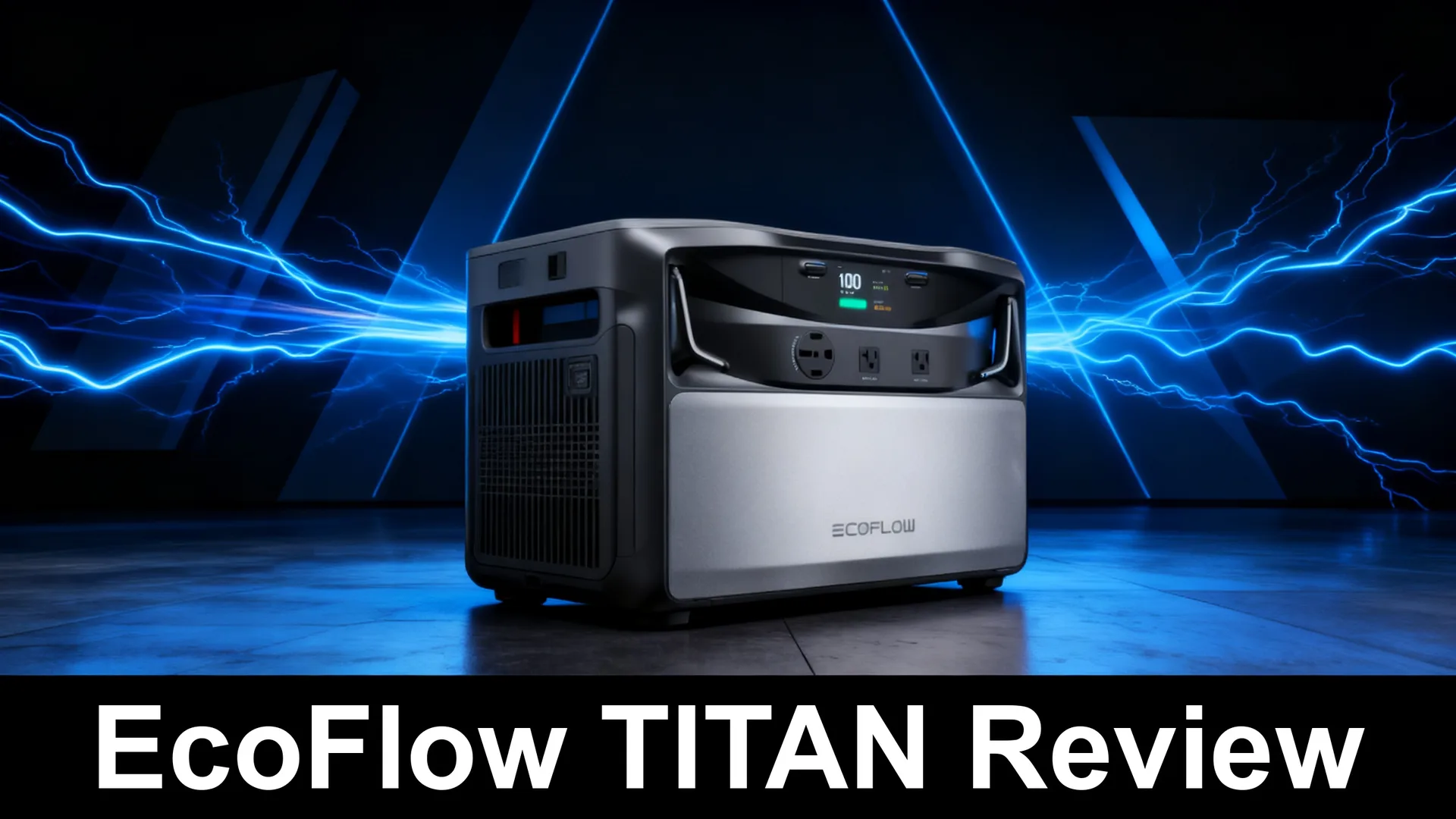
The EcoFlow TITAN series is EcoFlow’s attempt to close that gap. Announced on October 13, 2026, it comes in three models, the TITAN 5000 Plus, TITAN 5000 and TITAN 5000 Classic, all built around the same 5kWh LFP battery that expands to 30kWh. It joins the EcoFlow home backup options as a cheaper way into whole-home power than the DELTA Pro Ultra.
One thing to know up front: the TITAN is not a portable power station. It is a floor-standing home battery of roughly 100 to 120 lb, with no wheels and an IP20 rating, so it belongs indoors. It has outlets on the front, but it is designed to feed your home through EcoFlow’s Smart Home Panel 10.
A note on method: orders open on November 3, 2026, so no owner data exists yet. This is a spec-based analysis: every figure comes from EcoFlow’s published specifications, attributed as such, or from our own math, which we show.

Get our Black Friday alerts for EcoFlow
We track live prices on 40+ models from Jackery, EcoFlow, BLUETTI and Anker SOLIX. When a deal beats the lowest price we've recorded, you'll hear from us. During Black Friday week, one short recap a day at most.
Unsubscribe in one click. We may earn a commission when you buy through our links, at no extra cost to you. Privacy Policy
Quick Verdict
- TITAN 5000 Plus: the one to get if you have central air or rooftop solar. It pairs 7.2kW of 120/240V power with 8kW of solar input and up to 10kW of output in the sun.
- TITAN 5000: the same 7.2kW and 240V for less money, with half the solar input (4kW).
- TITAN 5000 Classic: 120V only and 4kW. It runs the essentials, but no central AC, well pump or electric water heater on 240V.
EcoFlow TITAN 5000 Plus: BPH Rating
8.5/10
“Whole-home power at a portable-station price, if you can install it”
Capacity & expansion 9.0
Power output 9.2
Solar 9.5
Ease of installation 7.0
Value (launch price) 8.5
Flexibility 7.5
Spec-based rating, updated when owner data becomes available.
The Three TITAN Models Compared
All three share the same 5kWh battery (5,017.6Wh), the same 24.5 × 13.2 × 16.9 in cabinet and the same 30kWh ceiling. They differ in power, voltage, solar input and outlets.
| Spec | TITAN 5000 Plus | TITAN 5000 | TITAN 5000 Classic |
|---|---|---|---|
| Capacity | 5kWh, up to 30kWh | 5kWh, up to 30kWh | 5kWh, up to 30kWh |
| Rated output | 7,200W (10,000W with solar) | 7,200W | 4,000W |
| Voltage | 120V/240V split-phase | 120V/240V split-phase | 120V only |
| AC outlets | 2 × NEMA 5-20R, 1 × L14-50R | 3 × NEMA 5-20R, 1 × L14-30R | 3 × NEMA 5-20R, 1 × TT-30R |
| USB | None | USB-C 60W, USB-A 18W | USB-C 60W, USB-A 18W |
| Solar input | 8,000W (2 × 4,000W, 40-450V) | 4,000W (1 input, 40-450V) | 3,200W (1 input, 30-250V) |
| Max AC input | 7,660W | 7,200W | 4,000W |
| Home panel | Smart Home Panel 10 (240V) | Smart Home Panel 10 (240V) | Smart Home Panel 10 (120V) |
| Weight | 121.3 lb | 119.0 lb | About 103 to 110 lb |
| EcoFlow launch price | From $3,699 | From $3,199 | From $2,499 |
Launch prices as listed by EcoFlow on October 14, 2026, before orders open. EcoFlow gives two different weights for the Classic (102.5 lb in its spec sheet, 110.2 lb in its comparison chart).

TITAN 5000 Plus: The Full Package
The Plus is the flagship. It is the only model with 8kW of solar input, split across two inputs of 4kW each, and the only one that can boost output to 10kW when solar is feeding it. EcoFlow’s “X-Boost 2.0” also lets it deliver up to 5kW on either 120V line, which helps when several large 120V appliances run at once.
It swaps the L14-30R for an L14-50R 240V outlet and drops the USB ports. That last detail says a lot: this is a home battery first, not a station you plug a phone into.
TITAN 5000: Same Power, Half the Solar
The TITAN 5000 keeps the 7.2kW of 120/240V output but takes 4kW of solar on a single input. For a home without a large solar array, that is often enough, and it costs less at launch prices.
TITAN 5000 Classic: 120V Only

The TITAN 5000 Classic is a different product in practice. It outputs 120V only, at 4,000W, with 3,200W of solar input. EcoFlow itself warns that it cannot run 240V appliances such as central AC or an electric water heater.
It still holds 5kWh and grows to 30kWh, and EcoFlow quotes “1 day to 1 week” of essential backup depending on capacity. For a fridge, lights, internet, a microwave and a CPAP, that is a lot of battery for the money.
Pick a TITAN if you…
- want whole-home backup through your breaker panel, central AC included (5000 Plus or 5000)
- have or plan rooftop solar and want to use more of it (5000 Plus)
- want to start at 5kWh and grow to 30kWh
- have indoor space near your panel and an electrician lined up
Look elsewhere if you…
- need something portable for camping, an RV or moving between rooms
- need power before November 3, 2026
- have no indoor spot for a 120 lb unit, or no electrician
- only want to run a few appliances from extension cords
Get our Black Friday alerts for EcoFlow
We track live prices on 40+ models from Jackery, EcoFlow, BLUETTI and Anker SOLIX. When a deal beats the lowest price we've recorded, you'll hear from us. During Black Friday week, one short recap a day at most.
Unsubscribe in one click. We may earn a commission when you buy through our links, at no extra cost to you. Privacy Policy
What Stands Out
5kWh per Unit, 30kWh per System
Each TITAN holds 5,017.6Wh of LFP battery. Up to five TITAN 5kWh Batteries (82.7 lb each) stack on, for 30kWh in total. That covers anything from one night of essentials to several days of a whole house, as long as you size it right.
7.2kW of Split-Phase Power, 10kW With Solar
The Plus and the 5000 deliver 7,200W at 120/240V. According to EcoFlow, that is enough to run a 3-ton central AC, a refrigerator and the rest of the house at once, without a soft starter. The Plus can reach 10,000W when solar and battery combine.
These are EcoFlow’s claims and depend on your actual loads. Check your AC’s running and starting watts before counting on it.
Rooftop-Grade Solar Input
The Plus accepts 8kW of solar through two inputs rated 40-450V and 16A each, which is in the range of a small rooftop array, not just a few portable panels. With an existing grid-tied solar system, the TITAN can also work alongside it through the Smart Home Panel 10 and a CT sensor, without exporting to the grid.

UL 9540 and UL 9540A
EcoFlow lists the TITAN as UL 9540 certified and tested to UL 9540A. The UL 9540A fire test method checks how a thermal runaway in one cell spreads to the others, which matters for a battery that will live inside your home.
What Could Be Better
It Is Not Portable
At about 103 to 121 lb with no wheels, the TITAN stays where it is installed. Its IP20 rating means indoors only, away from moisture. If you want one battery for home outages and weekend trips, a wheeled unit such as the Anker SOLIX S5000 fits better.
Whole-Home Backup Needs the Panel and an Electrician
To feed your circuits, the TITAN works with the Smart Home Panel 10: a wall-mounted panel with 10 circuits, a built-in CT sensor and a switchover of 20 ms or less. A licensed electrician has to wire it in. EcoFlow promises a 7-business-day installation once permits are approved, but its own pages still say the installation service is “coming soon.”
The Savings Claims Need Context
EcoFlow advertises yearly savings in the thousands of dollars. Those figures depend on time-of-use rates and solar production that EcoFlow does not spell out. On a flat electricity rate, a home battery saves little; we ran the numbers in what a home battery does for your electric bill. Buy the TITAN for backup first.
No Charging Below 32°F
EcoFlow rates charging from 32°F to 113°F and discharging from 14°F. Since the TITAN lives indoors, this rarely matters, but it rules out an unheated garage in cold climates.
Prices and Delivery Are Not Final Yet
On October 14, 2026, EcoFlow listed “from” launch prices but no final checkout price, and orders only open on November 3. Some spec details also differ between EcoFlow’s own pages, such as the Classic’s weight and noise level. We will update this review once the TITAN ships.
Solar Charging: How Fast Can It Refill?
Real panels rarely deliver their full rating, so we use 70% of nameplate for typical conditions and count hours of full sun, not daylight.
With expansion batteries, multiply by the number of 5kWh units. Before wiring panels in series, add up their open-circuit voltage (Voc): the string must stay under 450V on the Plus and the 5000, and under 250V on the Classic.
Runtime Estimates: What 5kWh Actually Powers
These are calculated estimates for one 5kWh unit, with a 0.85 factor for conversion losses. Add the same again for each expansion battery.
Refrigerator
~28 h
150W average draw
Chest freezer
~53 h
80W average draw
CPAP, no humidifier
~76 h
56W (ResMed figure)
Router + modem
~213 h
20W
Sump pump, 1/2 HP
~7 h
600W while running
Window AC, 10,000 BTU
~4.5 h
900W while running
Well pump, 2 HP, 240V
~3 h
1,500W of pump run time
Central AC, 3-ton
~1 h
about 3,500W while running
That last line matters. A 3-ton central AC can drain a single 5kWh unit in about an hour of compressor time. “Whole-home” in the summer means more batteries, solar, or a thermostat set a few degrees higher. Appliances cycle on and off, so real runtimes are usually longer than these figures. To run your own list, use our power station runtime calculator.
Expansion and Installation

A TITAN system has up to three parts: the TITAN unit (5kWh), up to five TITAN 5kWh Batteries, and the Smart Home Panel 10. The panel comes in a 240V version for the Plus and the 5000, and a 120V version for the Classic.
You can also run appliances straight from the TITAN’s outlets, following EcoFlow’s setup guide, but whole-home backup goes through the panel. Have a licensed electrician install the Smart Home Panel 10, and never backfeed a house through a wall outlet. Our transfer switch installation guide explains what the job involves.

How It Compares
The TITAN is not on sale yet, so the live prices below cover the closest alternatives you can buy today.
Rated output (W)
EcoFlow TITAN 5000 Plus: 7,200 (10,000 with solar)
EcoFlow DELTA Pro Ultra: 7,200
Anker SOLIX S5000: 4,500
Max solar input (W)
EcoFlow TITAN 5000 Plus: 8,000
EcoFlow DELTA Pro Ultra: 5,600
Anker SOLIX S5000: 3,000
| Model | Capacity / output | Price now | Per kWh | Lowest tracked | Link |
|---|---|---|---|---|---|
 Anker SOLIXS5000 | 5,024Wh · 4,500W | $3,599.99 | $717 | Tracking since Sep 26 | Check deal |
 EcoFlowDELTA Pro Ultra | 6,144Wh · 7,200W | $4,199 | $683 | $3,989 (Oct 8) | Check deal |
 JackeryExplorer 5000 Plus | 5,040Wh · 7,200W | $3,499 | $694 | $2,899 (Oct 8) | Check deal |
Prices come from each brand's US store and refresh automatically every few hours (oldest check on this table: Oct 15, 4:59 AM ET). Sale prices can change within the hour; the price in your cart is the one that counts. Prices, not coupon codes: some stores stack extra member or sign-up discounts at checkout.
TITAN 5000 Plus vs Anker SOLIX S5000
Both start at 5kWh and grow to 30kWh. The TITAN 5000 Plus brings much more power (7,200W against 4,500W) and almost three times the solar input (8,000W against 3,000W). The Anker SOLIX S5000 answers with portability: 97 lb on wheels, ready to roll from the garage to the kitchen.
The S5000 is on sale now at $3,599.99, while EcoFlow lists the TITAN 5000 Plus from $3,699 at launch. Pick the TITAN for a fixed whole-home install, the S5000 for flexible backup without an installer.
TITAN vs EcoFlow DELTA Pro Ultra
The EcoFlow DELTA Pro Ultra is EcoFlow’s bigger modular system: 6,144Wh per battery, 7,200W per inverter, and up to 90kWh with three inverters and the Smart Home Panel 2. It scales further than the TITAN.
The TITAN’s advantage is the entry price: at EcoFlow’s launch list prices, it gets you to whole-home 240V backup for less, with more solar input per unit on the Plus.
TITAN vs Anker SOLIX E10
The Anker SOLIX E10 is the closest rival in spirit: a modular whole-home system wired into the panel. Both target the same buyer. Once the TITAN ships, we will compare them figure by figure.
Who Should Buy the TITAN
Homes With Central AC and Rooftop Solar
The TITAN 5000 Plus is built for this case: 7.2kW for the AC and the house, 8kW of solar input to refill during the day, and up to 10kW when the sun is out.
Homes That Need 240V on a Tighter Budget
The TITAN 5000 keeps the 240V output and the 7.2kW for a well pump, a dryer or a central AC, at a lower launch price, if 4kW of solar is enough.
Smaller 120V Homes
The TITAN 5000 Classic fits a home with no critical 240V loads: fridge, freezer, lights, internet, a microwave and medical devices, with room to add batteries later.
Who Should Skip It
Anyone Who Needs Portability
For camping, an RV or moving power between rooms, a wheeled power station such as the S5000 or the DELTA Pro 3 makes more sense.
Buyers Who Need Power Now
Orders open on November 3, 2026. If an outage is coming sooner, look at stations that ship today.
Homes Without Space or an Electrician
The TITAN needs a dry indoor spot near the panel and a licensed installer to deliver whole-home backup. Without both, you get an expensive set of outlets.
Price, Launch Offer and Availability
On October 14, 2026, EcoFlow listed launch prices from $3,699 (TITAN 5000 Plus), $3,199 (TITAN 5000) and $2,499 (TITAN 5000 Classic). Orders open on November 3, 2026 on EcoFlow’s TITAN launch page.
Until November 2, EcoFlow sells a $50 TITAN coupon. According to EcoFlow’s terms, it gives 5% off a TITAN unit or bundle and two free 220W solar panels (valued at $798) on an order placed between November 3 and December 31, 2026. The coupon is not a deposit and does not count toward the price. EcoFlow also takes $300 off its Smart Home Panel 10 installation service over the same period.
Every TITAN carries a 5-year warranty, as do the expansion battery and the Smart Home Panel 10. We will update this section with final prices once orders open.
Frequently Asked Questions
When can I buy the EcoFlow TITAN?
EcoFlow opens TITAN orders on November 3, 2026. Until November 2, it sells a $50 coupon that gives 5% off and two free 220W solar panels on an order placed between November 3 and December 31, 2026.
What is the difference between the TITAN 5000 Plus, 5000 and Classic?
All three hold 5kWh and expand to 30kWh. The 5000 Plus and the 5000 deliver 7,200W at 120/240V, with 8kW and 4kW of solar input respectively. The Classic delivers 4,000W at 120V only, with 3.2kW of solar input.
Can the EcoFlow TITAN run central air conditioning?
EcoFlow says the TITAN 5000 Plus and 5000 can run a 3-ton central AC without a soft starter. By our estimate, a 3-ton unit uses one 5kWh battery in about an hour of compressor time, so plan extra batteries or solar. The 120V Classic cannot run central AC.
Is the EcoFlow TITAN portable?
No. Each TITAN weighs about 103 to 121 lb, has no wheels and carries an IP20 rating, so it is designed to stay indoors, usually near your breaker panel.
Does the TITAN work with existing rooftop solar?
Yes, through the Smart Home Panel 10 and a CT sensor, according to EcoFlow. In that setup, the TITAN stores and uses your solar power without exporting it to the grid.
What warranty does the EcoFlow TITAN have?
Five years, for the TITAN unit, the 5kWh expansion battery and the Smart Home Panel 10.
Final Verdict
The EcoFlow TITAN brings whole-home, 240V battery backup down to the price of a large portable station, with 5kWh per unit, 30kWh of headroom and, on the 5000 Plus, rooftop-grade solar input. Its trade-offs are clear: it stays in one place, it needs an electrician to reach its full potential, and its prices are not final yet.
For a homeowner planning a fixed backup system, especially with solar, the TITAN 5000 Plus looks like one of the strongest values announced this year. Our rating: 8.5/10, based on EcoFlow’s published specifications. We will revisit it once orders open on November 3.
Related Guides
Originally published: October 14, 2026