
Shopping for a portable power station in 2026? You’re facing over 50 models from a dozen brands, each claiming to be the “best.” Some cost $200, others push $4,000. Capacity ranges from 268Wh to 3,840Wh. Output spans 300W to 6,000W.
How do you actually choose the best portable power station for your needs?
We’ve spent the last six months analyzing the portable power station market—comparing specs, studying thousands of verified user reviews, and evaluating real-world performance data. We looked at capacity, output, battery technology, charging speeds, build quality, and long-term value across every major model available in 2026.
This guide covers everyone from weekend campers needing basic phone charging to off-grid homesteaders running entire cabins. We’ve ranked the top 10 portable power stations and explained exactly who each one serves best.
🏆 Spoiler Alert: The Jackery Explorer 1000 v2 takes our #1 spot at $559 for balancing capacity, output, features, and warranty better than anything else in the mid-range category. But if you’re running an RV or need whole-home backup, keep reading. For a closer look at that mid-range battle, see our mid-range station comparison.


How We Ranked These Power Stations
Portable power stations aren’t simple products. A $300 unit might suit weekend camping perfectly while being useless for home backup. A $4,000 behemoth could power your entire RV but feels ridiculous for charging phones at the beach.
Here’s how we evaluated and ranked these models.
Capacity & Runtime Analysis
Capacity determines how long your devices run. We calculated runtimes for common appliances across different capacity levels—60W mini-fridges, 100W CPAP machines, 45W laptops, 15W phone chargers.
The math is straightforward: a 1,000Wh power station theoretically runs a 100W device for 10 hours. Reality hits different. Inverter efficiency typically wastes 10-15% of stored energy. Battery cutoffs prevent full discharge to preserve lifespan. That 1,000Wh station actually delivers 850-900Wh of usable power.
Build Quality & Durability Standards
We evaluated IP ratings for weather resistance, handle stress capacity, port durability under repeated connections, and drop tolerance. LiFePO4 batteries automatically scored higher than standard lithium-ion for inherent safety and thermal stability.
Charging Speed Evaluation
Dead power station, no power. Charging speed matters enormously for daily use or multi-day trips. We compared wall charging times, solar efficiency with different panel wattages, and car charging viability.
Power Output Performance
Continuous output determines what you can actually run. Surge capacity handles startup loads for motors and compressors. We verified pure sine wave output across all recommendations—necessary for sensitive electronics.
Features & User Experience
We evaluated app functionality, display readability in direct sunlight, button responsiveness, port accessibility, and noise levels. Models with intuitive interfaces, bright LCD screens showing accurate battery percentages, and near-silent operation scored well.
Value Analysis
Price per watt-hour reveals true value. Battery cycle life determines long-term cost. Standard lithium-ion batteries rated for 500 cycles last about 18 months with daily use. LiFePO4 batteries rated 3,000+ cycles last 8-10 years—higher upfront cost, lower lifetime cost.
💎 Power Station Ranking Pyramid
🏆 #1 – Jackery Explorer 1000 v2 – Best Overall
Capacity: 1,070Wh | Output: 1,500W (3,000W surge)
Battery: LiFePO4, 4,000 cycles to 70% | Charge: 1 hour AC (Emergency Super Charge)
Weight: ~23.8 lbs | Warranty: 5 years (3 + 2 at jackery.com)
Price: $559
The Explorer 1000 v2 sits in the sweet spot most people actually need. Not the biggest, not the most powerful, not the cheapest—just the best balance of features, performance, and value for typical use cases.
What Makes It Stand Out
That 1-hour fast charging capability changes everything for daily use. Most power stations in the $700-900 range take 6-8 hours to fully recharge. The 1000 v2 goes 0-100% in 60 minutes via wall outlet with Emergency Super Charge turned on in the Jackery app. For van lifers stopping at cafes or RV parks, this means rapid turnarounds between driving days.
The 1,500W output outperforms most competitors in this price bracket. Standard $800 power stations max out at 1,000W continuous. That extra 500W opens up microwaves, coffee makers, and small space heaters—appliances that 1,000W units simply can’t handle.
Jackery’s ChargeShield 2.0 system includes 62 protection mechanisms against overcharging, overheating, short circuits, and voltage irregularities. That 5-year warranty doubles the industry standard 2-3 years, and the LiFePO4 cells are rated for 4,000 cycles to 70% capacity.
✅ Best for: Weekend campers, van lifers with modest needs, home backup essentials, first-timers wanting proven quality
❌ Skip if: Need 2,000W+, want expandability, budget under $559
🔥 Best Overall Winner
Why we recommend it: Perfect balance of 1,070Wh capacity, 1,500W output, 1-hour fast charging, and industry-leading 5-year warranty at competitive $559 price point.
$559 | Free shipping | 5-year warranty
Get our Black Friday alerts for power stations
We track live prices on 40+ models from Jackery, EcoFlow, BLUETTI and Anker SOLIX. When a deal beats the lowest price we've recorded, you'll hear from us. During Black Friday week, one short recap a day at most.
Unsubscribe in one click. We may earn a commission when you buy through our links, at no extra cost to you. Privacy Policy
⚡ #2 – Anker SOLIX F3800 Plus – Best Premium
Capacity: 3,840Wh (expandable to 26.9kWh, 53.8kWh with two units) | Output: 6,000W
Battery: LiFePO4, 3,000 cycles | Weight: 136.7 lbs
Warranty: 5 years (10-year rated lifespan)
Price: $2,999.99
The F3800 Plus plays in a completely different league. It replaced the original F3800, which Anker no longer sells in the US. This isn’t a “portable” power station you toss in your trunk for camping. This is a whole-home backup system that happens to have a handle.
Why It Dominates Premium Territory
That 6,000W output running on 120V/240V dual voltage means you’re powering actual home circuits, not just extension cords. RV air conditioners (1,800W), induction cooktops (1,500W), microwaves (1,200W), plus laptops and lights—all simultaneously without overload shutdown.
The expandability architecture separates this from oversized competitors. Start with 3,840Wh base capacity and add up to six BP3800 expansion batteries for 26,880Wh per unit, or link two units for up to 53.8kWh. That’s not a portable power station anymore—that’s a legitimate off-grid power system.
Anker’s InfiniPower™ technology and LiFePO4 chemistry deliver a 10-year lifespan with 3,000 charge cycles maintaining 80%+ capacity. Over a decade of daily use justifies the $2,999.99 price when you calculate cost-per-year.
✅ Best for: Full-time RV living, off-grid homesteaders, whole-home backup 2-3 days, 10-year investment justification
❌ Skip if: Need actual portability (136.7 lbs), power needs under 1,500W, $2,999.99 breaks budget, first-time experimenting
💎 Premium Powerhouse
Why we recommend it: Unmatched 6,000W output, expandable to 26.9kWh per unit, 120V/240V dual voltage, 5-year warranty, perfect for whole-home backup and off-grid living. Our Anker SOLIX F3800 review covers the original model, which shares the Plus’s 3,840Wh battery and 6,000W rating.
$2,999.99 | Free shipping | 5-year warranty


💰 #3 – Bluetti AC180 – Best Value
Capacity: 1,152Wh | Output: 1,800W (2,700W Power Lifting)
Battery: LiFePO4, 3,500 cycles | Charge: 45 min (0-80%)
Weight: 35 lbs | Warranty: 4 years
Price: $549
The AC180 delivers LiFePO4 battery technology at a price point where competitors still use standard lithium-ion. That alone makes it remarkable value.
Why This Represents Best Value
LiFePO4 batteries under $1,000 were impossible until recently. Those 3,500 rated cycles translate to 9.5 years of daily use before hitting 80% capacity retention. Standard lithium-ion batteries at this price point die after 2-3 years.
The 45-minute fast charging from 0-80% rivals much more expensive units. That 1,800W continuous output handles microwaves, space heaters, and power tools without breaking a sweat. Bluetti’s Power Lifting mode pushes certain resistive loads to 2,700W.
✅ Best for: Budget-conscious wanting longevity, daily users maximizing value, fast-charging priority
❌ Skip if: Need minimum weight, want expandability, need more than 1,800W, loyal to Jackery/Anker
🏆 Best Value Champion
Why we recommend it: LiFePO4 longevity (3,500 cycles = 9.5 years), 1,800W output, 45-min fast charging, unbeatable value at current price.
$549 | Free shipping | 4-year warranty
#4 – Anker SOLIX C1000 – Mid-Range Sweet Spot

Capacity: 1,056Wh | Output: 1,800W continuous
Battery: LiFePO4, 3,000 cycles
Weight: ~30 lbs | Warranty: 5 years
Price: $499.99
Looking for more options? See our best power stations for camping.
The SOLIX C1000 bridges the gap between budget options and the premium F3800 Plus. Anker’s engineering expertise shows in the refined details—the app actually works reliably, the display remains readable in direct sunlight, and the build quality feels premium without the premium price tag.
Why It Stands Out in Mid-Range
That 1,056Wh LiFePO4 capacity at $499.99 positions this directly against the Bluetti AC180, with one key advantage: Anker’s ecosystem integration. If you already own Anker solar panels or plan to expand your system, the C1000 connects seamlessly through their app for unified monitoring.
The 1,800W continuous output handles the same appliances as the AC180—microwaves, space heaters, power tools—but Anker’s inverter technology delivers cleaner power with less voltage fluctuation under heavy loads. For sensitive electronics like CPAP machines or medical devices, that stability matters.
Anker’s customer service consistently outperforms competitors in response time and warranty claim processing. The 5-year warranty matches Jackery and exceeds most competitors. When something goes wrong at 2 AM during a power outage, knowing you can actually reach support matters more than spec sheets suggest.
The weight sits around 30 pounds—heavier than the Jackery 1000 v2 but lighter than the AC180’s 35 pounds. That 5-pound difference feels negligible on paper but significant when carrying up basement stairs during an outage.
✅ Best for: Anker ecosystem users, buyers prioritizing customer service, reliable app control needs
❌ Skip if: AC180’s current price ($549) offers better raw value, need absolute lightest weight
🔷 Mid-Range Excellence
Why we recommend it: Perfect balance of 1,056Wh LiFePO4 capacity, 1,800W output, Anker’s superior app integration, and industry-leading customer service at competitive $499.99 price.
$499.99 | Free shipping | 5-year warranty
#5 – EcoFlow DELTA 3 Max – Best for Power Outages

Capacity: 2,048Wh | Output: 2,400W (4,800W surge, 3,400W X-Boost)
Battery: LiFePO4 | UPS: under 10 ms switchover
Weight: 44.8 lbs | Charge: 0-80% in 68 min (1,800W AC input)
Price: $854 $1,199 SALE
The EcoFlow DELTA 3 Max is the 2kWh pick for people who buy a power station mainly for blackouts. It has twice the capacity of the 1kWh units above it, and EcoFlow rates its switchover at under 10 ms. A fridge, a router or a CPAP keeps running when the grid drops.
Why It Leads the 2kWh Class for Outages
It shares the 2kWh class with the BLUETTI AC200L (#8) and the Jackery Explorer 2000 v2 (#9), at a similar price. The difference is surge. The DELTA 3 Max handles 4,800W of surge for motor startups, and its X-Boost mode runs resistive loads such as coffee makers up to 3,400W.
It also refills fast. The 1,800W wall input takes it from 0 to 80% in 68 minutes. In the EcoFlow app, Storm Guard watches severe weather alerts and starts charging the unit before the storm arrives.
It stays quiet under load. EcoFlow rates it at 25 dB or less at 600W, so it can sit in a bedroom overnight.
Know the limits before you buy. Solar input tops out at 500W, half of what the smaller DELTA 3 Plus accepts. It does not take extra batteries. The warranty is 3 years, plus 2 more years when you register the unit in the EcoFlow app.
✅ Best for: Outage backup for a fridge, a router and medical devices, apartments and condos, buyers who want 2kWh in one box without a transfer switch
❌ Skip if: You want to add batteries later (see the AC200L at #8), need 240V output, or plan to charge mostly from solar
🏠 Outage-Ready Pick
Why we recommend it: 2,048Wh of LiFePO4 capacity, 4,800W of surge, a switchover under 10 ms, and an 80% wall recharge in 68 minutes.
$854 $1,199 | Free shipping
#6 – EcoFlow DELTA 3 Plus – Best Expandable 1kWh
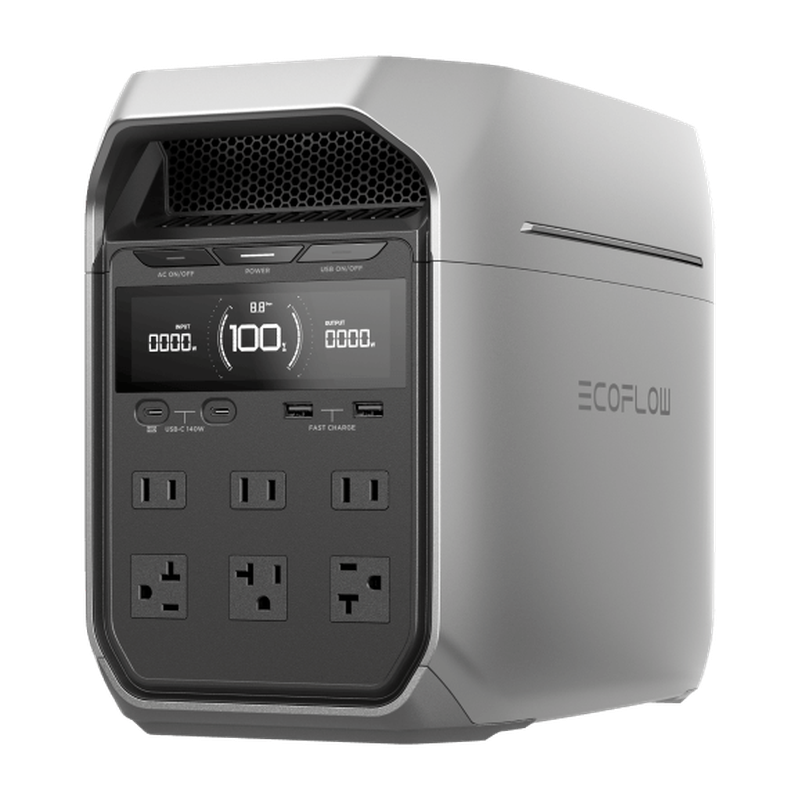
Capacity: 1,024Wh (expandable to 5kWh) | Output: 1,800W (3,600W surge)
Battery: LiFePO4, 4,000 cycles to 80% | UPS: under 10 ms
Weight: 27.6 lbs | Charge: 0-100% in 56 min (AC), 70 min (1,000W solar)
Price: $719 $799 SALE
The EcoFlow DELTA 3 Plus is the 1kWh unit that can grow with you. It starts at 1,024Wh and accepts EcoFlow extra batteries up to 5kWh in total. You can buy it for camping today and build toward home backup later.
What It Adds Over Our #3 and #4 Picks
It costs more than the AC180 and the C1000. The extra money buys three things: expansion to 5kWh, very fast charging from every source, and a UPS switchover under 10 ms for computers and network gear.
The 1,500W AC input takes it from empty to full in 56 minutes. Two solar inputs accept 500W each, for 1,000W of solar in total, which EcoFlow rates for a full charge in 70 minutes. An optional 800W Alternator Charger tops it up while you drive.
The LiFePO4 battery is rated for 4,000 cycles to 80% capacity, and the warranty runs 5 years. Under 600W it runs at about 30 dB.
✅ Best for: Buyers who want to start at 1kWh and expand later, home offices that need a UPS for computers and networking gear, overlanders with an alternator charger
❌ Skip if: You want the most capacity per dollar (the AC180 at #3), or need 2kWh from day one (the DELTA 3 Max at #5 currently costs less than a DELTA 3 Plus with an extra battery)
🔋 Grow-As-You-Go Pick
Why we recommend it: 1,024Wh of LiFePO4 that expands to 5kWh, a 56-minute wall recharge, 1,000W of solar input, and a switchover under 10 ms.
Check Current Price →Extra 5% off with code BPHUB5
$719 $799 | Free shipping
#7 – EcoFlow RIVER 2 Max 500 – Best for Weekend Camping
Capacity: 499Wh | Output: 500W (1,000W X-Boost)
Battery: LiFePO4, 3,000 cycles to 80%
Weight: 13.2 lbs | Charge: 0-100% in 1 hour (AC)
Price: $289
The EcoFlow RIVER 2 Max 500 hits the sweet spot for campers who carry their own gear: 499Wh at 13.2 pounds. One person can carry it from the car to the campsite without strain, or move it between rooms during an outage.
Why Portability Matters More Than Specs Suggest
That 499Wh capacity seems small compared to 1,000Wh+ competitors, but it matches realistic weekend camping needs. Two people running phones (30Wh daily), a laptop for work (50Wh), LED lanterns (20Wh), and a 12V cooler (80Wh) consume roughly 180Wh per day. The RIVER 2 Max 500 covers more than two days of that without solar recharging.
The 500W output won’t run microwaves or space heaters at full power, but it handles every realistic camping device: CPAP machines (40W), portable fridges (60W), laptops (65W), drone batteries (100W), and camera gear charging. Festival campers, overlanders, and car campers don’t need 1,500W output.
Charging is where it pulls ahead of older 500Wh units. It goes from 0 to 100% in about an hour on a wall outlet and accepts up to 220W of solar. You can also charge it from your car or over USB-C.
The LiFePO4 battery is rated for 3,000 cycles to 80% capacity. Weekend warriors charging the unit 30 times a year will hit maybe 90 cycles in three years, a tiny fraction of that rating. Daily van lifers need more capacity anyway.
✅ Best for: Solo campers, car campers prioritizing weight, festival-goers, weekend trips without appliances
❌ Skip if: Need multi-day power for appliances, run devices over 500W, need more than 499Wh capacity
🎒 Weekend Camping Pick
Why we recommend it: 499Wh of LiFePO4 capacity at 13.2 pounds, a one-hour wall recharge, and enough power for a full weekend of camping devices.
Check Current Price →Extra 5% off with code BPHUB5
We also put together a best value power stations worth checking out.
$289 | Free shipping
#8 – BLUETTI AC200L – Best Expandability

Capacity: 2,048Wh (expandable 8,192Wh) | Output: 2,400W
Battery: LiFePO4 | Charge: 45 min (0-80%)
Price: $899
The AC200L solves the classic power station dilemma: buy too little capacity and outgrow it within months, or buy too much and waste money on unused capability. Bluetti’s modular expansion system lets you start reasonable and scale intelligently.
Expandability That Actually Makes Sense
The base 2,048Wh capacity already exceeds most competitors in this price range. But add BLUETTI expansion batteries and you can reach up to 8,192Wh total capacity—enough to power a small cabin for days or run an RV completely off-grid.
This flexibility suits users who know they’ll need more capacity eventually but can’t afford a full 8kWh system upfront. Buy the AC200L now for $899, add a BLUETTI expansion battery next year when budget allows, and scale to full capacity over time. The alternative—buying multiple separate power stations—creates a management nightmare.
That 2,400W output handles almost any portable scenario short of running multiple high-draw appliances simultaneously. RV air conditioners (1,800W), space heaters (1,500W), power tools (1,000W), microwaves (1,200W)—the AC200L powers each individually or most in combination.
The LiFePO4 battery chemistry is built for a long service life. Compare that lifespan against buying multiple cheaper units every 2-3 years. The long-term economics favor the AC200L decisively, especially when you’re building toward 8kWh+ capacity.
Bluetti’s app integration enables monitoring across the base unit and all expansion batteries from one dashboard. The AC200L supports six charging methods, including solar, and recharges to 80% in 45 minutes.
✅ Best for: Users wanting scalable capacity, incremental investment strategy, long-term off-grid plans, RV living with growth potential
❌ Skip if: Need maximum capacity immediately, prefer all-in-one simplicity, tight budget limits future expansion purchases
📈 Scalability Master
Why we recommend it: Start at 2,048Wh, expand to 8,192Wh with BLUETTI expansion batteries, 2,400W output, LiFePO4 longevity, perfect for growing power needs over time.
$899 | Free shipping | Expandable to 8,192Wh
#9 – Jackery Explorer 2000 v2 – Heavy Appliance Champion

Capacity: 2,042Wh | Output: 2,200W continuous (4,000W surge)
Battery: LiFePO4 | Charge: ~1.7 hours AC (0-100%)
Weight: ~39.5 lbs | Warranty: 5 years (3 + 2 at jackery.com)
Price: $999
The 2000 v2 targets serious power users who actually run appliances, not just charge phones. That 2,200W continuous output transforms what’s possible with portable power—this isn’t camping gear anymore, this is legitimate home backup and RV infrastructure.
When You Actually Need 2,200W
RV air conditioners typically draw 1,500-1,800W. Space heaters pull 1,500W. Most microwaves need 1,000-1,200W. Power tools range 800-1,500W. The 2000 v2 runs each of these individually, and many simultaneously. That capability gap between 1,500W and 2,200W stations determines whether your power station is useful or decorative during real emergencies.
For a different angle, browse our best budget power stations under $500.
The 2,042Wh LiFePO4 capacity delivers roughly 1,800Wh usable after inverter losses. A 1,500W space heater runs 1.2 hours. A full-size refrigerator (150W average) runs 12 hours. CPAP users get 18+ nights. These aren’t theoretical calculations—this is what 2kWh actually delivers in practice.
Jackery’s decision to use LiFePO4 chemistry in the 2000 v2 shows they’re targeting long-term users. It also runs quietly, under 30 dB, and a wall outlet takes it from 0 to 100% in about 1.7 hours. The 5-year warranty (3 years standard + 2 years when bought from Jackery’s website) backs that longevity promise.
The USB-C ports enable fast charging laptops and tablets without occupying precious AC outlets. When you’re running a refrigerator and space heater, those USB ports become critical for maintaining devices without overloading the system.
At about 39.5 pounds, this isn’t portable in the “throw it in a backpack” sense. For stationary RV use or home backup, the weight matters less than the capability it delivers.
✅ Best for: RV users running air conditioning, job site power needs, heavy-duty backup applications, serious appliance support
❌ Skip if: Power needs max out under 1,500W, need expandable capacity, don’t want 39.5-pound weight, budget limited to under $999
⚡ Heavy-Duty Powerhouse
Why we recommend it: Serious 2,200W output for RVs and heavy appliances, 2,042Wh LiFePO4 capacity, Jackery reliability, and a full wall recharge in about 1.7 hours at a competitive $999.
$999 | Free shipping | 5-year warranty
#10 – Jackery Explorer 300 – Ultra-Budget Entry

Capacity: 293Wh | Output: 300W (500W surge)
Battery: Li-NMC, 500 cycles
Weight: 7.1 lbs | Warranty: 3 years (2+1 extended)
Price: $289
The Explorer 300 offers bare-minimum backup at absolute minimum price. That 293Wh capacity powers phones, tablets, laptops, and LED lights for a weekend—nothing more, nothing less. This isn’t false advertising; it’s honest positioning for ultra-budget buyers.
When Minimal Is Exactly What You Need
The math is straightforward: phone charging (15Wh × 3 devices × 2 charges daily = 90Wh), laptop work (50Wh × 3 hours = 150Wh), LED lantern (5Wh × 6 hours = 30Wh). Total: 270Wh daily. The 293Wh capacity delivers exactly one full day of basic device charging—perfect for weekend camping trips where you drive home Sunday afternoon.
The 7.1-pound weight makes this genuinely packable for backpacking or bike touring. Ultralight backpackers who still want device charging can justify the weight penalty because it replaces multiple battery banks and cables. At 7 pounds, the 300 weighs less than many camera kits.
The 300W continuous output (500W surge) handles laptops (65W), small fans (30W), 12V devices (varies), and LED lights (5-10W). It won’t run mini-fridges, CPAP machines over 50W, or anything requiring sustained power above 300W. Know the limitations before buying.
Jackery’s build quality shows even in this budget model. The handle ergonomics, button tactility, and LCD display match their premium units. After 500 cycles at weekend usage (25 charges annually), this unit lasts 20 years before hitting the cycle limit—though calendar aging will degrade it in 5-7 years regardless.
The 3-year warranty (2 years standard + 1 year automatic extension) covers the realistic lifespan for occasional users. This isn’t designed for daily off-grid living; it’s designed for weekend warriors who camp six times annually.
✅ Best for: Absolute budget buyers ($289), ultralight backpackers accepting weight, festival-goers needing basic charging, emergency phone power only
❌ Skip if: Need appliance support, multi-day power required, daily use planned, run devices over 300W
💵 Ultra-Budget Option
Why we recommend it: Honest 293Wh capacity for weekend basics, ultralight 7.1 pounds, Jackery quality at minimum price, perfect for basic device charging only.
$289 | Free shipping | 3-year warranty
Side-by-Side Mega Comparison
Here’s every spec that matters across all 10 models:
📊 Capacity vs Price: Value Leaders
Lower $/Wh = Better value | F3800 Plus’s premium justified by 6,000W output + 10yr warranty
Buying Guide: How to Actually Choose
Specs and rankings mean nothing if you buy the wrong capacity for your needs. Here’s how to match power stations to real-world applications.
Capacity Sizing: The Critical Formula
Capacity determines runtime. Use this formula:
Device wattage × Hours needed × 1.3 = Minimum capacity required
That 1.3 multiplier accounts for inverter losses (10-15%) and battery protection cutoffs.
Weekend camping example:
- Mini-fridge (60W × 24 hours) = 1,440Wh
- Phone charging (15W × 4 hours) = 60Wh
- LED lanterns (10W × 6 hours) = 60Wh
- Total: 1,560Wh × 1.3 = 2,028Wh needed
General capacity guidelines:
- 500-1,000Wh: Weekend camping with minimal appliances
- 1,000-2,000Wh: Van life, extended camping, light RV use
- 1,500-3,000Wh: Home backup for essentials during outages
- 3,000Wh+: Off-grid living, full RV appliances, whole-home backup
Output Wattage: What Can You Actually Run?
Output requirement ranges:
- 300-500W: Phones, laptops, CPAP, LED lights, 12V coolers
- 500-1,000W: Mini-fridges, TVs, small fans, laptop charging
- 1,000-1,500W: Microwaves, coffee makers, monitors, medical devices
- 1,500-2,200W: Space heaters, power tools, induction cooktops
- 2,200W+: RV air conditioning, well pumps, multiple simultaneous appliances
Battery Type: Lithium-Ion vs LiFePO4
Standard Lithium-Ion (Li-NMC): Lighter weight, lower cost ($200-500 less), 500-1,000 cycles (2-3 years daily use)
LiFePO4 (Lithium Iron Phosphate): 3,000-6,000 cycles (8-15 years daily use), superior thermal stability and safety, heavier (20-30% more), $200-500 premium
💡 The math: A $700 Li-NMC unit lasting 3 years costs $233/year. A $900 LiFePO4 unit lasting 10 years costs $90/year. LiFePO4 delivers 60% lower annual cost despite higher initial price.
⏳ Lifecycle Cost Comparison: Li-ion vs LiFePO4
💰 LiFePO4 saves 60% annually despite higher upfront cost!
Frequently Asked Questions
What size portable power station do I actually need?
Calculate your highest-draw appliance wattage and multiply by hours of use, then add 30% for inefficiency overhead. A 60W mini-fridge running 24 hours needs (60W × 24 × 1.3) = 1,872Wh minimum capacity. Most people overestimate needs—a 1,000-1,500Wh station covers 80% of camping and backup scenarios.
Are expensive power stations actually worth the cost?
Cost per watt-hour determines value, not absolute price. Factor in battery cycle life. LiFePO4 batteries lasting 3,000 cycles cost less annually than lithium-ion batteries lasting 500 cycles, even with higher upfront pricing. Expensive units also include faster charging, higher output, better warranties, and superior build quality.
Can I safely use a power station indoors during an outage?
Yes—portable power stations produce zero emissions, unlike gas generators. They’re specifically designed for indoor use. Ensure adequate ventilation around the unit (6-12 inches clearance) for heat dissipation. Power stations are exponentially safer indoors than generators, which produce lethal carbon monoxide.
Which brand is most reliable in 2026?
Jackery leads in customer service and warranty support based on independent reviews. Their products rarely fail, and when issues occur, replacements ship quickly. Bluetti offers best value with aggressive pricing and advanced features. Anker provides premium build quality and a 5-year warranty on the F3800 Plus. EcoFlow stands out for charging speed and outage features: the DELTA 3 Plus and DELTA 3 Max both switch to battery in under 10 ms.
How long will a power station run a refrigerator?
Standard mini-fridge (60W continuous): 500Wh station = 7 hours, 1,000Wh station = 14 hours, 2,000Wh station = 28 hours. Full-size Energy Star refrigerator (150W average): 1,000Wh station = 6 hours, 2,000Wh station = 12 hours, 3,000Wh station = 18 hours. Real-world runtime typically hits 80-90% of theoretical maximum.
Can I charge the power station while using it?
Most modern power stations support pass-through charging—simultaneous charging and discharging. However, pass-through charging generates additional heat from combined inefficiency. Continuous pass-through use slightly accelerates battery degradation. For optimal battery longevity, avoid constant pass-through operation.
How many years will a power station actually last?
Battery cycle life determines lifespan. Standard lithium-ion: 500-1,000 cycles = 2-3 years daily use, 5-7 years occasional use. LiFePO4: 3,000-6,000 cycles = 8-15 years daily use, 20+ years occasional use. Store power stations at 50-60% charge in cool, dry locations to maximize shelf life between uses.
Can I take a power station on an airplane?
No. TSA restricts lithium batteries to 160Wh maximum for carry-on luggage. All portable power stations in this guide exceed that limit—the smallest (Jackery Explorer 300 at 293Wh) is 83% over the legal threshold. Power stations must travel by ground transportation.
Final Recommendations by Use Case
Forget rankings—here’s what actually works for specific scenarios.
🏕️ Weekend Camping
Winner: EcoFlow RIVER 2 Max 500 ($289) – The 499Wh LiFePO4 capacity covers a full weekend of phone charging, LED lanterns, 12V coolers, and laptop work. At 13.2 pounds, one person carries it from car to campsite without strain.
🚐 Full-Time Van Life
Winner: Jackery Explorer 1000 v2 ($559) – Van life requires daily reliability. The 1000 v2’s 5-year warranty and proven track record matter more than cutting-edge specs. The 1-hour fast charging enables quick top-ups during driving days.
🏠 Emergency Home Backup
Winner: Anker SOLIX F3800 Plus ($2,999.99) – The 3,840Wh base capacity (expandable to 26.9kWh per unit) handles 2-3 days of essential power. The 6,000W 120V/240V output connects to your home’s circuit panel via transfer switch for whole-home backup.
🏢 Apartment and Condo Outages
Winner: EcoFlow DELTA 3 Max ($854) – 2,048Wh in one box with no installation. The switchover under 10 ms keeps a fridge, a router and a CPAP running through a blackout, and the 1,800W wall input refills it to 80% in 68 minutes once power returns.
💵 Budget-Conscious Buyers
Winner: Bluetti AC180 (currently $549) – You’re getting 1,152Wh LiFePO4 capacity with 3,500 cycles and 1,800W output. Nine-plus years of daily use versus two years for similarly-priced lithium-ion competitors.
🌲 Off-Grid Homesteaders
Winner: Anker SOLIX F3800 Plus + expansion batteries ($2,999.99 for the base unit) – Start with the F3800 Plus base unit and add expansion batteries as budget allows. Six BP3800 batteries take one unit to 26.9kWh, and two linked units reach 53.8kWh.
Conclusion: Making Your Decision
After months analyzing over 50 power station models, the winner for most people is clear: Jackery Explorer 1000 v2 at $559.
The 1000 v2 just doesn’t screw anything up. The capacity covers weekend camping, van life, and home backup essentials. The 1,500W output handles actual appliances beyond phone charging. The 1-hour fast charging enables daily use without lengthy recharge waits. The 5-year warranty doubles industry standard.
For premium needs—whole-home backup, off-grid living, RV air conditioning—the Anker F3800 Plus at $2,999.99 justifies its cost through scalability, 6,000W output, and a 5-year warranty.
For maximum value, the Bluetti AC180 at current $549 pricing delivers LiFePO4 longevity at throwaway prices.
🎯 Quick Match Guide
⚡ Our Top 3 Picks – Ready to Buy?
Still unsure? Default to mid-range capacity (1,000-1,500Wh) in the $700-1,000 price bracket. This covers 80% of realistic use cases without buying either insufficient capacity or expensive overkill.
The portable power station market matured significantly in 2024-2025. LiFePO4 batteries now appear at every price point. Fast charging is standard. Build quality improved across brands. Choose based on your actual needs, not aspirational scenarios. Buy sufficient capability, not maximum specs.
Visit Buying Guides & Comparisons Hub →
Originally published: November 8, 2025