
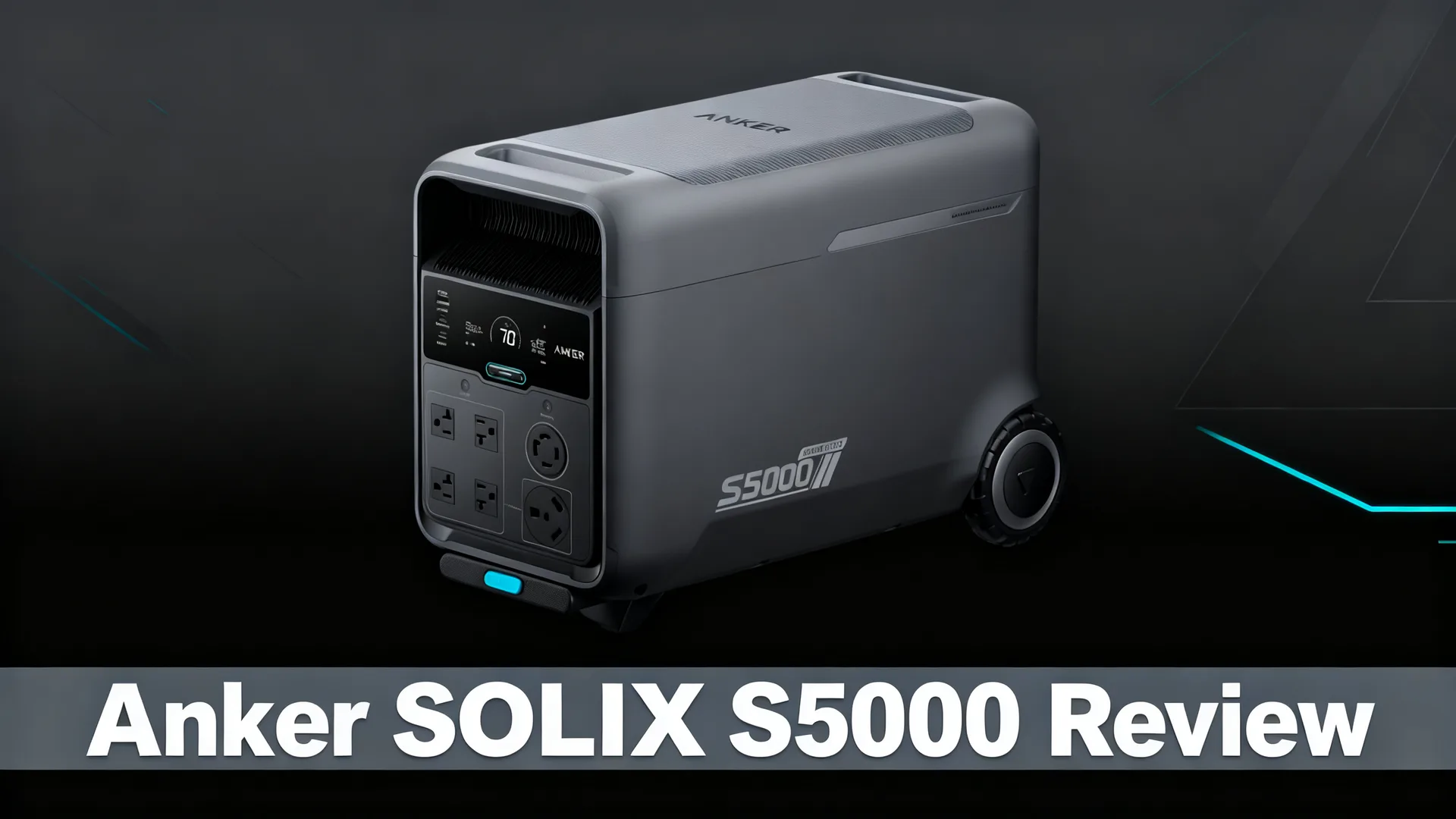
Picture a two-day outage in January. The fridge needs to stay cold, the internet needs to stay on, and the well pump runs on 240V, which rules out most portable power stations. Until now, the units that could handle all of that weighed well over 130 pounds or came as multi-box systems.
The Anker SOLIX S5000 is Anker’s answer. Announced on October 9, 2026 and on sale from October 27, it packs 5,024Wh of LFP battery and 4,500W of 120V/240V output into a 97 lb box on wheels. It sits between the F3800 and the E10 in the range of Anker SOLIX home backup options, and it is the first portable Anker with a 5kWh battery.
A note on method: this is a spec-based analysis. The S5000 ships on October 27, 2026, so no independent owner data exists yet. Every figure below comes from Anker’s published specifications, attributed as such, or from our own runtime math, which we show.
Below: the full spec sheet, what stands out and what falls short, six ways to charge it, runtime estimates, expansion to 30kWh, and how it compares with the F3800, the Jackery Explorer 5000 Plus and the EcoFlow DELTA Pro Ultra.


Anker SOLIX S5000
5,024Wh · 4,500W output · Price tracked daily since Sep 26
Ships October 27, 2026. Launch price for subscribers through November 8.
See the deal on Anker SOLIX Read our reviewGet our Black Friday alerts for Anker SOLIX
We track live prices on 40+ models from Jackery, EcoFlow, BLUETTI and Anker SOLIX. When a deal beats the lowest price we've recorded, you'll hear from us. During Black Friday week, one short recap a day at most.
Unsubscribe in one click. We may earn a commission when you buy through our links, at no extra cost to you. Privacy Policy
Quick Verdict
- The best weight-to-capacity ratio in the 5kWh class: 5,024Wh for 97 lb, against 132 to 135 lb for the F3800 and the Explorer 5000 Plus.
- The trade-off is power: 4,500W continuous is less than the F3800 (6,000W) and the Explorer 5000 Plus (7,200W), and there is no NEMA 14-50 outlet for EV charging.
- Timing matters: at its full price it costs more per watt-hour than the F3800; at the launch price it becomes one of the cheapest 5kWh setups on the market.
Anker SOLIX S5000: BPH Rating
8.6/10
“5kWh you can roll, with a power ceiling to know about”
Capacity & expansion 9.2
Power output 8.4
Charging 8.6
Portability 8.8
Value (full price) 8.0
Safety & build 9.0
Spec-based rating, updated when owner data becomes available.
Anker SOLIX S5000 Specs at a Glance
All values below come from Anker’s S5000 spec sheet, as published at launch.
| Specification | Anker SOLIX S5000 |
|---|---|
| Capacity | 5,024Wh |
| Battery cells | 314Ah LFP (LiFePO4) |
| Cycle life | 6,000 cycles to 80%, 10,000 cycles to 60% |
| AC output | 4,500W rated, 8,000W peak, 120V and 240V |
| AC outlets | 4 × NEMA 5-20R (120V), 1 × TT-30R (120V), 1 × L14-30R (240V) |
| USB | 1 × USB-A 12W, 1 × USB-C 15W, 1 × USB-C 100W |
| AC input | 1,800W at 120V, 4,500W at 240V |
| Solar input | 3,000W total: 1,000W (11-60V, 17A) + 2,000W (16-165V, 17A) |
| Generator input | 4,500W (DC generator input) |
| UPS switchover | 10 ms or less |
| Idle draw | 8.8W (120V output on), 13.7W (240V output on) |
| Expansion | Up to 5 expansion batteries, 30kWh total |
| Certification | UL 9540 and UL 9540A |
| Dimensions | 10.6 × 22.0 × 15.2 in |
| Weight | 97 lb |
| Operating temperature | Discharge -4°F to 104°F, charge 32°F to 104°F |
| Warranty | 5 years |

Get our Black Friday alerts for Anker SOLIX
We track live prices on 40+ models from Jackery, EcoFlow, BLUETTI and Anker SOLIX. When a deal beats the lowest price we've recorded, you'll hear from us. During Black Friday week, one short recap a day at most.
Unsubscribe in one click. We may earn a commission when you buy through our links, at no extra cost to you. Privacy Policy
What Stands Out
5kWh at 97 lb: Smaller and Lighter Than Its Rivals
The headline number is the weight. At 97 lb for 5,024Wh, the S5000 carries about 52Wh per pound. The F3800 stores 3,840Wh in 132.3 lb, and the Jackery Explorer 5000 Plus stores 5,040Wh in 134.5 lb. In other words, Anker matches the Jackery’s capacity while shedding about 37 lb.
Anker calls it “the smallest and lightest 5kWh power station,” based on its own comparison with mainstream 5kWh models. At 10.6 inches wide, it can sit against a wall in a utility room or a closet. Wheels, a telescoping handle and a foot pedal handle the rest, but 97 lb is still a two-person lift up stairs.

Real 240V Without an Add-On Hub
The L14-30R outlet delivers 240V directly, up to the 4,500W limit of the inverter. That covers the 240V loads Anker lists for the S5000: a 2 HP well pump, a 4,000W dryer or range, a 4,500W water heater. Many smaller stations need a hub or a second unit to reach 240V.
The TT-30R outlet is a 120V, 30-amp outlet, the standard RV plug. It lets a travel trailer or a small RV plug straight in. The four NEMA 5-20R outlets handle everyday 120V appliances.
314Ah LFP Cells Rated for 6,000 Cycles to 80%
The S5000 uses large 314Ah LFP cells, a format Anker says is used in utility-scale energy storage. Anker rates them for 6,000 cycles to 80% capacity and 10,000 cycles to 60%. For comparison, the F3800 is rated for 3,000+ cycles.
Anker also advertises a “15-year lifespan.” That estimate assumes up to 10,000 cycles at one to two cycles per day with more than 60% of capacity left. The warranty itself is 5 years, the same as the F3800.
8.8W Idle Draw and a 10 ms UPS
Idle draw is the power a station burns just by keeping its inverter on. Anker rates the S5000 at 8.8W with 120V output on, and 13.7W with 240V on. Over 24 hours, that is about 211Wh at 120V, roughly 4% of the battery. On a large station, a low idle draw adds hours of real runtime over a multi-day outage.
The UPS switchover is rated at 10 milliseconds or less, twice as fast as the F3800’s 20 ms. That should be fast enough for most computers, routers and fridges to ride through a grid failure without rebooting.
UL 9540 and UL 9540A Certification
The S5000 carries UL 9540 and UL 9540A certification. UL 9540 is the safety standard for energy storage systems. The UL 9540A fire test method checks how a thermal runaway in one cell spreads to the others. For a battery that will live inside a home, that is the certification to look for.
What Could Be Better
4,500W Is Less Than the F3800’s 6,000W
For a 5kWh station, 4,500W continuous is on the low side. The F3800 delivers 6,000W, and the Explorer 5000 Plus and DELTA Pro Ultra reach 7,200W. If you want to run a well pump, a microwave and a space heater at the same time, add up the watts before you buy.
The 8,000W peak helps with motor starts, such as a fridge compressor or a pump. A central AC, though, usually needs more continuous power than the S5000 can give.
No NEMA 14-50 Outlet for EV Charging
The F3800 has a NEMA 14-50 outlet, the plug most Level 2 EV chargers and 50-amp RVs use. The S5000 does not. Its 240V comes through an L14-30R twist-lock, which is meant for a transfer switch or an inlet box. You can still trickle-charge an EV from a 120V outlet, but a 5kWh battery adds only a modest number of miles that way.
120V Charging Tops Out at 1,800W
From a regular wall outlet, the S5000 charges at 1,800W, and Anker rates a full charge at 3.1 hours. The fast “0 to 100% in 99 minutes” figure needs Anker’s fastest input. For the wall, that means a 240V source and the 240V fast charging cable, which is sold separately (it is part of the launch bundle described below).
Too Heavy for RV or Stair Use
At 97 lb, the S5000 is light for its class but heavy in absolute terms. It is a home backup station on wheels, not a camping unit. For an RV or a campsite, a 2kWh or 3kWh unit such as the C2000 Gen 2 or the F3000 makes more sense.
No Charging Below 32°F
Anker rates charging between 32°F and 104°F, while discharging works down to -4°F. In a winter outage, keep the S5000 inside the heated part of the house while it recharges. A cold garage or a porch is fine for running loads, not for refilling the battery from solar.
Buy the S5000 if you…
- need 240V for a well pump, dryer or water heater on a 5kWh budget
- want to start at 5kWh and grow to 30kWh later
- care about weight: 97 lb against 132 lb for the F3800
- can buy in the October 27 to November 8 launch window
Skip it if you…
- need more than 4,500W of continuous power
- want to charge an EV from a NEMA 14-50 outlet
- only have 120V to recharge and need a fast refill
- need to carry it up stairs or into an RV
How to Charge the S5000: 6 Ways


Anker lists six ways to recharge the S5000. The times below are Anker’s, where it publishes one.
| Source | Max input | Full charge (Anker) |
|---|---|---|
| Wall outlet, 120V | 1,800W | 3.1 hours |
| 240V AC | 4,500W | Fastest input: “0 to 100% in 99 minutes” |
| Solar (two inputs) | 3,000W | 2.1 hours |
| Anker SOLIX Alternator Charger | 800W | – |
| Anker Smart Generator or a third-party generator | 4,500W | – |
| Mixed charging (several sources at once) | 4,300W per unit | – |
Solar: Watch the Voltage on Each Input
The two solar inputs are not the same. Input 1 takes 11-60V and up to 1,000W. Input 2 takes 16-165V and up to 2,000W. What limits a series string is the panels’ open-circuit voltage (Voc), not their nominal voltage.
For example, an Anker PS400 panel has a Voc of about 57.6V. Two in series reach about 115V: fine on input 2, too high for input 1. Always add up the Voc printed on the panel label before wiring a string.
Real panels rarely deliver their rated watts, so we use 70% of nameplate for typical conditions. Count hours of full sun (usually 4 to 6 a day), not hours of daylight.

Generator: Backup for the Backup
The S5000 accepts up to 4,500W from a generator, from Anker’s Smart Generator or a third-party unit through the generator input adapter. In a long outage, that means running a generator a few hours a day to refill the battery, then running the house silently from the S5000 the rest of the time.

Runtime Estimates: What 5,024Wh Actually Powers
No owner has run an S5000 through an outage yet, so these are calculated estimates. We use the same formula as our other reviews, with a 0.85 factor for inverter and conversion losses.
Refrigerator
~28 h
150W average draw
Chest freezer
~53 h
80W average draw
CPAP, no humidifier
~76 h
56W (ResMed figure)
Router + modem
~214 h
20W
Sump pump, 1/2 HP
~7 h
600W while running
Window AC, 10,000 BTU
~4.5 h
900W while running
Well pump, 2 HP, 240V
~3 h
1,500W of pump run time
Laptop
~71 h
60W
Pumps, fridges and AC units cycle on and off, so a well pump that runs 30 minutes a day uses far less than its 3 hours of continuous runtime suggests. To run your own appliance list, use our power station runtime calculator.
Anker’s own claims are more generous, and they come from its internal testing: up to 86 hours for a 700L (24.7 cu ft) fridge in a 77°F room, and 48 hours for a basket of essentials (fridge, Wi-Fi router, coffee maker, lights and a phone). Its “longest-lasting 5kWh” claim also comes from internal testing, and it only covers loads in the 1,000W range. Treat these as best cases.
Anker SOLIX S5000
5,024Wh · 4,500W output · Price tracked daily since Sep 26
About 28 hours of fridge runtime by our estimate, before any solar or generator top-up.
See the deal on Anker SOLIX Read our reviewExpansion: From 5kWh to 30kWh

The S5000 accepts up to five expansion batteries through its DC input and expansion port. Anker’s figures: 10kWh with one battery, and 30kWh with five. At our 0.85 factor, 30kWh is about 25,500Wh usable. A fridge, a chest freezer, a router and some LED lights use about 6.5kWh a day, so that is roughly four days without any recharge.
Anker calls the battery the BP5000 Expansion Battery. Its standalone price was not published at launch. For now, Anker sells it in the S5000 + Expansion Battery bundle. Check the current bundle price there.
The S5000 is also “generator-ready,” so a generator can extend any of these setups indefinitely as long as there is fuel.
Connecting the S5000 to Your Home

Anker lists three ways to use the S5000 at home: through a transfer switch, through an inlet box, or by plugging appliances straight into it. Plugging in directly needs no installation, but it means running extension cords to each appliance.
A transfer switch powers selected circuits from your breaker panel, including hardwired loads such as a well pump or a furnace blower. Anker sells an S5000 + Transfer Switch bundle. Our guide to Anker transfer switch options explains how these setups work on the F3800 and the E10. Check the S5000 bundle page for its exact compatibility.
Have a licensed electrician install the transfer switch or inlet box. Never feed power into a home through a wall outlet with a double-ended cord. Called backfeeding, it can energize the utility line and injure line workers.
How It Compares to Other 5kWh-Class Stations
The table below uses each brand’s published specifications. The live prices below the table are for each station alone.
| Spec | Anker S5000 | Anker F3800 | Jackery Explorer 5000 Plus | EcoFlow DELTA Pro Ultra |
|---|---|---|---|---|
| Capacity | 5,024Wh | 3,840Wh | 5,040Wh | 6,144Wh |
| Rated output | 4,500W | 6,000W | 7,200W | 7,200W |
| Peak output | 8,000W | 9,000W | 14,400W | 10,800W |
| 240V outlet | L14-30R | NEMA 14-50 + L14-30 | Yes | Yes |
| Max solar | 3,000W | 2,400W | 4,000W | 5,600W |
| Max capacity | 30kWh | 26.88kWh | 60kWh (2 units) | 90kWh (3 inverters) |
| Weight | 97 lb | 132.3 lb | 134.5 lb | – |
| UPS switchover | 10 ms or less | 20 ms | – | – |
| Warranty | 5 years | 5 years | 5 years (jackery.com) | 5 years |
| Model | Capacity / output | Price now | Per kWh | Lowest tracked | Link |
|---|---|---|---|---|---|
 Anker SOLIXS5000 | 5,024Wh · 4,500W | $3,599.99 | $717 | Tracking since Sep 26 | Check deal |
 Anker SOLIXF3800 | 3,840Wh · 6,000W | $2,199.99 | $573 | $1,799.99 (Oct 8) | Check deal |
 JackeryExplorer 5000 Plus | 5,040Wh · 7,200W | $3,149 | $625 | $2,899 (Oct 8) | Check deal |
 EcoFlowDELTA Pro Ultra | 6,144Wh · 7,200W | $4,199 | $683 | $3,989 (Oct 8) | Check deal |
Prices come from each brand's US store and refresh automatically every few hours (oldest check on this table: Oct 12, 1:59 PM ET). Sale prices can change within the hour; the price in your cart is the one that counts. Prices, not coupon codes: some stores stack extra member or sign-up discounts at checkout.
Capacity (Wh)
Anker S5000: 5,024
Anker F3800: 3,840
Jackery Explorer 5000 Plus: 5,040
EcoFlow DELTA Pro Ultra: 6,144
Rated output (W)
Anker S5000: 4,500
Anker F3800: 6,000
Jackery Explorer 5000 Plus: 7,200
EcoFlow DELTA Pro Ultra: 7,200
S5000 vs F3800
This is the comparison most Anker buyers will make. The S5000 offers 31% more capacity (5,024Wh against 3,840Wh), weighs 35 lb less, is rated for twice the cycles to 80%, and switches over twice as fast in UPS mode. It also takes more solar (3,000W against 2,400W).
The F3800 answers with more power (6,000W against 4,500W) and a NEMA 14-50 outlet for EVs and 50-amp RVs. If you need that outlet, the F3800 still has it, as detailed in our F3800 analysis. Today, the F3800 costs $0.57 and the S5000 costs $0.72 at full price.
S5000 vs Jackery Explorer 5000 Plus
Same capacity, different priorities. The Jackery Explorer 5000 Plus delivers 7,200W with a 14,400W surge, takes 4,000W of solar and scales to 60kWh with two units. It is the stronger pick for central AC or several large loads at once.
The S5000 is 37 lb lighter, has a faster UPS rating on paper, and costs less at its launch price. For a home that mostly needs essential circuits plus a well pump, the extra power of the Jackery may go unused.
S5000 vs EcoFlow DELTA Pro Ultra
The EcoFlow DELTA Pro Ultra plays in a different league: a modular inverter and battery system with 6,144Wh per battery, 7,200W of output, 5,600W of solar and up to 90kWh with three inverters. It is built to back up most of a house.
The S5000 is a single box you roll into place. If your plan stops at 5 to 10kWh, it is simpler and lighter. If you already think in whole-home terms, look at the DELTA Pro Ultra or Anker’s own E10.
Who Should Buy the S5000
Homes on a Well Pump
A 240V well pump is the single load that rules out most portable stations. The S5000 can run it from its L14-30R outlet, and 5kWh covers about a day of a fridge plus normal pump cycles, longer with solar or a generator top-up. Our guide to well pump backup explains how to size for starting current.
Buyers Who Want to Start at 5kWh and Grow
The S5000 starts where many systems end up. Buy the station now, then add expansion batteries over time, up to 30kWh. The battery cells are rated for 6,000 cycles to 80%, so the base unit should outlast several expansion upgrades.
Anyone Who Found the F3800 Too Heavy
The F3800 is a proven unit, but 132.3 lb is a lot to roll out of a closet. The S5000 brings more capacity for 35 lb less. If you will move your station between a garage and the house, that difference is real.
Who Should Skip It
EV Owners
Without a NEMA 14-50 outlet, the S5000 is not built for EV charging. If topping up a car matters, the F3800 or a Level 2 home charger tied to the grid is the better path.
Homes With Large 240V Loads
Central air conditioning, an electric range and a water heater together can exceed 4,500W. For that kind of load, look at the Explorer 5000 Plus (7,200W) or a whole-home system such as the DELTA Pro Ultra or the E10.
Campers and RV Travelers
The TT-30R outlet is handy for a trailer parked at home, but 97 lb is too much for regular trips. For camping and RV use, a smaller unit such as the Anker SOLIX C2000 Gen 2 or the F3000 fits better.
Price, Launch Offer and Availability
The S5000 lists at $3,599.99 on Anker’s store. Sales open on October 27, 2026.
Anker runs a launch offer for people who sign up on Anker’s S5000 launch page between October 9 and October 26, 2026. According to Anker’s terms, subscribers can buy the S5000 for $2,499 from October 27 to November 8, 2026. The offer is limited to the contiguous United States. Subscribers who buy in that window also get:
- a subscriber bundle valued at $699: the 240V fast charging cable for the S5000, an Anker Prime charger, and two extra years of warranty (7 years in total);
- 180-day price protection on the order;
- double AnkerCredits and a 5% referral cashback;
- one gift per order on ankersolix.com, assigned by order sequence: an expansion battery for the first order, a 400W panel for orders 2 to 6, then store credit or a cap.
Some launch coverage described the bundle differently. The list above follows Anker’s published terms. At $2,499, the S5000 works out to about $0.50 per watt-hour, which puts it at the low end of the 5kWh class.
Anker had not published the full contents of the box when we wrote this. We will add them once the manual is online.
Frequently Asked Questions
When does the Anker SOLIX S5000 ship?
Anker opens sales on October 27, 2026, on its US store. People who signed up on Anker’s launch page between October 9 and 26 can buy it at the $2,499 launch price until November 8, 2026.
Can the Anker SOLIX S5000 run a 240V well pump?
Yes, within its limits. The L14-30R outlet delivers 240V up to the 4,500W rating of the inverter, with an 8,000W peak for motor starts. Anker lists a 2 HP well pump among its 240V examples. Check your pump’s starting current before relying on it.
How long does the S5000 take to charge?
Anker rates a full charge at 3.1 hours from a 120V outlet at 1,800W, and 2.1 hours from 3,000W of solar in ideal sun. Its fastest figure, 0 to 100% in 99 minutes, needs its fastest input, which means a 240V source.
How many expansion batteries does the S5000 support?
Up to five. With five expansion batteries, total capacity reaches 30kWh, according to Anker. Anker calls the battery the BP5000 Expansion Battery.
Can the S5000 charge an electric car?
Only slowly. It has no NEMA 14-50 outlet, the plug most Level 2 chargers use. You can trickle-charge a car from one of its 120V outlets, but a 5kWh battery adds only a limited number of miles that way. The Anker F3800 has a NEMA 14-50 outlet.
What warranty does the S5000 have?
Five years. Buyers who signed up for Anker’s launch offer and purchase between October 27 and November 8, 2026 receive two extra years, for seven years in total.
Final Verdict
The Anker SOLIX S5000 puts 5kWh, real 240V and room for 30kWh into a 97 lb box, a combination few portable stations match today. Its limits are clear on paper: 4,500W of output, no NEMA 14-50 outlet, and slow 120V charging.
For a home that needs a well pump, a fridge and essential circuits through a multi-day outage, it is one of the most practical 5kWh options available. Our rating: 8.6/10. The launch window from October 27 to November 8 is the time to buy, since the full price makes it harder to recommend over the F3800.
Anker SOLIX S5000
5,024Wh · 4,500W output · Price tracked daily since Sep 26
5kWh and 240V at 97 lb. Launch offer for subscribers October 27 to November 8, 2026.
See the deal on Anker SOLIX Read our reviewRelated Guides
Originally published: October 12, 2026