
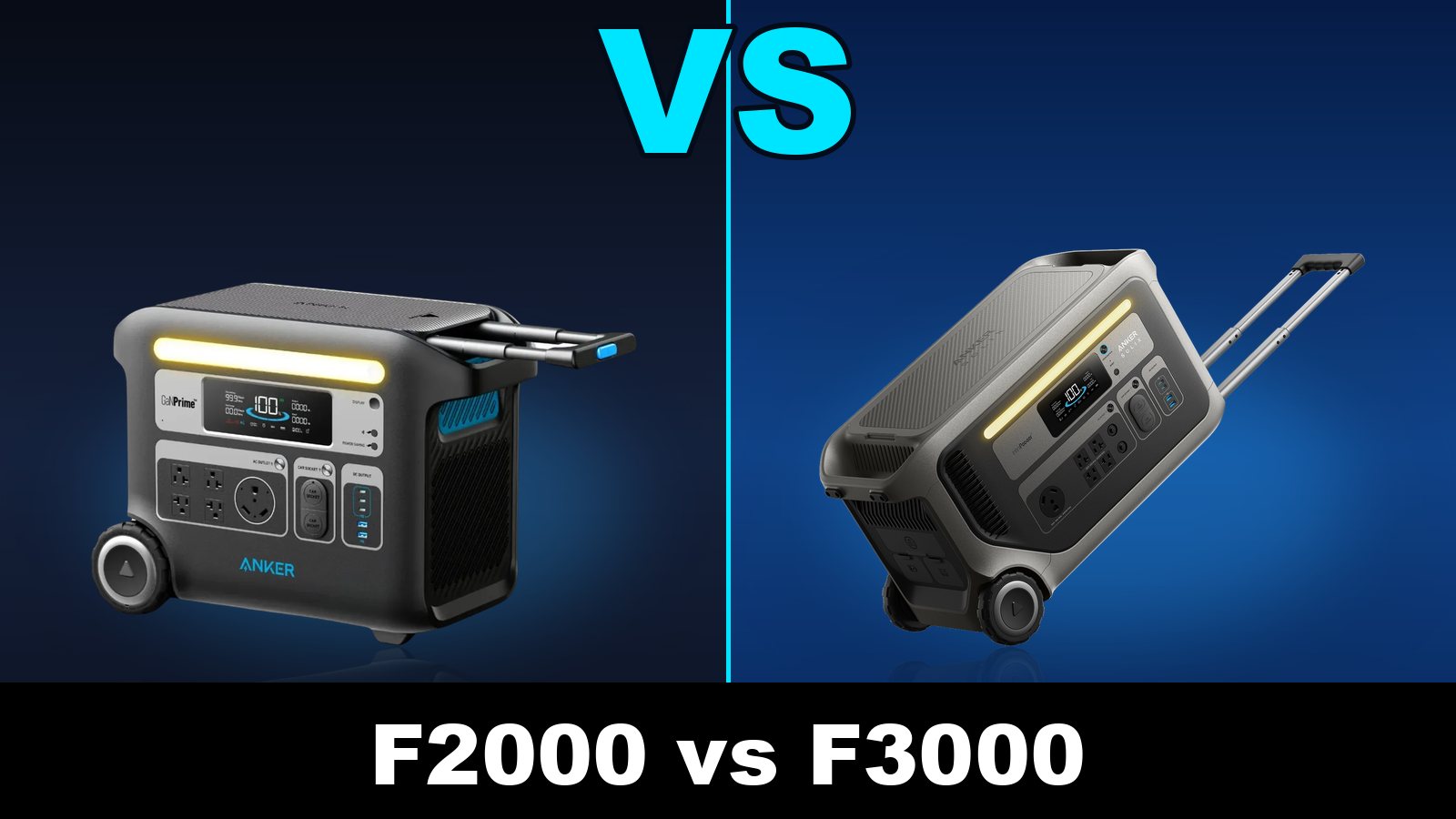
F2000
- you already own one: 2kWh and a TT-30 still go far
- a BP2000 takes it to 4,096Wh
- you want it 24 lb lighter than an F3000

F3000
- you want 3,072Wh and room to 12kWh
- your RV needs 3,600W on a TT-30R
- you’ll run up to 2,400W of solar
Prices and stock checked by our price engine on November 21, 2026 at 1:29 PM EST. Each product is rechecked several times a day; the time refreshes when you load the page.
Anker’s 2kWh and 3kWh wheeled stations. One of them is gone from Anker US.
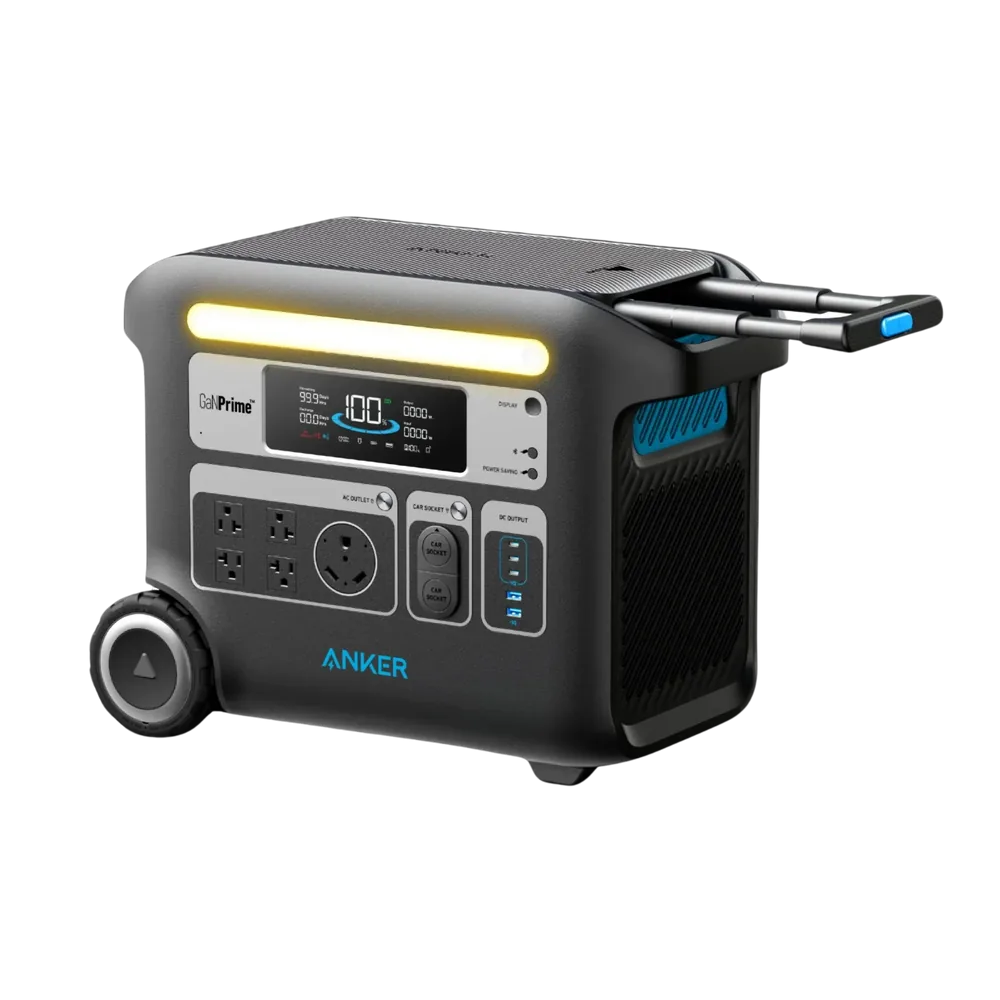
Anker US no longer sells the F2000: since August 2026 its page redirects to the C2000 Gen 2. The F2000 stored 2,048Wh, delivered 2,400W from four outlets and a TT-30 and took 1,000W of solar, at 67.2 lb. The F3000 stores 3,072Wh, delivers 3,600W through its TT-30R, takes 2,400W of solar on two ports and grows to 12,288Wh, at 91.5 lb. Both switch to battery in under 20ms.
Below: what changed with numbers, a 20-second calculator for your own gear, seven modeled situations, a third option, and what published tests found on each.
If you’re buying today, the F3000 or the C2000 Gen 2: Anker US no longer sells the F2000. Against it, the F3000 adds 1,024Wh, 1,200W more on the TT-30R, 2,400W of solar instead of 1,000W and three expansion batteries instead of one, for 24 lb more.
- 2kWh, or 4kWh with a BP2000, covers you
- you move it: 67.2 lb
- your loads stay under 2,400W
- your RV needs 3,600W
- you’ll use 2,400W of solar
- you’ll grow to 12kWh
The five differences that decide it
Both use LFP cells, have a TT-30 RV outlet, NEMA 5-20 household outlets, a 12V car socket, an expansion port and a 5-year Anker warranty, and switch to battery in under 20ms.
Will it run your setup? Check in 20 seconds
Estimates use 85% usable capacity and 70% of rated solar output. Real results vary with temperature, inverter load, shade and appliance cycling. Fridge and freezer watts are daily averages and do not include compressor startup surges.
Runtime by appliance, one at a time
Simple energy estimates, not measured runtimes. About 1,741Wh usable on the F2000 and 2,611Wh on the F3000; StorageReview got 1,870Wh out of an F2000.
Appliance for appliance, the F3000 lasts 50% longer than the F2000.
Same appliance, same watts: the gap is always the size of the battery.Get our Black Friday alerts for Anker SOLIX
We track live prices on 40+ models from Jackery, EcoFlow, BLUETTI and Anker SOLIX. When a deal beats the lowest price we've recorded, you'll hear from us. During Black Friday week, one short recap a day at most.
Unsubscribe in one click. We may earn a commission when you buy through our links, at no extra cost to you. Privacy Policy
What the current options cost today
The C2000 Gen 2 is where Anker US now sends F2000 shoppers: the same 2,048Wh and 2,400W, with a 10ms UPS, at 41.7 lb. It takes one expansion battery, like the F2000 did. The F3000 is the step up in capacity, RV output and solar input.
The third option: the C2000 Gen 2 at $849.99

Anker SOLIX C2000 Gen 2: $849.99 today
Where Anker US now sends F2000 shoppers. The same 2,048Wh and 2,400W, five NEMA 5-20 outlets and a TT-30, two 140W USB-C ports, 800W of solar, a 10ms UPS and one BP2000 Gen 2 for 4,096Wh, at 41.7 lb instead of 67.2. Our C2000 Gen 2 vs F2000 comparison goes deeper. See the C2000 Gen 2 at Anker.
Seven modeled situations, worked out
Same formula as the calculator above, with no expansion battery. The fridge averages 60W, about 525kWh a year.
24-hour outage, essentials only
The F3000 covers a full day alone; the F2000 a night and a morning. A BP2000 doubled the F2000; a BP3000 doubles the F3000.
RV air conditioner and microwave
Only the F3000 has the headroom, through its TT-30R. Android Central found the F2000’s voltage dropped above 2,400W instead of tripping; run the two loads one at a time.
Weekend off-grid with big panels
With 1,000W of panels or less they bank energy at the same rate. Above that, only the F3000 uses the array.
Air fryer during an outage
Both run it. Gizmodo’s 1,620W air fryer used 20% of the F2000’s charge in 20 minutes.
Home office through an outage
Both switch to battery in under 20ms; Trusted Reviews and Notebookcheck found the F2000’s switchover kept equipment running. The F3000 lasts longer.
Moving it
Both are two-person lifts. The F3000 rolls on wheels with a pull handle; budget for its 24 extra pounds.
A full-size fridge, nothing else
The F3000 keeps food cold about 14.5 h longer. Gizmodo ran a full-size fridge about 34 hours on an F2000, down to 5%.
Nine more differences, the spec sheet and the box
Smaller gaps that rarely decide the purchase, then the full specifications and what ships in the box.
F2000 and F3000 weight, dimensions and full specifications
Weight: 67.2 lb for the F2000 and 91.5 lb for the F3000. Dimensions: 20.7 × 15.5 × 9.8 in and 25.6 × 11.8 × 14.8 in. F2000 figures come from Anker US’s last archived product page (July 25, 2026).
Anker SOLIX F2000 and F3000 full specifications
Every published figure for both units, grouped. Green marks the better value.
What’s in the box
F2000
- F2000 power station2,048Wh, 67.2 lb
- AC charging cable
- Car charging cable
- User manual
F3000
- F3000 power station3,072Wh, 91.5 lb
- AC charging cable
- High-voltage solar charging cablein the box
- User manual
- TT-30 charging cable sold separately
F2000 contents as Anker listed them when it was on sale; F3000 from Anker US.
07 · ChargingHow fast each one refills
Shorter bar, faster refill. Each row is scaled to its slower unit.
F2000: AC or solar, not both at onceF3000: high- and low-voltage solar ports, 60V 120A DC input
Our solar times divide capacity by input power, with solar at 70% of panel rating.
Every port, side by side
F2000
F3000
Practical consequence: the same four household outlets and a TT-30 on both. The F3000 puts its full 3,600W on the TT-30R, adds a 30A Anderson port and a second solar input; the F2000 had a second car socket and three USB-C ports.
09 · NoiseNoise and heat: F2000 vs F3000
The Anker SOLIX F3000 is far quieter on the measurements: Notebookcheck found about 35dB near 3,000W, while reviewers measured the Anker SOLIX F2000 at 49 to 55dB while fast charging and about 60dB at full output.
All figures are from European or UK units. Anker publishes no noise rating for either.Every figure we found, with its source
What reviewers heard: Almost silent at low output, with the fan noticeable from about 1,000W (Notebookcheck, EU unit); charging an EV near full power for 52 minutes, the batteries only reached 41°C, about 106°F (Trusted Reviews, UK unit).
What reviewers heard: Stayed around 35dB at 1 m even at about 3,000W AC output (Notebookcheck, EU unit).
Measured by a tester Brand figure
- On the F2000, use the silent charging mode in the app overnight.
Cold, heat and storage: F2000 vs F3000
The Anker SOLIX F2000 and the Anker SOLIX F3000 share the same limits: charging from 32°F to 104°F, running from −4°F to 104°F. Neither has a water rating.
Figures from Anker US product pages (the F2000’s archived on July 25, 2026).- Charge either one above freezing: in a garage or an RV in winter, bring it inside to recharge.
- To store the F2000, turn off the outputs, keep it dry and cool, recharge to 100% if it drops below 30%, give it a full charge every 3 months, and keep power saving on: Android Central saw it lose 19% in 12 hours without it.
App, UPS and smart features
The Anker SOLIX F3000 does more: it grows to 12,288Wh, charges off-peak with TOU and links to a home panel through a bi-directional inlet box. The Anker SOLIX F2000 matches it on the 20ms UPS.
Both switch in under 20ms. The F2000 worked with Anker’s 6-circuit transfer switch.Green zone: a switch under about 16ms, which most desktop PCs ride through without restarting.
Can it charge off-peak? Trusted Reviews found no off-peak charging schedule on the Anker SOLIX F2000; the Anker SOLIX F3000 has a TOU mode with the bi-directional inlet box and a smart meter.
Can you add a battery later? Both take extra batteries: one BP2000 on the Anker SOLIX F2000 for 4,096Wh, up to three BP3000 on the Anker SOLIX F3000 for 12,288Wh.
Does it work as a UPS? Both switch in under 20ms. Trusted Reviews and Notebookcheck kept equipment running through the Anker SOLIX F2000’s switchover. Desktop PC power supplies hold up for about 16ms, so test yours.
Does it connect to a home panel? The Anker SOLIX F2000 worked with Anker’s home backup kit, a 6-circuit transfer switch; the Anker SOLIX F3000 uses a bi-directional inlet box and, with a second unit and the Double Voltage Hub, delivers 240V at 7,200W.
How does the app connect? Both use the Anker app. Anker’s last F2000 page lists Wi-Fi and Bluetooth, though 2023 reviewers found Bluetooth only on early units.
Warranty and support
Anker lists both at 5 years. The Anker SOLIX F2000 is no longer sold by Anker US, so an existing unit keeps the term it was sold with; for the Anker SOLIX F3000, Anker’s registration page says registering activates the 5 years.
Same 5 years on paper. The F3000 is rated for more cycles.Subject to each brand’s warranty terms and eligibility.
Anker rates the F2000 at 3,000 cycles to 80% capacity and the F3000 at 4,000, about 8 and 11 years at one full cycle a day. Anker doesn’t say how much capacity the F3000 keeps at that point. Calendar aging and heat also reduce capacity, so read any rating as a ceiling.
- If you buy a used or third-party F2000, check what warranty the seller honors: Anker US no longer sells it.
- Register the F3000 with Anker when it arrives: Anker’s registration page says that activates the 5-year protection.
What reviewers report
We have not lab-tested these two units. Here is what 12 published reviews found, with the source, author and date for each point. Reviews of UK and EU units are flagged: those models charge from 230V outlets and have different sockets, so their charge times and outlet findings don’t carry over to US units.
F2000: StorageReview (December 2023), Trusted Reviews (October 2023, UK unit), Notebookcheck (January 2023, EU unit), Android Central (June 2023), Gizmodo (June 2023), The Technology Man (March 2023, UK unit)F3000: Notebookcheck (February 2026, EU unit), CleanTechnica (August 2025), Android Authority (August 2025), MobileSyrup (October 2025), AndroidGuys (July 2025), Gear Diary (July 2025)
Usable capacity
- F2000Reviewer Delivered 1,870Wh before the inverter cut off, and a full recharge from empty took 2,300Wh. StorageReview, Jordan Ranous, December 2023
- F2000Reviewer AC output gave 1,705Wh charging an EV and 1,641Wh at a 200 to 300W load. Trusted Reviews, Simon Handby, October 2023, UK unit
- F3000Reviewer At a steady 200W AC load about 2,500Wh of 3,072Wh came out (81%), weaker at low loads. Notebookcheck, Marcus Schwarten, February 2026, EU unit
- F3000Reviewer Running a small camp (five lights, two outlets) it delivered uninterrupted power for about nine and a half hours. MobileSyrup, Brad Bennett, October 2025
Charging
- F2000Reviewer A full recharge took 2,323Wh at the fastest setting versus 2,419Wh at 200W. UK 2,200W input, flag. Trusted Reviews, Simon Handby, October 2023, UK unit
- F2000Reviewer Exactly 2,309Wh flowed in for a full charge, just under 89% efficient, in under 1.5 hours. EU 230V input, flag. Notebookcheck, Marcus Schwarten, January 2023, EU unit
- F2000Reviewer At the 1,440W maximum, it reached 29% in 30 minutes, 77% in 60 minutes and 100% in 112 minutes. Android Central, Jerry Hildenbrand, June 2023
- F3000Reviewer AC charging took 1h20 at up to 2,992W and drew 3,480Wh, 88% efficient. EU 230V input, flag. Notebookcheck, Marcus Schwarten, February 2026, EU unit
- F3000Reviewer Pulled just under 1,700W from a wall outlet, for a full charge in just under 2 hours. CleanTechnica, Kyle Field, August 2025
Noise and heat
- F2000Reviewer Charging an EV near full rated power for 52 minutes, the batteries only reached 41C. Trusted Reviews, Simon Handby, October 2023, UK unit
- F2000Reviewer Charging at around 2,000W, it reached up to 55dB; a silent charging mode exists in the app. Notebookcheck, Marcus Schwarten, January 2023, EU unit
- F2000Reviewer Almost silent at low output; the fan becomes noticeable from about 1,000W. Notebookcheck, Marcus Schwarten, January 2023, EU unit
- F2000Reviewer Measured 49dB at 1m while charging at full speed, about 13dB above background. The Technology Man, Gidon, March 2023, UK unit
- F3000Reviewer Even at about 3,000W AC output it stayed around 35dB at 1m. Notebookcheck, Marcus Schwarten, February 2026, EU unit
UPS and output
- F2000Reviewer The switchover to battery kept the reviewer’s office equipment running without a glitch. Trusted Reviews, Simon Handby, October 2023, UK unit
- F2000Reviewer The under 20ms UPS switchover worked reliably in testing. Notebookcheck, Marcus Schwarten, January 2023, EU unit
- F2000Reviewer Above 2,400W it lowers output voltage instead of tripping, so heaters and hotplates run weaker. Android Central, Jerry Hildenbrand, June 2023
- F3000Reviewer Handled a high-power Vitamix blender that trips 20A home breakers, up to an EV charger. CleanTechnica, Kyle Field, August 2025
- F3000Reviewer Through the four AC outlets alone, max output is 2,400W. Android Authority, Edgar Cervantes, August 2025
Daily use and issues
- F2000Reviewer The LED light bar is rated one of the best they have tested, with three brightness levels and a flashing mode. StorageReview, Jordan Ranous, December 2023
- F2000Reviewer At a light 30W load it delivered only 834Wh over nearly three days, about 41% of rated capacity. Trusted Reviews, Simon Handby, October 2023, UK unit
- F2000Reviewer The app can switch outputs and set timers, but cannot schedule charging for off-peak overnight rates. Trusted Reviews, Simon Handby, October 2023, UK unit
- F3000Reviewer At 41.5kg it is a heavyweight; the wheels and telescopic handle help on flat ground. Notebookcheck, Marcus Schwarten, February 2026, EU unit
- F3000Reviewer No automatic time-of-use charging mode was found on the EU unit’s app. Notebookcheck, Marcus Schwarten, February 2026, EU unit
Practical limits before you buy
- Anker US no longer sells the F2000. Its page redirects to the C2000 Gen 2; check any seller’s warranty before buying one.
- The F2000 can’t charge from AC and solar at once. AC input takes priority.
- The F2000’s TT-30 shares its 2,400W with the household outlets. The F3000’s 3,600W is on the TT-30R only; its household outlets share 2,400W.
- The F3000’s 3,600W charging needs an adapter: the TT-30 charging cable or the EV charging adapter, sold separately.
- 91.5 lb. The F3000 rolls, but it’s heavy to lift into a vehicle.
- Neither has 240V alone. The F3000 needs a second unit and the Double Voltage Hub.
- The Technology Man found the F2000 struggled to start induction-motor machines. Check surge needs before relying on either for a pump or a compressor.
- F2000, per its archived US page: AC and DC (solar or car) input cannot be used at the same time; AC input takes priority.
- F2000, per its archived US page: Solar input 11 to 60V via XT-60: 10A max at 11 to 32V, 20A max at 32 to 60V, 1,000W max.
- F2000, per its archived US page: Charging temperature 32 to 104F; discharging -4 to 104F.
- F2000, per its archived US page: Storage: turn off outputs, store dry and cool, recharge to 100% if below 30%, full charge every 3 months.
- F3000, per its US documentation: Provides only 120V on its own; 240V requires two F3000 units joined with a double voltage hub.
Frequently asked questions
Is the F3000 the replacement for the F2000?
Not directly. Anker US redirects its F2000 page to the C2000 Gen 2, the same 2,048Wh size. The F3000 is the bigger step up, with 3,072Wh, 3,600W on a TT-30R and 2,400W of solar.
Can I still buy a BP2000 for my F2000?
Yes. On October 30, 2026, Anker US still sold the BP2000 expansion battery, which takes an F2000 to 4,096Wh.
Which is better for an RV?
The F3000: 3,600W through its TT-30R, enough for a rooftop AC and a microwave together. The F2000’s TT-30 shares 2,400W with its other outlets.
How long will each run a refrigerator?
At a 60W average: about 29 hours on the F2000 and 43.5 hours on the F3000. Gizmodo ran a full-size fridge about 34 hours on an F2000.
Do reviews confirm the rated capacity?
F2000: StorageReview got 1,870Wh out of the 2,048Wh battery; Android Central just under 1,900Wh on AC. F3000: see the reviewer reports below. Our calculator uses 85% of the rating.
Which charges faster?
From a standard outlet, about the same two hours. From an RV pedestal with the TT-30 cable, or from more than 1,000W of solar, the F3000.
How loud are they?
Anker publishes no rating. Reviewers measured the F2000 at 49 to 55dB while fast charging, and Notebookcheck about 35dB on the F3000 at around 3,000W.
Is there a third option?
Yes: the C2000 Gen 2, where Anker now sends F2000 shoppers. Same 2,048Wh and 2,400W, a 10ms UPS, one expansion battery, at 41.7 lb.
Related comparisons and reviews
How we compared and sources
Research-based comparison. We have not physically tested these two units. F2000 specs come from Anker US’s product page as archived on July 25, 2026, because the live page now redirects to the C2000 Gen 2; F3000 specs from Anker US. Usage observations are attributed to named reviewers. Checked on October 30, 2026.
- Specs: Anker US, F2000 (archived July 25, 2026) and Anker US, F3000, read on October 30, 2026.
- F2000 surge: Anker’s page says 2,800W; Android Central lists 3,600W. We use Anker’s figure.
- Reviewer reports on the F2000: StorageReview, Jordan Ranous, December 2023, Trusted Reviews, Simon Handby, October 2023, UK unit, Notebookcheck, Marcus Schwarten, January 2023, EU unit, Android Central, Jerry Hildenbrand, June 2023, Gizmodo, Andrew Liszewski, June 2023, The Technology Man, Gidon, March 2023, UK unit; on the F3000: Notebookcheck, Marcus Schwarten, February 2026, EU unit, CleanTechnica, Kyle Field, August 2025, Android Authority, Edgar Cervantes, August 2025, MobileSyrup, Brad Bennett, October 2025, AndroidGuys, Andrew Allen, July 2025, Gear Diary, Travis Ehrlich, July 2025.
- Runtime = capacity × 0.85 ÷ watts. Solar harvest = min(panel watts, max input) × sun hours × 0.70.
The F3000 adds 1kWh, 3,600W on its TT-30R and 2,400W of solar; the F2000, no longer sold by Anker US, was 24 lb lighter.
Prices checked November 21, 2026 at 1:29 PM EST
Looking at other models? Browse all power station comparisons, or pick any two models on the hub and we point you to the right duel.
Originally published: November 21, 2026