
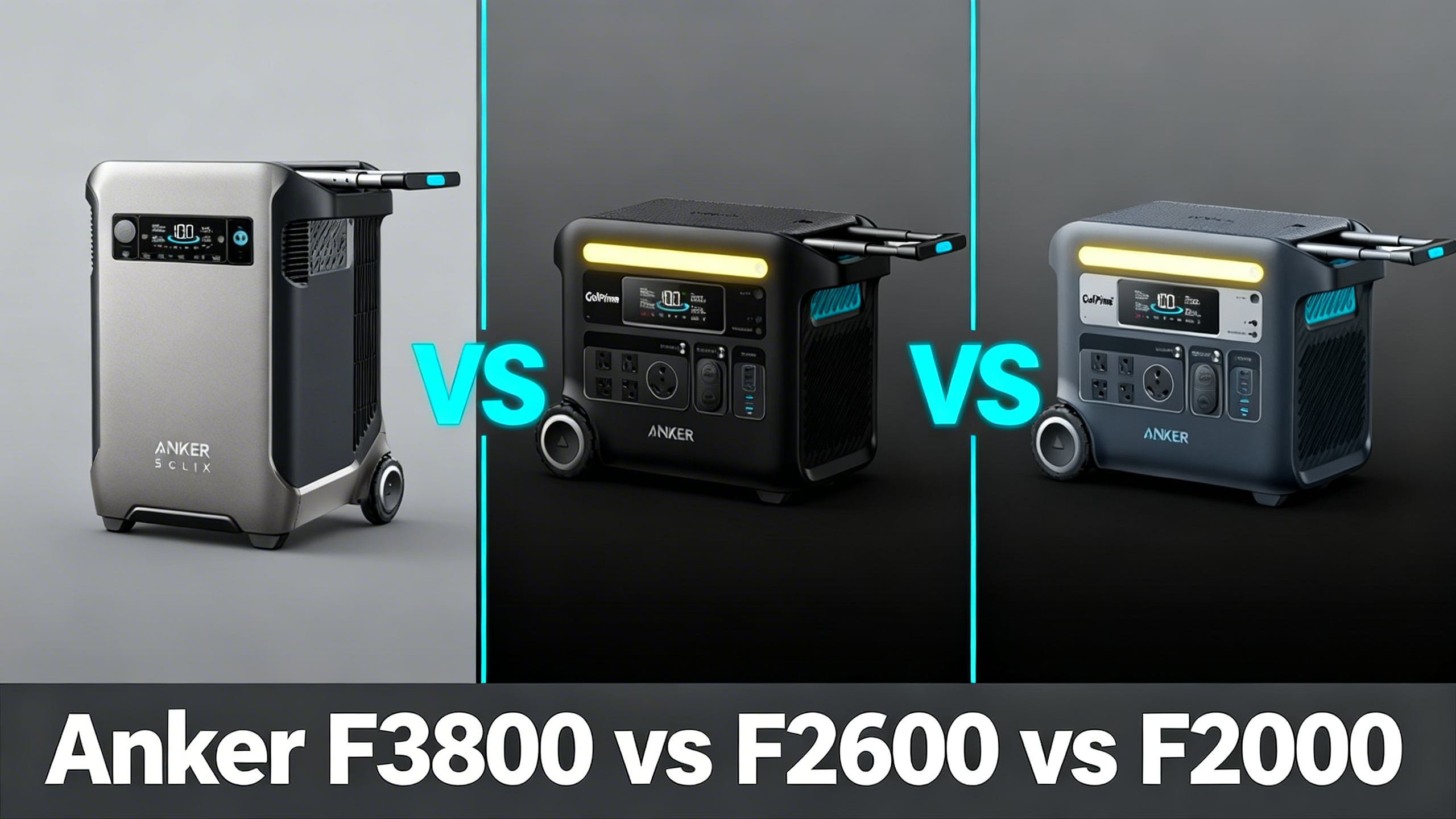
Update (September 2026): Anker has discontinued the F2000; its product page now redirects to the Anker SOLIX C2000 Gen 2 (2,048Wh, 2,400W), which we cover below as the current alternative.
Choosing between three flagship power stations from the same brand feels confusing—especially when they all share the same core technology but differ dramatically in price and capabilities. The Anker F3800 portable power station sits at $2,199.99 with massive 6,000W output and 240V capability. The Anker F2600 Solix lands at $1,999.99 as the balanced premium option. And the Anker F2000, once the value flagship, is now discontinued and replaced by the Anker SOLIX C2000 Gen 2.
All three models share Anker’s proprietary InfiniPower™ technology, promising a 10-year lifespan with LiFePO4 batteries. They’re all backed by a 5-year full-device warranty. But the similarities end there. The Anker F3800 solar generator weighs a hefty 132 pounds and targets whole-home backup users who need split-phase power for central AC units or well pumps. The F2600 and F2000, on the other hand, deliver identical 2,400W continuous output but differ in capacity and expandability.


Here’s the challenge: most buyers don’t need the F3800’s specialized capabilities, yet they’re drawn to the flagship label. Meanwhile, the F2600 and the F2000 (now replaced by the C2000 Gen 2) share so many specs that the choice between them comes down to specific usage patterns and expansion plans. We’ve compared all three Anker flagship power stations across capacity, output power, solar charging, portability, and real-world scenarios to help you identify which fits your needs—and which represents unnecessary spending.
The short answer: there’s no universal winner. Your decision depends on whether you need 240V power (F3800 only), how much capacity you require, and whether portability matters.
Get our Black Friday alerts for Anker SOLIX
We track live prices on 40+ models from Jackery, EcoFlow, BLUETTI and Anker SOLIX. When a deal beats the lowest price we've recorded, you'll hear from us. During Black Friday week, one short recap a day at most.
Unsubscribe in one click. We may earn a commission when you buy through our links, at no extra cost to you. Privacy Policy
Quick Comparison Table
| Feature | F3800 | F2600 | F2000 (discontinued) |
|---|---|---|---|
| Price | $2,199.99 | $1,999.99 | Discontinued |
| Capacity | 3,840Wh | 2,560Wh | 2,048Wh |
| Continuous Output | 6,000W | 2,400W | 2,400W |
| Voltage | 120V/240V | 120V only | 120V only |
| Max Expansion | 53.8kWh | Anker 760 battery | 4.096kWh |
| Solar Input | 2,400W | 1,000W | 1,800W |
| Weight | 132 lbs | 69.7 lbs | 59.5 lbs |
| $/Wh | $0.57 | $0.78 | n/a |
🧭 Quick Decision Tree: Which Model Fits You?
Do you need 240V split-phase power?
✅ YES → F3800 is your only option (central AC, well pumps, EV charging)
❌ NO → Continue to next question
Is portability a priority? (moving it regularly)
✅ YES → C2000 Gen 2 at 41.7 lbs (the F2000’s successor)
❌ NO → Continue to next question
Is the lowest cost per Wh your main goal?
✅ YES → Compare today’s prices: F3800 at $0.57/Wh, F2600 at $0.78/Wh
❌ NO → F2600 for balanced capacity + portability (our top pick for most users)
Anker F3800 Overview – The 6,000W Beast


Key Specs & What’s in the Box
The Anker F3800 represents Anker’s top-tier offering, designed for users who need serious power output and massive expandability. At its core sits a 3,840Wh LiFePO4 battery that can scale up to 53.8kWh when paired with six BP3800 expansion batteries. That’s enough capacity to power an entire home for days during extended outages.
The headline feature is the 6,000W continuous output with 12,000W surge capability. More importantly, the F3800 is the only model in Anker SOLIX comparison that offers true 120V/240V split-phase power. This means it can handle power-hungry appliances that require 240V—central air conditioning units, well pumps, electric dryers, and Level 2 EV charging.
Physical specs matter here. The F3800 weighs 132 pounds without expansion batteries. This isn’t a unit you’ll carry camping. Solar charging maxes out at 2,400W input, allowing for a 0-80% charge in roughly 1.5 hours under ideal conditions with six 400W solar panels.
⚡ F3800: Only Option for 240V Power
Why we recommend it: If you need to run central AC, well pumps, or Level 2 EV charging, the F3800 is your only choice. No other Anker model provides split-phase 240V output.
$2,199.99 | Free shipping | 5-year warranty + 10-year InfiniPower™
Who It’s Built For
The F3800 targets a specific subset of power station buyers. If you’re considering this model, you likely fall into one of these categories.
Whole-home backup users who need to power essential 240V appliances during outages. If your home relies on a well pump that requires 240V, or if you need to run a central air conditioning unit during summer blackouts, the F3800 is your only option in Anker’s lineup. Standard 120V power stations simply can’t deliver split-phase power no matter how high their wattage rating.
Off-grid system builders who want massive expandability. The ability to scale up to 53.8kWh means you can build a legitimate off-grid power system rivaling some traditional generator setups. Each BP3800 expansion battery adds 3.8kWh for roughly $3,000.
RV owners with heavy AC needs and 50-amp shore power requirements. The NEMA 14-50 outlet connects directly to your RV’s shore power inlet, delivering the full 6,000W through a single connection.
Standout Features
The NEMA 14-50 outlet delivers up to 6,000W through a single connection, the same outlet used for RV shore power and Level 2 EV charging. This means you can add roughly 25-30 miles of range per hour to most electric vehicles.
The L14-30 outlet connects to manual transfer switches, allowing the F3800 to integrate with your home’s electrical panel. When properly installed by a licensed electrician, this enables you to power hardwired circuits like well pumps, HVAC systems, or hardwired appliances.
Dual power hub capability lets you parallel connect two F3800 units using Anker’s Double Power Hub accessory. This configuration delivers 12,000W continuous output with up to 107.6kWh of total capacity.
Get our Black Friday alerts for Anker SOLIX
We track live prices on 40+ models from Jackery, EcoFlow, BLUETTI and Anker SOLIX. When a deal beats the lowest price we've recorded, you'll hear from us. During Black Friday week, one short recap a day at most.
Unsubscribe in one click. We may earn a commission when you buy through our links, at no extra cost to you. Privacy Policy
Anker F2600 Overview – The Balanced Premium Choice
Key Specs & What’s in the Box
The F2600 occupies the middle ground in Anker’s flagship lineup, balancing capacity, output power, and portability. The 2,560Wh battery provides more runtime than the F2000 without reaching the F3800’s massive size and weight. It can be expanded with the Anker 760 Expansion Battery.
Output power matches the F2000 at 2,400W continuous, and the F2600 is rated for 2,800W surge. This handles most household appliances and power tools, though you’re limited to 120V devices. Solar input maxes out at 1,000W, enough to charge from 0-80% in about 2.4 hours at full solar input under ideal conditions.
The F2600 weighs 69.7 pounds, making it more portable than the F3800 but still requiring two people for comfortable carrying over any distance.
🏆 F2600: Editor’s Choice – Our Top Pick for Most Users
Why we recommend it: Perfect balance of 2,560Wh capacity and 69.7-pound portability. Ideal for RV users and home backup without F3800’s weight penalty.
$1,999.99 | Free shipping | 5-year warranty + 10-year InfiniPower™
Who It’s Built For
Home backup for essential circuits describes the primary use case. A 2,560Wh capacity runs a standard refrigerator (150W average) for about 15 hours, enough to ride out an overnight outage; longer outages call for solar recharging or an expansion battery.
RV users in Class B or C motorhomes who don’t need 240V power benefit from the F2600’s balance of capacity and weight. At 69.7 pounds, it’s manageable for two people to move in and out of an RV.
Weekend warriors who want more capacity than entry-level models appreciate the F2600’s headroom. If you’re camping for 3-4 days without shore power or generator access, the 2,560Wh base capacity plus solar charging covers most recreational needs.
Standout Features
Portability relative to capacity stands out. At 69.7 pounds for 2,560Wh, the F2600 offers better capacity-to-weight ratio than the F3800 (132 pounds for 3,840Wh).
Smart app control through Anker’s iOS and Android app provides real-time energy monitoring, remote power on/off control, firmware updates over WiFi, and historical usage data.
Anker 760 Expansion Battery compatibility lets you add capacity later if your needs grow.
Anker F2000 Overview – Discontinued, Replaced by the C2000 Gen 2


Key Specs & What’s in the Box
The Anker F2000 delivered flagship features at an entry-level price point, which made it Anker’s most accessible model with the company’s premium InfiniPower™ technology until Anker discontinued it. The 2,048Wh LiFePO4 battery expands to 4.096kWh with one BP2000 expansion battery.
Output power matches the F2600 at 2,400W continuous, and the F2000 is rated for 3,600W surge. Solar input caps at 1,800W. The key difference lies in base capacity—512Wh less than the F2600—and overall weight.
At 59.5 pounds, the F2000 is genuinely portable for one person to carry short distances. AC charging from 0-80% takes just 1.4 hours, the fastest of the three flagships.
🔄 F2000: Discontinued – Consider the C2000 Gen 2
What changed: Anker no longer sells the F2000, and its product page now redirects to the Anker SOLIX C2000 Gen 2. The C2000 Gen 2 keeps the same 2,048Wh capacity and 2,400W output in a lighter 41.7-pound body, uses LiFePO4 cells rated for 3,000 cycles to 80%, and expands to 4kWh with one BP2000 (Gen 2) battery.
See the C2000 Gen 2 (F2000 successor) →
$899.99 | 2,048Wh | 2,400W | 41.7 lbs
Who It’s Built For
Budget-conscious buyers who wanted flagship quality were the F2000’s core audience. Now that it’s discontinued, the closest match is its successor, the C2000 Gen 2 (same 2,048Wh), so compare the live prices in this Anker SOLIX comparison before deciding.
Home backup for basic essentials suits the F2000’s 2,048Wh capacity. This runs a refrigerator (150W average) for about 12 hours, enough for an overnight outage.
CPAP users who need reliable overnight backup value the F2000’s capacity and battery longevity. A typical CPAP machine draws 30-60W depending on settings. At 50W average draw, the F2000 provides roughly 35 hours of use.
Standout Features
Low cost per watt-hour was the F2000’s main selling point, but it’s no longer sold. At today’s prices, the F3800 costs $0.57/Wh, the F2600 $0.78/Wh and the C2000 Gen 2 $0.44/Wh.
Same InfiniPower™ technology as the F3800 meant identical battery longevity at a lower price. The LiFePO4 cells, thermal management system, and battery management circuits are essentially the same across all three models.
BP2000 expansion battery compatibility doubles capacity to 4.096kWh for approximately $999. Its successor, the C2000 Gen 2, expands to 4kWh with one BP2000 (Gen 2) battery.
Fast recharge time of 1.4 hours to 80% beats both larger models. Smaller battery capacity means proportionally faster charging when using the same AC input wattage.
Head-to-Head Comparison


📊 Capacity vs Weight vs Price
Capacity & Expandability
Looking at base capacity alone doesn’t tell the complete story. The Anker F3800 vs Jackery 5000 comparison reveals similar patterns—flagship models offer massive expandability that most users never need.
The F3800 scales up to 53.8kWh with six BP3800 expansion batteries. Each battery costs approximately $3,000 and adds 3.8kWh of capacity. Full expansion would cost $2,199.99 plus six batteries for the complete system—a genuine off-grid power solution.
The F2600 expands with the Anker 760 Expansion Battery. Total system cost is $1,999.99 plus the battery.
The F2000 expands to 4.096kWh with one BP2000 expansion battery at approximately $999, but the F2000 itself is no longer sold. Its successor, the C2000 Gen 2, expands to 4kWh with one BP2000 (Gen 2) battery.
Key insight: the F3800’s massive expandability only matters if you actually need 10kWh+ of storage. Most homeowners running essential circuits during outages don’t consume more than 3-5kWh per day.
Output Power & Voltage
Output power reveals the most significant functional difference between models. The Anker F3800 vs EcoFlow Delta Pro 3 battle comes down to this: split-phase 240V capability.
The F3800 delivers 6,000W continuous with 12,000W surge across both 120V and 240V configurations. This handles virtually any residential appliance or tool. The split-phase capability means you can run central AC units, well pumps, electric dryers, and other 240V equipment that the other models simply cannot power regardless of wattage.
The F2600 and F2000 both output 2,400W continuous, exclusively at 120V, with surge ratings of 2,800W and 3,600W respectively. They deliver the same continuous power despite the price difference.
For context, 2,400W covers roughly 95% of household appliances. Refrigerators draw 150-200W, window AC units consume 1,000-1,500W, laptops use 60-100W, and phone chargers draw 5-20W.
The voltage limitation matters more than wattage for most buyers. If you need to run anything requiring 240V, the F3800 is your only option. If all your needs are 120V, the F2600 and F2000 deliver the same continuous output.
⚠️ Important: Most US households use standard 120V outlets. You only need 240V for: central AC, well pumps, electric dryers, large workshop equipment, and Level 2 EV charging. If unsure, the F2600 will handle your needs at a lower cost. Not sure how much capacity your home actually needs? Use our power station capacity calculator to size correctly before buying.
Solar Charging Performance
Solar input capability determines how quickly you can recharge off-grid and whether you can maintain indefinite runtime with adequate sunlight.

F3800: 2,400W Solar

F2000: 1,800W Solar
The Anker F3800 solar generator accepts up to 2,400W of solar input, allowing for a 0-80% charge in approximately 1.5 hours under ideal conditions. This requires six Anker PS400 solar panels (400W each) or equivalent panels from other manufacturers.
The F2600 maxes out at 1,000W solar input, which works out to about 2.4 hours for a 0-80% charge at full input; three 400W panels (1,200W rated) are enough to max it out on paper. The F2000 accepts up to 1,800W.
While slower than the F3800, 1,800W input still qualifies as excellent by industry standards. When comparing Anker F2000 vs EcoFlow Delta 2 Max, both offer similar 1,800W solar capacity—more than sufficient for recreational and backup power scenarios.
Practical reality: achieving maximum solar input requires optimal conditions—panels perpendicular to the sun, clear skies, clean panel surfaces, and operation during peak sun hours. Real-world charging rates typically reach 60-70% of rated capacity.
🔋 Expansion Options & Accessories
Anker 760 Battery
Expansion for the F2600
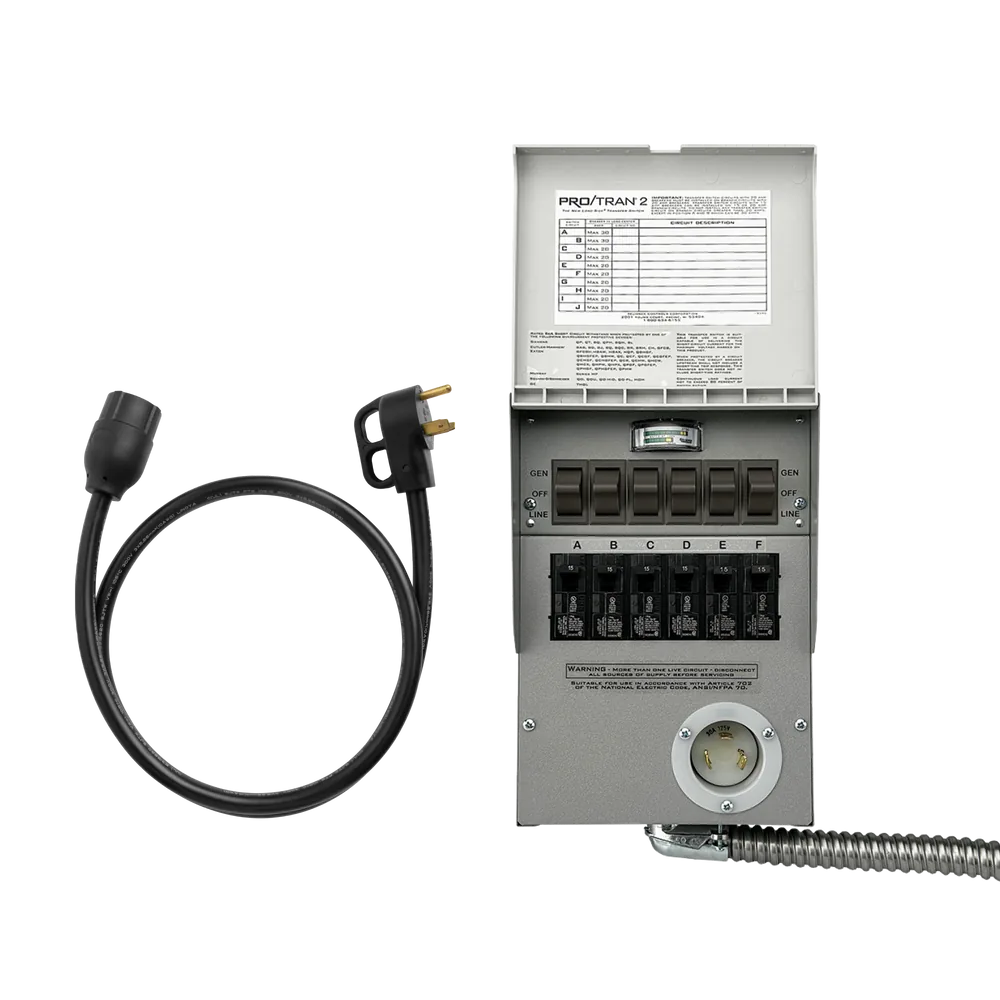
Transfer Switch
6-Circuit • Compatible
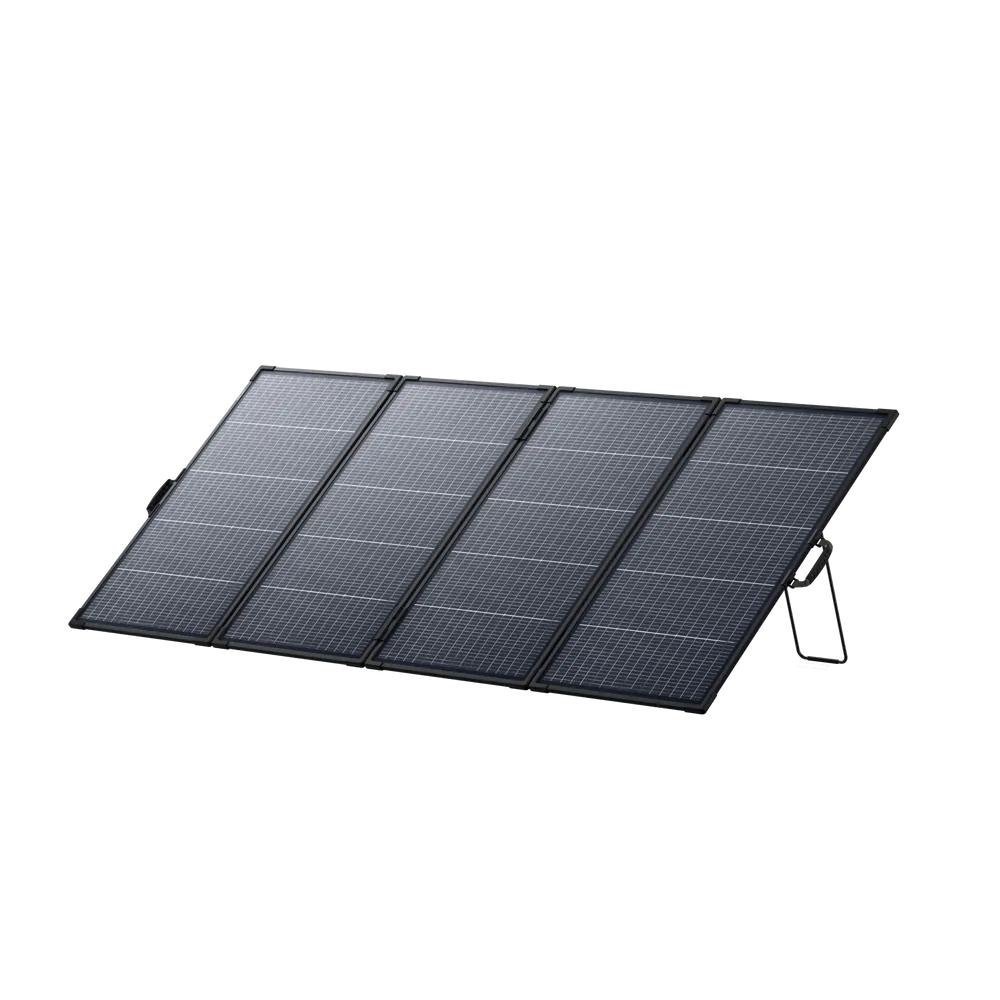
PS400 Solar Panel
400W • Bifacial
Real-World Runtime Calculations
⏱️ Runtime Estimator: Common Appliances
* Estimates assume 85% conversion efficiency. Actual runtime varies by usage pattern.
Which Should You Buy?
The right choice depends entirely on your specific needs, budget, and whether you require 240V capability.
Choose the F3800 if:
✅ You need 240V split-phase power for central air conditioning, well pumps, electric dryers, or Level 2 EV charging. This is the only hard requirement that eliminates the other two models from consideration.
✅ You’re building a serious off-grid system requiring massive expandability beyond 10kWh. The ability to scale up to 53.8kWh with six expansion batteries creates a genuine off-grid power solution.
✅ You need to power multiple high-wattage 120V appliances simultaneously and want significant headroom. The 6,000W continuous output lets you run a refrigerator, window AC unit, microwave, space heater, and power tools at the same time.
✅ Budget isn’t a primary constraint and you want maximum capability regardless of cost.
🔌 Need 240V? F3800 is Your Only Option
Central AC • Well Pumps • Electric Dryers • Level 2 EV Charging • Split-Phase Equipment
Choose the F2600 if:
✅ You want more base capacity than the F2000 without the F3800’s specialized features or extreme weight. The 2,560Wh starting point provides noticeably longer runtime for refrigerator backup and multi-day camping scenarios.
✅ You’re an RV user who needs a balance of capacity and portability for frequent loading and unloading. At 69.7 pounds, it’s manageable for two people while providing enough capacity for comfortable weekend trips.
✅ You value having expansion options but don’t need the F3800’s massive scalability. The F2600 works with the Anker 760 Expansion Battery when you need more runtime for home backup or RV use.
🏆 Our Top Pick for Most Users: Balanced Capacity + Portability
2,560Wh • 69.7 lbs • 2,400W Output • Expandable (Anker 760 battery) • Perfect RV/Home Backup
Looking for the F2000?
Anker has discontinued the F2000, and its product page now redirects to the Anker SOLIX C2000 Gen 2. If the F2000 was on your shortlist, the C2000 Gen 2 is the closest match you can buy today:
✅ The same 2,048Wh capacity and 2,400W output, with LiFePO4 cells rated for 3,000 cycles to 80%.
✅ Lighter at 41.7 pounds, in a compact body with no wheels, so you carry it rather than roll it.
✅ Expandable to 4kWh with one BP2000 (Gen 2) battery if you need more runtime later.
If 2,048Wh feels tight for your needs, the F2600 is our top pick for most users. For the full picture on the successor, read our Anker SOLIX C2000 Gen 2 review.
🔄 F2000 Successor: Anker SOLIX C2000 Gen 2
✅ Same 2,048Wh as the F2000
✅ Same 2,400W as F2600
✅ Lighter: 41.7 lbs
✅ 3,000 cycles to 80%
✅ Expandable to 4kWh
✅ LiFePO4 battery
See the C2000 Gen 2 (F2000 successor) →
$899.99 | Official F2000 successor | Compact, no wheels
📸 Visual Comparison: All Three Models

F3800 + Expansion
7.68kWh Total Capacity
F2600 Standalone
2.56kWh Balanced

F2000 + Solar
2.048kWh • Discontinued
Real-World Usage Scenarios
Scenario 1: Weekend Warrior Camping
You take 2-3 camping trips per month, typically Friday through Sunday, at campgrounds without electrical hookups. You need to run a small electric cooler, charge phones and laptops, power LED lighting, and occasionally use a portable fan or electric kettle.
Winner: C2000 Gen 2 (F2000 successor)

The 2,048Wh capacity easily covers a weekend of recreational power use. An electric cooler draws roughly 40-60W, running intermittently—estimate 8 hours of actual runtime per 24-hour period at 50W average, consuming 400Wh daily. Add phone charging (20Wh per full charge, maybe 4 charges = 80Wh), laptop charging (one full charge = 65Wh), LED lighting for 4 hours (20W bulb = 80Wh), and occasional electric kettle use (1,500W for 5 minutes = 125Wh). Total daily consumption hits roughly 750Wh.
The C2000 Gen 2, which replaces the F2000, has the same 2,048Wh capacity and weighs 41.7 pounds, so loading and unloading stay manageable. Add 200-400W of portable solar panels and you can maintain indefinite runtime during sunny conditions.
Scenario 2: Whole-Home Backup with Central AC
You live in an area with frequent summer power outages lasting 12-24 hours. Your home relies on a central air conditioning unit requiring 240V power. You also need to keep refrigerator, lights, and WiFi running during outages.
Winner: F3800
The split-phase 240V capability makes this decision automatic. Standard 120V power stations, regardless of wattage, cannot power central AC units that require 240V. The F3800’s 6,000W continuous output handles a typical 3-ton central AC unit (drawing 3,500-4,500W during operation) while leaving headroom for refrigerator, lighting, and electronics.
This scenario demands expansion batteries. With three BP3800 units added (total 15.2kWh), you get roughly 3-4 hours of compressor run time at a 3,500-4,500W draw; how many hours of cooling that covers depends on how often the compressor cycles, which varies with temperature and home insulation. For longer outages, you’d need solar input or additional expansion batteries.
Scenario 3: Van Life with Modest Daily Power Needs
You’re living full-time in a converted van, consuming roughly 500-800Wh daily for LED lighting, laptop work, phone charging, small electric cooler, and occasional power tool use for van modifications. You have 400W of rooftop solar panels.
Winner: F2600
The F2600’s 2,560Wh base capacity provides roughly 3-4 days of buffer for cloudy weather or higher-than-normal consumption. Van life requires reliability—running out of power when you’re parked in a remote area without shore power access creates genuine problems.
The 1,000W solar input accepts your 400W of rooftop panels with room for up to 600W more of portable panels during stationary periods. This solar capacity exceeds your daily consumption on sunny days, allowing you to maintain indefinite runtime while topping off the battery for overnight use and cloudy periods.
Adding an Anker 760 Expansion Battery extends that buffer for extended cloudy periods or unexpected high-consumption days. The expanded system costs $1,999.99 plus the battery—reasonable for full-time van life where your power station becomes essential infrastructure.
Scenario 4: Home Backup for Essentials Only
You experience 3-4 power outages per year, typically lasting 8-36 hours. Your priority is preserving food in your refrigerator and maintaining lighting, phone charging, and WiFi connectivity.
Winner: C2000 Gen 2 (F2000 successor)
The 2,048Wh capacity handles essential backup for shorter outages. A refrigerator consumes 150-200W average, WiFi router draws 10-20W, LED lighting uses 20-40W total, and phone/laptop charging adds another 20-30W intermittently.
Total continuous load sits around 200-250W, consuming roughly 5kWh per day. The C2000 Gen 2, with the same 2,048Wh as the F2000, provides roughly 7-9 hours of runtime at that load before requiring recharge, enough for a short overnight outage or a daytime disruption. Running the refrigerator alone stretches that to roughly 9-12 hours; for outages at the long end of your 8-36 hour range, you’ll need solar recharging or an expansion battery.
The C2000 Gen 2 makes sense for infrequent emergency backup: you’re not paying for capacity you’ll rarely use, and at 41.7 pounds it’s easy to move from garage to kitchen during outages.
Scenario 5: Off-Grid Cabin with High Daily Consumption
You own an off-grid cabin used for extended stays, consuming 5-8kWh daily for lighting, refrigeration, water pump, power tools for ongoing improvements, and entertainment electronics. You have space and budget for a serious solar array.
Winner: F3800 (with expansion)
This scenario demands the F3800’s massive expandability and high solar input. Daily consumption of 5-8kWh requires at least 10-15kWh of storage to account for cloudy days and overnight use. The F3800 with two BP3800 expansion batteries provides 11.4kWh total capacity—enough for 1-2 days of typical use.
The 2,400W solar input accepts up to six 400W panels, generating roughly 10-12kWh per day in good conditions. This solar capacity exceeds your daily consumption, allowing you to maintain indefinite operation while recharging batteries for overnight use and weather contingencies.
Total system cost approaches $10,000-12,000 with expansion batteries and solar panels, but this creates a legitimate off-grid power system without generator noise, fuel logistics, or maintenance requirements. The F3800’s 120V and 240V outputs handle any appliance or tool you might use at the cabin.
Frequently Asked Questions
Can I parallel connect two different models (e.g., F3800 + F2600)?
No. Only the F3800 supports parallel connection, and it can ONLY be paired with another F3800 using Anker’s Double Power Hub accessory. The F2600 and F2000 are standalone units with no parallel capability.
If you need more than 6,000W output, you’ll need two F3800 units plus the Double Power Hub for the complete system. This configuration delivers 12,000W continuous output with 7.68kWh base capacity (or up to 107.6kWh fully expanded with twelve BP3800 batteries across both units).
Which model has the fastest AC charging time?
The F2000 (now discontinued) charges fastest at 1.4 hours from 0-80%, followed by the F2600 at about 1.7 hours with its 1,440W AC input, and the F3800 at roughly 2 hours. This counterintuitive result occurs because smaller battery capacity means proportionally faster charging when using similar AC input wattage.
All three models use Anker’s GaNPrime™ fast-charging technology, which maximizes charging efficiency through advanced power management circuits. For users experiencing rolling blackouts or needing to quickly recharge between uses, the F2000’s faster charging provides a practical advantage despite its smaller capacity.
Do all three share the same expansion batteries?
No, each model requires its specific expansion battery:
- F3800 → BP3800 (3.8kWh, approximately $3,000)
- F2600 → Anker 760 Expansion Battery
- F2000 → BP2000 (2.0kWh, approximately $999)
These batteries are NOT interchangeable. The connectors and voltage requirements differ between models, preventing cross-compatibility. Plan your expansion strategy carefully before purchasing: the F3800’s expansion path becomes expensive quickly at $3,000 per battery. The F2000 is discontinued; its successor, the C2000 Gen 2, expands to 4kWh with one BP2000 (Gen 2) battery.
Which is best for running a fridge during outages?
All three models can power a standard refrigerator, but runtime varies significantly based on capacity:
- F2000 (discontinued): about 12 hours
- F2600: about 15 hours
- F3800: about 22 hours
These estimates assume refrigerator-only load with a typical model drawing 150W average (accounting for compressor cycling) and 85% conversion efficiency. Power outages rarely exceed 48 hours in most regions, but none of the three covers that much on its own battery at this load, so plan on solar recharging or expansion batteries for longer outages.
Is the F3800 worth the extra cost over the F2000?
Only if you specifically need 240V split-phase power. The F2000 itself is no longer sold, so here’s how the models you can buy today compare at current prices:
- F3800: $2,199.99 for 3,840Wh = $0.57/Wh
- F2600: $1,999.99 for 2,560Wh = $0.78/Wh
- C2000 Gen 2 (F2000 successor): $899.99 for 2,048Wh = $0.44/Wh
You’re paying a premium for the F3800. That premium buys you: 240V capability (central AC, well pumps, Level 2 EV charging), 6,000W versus 2,400W continuous output, and massive expandability to 53.8kWh versus 4kWh.
If you don’t need those features, you’re essentially wasting the price difference. Most buyers don’t need 240V power or 6,000W output. Standard 120V appliances running on 2,400W handle the vast majority of backup power and off-grid scenarios.
Can I charge an EV with F2600 or F2000?
Yes, but only for small top-ups. Plugged into a standard 120V outlet (Level 1 charging), the F2600 adds roughly 3-4 miles of range per hour for most electric vehicles. Its 2,560Wh battery holds only a small fraction of what an EV battery stores, so the total range it can add before running empty stays small. The F2000 had the same limits with 2,048Wh, and it is now discontinued.
The F3800’s NEMA 14-50 outlet supports Level 2 charging at 240V, so it adds range faster. Its 3,840Wh battery is still small next to an EV battery, though: on its own it adds a modest amount of range, and you would need expansion batteries or solar input to go further.
If EV charging is a priority, the F3800 is the only one of these models with a Level 2 outlet, but none of them replaces a home EV charger. For emergency “limp mode” charging to reach the next charging station during road trips, the F2600 can add several miles.
Do I need the F3800 to use solar panels?
Absolutely not. The F2600 accepts up to 1,000W of solar input and the F2000 up to 1,800W, enough for the arrays most users can realistically deploy and maintain.
With the F2600, two Anker PS400 solar panels (400W each, totaling 800W) fit within the limit, while a third (1,200W rated in total) exceeds it on paper. The F2000’s 1,800W limit would take five 400W panels to exceed.
The F3800’s 2,400W solar input only matters if you’re building a large off-grid system with six or more panels totaling 2,400W+. For typical camping, RV, or home backup solar setups with 400-1,000W of panels, the F2600’s 1,000W input is sufficient.
⚖️ How Anker Stacks Up Against Competitors
See how the Anker SOLIX lineup compares to Jackery, EcoFlow, and Bluetti flagship models

Jackery 2000 Plus
2kWh • $1,999
vs C2000 Gen 2 ($899.99)

Bluetti Elite 200 V2
2kWh • $899
vs C2000 Gen 2 ($899.99)
Anker C2000 Gen 2
2kWh • $899.99
F2000 successor

Bluetti Apex 300
3kWh • $1,599
vs F2600 ($1,999.99)
🏆 Why Anker Wins:
- True Portability: 41.7 lbs for 2,048Wh on the C2000 Gen 2, the F2000’s successor
💰 Total Cost of Ownership: 5-Year Comparison
| Cost Factor | F3800 | F2600 | F2000 (discontinued) |
|---|---|---|---|
| Base Unit | $2,199.99 | $1,999.99 | No longer sold |
| + Expansion Battery | +$3,000 | + Anker 760 battery | +$999 |
| Total Expanded | $2,199.99 + $3,000 | $1,999.99 + battery | n/a |
| Expanded Capacity | 7.68kWh | 2,560Wh + battery | 4.096kWh |
| 10-Year Maintenance | $0 (warranty) | $0 (warranty) | $0 (warranty) |
Note: F3800 and F2600 prices are today’s prices on Anker’s US store; expansion battery prices are approximate. The F2000 is no longer sold.
Final Verdict & Recommendations
Choosing between these three flagships comes down to honest assessment of your actual needs versus aspirational “what if” scenarios.
The Anker F3800 solves specific problems that no other Anker model can address. If you need 240V power for central air conditioning, well pumps, or Level 2 EV charging, your decision is made—the F3800 is your only option. If you’re building a serious off-grid system requiring 10kWh+ of expandable storage, the F3800’s scalability justifies its cost. But for the majority of buyers, the F3800 represents overkill. You’re paying for capabilities you’ll rarely or never use.
In this Solix Anker F3800 comparison, the F2600 occupies the middle ground, appealing to users who want more capacity than entry-level models without committing to the F3800’s size, weight, and cost. The 2,560Wh base capacity extends runtime noticeably over 2,048Wh models like the F2000 and its successor, the C2000 Gen 2, for refrigerator backup and multi-day camping scenarios. If that extra 512Wh matters for your usage patterns, the F2600 is the better fit.
The Anker F2000 is no longer sold: Anker discontinued it, and its product page now redirects to the Anker SOLIX C2000 Gen 2. The C2000 Gen 2 keeps the F2000’s 2,048Wh capacity and 2,400W continuous output, weighs 41.7 pounds and expands to 4kWh with one BP2000 (Gen 2) battery. The 2,048Wh capacity handles common backup needs: about 12 hours of refrigerator backup at 150W average, weekend camping power, and around 35 hours of CPAP use at 50W.
Most buyers should start with the F2600 unless they have specific reasons to choose otherwise. It delivers 2,560Wh of capacity and 2,400W of continuous output, runs on LiFePO4 cells rated for 3,000 cycles to 80%, carries a 5-year warranty and can be expanded later, all without the F3800’s size and cost.
The F2600 makes sense for RV users who move their power station frequently but need more than 2,048Wh base capacity, or for buyers who want maximum capacity without crossing into F3800 territory.
The F3800 is the right choice only if you specifically need 240V capability or plan to build a 10kWh+ expandable system. For everyone else, it’s an expensive solution to problems you don’t have.
Make your decision based on actual requirements: Do you need 240V? Do you truly require more than 2,048Wh base capacity before expansion? Can you justify the weight and cost differences for your usage patterns? Answer those questions honestly, and the right model becomes clear.
Originally published: April 7, 2026