
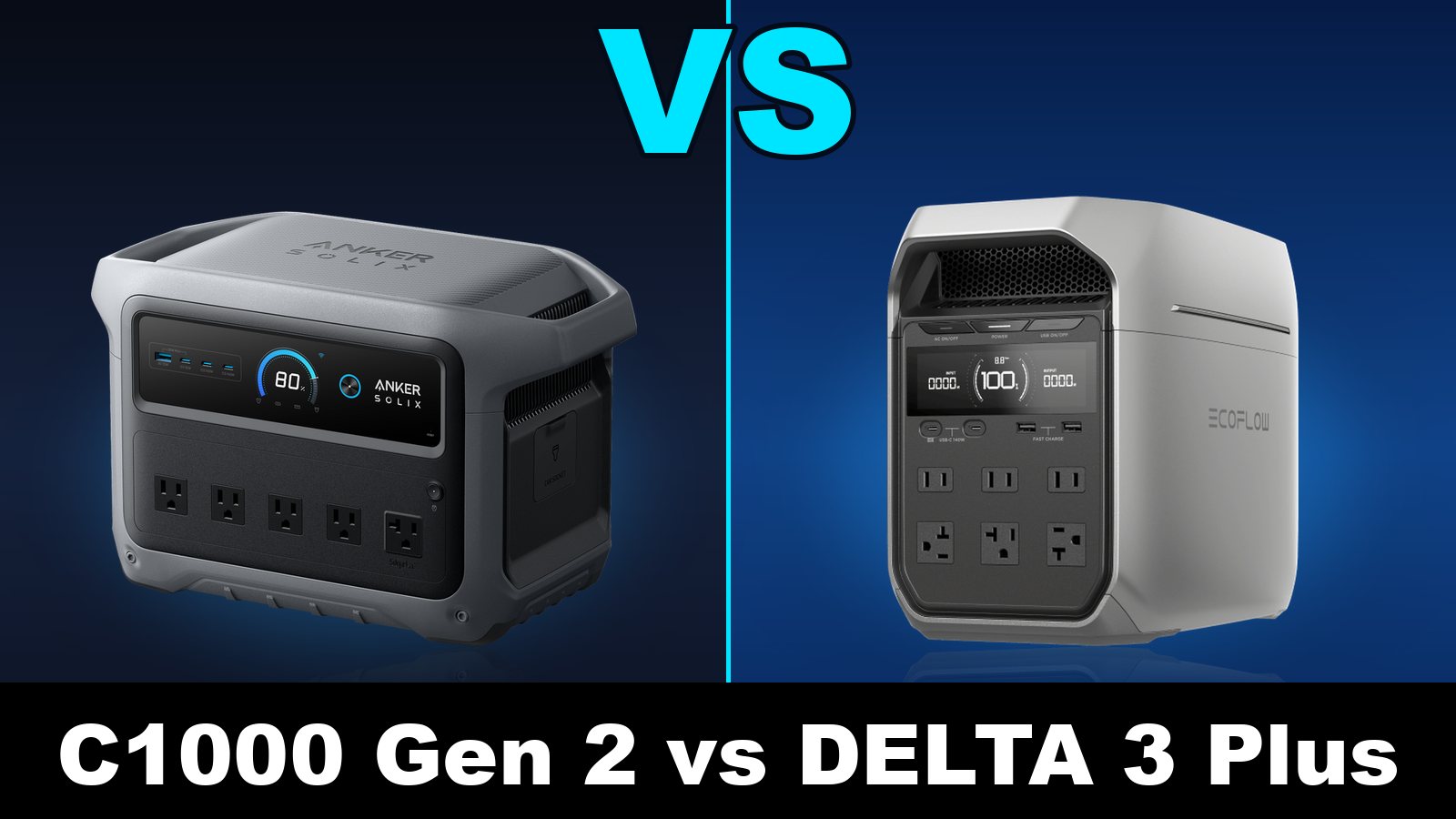

C1000 Gen 2
- you run up to 2,000W
- 1kWh covers you, for $249.01 less
- you carry it: 24.9 lb
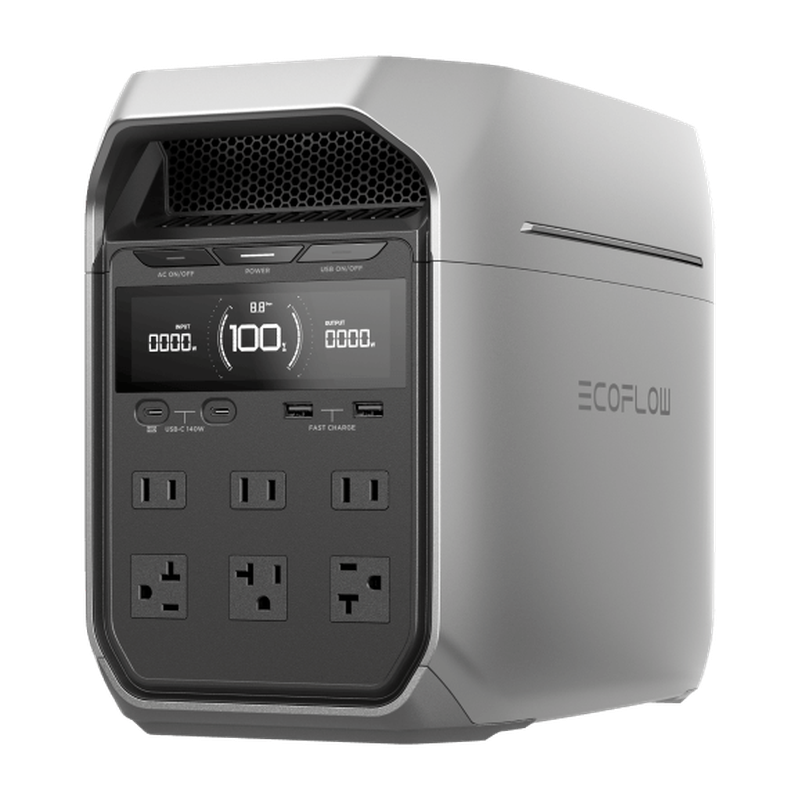
DELTA 3 Plus
- you’ll run up to 1,000W of solar
- you’ll grow to about 5kWh
- you run 12V barrel gear and a NAS
Prices and stock checked by our price engine on November 23, 2026 at 6:29 AM EST. Each product is rechecked several times a day; the time refreshes when you load the page.
The Plus is worth $249.01 more only if you own big panels or plan a second battery.
The Anker SOLIX C1000 Gen 2 and the EcoFlow DELTA 3 Plus both store 1,024Wh of LFP rated for 4,000 cycles and switch to battery in 10ms. The C1000 Gen 2 delivers 2,000W from five outlets, takes 600W of solar and refills in 49 minutes when warm, at 24.9 lb, and can’t be expanded. The DELTA 3 Plus delivers 1,800W from six outlets with two DC barrels, takes 1,000W of solar on two ports, has an IP65 battery pack and grows to about 5kWh, at 27.6 lb. If your panels stay under 600W and 1kWh is enough, the Gen 2 does the same job with more output.
Below: every difference with numbers, a 20-second calculator for your own gear, eight modeled situations, a third option, and what published tests found on each.
Same 1,024Wh, same 10ms UPS, same 4,000 cycles. The DELTA 3 Plus costs $249.01 more today for 400W more solar input, a battery port, a sixth outlet, two DC barrels and an IP65 pack; the C1000 Gen 2 has 200W more output, a slightly faster refill and is 2.7 lb lighter.
- you want 1kWh for $249.01 less
- you run up to 2,000W
- you carry it: 24.9 lb
- you own more than 600W of panels
- you’ll grow past 1kWh
- you run 12V barrel gear
The five differences that decide it
The five gaps that decide the purchase, with the better spec for most buyers flagged. Both store 1,024Wh of LFP rated for 4,000 cycles, switch to battery in 10ms, have a 12V car socket and a 140W USB-C, and charge from the wall in under an hour.
Will it run your setup? Check in 20 seconds
Estimates use 85% usable capacity and 70% of rated solar output. Real results vary with temperature, inverter load, shade and appliance cycling. Fridge and freezer watts are daily averages and do not include compressor startup surges.
Runtime by appliance, one at a time
Simple energy estimates, not measured runtimes. Same 1,024Wh, about 870Wh usable on both; OutdoorGearLab measured 890Wh from the C1000 Gen 2 and StorageReview 910Wh from the DELTA 3 Plus.
Same battery, same runtime.
The C1000 Gen 2 and the Plus both hold about 870Wh usable, so every appliance runs just as long on either one.Get our Black Friday alerts for power stations
We track live prices on 40+ models from Jackery, EcoFlow, BLUETTI and Anker SOLIX. When a deal beats the lowest price we've recorded, you'll hear from us. During Black Friday week, one short recap a day at most.
Unsubscribe in one click. We may earn a commission when you buy through our links, at no extra cost to you. Privacy Policy
The price gap, in numbers
Same 1,024Wh battery: the Anker SOLIX C1000 Gen 2 costs $249.01 less than the EcoFlow DELTA 3 Plus.
Prices refresh daily from Anker US and EcoFlow US.Check today’s price of both before you choose.
Same battery and the same 4,000-cycle rating, so the cost per kWh cycled follows the price gap of the day. For 2kWh, two Gen 2 units give you two separate 2,000W inverters but no shared battery; the Plus with an extra battery is one system you can run a single appliance from. Both prices move often; the figures are refreshed daily by our price engine.
The third option: the BLUETTI Elite 100 V2 at $549

BLUETTI Elite 100 V2: $549 today
If the Plus appeals for its 1,000W of solar but not for its price or its battery port, the Elite 100 V2 takes the same 1,000W from a single XT60 input, switches in 10ms and delivers 1,800W from four outlets, with two DC barrels and a car socket, at 25.3 lb in the smallest box of the three. Like the Gen 2, it can’t be expanded, and it charges at 600W by default unless you switch to Turbo. Our Elite 100 V2 review goes deeper. See the Elite 100 V2 at BLUETTI.
Eight modeled situations, worked out
Same formula as the calculator above, with no extra battery. The fridge averages 60W, about 525kWh a year.
24-hour outage, essentials only
Identical on one battery. Only the Plus can add a second for day two.
Refill from 1,000W of panels
With big panels, the Plus is full about an hour sooner, which matters on short winter days.
Refill from 400W of panels
No difference: below 600W of panels, the Plus’s extra solar input does nothing.
Microwave and toaster at once
Only the Gen 2 has the headroom, barely. On the Plus, run them one after the other.
12V gear in a van
The Plus runs barrel-plug gear without touching the inverter; the Gen 2 needs an adapter. The Plus also takes EcoFlow’s 800W Alternator Charger.
Growing the system
Only the Plus grows, with DELTA 3, DELTA 2, DELTA 2 Max or DELTA Pro 3 extra batteries.
A NAS or home office on UPS
Same runtime and both switch in 10ms; StorageReview measured just over 8ms on the Plus. The Plus can also tell a NAS to shut down over USB.
Carrying it
Both are one-hand carries; the Gen 2 is 2.7 lb lighter.
Nine more differences, the spec sheet and the box
Smaller gaps that rarely decide the purchase, then the full specifications and what ships in the box.
C1000 Gen 2 and DELTA 3 Plus weight, dimensions and full specifications
Weight: 24.9 lb for the C1000 Gen 2 and 27.6 lb for the DELTA 3 Plus. Dimensions: 15.1 × 8.2 × 9.6 in and 16 × 8.0 × 11 in. Everything else is in the sheet below.
Anker SOLIX C1000 Gen 2 and EcoFlow DELTA 3 Plus full specifications
Every published figure for both units, grouped. Green marks the better value.
What’s in the box
C1000 Gen 2
- C1000 Gen 2 power station1,024Wh, 24.9 lb
- AC charging cable
- User manual
- Solar cable sold separately
DELTA 3 Plus
- DELTA 3 Plus power station1,024Wh, 27.6 lb
- AC charging cable
- Manuals and warranty card
- Solar cable sold separatelyincluded with the solar bundles
- No extra battery, no Alternator Chargerboth sold separately
From the brands’ US product pages and manuals.
07 · ChargingHow fast each one refills
Shorter bar, faster refill. Each row is scaled to its slower unit.
C1000 Gen 2: OutdoorGearLab averaged 1,097Wh per hour from the wallDELTA 3 Plus: 800W Alternator Charger, Smart Generator at 1,500W
Our solar times assume panels deliver 70% of their rating; the brands’ figures assume ideal sun.
Every port, side by side
C1000 Gen 2
DELTA 3 Plus
Practical consequence: the Plus has a sixth AC outlet, two DC barrels, a battery port and inputs for an alternator charger and a generator. The Gen 2 has five outlets and a 140W USB-C, with its USB-A port and first USB-C sharing 20W.
09 · NoiseNoise and heat: C1000 Gen 2 vs Plus
On paper the EcoFlow DELTA 3 Plus is quieter under load: under 40dB at 1,200W, while Notebookcheck measured about 45dB on the Anker SOLIX C1000 Gen 2 under high load. But reviewers found the Plus’s fans run even at light loads.
The EcoFlow figures are brand ratings; the Anker 45dB is a measurement at 1 m on an EU unit.Every figure we found, with its source
What reviewers heard: Near maximum wattage the fan gets frustratingly loud (OutdoorGearLab); at very high charging rates the fans kick on loudly (CleanTechnica).
What reviewers heard: Fans tended to run even at low loads (Trusted Reviews, UK unit); still audible over a 700W vacuum, and warmer than expected on light loads (How-To Geek).
Measured by a tester Brand figure
- Cap the AC charging speed in the app overnight.
Cold and heat: C1000 Gen 2 vs Plus
The Anker SOLIX C1000 Gen 2 charges from 32°F to 104°F and runs from −4°F to 104°F. EcoFlow US publishes no temperature range for the EcoFlow DELTA 3 Plus, so we can’t compare them; the Plus has the only water rating, IP65 on its battery pack.
Figures from Anker US for the C1000 Gen 2; EcoFlow US publishes no range for the DELTA 3 Plus.- Charge the C1000 Gen 2 indoors in winter: it doesn’t charge below 32°F.
- EcoFlow publishes no range for the DELTA 3 Plus, so treat it the same way and charge it above freezing.
App, UPS and smart features
The EcoFlow DELTA 3 Plus does more: it takes extra batteries, prepares for storms and can signal a NAS. The Anker SOLIX C1000 Gen 2 answers with 1,600W UltraFast charging.
Same 10ms UPS, Wi-Fi and Bluetooth on both. The gap is expansion.Green zone: a switch under about 16ms, which most desktop PCs ride through without restarting.
Can you add a battery later? The EcoFlow DELTA 3 Plus takes DELTA 3, DELTA 2, DELTA 2 Max or DELTA Pro 3 extra batteries, up to about 5kWh; some need the XT150 cable sold with the Alternator Charger. The Anker SOLIX C1000 Gen 2 can’t be expanded.
Does it prepare for storms? The EcoFlow DELTA 3 Plus starts a charge when a weather alert hits your area; Anker lists no storm mode for the Anker SOLIX C1000 Gen 2.
Does it have a fast charging mode? The Anker SOLIX C1000 Gen 2 charges at 1,600W (49 minutes full) once UltraFast is turned on in the Anker app, Input section.
Does it work as a UPS? Both switch to battery in 10ms; StorageReview measured just over 8ms on the EcoFlow DELTA 3 Plus with a workstation load. The DELTA 3 Plus can also signal a NAS over USB through EcoFlow’s PowerManager and a NUT server.
Can it charge off-peak? Both have time-of-use scheduling in their app, to charge during off-peak hours.
Can it run a heater or kettle above its rating? SurgePad on the Anker SOLIX C1000 Gen 2 (2,400W) and X-Boost on the EcoFlow DELTA 3 Plus (2,200W) run heaters past the rating at reduced power. Neither helps motors.
How does the app connect? Both use their brand’s app over Wi-Fi and Bluetooth.
Warranty and support
Both reach 5 years. The EcoFlow DELTA 3 Plus gets them with no registration condition; Anker activates the Anker SOLIX C1000 Gen 2‘s 5-year coverage when you register it.
Same term at best. Only the Anker asks you to register.Subject to each brand’s warranty terms and eligibility.
Both are rated for 4,000 cycles to 80%, about 11 years at one full cycle a day. Anker’s US spec table for the C1000 Gen 2 does not list the warranty years; the 5 years come from Anker’s registration page.
- If you choose the C1000 Gen 2, register it with Anker: registration is what activates the 5-year coverage.
- The DELTA 3 Plus needs no registration for its 5 years.
What reviewers report
We have not lab-tested these two units. Here is what 10 published reviews found, with the source, author and date for each point. Reviews of UK and EU units are flagged: those models charge from 230V outlets and have different sockets, so their charge times and outlet findings don’t carry over to US units.
C1000 Gen 2: OutdoorGearLab (July 2026), Notebookcheck (December 2025, EU unit), CleanTechnica (September 2025), MacRumors (December 2025), Techaeris (November 2025)DELTA 3 Plus: StorageReview (January 2025), Trusted Reviews (February 2025, UK unit), How-To Geek (January 2025), T3 (January 2025), TechRadar (February 2025)
Usable capacity
- C1000 Gen 2Reviewer Their load bank measured 890Wh of the rated 1,024Wh, about 87%, well above average. OutdoorGearLab, Kenji Mowrey, July 2026
- C1000 Gen 2Reviewer At a steady 250W load (230V) it gave 850Wh, 83%, before stopping at 1%; lower with fluctuating loads. Notebookcheck, Marcus Schwarten, December 2025, EU unit
- C1000 Gen 2Reviewer Ran a full Mac setup (MacBook Pro, Studio Display, lights) for almost 24 hours. MacRumors, Juli Clover, December 2025
- PlusReviewer A full discharge delivered 910Wh from the 1,024Wh pack, about 89 percent. StorageReview, Dylan Dougherty, January 2025
- PlusReviewer A 1,000W heater ran almost exactly one hour and drew 888Wh, about 87 percent of rated capacity. Trusted Reviews, Harry Duncton, February 2025, UK unit
Charging
- C1000 Gen 2Reviewer Without the app’s boost mode AC charging took just under 55 minutes; 1,110Wh flowed in. EU charging power, flag. Notebookcheck, Marcus Schwarten, December 2025, EU unit
- C1000 Gen 2Reviewer Recharged to full in 49 minutes from a standard plug, drawing about 1,200W; 1,600W needs enabling. MacRumors, Juli Clover, December 2025
- PlusReviewer Refilling from empty took 1,180Wh from the wall, about 87 percent charging efficiency. StorageReview, Dylan Dougherty, January 2025
- PlusReviewer A full mains charge at 1,500W took 55 minutes and used 1,109Wh, about 92 percent efficient. Flag: UK 230V charging. Trusted Reviews, Harry Duncton, February 2025, UK unit
- PlusReviewer AC input peaked at 1,500W but mostly held 1,350 to 1,400W; the battery was full within an hour. How-To Geek, Mark LoProto, January 2025
Noise and heat
- C1000 Gen 2Reviewer Near maximum wattage the fan gets frustratingly loud, an issue carried over from the first generation. OutdoorGearLab, Kenji Mowrey, July 2026
- C1000 Gen 2Reviewer Measured about 45dB at 1m under high output and fast AC charging; much quieter at low load. Notebookcheck, Marcus Schwarten, December 2025, EU unit
- PlusReviewer Fans tended to run even at low loads, which the reviewer found distracting. Trusted Reviews, Harry Duncton, February 2025, UK unit
- PlusReviewer With a 700W vacuum running, the station fan was still audible over the vacuum. How-To Geek, Mark LoProto, January 2025
- PlusReviewer The unit got warmer than expected even on light loads, and the reviewer questions its temperature control. How-To Geek, Mark LoProto, January 2025
UPS and output
- C1000 Gen 2Reviewer It ran a refrigerator and gear flawlessly over a 4-day Cybertruck road trip used as a buffer battery. CleanTechnica, Kyle Field, September 2025
- PlusReviewer Measured UPS transfer time was just over 8ms with a workstation load, inside EcoFlow’s 10ms claim. StorageReview, Dylan Dougherty, January 2025
- PlusReviewer In simulated outages the router, modem, computer and monitor stayed on without any blips. TechRadar, Collin Probst, February 2025
Daily use and issues
- C1000 Gen 2Reviewer Measured weight 25.2 lb, one of the best power-to-weight ratios they have tested. OutdoorGearLab, Kenji Mowrey, July 2026
- C1000 Gen 2Reviewer Compared with Gen 1 it lost the expansion port and the built-in LED light. Notebookcheck, Marcus Schwarten, December 2025, EU unit
- C1000 Gen 2Reviewer At 24.9 lb it is easy to lift with one hand. CleanTechnica, Kyle Field, September 2025
- C1000 Gen 2Reviewer App over Wi-Fi or Bluetooth shows draw and time left, toggles outputs and sets charging power. MacRumors, Juli Clover, December 2025
- PlusReviewer The app showed the unit charging at about 1.45kW against its 1500W rating. StorageReview, Dylan Dougherty, January 2025
- PlusReviewer Only three of the AC outlets are three-pronged, listed as the main drawback. TechRadar, Collin Probst, February 2025
Practical limits before you buy
- The C1000 Gen 2 can’t be expanded. 1,024Wh is its ceiling.
- The Plus’s 1,000W solar needs two strings of up to 500W each, one per XT60i port.
- The Plus stops at 1,800W, the Gen 2 at 2,000W.
- Only three of the Plus’s six AC outlets are three-prong, per TechRadar.
- The Gen 2’s 49-minute refill needs the battery above 68°F, per Anker.
- The Gen 2’s USB-A port and first USB-C share 20W.
- Solar cables are extra on both.
- C1000 Gen 2, per its US documentation: UltraFast charging only activates when battery temperature is above 68F (20C); charging at 32-68F is significantly slower.
- C1000 Gen 2, per its US documentation: USB-A and USB-C1 share a 20W total limit; only USB-C2 reaches 140W.
- C1000 Gen 2, per its US documentation: Not expandable; Anker recommends the original C1000 for users who need extra capacity.
- C1000 Gen 2, per its US documentation: Normal AC charging 1,200W max; AC bypass 1,800W max; solar 600W, 60V max.
- DELTA 3 Plus, per its US documentation: AC and Smart Generator charging capped at 1500W; solar 2 x 500W (11-60V).
Frequently asked questions
What is the difference between the Anker C1000 Gen 2 and the EcoFlow DELTA 3 Plus?
Same 1,024Wh, 10ms UPS and 4,000 cycles. The C1000 Gen 2 delivers 2,000W and is lighter; the DELTA 3 Plus takes 1,000W of solar, has 13 outputs including DC barrels and grows to about 5kWh.
Is the DELTA 3 Plus worth the extra money?
Only if you’ll use more than 600W of panels or add batteries. Otherwise the Gen 2 matches it on battery and UPS; the price section shows today’s gap.
Which is cheaper?
The Anker SOLIX C1000 Gen 2 costs $249.01 less today: $469.99, against $719 for the EcoFlow DELTA 3 Plus. Prices refresh daily; the price section above has the full breakdown.
Can either be expanded?
Only the DELTA 3 Plus, to about 5kWh with EcoFlow extra batteries.
Which charges faster?
From the wall, the Gen 2 by a few minutes when warm: 49 against 56. From solar, the Plus, if you have more than 600W of panels.
Which is better as a UPS?
Both switch in 10ms. The Plus adds USB signaling for a NAS.
How long will each run a refrigerator?
At a 60W average and 85% usable capacity: about 14.5 hours on either, before extra batteries.
How much do they weigh?
24.9 lb for the C1000 Gen 2 and 27.6 lb for the DELTA 3 Plus.
Related comparisons and reviews
How we compared and sources
Research-based comparison. We have not physically tested these two units. Specs come from Anker and EcoFlow US documentation; usage observations are attributed to named reviewers. Prices and availability were checked on October 30, 2026.
- Specs: Anker US, C1000 Gen 2, and EcoFlow US, DELTA 3 Plus, read on October 30, 2026.
- Reviewer reports on the C1000 Gen 2: OutdoorGearLab, Kenji Mowrey, July 2026, Notebookcheck, Marcus Schwarten, December 2025, EU unit, CleanTechnica, Kyle Field, September 2025, MacRumors, Juli Clover, December 2025, Techaeris, Alex Hernandez, November 2025; on the DELTA 3 Plus: StorageReview, Dylan Dougherty, January 2025, Trusted Reviews, Harry Duncton, February 2025, UK unit, How-To Geek, Mark LoProto, January 2025, T3, Matt Kollat, January 2025, TechRadar, Collin Probst, February 2025.
- Runtime = capacity × 0.85 ÷ watts. Solar harvest = min(panel watts, max input) × sun hours × 0.70. Cost per lifetime kWh = price ÷ (cycles × capacity in kWh).
Same 1,024Wh and 10ms UPS. The C1000 Gen 2 has 2,000W for $249.01 less; the DELTA 3 Plus takes 1,000W of solar and grows to about 5kWh.
Prices checked November 23, 2026 at 6:29 AM EST
Looking at other models? Browse all power station comparisons, or pick any two models on the hub and we point you to the right duel.
Originally published: November 21, 2026