
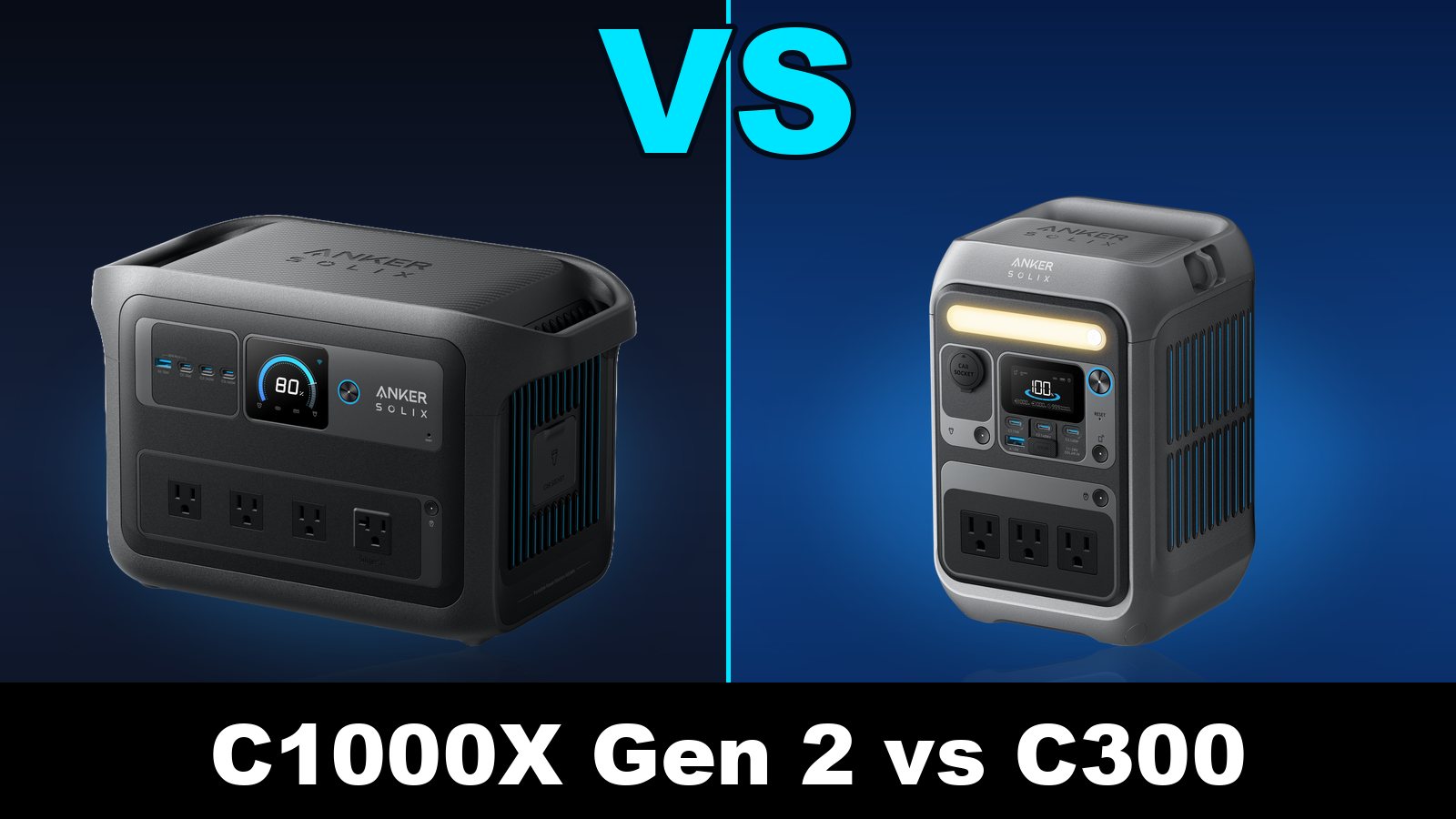

C1000X Gen 2
- you keep a fridge running through an outage
- you run a microwave or a kettle: 2,000W
- you refill from 600W of solar

C300
- you carry it: 9.1 lb
- a router or a laptop is the job
- it costs $270 less
Prices and stock checked by our price engine on November 21, 2026 at 7:00 PM EST. Each product is rechecked several times a day; the time refreshes when you load the page.
One keeps the kitchen going through a blackout; the other keeps the router up and rides in a backpack.
The Anker SOLIX C1000X Gen 2 stores 1,024Wh of LFP and runs 2,000W, with a 49-minute wall refill in UltraFlash mode and 600W of solar. The Anker SOLIX C300 stores 288Wh and runs 300W from three outlets, refills to 80% in 50 minutes and takes 100W of solar, at 9.1 lb. Both switch to battery in 10ms. For a router, phones and a laptop on a trip, the C300 is enough and has been weighed and tested; for a fridge, a microwave or a whole evening without power, it’s the C1000X Gen 2.
Below: what separates them with numbers, a 20-second calculator for your own gear, seven modeled situations, a third option with a full spec sheet, and what published tests found on the C300.
The C1000X Gen 2 costs $270 more today for 3.6 times the battery, 2,000W instead of 300W and six times the solar input. The C300 answers with a one-hand carry, the same 10ms UPS, two 140W USB-C ports and four published tests.
- you keep a fridge going
- you run more than 300W
- you refill from 600W of solar
- you carry it: 9.1 lb
- you charge laptops: two 140W USB-C
- you want it for $270 less
The five differences that decide it
The five gaps that decide the purchase, with the better spec for most buyers flagged. Both use LFP cells, switch to battery in 10ms, connect to the Anker app and carry a 5-year warranty; neither lists a battery port. The C1000X Gen 2’s US page is short, so some of its figures are missing.
Will it run your setup? Check in 20 seconds
Estimates use 85% usable capacity and 70% of rated solar output. Real results vary with temperature, inverter load, shade and appliance cycling. Fridge and freezer watts are daily averages and do not include compressor startup surges.
Runtime by appliance, one at a time
Simple energy estimates, not measured runtimes. About 870Wh usable on the C1000X Gen 2 and 245Wh on the C300; OutdoorGearLab measured 230Wh out of a C300, and no independent test has measured the C1000X Gen 2.
Appliance for appliance, the C1000X Gen 2 lasts 3.6 times as long as the C300.
Same appliance, same watts: the gap is always the size of the battery.Get our Black Friday alerts for Anker SOLIX
We track live prices on 40+ models from Jackery, EcoFlow, BLUETTI and Anker SOLIX. When a deal beats the lowest price we've recorded, you'll hear from us. During Black Friday week, one short recap a day at most.
Unsubscribe in one click. We may earn a commission when you buy through our links, at no extra cost to you. Privacy Policy
The price gap, in numbers
The Anker SOLIX C1000X Gen 2 costs $270 more than the Anker SOLIX C300 and adds 736Wh: that is $0.37 per extra Wh, against $1.49 per Wh for the C300.
Prices refresh daily from Anker US.Per watt-hour stored, the bigger battery is usually the better buy, and it is rated for 1,000 more cycles. The C300’s lower ticket buys portability, not value per Wh. Anker US prices move often; the figures here are refreshed daily by our price engine.
The third option: the Anker SOLIX C1000 Gen 2 at $469.99

Anker SOLIX C1000 Gen 2: $469.99 today
The C1000 Gen 2 has the C1000X Gen 2’s headline figures, 1,024Wh, 2,000W, a 10ms UPS, 600W of solar and a 49-minute refill, with a full spec sheet: five AC outlets, two 140W USB-C, 3,000W surge, 24.9 lb and five independent tests. Like the X, it has no battery port. Pick it if you want the 1kWh size with a published weight and port list; it weighs nearly three times as much as the C300. Our C1000 Gen 2 review goes deeper. See the C1000 Gen 2 at Anker.
Seven modeled situations, worked out
Same formula as the calculator above: 85% of the rated capacity, no extra battery. The fridge averages 60W, about 525kWh a year.
24-hour outage, essentials only
The C1000X Gen 2 covers an evening and a night; the C300 under three hours. Neither covers a full day on its own.
Full-size fridge through an outage
About 14 hours on the C1000X Gen 2, about 4 on the C300. Check the fridge’s startup draw against the C300’s 600W surge rating before relying on it.
A 1,100W microwave
Only the C1000X Gen 2. The C300 stops at 300W; SurgePad lowers the power of heating loads, but a microwave isn’t one.
Wi-Fi router through an outage
Both switch to battery in 10ms, per Anker, fast enough that the router doesn’t reboot. LanOC Reviews kept devices running through a power cut on a C300. The C300 keeps the router up for most of a day, the C1000X Gen 2 for about three.
A laptop at a campsite
Over USB the C300 does better than on AC: Trusted Reviews got 269Wh out at 60W. That’s about four hours of a 65W laptop, against about thirteen on the bigger station (modeled).
Refill from solar, each at its maximum
The C1000X Gen 2 refills faster despite holding 3.6 times as much, because it takes six times the solar. The C300 stops at 28V: wire panels in parallel.
Carrying it
The C300 goes in one hand or a backpack; OutdoorGearLab and LanOC Reviews both weighed about 9.1 lb. Anker gives no weight for the C1000X Gen 2; the C1000 Gen 2 with the same battery weighs 24.9 lb.
Ten more differences, the spec sheet and the box
Smaller gaps that rarely decide the purchase, then the full specifications and what ships in the box.
C1000X Gen 2 and C300 weight, dimensions and full specifications
Weight: Anker publishes none for the Anker SOLIX C1000X Gen 2; 9.1 lb for the C300. Dimensions: none published for the C1000X Gen 2; 6.46 × 6.34 × 9.45 in for the C300. Everything else is in the sheet below.
Anker SOLIX C1000X Gen 2 and Anker SOLIX C300 full specifications
Every published figure for both units, grouped. Green marks the better value.
What’s in the box
C1000X Gen 2
- C1000X Gen 2 power station1,024Wh
- AC charging cable
- Car charging cable
- Quick start guide, safety and warranty card
C300
- C300288Wh, 9.1 lb
- AC charging cable
- User manual
- Solar cable sold separately
From the Anker US pages and the C300’s manual.
07 · ChargingHow fast each one refills
Shorter bar, faster refill. Each row is scaled to its slower unit.
C1000X Gen 2: recharges from AC, solar, a car outlet, a generator or an alternator, per AnkerC300: OutdoorGearLab charged it from empty to full in 63 minutes on the supplied AC cord; LanOC Reviews saw about 325W at the fastest setting
Our solar times assume panels deliver 70% of their rating; the brands’ figures assume ideal sun.
Every port, side by side
C1000X Gen 2
C300
Practical consequence: Anker itemizes none of the C1000X Gen 2’s 9 ports; its product photo shows four AC outlets. The C300 has three AC outlets, two 140W USB-C and one 15W USB-C, a USB-A and a 12V socket, all documented, and one of the 140W ports also recharges it.
09 · NoiseNoise: C1000X Gen 2 vs C300
Both are quiet by Anker’s figures: 0 to 20dB under 200W for the Anker SOLIX C1000X Gen 2, 25dB from 3.3 ft for the Anker SOLIX C300. Reviewers found the C300 barely audible; no test has measured the C1000X Gen 2.
C300 observations come from UK, EU and US units.Every figure we found, with its source
What reviewers heard: A very quiet hum or slight hiss in normal use (Basic Tutorials, EU unit); the fan switched on during fast AC charging (LanOC Reviews).
Measured by a tester Brand figure
- Charge during the day, or lower the charging speed in the Anker app overnight.
Cold and heat: C1000X Gen 2 vs C300
The Anker SOLIX C300 charges from 32°F to 104°F and runs from −4°F to 104°F, per Anker. Anker publishes no range for the Anker SOLIX C1000X Gen 2.
Figures from Anker US for the C300; none published for the C1000X Gen 2.- Charge either one indoors in winter: the C300 doesn’t charge below 32°F, and Anker publishes no range for the C1000X Gen 2.
App, UPS and smart features
Same 10ms UPS and the Anker app on both: the Anker SOLIX C1000X Gen 2 adds a 1,500W fast-charging mode; the Anker SOLIX C300 charges at 330W and documents Wi-Fi and Bluetooth.
Neither lists a battery port.Green zone: a switch under about 16ms, which most desktop PCs ride through without restarting.
How does the app connect? The Anker SOLIX C300 connects over Wi-Fi or Bluetooth; the Anker SOLIX C1000X Gen 2 page mentions remote monitoring in the Anker app without naming the connection.
Can you add a battery later? The Anker SOLIX C300 has no battery port, and the Anker SOLIX C1000X Gen 2 page lists none.
Does it work as a UPS? Both switch to battery in 10ms per Anker, fast enough for a router. LanOC Reviews kept devices running through a power cut on the Anker SOLIX C300.
Does it have a fast charging mode? The Anker SOLIX C1000X Gen 2 reaches 49 minutes with UltraFlash switched on in the Anker app. The Anker SOLIX C300 charges at 330W and reaches 80% in 50 minutes.
Warranty and support
5 years on both: the Anker SOLIX C300 per its Anker US page, the Anker SOLIX C1000X Gen 2 once registered, per Anker’s registration page.
Same term; the C1000X Gen 2 is rated for 1,000 more cycles.Subject to each brand’s warranty terms and eligibility.
Anker rates the C1000X Gen 2 at 4,000 cycles to 80% capacity and the C300 at 3,000+, about 11 and 8 years at one full cycle a day. Calendar aging and heat also reduce capacity, so read the ratings as ceilings.
- Register the C1000X Gen 2 with Anker when it arrives: Anker’s registration page says that activates the 5-year coverage.
- Keep proof of purchase for either one.
What reviewers report
We have not lab-tested these two units. Here is what 4 published reviews found, with the source, author and date for each point. Reviews of UK and EU units are flagged: those models charge from 230V outlets and have different sockets, so their charge times and outlet findings don’t carry over to US units.
C1000X Gen 2: no verifiable independent test foundC300: OutdoorGearLab (July 2026), Trusted Reviews (December 2024, UK unit), Basic Tutorials (March 2026, EU unit), LanOC Reviews (November 2024)
Usable capacity
- C300Reviewer Measured 230Wh of usable energy from the rated 288Wh, about 80%, which they found underwhelming for a small battery. OutdoorGearLab, Kenji Mowrey, July 2026
- C300Reviewer From a full charge the AC outlets gave 240Wh at 100W and 238Wh at 200W. UK 230V inverter, battery data usable. Trusted Reviews, Simon Handby, December 2024, UK unit
- C300Reviewer Over USB at a constant 60W it delivered 269Wh, a strong 93.4% of rated capacity. Trusted Reviews, Simon Handby, December 2024, UK unit
Charging
- C300Reviewer With the supplied AC cord it charged from empty to full in 63 minutes. OutdoorGearLab, Kenji Mowrey, July 2026
- C300Reviewer A mains recharge at 330W took 66 minutes and drew 333Wh from the wall. UK mains unit, flag charging power. Trusted Reviews, Simon Handby, December 2024, UK unit
- C300Reviewer Mains and USB or solar charging cannot be combined; it switches to mains only once AC is present. Trusted Reviews, Simon Handby, December 2024, UK unit
- C300Reviewer Reached 80% in 43 minutes, faster than Anker’s 50-minute claim. EU 230V unit, flag charging power. Basic Tutorials, Simon Lüthje, March 2026, EU unit
Noise and heat
- C300Reviewer During mains charging it stayed reasonably cool with barely any fan noise. Trusted Reviews, Simon Handby, December 2024, UK unit
- C300Reviewer Barely audible in normal use, a very quiet hum or slight hiss, consistent with the 25dB claim. Basic Tutorials, Simon Lüthje, March 2026, EU unit
- C300Reviewer While charging, the housing warmed slightly and a faint warm-plastic smell was noticeable at first. Basic Tutorials, Simon Lüthje, March 2026, EU unit
- C300Reviewer Battery temperature reached 42C during fast AC charging, and the internal fan switched on. LanOC Reviews, Wes Compton, November 2024
UPS and output
- C300Reviewer Usable as a basic UPS thanks to the 10ms switchover, though they would pick a dedicated UPS first. OutdoorGearLab, Kenji Mowrey, July 2026
- C300Reviewer Verdict: fine for devices and small appliances, but not something to rely on through a power outage. OutdoorGearLab, Kenji Mowrey, July 2026
- C300Reviewer At a full 300W load the UK unit cut out immediately; a mixed load of about 255W ran fine. Flag: UK inverter. Trusted Reviews, Simon Handby, December 2024, UK unit
- C300Reviewer A PC drawing 94W ran for 2 hours 13 minutes from 81% charge, close to the 2.2-hour app estimate. LanOC Reviews, Wes Compton, November 2024
Daily use and issues
- C300Reviewer Measured weight was 9.1 lb, light enough to carry in a backpack to a campsite. OutdoorGearLab, Kenji Mowrey, July 2026
- C300Reviewer A sliding cover blocks the 140W USB-C port whenever the solar input is in use. OutdoorGearLab, Kenji Mowrey, July 2026
- C300Reviewer The app shows charging power, battery level, temperature and active ports more conveniently than the screen. Basic Tutorials, Simon Lüthje, March 2026, EU unit
- C300Reviewer The first launch sample drained abnormally fast past half charge; Anker’s replacement unit did not have the problem. LanOC Reviews, Wes Compton, November 2024
- C300Reviewer The app lets you pick 100W, 200W or 330W AC charging and schedule the AC outlets. LanOC Reviews, Wes Compton, November 2024
Practical limits before you buy
- The C300 stops at 300W. A microwave, a kettle, a coffee maker or a hair dryer won’t run on it.
- Anker doesn’t itemize the C1000X Gen 2’s ports or publish its weight. Count the outlets on the unit you buy if you need more than four.
- The C1000X Gen 2’s 49-minute refill needs UltraFlash, switched on in the Anker app.
- The C300’s solar input stops at 28V. Wire panels in parallel, not in series.
- On the C300, a sliding cover blocks the 140W USB-C port while the solar input is in use, per OutdoorGearLab.
- Neither lists a battery port. 1,024Wh and 288Wh are the ceilings.
- The C300 doesn’t charge below 32°F; Anker publishes no range for the C1000X Gen 2. Charge either one indoors in winter.
- C1000X Gen 2, per its US documentation: The 0-20dB quiet claim applies only under 200W load.
- C1000X Gen 2, per its US documentation: Fast AC recharging uses a 1,500W AC input and must be activated in the app to reach 49 minutes.
- C1000X Gen 2, per its US documentation: Solar input up to 600W; full solar recharge about 1.8 hours in optimal sun.
- C1000X Gen 2, per its US documentation: 2,000W output across 9 ports, 2,400W surge support; battery keeps over 80% after 4,000 cycles.
- C300, per Anker US and its A1722 manual: USB-C recharging and XT-60 (solar or car) recharging cannot be used at the same time; a sliding cover blocks one port.
Frequently asked questions
What is the difference between the Anker C1000X Gen 2 and the C300?
Size. The C1000X Gen 2 stores 1,024Wh and runs 2,000W, with 600W of solar. The C300 stores 288Wh and runs 300W from three outlets, with 100W of solar, at 9.1 lb. Both have a 10ms UPS, LFP cells and the Anker app.
Which is cheaper?
The Anker SOLIX C300 costs $270 less today: $429.99, against $699.99 for the Anker SOLIX C1000X Gen 2. Prices refresh daily; the price section above has the full breakdown.
Can the C300 run a fridge?
A fridge averaging 60W for about 4 hours, if its startup draw stays within the 600W surge rating. The C1000X Gen 2 runs the same fridge for about 15 hours.
Can the C300 run a microwave?
No. It stops at 300W. The C1000X Gen 2 runs a 1,100W microwave for about 47 minutes.
Do both work as a UPS?
Yes. Both switch to battery in 10ms, per Anker.
How much usable energy does the C300 give?
OutdoorGearLab measured 230Wh through AC; Trusted Reviews measured 238 to 240Wh through AC and 269Wh over USB at 60W (UK unit). No test has measured the C1000X Gen 2.
How much do they weigh?
9.1 lb for the C300, per Anker and two reviewers’ scales. Anker publishes no weight for the C1000X Gen 2, only that it is 11% lighter than comparable units.
What warranty do they have?
5 years on both: the C300 per its Anker US page, the C1000X Gen 2 once registered, per Anker’s registration page.
Related comparisons and reviews
How we compared and sources
Research-based comparison. We have not physically tested these two units. Specs come from the Anker US pages of both models, the C300’s US user manual and Anker’s US registration page; the C1000X Gen 2 page has no full spec table. Usage observations are attributed to named reviewers. Checked on October 31, 2026.
- Specs: Anker US, C1000X Gen 2 (A1765111), Anker’s US warranty registration page, Anker US, C300 and its US user manual (A1722), read on October 31, 2026.
- The C1000X Gen 2 page has no spec table: no weight, size, temperature range or port list. Its four AC outlets are counted on Anker’s product photo.
- Reviewer reports on the C300: OutdoorGearLab, Kenji Mowrey, July 2026, Trusted Reviews, Simon Handby, December 2024, UK unit, Basic Tutorials, Simon Lüthje, March 2026, EU unit, LanOC Reviews, Wes Compton, November 2024.
- Runtime = capacity × 0.85 ÷ watts. Solar harvest = min(panel watts, max input) × sun hours × 0.70. Cost per lifetime kWh = price ÷ (cycles × capacity in kWh).
1,024Wh and 2,000W against 288Wh and 300W. Same 10ms UPS; the C300 weighs 9.1 lb.
Prices checked November 21, 2026 at 7:00 PM EST
Looking at other models? Browse all power station comparisons, or pick any two models on the hub and we point you to the right duel.
Originally published: November 14, 2026