
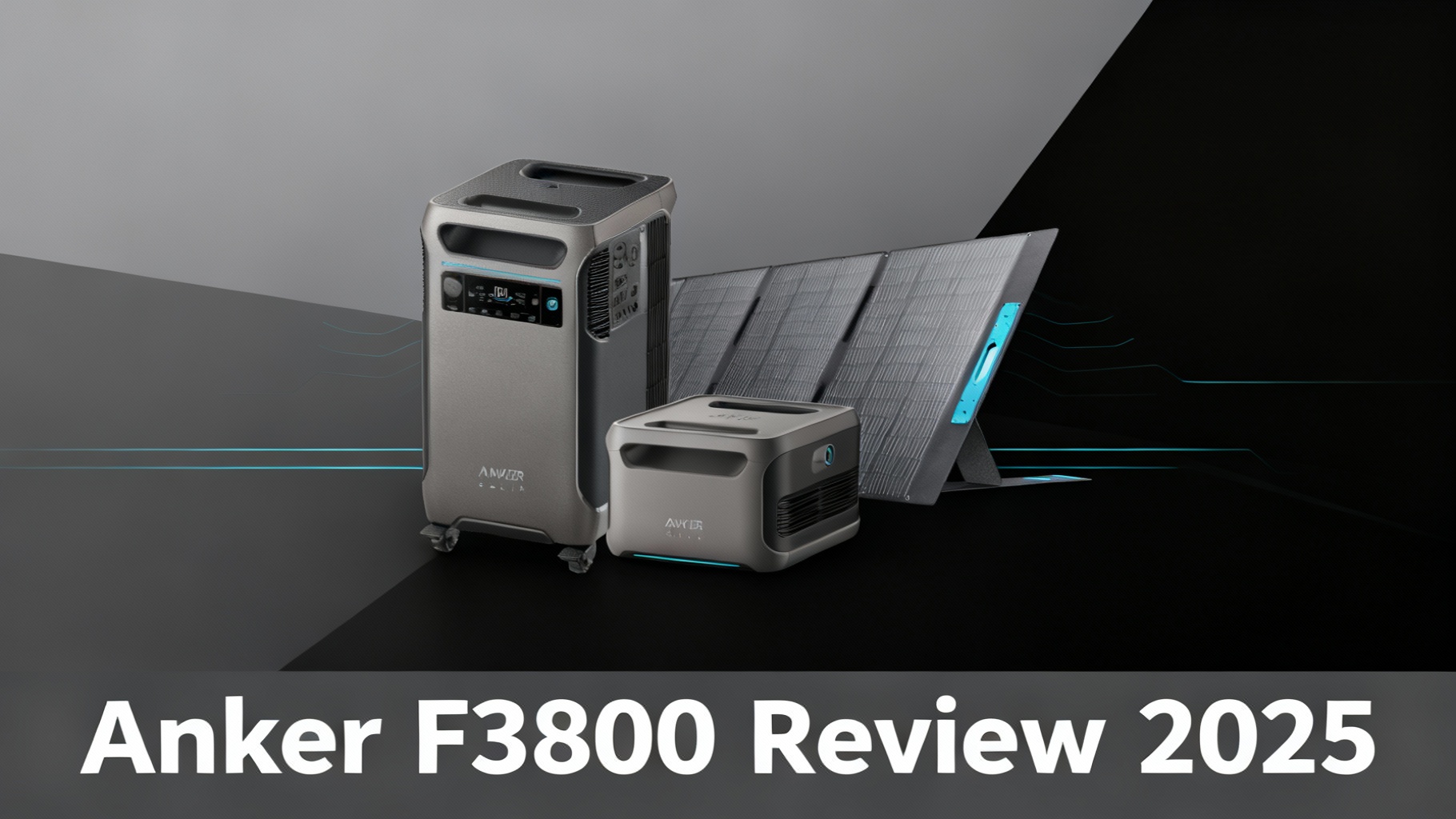

What if a power outage didn’t mean panic mode anymore? That’s the promise behind whole-home backup systems, from portable powerhouses like the F3800 to Anker’s modular E10 system, but most solutions either cost a fortune or can’t actually power what matters. The Anker SOLIX F3800 enters this space with an ambitious pitch: 6000W of split-phase power, a 10-year lifespan, and a price tag of $1,799.99 for the station alone.
We compared Anker’s specs with the loads that matter in a whole-home outage, from central AC and refrigerators to power tools. Here’s the verdict upfront: The F3800 delivers on its whole-home power promise, earning a solid 9.2/10. It’s one of the few portable power stations that can genuinely claim to back up an entire house during an outage, thanks to that rare split-phase 240V output. The InfiniPower™ battery tech promises 3,000 cycles to 80% capacity, which works out to about 8 years of daily full cycles (3,000 ÷ 365), and Anker quotes 10+ years of lifespan.
But here’s the thing—at 132 pounds and starting around $3,500 for meaningful bundle configurations, this isn’t a grab-and-go camping unit. It’s designed for homeowners who want serious backup power without installing a $10,000+ permanent generator.
🏆 Best Anker SOLIX F3800 Bundle
Why we recommend it: The Home Backup Kit bundle gives you everything needed for whole-home installation: F3800 unit, 6-circuit transfer switch, inlet box, and power cable. Perfect starting point for emergency preparedness.
$3,549 (was $5,497) | Free Protective Cover + 200W Solar Panel (Limited Time) | Compare all Anker SOLIX models
Get our Black Friday alerts for Anker SOLIX
We track live prices on 40+ models from Jackery, EcoFlow, BLUETTI and Anker SOLIX. When a deal beats the lowest price we've recorded, you'll hear from us. During Black Friday week, one short recap a day at most.
Unsubscribe in one click. We may earn a commission when you buy through our links, at no extra cost to you. Privacy Policy
Quick Specs & What’s in the Box
Real-World Look: The Anker SOLIX F3800 in Use
Studio renders only tell part of the story. Here is the Anker SOLIX F3800 as it actually looks in a real owner’s hands, away from the polished marketing shots.
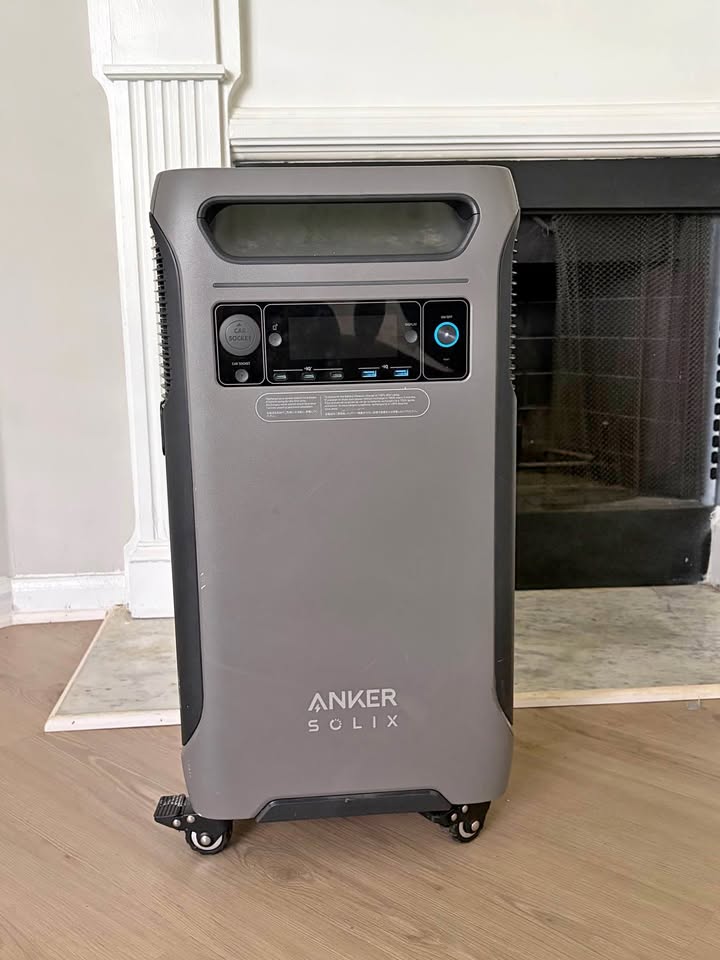
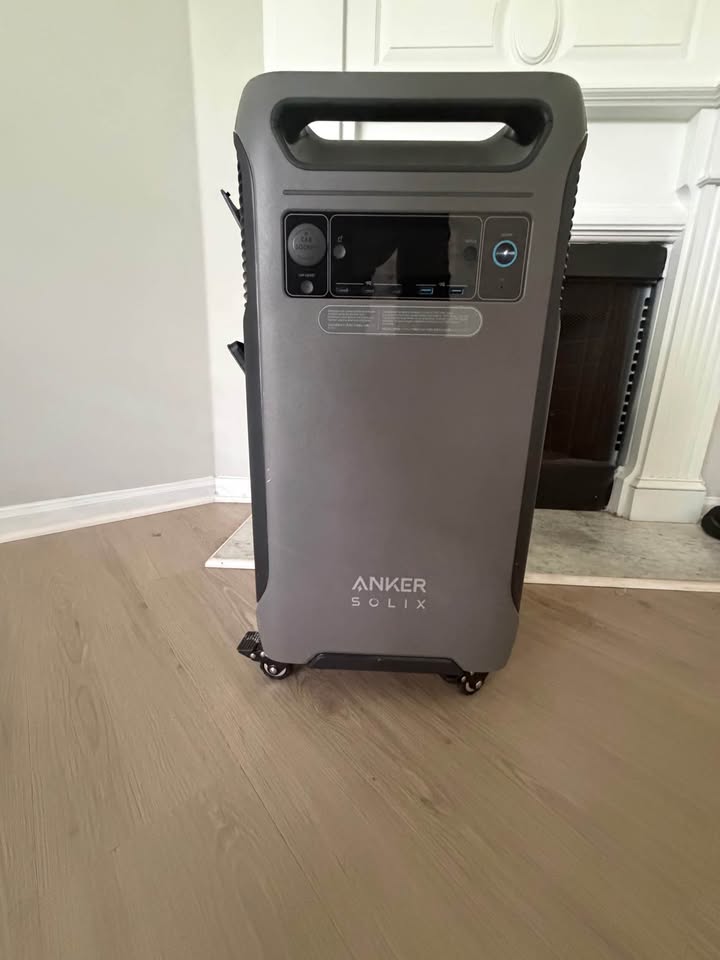
Real-world photos of the Anker SOLIX F3800.
Let’s start with the numbers that matter. The F3800 sits at the top of Anker’s consumer lineup, and the specs reflect that positioning.


Anker sells the F3800 on its own or bundled with accessories, depending on your needs. The most common configurations include the Home Backup Kit bundle at $3,549 which adds the transfer switch and cables, and solar panel bundles ranging from $3,799 to $4,599.
💡 Pro Tip: The 132-pound weight isn’t a typo. If you’re setting this up as permanent home backup, that weight becomes irrelevant. For camping? Look at lighter 50-80 pound options like the Anker F2000 instead.
Get our Black Friday alerts for Anker SOLIX
We track live prices on 40+ models from Jackery, EcoFlow, BLUETTI and Anker SOLIX. When a deal beats the lowest price we've recorded, you'll hear from us. During Black Friday week, one short recap a day at most.
Unsubscribe in one click. We may earn a commission when you buy through our links, at no extra cost to you. Privacy Policy
Power Output Comparison Chart
F3800 vs Top Competitors: Output Power
The F3800 delivers true split-phase 240V power for well pumps, EV chargers, and central HVAC systems.
Design & Build Quality
The F3800’s design language screams “industrial tool” rather than “consumer electronics.” That’s intentional. The housing uses reinforced plastic and aluminum, with rubberized corners. Anker fits it with industrial-grade wheels for rolling and handles at the top and bottom for carrying.

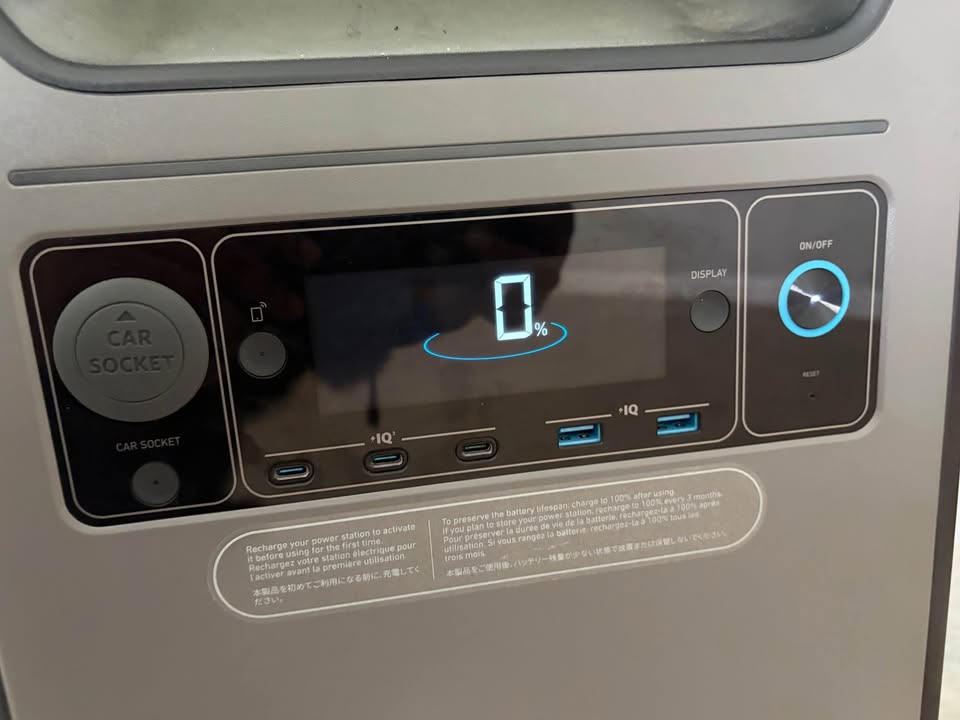
The front panel houses a 3.5-inch color LCD display showing real-time input/output wattage, battery percentage, time remaining estimates, and active port indicators.
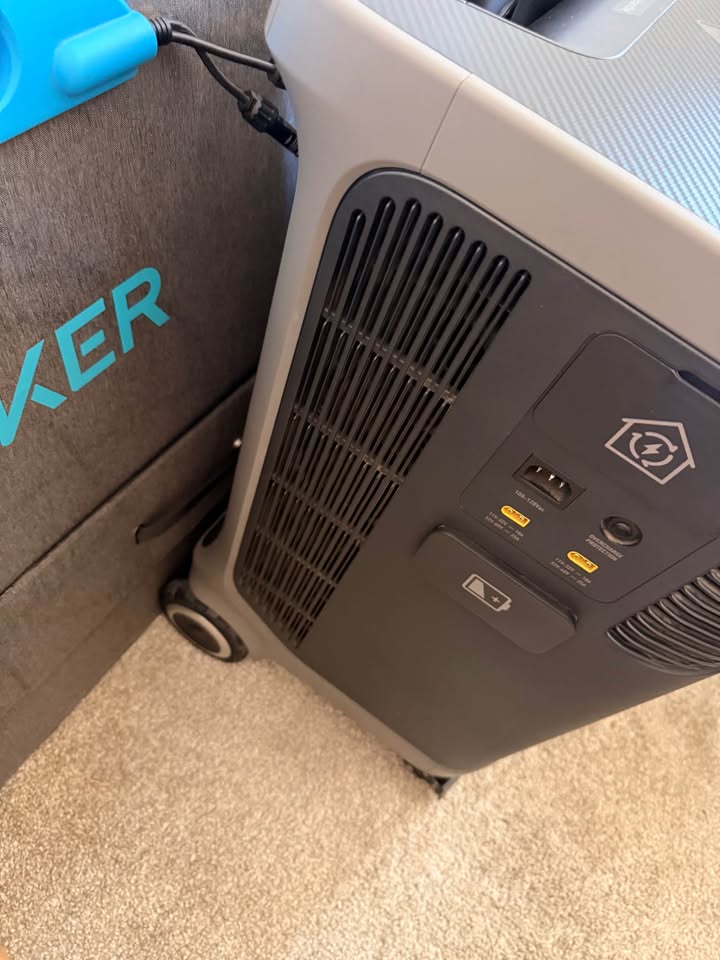
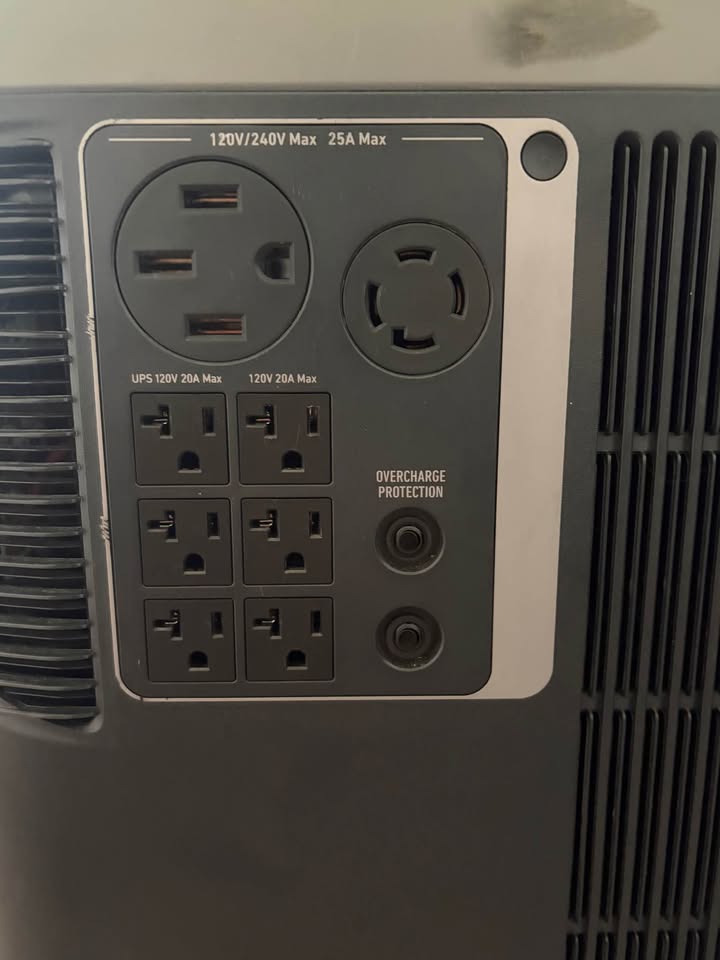
Port selection is where the F3800 differentiates itself. Anker lists six 120V AC outlets (NEMA 5-20), three 100W USB-C Power Delivery ports, two 12W USB-A ports, and a 120W car outlet. What makes this special are the heavy-duty side panel outlets: one NEMA 14-50 (RVs and Level 2 EV chargers) and one L14-30 for connecting to your home’s electrical panel via transfer switch.
⚡ Ready to Power Your Whole Home?
The F3800 delivers 6000W split-phase output—enough to run central AC, well pumps, and EV chargers simultaneously. Perfect for serious home backup without generator maintenance.
From $3,799 | 2× or 3× 400W Panels | Free Shipping
Expected Performance
Specs on paper only matter if they cover what you actually need to run. Here’s how Anker’s ratings line up with common household loads. Every runtime below is an estimate based on capacity and load.
AC Output & Inverter Performance
Anker rates the F3800 at 6,000W of continuous output, enough to run space heaters, hair dryers, and power tools at the same time as long as their combined draw stays under that figure. The 9,000W surge rating covers motor startups: a 2-ton central air conditioner with a 4,800W startup surge sits well within it.
Our runtime estimates assume inverter efficiency of around 85%, typical for pure sine wave inverters at this scale. When drawing 3,000W from AC outlets, you’re actually pulling about 3,530W from the battery. This matters for runtime calculations—always factor in that 15% conversion loss.
⚠️ Important: The split-phase 240V capability is the F3800’s killer feature. Most portable power stations max out at 120V, meaning you can’t run well pumps, certain electric water heaters, or Level 2 EV chargers. The F3800 delivers genuine 120V/240V split-phase power.
Runtime Estimates
Runtime depends entirely on what you’re powering. Here’s what our runtime formula (3,840Wh × 0.85 ÷ load in watts) gives with common appliances:
- Full-size refrigerator (150W average): about 21.5 hours
- 1,500W space heater at full blast: about 2.1 hours (resistive heating drains fast)
- Home office setup (170W total): about 19 hours of backup power
- 2-ton central AC (2,400W): about 1.3 hours of continuous runtime
Pass-through charging is supported, which matters if you’re using it as a buffer in a solar setup. One caveat from Anker: while the F3800 recharges from AC power, only its 120V UPS outlet can power other devices, and the 240V output can’t be used.
Charging Performance
For wall charging, Anker lists a maximum AC input of 1,800W.
Solar charging goes up to 2,400W through two inputs (1,200W each), and Anker says it can fully recharge the F3800 in under 2 hours in optimal sunlight. Actual solar input depends on your panels’ total wattage, the sun angle and cloud cover. For optimal solar charging, check out our guide on sizing solar generators for home backup.
More Photos of the F3800
Expandability Roadmap
Scale from 3.84kWh to 26.9kWh
Base F3800
3.84kWh
Runs a 150W fridge for about 21.5 hours
+ 2 BP3800
11.5kWh
Runs a 150W fridge for about 2.7 days
+ 6 BP3800
26.9kWh
Runs a 150W fridge for about 6 days
Each BP3800 Expansion Battery adds 3,840Wh capacity. Connect up to 6 for maximum 26.9kWh total system capacity.

The F3800 can chain up to six BP3800 expansion batteries for a total system capacity of 26.9kWh. Each expansion battery adds 3,840Wh and costs $1,799.99. The batteries connect via proprietary cables—no tools required, just plug and lock. With one expansion battery added, total capacity reaches 7,680Wh.
For homeowners who prefer a permanently installed modular solution, Anker also offers the E10 system, which takes a different approach to home backup.
Key Features Breakdown
InfiniPower™ Battery System
Anker’s InfiniPower™ tech combines LiFePO4 cells, advanced BMS, and superior thermal monitoring. The 3,000 cycle rating to 80% capacity is genuine—LFP chemistry typically delivers 3,000-5,000 cycles depending on depth of discharge and temperature management.
What does 3,000 cycles mean in practical terms? If you fully discharge and recharge every single day, you’d hit 3,000 cycles in about 8.2 years. At that point, the battery would still hold 80% of its original capacity (roughly 3,072Wh remaining). For most home backup users who only cycle during outages, you’re looking at well over 10 years of useful life.
Smart App Integration
The Anker SOLIX app (iOS and Android) connects via Bluetooth or WiFi. The app shows input/output watts, battery percentage, estimated runtime, and charge time remaining. You can turn individual outlet banks on or off remotely.
One genuinely useful feature: historical data logging. The app tracks daily energy consumption and generation (if you have solar connected) and builds charts over time. For setup guidance, see our Anker SOLIX app features guide.
🔋 Need More Capacity?
Expand your F3800 system from 3.84kWh to 26.9kWh with BP3800 batteries. Each adds 3,840Wh—perfect for multi-day outages or off-grid living. It’s also our top pick as the best power station for homestead use.
The Anker SOLIX F3800’s closest competitor is the EcoFlow DELTA Pro 3, which trades Anker’s modular expansion approach for faster AC charging and tighter smart-home integration via the Smart Home Panel.
View F3800 + Expansion Bundle →
$4,599 (was $7,397) | Includes 1× BP3800 + 400W Panel
Pros, Cons & Overall Rating
Let’s break down what works and what doesn’t.
Overall Rating: 9.2/10
Anker SOLIX F3800 Overall Rating
9.2/10
“The ultimate whole-home backup solution for those who refuse to compromise”
| ⚡ Performance: | 9.8/10 |
| 💰 Value: | 8.5/10 |
| 🎨 Design: | 9.0/10 |
| 🔋 Battery Life: | 9.6/10 |
| 🌟 Features: | 9.4/10 |
Portability is the F3800’s main weakness. If you need something you can carry to different locations regularly, this isn’t it. But for semi-permanent or permanent home backup, that weight becomes irrelevant.
Who Should (and Shouldn’t) Buy
This is the right choice if you:
Need genuine whole-home backup power. If you want to run your well pump, charge your EV, or power a 240V appliance during an outage, the split-phase output makes this one of the only portable options. If you have a larger property, check our guide on the best Anker SOLIX systems for large houses. For comprehensive guidance on home backup systems, check our whole-home backup power station guide.
Plan to use it as a daily solar battery. The 10-year lifespan and fast solar charging make this viable for daily cycling. If you’re offsetting peak electricity rates with solar, the F3800 can charge during the day and discharge during expensive evening hours.
Want to avoid generator maintenance. No oil changes, no carburetor cleaning, no stale fuel problems. The F3800 can sit in your garage between outages, as long as you top it up: Anker recommends charging it to 100% every 3 months.
This is NOT the right choice if you:
Need a portable camping power station. At 132 pounds, you’re not hauling this around casually. If you want serious power in a lighter package, the F3000 is a more portable alternative. There are also options in the 50-80 pound range with 1,500-2,500Wh capacity for camping.
Expect to run central AC all day. The math doesn’t work. A 2-ton AC will drain the F3800 in about 1.3 hours (3,840Wh × 0.85 ÷ 2,400W). Even with two expansion batteries (11,520Wh total), you’re looking at under 5 hours.
Are on a tight budget. The base bundles start around $3,500. You can get 3,000Wh units with 2,000-3,000W output for under $2,000 from other brands.
Frequently Asked Questions
How long will the Anker F3800 run a refrigerator?
A full-size refrigerator (150W average) will run for about 21.5 hours on the F3800’s 3,840Wh capacity. Factor in 85% inverter efficiency: 3,840Wh × 0.85 = 3,264Wh ÷ 150W = 21.76 hours, or about 21.5 hours of continuous runtime.
Can the F3800 power a central air conditioner?
Yes, with caveats. A 2-ton central AC (2,400W running, 4,800W startup) will START successfully (9000W surge), but runtime is limited: ~1.3 hours at full load (3,840Wh × 0.85 ÷ 2,400W). Better suited for window units or emergency backup.
What’s the difference between F3800 and F3800 Plus?
The F3800 Plus is an official model that Anker sells alongside the F3800. Anker’s comparison table lists generator bypass on the F3800 Plus but not on the F3800. Base F3800 specs: 3,840Wh, 6000W output, 10-year lifespan. If you’re comparing the F3800 to other high-capacity Anker models, see our F3000 vs F3800 comparison.
Is the F3800 better than EcoFlow Delta Pro 3?
Depends on priorities. F3800 wins: 6000W output (vs 4000W), 10-year lifespan. Delta Pro 3 wins: Lighter weight, built-in EPS. On price, the F3800 currently sells for $1,799.99 and the Delta Pro 3 for $2,799. See our F3800 vs EcoFlow Delta Pro 3 comparison for detailed analysis.
How many solar panels do I need for F3800?
For 2400W max input, use 6× Anker PS400 (400W each). Budget option: 8× Renogy 200W panels ($1,600) vs 6× Anker PS400 ($2,400). Actual input usually stays below the 2,400W maximum, depending on sun angle and cloud cover. If you’re considering the F3000 instead, check our F3000 solar setup guide for panel requirements.
Can I use the F3800 while it’s charging?
Yes, pass-through charging is supported, with a limit: while the F3800 recharges from AC power, Anker says only its 120V UPS outlet can power other devices, and the 240V output can’t be used. AC charging tops out at 1,800W.
What’s included with the Home Backup Kit?
The Smart Home Power Kit ($449 separate) includes: Pro/Tran 2® 30A 6-circuit transfer switch, L14-30 inlet box, 10ft power cable. For detailed installation steps, see our Anker SOLIX transfer switch guide. Installation requires basic electrical knowledge.
How loud is the F3800 under load?
Anker doesn’t list a noise rating on the F3800 product page, so we can’t give you a reliable number. Like most large power stations, it uses cooling fans that get louder under heavy loads, so if noise matters, place it in a garage or utility room rather than a living space.
Final Verdict
The F3800 earns its 9.2/10 rating by delivering on a simple promise: genuine whole-home backup power in a (technically) portable package. That split-phase 240V output isn’t just a spec sheet bullet point—it’s the feature that makes this unit relevant for serious home backup rather than just oversized camping gear. One use case where the F3800 truly shines is medical-grade backup, especially for chronic-care patients on home dialysis who need expandable multi-day capacity.

The 10-year lifespan backed by 3,000 LFP cycles means this is a long-term investment rather than a disposable gadget. At $3,549 for the Home Backup Kit bundle or $3,799 for solar configurations, you’re paying premium pricing for premium features. The math works if you value that longevity and actually need the power output.
The weight remains the elephant in the room—132 pounds isn’t portable in any meaningful sense unless you have a dedicated cart or permanent installation spot. But for homeowners who want reliable backup power without generator maintenance headaches, and who have space for a semi-permanent setup, the F3800 hits a sweet spot that few competitors match. It’s equally capable of powering an off-grid workshop where heavy tools demand serious continuous wattage.
If you specifically need split-phase 240V power, the decision is easy—there are only a handful of portable options that deliver it, and the F3800 does it better than most at a lower price point. For the right user—homeowners with 240V loads, solar ambitions, and a multi-year planning horizon—this is the best option on the market right now.
Ready to Secure Your Home’s Power?
The F3800 delivers 6000W split-phase output, 10-year InfiniPower™ lifespan, and expandability to 26.9kWh—outclassing every competitor in raw capability.
Or compare with: Jackery 3000 Pro | Bluetti AC500
Visit Anker SOLIX Knowledge Hub →
Related Reads
Originally published: November 6, 2025