
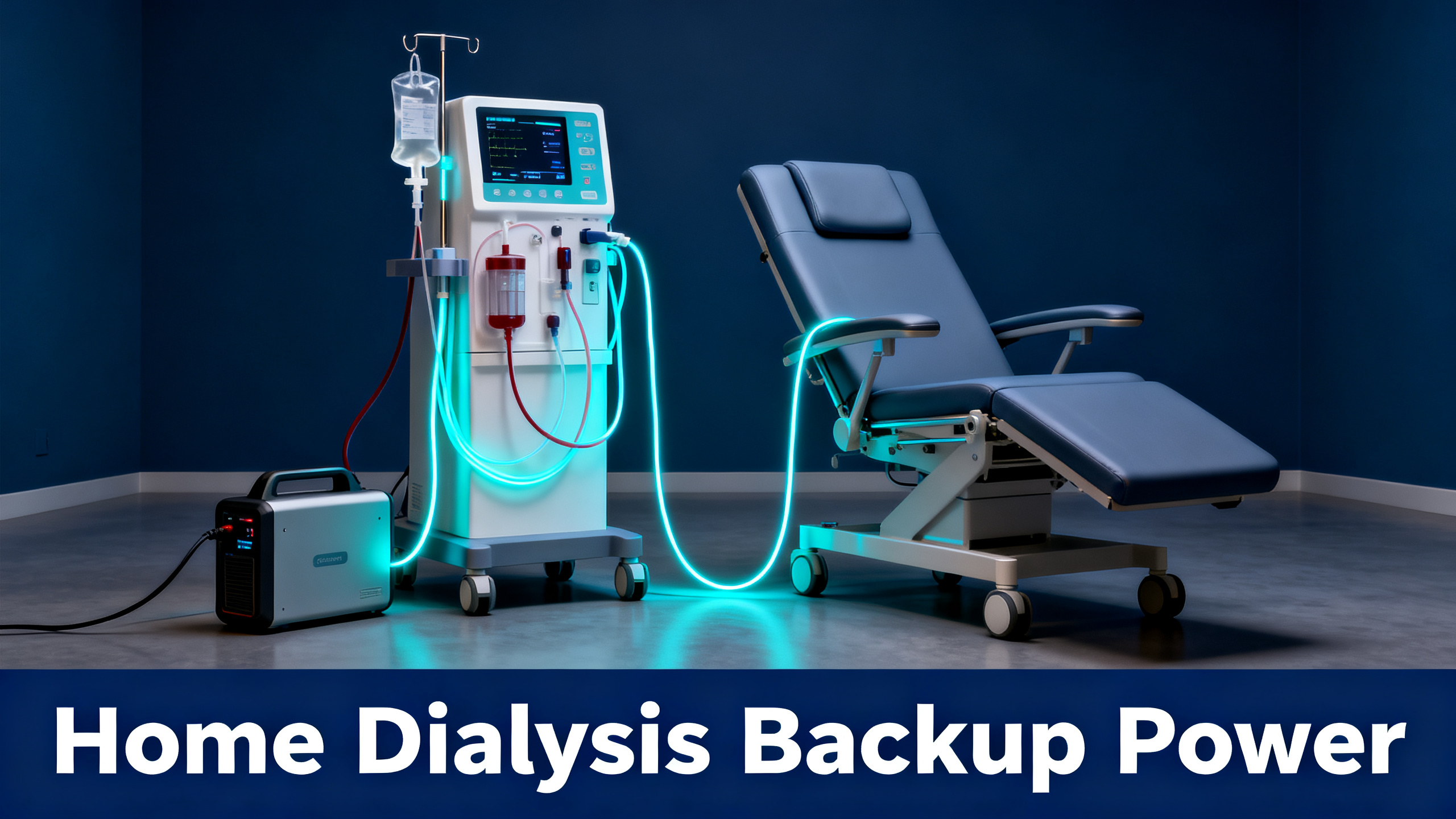
As a home dialysis patient, your power needs are not just practical: they are life-critical. A power outage mid-treatment is not an inconvenience you reschedule. For hemodialysis patients on a daily short session schedule, or peritoneal dialysis patients mid-cycle at 2 AM, grid failure without a reliable backup plan carries real clinical risk.
This guide covers everything you need to size, select, and set up backup power for home dialysis, including hemodialysis machines like the NxStage System One and Tablo, and PD cyclers like the Baxter Amia and Fresenius Liberty. Before diving into dialysis-specific requirements, readers new to medical backup planning should review our complete medical power guide, which covers shared sizing principles across CPAP, oxygen concentrators, and dialysis.
⚠️ Important: This guide provides general information about backup power equipment. It is not medical advice. Always coordinate any change to your home dialysis setup with your nephrology care team and your dialysis center’s emergency protocol office.

Anker SOLIX F3800
$2,199.99
- 3,840Wh expandable to 26.9kWh
- 6,000W 120V/240V split-phase output
- 5-year warranty, 10-year LFP lifespan
Get the 1-page outage plan
What to plug in first, how long a fridge really runs on a battery, and the 3 safety rules for connecting a power station to your home. Printable, sent by email.
About one email a week. Unsubscribe in one click. We may earn a commission when you buy through our links, at no extra cost to you. Privacy Policy
Why Backup Power Is Non-Negotiable for Home Dialysis
Home dialysis patients face a specific vulnerability that most households do not: treatment schedules are fixed by clinical necessity, not convenience. NxStage patients may run six sessions per week, each lasting two to three hours. Peritoneal dialysis cyclers run overnight, often unsupervised. Grid outages, even short ones, create a decision point that should never be improvised.
The CMS emergency preparedness rule requires dialysis facilities to maintain emergency protocols for patients, including displaced home dialysis patients. That infrastructure exists precisely because power disruptions are recognized as a genuine clinical risk, not an edge case. As an ESRD patient on a home program, you are responsible for your segment of that preparedness chain.
What does a practical backup plan look like? It has three components: a power source large enough to complete at least one full treatment cycle, a setup that does not require manual intervention when the grid fails, and a coordination plan with your dialysis center for multi-day outages. This guide addresses the first two.
Understanding Your Dialysis Machine’s Power Profile
The National Kidney Foundation home dialysis overview covers the clinical landscape, but for backup power planning, what matters is the electrical profile of your specific machine. Home dialysis equipment spans a wide range of power draws depending on modality and brand.
Hemodialysis Machines (NxStage, Tablo)
The NxStage System One is the most common home hemodialysis machine in the US. Published specifications list running power between 300W and 500W during active treatment. The Outset Medical Tablo runs slightly higher at 350W to 600W, with a longer typical session of three to four hours. Both machines draw surge current at startup, but modern power stations with true sine wave output handle this cleanly.
For more on the NxStage specifically, the NxStage System One patient resources page includes electrical specifications and emergency planning guidance from the manufacturer.
Peritoneal Dialysis Cyclers (Baxter Amia, Fresenius Liberty)
PD cyclers are significantly lower-draw than hemodialysis machines, typically 100W to 250W during operation. The tradeoff is duration: overnight PD runs eight to ten hours, meaning total energy consumption per session (1.0 to 2.5kWh) is comparable to a shorter HD session despite the lower wattage. Battery sizing for PD must account for the full overnight window, not just peak wattage.
Water Purification Systems (NxStage PureFlow)
Patients using the NxStage PureFlow SL dialysate preparation system add a meaningful load. The PureFlow heats water in cycles, drawing 600W to 900W when active. On a duty-cycle basis, it averages lower, but your backup system needs to handle the peak without tripping. Add 0.5 to 1.0kWh to your session energy estimate if you use a PureFlow.
Power Profile by Home Dialysis System
Figures based on manufacturer specifications and verified user reports. Always consult your specific machine’s user manual.
Get the 1-page outage plan
What to plug in first, how long a fridge really runs on a battery, and the 3 safety rules for connecting a power station to your home. Printable, sent by email.
About one email a week. Unsubscribe in one click. We may earn a commission when you buy through our links, at no extra cost to you. Privacy Policy
Power Requirements: Sizing Your Backup Correctly
Calculating Wattage Needs
Watt-hours (Wh) are the capacity measure that matters here, not peak wattage. Think of it like the size of a fuel tank: the tank needs to be large enough to complete the journey, with a margin for detours. For a standard NxStage session at 400W average draw over 2.5 hours, that is roughly 1,000Wh consumed per treatment. Add 10 to 15% for inverter losses and you need about 1,100 to 1,150Wh available to complete one session.
PD patients need to think in overnight terms. A Baxter Amia running at 150W average for nine hours consumes approximately 1,350Wh. The same inverter-loss buffer pushes the real requirement to around 1,500Wh minimum for a single overnight session.
Calculate your exact runtime
Match these estimates to your specific machine and capacity.
Calculating Capacity for Multi-Session Coverage
Most backup planning targets coverage for two to three sessions, not one. This accounts for the time needed to recharge the power station between sessions, or for back-to-back treatment days before grid power is restored. For NxStage patients running six sessions per week, a 3,840Wh unit like the Anker SOLIX F3800 provides roughly three full sessions of margin. That is a realistic buffer for most short-to-medium outage scenarios.
Peritoneal dialysis patients planning for two consecutive nights of overnight treatment need approximately 3,000 to 3,500Wh of usable capacity, accounting for the realistic depth-of-discharge constraints of lithium iron phosphate (LFP) batteries. Both the Anker F3800 and the EcoFlow DELTA Pro 3 clear this threshold comfortably.
How Many Dialysis Sessions Can Each Unit Power?
Anker SOLIX F3800
3,840Wh capacity (single unit)
🩺
NxStage HD
~3 sessions
~1.2kWh each
🌙
PD overnight
~2 nights
~1.7kWh each
EcoFlow DELTA Pro 3
4,000Wh capacity (single unit)
🩺
NxStage HD
~3 sessions
~1.2kWh each
🌙
PD overnight
~2 nights
~1.7kWh each
Estimates assume typical machine draw plus reasonable inverter losses. Add expansion batteries for multi-day coverage.
Why UPS Matters for Mid-Treatment Outages
There is a meaningful difference between a power station that powers your machine after a planned switch and one that prevents the machine from ever registering an interruption. Most home dialysis machines will abort an active treatment cycle if power is cut, even momentarily. Restarting mid-cycle is not always clinically straightforward, particularly for hemodialysis patients with blood currently in the extracorporeal circuit.
UPS (Uninterruptible Power Supply) mode addresses this directly. In UPS mode, the power station passes grid power through to your machine during normal operation, maintaining its own battery at full charge. The instant the grid signal drops, the unit switches to battery power. The question is how fast that switch happens.

Verified UPS transfer-time data for the EcoFlow DELTA Pro 3 confirms a switchover of under 30 milliseconds. At that speed, most dialysis machines will not register the interruption. The machine’s internal capacitors hold long enough for the power station to take over, and treatment continues without an alarm or abort sequence. This is a material advantage over units with 20ms or slower transfer times, and it is one of the strongest arguments for the DELTA Pro 3 in a home dialysis context.
Recommended Setups for Home Dialysis
Home dialysis patients generally fall into two planning profiles: those focused on maximum capacity and long-term reliability for chronic-care households, and those prioritizing seamless mid-treatment protection above all else. The two units recommended here address each profile directly.
Long-Term Pick: Anker SOLIX F3800
Performance data and warranty terms covered in our Anker SOLIX F3800 review make it the strongest match for households planning multi-year reliance on backup power. The F3800 carries a 5-year warranty and a documented LFP InfiniPower battery lifespan of 10 years, which aligns with the long-term nature of ESRD management. You are not buying backup power for next hurricane season. You are buying infrastructure that needs to be reliable for years.
Capacity-wise, the F3800 starts at 3,840Wh and expands to 26.9kWh with up to six BP3800 expansion batteries. For most home HD patients, the base unit alone covers three NxStage sessions before needing recharge. The Anker SOLIX F3800 also delivers 6,000W output at 120V/240V split-phase, meaning it can handle the full electrical load of a dialysis machine plus basic household essentials simultaneously.


UPS Pick: EcoFlow DELTA Pro 3
Our detailed EcoFlow DELTA Pro 3 review documents the sub-30ms transfer time, X-Boost behavior, and Smart Home Panel 2 integration that make this unit a preferred choice for treatment-mid-cycle outage protection. The DELTA Pro 3 is UL9540 certified, a residential energy storage safety standard that matters if your insurer, HOA, or dialysis center has specific equipment approval requirements.
Capacity at 4,000Wh base is slightly higher than the F3800 in stock configuration. The X-Boost technology extends effective output to 6,000W for demanding loads, and the unit charges 0 to 80% in approximately 50 minutes, which is useful for rapid recharge between treatment sessions. Expandability runs from 4kWh to 48kWh, which covers even the most demanding multi-day outage scenarios for households running both dialysis and other medical equipment.


Long-Term Pick
Anker SOLIX F3800
$2,199.99
Best for capacity (3.84 to 26.9kWh) and 10-year lifespan
UPS Pick
EcoFlow DELTA Pro 3
$2,799
Best for UPS under 30ms and Smart Home Panel integration
Which Setup Is Right for You?
✅ Pick Anker SOLIX F3800 if…
- You expect to rely on backup for many years (10-year LFP lifespan).
- You may add expansion batteries later (up to 26.9kWh).
- You need strong capacity-per-dollar for chronic conditions.
- Your home includes other heavy loads (well pump, A/C) you want covered.
✅ Pick EcoFlow DELTA Pro 3 if…
- Mid-treatment outages are your top concern (UPS under 30ms).
- You want Smart Home Panel 2 integration with your breaker box.
- UL9540 certification is required by your insurer or HOA.
- You value app-based monitoring during overnight PD cycles.
⚠️ Skip both and consult your provider if…
Your machine requires 240V hardwiring without a NEMA plug, your treatment is unsupervised pediatric, or your dialysis center has not approved a portable backup setup for your specific protocol.
Setup Walkthrough: From Unboxing to First Treatment
Plug-and-Play Setup (Standalone Unit)
For most home dialysis patients, the plug-and-play approach is the correct starting point. Place the power station within reach of your dialysis machine’s power cord, but away from dialysate storage and fluid handling areas. Plug your dialysis machine directly into one of the AC outlets on the power station. If your machine has a NEMA 5-15 standard plug, it connects directly without adapters to either the Anker F3800 or the EcoFlow DELTA Pro 3.
For UPS protection on the DELTA Pro 3, enable pass-through or UPS mode in the EcoFlow app before treatment begins. The unit will then hold your grid connection as the primary source and keep the battery at full charge. If the grid drops, switchover is automatic and takes under 30ms. You do not need to take any action during an outage for the machine to continue running.

Hardwired Setup (Transfer Switch + Smart Panel)
Hardwiring an Anker F3800 or DELTA Pro 3 to a dedicated dialysis circuit requires a manual or automatic transfer switch. Our transfer switch installation guide walks through code requirements and licensed-electrician selection. This approach makes sense for patients who want the power station to protect an entire room circuit, not just the machine’s individual outlet.
The EcoFlow Smart Home Panel 2 takes this further by integrating directly with your home’s breaker box. You designate specific circuits as backup-priority, and the DELTA Pro 3 takes over those circuits automatically during an outage, without any manual switching. For PD patients who also rely on refrigeration for dialysate storage, this whole-home integration covers multiple critical loads simultaneously.
Whole-Home Integration for Chronic Care Households
Home dialysis does not exist in isolation. Most ESRD patients also manage refrigeration needs for medications, climate control for health reasons, and potentially other home medical equipment running concurrently. A portable power station sized only for the dialysis machine may leave other critical loads unprotected during an extended outage.
For households that want dialysis covered alongside refrigeration, lighting, and HVAC, exploring whole-home backup battery systems is the next step beyond a single portable unit. The EcoFlow DELTA Pro 3 with Smart Home Panel 2 and the Anker SOLIX F3800 with Anker Home Power Panel both offer genuine whole-home integration pathways that scale from single-machine protection to full household backup.
Whole-home backup for medical households
Cover dialysis, refrigeration, and other critical loads from one system.
The practical starting point for most patients is to size initially for dialysis coverage, then evaluate whether expanding to whole-home makes clinical and financial sense for your household. The expandability of both the F3800 and the DELTA Pro 3 means you can start with a base unit and add capacity later without replacing the core equipment.
Multi-Day Outage Strategy
What happens when a grid outage extends beyond one or two sessions? This is where single-unit solutions show their limits, and where a layered strategy becomes essential.

Solar recharging is the most practical daytime recharge solution. The Anker F3800 accepts up to 2,400W of solar input, which means a modest 800W to 1,200W panel array can restore a significant portion of consumed capacity during daylight hours. Even partial recharge between daily sessions extends effective backup from two sessions to potentially indefinite duration during sunny weather.
A gas or dual-fuel generator provides a weather-independent recharge option. Neither the F3800 nor the DELTA Pro 3 requires anything special here: plug the generator output into the AC input on the power station and it recharges like a wall outlet. This approach avoids the carbon monoxide risks of running a generator indoors while your machine operates.
⚠️ Important: Never operate a gas generator indoors or in an attached garage. Carbon monoxide poisoning is a serious risk. Charge your power station from the generator outdoors, with extension cords if necessary, and rely on the power station alone inside the treatment space.
Coordinating with Your Dialysis Center
Backup power equipment is one component of a complete home dialysis emergency plan. The other components are human and institutional. Your dialysis center is required by CMS emergency preparedness rules to have protocols for displaced home dialysis patients, including provisions for in-center treatment during declared emergencies. Knowing those protocols before you need them is part of your preparedness baseline.
Practical coordination steps include: confirming with your center that your backup power approach is compatible with your specific machine and treatment protocol, documenting the power station’s location and access instructions for emergency responders, and establishing a call-in threshold for when a power outage triggers a center-escalation call rather than a home backup attempt.
The NxStage System One patient resources page includes specific guidance on power outage protocols for NxStage patients. Your Fresenius or Outset Medical care team will have equivalent documentation for Tablo and PD cycler patients.
Frequently Asked Questions
How many watts does a home dialysis machine actually use?
Most home hemodialysis machines (NxStage, Tablo) draw between 300W and 600W during treatment. Peritoneal dialysis cyclers run lower at 100W to 250W. Water purification systems can add 600W to 900W when actively heating water. Always verify with your specific machine’s manual before sizing backup.
Will a portable power station damage my dialysis machine?
No, when the unit produces a true sine wave output, which all major brands like Anker SOLIX and EcoFlow do. Avoid modified-sine-wave inverters with medical equipment. Both the Anker SOLIX F3800 and EcoFlow DELTA Pro 3 deliver pure sine wave output that is safe for sensitive electronics.
What is UPS mode and why does it matter for dialysis?
UPS (Uninterruptible Power Supply) mode means the power station passes wall power through to your machine, but switches instantly to its battery if the wall power cuts out. The EcoFlow DELTA Pro 3 transitions in under 30ms, fast enough that most dialysis machines will not register the interruption and will not abort treatment.
Can I run my dialysis machine on solar alone?
Solar can recharge your power station during the day, but it should not directly power treatment without battery buffering. Cloud cover and night cycles make solar unreliable as a primary medical power source. Use solar to keep your battery topped off, then run treatment from the battery.
How long can the Anker F3800 power a typical NxStage treatment?
At 400W average draw over a 3-hour session (about 1.2kWh per treatment), the F3800’s 3,840Wh capacity supports approximately three full treatments before needing recharge. Adding one BP3800 expansion battery roughly doubles that.
Do I need a transfer switch or can I just plug my machine in?
For a plug-and-play setup, you simply plug the machine into the power station like any wall outlet (no transfer switch needed). A transfer switch becomes useful only if you want the power station to feed a hardwired circuit or your home’s panel for whole-home backup.
Are these power stations covered by insurance or Medicare?
Backup power equipment is generally not covered by Medicare or private insurance. The federal Residential Clean Energy Credit, which returned 30% of the cost of qualifying solar-and-battery setups, ended for systems installed after December 31, 2025. Consult your tax advisor and your dialysis center’s social worker about local assistance programs.
What should I do during a multi-day outage?
Combine three layers: a power station (such as the Anker F3800) for immediate session coverage, solar panels or a generator for daytime recharge, and a coordination plan with your dialysis center for in-center treatment if home backup runs out. CMS rules require centers to have emergency protocols for displaced patients.
Conclusion
Home dialysis backup power is not a luxury item. For ESRD patients managing treatment at home, a reliable power station sized correctly for your specific machine and treatment schedule is a core component of your safety infrastructure, alongside your clinical protocols and your dialysis center’s emergency planning.
A backup power station is one piece of a broader strategy. Combine it with documented protocols, dialysis center coordination, and a structured emergency medical power planning checklist to be fully prepared.
Anker SOLIX F3800
$2,199.99
Built for chronic-care households: 5-year warranty, 10-year LFP lifespan, expandable to 26.9kWh.
Price checked automatically on Anker SOLIX’s US store · 5-year warranty included
Originally published: April 30, 2026