
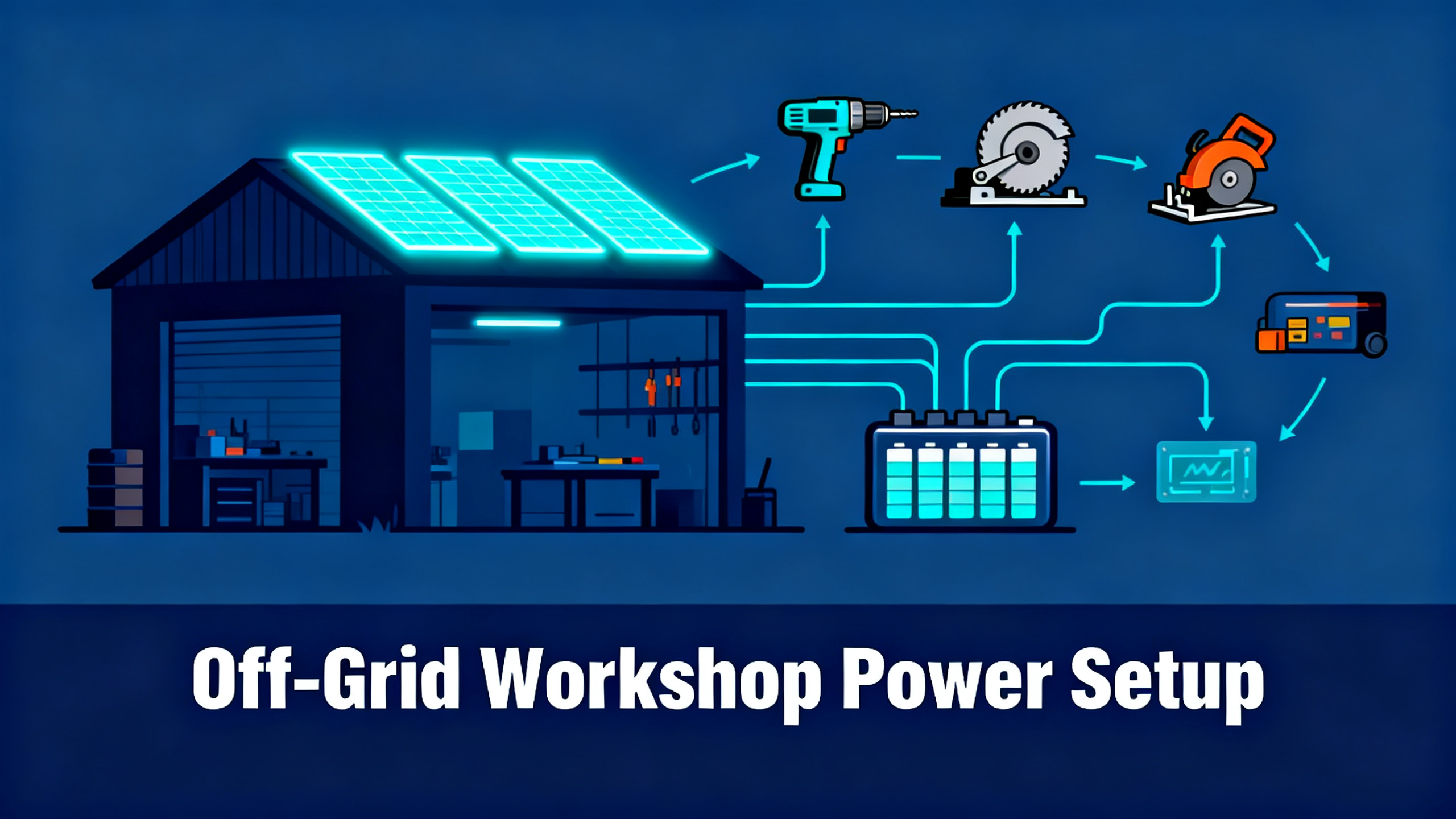
Setting up an off-grid workshop sounds straightforward until you flip the switch on a table saw and watch the power station shut itself off. The capacity number on the side of the unit, that big 3,000Wh or 5,000Wh figure, is not the spec that matters. What actually decides whether your shed runs cleanly is the surge watt rating, and most off-grid workshop builders learn this the hard way.
For a full breakdown of how to size an off-grid solar setup from scratch, our off-grid solar power systems guide covers panel sizing, battery banks, and load calculations in detail. This guide focuses on a narrower problem: which power stations actually survive the startup spikes from common workshop tools, and how to design a setup that does not trip on every cut.

Anker SOLIX F3800
$1,799
- 6,000W AC output with 7,600W SurgePad, handles table saw and compressor spikes
- 3,840Wh LFP battery, expandable to 53.8kWh
- 2,400W solar input: 0 to 80% in 1.5 hours
Get our Black Friday alerts for power stations
We track live prices on 40+ models from Jackery, EcoFlow, BLUETTI and Anker SOLIX. When a deal beats the lowest price we've recorded, you'll hear from us. During Black Friday week, one short recap a day at most.
Unsubscribe in one click. We may earn a commission when you buy through our links, at no extra cost to you. Privacy Policy
Understanding Power Tool Surge Requirements
Power tools with electric motors share a single, frustrating quirk: they pull two to three times their rated wattage at the moment of startup. A circular saw rated at 1,500W can briefly demand 4,000W or more during the first second of spinup. Power stations that look perfectly capable on paper, with healthy 2,000W to 3,000W continuous outputs, fail the moment a router fires up because their inverter cannot sustain the inrush current.
For readers new to the spec sheet, surge watt capacity explained in detail, and it is the single most important number for any workshop application. The continuous output rating tells you what the station can deliver indefinitely. The surge rating tells you what it can deliver for one to five seconds during motor startup. If your tool’s startup draw exceeds the station’s surge capacity, the inverter trips and the tool never gets out of stall.
Workshop Reality Check
Common Power Tool Surge Requirements
🔩
Table Saw
1,800W rated
~4,000W surge
🔧
Air Compressor
1,500W rated
~4,500W surge
🔨
Miter Saw
1,200W rated
~3,600W surge
⚠️
Simultaneous Use
3,000W+ rated
8,000W+ surge
Surge values are motor startup estimates. Actual figures vary by motor size and load condition. Source: typical induction motor startup data.
Why Surge Watts Matter More Than Rated Watts
Marketing copy on most power station product pages leads with the rated wattage because it is the bigger, friendlier number. A 3,000W station sounds more capable than one labeled 6,000W of surge. In a workshop context, this hierarchy is upside down. The continuous output only governs whether your tool can keep running once it is already up to speed. The surge rating governs whether it gets there at all.
Spec analysis confirms a clear pattern across owner reports: stations with surge ratings under 4,000W consistently fail to start mid-range table saws and compressors, even when their continuous rating sits comfortably above the tool’s rated draw. Stations with surge ratings of 6,000W or higher start the same tools without complaint. The number that prevents nuisance shutdowns is the one buyers tend to skip.
The Startup Surge Problem: What Actually Trips a Power Station
Inside every electric motor sits an induction coil that, at the instant of startup, behaves almost like a short circuit. Current spikes hard for a fraction of a second, then collapses to the steady-state running draw. Power station inverters monitor this current and have two responses: deliver the surge if their topology supports it, or shut down to protect the components.
Home Power Load Management
The same principles apply when managing high-draw power loads in a home backup context, knowing your peak draw prevents costly overloads.
Modern LFP-based stations from Anker, Jackery, and Bluetti use what manufacturers variously call SurgePad, X-Boost, or Power Lifting modes. These are software-driven inverter behaviors that briefly drop output voltage to extend the surge window. They work, but only up to the hard ceiling published in the surge spec. Beyond that ceiling, the protection circuit wins, and the station resets.

How Much Power Does a Workshop Actually Need?
Sizing an off-grid workshop power system is a two-axis problem. The first axis is peak surge: what is the largest tool you will ever start, and what is its inrush rating. The second axis is daily energy: across a typical workday, how many watt-hours does your tool mix actually consume. Both numbers matter, and they have completely different implications for which station fits.
The peak surge number sets the floor on your inverter rating. If your largest tool surges to 4,000W, you need a station with at least 4,500W to 5,000W of surge headroom, never less. The daily energy number sets the floor on your battery capacity. A typical small workshop runs between 800Wh and 2,000Wh per active day depending on the tool mix and total runtime, before adding lighting, ventilation, and dust collection.
Sizing for a Light Workshop (1-2 tools)
A light workshop runs one tool at a time, with intermittent duty cycles. Think a hobby woodworker cutting on a table saw for short bursts, then sanding, then drilling. Total energy consumption rarely exceeds 1,500Wh on a productive day, but the peak draw still hits 4,000W or higher every time the saw fires up.
For this profile, runtime calculations based on a 3,840Wh battery show a comfortable margin: roughly two full workdays of intermittent tool use before recharge becomes necessary. The critical specification is not the capacity but the inverter’s surge ceiling. A station like the Anker SOLIX F3800 with its 6,000W rated output and 7,600W SurgePad sits well above the surge envelope of a single mid-size tool, with margin for occasional concurrent use of a shop vac or compressor.
Sizing for a Heavy Workshop (multiple concurrent tools)
A heavy workshop runs multiple high-draw devices simultaneously. A common scenario: a contractor framing in a remote build, with a table saw, an air compressor cycling on its pressure switch, and a worklight running in parallel. The instant the compressor kicks in while the saw is still cutting, instantaneous draw can exceed 5,000W continuous and surge to 8,000W or more.
Heavy workshop profiles typically demand a station with 7,000W or higher of continuous output and surge ratings approaching 14,000W, which puts the Jackery Explorer 5000 Plus in a class of its own. Daily energy budgets routinely reach 3,000Wh to 4,500Wh on full active days, which is why expandable battery systems become essential rather than optional. The model that ranks among the best power stations for heavy-duty use share one critical trait: surge watt headroom well above their rated output.
Get our Black Friday alerts for power stations
We track live prices on 40+ models from Jackery, EcoFlow, BLUETTI and Anker SOLIX. When a deal beats the lowest price we've recorded, you'll hear from us. During Black Friday week, one short recap a day at most.
Unsubscribe in one click. We may earn a commission when you buy through our links, at no extra cost to you. Privacy Policy
Best Power Stations for Off-Grid Workshops
Two models stand out for off-grid workshop applications in 2026, and they target distinctly different user profiles. The Anker SOLIX F3800 sits at the value end of the heavy-duty category, while the Jackery Explorer 5000 Plus targets the upper tier of users running concurrent high-draw tools. Both deliver native 240V output, both use LFP chemistry for long cycle life, and both expand into multi-battery configurations.
Anker SOLIX F3800, Best Overall for Workshop Use
The Anker SOLIX F3800 delivers 6,000W of continuous AC output with a 7,600W SurgePad ceiling, a combination that handles the vast majority of single-tool workshop scenarios with margin to spare. Its 3,840Wh LFP battery covers roughly a full day of intermittent tool use before requiring recharge, and the 2,400W solar input means a moderate panel array tops it back up in under two hours under good conditions.
For a detailed spec breakdown, the full Anker SOLIX F3800 review covers surge performance, solar charging speeds, and expansion options. The data points to the F3800 as the cleaner choice for solo woodworkers, hobbyists, and small contractors whose largest concurrent draw stays under 4,000W. Pricing at $1,799 puts it well below the multi-thousand dollar tier of the next class up, which matters when the alternative is a $5,000 generator with maintenance, fuel, and noise.


Jackery Explorer 5000 Plus, Best for High-Surge Workshops
The Jackery Explorer 5000 Plus is built for the scenario the F3800 cannot quite handle: concurrent high-draw tools with combined surge demands above 8,000W. Its 7,200W rated output and 14,400W surge ceiling provide the margin needed to start a compressor mid-cut on a table saw without tripping. The 5,040Wh base capacity, expandable to 60kWh, supports longer active days where the runtime calculation matters as much as the peak draw.
At $2,899 (regularly $4,299), the Jackery sits in a clearly higher price tier, and the analysis suggests the upgrade only makes sense for users who genuinely need the dual-tool concurrency or the larger expandable capacity. For solo or sequential tool use, the additional surge headroom goes unused, and the F3800 delivers comparable workshop functionality at roughly 60% of the cost.
Head-to-Head: Workshop Power Comparison
The decision usually breaks along a single line: do you ever need to run two motorized tools at the same time. If the answer is no, the F3800 wins on cost, footprint, and feature parity for solo tool operation. If the answer is yes, the Jackery’s surge headroom is not a luxury but a structural requirement, and the price premium maps directly onto a real engineering capability rather than a marketing one. Spec analysis confirms that the data lines up cleanly with these two distinct buyer profiles.
High-Surge Alternative
Jackery Explorer 5000 Plus
7,200W / 14,400W surge
$2,899
$4,299
✅ The F3800 is your pick if…
- You run one heavy tool at a time (table saw or compressor, not both)
- Budget is a priority and $1,799 makes more sense than $2,899
- You plan to add solar panels and charge via the 2,400W input
- You want 240V output for larger workshop equipment
⚡ Go Jackery 5000 Plus if…
- You run multiple high-draw tools simultaneously
- Your compressor and table saw operate at the same time
- You need the extra 14,400W surge headroom for large motor loads
- Longer runtime per charge cycle is a priority (5,040Wh base)
Buyers comparing these two models often start by gravitating toward the Jackery for its raw spec advantage, then walk back when they audit their actual tool mix. The honest reality for most workshop builds: the F3800 is overkill for half the buyer profiles and the Jackery is underused for half of the rest. Owner feedback patterns consistently report a similar narrative arc, with users praising the F3800 for “doing exactly what I needed without paying for capacity I don’t use.” Buyers who chose the Jackery and use the surge headroom regularly report the opposite: zero regrets, citing the absence of nuisance trips during multi-tool sessions as the deciding factor.
Setting Up Solar for a Workshop: Panel Count and Layout
Solar sizing for a workshop power station follows the same math as any solar charging setup, but the duty cycle is different. Workshops are usually used in concentrated bursts: a productive Saturday, a multi-day build, then nothing for a week. This pattern favors a panel array sized to fully recharge the station overnight or during light-use days, rather than running it directly off solar during peak tool draw.
The U.S. Department of Energy’s residential solar sizing guidelines apply at smaller scales as well. The basic calculation: divide the daily energy budget (in Wh) by the local peak sun hours, then add a 25% margin for inefficiency, weather, and panel orientation losses. For a 1,500Wh daily workshop budget in a region with five peak sun hours, the math points to roughly 375W of panels at minimum, with 500W to 600W as a comfortable target.

The F3800 accepts up to 2,400W of solar input, which is far more than most workshop setups will deploy, but the headroom matters for two reasons. First, panels rarely deliver their rated output in real conditions, so oversizing the array compensates for cloudy days and oblique sun angles. Second, a fully charged station before the workshop session begins eliminates the most common off-grid frustration: running out of capacity halfway through a project.

💡 Pro Tip: Mount panels on a tilt frame rather than flat on a shed roof. Real-world data shows tilt-mounted panels capture 20% to 30% more energy across a full day, which often eliminates the need to add a fourth panel just to hit the daily target.
Owner data consistently reports that buyers who underspecify their solar array end up shuttling the station back to grid power for top-ups, which defeats the off-grid premise. Oversizing by 25% to 50% above the calculated minimum is the practical sweet spot. The marginal cost of an extra 200W panel is small compared to the ongoing inconvenience of insufficient charging.
Workshop Safety: Grounding and Electrical Considerations
Running power tools off a portable station introduces a few electrical considerations that grid-connected workshops handle automatically. Grounding is the most important. The F3800 and Jackery 5000 Plus both ship as bonded neutral-ground systems on their AC outputs, which is the same configuration as a residential outlet. This means standard tools work as expected, but it also means you should not connect the station to a transfer switch or subpanel without understanding how the grounding interacts with house wiring.
The OSHA electrical safety standards outline the baseline requirements for portable power in a workshop context. The relevant rules: GFCI protection on outlets serving the work area, properly rated extension cords (12-gauge minimum for tool circuits), and clear separation between the power station and any source of moisture or flammable dust. Most workshops fail at the cord-gauge step, using lightweight 16-gauge extensions that drop voltage and overheat at sustained tool loads.
⚠️ Important: Never connect a portable power station to building wiring through a standard outlet (no “suicide cords”). For permanent or semi-permanent setups feeding multiple workshop circuits, use an interlock-equipped transfer switch installed by a licensed electrician.


Temperature management deserves attention in shed-mounted setups. Both units use LFP batteries, which tolerate operating temperatures roughly between 0°C and 40°C. Workshops in unheated sheds in northern climates can drop well below freezing in winter, and charge performance degrades sharply below 0°C. The practical solution: bring the station indoors during deep cold, or insulate the workshop enclosure enough to keep ambient temperatures above the threshold.
Anker SOLIX F3800 Full Review
Detailed look at the F3800’s surge performance, solar charging speeds, expansion options, and real-world owner feedback.
Dust and debris are the second environmental factor. Workshops generate fine particulates from sanding, cutting, and drilling, and these particles work their way into ventilation grilles. The Anker SOLIX F3800 ships with sealed intake filters, but periodic cleaning is still part of the maintenance routine. Position the station outside the immediate dust cloud (against a wall, not under the bench) and the intervals between cleanings stretch from monthly to quarterly.
Frequently Asked Questions
Can a power station really run a table saw?
Yes, provided the station has sufficient surge watt headroom. The Anker SOLIX F3800 with its 7,600W SurgePad handles a 1,800W table saw (approximately 4,000W startup surge) with margin. The hard rule is to avoid starting two high-draw tools simultaneously, which can briefly stack inrush currents above the inverter’s protection threshold. For sequential single-tool use on a circular saw, table saw, or miter saw, the F3800 and similar 6,000W-class stations operate without nuisance trips.
How many solar panels do I need to power an off-grid workshop daily?
For moderate use (4 hours of light tools plus lighting), 800W to 1,200W of solar panels can recharge a 3,840Wh station under normal conditions. The basic formula: divide your daily Wh consumption by local peak sun hours, then add a 25% margin for weather and orientation losses. A workshop pulling 1,500Wh per day in a region with five peak sun hours needs roughly 375W minimum, with 500W to 600W recommended for reliability. Oversizing the array by 25% to 50% is the practical sweet spot.
What is the difference between rated watts and surge watts on a power station?
Rated watts indicate the maximum continuous power output the station can deliver indefinitely. Surge watts indicate the peak power the station can deliver for one to five seconds during motor startup. Electric motors typically draw two to three times their rated wattage at the instant of startup, which is why surge capacity matters more than continuous output for workshop applications. Always choose a station whose surge rating exceeds your tool’s peak startup draw, with at least 25% headroom for safety.
Is it safe to run power tools from a portable power station?
Yes, provided you stay within the station’s wattage limits, use properly rated cables, and do not exceed the continuous rated output during sustained use. Modern LFP-based stations include protection circuits for overload, overheating, and short circuits, all of which trip cleanly without damaging the unit or the tool. The two most common safety failures are not station-related: undersized extension cords (use 12-gauge minimum) and inadequate GFCI protection on outdoor or damp-location outlets.
Can I leave a power station outside in my workshop shed?
LFP stations operate between approximately 0°C and 40°C. Below freezing, charging performance degrades and the BMS may refuse to accept charge until the cells warm up. Keep units protected from direct moisture, condensation, and dust accumulation. The Anker SOLIX F3800 has an optional protective cover available separately. For deep-winter operation in unheated sheds, the practical solution is to bring the station inside during cold spells or insulate the workshop enclosure enough to keep ambient temperatures above the threshold.
Anker SOLIX F3800
$1,799
Best power station for off-grid workshop surge loads
Price verified May 2026, Free shipping available
Final Verdict
Building an off-grid workshop is an exercise in matching peak surge capacity to your worst-case tool startup, then sizing battery and solar around the daily energy budget. Both products covered here clear the surge bar that traditional 2,000W to 3,000W power stations cannot, which is why they keep showing up in serious workshop builds. The decision between them is rarely about specs in the abstract: it is about whether your tool mix ever runs concurrent high-draw devices.
For solo woodworkers, weekend builders, and small contractors using one tool at a time, the Anker SOLIX F3800 at $1,799 delivers the right balance of surge headroom, capacity, and solar input without paying for capability that goes unused. For shops running compressors, saws, and dust collection in parallel, or for users planning to expand into whole-shop battery banks, the Jackery Explorer 5000 Plus pays back its price premium in eliminated trip events and longer per-charge runtime. The data points to the F3800 as the higher-volume default and the Jackery as the targeted upgrade for genuine concurrent-tool scenarios.
Originally published: May 7, 2026