
Choosing the right power station for off-grid use feels deceptively simple until you realize the answer depends on a dozen variables: your appliances, your daily routines, your local sunlight, and how much battery cushion you actually need. Get it wrong, and you either burn cash on capacity you never use or run out of juice halfway through a Saturday morning coffee. Get it right, and your system disappears into the background, doing exactly what it should without drama.
This calculator is part of our broader off-grid solar power systems guide, designed to take you from first question to fully operational setup. The five-step method below is the same one experienced installers use to size systems for cabins, tiny houses, and full homesteads. By the end, you will know exactly how much battery capacity and solar input your specific setup demands, and you will have a sanity-checked number to take into any buying decision.

If you would rather skip the math and let an interactive tool handle the heavy lifting, our calculator does the full Wh-to-capacity conversion automatically. Enter your appliances, get your daily total, and see matching power stations in seconds.

Try Our Interactive Power Station Calculator
Enter your appliances, get your Wh/day total, and find the right power station, in under 2 minutes.
Get our Black Friday alerts for power stations
We track live prices on 40+ models from Jackery, EcoFlow, BLUETTI and Anker SOLIX. When a deal beats the lowest price we've recorded, you'll hear from us. During Black Friday week, one short recap a day at most.
Unsubscribe in one click. We may earn a commission when you buy through our links, at no extra cost to you. Privacy Policy
What Is Off-Grid Power Sizing? (And Why It Matters)
Off-grid power sizing is the process of matching your battery capacity and solar input to your actual daily energy use. Think of it like sizing a water tank for a remote property: too small and you run out mid-shower, too large and you have paid for storage you will never fill. The goal is the smallest system that reliably covers your worst-case day, not the biggest system you can afford.
The cost of getting it wrong is real on both sides. Undersize, and you face midnight fridge shutoffs, dead phones during emergencies, or worse, a generator running through the night just to keep the basics alive. Oversize by 50% or more, and you have spent hundreds (sometimes thousands) of extra dollars on capacity that sits unused, plus the extra weight and footprint that comes with bigger batteries. Sizing data consistently shows that most first-time off-grid buyers err toward oversizing by 30 to 60 percent because they confuse capacity with reliability.
The five steps that follow are designed to remove that guesswork. Each one builds on the last, and by Step 5 you will have a single number (your minimum required Wh capacity) plus a target solar wattage. From there, picking the actual hardware becomes a much smaller decision.
Step 1: List Your Appliances and Their Power Draw
Every sizing calculation starts with a complete inventory of what you plan to plug in. This is where most off-grid plans fall apart, not because the math is hard, but because the appliance list is incomplete. The phone charger you forgot, the espresso machine you swore you would not bring, the second laptop for work calls: every watt counts when you are running on battery alone.
Write down every device you plan to use. For each one, note two figures: its rated wattage (in watts) and how many hours per day you realistically use it. Be honest about runtime, especially for always-on devices like fridges, which run roughly 8 to 12 hours per 24-hour cycle even though they are technically plugged in continuously.
How to Find Your Appliance Wattage
Three methods give you reliable wattage figures, in order of accuracy:
The appliance label. Most devices have a sticker or plate listing watts, amps, or both. If you see amps only, multiply by your voltage (120V in the US) to get watts. A label reading “1.5A” at 120V means 180W. This is the easiest method but it shows the maximum draw, not the average, which matters for cycling appliances like fridges.
A Kill-A-Watt or similar wattage meter. Plug the meter into your wall outlet, plug your appliance into the meter, and run the device for an hour or two. The meter gives you actual measured wattage, including the cycling losses that labels miss. This is the gold standard for fridges, freezers, and anything with a compressor.
Reference tables. When neither method is available, published standard appliance wattage reference data from the US Department of Energy gives reliable averages. Not sure of your appliance wattage? Check appliance compatibility with our interactive tool to get accurate power draw figures.
Common Off-Grid Appliance Power Draw
Wattage figures are typical ranges. Check your appliance label or manufacturer spec for exact draw.
Get our Black Friday alerts for power stations
We track live prices on 40+ models from Jackery, EcoFlow, BLUETTI and Anker SOLIX. When a deal beats the lowest price we've recorded, you'll hear from us. During Black Friday week, one short recap a day at most.
Unsubscribe in one click. We may earn a commission when you buy through our links, at no extra cost to you. Privacy Policy
Step 2: Calculate Your Daily Wh Consumption
With your appliance list complete, the math is straightforward. The core formula is the same one used by every solar designer in the industry: watts multiplied by hours equals watt-hours. Apply it to each device individually, then add the totals together to get your daily Wh consumption.
Here is a worked example for a typical weekend cabin: a 50W mini fridge running 24 hours produces about 600Wh once you factor in the duty cycle (the fridge does not pull 50W continuously, it cycles on and off, so real-world consumption is closer to 400 to 600Wh per day). Add 6 hours of LED lighting at 15W (90Wh), 6 hours of laptop work at 65W (390Wh), and 2 hours of phone charging at 15W (30Wh). The total: about 1,110Wh per day.
The Simple Formula: Watts × Hours = Wh
Two pitfalls trip up first-time calculators. First, the duty cycle problem: appliances with compressors (fridges, freezers, AC units) do not run continuously. A 100W mini fridge listed at “100W” actually averages 30 to 50W over a 24-hour period because it cycles. Use measured averages (a Kill-A-Watt is invaluable here) rather than nameplate maximums.
Second, the surge factor for high-draw devices. Microwaves, kettles, hair dryers, and power tools draw their full rated wattage the moment they switch on, and some pull a brief surge well beyond the rated figure. Your daily Wh calculation does not need to account for surges (those are an output question, covered in Step 5), but make sure to add at least 15 to 20 percent buffer to your daily total to absorb unplanned use, dimmer days, and the appliance you forgot to list.
The Off-Grid Sizing Formula
Step 1
Total Wh/day
All appliances × hours
Step 2
Safety Factor
1.25 (recommended)
Step 3
DoD Limit
0.8 for LFP
Result
Min. Capacity
Wh needed
Example Calculation
Daily consumption: 1,200Wh (fridge + lights + laptop + phone)
× 1.25 safety factor = 1,500Wh
÷ 0.8 DoD = 1,875Wh minimum capacity
→ A 2,000Wh power station covers this comfortably.
Step 3: Factor In Efficiency Losses
Battery capacity on a spec sheet is not the same as battery capacity in real-world use. Three losses systematically eat into the headline Wh number, and ignoring them is the single most common reason off-grid systems underdeliver. Sizing data confirms that the cumulative effect of these losses can reduce usable capacity by 25 to 35 percent versus the rated figure.
Inverter Efficiency, Temperature, and Depth of Discharge
Inverter efficiency is the first loss. Power stations convert DC battery output into AC for your appliances, and that conversion costs energy. Modern LiFePO4 power stations from Jackery, Bluetti, EcoFlow, and Anker SOLIX run at 85 to 95 percent inverter efficiency. The premium models cluster near 92 to 95 percent, while older or budget models can dip to 85 percent. For sizing purposes, assume 90 percent unless your manufacturer specs say otherwise.
Temperature is the second loss, and it is the one most users underestimate. LFP batteries lose roughly 10 to 20 percent of usable capacity below 32°F, and they should not be charged at all below freezing without an internal heater (a feature on most premium 2024 to 2026 models). Hot weather is gentler but still costs you: above 104°F, expect a 5 to 10 percent capacity hit and accelerated cycle wear. Plan your worst-case temperature into your sizing.
Depth of discharge (DoD) is the third and most controllable loss. While LFP cells can technically discharge to 5 to 10 percent of capacity, doing so daily shortens cycle life dramatically. The industry-standard recommendation is to size around 80 percent DoD, meaning a 2,000Wh battery effectively gives you 1,600Wh of daily usable energy. For a deeper look at how inverters, MPPT controllers, and BMS interact, see our guide to understanding power system components.
The cleanest way to bake all three losses into your sizing is the formula from Infographic #2: multiply your daily Wh consumption by 1.25 (safety factor for inverter and temperature losses), then divide by 0.8 (DoD limit). The result is your minimum required battery capacity in Wh.
📚 Go Deeper: Complete Off-Grid Solar Guide
From components and solar panels to full system design, our complete off-grid guide covers everything beyond the calculator.
Step 4: Determine Your Solar Input Requirements
Battery capacity tells you how much you can store. Solar input tells you how fast you can refill it. For weekend trips with grid-charged batteries, solar input is optional. For anything longer than 48 to 72 hours of continuous off-grid use, your solar array is what keeps the system from draining to zero. Getting the panel wattage right is just as important as getting the battery capacity right.
Peak Sun Hours and Panel Sizing
The single most important variable in solar sizing is peak sun hours (PSH). PSH is not the number of daylight hours, it is the equivalent number of hours your location receives at full irradiance (1,000 watts per square meter). A panel rated 200W produces 200W only during peak conditions, so PSH directly translates spec wattage into real daily harvest.
Peak sun hours vary dramatically by region. The American Southwest (Arizona, southern Nevada, southern California) sees 6 to 7 PSH on average annual basis. The Mountain West and Great Plains average 5 to 6 PSH. The Northeast and Midwest fall around 3.5 to 4.5 PSH. The Pacific Northwest sits at 3 to 4 PSH, with winter months dropping below 3. For accurate location-specific data, the National Renewable Energy Laboratory publishes detailed solar irradiance data by region, broken down by state and even county.
The solar sizing formula is simple: daily Wh need ÷ PSH × 1.25 = required panel wattage. The 1.25 multiplier covers cable losses, MPPT controller efficiency (typically 95 to 98 percent), panel angle imperfections, and dust or shade. Skip this multiplier and you will harvest 15 to 25 percent less than your math predicts.
A worked example for a Colorado cabin running 1,500Wh per day at 5 PSH: 1,500 ÷ 5 × 1.25 = 375W of panel capacity. In practice, that means a single 400W panel or two 200W panels in parallel. For the same cabin in coastal Washington at 3.5 PSH, the math becomes 1,500 ÷ 3.5 × 1.25 = 535W, requiring closer to 600W of panel capacity to harvest the same daily Wh. The location matters enormously.
⚠️ Important: Winter PSH is typically 30 to 50 percent lower than the annual average in northern states. If your system needs to operate year-round, size your solar array for the worst month, not the average.
Step 5: Match to the Right Power Station
You now have two numbers: a minimum battery capacity in Wh and a target solar wattage. Translating those into a specific power station purchase requires understanding two specs that work together but mean very different things. Once you have your daily Wh total and solar input requirements, use our power station calculator to instantly match your needs to a compatible model.
Capacity vs. Output: Two Different Specs That Both Matter
Capacity (Wh) is the size of your tank. A 2,000Wh power station stores 2,000Wh of energy, period. This is what your sizing formula points to, and matching it correctly means your daily energy needs are covered.
Output (W) is the speed at which the tank can be drained. A 2,000Wh station with a 1,500W AC output can power devices that draw up to 1,500W simultaneously, but no more. If you try to run a 1,800W kettle, the unit either trips its overload protection or refuses to start. Surge output is a separate spec that briefly allows higher draws (often 2x to 3x rated) for motor-startup loads like fridges and pumps.
The most common sizing mistake is choosing on capacity alone and getting blindsided by output limits. A 3,000Wh station with only 1,800W AC output cannot run a microwave (1,000W) and a kettle (1,500W) simultaneously, despite having ample capacity. Verify that your highest single-appliance draw fits within the station’s continuous AC output, then check that your two highest simultaneous loads add up to less than that figure.
Capacity is just one factor: our guide to choosing the right capacity for your needs covers output wattage, solar input ceilings, and long-term reliability factors that pure Wh math will not surface.
Sizing Examples by Use Case
The five-step method produces different recommendations depending on your usage pattern. Three common scenarios cover the majority of off-grid setups, and the calculations below give you a realistic starting point for each.
Weekend Cabin (600 to 900Wh per day)
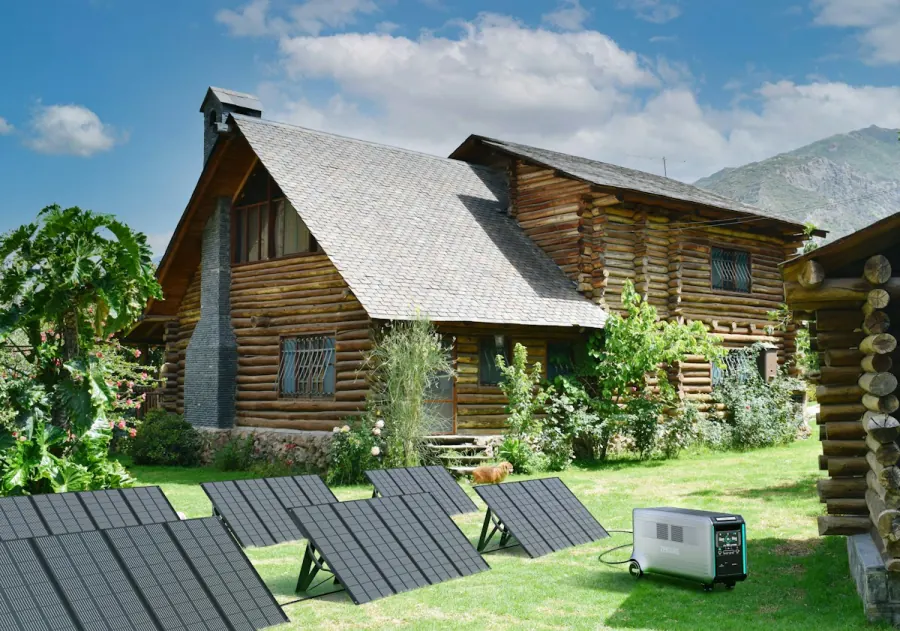
The classic two-night cabin getaway covers basics: mini fridge, LED lighting, phone and laptop charging, maybe a small fan. Sizing calculations show that a typical cabin weekend requires roughly 750Wh of daily consumption (450Wh fridge + 100Wh lights + 150Wh laptop + 50Wh phones). Apply the formula: 750 × 1.25 ÷ 0.8 = 1,172Wh minimum capacity. A 1,000 to 1,500Wh power station covers this comfortably, paired with a 100 to 200W solar panel for self-sufficient operation. This is the entry-level off-grid setup, and it is where most first-time buyers should start.
Tiny House Full-Time (1,500 to 2,500Wh per day)
Year-round tiny house living adds appliances, longer runtimes, and the need to handle peak loads. A typical tiny house consumes 2,000Wh per day across a fridge running continuously, full lighting, laptop and TV, fans or small heat sources, and occasional cooking on induction or microwave. The formula: 2,000 × 1.25 ÷ 0.8 = 3,125Wh minimum capacity. This is the territory where expandable systems pay off, with a 2,000 to 3,600Wh main unit plus optional add-on batteries for high-demand weeks. Solar requirements scale to 200 to 400W of panels, depending on PSH.
Homestead Year-Round (3,000Wh+ per day)
Full homesteading puts realistic ceilings on what portable power stations can handle. Daily loads of 4,000 to 6,000Wh are common once you add a full kitchen, well pump, modest HVAC, and workshop tools. The formula: 4,000 × 1.25 ÷ 0.8 = 6,250Wh, scaling up to 9,375Wh for the higher end. At this level, expandable systems with multiple battery modules become essential, often paired with a propane or gasoline generator for cloudy stretches and high-load events. Solar arrays at this scale start at 400W and routinely reach 1,000 to 1,200W for autonomous operation.
Off-Grid Sizing by Scenario
🏕️
Weekend Cabin
2 nights off-grid, basic needs
Typical load: 600–900Wh/day
Recommended: 1,000–1,500Wh
Solar: 100–200W panel
Entry-level portable station
🌲
Tiny House / Full-Time
Daily living, essential appliances
Typical load: 1,500–2,500Wh/day
Recommended: 2,000–3,600Wh
Solar: 200–400W panels
Mid-range + expandable system
🏡
Homestead
Year-round, high-load appliances
Typical load: 3,000–8,000Wh/day
Recommended: 5,000–12,000Wh
Solar: 400–1,200W array
Expandable system, generator backup

🏕️
Weekend Cabin
600–1,200Wh setup
Best power stations for part-time off-grid cabin use
🏡
Full Homestead
3,000–10,000Wh setup
High-capacity systems for year-round off-grid living
FAQ: Off-Grid Power Sizing
How many Wh do I need to power a mini fridge off-grid?
A mini fridge draws approximately 30 to 60W on average, running 24 hours. Runtime calculations based on a 45W average draw give approximately 1,080Wh per day. A power station with 1,500Wh capacity covers the fridge with buffer for other devices, while a 2,000Wh unit gives you full overnight operation plus lights, laptop, and phone charging without strain.
What is the rule of thumb for off-grid solar sizing?
A reliable starting point is to calculate your total daily Wh, multiply by 1.25 as a safety factor, then divide by 0.8 to account for recommended depth of discharge. The result is your minimum required battery capacity. For solar, divide that same daily Wh figure by your local peak sun hours, then multiply by 1.25 to cover line and conversion losses. The two formulas together give you both your battery target and your panel target.
Can I run my whole house off a portable power station?
A standard US home uses 30 to 40kWh per day, which is well beyond portable power station capacity (most max out at 3 to 12kWh with expansion batteries). Portable systems are best suited for essential load management (fridge, lighting, medical devices, charging) rather than whole-home replacement. For full-house off-grid, you typically need a fixed solar system with rack-mounted batteries and a hybrid inverter.
How many solar panels do I need for a 2,000Wh battery?
The number depends on your location’s peak sun hours. In the Southwest (6 PSH), one 400W panel produces approximately 2,400Wh per day, which is sufficient. In the Northeast (4 PSH), the same panel produces approximately 1,600Wh. Two panels in parallel would be the safer choice for northeastern states, especially if you need to recharge a fully drained battery in a single sunny day.
What’s the difference between capacity (Wh) and output (W)?
Capacity is the total energy stored, measured in watt-hours. Output is how much power you can draw at once, measured in watts. A 2,000Wh station with 2,000W AC output can run a 1,500W microwave, but it will drain in roughly one hour at that rate. Both specs matter: match capacity to daily needs and output to your highest-draw appliance.
How do I size my off-grid system for winter use?
Two factors compress winter capacity. Shorter daylight hours reduce solar harvest (often by 30 to 50 percent versus summer in northern states), and cold temperatures reduce LFP battery capacity by 10 to 20 percent below 32°F. Published data confirms that winter systems should be sized at 1.5 to 2x the summer equivalent to maintain the same daily output, which is why year-round off-grid users often add a generator for the worst weeks.
Conclusion: Sizing Right the First Time
Off-grid sizing is not complicated, but it does reward patience. The five-step method (inventory appliances, calculate daily Wh, factor losses, size solar input, match to a power station) takes 15 minutes with a calculator and saves you from the two most expensive mistakes in this category: undersizing and finding out at midnight, or oversizing and paying for capacity you will never touch.
The numbers do most of the work. Once you have your daily Wh consumption and your local PSH, the rest is arithmetic. From there, it becomes a question of finding a power station that matches both your capacity target and your output requirements, with solar input ceilings that work for your panel array.
Ready to Pick the Right Power Station?
Our buying guide walks you through every decision point: capacity, output, solar compatibility, and budget, so you choose once and choose right.
Originally published: May 7, 2026