
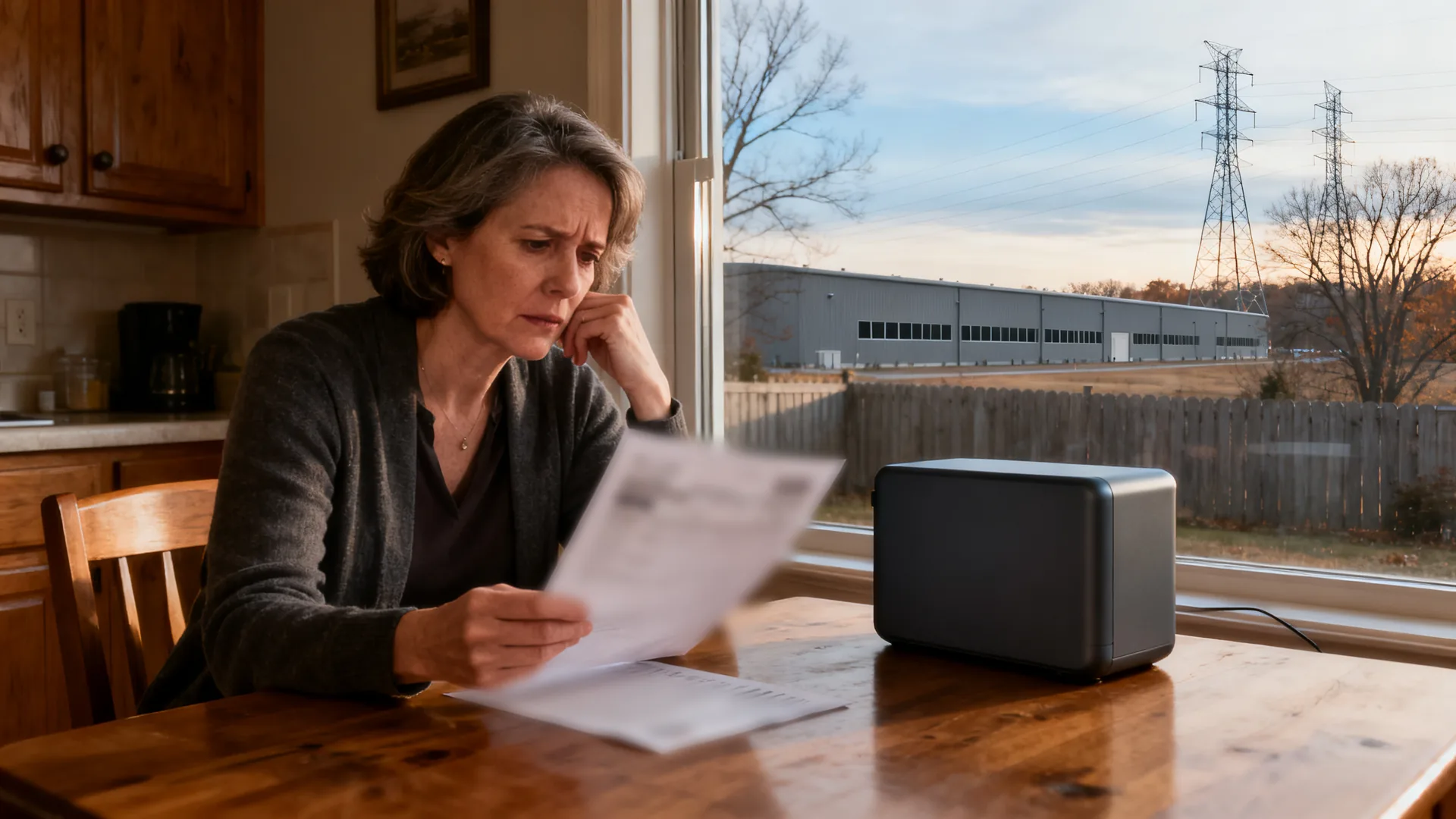
If your electric bill jumped and you live between New Jersey and Illinois, a building you will never enter may be part of the reason. Data centers account for $6.3 billion of the charges in the latest power auction run by PJM, the grid operator for 67 million people, according to its independent market monitor.
Even at that price, the grid came up 6,831 MW short of its reliability target. On October 29, PJM went back to federal regulators with a revised plan to close the gap, after most of the first version was rejected in September. Here is what is real, what is overblown, and what reaches your home.
- In PJM states, the effect is real. It reaches you through the supply part of your bill.
- Nationally, the link is much weaker. Grid spending and gas prices weigh more so far.
- The hidden cost is risk: thinner reserves, not guaranteed blackouts. That part you can plan for.
Are you in PJM?
All or part of DE, IL, IN, KY, MD, MI, NJ, NC, OH, PA, TN, VA, WV and D.C. If you are outside this map, the auction below is not on your bill.
The auction that went from $2.2 billion to $16.4 billion
Every year, PJM pays power plants to be available years ahead. Most customers cover that cost through their bill. When demand forecasts rose and older plants retired, the price exploded in a single round and has stayed there.
PJM capacity auction total, by delivery year
Source: PJM auction report, July 14, 2026. Totals are not the exact cost to customers, because some load is hedged.
The flat line comes from a price cap. Without it, this year’s auction would have cost $29.7 billion, according to Utility Dive. And over the last four auctions, the market monitor puts the data center share at $29.4 billion of $63.6 billion, or 46%.
The one piece of good news: because the price barely moved this time, little change is expected in bills from this auction when it takes effect in June 2028. High, but no longer climbing.
What the headlines get wrong
No clear national link
USAFacts found no significant tie between a state’s data center capacity and its home electricity prices from 2022 to 2025. Texas and Virginia hold about 41% of that capacity and rose less than the average state.
Other costs weigh more
A federally funded analysis ranks grid investment first among the causes of 2019-2025 rate hikes, ahead of natural gas prices, disaster recovery and state policy.
Wholesale is not your bill
PolitiFact rated a viral 267% claim Mostly False. It was a wholesale figure, and supply is only about 30% to 50% of a bill.
PJM is the exception USAFacts points to, especially in Pennsylvania and New Jersey. Plant retirements and market rules push prices up there too, so data centers are a big part of the story, not all of it.
The cost that is not on your bill
PJM’s last two auctions are the first in its history to fall short of the reliability requirement across its whole territory. The operator is careful here: the shortage “does not necessarily mean” it cannot serve customers, but it would run with slimmer reserves and more risk.
NERC, the North American grid watchdog, rates PJM at elevated risk through 2028 and high risk from 2029. In practice, that kind of shortage would show up as emergency alerts and, in the worst case, controlled outages on the hottest or coldest days.
The forecasts could still prove too high. Three utilities just cut their near-term large-load estimates by 6.5 GW, which could shrink PJM’s emergency purchase from 6,800 MW to about 630 MW. Another analysis sees an 11.5 GW gap by 2030. Nobody knows yet which one is right.
What you can do about it
For the bill
Capacity costs sit in the supply charge. Where your state lets you choose a supplier, compare fixed offers with your utility’s default rate. A battery will not help much here: we ran the numbers, and it saves nothing on a flat rate.
For the risk
List what must stay on: fridge, router, CPAP, sump pump. That list sets the size you need. By our hour-by-hour estimate, 2 kWh covers a fridge, internet and a CPAP for one night.
One night of essentials: EcoFlow DELTA 3 Max

EcoFlow DELTA 3 Max
2,048Wh · 2,400W output · Lowest tracked: $799 (Oct 8)
2,048Wh LiFePO4, 2,400W, switches to battery in about 10 ms. Full review.
See the deal on EcoFlow Read our reviewMore output at the same size: BLUETTI Elite 200 V2

BLUETTI Elite 200 V2
2,073Wh · 2,600W output · Lowest tracked: $849 (Oct 8)
About 2kWh of LiFePO4 and 2,600W, useful for a pump or a microwave. Full review.
See the deal on BLUETTI Read our reviewA longer gap and 240V: Anker SOLIX S5000

Anker SOLIX S5000
5,024Wh · 4,500W output · Lowest tracked: $2,499.99 (Nov 5)
Pre-order
5,024Wh and 240V output, for a well pump or a multi-day plan. Full review.
See the deal on Anker SOLIX Read our reviewSide by side
Links to the brand stores are affiliate links: we may earn a commission, at no extra cost to you. It never changes which models we list.
| Model | Capacity / output | Price now | Per kWh | Lowest tracked | Link |
|---|---|---|---|---|---|
 EcoFlowDELTA 3 Max | 2,048Wh · 2,400W | $879 | $429 | $799 (Oct 8) | Check deal |
 BLUETTIElite 200 V2 | 2,073Wh · 2,600W | $899 | $434 | $849 (Oct 8) | Check deal |
 Anker SOLIXC2000 Gen 2 | 2,048Wh · 2,400W | $999.99 Pre-order | $488 | $849.99 (Oct 7) | Check deal |
 Anker SOLIXS5000 | 5,024Wh · 4,500W | $2,499.99 Pre-order | $498 | $2,499.99 (Nov 5) | Check deal |
Prices come from each brand's US store and refresh automatically every few hours (oldest check on this table: Nov 5, 2:29 AM ET). Sale prices can change within the hour; the price in your cart is the one that counts. Prices, not coupon codes: some stores stack extra member or sign-up discounts at checkout.
Not sure what your list adds up to? Our runtime calculator works it out from your appliances.
Quick answers
Are data centers raising electric bills?
In the 13 PJM states, partly yes: the grid’s market monitor ties $6.3 billion of the latest $16.4 billion capacity auction to data centers. Nationally the link is weaker. USAFacts found no statistically significant relationship between a state’s data center capacity and its residential price changes from 2022 to 2025.
Which states are in PJM?
All or part of Delaware, Illinois, Indiana, Kentucky, Maryland, Michigan, New Jersey, North Carolina, Ohio, Pennsylvania, Tennessee, Virginia and West Virginia, plus Washington, D.C. PJM says it serves more than 67 million people.
Does the PJM shortfall mean blackouts?
Not automatically. PJM says the shortage does not necessarily mean it will be unable to serve customers in the 2028/2029 delivery year. It means slimmer reserves and a greater level of risk.
Originally published: November 4, 2026