
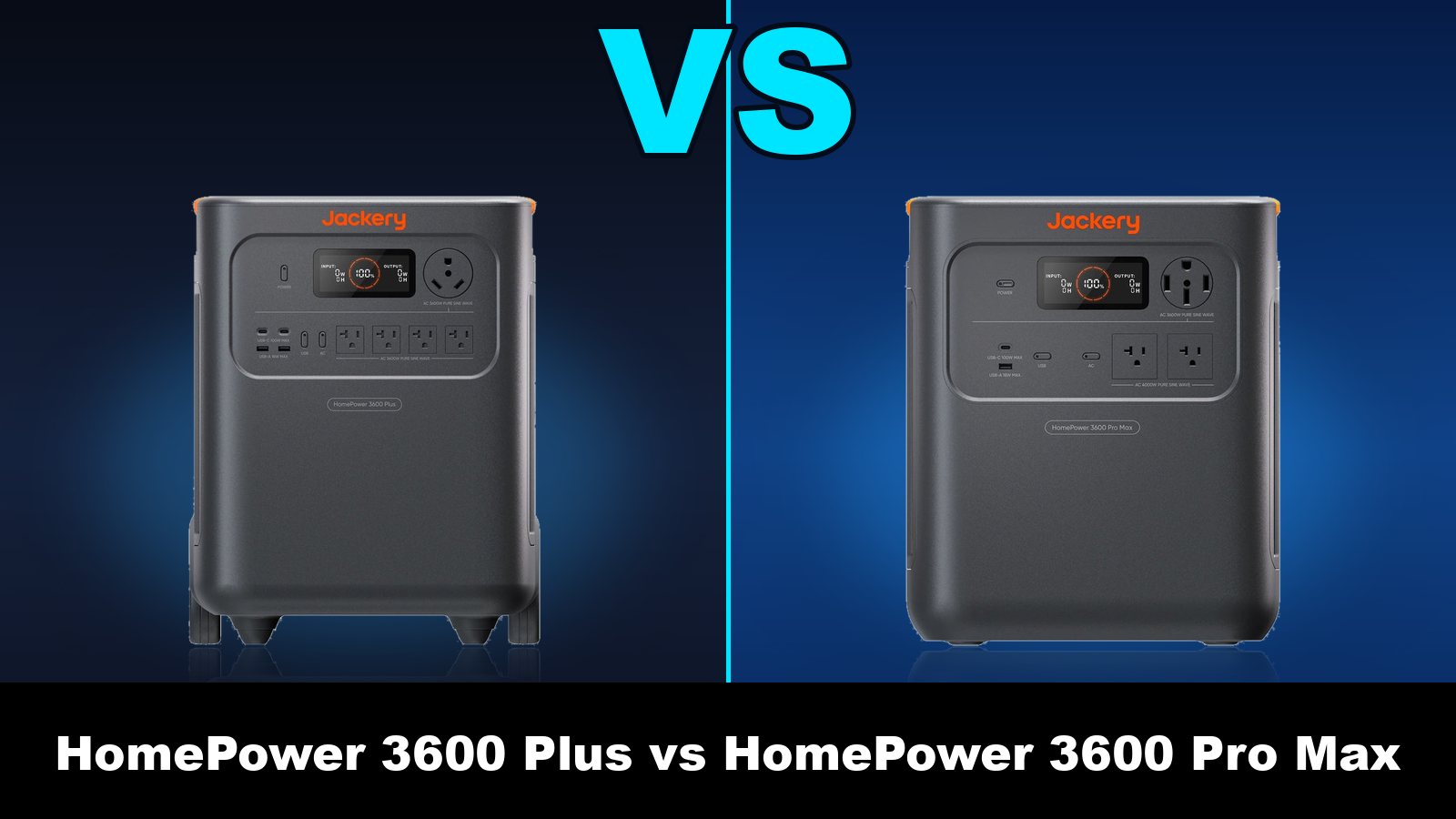

HomePower 3600 Plus
- you plug in an RV: TT-30
- you run 3,600W at 120V
- you’ll roll it around

HomePower 3600 Pro Max
- you need 240V from one unit
- it backs up a home panel
- you’ll use 1,200W of solar
Prices and stock checked by our price engine on November 22, 2026 at 8:00 AM EST. Each product is rechecked several times a day; the time refreshes when you load the page.
The same 3,584Wh battery, wired for two different jobs.
The Jackery HomePower 3600 Plus and the HomePower 3600 Pro Max share the battery: 3,584Wh, 6,000 cycles to 70%, the same Battery Pack 3600 up to five, and charging and running from −4°F. The 3600 Plus is a 120V machine: 3,600W through a TT-30 outlet, four 20A outlets sharing 2,400W, 1,000W of solar and wheels, at 77.16 lb; it reaches 240V only with a second unit. The 3600 Pro Max delivers 4,000W at 240V from a NEMA 14-50 outlet on its own, but only 2,000W at 120V from two 20A outlets, takes 1,200W of solar and weighs 73.85 lb without wheels; it backs up home circuits automatically through a transfer switch sold separately. For an RV or 120V loads you move around, the 3600 Plus; for a 240V well pump or a home panel, the Pro Max.
Below: every difference with numbers, a 20-second calculator for your own gear, eight modeled situations, a bigger third option, and what published tests found.
Same 3,584Wh, same 6,000 cycles, same Battery Pack 3600, same −4°F rating, same 15A wall refill in 2.5 hours and no 12V port on either; prices sit $200 apart today. The Pro Max adds 240V at 4,000W from one unit, 200W more solar and a faster 240V refill option. The 3600 Plus keeps 3,600W at 120V, a TT-30, four 20A outlets and wheels.
- you plug in an RV
- you run 3,600W at 120V
- you want wheels
- you run a 240V pump
- you’ll wire it to a panel
- you’ll use 1,200W of solar
The six differences that decide it
Both store 3,584Wh, are rated for 6,000 cycles to 70%, take up to five Battery Pack 3600, charge and run from −4°F to 113°F, refill from a 15A outlet in 2.5 hours and have no 12V port. These six gaps decide it.
Will it run your setup? Check in 20 seconds
Estimates use 85% usable capacity and 70% of rated solar output. Real results vary with temperature, inverter load, shade and appliance cycling. Fridge and freezer watts are daily averages and do not include compressor startup surges.
Runtime by appliance, one at a time
Simple energy estimates, not measured runtimes: about 3,046Wh usable on both, without extra batteries. PCMag measured about 3,240Wh out of a 3600 Plus.
Same battery, same runtime.
The HomePower 3600 Plus and the 3600 Pro Max both hold about 3,046Wh usable, so every appliance runs just as long on either one.Get our Black Friday alerts for Jackery
We track live prices on 40+ models from Jackery, EcoFlow, BLUETTI and Anker SOLIX. When a deal beats the lowest price we've recorded, you'll hear from us. During Black Friday week, one short recap a day at most.
Unsubscribe in one click. We may earn a commission when you buy through our links, at no extra cost to you. Privacy Policy
The price gap, in numbers
Same 3,584Wh battery: the Jackery HomePower 3600 Plus costs $200 less than the Jackery HomePower 3600 Pro Max.
Prices refresh daily from Jackery US.What the $200 buys: 240V at 4,000W from one unit, 200W more solar and a 1.3-hour refill on 240V, for the same battery.
Same battery and cycle rating, so the first two cards differ only by the price gap. The third card is where the Pro Max earns it: one unit delivers 240V, where the 3600 Plus needs a second unit and the Jackery Connector, not included above. Neither price includes a transfer switch or the electrician.
The third option: the Jackery Explorer 5000 Plus at $3,499

Jackery Explorer 5000 Plus: $3,499 today
If you want both sides at full strength: 5,040Wh and 7,200W at 120V and 240V from one box, with a NEMA 14-50 and an L14-30R, 4,000W of solar, a 0ms Online UPS on its 120V outlets, Jackery’s Smart Transfer Switch option for home circuits and up to five Battery Pack 5000 Plus for about 30kWh, at 134.5 lb on wheels. It charges from 32°F only. Our Explorer 5000 Plus review goes deeper. See the Explorer 5000 Plus at Jackery.
Eight modeled situations, worked out
Same formula as the calculator above: 85% of the rated capacity, no extra battery unless stated.
A 240V well pump
The Pro Max delivers 4,000W at 240V from its NEMA 14-50 outlet. The 3600 Plus needs a second unit and the Jackery Connector, sold separately, for 240V and 7,200W, charging from solar only while paralleled.
An RV at a campground
The 3600 Plus has a TT-30 outlet at 3,600W. The Pro Max has none; an RV would run from an adapter on a 20A outlet, at up to 2,000W.
Backing up a home panel
Jackery sells the Pro Max to back up home circuits automatically through a manual transfer switch, its ATS or its Smart Transfer Switch, all sold separately, with the AC input left plugged in. It has no transfer switch built in. We found no transfer switch Jackery names for the 3600 Plus.
A space heater and a microwave
The 3600 Plus runs it through its 3,600W TT-30; its four 20A outlets share 2,400W. The Pro Max is rated 2,000W at 120V.
A three-day outage
Identical on battery: about a day and a half alone and two and a half days with one pack, on either.
Refill from solar at max input
Same battery, so the Pro Max’s extra 200W of input saves close to an hour of sun.
Refill from the wall before a storm
Both take 2.5 hours on a 15A, 120V outlet. The Pro Max refills in 1.3 hours on 240V with its optional 40A cable; the 3600 Plus takes 2 hours with solar added.
Moving it
The 3600 Plus rolls on wheels with a retractable handle. The Pro Max is 3.3 lb lighter but has no wheels: it is built to stay next to the panel.
Ten more differences, the spec sheet and the box
Smaller gaps that rarely decide the purchase, then the full specifications and what ships in the box.
HomePower 3600 Plus and HomePower 3600 Pro Max weight, dimensions and full specifications
Weight: 77.16 lb for the HomePower 3600 Plus and 73.85 lb for the HomePower 3600 Pro Max. Dimensions: 15.2 × 12.2 × 19.3 in and 14.76 × 10.83 × 17.72 in. Everything else is in the sheet below.
Jackery HomePower 3600 Plus and Jackery HomePower 3600 Pro Max full specifications
Every published figure for both units, grouped. Green marks the better value.
What’s in the box
HomePower 3600 Plus
- HomePower 3600 Plus3,584Wh, 77.16 lb
- AC charging cable
- User manual
- Jackery Connector for 240V sold separately
HomePower 3600 Pro Max
- HomePower 3600 Pro Max3,584Wh, 73.85 lb
- AC charging cable
- User manual and screw terminal block
- Manual transfer switch and 40A cable sold separatelyor in Jackery’s bundles
From Jackery’s US pages and manuals; battery packs, the Jackery Connector, the transfer switches, the 40A cable and the car charging cables are sold separately.
07 · ChargingHow fast each one refills
Shorter bar, faster refill. Each row is scaled to its slower unit.
HomePower 3600 Plus: PCMag refilled it in under two hours from a 3,500W generator, and saw the inverter output shut off at about 1,700W of AC input until it lowered the charge rate in the appHomePower 3600 Pro Max: Jackery’s figures; no allowed reviewer has tested it
Our solar times assume panels deliver 70% of their rating; the brands’ figures assume ideal sun.
Every port, side by side
HomePower 3600 Plus
HomePower 3600 Pro Max
Practical consequence: the 3600 Plus has four 20A outlets sharing 2,400W plus a 3,600W TT-30, two 100W USB-C and two USB-A. The Pro Max has two 20A outlets at 2,000W, a 240V NEMA 14-50 at 4,000W, one 100W USB-C and one USB-A. Neither has a 12V port.
09 · NoiseNoise: HomePower 3600 Plus vs 3600 Pro Max
Jackery rates both at 30dB in Quiet Mode. PCMag measured 55 to 60dB from 3 ft on the Jackery HomePower 3600 Plus at 3,400W; nobody has measured the Jackery HomePower 3600 Pro Max.
One measurement, on the 3600 Plus.Every figure we found, with its source
What reviewers heard: Fan noise of about 55 to 60dB from three feet while it ran a hair dryer, a heater and a water distiller at 3,400W (PCMag).
Measured by a tester Brand figure
- Charge overnight in Quiet Mode, on either.
Cold and heat: HomePower 3600 Plus vs 3600 Pro Max
The Jackery HomePower 3600 Plus and the Jackery HomePower 3600 Pro Max both charge and run from −4°F to 113°F.
Figures from the US manuals for both.- Below −4°F, bring either one inside before charging or running it.
App, UPS and smart features
The Jackery HomePower 3600 Pro Max delivers 240V alone and backs up home circuits through a transfer switch sold separately; the Jackery HomePower 3600 Plus needs a second unit for 240V.
Both use the Jackery app over Wi-Fi and Bluetooth.Green zone: a switch under about 16ms, which most desktop PCs ride through without restarting.
Does it back up home circuits? The Jackery HomePower 3600 Pro Max does, through a manual transfer switch, the Jackery ATS or the Smart Transfer Switch, sold separately, with the AC input plugged in. We found no transfer switch named for the Jackery HomePower 3600 Plus; neither has one built in.
Does it work as a UPS? Both switch to battery when the grid drops. The Jackery HomePower 3600 Plus does it in 10ms, at up to 1,440W in UPS mode; the Jackery HomePower 3600 Pro Max in under 10ms, or 20ms through the Jackery ATS.
Can it deliver 240V? The Jackery HomePower 3600 Pro Max delivers 4,000W at 240V on its own. Two Jackery HomePower 3600 Plus units with the Jackery Connector deliver 7,200W.
Can you add a battery later? Both take up to five Battery Pack 3600, about 21.5kWh.
Warranty and support
Same 3 years plus 2 and the same 6,000-cycle rating on the Jackery HomePower 3600 Plus and the Jackery HomePower 3600 Pro Max; the Pro Max’s extra 2 years apply only to Jackery.com purchases.
Same term, different conditions.Subject to each brand’s warranty terms and eligibility.
Jackery rates both at 6,000 cycles to 70% capacity. Calendar aging and heat also reduce capacity, so read it as a ceiling.
- Buy the Pro Max on Jackery.com and register it to get the 2 extra years.
- Charge either one fully within 7 days of purchase and at least every 6 months to keep the cell coverage.
What reviewers report
We have not lab-tested these two units. Here is what 1 published reviews found, with the source, author and date for each point. Reviews of UK and EU units are flagged: those models charge from 230V outlets and have different sockets, so their charge times and outlet findings don’t carry over to US units.
HomePower 3600 Plus: PCMag (May 2026)HomePower 3600 Pro Max: no verifiable independent test found
Usable capacity
- HomePower 3600 PlusReviewer Measured 90% inverter efficiency: about 3,240Wh usable from 3,584Wh. PCMag, Michael Lydick, May 2026
Charging
- HomePower 3600 PlusReviewer Recharged to 100% in under two hours from a 3,500W gas generator. PCMag, Michael Lydick, May 2026
Noise and heat
- HomePower 3600 PlusReviewer Fan noise around 55 to 60dB from three feet at that 3,400W load. PCMag, Michael Lydick, May 2026
UPS and output
Practical limits before you buy
- The Pro Max gives only 2,000W at 120V from its two 20A outlets.
- Automatic backup on the Pro Max needs a transfer switch sold separately, and the AC input plugged in at all times.
- The Pro Max’s 2 extra warranty years apply only to Jackery.com purchases.
- The 3600 Plus’s four 20A outlets share 2,400W; only its TT-30 delivers 3,600W.
- At its max AC input the 3600 Plus cut its output in PCMag’s test; lowering the charge rate fixed it.
- Neither has a 12V port. A car cooler runs from an AC adapter.
- HomePower 3600 Plus, per its US documentation: Up to five Battery Pack 3600 (3,584Wh each), about 21.5kWh.
- HomePower 3600 Plus, per its US documentation: Four 20A outlets share 2,400W; the TT-30 delivers 3,600W.
- HomePower 3600 Plus, per its US documentation: Solar 1,000W max over two DC8020 ports, 16-60V.
- HomePower 3600 Plus, per its US documentation: Charges and discharges from -4°F to 113°F.
- HomePower 3600 Pro Max, per its US documentation: On 120V input, bypass carries up to 1,440W; above that the battery tops up to 2,880W total across all outlets.
- HomePower 3600 Pro Max, per its US documentation: Automatic switching through an MTS requires the AC input to stay connected at all times.
Frequently asked questions
What is the difference between the Jackery HomePower 3600 Plus and the 3600 Pro Max?
Same 3,584Wh battery, same packs, same −4°F rating. The Pro Max delivers 4,000W at 240V from one unit but 2,000W at 120V, takes 1,200W of solar and backs up home circuits through a transfer switch. The 3600 Plus delivers 3,600W at 120V with a TT-30 outlet and rolls on wheels; it needs a second unit for 240V.
Which is cheaper?
The Jackery HomePower 3600 Plus costs $200 less today: $1,899, against $2,099 for the Jackery HomePower 3600 Pro Max. Prices refresh daily; the price section above has the full breakdown.
Does the 3600 Pro Max have a built-in transfer switch?
No. Automatic backup of home circuits goes through a manual transfer switch, the Jackery ATS or the Smart Transfer Switch, sold separately, with the AC input plugged in.
Can the 3600 Plus deliver 240V?
Only with a second 3600 Plus and the Jackery Connector, sold separately: 7,200W at 240V. The Pro Max does 4,000W at 240V on its own.
Do they use the same expansion battery?
Yes, both take up to five Battery Pack 3600, 3,584Wh each.
Which is better for an RV?
The 3600 Plus, with a TT-30 outlet at 3,600W and wheels. The Pro Max has no TT-30.
How fast do they recharge?
Both take 2.5 hours on a 15A, 120V outlet. The Pro Max takes 1.3 hours on 240V with its optional 40A cable.
How much do they weigh?
77.16 lb for the 3600 Plus, with wheels, and 73.85 lb for the Pro Max, without wheels, per Jackery.
Related comparisons and reviews
How we compared and sources
Research-based comparison. We have not lab-tested these units. Specs come from Jackery’s US pages and US user manuals for the HomePower 3600 Plus and the HomePower 3600 Pro Max; usage observations are attributed to named reviewers. Prices and availability were checked on October 31, 2026.
- Specs: Jackery US, HomePower 3600 Plus and its US user manual (JHP-3600A); Jackery US, HomePower 3600 Pro Max and its US user manual (JHP-3600C), read on October 31, 2026.
- Jackery’s Pro Max page rates one unit at 2,000W at 120V; the manual’s table lists 2,000W per 20A outlet. We use the page’s 2,000W. Neither model has a transfer switch built in, and we found no allowed independent test of the Pro Max.
- Reviewer reports on the HomePower 3600 Plus: PCMag, Michael Lydick, May 2026.
- Runtime = capacity × 0.85 ÷ watts. Solar harvest = min(panel watts, max input) × sun hours × 0.70. Cost per lifetime kWh = price ÷ (cycles × capacity in kWh).
Same 3,584Wh, packs and −4°F rating. The Pro Max gives 4,000W at 240V from one unit; the 3600 Plus gives 3,600W at 120V with a TT-30 and wheels.
Prices checked November 22, 2026 at 8:00 AM EST
Looking at other models? Browse all power station comparisons, or pick any two models on the hub and we point you to the right duel.
Originally published: November 17, 2026