
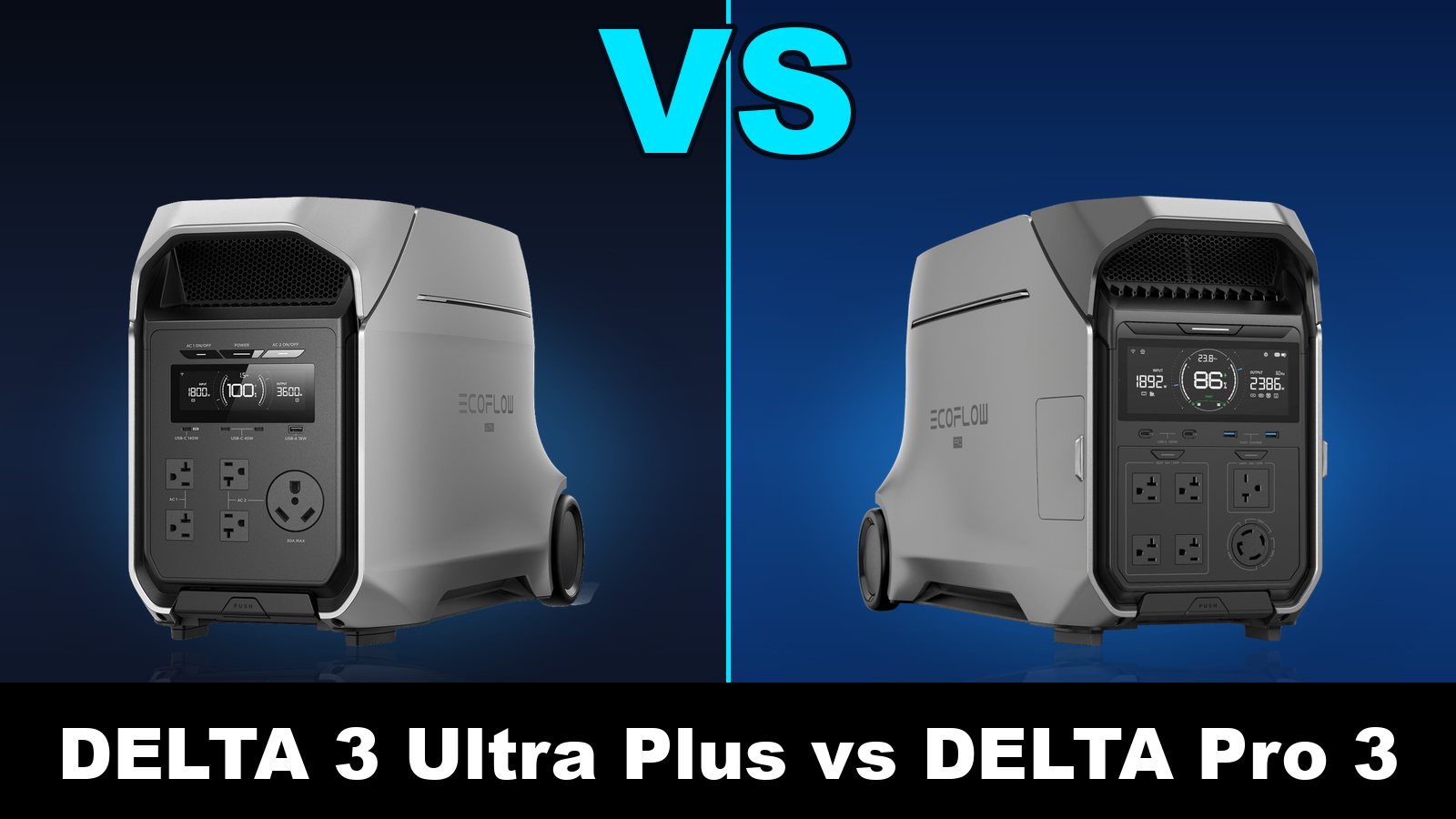

DELTA 3 Ultra Plus
- your house runs on 120V loads, up to 3,600W
- you’ll move it: 74.3 lb, 39 lb lighter
- you want the same battery system for $1,200 less

DELTA Pro 3
- you need 240V: well pump, dryer, L14-30 to a transfer switch
- you run 2,600W of solar or loads up to 4,000W
- you want 4,096Wh in the base unit
Prices and stock checked by our price engine on November 23, 2026 at 6:59 AM EST. Each product is rechecked several times a day; the time refreshes when you load the page.
$1,200 buys 240V, 1,024Wh more and 1,000W more solar. If you don’t need 240V, it mostly buys weight.
The EcoFlow DELTA 3 Ultra Plus and the EcoFlow DELTA Pro 3 take the same DELTA Pro 3 Extra Battery, switch to UPS in 10ms and charge at 1,800W from a 120V outlet. The DELTA Pro 3 stores 4,096Wh instead of 3,072Wh, delivers 4,000W at 120V and 240V instead of 3,600W at 120V, and takes 2,600W of solar instead of 1,600W. The Ultra Plus weighs 74.3 lb instead of 113.5 and costs $1,200 less.
Below: every difference with numbers, a 20-second calculator for your own gear, six modeled situations, and what published tests found.
Same extra battery, same 10ms UPS, same 1,800W wall charging at 120V. The DELTA Pro 3 costs $1,200 more for 240V, 400W more output, 1,000W more solar and 1,024Wh more; the Ultra Plus is 39 lb lighter.
- your loads are 120V
- you move it: 74.3 lb
- you want the system for $1,200 less
- you need 240V or 4,000W
- you’ll run 2,600W of solar
- you want 4,096Wh to start
The five differences that decide it
The five gaps that decide the purchase, with the better spec for most buyers flagged. Both take up to two DELTA Pro 3 Extra Batteries, switch to UPS in 10ms, charge at 1,800W from a 120V outlet, have four 20A outlets, a TT-30 and a 30A Anderson port, and carry 5 years with app registration.
Will it run your setup? Check in 20 seconds
Estimates use 85% usable capacity and 70% of rated solar output. Real results vary with temperature, inverter load, shade and appliance cycling. Fridge and freezer watts are daily averages and do not include compressor startup surges.
Runtime by appliance, one at a time
Simple energy estimates, not measured runtimes. About 2,611Wh usable on the Ultra Plus and 3,482Wh on the DELTA Pro 3; reviewers measured about 2,610Wh and 3,700Wh.
Appliance for appliance, the DELTA Pro 3 lasts 33% longer than the Ultra Plus.
Same appliance, same watts: the gap is always the size of the battery.Get our Black Friday alerts for EcoFlow
We track live prices on 40+ models from Jackery, EcoFlow, BLUETTI and Anker SOLIX. When a deal beats the lowest price we've recorded, you'll hear from us. During Black Friday week, one short recap a day at most.
Unsubscribe in one click. We may earn a commission when you buy through our links, at no extra cost to you. Privacy Policy
The price gap, in numbers
The EcoFlow DELTA Pro 3 costs $1,200 more than the EcoFlow DELTA 3 Ultra Plus and adds 1,024Wh: that is $1.17 per extra Wh, against $0.52 per Wh for the Ultra Plus.
Prices refresh daily from EcoFlow US.What the $1,200 buys: 1,024Wh more battery (4,096Wh vs 3,072Wh), 240V output and 3,600W charging from a 240V outlet.
Both systems grow with the same DELTA Pro 3 Extra Battery, so the gap between them stays the price of the base units. EcoFlow rates the DELTA Pro 3 at 4,000 cycles to 80% and publishes no cycle figure for the Ultra Plus, so we skip the price-per-cycle card. EcoFlow US prices move often; the figures here are refreshed daily by our price engine.
The third option: the DELTA Pro Ultra at $4,199
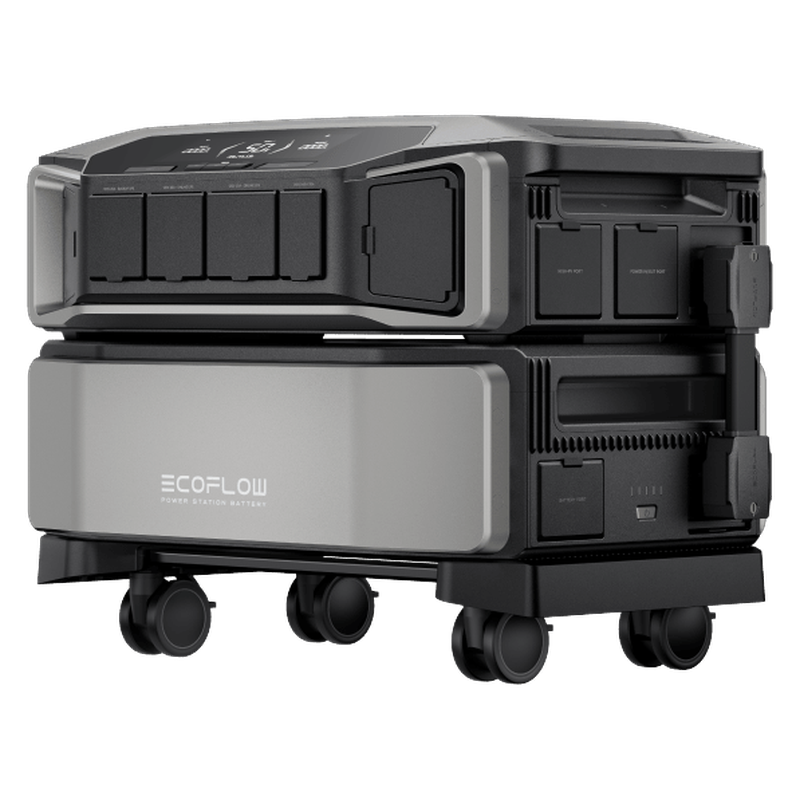
EcoFlow DELTA Pro Ultra: $4,199 today
6,144Wh per battery, 7,200W at 120V and 240V, 5,600W of solar and up to 30.7kWh per inverter, with a 0ms online UPS on three outlets per EcoFlow. It ships as a 70 lb inverter and a 111.8 lb battery and is built for whole-home backup. Our DELTA Pro Ultra review goes deeper. See the DELTA Pro Ultra at EcoFlow.
Eight modeled situations, worked out
Same formula as the calculator above, with 0 extra batteries unless stated. The fridge averages 60W, about 525kWh a year, in the range printed on typical EnergyGuide labels; that average does not include compressor startup surges.
24-hour outage, essentials only
The DELTA Pro 3 lasts about ten hours longer on its own. Add one extra battery to either and both cover about three days.
A 240V well pump or dryer
Only the DELTA Pro 3 delivers 240V, on its L14-30 and 6-20R outlets. The Ultra Plus feeds 120V circuits only.
Weekend off-grid with 2,600W of panels
With 1,600W of panels or less they bank energy at the same rate. Above that, only the DELTA Pro 3 uses the array, split between its high- and low-voltage ports.
Moving it
Both have wheels. The Ultra Plus is a one-person lift for most; three DELTA Pro 3 reviewers recommend help.
Two nights in an RV
Both have a TT-30 for the shore cord and a 30A Anderson port for the fridge. The DELTA Pro 3 runs longer; the Ultra Plus is 39 lb easier to load.
Home office through an outage
Both carry more than a workday and both switch to battery in 10ms; StorageReview measured 8.25ms on the Ultra Plus.
A full-size fridge, nothing else
The DELTA Pro 3 keeps food cold about 14.5 h longer on one charge. With solar during the day, either one can carry a fridge through a multi-day outage.
A 1,500W space heater on high
Heaters drain any portable station fast. Use the low setting, heat one small room, and treat the station as a bridge, not a heating plan.
Nine more differences, the spec sheet and the box
Smaller gaps that rarely decide the purchase, then the full specifications and what ships in the box.
DELTA 3 Ultra Plus and DELTA Pro 3 weight, dimensions and full specifications
Weight: 74.3 lb for the Ultra Plus and 113.5 lb for the DELTA Pro 3. Dimensions: 24.1 × 12.9 × 15.6 in and 16.16 × 13.43 × 27.28 in. Everything else is in the sheet below.
EcoFlow DELTA 3 Ultra Plus and DELTA Pro 3 full specifications
Every published figure for both units, grouped. Green marks the better value.
What’s in the box
DELTA 3 Ultra Plus
- DELTA 3 Ultra Plus3,072Wh, 74.3 lb
- AC charging cable
- Manuals and warranty card
- No solar or car cablesold separately
DELTA Pro 3
- DELTA Pro 34,096Wh, 113.5 lb
- AC charging cable
- Manuals and warranty card
- Extra battery sold separately
From EcoFlow US product pages. Bundles with a panel, an extra battery or a generator come with the matching cables.
07 · ChargingHow fast each one refills
Shorter bar, faster refill. Each row is scaled to its slower unit.
Ultra Plus: 3,200W from an EcoFlow Smart GeneratorDELTA Pro 3: Smart Generator auto start, EV-station charging with an adapter
Our solar times assume panels deliver 70% of their rating; EcoFlow’s own figures assume ideal conditions. The DELTA Pro 3’s 2,600W needs two arrays, one per port.
Every port, side by side
DELTA 3 Ultra Plus
DELTA Pro 3
Practical consequence: the same 120V layout on both, with four 20A outlets, a TT-30 and an Anderson port. The DELTA Pro 3 adds the two 240V outlets, the L14-30 being the one that feeds a transfer switch.
09 · NoiseNoise: Ultra Plus vs DELTA Pro 3
Both are quiet. Digital Trends found the EcoFlow DELTA 3 Ultra Plus‘s fan unobtrusive even at full load; OutdoorGearLab ran the EcoFlow DELTA Pro 3 overnight with CPAP machines and heaters without noticing the fan, which only gets louder near 4,000W.
EcoFlow rates the Ultra Plus at 25dB or less at 600W and the DELTA Pro 3 as low as 30dB. We found no independent dB measurement for either.Every figure we found, with its source
What reviewers heard: Fan noise stayed unnoticeable even under full load (Digital Trends).
What reviewers heard: Ran overnight with CPAP machines and heaters without the fan being noticed; louder only near its 4,000W maximum (OutdoorGearLab).
Measured by a tester Brand figure
- Lower the AC charging speed in the app overnight.
Cold, heat and storage: Ultra Plus vs DELTA Pro 3
The EcoFlow DELTA 3 Ultra Plus and the EcoFlow DELTA Pro 3 share the same limits: charging from 32°F to 113°F, running from 14°F to 113°F. Only the DELTA Pro 3’s battery pack is sealed to IP65; its main unit is IP20.
Figures from the EcoFlow US product pages for both models.- In a garage in winter, bring either one inside to charge: neither charges below 32°F.
- For storage, keep it between 68°F and 86°F with some charge left, and top it up every few months (EcoFlow US).
App, UPS and smart features
The EcoFlow DELTA Pro 3 does more: 240V, the Smart Home Panel 2 and automatic Smart Generator starts. The EcoFlow DELTA 3 Ultra Plus matches it on the 10ms UPS, off-peak charging and extra batteries, and adds Storm Guard.
Same app, same 10ms UPS, same Extra Batteries. The gap is 240V and home integration.Green zone: a switch under about 16ms, which most desktop PCs ride through without restarting.
Does it deliver 240V? The EcoFlow DELTA 3 Ultra Plus has no 240V: well pumps, dryers and 240V transfer switches need the EcoFlow DELTA Pro 3.
Can it start a generator by itself? The EcoFlow DELTA Pro 3 starts an EcoFlow Smart Generator automatically; EcoFlow lists no such feature for the Ultra Plus.
Does it prepare for storms? The EcoFlow DELTA 3 Ultra Plus’s Storm Guard Mode charges ahead of severe weather; EcoFlow lists no storm feature for the DELTA Pro 3.
Does it connect to a home panel? The EcoFlow DELTA Pro 3 pairs with the Smart Home Panel 2, with app control of up to 12 circuits, and feeds a transfer switch from its L14-30. The EcoFlow DELTA 3 Ultra Plus connects to a 120V transfer switch or inlet box.
Does it work as a UPS? Both switch to battery in 10ms; StorageReview measured 8.25ms on the EcoFlow DELTA 3 Ultra Plus.
Can you add a battery later? Both take up to two DELTA Pro 3 Extra Batteries, so a battery bought for one fits the other: about 11kWh on the Ultra Plus, about 12kWh on the DELTA Pro 3.
Can it charge off-peak? Both can charge off-peak and discharge during the day from the EcoFlow app. On the Ultra Plus this needs app V6.15+ and firmware V7.80.99.52+.
Warranty and support
The EcoFlow DELTA 3 Ultra Plus gets 3 years, plus 2 more once registered in the EcoFlow app. EcoFlow’s warranty policy gives the EcoFlow DELTA Pro 3 5 years with no condition, but its product page still shows 3 plus 2 on registration, so register it too.
Both reach 5 years. Registering both is the safe reading.Subject to each brand’s warranty terms and eligibility.
EcoFlow rates the DELTA Pro 3 at 4,000 cycles to 80% capacity, about 11 years at one full cycle a day. It publishes no cycle count for the Ultra Plus, only a lifespan of about 10 years. Calendar aging and heat also reduce capacity, so read any rating as a ceiling.
- Register both in the EcoFlow app the day they arrive: the Ultra Plus is 3 years without it, and the DELTA Pro 3’s product page shows the same 3 plus 2.
What reviewers report
We have not lab-tested these two units. Here is what 9 published reviews found, with the source, author and date for each point. Reviews of UK and EU units are flagged: those models charge from 230V outlets and have different sockets, so their charge times and outlet findings don’t carry over to US units.
Ultra Plus: StorageReview (September 2025), Digital Trends (July 2026), How-To Geek (October 2025)DELTA Pro 3: Digital Trends (June 2024), OutdoorGearLab (January 2026), TechRadar (March 2025), RV.com (July 2024), The Gadgeteer (October 2024), Techspective (July 2025)
Usable capacity
- Ultra PlusReviewer A full discharge delivered 2.61kWh from the 3,072Wh pack, about 85 percent. StorageReview, Dylan Dougherty, September 2025
- DELTA Pro 3Reviewer Averaged 3.7kWh of discharge over several cycles, a little under the 4kWh rating. Digital Trends, Simon Sage, June 2024
- DELTA Pro 3Reviewer Test jig measured 3,790Wh from the 4,096Wh battery, over 93%, well above average for power stations. OutdoorGearLab, Kenji Mowrey, January 2026
Charging
- Ultra PlusReviewer Refilling from empty took 3.54kWh from the wall, about 87 percent charging efficiency. StorageReview, Dylan Dougherty, September 2025
- Ultra PlusReviewer Wall charging at 1,800W reached 100 percent in roughly an hour and forty minutes. Digital Trends, Ian Bell, July 2026
- DELTA Pro 3Reviewer A full charge from empty drew close to 5kWh from the wall and took about three hours. Digital Trends, Simon Sage, June 2024
- DELTA Pro 3Reviewer Never reached the full 1,800W input on a 15A outlet: peak near 1,600W, average 1,293Wh per hour, full charge within 3 hours. OutdoorGearLab, Kenji Mowrey, January 2026
Noise and heat
- Ultra PlusReviewer Fan noise stayed unnoticeable even under full load. Digital Trends, Ian Bell, July 2026
- DELTA Pro 3Reviewer Used through an East Coast heat wave, routinely above 90 degrees F, which let the reviewer test its operating limits. Digital Trends, Simon Sage, June 2024
- DELTA Pro 3Reviewer Ran overnight with CPAP machines and heaters without the fan being noticed; fan gets louder only near its 4,000W maximum. OutdoorGearLab, Kenji Mowrey, January 2026
UPS and output
- Ultra PlusReviewer Measured UPS transfer time was 8.25ms on a workstation load. StorageReview, Dylan Dougherty, September 2025
- Ultra PlusReviewer A full workstation with desktop, monitor, tablet and router ran for over 10 hours with capacity left. Digital Trends, Ian Bell, July 2026
- DELTA Pro 3Reviewer Reviewer pushed it to add charge to a Tesla, and says it can run an industrial popcorn machine for hours. TechRadar, Collin Probst, March 2025
- DELTA Pro 3Reviewer Used as a UPS and home backup; the reviewer cites EcoFlow’s 10ms switchover for critical appliances. TechRadar, Collin Probst, March 2025
Daily use and issues
- Ultra PlusReviewer The display struggles in direct sunlight. Digital Trends, Ian Bell, July 2026
- Ultra PlusReviewer Switching to full 1,800W charging tripped the reviewer’s garage GFCI outlet. How-To Geek, Cory Gunther, October 2025
- DELTA Pro 3Reviewer At 115 lb, the reviewer says it barely counts as portable. Digital Trends, Simon Sage, June 2024
- DELTA Pro 3Reviewer Measured weight 114.1 lb, versus 97.5 lb for the original DELTA Pro. OutdoorGearLab, Kenji Mowrey, January 2026
Practical limits before you buy
- The Ultra Plus has no 240V. Well pumps, dryers and 240V transfer switches need the DELTA Pro 3.
- The DELTA Pro 3’s 3,600W charging needs a 240V outlet. On 120V, both charge at 1,800W.
- 2,600W of solar needs two arrays on the DELTA Pro 3: up to 1,600W high-voltage and 1,000W low-voltage.
- X-Boost is for heating loads only. Motors need the continuous rating: 3,600W or 4,000W.
- 113.5 lb. The DELTA Pro 3 rolls, but lifting it is a two-person job.
- Neither ships with a solar cable.
- Register both in the EcoFlow app. The Ultra Plus is 3 years out of the box, plus 2 after registration; EcoFlow’s warranty policy gives the DELTA Pro 3 5 years, though its product page still shows 3 + 2 on registration.
- Ultra Plus, per its US documentation: Anderson 30A and car outlet share one 12.6V budget: 378W total.
- Ultra Plus, per its US documentation: The two 45W USB-C ports share 45W total.
- Ultra Plus, per its US documentation: Wall charging 1800W, 0-80% in 89 minutes; the 48-minute figure needs solar plus Smart Generator together.
- Ultra Plus, per its US documentation: Expandable to 11kWh with 2 x DELTA Pro 3 Extra Battery.
- DELTA Pro 3, per its US documentation: Only the battery pack is sealed to IP65; the main unit is IP20 with no water or dust rating.
Frequently asked questions
What is the difference between the DELTA 3 Ultra Plus and the DELTA Pro 3?
The DELTA Pro 3 adds 240V output, 4,000W instead of 3,600W, 2,600W of solar instead of 1,600W and 4,096Wh instead of 3,072Wh. The Ultra Plus is 39 lb lighter; both use the same extra battery and a 10ms UPS.
Do they use the same extra battery?
Yes. Both take up to two DELTA Pro 3 Extra Batteries: about 11kWh on the Ultra Plus, about 12kWh on the DELTA Pro 3.
Can the Ultra Plus run 240V appliances?
No. It’s 120V only. The DELTA Pro 3 delivers 240V on its L14-30 and 6-20R outlets.
How long will each run a refrigerator?
At a 60W average: about 43 hours on the Ultra Plus and 58 hours on the DELTA Pro 3.
Which charges faster?
From a 120V outlet, both take 1,800W. The DELTA Pro 3 takes 3,600W from a 240V outlet and 2,600W of solar.
Which is better as a UPS?
Both switch in 10ms; StorageReview measured 8.25ms on the Ultra Plus.
How much do they weigh?
74.3 lb for the Ultra Plus and 113.5 lb for the DELTA Pro 3.
Which is better for whole-home backup?
The DELTA Pro 3, if you need 240V circuits or the Smart Home Panel 2. For 120V circuits through a transfer switch, the Ultra Plus does the job.
Do reviews confirm the rated capacity?
Ultra Plus: A full discharge delivered 2.61kWh from the 3,072Wh pack, about 85 percent (StorageReview). DELTA Pro 3: Averaged 3.7kWh of discharge over several cycles, a little under the 4kWh rating (Digital Trends). Inverter losses usually take 10 to 20% on AC, which is why our calculator uses 85% of the rating.
How loud are the Ultra Plus and the DELTA Pro 3?
EcoFlow rates the Ultra Plus at 25dB or less at 600W, measured at 1 m and the DELTA Pro 3 at as low as 30dB, conditions not stated. Fans ramp up mostly during fast charging and near full output; capping the charging speed in the app is the easiest way to keep either quiet at night.
Do I have to register for the 5-year warranty?
Ultra Plus: 3 years, 5 after app registration. DELTA Pro 3: 3 years, 5 after app registration. Where the extension depends on registration, do it in the EcoFlow app as soon as the unit arrives.
Related comparisons and reviews
How we compared and sources
Research-based comparison. We have not physically tested these two units. Specs come from EcoFlow US documentation; usage observations are attributed to named reviewers. Prices and availability were checked on October 30, 2026.
- Specs: EcoFlow US, DELTA 3 Ultra Plus and EcoFlow US, DELTA Pro 3, read on October 30, 2026.
- Reviewer reports on the Ultra Plus: StorageReview, Dylan Dougherty, September 2025, Digital Trends, Ian Bell, July 2026, How-To Geek, Cory Gunther, October 2025; on the DELTA Pro 3: Digital Trends, Simon Sage, June 2024, OutdoorGearLab, Kenji Mowrey, January 2026, TechRadar, Collin Probst, March 2025, RV.com, Kraig Becker, July 2024, The Gadgeteer, Julian Perry, October 2024, Techspective, Tony Bradley, July 2025.
- Runtime = capacity × 0.85 ÷ watts. Solar harvest = min(panel watts, max input) × sun hours × 0.70.
Same extra battery and UPS. The DELTA Pro 3 adds 240V, 2,600W solar and 1kWh for $1,200 more; the Ultra Plus is 39 lb lighter.
Prices checked November 23, 2026 at 6:59 AM EST
Looking at other models? Browse all power station comparisons, or pick any two models on the hub and we point you to the right duel.
Originally published: November 17, 2026