

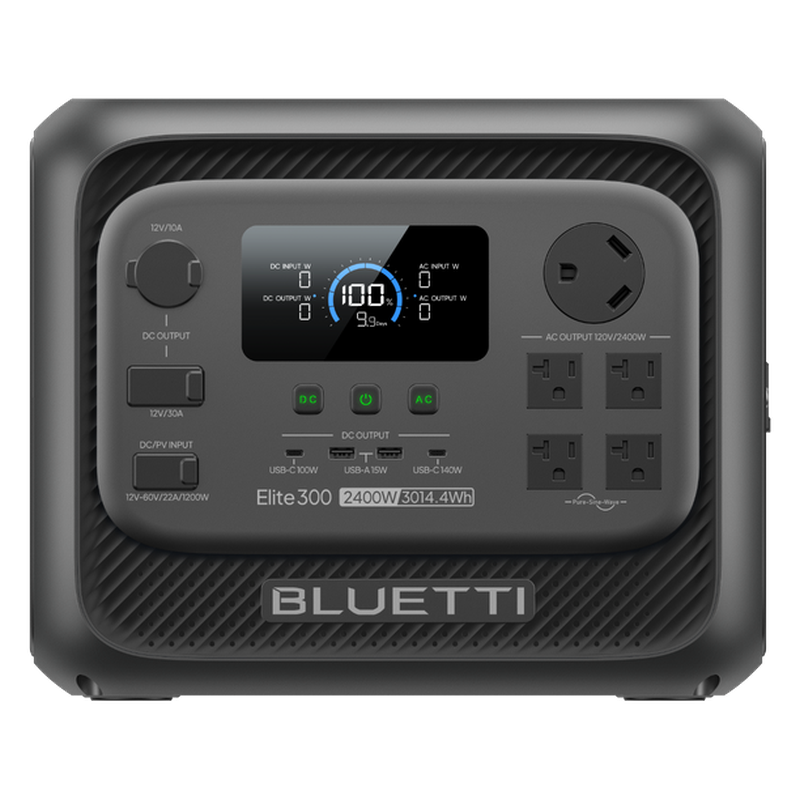
Elite 300
- you’ll use 1,200W of solar
- you run 12V/30A gear in an RV
- it costs $270 less today

DELTA 3 Ultra
- you run up to 3,600W at once
- it sits in a living room: 25dB
- you’ll roll it: wheels and a handle
Prices and stock checked by our price engine on November 23, 2026 at 6:59 AM EST. Each product is rechecked several times a day; the time refreshes when you load the page.
Neither one will ever grow. So buy the one that fits the job you have today.
The BLUETTI Elite 300 and the EcoFlow DELTA 3 Ultra both store about 3kWh, switch to battery in 10ms, have a TT-30 RV outlet and take no extra battery. The DELTA 3 Ultra delivers 3,600W instead of 2,400W and is rated at 25dB at 600W, on wheels at 72.1 lb. The Elite 300 weighs 58 lb, takes 1,200W of solar instead of 800W, adds a 12V/30A port and costs $270 less.
Below: every difference with numbers, a 20-second calculator for your own gear, seven modeled situations, a third option, and what published tests found on each.
Same 3kWh class, same 10ms UPS, no expansion on either. The DELTA 3 Ultra delivers 1,200W more and is the quieter unit on paper; the Elite 300 costs $270 less, weighs 14 lb less, takes 400W more solar and has a 12V/30A port.
- you’ll use 1,200W of solar
- you run 12V/30A gear
- you’ll lift it: 58 lb
- you run up to 3,600W
- you want it quiet: 25dB
- you’ll roll it: wheels
The five differences that decide it
Both store about 3kWh of LFP, switch to battery in 10ms, have four 20A outlets and a TT-30, charge at 1,800W from the wall and can’t be expanded. These five gaps decide it.
Will it run your setup? Check in 20 seconds
Estimates use 85% usable capacity and 70% of rated solar output. Real results vary with temperature, inverter load, shade and appliance cycling. Fridge and freezer watts are daily averages and do not include compressor startup surges.
Runtime by appliance, one at a time
Simple energy estimates, not measured runtimes. About 2,562Wh usable on the Elite 300 and 2,611Wh on the DELTA 3 Ultra; StorageReview measured 2,670Wh from the Elite 300.
Practically a tie: the Ultra holds only 2% more than the Elite 300.
Same appliance, same watts: the gap is always the size of the battery.Get our Black Friday alerts for power stations
We track live prices on 40+ models from Jackery, EcoFlow, BLUETTI and Anker SOLIX. When a deal beats the lowest price we've recorded, you'll hear from us. During Black Friday week, one short recap a day at most.
Unsubscribe in one click. We may earn a commission when you buy through our links, at no extra cost to you. Privacy Policy
The price gap, in numbers
The EcoFlow DELTA 3 Ultra costs $270 more than the BLUETTI Elite 300 and adds 58Wh: that is $4.66 per extra Wh, against $0.36 per Wh for the Elite 300.
Prices refresh daily from BLUETTI US and EcoFlow US.What the $270 buys: 3,600W instead of 2,400W, full output while charging from the wall and a 25dB rating at 600W.
The gap buys output and quiet, not runtime: the two batteries are within 58Wh. EcoFlow publishes no cycle count for the DELTA 3 Ultra, only an estimated 10-year life, so its lifetime cost can’t be compared on the same basis.
The third option: the EcoFlow DELTA 3 Ultra Plus at $1,599

EcoFlow DELTA 3 Ultra Plus: $1,599 today
The Ultra with the two things both of these lack: a battery port, up to about 11kWh with two DELTA Pro 3 Extra Batteries, and 1,600W of solar. It keeps the 3,600W inverter and 10ms UPS, adds a 30A Anderson port and weighs 74.3 lb. Pick it if a fixed 3kWh worries you. Our DELTA 3 Ultra review goes deeper. See the DELTA 3 Ultra Plus at EcoFlow.
Seven modeled situations, worked out
Same formula as the calculator above. Neither takes an extra battery. The fridge averages 60W, about 525kWh a year, in the range printed on typical EnergyGuide labels; that average does not include compressor startup surges.
24-hour outage, essentials only
A tie: both cover a full day and neither extends past it without solar or a generator.
Microwave and space heater together
The DELTA 3 Ultra runs both with 1,000W to spare. On the Elite 300, one at a time; Trusted Reviews saw it shut off its AC after an hour at the full 2,400W on a UK unit.
Home office through an outage
Both carry more than a workday and both switch in 10ms; StorageReview measured 8ms on the Elite 300 and 8.25ms on the Ultra Plus, which shares the Ultra’s platform. The Ultra’s 140W USB-C also supports HID for clean PC shutdown.
Refill from solar, each at its maximum
The Elite 300 refills in one good day of sun; the Ultra needs most of a long one, or two.
Two nights in an RV
Both plug into the RV through their TT-30. For 12V gear, the Elite 300’s 30A port carries far more than the Ultra’s 126W car socket.
A unit that lives in the living room
EcoFlow rates the Ultra at 25dB at 600W, a whisper. Reviewed found the Elite 300’s fan quiet enough for normal conversation beside it, but Notebookcheck measured over 50dB under load on an EU unit.
Moving it
The Ultra rolls on wheels with a handle; the Elite 300 has none but weighs 14 lb less, which matters more when you lift it into a vehicle.
Eight more differences, the spec sheet and the box
Smaller gaps that rarely decide the purchase, then the full specifications and what ships in the box.
Elite 300 and DELTA 3 Ultra weight, dimensions and full specifications
Weight: 58 lb for the BLUETTI Elite 300 and 72.1 lb for the EcoFlow DELTA 3 Ultra. Dimensions: 14.4 × 12.0 × 11.7 in and 24.6 × 12.9 × 15.6 in. Everything else is in the sheet below.
BLUETTI Elite 300 and EcoFlow DELTA 3 Ultra full specifications
Every published figure for both units, grouped. Green marks the better value.
What’s in the box
Elite 300
- Elite 3003,014Wh, 58 lb
- AC charging cable
- Manual, grounding screw
- No car cable
DELTA 3 Ultra
- DELTA 3 Ultra power station3,072Wh, 72.1 lb
- AC charging cable
- Manuals and warranty card
- No solar or car cablesold separately
From the BLUETTI US manual and the EcoFlow US DELTA 3 Ultra page.
07 · ChargingHow fast each one refills
Shorter bar, faster refill. Each row is scaled to its slower unit.
Elite 300: Silent 800W, Standard 1,200W and Turbo 1,800W modesDELTA 3 Ultra: X-Fusion keeps the full 3,600W available while it charges from the wall
Our solar times divide capacity by 70% of the panel rating; real charging slows near full.
Every port, side by side
Elite 300
DELTA 3 Ultra
Practical consequence: the same four 20A outlets and TT-30 on both. The Elite 300 adds a 12V/30A port, a second fast USB-C and a second USB-A; the Ultra adds a third USB-C and a generator input.
09 · NoiseNoise: Elite 300 vs Ultra
The EcoFlow DELTA 3 Ultra is the quieter one on paper: EcoFlow rates it at 25dB or less at 600W. BLUETTI publishes no rating for the BLUETTI Elite 300, and Notebookcheck measured it over 50dB under load.
We found no independent test of the base DELTA 3 Ultra; its figure is EcoFlow’s, at 1 m.Every figure we found, with its source
What reviewers heard: Fans ramped up noticeably while charging at full speed and powering about 900W (StorageReview); quiet enough for normal conversation beside it under heavier loads (Reviewed).
Measured by a tester Brand figure
- Fast charging spins the fans up most: use the slower charging modes overnight.
Cold and heat: Elite 300 vs Ultra
For a cold garage, the BLUETTI Elite 300 keeps running down to −4°F; for a hot one, the EcoFlow DELTA 3 Ultra is rated to 113°F. Neither charges below freezing.
Figures from the Elite 300 user manual and the EcoFlow US DELTA 3 Ultra page.- Charge either one indoors in winter: neither charges below 32°F.
App, UPS and smart features
The EcoFlow DELTA 3 Ultra does more: full power while charging, Storm Guard and time-of-use. The BLUETTI Elite 300 matches it on the 10ms UPS and pushes heaters a little further.
Both use their brand’s app over Wi-Fi and Bluetooth, and neither takes an extra battery.Green zone: a switch under about 16ms, which most desktop PCs ride through without restarting.
Does it keep full power while charging? The EcoFlow DELTA 3 Ultra’s X-Fusion keeps the full 3,600W available while it charges from the wall; the BLUETTI Elite 300’s AC output is limited to 1,800W in bypass, per its US manual.
Does it prepare for storms? The EcoFlow DELTA 3 Ultra’s Storm Guard charges from AC ahead of severe weather once set up; BLUETTI lists no such feature for the Elite 300.
Does it work as a UPS? Both switch in 10ms, and StorageReview measured 8ms on the BLUETTI Elite 300.
Can it charge off-peak? Both can charge off-peak: Time Control on the BLUETTI Elite 300, time-of-use and Scheduled Tasks on the EcoFlow DELTA 3 Ultra.
Can it run a heater or kettle above its rating? Both run heaters at reduced power above their rating, not motors: up to 4,800W on the BLUETTI Elite 300, 4,600W on the EcoFlow DELTA 3 Ultra.
Can you add a battery later? Neither takes an extra battery. The expandable versions are the BLUETTI Apex 300 and the EcoFlow DELTA 3 Ultra Plus.
How does the app connect? Both use their brand’s app over Wi-Fi or Bluetooth; on the EcoFlow DELTA 3 Ultra, Digital Trends found most settings need the app.
Warranty and support
The BLUETTI Elite 300 has 5 years with nothing to do; the EcoFlow DELTA 3 Ultra gets 3 years, plus 2 more if you register it in the EcoFlow app.
Same 5 years at best. Only the Ultra asks you to do something to get them.Subject to each brand’s warranty terms and eligibility.
BLUETTI rates the Elite 300 at 6,000+ cycles to 80%, about 16 years at one full cycle a day. EcoFlow publishes no cycle count for the DELTA 3 Ultra, only an estimated 10-year life.
- If you choose the DELTA 3 Ultra, register it in the EcoFlow app when it arrives: without registration, the warranty stops at 3 years.
- Buy the Elite 300 from BLUETTI or an authorized seller and keep proof of purchase: BLUETTI voids the warranty for unauthorized resellers.
What reviewers report
We have not lab-tested these two units. Here is what 5 published reviews found, with the source, author and date for each point. Reviews of UK and EU units are flagged: those models charge from 230V outlets and have different sockets, so their charge times and outlet findings don’t carry over to US units.
Elite 300: StorageReview (August 2026), Trusted Reviews (June 2026, UK unit), Notebookcheck (March 2026, EU unit), Reviewed (March 2026), CGMagazine (April 2026)DELTA 3 Ultra: no verifiable independent test found
Usable capacity
- Elite 300Reviewer A full discharge measured 2.67kWh at the AC output, against a 3,014.4Wh rating. StorageReview, Dylan Bryan, August 2026
- Elite 300Reviewer Best usable output was 2,781Wh at a 1,000W load, about 92% of rated capacity. Trusted Reviews, Simon Handby, June 2026, UK unit
- Elite 300Reviewer At a steady load just over 200W it delivered about 2,650Wh (just under 88%); at 1,800W over 92%. Notebookcheck, Marcus Schwarten, March 2026, EU unit
- Elite 300Reviewer A half-hour rice cooker run used 9% of the battery; a 90-minute lasagna in an air fryer oven used 55%. Reviewed, Jessica Kanzler, March 2026
- Elite 300Reviewer A full-size refrigerator ran for two hours using about 2% of the battery per hour. Reviewed, Jessica Kanzler, March 2026
Charging
- Elite 300Reviewer A 0 to 100% recharge drew 3.49kWh from the wall on a Kill-A-Watt meter. StorageReview, Dylan Bryan, August 2026
- Elite 300Reviewer Turbo charging at 2,300W took 1 h 47 min (UK 230V; the US wall limit is 1,800W). Trusted Reviews, Simon Handby, June 2026, UK unit
- Elite 300Reviewer A standard-speed (1,200W) recharge drew 3,450Wh from the mains, about 87% efficiency. Notebookcheck, Marcus Schwarten, March 2026, EU unit
Noise and heat
- Elite 300Reviewer Fans ramped up noticeably while charging at full speed and powering about 900W at the same time. StorageReview, Dylan Bryan, August 2026
- Elite 300Reviewer Measured over 50 dB at 1 meter under load. Notebookcheck, Marcus Schwarten, March 2026, EU unit
- Elite 300Reviewer Even under heavier loads the fan stayed quiet enough for normal conversation beside it. Reviewed, Jessica Kanzler, March 2026
UPS and output
- Elite 300Reviewer A Quarch power analyzer measured an 8ms switch to battery and 8.25ms back to grid. StorageReview, Dylan Bryan, August 2026
- Elite 300Reviewer With Power Lifting on, a 1,600W kettle and 2,200W toaster ran together, both heating more slowly. Trusted Reviews, Simon Handby, June 2026, UK unit
- Elite 300Reviewer The UPS function worked reliably and quickly in practical tests. Notebookcheck, Marcus Schwarten, March 2026, EU unit
- Elite 300Reviewer Two 3D printers kept printing when wall power was pulled; the switch went unnoticed. CGMagazine, Brendan Frye, April 2026
- Elite 300Reviewer A gaming PC drew around 380W and the unit estimated about seven and a half hours of runtime. CGMagazine, Brendan Frye, April 2026
Daily use and issues
- Elite 300Reviewer At the full 2,400W rated output, AC shut off after over an hour with 7% still indicated. Trusted Reviews, Simon Handby, June 2026, UK unit
- Elite 300Reviewer A near-140W USB-C load ran over three hours, then DC ports shut down on an over-current fault. Trusted Reviews, Simon Handby, June 2026, UK unit
Practical limits before you buy
- Neither can be expanded. 3,014Wh and 3,072Wh are the ceilings; the DELTA 3 Ultra Plus is the version with a battery port.
- The Elite 300 stops at 2,400W, and at 1,800W in bypass while charging from the wall.
- The Ultra takes 800W of solar. Bigger arrays are wasted on it.
- The Ultra has no high-current 12V port. Its car socket stops at 126W.
- Heating-load modes run heaters at reduced power, not motors.
- Neither has 240V. Both are 120V-only units.
- The Ultra ships without solar or car cables. The Elite 300 ships with an AC cable only.
- Register the Ultra in the EcoFlow app for the 5-year warranty.
- Elite 300, per its US documentation: US AC charging is 1,800W max (15A, 120V); Turbo reaches 80% in 95 min, Standard 1,200W full in 2.8 h, Silent 800W 4.2 h.
- Elite 300, per its US documentation: AC plus solar charging is capped at 2,400W; solar input 1,200W max, 12 to 60V.
- Elite 300, per its US documentation: AC output is 2,400W while discharging but 1,800W in bypass (grid-connected) mode.
- Elite 300, per its US documentation: The cigarette lighter port and 12V/30A port share one 30A total.
Frequently asked questions
What is the difference between the BLUETTI Elite 300 and the EcoFlow DELTA 3 Ultra?
Both store about 3kWh, switch in 10ms and can’t be expanded. The DELTA 3 Ultra delivers 3,600W instead of 2,400W and is rated at 25dB at 600W; the Elite 300 weighs 14 lb less, takes 1,200W of solar instead of 800W and has a 12V/30A port.
Which is cheaper?
The BLUETTI Elite 300 costs $270 less today: $1,099, against $1,369 for the EcoFlow DELTA 3 Ultra. Per Wh, the Elite 300 is cheaper: $0.36, against $0.45. Prices refresh daily; the price section above has the full breakdown.
Can either be expanded?
No. EcoFlow’s expandable version is the DELTA 3 Ultra Plus; BLUETTI’s is the Apex 300.
Which runs a microwave and a heater at once?
The DELTA 3 Ultra, at 3,600W. The Elite 300 stops at 2,400W.
Which charges faster from solar?
The Elite 300: 1,200W against 800W, about 3.6 hours of full sun instead of 5.5.
Which is quieter?
On paper, the DELTA 3 Ultra: EcoFlow rates it at 25dB at 600W. BLUETTI publishes no figure for the Elite 300.
Which is better for an RV?
Both have a TT-30. The Elite 300 adds a 12V/30A port and weighs less; the Ultra has more output for an air conditioner and microwave together.
How much do they weigh?
58 lb for the Elite 300 and 72.1 lb for the DELTA 3 Ultra, which has wheels.
Related comparisons and reviews
How we compared and sources
Research-based comparison. We have not physically tested these two units. Specs come from BLUETTI and EcoFlow US documentation and the Elite 300 user manual; usage observations are attributed to named reviewers. Prices and availability were checked on October 30, 2026.
- Specs: BLUETTI US, Elite 300 and EcoFlow US, DELTA 3 Ultra (including its Basic vs Plus table and box contents), read on October 30, 2026.
- Elite 300 ports, charging modes, bypass limit and temperatures: Elite 300 user manual (US EN-FR, March 2026). We found no independent test of the base DELTA 3 Ultra; figures measured on the DELTA 3 Ultra Plus, which shares its inverter and battery, are labeled as such.
- Reviewer reports on the Elite 300: StorageReview, Dylan Bryan, August 2026, Trusted Reviews, Simon Handby, June 2026, UK unit, Notebookcheck, Marcus Schwarten, March 2026, EU unit, Reviewed, Jessica Kanzler, March 2026, CGMagazine, Brendan Frye, April 2026.
- Runtime = capacity × 0.85 ÷ watts. Solar harvest = min(panel watts, max input) × sun hours × 0.70. Cost per lifetime kWh = price ÷ (cycles × capacity in kWh).
Same 3kWh, same 10ms, no expansion. The DELTA 3 Ultra has 3,600W at 25dB; the Elite 300 is 14 lb lighter with 1,200W of solar, for $270 less.
Prices checked November 23, 2026 at 6:59 AM EST
Looking at other models? Browse all power station comparisons, or pick any two models on the hub and we point you to the right duel.
Originally published: November 21, 2026