
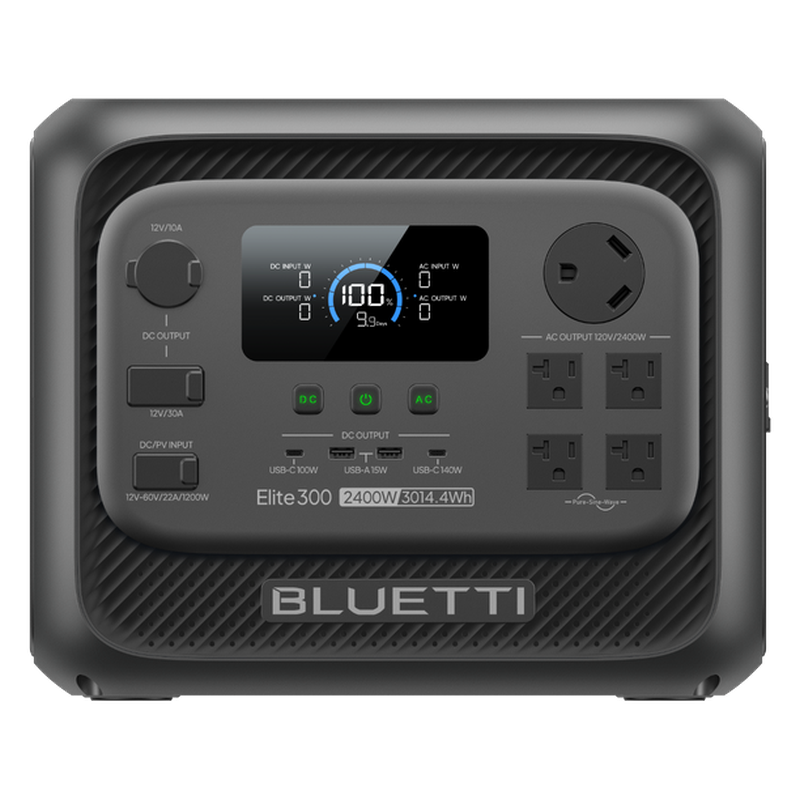
Elite 300
- you want 3kWh in one box and no add-ons
- your RV takes a TT-30 plug
- you want 6,000 cycles and a 5-year warranty with no sign-up
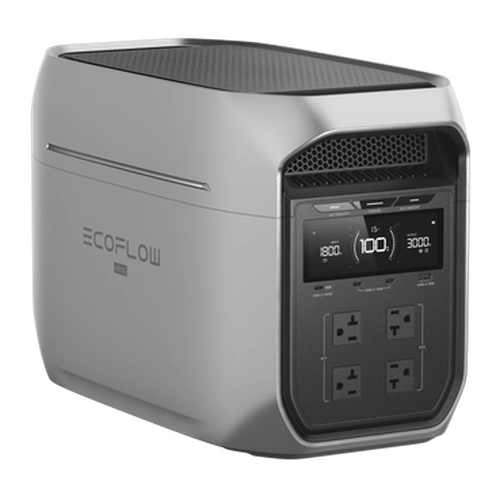
DELTA 3 Max Plus
- you run 3,000W loads, 6,000W surge
- you’ll add batteries, up to 10kWh
- you want 64-minute charging to 80%
Prices and stock checked by our price engine on November 22, 2026 at 10:42 AM EST. Each product is rechecked several times a day; the time refreshes when you load the page.
One fills the tank today. The other gives you a bigger engine and room to add tanks later.
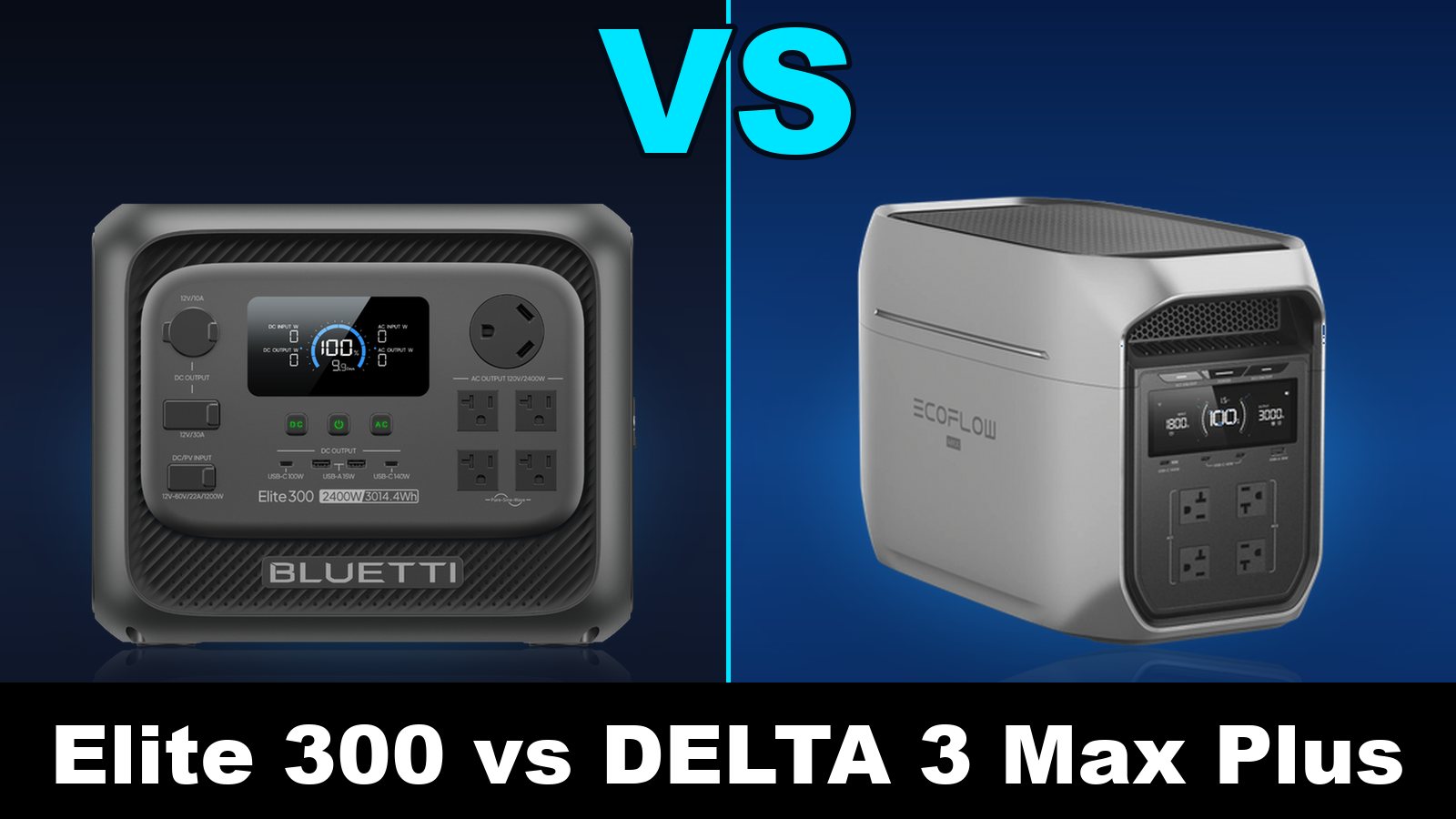
The BLUETTI Elite 300 stores 3,014Wh in a 58 lb box, delivers 2,400W, has a TT-30 RV outlet and a 12V/30A port, and is rated for 6,000 cycles, but it can never be expanded. The EcoFlow DELTA 3 Max Plus stores 2,048Wh at 48.7 lb, delivers 3,000W with a 6,000W surge, charges 0 to 80% in 64 minutes and takes extra batteries up to 10kWh. Prices sit $50 apart today. If 3kWh will always be enough, the Elite 300 gives more per dollar; if you’ll grow or run 3,000W loads, the Max Plus.
Below: the differences with numbers, a 20-second calculator for your own gear, seven modeled situations, the price per Wh, a third option, and what published tests found on each.
The Elite 300 stores 966Wh more and has a TT-30, a 12V/30A port and a 6,000-cycle rating; it can’t be expanded. The DELTA 3 Max Plus delivers 600W more, weighs 9.3 lb less, charges faster and takes extra batteries to 10kWh. Prices sit $50 apart today.
- you want the most Wh now
- your RV uses a TT-30
- you’ll cycle it daily: 6,000+
- you need 3,000W
- you’ll grow to 10kWh
- you carry it: 48.7 lb
The five differences that decide it
Both use LFP cells, four 20A household outlets, 140W USB-C, a 30A 12V output, a 10ms UPS, the brand’s app over Wi-Fi and Bluetooth, and 1,800W charging from a standard outlet. These five gaps decide it.
Will it run your setup? Check in 20 seconds
Estimates use 85% usable capacity and 70% of rated solar output. Real results vary with temperature, inverter load, shade and appliance cycling. Fridge and freezer watts are daily averages and do not include compressor startup surges.
Runtime by appliance, one at a time
Simple energy estimates, not measured runtimes. About 2,562Wh usable on the Elite 300 and 1,741Wh on the DELTA 3 Max Plus; StorageReview got 2.67kWh and 1.64kWh out.
Appliance for appliance, the Elite 300 lasts 47% longer than the Max Plus.
Same appliance, same watts: the gap is always the size of the battery.Get our Black Friday alerts for power stations
We track live prices on 40+ models from Jackery, EcoFlow, BLUETTI and Anker SOLIX. When a deal beats the lowest price we've recorded, you'll hear from us. During Black Friday week, one short recap a day at most.
Unsubscribe in one click. We may earn a commission when you buy through our links, at no extra cost to you. Privacy Policy
The price gap, in numbers
The BLUETTI Elite 300 costs $50 less than the EcoFlow DELTA 3 Max Plus and still holds 966Wh more.
Prices refresh daily from BLUETTI US and EcoFlow US.The lifetime figure divides the price by the rated cycles times the capacity: BLUETTI rates the Elite 300 at 6,000+ cycles, while EcoFlow US doesn’t publish a cycle rating for the Max Plus, so there’s no lifetime cost to compare. Prices move often at both brands; the figures here are refreshed daily by our price engine.
The third option: the DELTA 3 Ultra Plus at $1,599

EcoFlow DELTA 3 Ultra Plus: $1,599 today
If you want the Elite 300’s capacity and the Max Plus’s expansion in one unit: 3,072Wh, 3,600W with a 7,200W surge, four 20A outlets and a TT-30, 1,600W of solar, a 10ms UPS and extra batteries to about 11kWh. It weighs 74.3 lb. See the DELTA 3 Ultra Plus at EcoFlow.
Seven modeled situations, worked out
Same formula as the calculator above, with no extra battery unless stated. The fridge averages 60W, about 525kWh a year.
24-hour outage, essentials only
The Elite 300 covers a full day; the Max Plus about 19 hours, or 38 with one extra battery.
Microwave, coffee maker and toaster
Only the Max Plus carries all three. On the Elite 300, run two of them at a time.
RV with a 30A inlet
The Elite 300’s TT-30 takes the cord directly. The Max Plus needs an adapter to a 20A outlet, so you’d run fewer loads at once.
Home office through an outage
Both switch in 10ms. StorageReview measured 8ms on the Elite 300; the Max Plus can signal a PC over its 140W USB-C for a clean shutdown.
Refill from solar, each at its maximum
The smaller battery refills sooner; the Elite 300 banks more energy per sunny day.
A full-size fridge, nothing else
The Elite 300 keeps food cold about 14 hours longer.
Moving it
Both are two-hand lifts without wheels; the Max Plus is 9.3 lb lighter and narrower.
Nine more differences, the spec sheet and the box
Smaller gaps that rarely decide the purchase, then the full specifications and what ships in the box.
Elite 300 and DELTA 3 Max Plus weight, dimensions and full specifications
Weight: 58 lb for the Elite 300 and 48.7 lb for the DELTA 3 Max Plus. Dimensions: 14.4 × 12.0 × 11.7 in and 19.4 × 9.5 × 12.0 in.
BLUETTI Elite 300 and EcoFlow DELTA 3 Max Plus full specifications
Every published figure for both units, grouped. Green marks the better value.
What’s in the box
Elite 300
- Elite 3003,014Wh, 58 lb
- AC charging cable
- Manual, grounding screw
- No car cable
DELTA 3 Max Plus
- DELTA 3 Max Plus power station2,048Wh, 48.7 lb
- AC charging cable
- Manuals and warranty card
- No solar cable, no car cablea reviewer flagged both; bundles include the matching cables
- No extra battery, no Alternator Charger, no Anderson adapterall sold separately
Elite 300 from its US manual; DELTA 3 Max Plus from EcoFlow US.
07 · ChargingHow fast each one refills
Shorter bar, faster refill. Each row is scaled to its slower unit.
Elite 300: Silent 800W, Standard 1,200W, Turbo 1,800WMax Plus: Smart Generator 2,600W via XT150, 0 to 80% in 43 min
Our times divide capacity by input power, with solar at 70% of panel rating; real charging slows near full.
Every port, side by side
Elite 300
DELTA 3 Max Plus
Practical consequence: the Elite 300 has the TT-30 for an RV and a 12V/30A port; the Max Plus has an Anderson port, an XT150 for extra batteries, a generator or an alternator charger, and three USB-C.
09 · NoiseNoise and heat: Elite 300 vs Max Plus
The EcoFlow DELTA 3 Max Plus is the quieter one: The Technology Man found it barely above room noise even charging at full power. Notebookcheck measured the BLUETTI Elite 300 at over 50dB at 1 m under load.
EcoFlow rates the Max Plus at 25dB or less at 600W; BLUETTI publishes no rating for the Elite 300.Every figure we found, with its source
What reviewers heard: Fans ramped up noticeably while charging at full speed and powering about 900W (StorageReview); even under heavier loads, quiet enough for normal conversation beside it (Reviewed).
What reviewers heard: Barely above room noise at 1 m even charging at full power, with exhaust just over 40°C, about 104°F (The Technology Man, UK unit); silent during a brief spike over 3kW (T3).
Measured by a tester Brand figure
- Pick the slower charging mode overnight: fans mostly run while fast charging.
Cold, heat and storage: Elite 300 vs Max Plus
For a cold garage, the BLUETTI Elite 300 runs down to −4°F; for heat, the EcoFlow DELTA 3 Max Plus charges and runs up to 113°F. Both are IP20, so keep them out of the rain.
Figures from the Elite 300 and DELTA 3 Max Plus user manuals.- Charge either one above freezing.
- For storage, keep the Elite 300 at 40 to 60% and recharge it every 3 to 6 months (BLUETTI); EcoFlow gives 68°F to 86°F as the best storage range for the Max Plus.
App, UPS and smart features
The EcoFlow DELTA 3 Max Plus does more: extra batteries up to 10kWh, Storm Guard, Smart Output Priority and a PC shutdown signal over USB-C. The BLUETTI Elite 300 matches it on the 10ms UPS and off-peak charging.
Both switch in 10ms; StorageReview measured 8ms on the Elite 300. With Power Lifting, Trusted Reviews ran a kettle and a toaster together on the Elite 300.Green zone: a switch under about 16ms, which most desktop PCs ride through without restarting.
Can you add a battery later? The EcoFlow DELTA 3 Max Plus takes its own extra batteries, 2,048Wh each, up to 10kWh; the BLUETTI Elite 300 can never be expanded.
Can it tell your computer to shut down? The EcoFlow DELTA 3 Max Plus signals a PC over its 140W USB-C for a clean shutdown; BLUETTI lists no such feature for the BLUETTI Elite 300.
Does it prepare for storms? The EcoFlow DELTA 3 Max Plus’s Storm Guard Mode starts backup charging before extreme weather; BLUETTI lists no storm mode for the BLUETTI Elite 300.
Does it work as a UPS? Both switch in 10ms, faster than the roughly 16ms a desktop PC power supply rides through. StorageReview measured 8ms on the BLUETTI Elite 300.
Can it charge off-peak? Both can: Time Control on the BLUETTI Elite 300, Scheduled Tasks and electricity prices on the EcoFlow DELTA 3 Max Plus’s OASIS 3.0 dashboard.
How does the app connect? Both use their brand’s app over Wi-Fi or Bluetooth, with charging limits and scheduling.
Warranty and support
The BLUETTI Elite 300 has a 5-year warranty with no registration step; the EcoFlow DELTA 3 Max Plus gets 3 years, plus 2 more once registered in the EcoFlow app.
Same 5 years at best. Only the Max Plus asks you to do something to get them.Subject to each brand’s warranty terms and eligibility.
BLUETTI rates the Elite 300 at 6,000+ cycles to 80% capacity, about 16 years at one full cycle a day. EcoFlow US doesn’t publish a cycle rating for the DELTA 3 Max Plus. Heat and age also wear a battery, so read any rating as a ceiling.
- If you choose the DELTA 3 Max Plus, register it in the EcoFlow app the day it arrives: without registration, the warranty stops at 3 years.
- Buy the Elite 300 from BLUETTI or an authorized seller and keep proof of purchase: BLUETTI voids the warranty for unauthorized resellers.
What reviewers report
We have not lab-tested these two units. Here is what 10 published reviews found, with the source, author and date for each point. Reviews of UK and EU units are flagged: those models charge from 230V outlets and have different sockets, so their charge times and outlet findings don’t carry over to US units.
Elite 300: StorageReview (August 2026), Trusted Reviews (June 2026, UK unit), Notebookcheck (March 2026, EU unit), Reviewed (March 2026), CGMagazine (April 2026)Max Plus: StorageReview (September 2025), The Technology Man (January 2026, UK unit), Trusted Reviews (January 2026, UK unit), T3 (January 2026), AndroidGuys (November 2025)
Usable capacity
- Elite 300Reviewer A full discharge measured 2.67kWh at the AC output, against a 3,014.4Wh rating. StorageReview, Dylan Bryan, August 2026
- Elite 300Reviewer Best usable output was 2,781Wh at a 1,000W load, about 92% of rated capacity. Trusted Reviews, Simon Handby, June 2026, UK unit
- Max PlusReviewer A full discharge delivered 1.64kWh from the 2,048Wh pack, about 80 percent. StorageReview, Dylan Dougherty, September 2025
- Max PlusReviewer A constant 2kW heater load ran just over 57 minutes and delivered 1,898Wh, about 93 percent. The Technology Man, Gidon, January 2026, UK unit
- Max PlusReviewer Discharge efficiency hovered around 87 percent at loads from 200W to 3,000W. Trusted Reviews, David Ludlow, January 2026, UK unit
Charging
- Elite 300Reviewer A 0 to 100% recharge drew 3.49kWh from the wall on a Kill-A-Watt meter. StorageReview, Dylan Bryan, August 2026
- Elite 300Reviewer Turbo charging at 2,300W took 1 h 47 min (UK 230V; the US wall limit is 1,800W). Trusted Reviews, Simon Handby, June 2026, UK unit
- Elite 300Reviewer A standard-speed (1,200W) recharge drew 3,450Wh from the mains, about 87% efficiency. Notebookcheck, Marcus Schwarten, March 2026, EU unit
- Max PlusReviewer Refilling from empty took 2.33kWh from the wall, about 88 percent charging efficiency. StorageReview, Dylan Dougherty, September 2025
- Max PlusReviewer Fast mode reached 80 percent in 50 minutes and full in about 70 minutes on UK mains. Flag: 230V, up to 2300W input. The Technology Man, Gidon, January 2026, UK unit
- Max PlusReviewer Charging at 2,400W took 2,317Wh of input to fill the battery, 88.39 percent efficient. Flag: UK 230V input. Trusted Reviews, David Ludlow, January 2026, UK unit
Noise and heat
- Elite 300Reviewer Fans ramped up noticeably while charging at full speed and powering about 900W at the same time. StorageReview, Dylan Bryan, August 2026
- Elite 300Reviewer Measured over 50 dB at 1 meter under load. Notebookcheck, Marcus Schwarten, March 2026, EU unit
- Elite 300Reviewer Even under heavier loads the fan stayed quiet enough for normal conversation beside it. Reviewed, Jessica Kanzler, March 2026
- Max PlusReviewer Even charging at full power, the meter barely registered above room noise at one metre; exhaust measured just over 40°C. The Technology Man, Gidon, January 2026, UK unit
- Max PlusReviewer Fans almost never came on with a home office load and stayed silent during a brief spike over 3kW. T3, Matt Kollat, January 2026
UPS and output
- Elite 300Reviewer A Quarch power analyzer measured an 8ms switch to battery and 8.25ms back to grid. StorageReview, Dylan Bryan, August 2026
- Elite 300Reviewer With Power Lifting on, a 1,600W kettle and 2,200W toaster ran together, both heating more slowly. Trusted Reviews, Simon Handby, June 2026, UK unit
- Elite 300Reviewer The UPS function worked reliably and quickly in practical tests. Notebookcheck, Marcus Schwarten, March 2026, EU unit
- Max PlusReviewer Measured UPS transfer time was 8ms on a workstation load. StorageReview, Dylan Dougherty, September 2025
- Max PlusReviewer Oscilloscope measurement showed a clean handover at 8.4ms; a desktop PC under benchmark load stayed on. The Technology Man, Gidon, January 2026, UK unit
- Max PlusReviewer Inverter idle draw with no load was about 22W (100 to 87 percent in 12 hours). The Technology Man, Gidon, January 2026, UK unit
Daily use and issues
- Elite 300Reviewer At the full 2,400W rated output, AC shut off after over an hour with 7% still indicated. Trusted Reviews, Simon Handby, June 2026, UK unit
- Elite 300Reviewer A near-140W USB-C load ran over three hours, then DC ports shut down on an over-current fault. Trusted Reviews, Simon Handby, June 2026, UK unit
Practical limits before you buy
- The Elite 300 can never be expanded. 3,014Wh is the ceiling.
- The Elite 300 stops at 2,400W. A microwave, a coffee maker and a toaster together overload it.
- The Max Plus has no TT-30. A 30A RV cord needs an adapter to a 20A outlet.
- The Max Plus’s Anderson port and car socket share 378W.
- Power Lifting and X-Boost are for heating loads only. Motors need the continuous rating: 2,400W or 3,000W.
- Register the Max Plus in the EcoFlow app for the 5-year warranty.
- Neither has wheels or a water rating. Both are IP20.
- Elite 300, per its US documentation: US AC charging is 1,800W max (15A, 120V); Turbo reaches 80% in 95 min, Standard 1,200W full in 2.8 h, Silent 800W 4.2 h.
- Elite 300, per its US documentation: AC plus solar charging is capped at 2,400W; solar input 1,200W max, 12 to 60V.
- Elite 300, per its US documentation: AC output is 2,400W while discharging but 1,800W in bypass (grid-connected) mode.
- Elite 300, per its US documentation: The cigarette lighter port and 12V/30A port share one 30A total.
- Max Plus, per its US documentation: Anderson 30A and car outlet share one 12.6V budget: 378W total.
Frequently asked questions
What is the difference between the BLUETTI Elite 300 and the EcoFlow DELTA 3 Max Plus?
The Elite 300 is a fixed 3,014Wh, 2,400W station with a TT-30 and 6,000-cycle cells at 58 lb. The DELTA 3 Max Plus is a 2,048Wh, 3,000W station at 48.7 lb that expands to 10kWh.
Which has more capacity?
Out of the box, the Elite 300: 3,014Wh against 2,048Wh. With one extra battery, the Max Plus reaches 4,096Wh.
Which is better for an RV?
The Elite 300, thanks to its TT-30 outlet and 12V/30A port. The Max Plus needs an adapter for a 30A cord.
Which charges faster?
The Max Plus: 0 to 80% in 64 minutes from the wall, against 95 minutes for the Elite 300 in Turbo.
Can either run a 240V appliance?
No. Both are 120V only.
How long will each run a refrigerator?
At a 60W average: about 42.7 hours on the Elite 300 and 29 hours on the Max Plus.
Which is quieter?
EcoFlow rates the Max Plus at 25dB or less at 600W. BLUETTI publishes no rating for the Elite 300; Notebookcheck measured over 50dB under load.
Is there a third option?
Yes: the DELTA 3 Ultra Plus, with 3,072Wh, 3,600W, a TT-30 and expansion to about 11kWh.
Related comparisons and reviews
How we compared and sources
Research-based comparison. We have not lab-tested these two units. Specs come from BLUETTI US and EcoFlow US documentation and the user manuals; usage observations are attributed to named reviewers. Prices and availability were checked on October 30, 2026.
- Specs: BLUETTI US, Elite 300 and EcoFlow US, DELTA 3 Max Plus, plus the Elite 300 user manual (US EN-FR, March 2026) and the DELTA 3 Max Plus manual (EF-DL3-MP).
- Reviewer reports on the Elite 300: StorageReview, Dylan Bryan, August 2026, Trusted Reviews, Simon Handby, June 2026, UK unit, Notebookcheck, Marcus Schwarten, March 2026, EU unit, Reviewed, Jessica Kanzler, March 2026, CGMagazine, Brendan Frye, April 2026; on the Max Plus: StorageReview, Dylan Dougherty, September 2025, The Technology Man, Gidon, January 2026, UK unit, Trusted Reviews, David Ludlow, January 2026, UK unit, T3, Matt Kollat, January 2026, AndroidGuys, Scott Webster, November 2025.
- Runtime = capacity × 0.85 ÷ watts. Solar harvest = min(panel watts, max input) × sun hours × 0.70.
The Elite 300 holds 966Wh more with a TT-30 and 6,000 cycles; the Max Plus delivers 3,000W, is 9 lb lighter and grows to 10kWh. Prices sit $50 apart.
Prices checked November 22, 2026 at 10:42 AM EST
Looking at other models? Browse all power station comparisons, or pick any two models on the hub and we point you to the right duel.
Originally published: November 21, 2026