
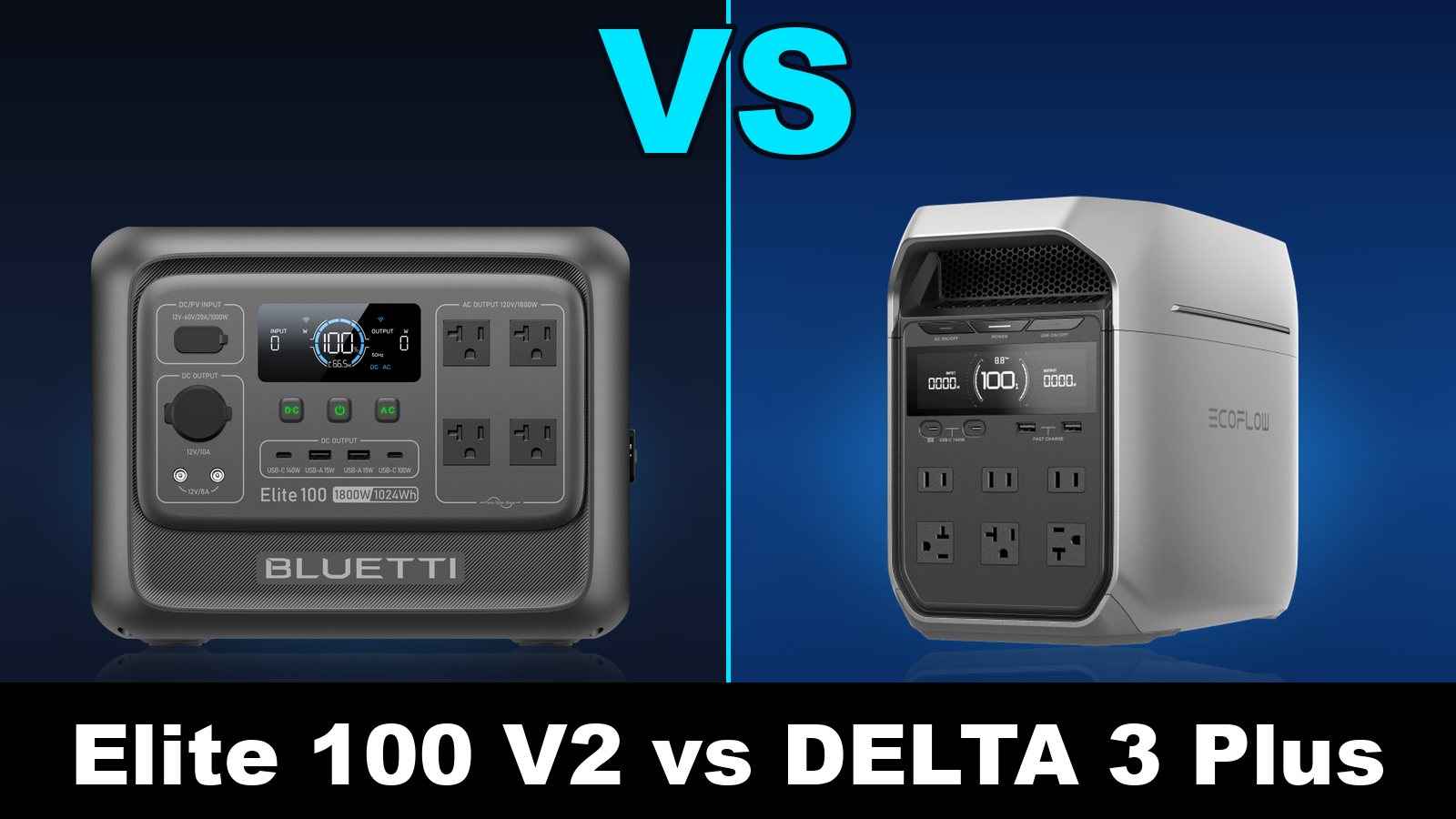

Elite 100 V2
- 1,000W of solar for $269.01 less
- you want the smaller box
- it sits near you: reviewers found it quiet
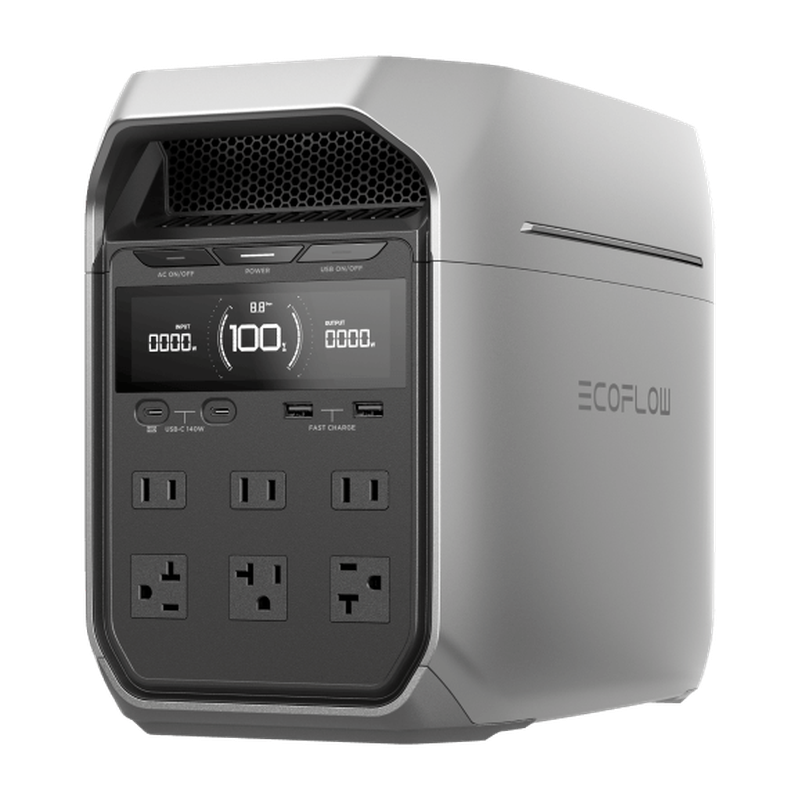
DELTA 3 Plus
- you’ll grow to about 5kWh
- you plug in six devices
- you refill from the wall: 56 min by default
Prices and stock checked by our price engine on November 22, 2026 at 9:41 AM EST. Each product is rechecked several times a day; the time refreshes when you load the page.
Both drink 1,000W of sun. The $269.01 buys a battery port and two more outlets, little else.
The BLUETTI Elite 100 V2 and the EcoFlow DELTA 3 Plus are the two 1kWh units here that take 1,000W of solar, and they share the rest of the core: 1,024Wh of LFP rated for 4,000 cycles, 1,800W and a 10ms switchover. The Elite 100 V2 has four outlets, can’t be expanded and charges at 600W from the wall by default, in a box about a quarter smaller at 25.3 lb. The DELTA 3 Plus has six outlets, an IP65 battery pack, a 56-minute default wall refill and grows to about 5kWh, at 27.6 lb. If 1kWh and four plugs are enough, the Elite does the solar job in a smaller box.
Below: every difference with numbers, a 20-second calculator for your own gear, eight modeled situations, a third option, and what published tests found on each.
Same 1,000W of solar, 1,024Wh, 1,800W, 10ms UPS and 4,000 cycles. The DELTA 3 Plus costs $269.01 more today for two more outlets, a battery port, an IP65 pack, a faster default wall refill and inputs for an alternator charger; the Elite 100 V2 is smaller, lighter and has the stronger heating-load mode.
- 1kWh is enough, for $269.01 less
- you want the smaller box
- four outlets cover you
- you’ll grow past 1kWh
- you need six outlets
- you’ll charge while driving
The five differences that decide it
The five gaps that decide the purchase, with the better spec for most buyers flagged. Both take 1,000W of solar, store 1,024Wh of LFP rated for 4,000 cycles, deliver 1,800W, switch in 10ms, and have a 12V car socket, two DC5521 barrels and a 140W USB-C.
Will it run your setup? Check in 20 seconds
Estimates use 85% usable capacity and 70% of rated solar output. Real results vary with temperature, inverter load, shade and appliance cycling. Fridge and freezer watts are daily averages and do not include compressor startup surges.
Runtime by appliance, one at a time
Simple energy estimates, not measured runtimes. Same 1,024Wh, about 870Wh usable on both; OutdoorGearLab measured 890Wh from the Elite 100 V2 and StorageReview 910Wh from the DELTA 3 Plus.
Same battery, same runtime.
The Elite 100 V2 and the Plus both hold about 870Wh usable, so every appliance runs just as long on either one.Get our Black Friday alerts for power stations
We track live prices on 40+ models from Jackery, EcoFlow, BLUETTI and Anker SOLIX. When a deal beats the lowest price we've recorded, you'll hear from us. During Black Friday week, one short recap a day at most.
Unsubscribe in one click. We may earn a commission when you buy through our links, at no extra cost to you. Privacy Policy
The price gap, in numbers
Same 1,024Wh battery: the BLUETTI Elite 100 V2 costs $269.01 less than the EcoFlow DELTA 3 Plus.
Prices refresh daily from BLUETTI US and EcoFlow US.Check today’s price of both before you choose.
Same capacity and the same rated cycles, so the price gap is pure hardware: outlets, the battery port and the IP65 pack. Two Elite 100 V2 units give 2kWh and two separate inverters but no shared battery; the Plus with an extra battery is one system. The Elite ships without solar or car cables. Both prices move often; the figures are refreshed daily by our price engine.
The third option: the EcoFlow DELTA 3 at $599

EcoFlow DELTA 3: $599 today
If what draws you to the Plus is the battery port and six outlets, not the 1,000W of solar, the regular DELTA 3 has both: the same 1,024Wh, 1,800W, 10ms UPS and extra batteries up to about 5kWh, with one 500W solar port instead of two, at 27.6 lb. It costs $120 less than the Plus today. Our DELTA 3 vs DELTA 3 Plus comparison goes deeper. See the DELTA 3 at EcoFlow.
Eight modeled situations, worked out
Same formula as the calculator above, with no extra battery. The fridge averages 60W, about 525kWh a year.
24-hour outage, essentials only
Identical on one battery. Only the Plus can add a second for day two.
Off-grid weekend on 800W of panels
A tie: both accept the full 800W. The Plus needs it split across its two XT60i ports, 500W max each; the Elite takes it on one XT60 input, up to 60V.
Six plugs at once
The Plus takes all six; on the Elite, add a power strip and keep the total under 1,800W.
Refill from the wall before a storm
Switch the Elite to Turbo and it reaches 80% in 45 minutes; left alone, it takes about two hours.
Charging while you drive
The Plus works with EcoFlow’s 800W Alternator Charger, sold separately; How-To Geek’s older car didn’t reach 800W. The Elite charges from a car socket only.
A 2,500W-rated kettle or heater
Power Lifting covers heating loads up to 2,700W at reduced power; the Plus’s X-Boost stops at 2,200W. Real output stays at 1,800W on both.
Growing the system
Only the Plus grows.
Packing it for a trip
The Elite 100 V2 is 2.3 lb lighter and about a quarter smaller: 12.6 × 8.5 × 9.8 in against 16 × 8.0 × 11 in.
Nine more differences, the spec sheet and the box
Smaller gaps that rarely decide the purchase, then the full specifications and what ships in the box.
Elite 100 V2 and DELTA 3 Plus weight, dimensions and full specifications
Weight: 25.3 lb for the Elite 100 V2 and 27.6 lb for the DELTA 3 Plus. Dimensions: 12.6 × 8.5 × 9.8 in and 16 × 8.0 × 11 in. Everything else is in the sheet below.
BLUETTI Elite 100 V2 and EcoFlow DELTA 3 Plus full specifications
Every published figure for both units, grouped. Green marks the better value.
What’s in the box
Elite 100 V2
- Elite 100 V2 power station1,024Wh, 25.3 lb
- AC charging cable1.8 m
- Manual and grounding screw
- Solar cable sold separatelyMC4 to XT60
- Car cable sold separatelycigarette lighter to XT60
DELTA 3 Plus
- DELTA 3 Plus power station1,024Wh, 27.6 lb
- AC charging cable
- Manuals and warranty card
- Solar cable sold separatelyincluded with the solar bundles
- No extra battery, no Alternator Chargerboth sold separately
From the brands’ US product pages and manuals.
07 · ChargingHow fast each one refills
Shorter bar, faster refill. Each row is scaled to its slower unit.
Elite 100 V2: AC plus solar capped at 1,200W combinedDELTA 3 Plus: 800W Alternator Charger, Smart Generator at 1,500W
Our solar times assume panels deliver 70% of their rating; the brands’ figures assume ideal sun.
Every port, side by side
Elite 100 V2
DELTA 3 Plus
Practical consequence: a car socket, two DC barrels and a 140W USB-C on both. The Plus adds two AC outlets, a battery port and inputs for an alternator charger and a generator; the Elite’s second USB-C is 100W against the Plus’s shared 140W.
09 · NoiseNoise and heat: Elite 100 V2 vs Plus
Both brands rate their unit around 30dB at 600W. In reviews, the BLUETTI Elite 100 V2 stayed quiet even at its full 1,800W, while several reviewers heard the EcoFlow DELTA 3 Plus‘s fans running at light loads.
Brand figures only; we found no independent dB measurement for either.Every figure we found, with its source
What reviewers heard: The fan stayed very quiet at 80% of rated output (OutdoorGearLab); not loud or intrusive even at 1,800W from full to empty (Trusted Reviews, UK unit).
What reviewers heard: Fans tended to run even at low loads, which the reviewer found distracting (Trusted Reviews, UK unit); still audible over a 700W vacuum, and warmer than expected on light loads (How-To Geek).
Measured by a tester Brand figure
- A slower AC charge runs cooler and quieter; on the Elite 100 V2, Silent mode charges at 600W.
Cold and heat: Elite 100 V2 vs Plus
The BLUETTI Elite 100 V2 charges from 32°F to 104°F and runs from −4°F to 104°F. EcoFlow US publishes no temperature range for the EcoFlow DELTA 3 Plus, but its battery pack is rated IP65.
Figures from the Elite 100 V2 US user manual and EcoFlow US for the DELTA 3 Plus.- Charge the Elite 100 V2 indoors in winter: it doesn’t charge below 32°F.
- EcoFlow US gives no range for the DELTA 3 Plus; the regular DELTA 3, same platform, doesn’t charge below 32°F either, so treat the Plus the same way.
App, UPS and smart features
The EcoFlow DELTA 3 Plus does more: it takes extra batteries, has Storm Guard and can signal a NAS to shut down. The BLUETTI Elite 100 V2 matches it on UPS speed and off-peak charging, and lifts heaters higher.
Same 10ms UPS, both apps over Wi-Fi and Bluetooth.Green zone: a switch under about 16ms, which most desktop PCs ride through without restarting.
Can you add a battery later? The EcoFlow DELTA 3 Plus takes DELTA 3, DELTA 2, DELTA 2 Max or DELTA Pro 3 extra batteries, up to about 5kWh; the BLUETTI Elite 100 V2 can’t be expanded past 1,024Wh.
Does it prepare for storms? The EcoFlow DELTA 3 Plus has a Storm Warning Alert in the app; BLUETTI lists no storm mode for the BLUETTI Elite 100 V2.
Can it tell a computer to shut down? With EcoFlow PowerManager and a NUT server, the EcoFlow DELTA 3 Plus can signal a NAS over USB; BLUETTI lists no such link for the BLUETTI Elite 100 V2.
Does it work as a UPS? Both switch to battery in 10ms, inside the roughly 16ms a desktop PC power supply rides through; StorageReview measured just over 8ms on the EcoFlow DELTA 3 Plus.
Can it charge off-peak? Both have time-of-use scheduling in the app. Trusted Reviews measured the BLUETTI Elite 100 V2 drawing about 13W from the wall just to hold its time-of-use mode.
Can it run a heater or kettle above its rating? Both run resistive loads past their 1,800W rating at reduced power: Power Lifting to 2,700W on the BLUETTI Elite 100 V2, X-Boost to 2,200W on the EcoFlow DELTA 3 Plus. Neither helps motors.
How does the app connect? Both use their brand’s app over Wi-Fi or Bluetooth. On the BLUETTI Elite 100 V2, turn ECO mode off for fridges, CPAP machines and routers: CleanTechnica’s overnight fridge test stopped when it cut AC.
Warranty and support
A tie: BLUETTI US gives the BLUETTI Elite 100 V2 5 years, and EcoFlow US gives the EcoFlow DELTA 3 Plus 5 years with no registration condition.
Only BLUETTI attaches a condition: buy from an authorized seller.Subject to each brand’s warranty terms and eligibility.
Both are rated for 4,000 cycles to 80% capacity, about 11 years at one full cycle a day; BLUETTI’s US page says 4,000+. On paper, neither outlasts the other.
- If you choose the Elite 100 V2, buy it from BLUETTI or an authorized seller and keep the proof of purchase: the warranty is void for unauthorized resellers.
What reviewers report
We have not lab-tested these two units. Here is what 11 published reviews found, with the source, author and date for each point. Reviews of UK and EU units are flagged: those models charge from 230V outlets and have different sockets, so their charge times and outlet findings don’t carry over to US units.
Elite 100 V2: OutdoorGearLab (July 2026), Trusted Reviews (October 2025, UK unit), New Atlas (October 2025, Australian unit), TechRadar (September 2025), CleanTechnica (September 2025), CGMagazine (September 2025)DELTA 3 Plus: StorageReview (January 2025), Trusted Reviews (February 2025, UK unit), How-To Geek (January 2025), T3 (January 2025), TechRadar (February 2025)
Usable capacity
- Elite 100 V2Reviewer Measured 890Wh of the advertised 1,024Wh, 87%, among the most efficient they have tested. OutdoorGearLab, Kenji Mowrey, July 2026
- Elite 100 V2Reviewer Boiling a liter of water with a standard kettle used about 10% of the battery. New Atlas, Noel McKeegan, October 2025, Australian unit
- PlusReviewer A full discharge delivered 910Wh from the 1,024Wh pack, about 89 percent. StorageReview, Dylan Dougherty, January 2025
- PlusReviewer A 1,000W heater ran almost exactly one hour and drew 888Wh, about 87 percent of rated capacity. Trusted Reviews, Harry Duncton, February 2025, UK unit
Charging
- Elite 100 V2Reviewer Charging rate measured at just 512Wh per hour, two hours from empty; many rivals charge twice as fast. OutdoorGearLab, Kenji Mowrey, July 2026
- Elite 100 V2Reviewer A full Turbo recharge drew 1,143Wh; Standard was most efficient at 1,135Wh (90.2%). Trusted Reviews, Simon Handby, October 2025, UK unit
- PlusReviewer Refilling from empty took 1,180Wh from the wall, about 87 percent charging efficiency. StorageReview, Dylan Dougherty, January 2025
- PlusReviewer A full mains charge at 1,500W took 55 minutes and used 1,109Wh, about 92 percent efficient. Flag: UK 230V charging. Trusted Reviews, Harry Duncton, February 2025, UK unit
- PlusReviewer AC input peaked at 1,500W but mostly held 1,350 to 1,400W; the battery was full within an hour. How-To Geek, Mark LoProto, January 2025
Noise and heat
- Elite 100 V2Reviewer Fan stayed very quiet at 80% of rated output. OutdoorGearLab, Kenji Mowrey, July 2026
- Elite 100 V2Reviewer Not loud or intrusive even at its rated 1,800W from full to empty. Trusted Reviews, Simon Handby, October 2025, UK unit
- PlusReviewer Fans tended to run even at low loads, which the reviewer found distracting. Trusted Reviews, Harry Duncton, February 2025, UK unit
- PlusReviewer With a 700W vacuum running, the station fan was still audible over the vacuum. How-To Geek, Mark LoProto, January 2025
- PlusReviewer The unit got warmer than expected even on light loads, and the reviewer questions its temperature control. How-To Geek, Mark LoProto, January 2025
UPS and output
- Elite 100 V2Reviewer Peak AC output efficiency was 91.1% at a 1,000W load; USB-C at 60W only 86%. Trusted Reviews, Simon Handby, October 2025, UK unit
- Elite 100 V2Reviewer A 200W home office setup showed no sign of power loss when mains was switched off. TechRadar, Jack Laurent, September 2025
- Elite 100 V2Reviewer Could not run a mini induction cooktop drawing a sustained 2,000W. TechRadar, Jack Laurent, September 2025
- PlusReviewer Measured UPS transfer time was just over 8ms with a workstation load, inside EcoFlow’s 10ms claim. StorageReview, Dylan Dougherty, January 2025
- PlusReviewer In simulated outages the router, modem, computer and monitor stayed on without any blips. TechRadar, Collin Probst, February 2025
Daily use and issues
- Elite 100 V2Reviewer In time-of-use mode it drew about 13W of mains just to maintain the mode and recharged if below 5%. Trusted Reviews, Simon Handby, October 2025, UK unit
- Elite 100 V2Reviewer Setting up the UPS modes in the app takes a bit of fiddling. New Atlas, Noel McKeegan, October 2025, Australian unit
- Elite 100 V2Reviewer Display shows only total input and output watts, not a breakdown by port type. TechRadar, Jack Laurent, September 2025
- PlusReviewer The app showed the unit charging at about 1.45kW against its 1500W rating. StorageReview, Dylan Dougherty, January 2025
- PlusReviewer Only three of the AC outlets are three-pronged, listed as the main drawback. TechRadar, Collin Probst, February 2025
Practical limits before you buy
- The Elite 100 V2 can’t be expanded. 1,024Wh is its ceiling.
- The Elite 100 V2 charges at 600W by default. Switch to Turbo for 80% in 45 minutes.
- The Plus’s 1,000W solar needs two strings of up to 500W each; the Elite takes 1,000W on one input.
- Only three of the Plus’s six AC outlets are three-prong, per TechRadar.
- The Elite 100 V2 ships without solar or car cables.
- Both stop at 1,800W continuous. Power Lifting and X-Boost don’t help motors.
- Elite 100 V2, per its US documentation: AC plus solar charging is capped at 1,200W total, so combining sources is no faster than Turbo AC.
- Elite 100 V2, per its US documentation: Charge modes: Standard and Silent 600W, about 2 h; Turbo 1,200W, 80% in 45 min.
- Elite 100 V2, per its US documentation: Power Lifting only for resistive loads rated 1,800W to 2,700W; actual output stays 1,800W.
- Elite 100 V2, per its US documentation: Cigarette lighter and DC5521 ports are wired in parallel, 10A total.
- DELTA 3 Plus, per its US documentation: AC and Smart Generator charging capped at 1500W; solar 2 x 500W (11-60V).
- DELTA 3 Plus, per its US documentation: X-Boost runs devices up to 2200W (rated 1800W total AC, 3600W surge).
Frequently asked questions
What is the difference between the BLUETTI Elite 100 V2 and the EcoFlow DELTA 3 Plus?
Same 1,000W of solar, 1,024Wh, 1,800W, 10ms UPS and 4,000 cycles. The Elite is smaller and lighter, with four outlets; the Plus has six outlets, an IP65 pack, a faster default wall charge and grows to about 5kWh.
Which is cheaper?
The BLUETTI Elite 100 V2 costs $269.01 less today: $449.99, against $719 for the EcoFlow DELTA 3 Plus. Prices refresh daily; the price section above has the full breakdown.
Which charges faster from solar?
Neither: both take 1,000W. The Plus splits it across two ports of 500W.
Which charges faster from the wall?
By default, the Plus: 56 minutes. The Elite reaches 80% in 45 minutes in Turbo and takes about 2 hours in Standard.
Can either be expanded?
Only the DELTA 3 Plus, to about 5kWh with EcoFlow extra batteries.
Which is quieter?
Reviewers found the Elite 100 V2 quiet even at full output; several reported the Plus’s fans running at light loads.
How long will each run a refrigerator?
At a 60W average and 85% usable capacity: about 14.5 hours on either, before extra batteries. Turn the Elite’s ECO mode off first.
How much do they weigh?
25.3 lb for the Elite 100 V2 and 27.6 lb for the DELTA 3 Plus.
Related comparisons and reviews
How we compared and sources
Research-based comparison. We have not physically tested these two units. Specs come from BLUETTI and EcoFlow US documentation; usage observations are attributed to named reviewers. Prices and availability were checked on October 30, 2026.
- Specs: BLUETTI US, Elite 100 V2 and the Elite 100 V2 US user manual, and EcoFlow US, DELTA 3 Plus, read on October 30, 2026.
- Reviewer reports on the Elite 100 V2: OutdoorGearLab, Kenji Mowrey, July 2026, Trusted Reviews, Simon Handby, October 2025, UK unit, New Atlas, Noel McKeegan, October 2025, Australian unit, TechRadar, Jack Laurent, September 2025, CleanTechnica, Paul Fosse, September 2025, CGMagazine, Matt Keith, September 2025; on the DELTA 3 Plus: StorageReview, Dylan Dougherty, January 2025, Trusted Reviews, Harry Duncton, February 2025, UK unit, How-To Geek, Mark LoProto, January 2025, T3, Matt Kollat, January 2025, TechRadar, Collin Probst, February 2025.
- Runtime = capacity × 0.85 ÷ watts. Solar harvest = min(panel watts, max input) × sun hours × 0.70. Cost per lifetime kWh = price ÷ (cycles × capacity in kWh).
Same 1,000W of solar, 1,800W and 10ms UPS. The Elite 100 V2 is smaller and $269.01 cheaper; the DELTA 3 Plus has six outlets and grows to about 5kWh.
Prices checked November 22, 2026 at 9:41 AM EST
Looking at other models? Browse all power station comparisons, or pick any two models on the hub and we point you to the right duel.
Originally published: November 22, 2026