


SOLIX E10 (2 batteries)
- it will live outdoors: NEMA 4 (IP66)
- your peak stays under 7,680W, 10kW for 90 min
- you’d rather spend $2,100 on panels or a Power Dock

DELTA Pro Ultra X
- you need 12,000W continuously
- you’ll charge from a 50A circuit or big generator in about an hour
- you want outlets on the inverter and 61kWh of growth
Prices and stock checked by our price engine on November 21, 2026 at 7:29 PM EST. Each product is rechecked several times a day; the time refreshes when you load the page.
Same 12kWh on the wall. You’re choosing between an outdoor box and a bigger inverter.
Compared like for like with two 6,144Wh batteries each, the Anker SOLIX E10 and the EcoFlow DELTA Pro Ultra X store the same 12,288Wh at 120/240V. The Ultra X delivers 12,000W continuously, charges at up to 12,000W from a 50A circuit and keeps four outlets on the inverter; the E10 delivers 7,680W, or 10,000W for 90 minutes, has no outlets of its own, but is NEMA 4 rated for outdoor installs and costs $2,100 less today. If your biggest loads together stay under 7,680W and the system can live outside, the E10 does the job.
Below: every difference with numbers, a 20-second calculator for your own gear, eight modeled situations, a third option at the same 12kWh, and what published reviews found, five of them on the E10.
Same 12,288Wh in this comparison, same LFP chemistry, both 120/240V split phase. The Ultra X costs $2,100 more and buys 4,320W more continuous output, about 4,300W more AC charging, 1kW more solar, four outlets on the inverter and twice the growth per inverter. The E10 answers with an outdoor NEMA 4 enclosure and a documented 4,000-cycle rating.
- it mounts outside: NEMA 4
- your peak stays under 7,680W
- you want 4,000 documented cycles
- you need 12,000W at once
- you’ll charge at 12kW
- you want outlets on the unit
The five differences that decide it
Compared as both brands sell them at the same capacity: one inverter and two 6,144Wh batteries each. Both are 120/240V split phase, both switch to battery in 20ms or less with their automatic panel, both take a generator and both carry 5 years on the inverter and batteries. These five gaps decide it.
Will it run your setup? Check in 20 seconds
Estimates use 85% usable capacity and 70% of rated solar output. Real results vary with temperature, inverter load, shade and appliance cycling. Fridge and freezer watts are daily averages and do not include compressor startup surges.
Runtime by appliance, one at a time
Simple energy estimates, not measured runtimes. Same 12,288Wh in both, about 10,445Wh usable, so one column serves both. Gizmodo’s reviewer had about 9.75kWh available with a 15% reserve on his E10.
Same battery, same runtime.
The E10 and the Ultra X both hold about 10,445Wh usable, so every appliance runs just as long on either one.Get our Black Friday alerts for power stations
We track live prices on 40+ models from Jackery, EcoFlow, BLUETTI and Anker SOLIX. When a deal beats the lowest price we've recorded, you'll hear from us. During Black Friday week, one short recap a day at most.
Unsubscribe in one click. We may earn a commission when you buy through our links, at no extra cost to you. Privacy Policy
The price gap, in numbers
Same 12,288Wh battery: the Anker SOLIX E10 with two B6000 batteries costs $2,100 less than the EcoFlow DELTA Pro Ultra X.
Prices refresh daily from Anker US and EcoFlow US.Anker rates the E10 for 4,000 cycles to 80%; EcoFlow publishes no cycle count for the Ultra X, so we apply the same figure: read the lifetime card as a ranking, not a bill. Both prices are equipment only. Anker sells the E10 with two B6000 batteries as its Prime Off-Grid Kit; whole-home use adds a Power Dock or Smart Inlet Box, and the Ultra X a Smart Home Panel 3 or Smart Gateway, plus an electrician for either.
The third option: the DELTA Pro Ultra at 12kWh, $6,199
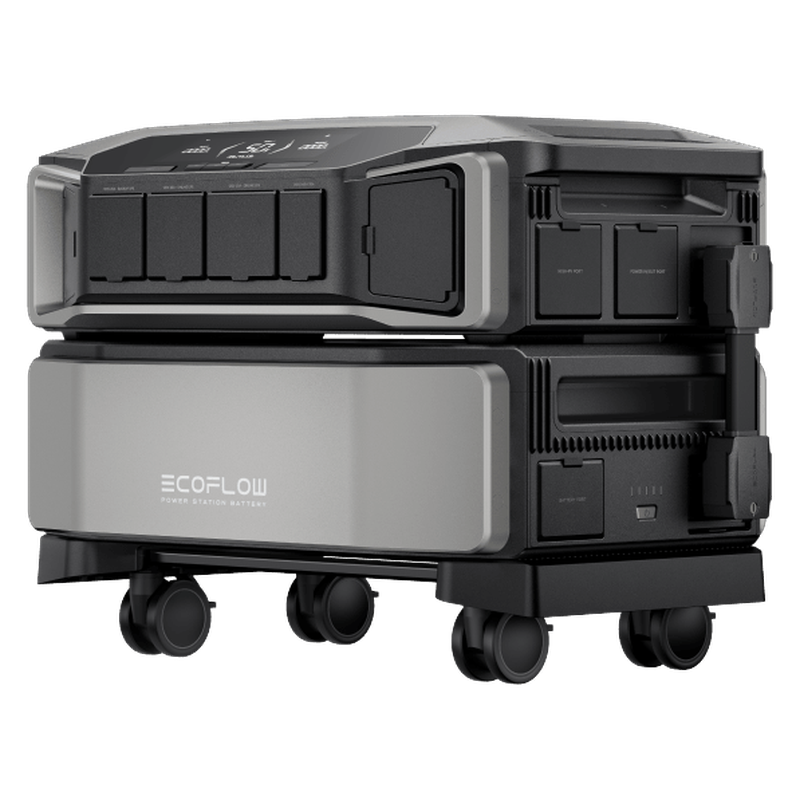
EcoFlow DELTA Pro Ultra, 2 batteries: $6,199 today
The same 12,288Wh with a 7,200W inverter, close to the E10’s output: 10,800W surge, 5,600W of solar, a TT-30, four 20A outlets, USB and a 30A 12V port on the unit, and 0ms online UPS on three outlets, at IP54. It sits $1,700 below the Ultra X. Pick it if you want the E10’s power class with outlets on the unit for portable use. Our DELTA Pro Ultra review and E10 vs DELTA Pro Ultra comparison go deeper. See the DELTA Pro Ultra at EcoFlow.
Eight modeled situations, worked out
Same formula as the calculator above, both at 12,288Wh. Whole-home figures use about 28kWh a day, a typical US home.
Essentials through a long outage
Identical: same storage. Each extra 6,144Wh battery adds about 2.4 days on either.
A whole house, as usual
Neither covers a full day of normal use on two batteries. Gizmodo’s reviewer found two E10 batteries covered at least 10 hours of normal April loads, but only four hours on a hot day with central AC.
A 4-ton central AC with the house
Anker says one E10 with two batteries starts a 5-ton AC (155A LRA) and runs 10kW for 90 minutes; the Ultra X has 12kW of continuous headroom. Have an installer check your unit’s running and locked-rotor amps.
AC, dryer and well pump at once
The E10’s Turbo covers 10kW for up to 90 minutes, below 86°F ambient per its guide; beyond that, only the Ultra X keeps going.
Recharging from a generator
On a 30A generator outlet they’re about even. With a 50A circuit, the Ultra X takes 12kW and refills in about an hour. Anker’s own Smart Generator 5500 feeds the E10 through a 4,500W DC input.
Refill from solar, each at its maximum
Close: both take two high-voltage strings, 30 to 450V on the E10 and 80 to 500V on the Ultra X. Few roofs carry more than 9kW anyway.
Mounted outside the garage
Anker rates the E10 NEMA 4 for extended outdoor use from −4°F to 131°F; TechRadar’s reviewer mounted his on the side of his house. The Ultra X’s IP54 suits a covered spot or a garage.
An RV or a job site
The Ultra X has two 20A outlets, an L14-30 and a 14-50 for a 50A RV. The E10 has no outlets of its own; Anker sells a 120V/240V Power Strip with a 14-50.
Nine more differences, the spec sheet and the box
Smaller gaps that rarely decide the purchase, then the full specifications and what ships in the box.
E10 and Ultra X weight, dimensions and full specifications
Weight: 320.6 lb as compared for the E10 and 292.7 lb as compared for the Ultra X. Dimensions: Power module 26.4 × 11.8 × 10.2 in and Inverter 26.6 × 18.7 × 9.1 in. Batteries: 130 lb per B6000 and 111.3 lb per Ultra X battery. Everything else is in the sheet below.
Anker SOLIX E10 (two B6000 batteries) and EcoFlow DELTA Pro Ultra X full specifications
Every published figure for both units, grouped. Green marks the better value.
What’s in the box
E10, 2 batteries
- E10 power module + 2 × B600012,288Wh, 320.6 lb
- Power Dock or Smart Inlet Box sold separatelyneeded for whole-home backup
- Licensed electrician requiredfor the Power Dock or Smart Inlet Box
Ultra X, 2 batteries
- Inverter + 2 × 6,144Wh batteries12,288Wh, on a wheeled stand
- Smart Home Panel 3 or Smart Gateway sold separatelyneeded for whole-home backup
- EcoFlow installation programone-day install, 7 days from permit
From the Anker and EcoFlow US product pages. Anker sells the E10 with two B6000 batteries as its Prime Off-Grid Kit; bundles with a Power Dock, Smart Inlet Box or panel are separate listings.
07 · ChargingHow fast each one refills
Shorter bar, faster refill. Each row is scaled to its slower unit.
E10: full charging speed only with the battery between 59°F and 131°F; ESS News saw Storm Guard charge at about 7.6kWUltra X: can charge from a generator while delivering up to 12kW (FlowMaster rectifier)
Our solar times assume panels deliver 70% of their rating; the brands’ figures assume ideal sun.
Every port, side by side
SOLIX E10
DELTA Pro Ultra X
Practical consequence: the Ultra X doubles as a big portable station with four outlets on the inverter. The E10 is built to wire into the house: all its power goes out through a Power Dock, Smart Inlet Box, transfer switch cable or Power Strip.
09 · NoiseNoise: E10 vs Ultra X
Only the EcoFlow DELTA Pro Ultra X has a figure: under 30dB at 0.5 m at a 4kW output, per EcoFlow. Anker publishes no dB rating for the Anker SOLIX E10 with two B6000 batteries.
No reviewer measured either. Anker’s only figure is for its Smart Generator 5500.Every figure we found, with its source
No decibel figure published.
Measured by a tester Brand figure
- Both usually sit in a garage, a utility room or, for the E10, outdoors, where noise matters less than on a portable unit.
Cold and heat: E10 vs Ultra X
The Anker SOLIX E10 with two B6000 batteries is built for outdoors: NEMA 4 (IP66) and rated to 131°F, against IP54 and 113°F for the EcoFlow DELTA Pro Ultra X‘s batteries. Both run down to −4°F and heat their batteries to charge in the cold.
Figures from the Anker US E10 page and user guide and the EcoFlow US Ultra X page.E10: thermal derating starts at 113°F ambient, per Anker via ESS News.
- If your winter lows fall below −4°F, install the E10 indoors: Anker advised Gizmodo’s reviewer to do so.
- Expect the E10’s battery heater to draw up to about 200W in cold weather, per Anker via ESS News.
App, UPS and smart features
The EcoFlow DELTA Pro Ultra X switches faster, under 10ms on its own, and its home panel handles 32 circuits against 12. The Anker SOLIX E10 with two B6000 batteries can start and stop a generator by itself.
Both offer time-of-use, self-consumption modes and Storm Guard.Green zone: a switch under about 16ms, which most desktop PCs ride through without restarting.
Can it start a generator by itself? The Anker SOLIX E10 with two B6000 batteries starts and stops a Smart Generator at set charge limits, in Turbo, ECO or Quiet mode by time of day; our EcoFlow sources list no such feature for the Ultra X.
Can it send power back to the grid? Anker’s FAQ says neither the E10 nor the Power Dock feeds electricity back to the grid; the savings modes work by covering your own loads. Our EcoFlow sources don’t say.
Does it work as a UPS? EcoFlow rates the EcoFlow DELTA Pro Ultra X under 10ms on its own and under 20ms through the Smart Home Panel 3. Anker rates the Anker SOLIX E10 with two B6000 batteries at 20ms or less with the Power Dock; with the Smart Inlet Box, backup is manual.
Does it connect to a home panel? Both do. The E10’s Power Dock handles 200A service, 12 smart circuits and up to three E10s; the Ultra X pairs with the Smart Home Panel 3 (200A, 32 circuits) or the Smart Gateway.
Can it charge off-peak? Both have time-of-use and self-consumption (or self-powered) modes in their app.
Does it prepare for storms? Both have Storm Guard. On the E10, a severe weather alert for your area makes it charge at full speed from solar and grid.
Which app runs it? The E10 runs through the Anker app, which Android Authority found mandatory for both installing and operating it; the Ultra X uses the EcoFlow app with an AI Assistant.
Warranty and support
Both carry 5 years on the inverter and batteries from their US stores. The Anker SOLIX E10 with two B6000 batteries adds 10 years on its Power Dock and Smart Inlet Box; the EcoFlow DELTA Pro Ultra X has no cycle count published.
Same 5 years. Anker’s battery term can end sooner, at 15MWh of throughput.Subject to each brand’s warranty terms and eligibility.
Neither brand publishes a cycle count. Anker’s B6000 term ends at 15MWh of throughput if that comes first, with at least 60% of original capacity guaranteed over that period. EcoFlow gives no cycle figure for the Ultra X.
- Buy the E10 from ankersolix.com or an authorized reseller: Anker’s warranty covers the original purchaser only and isn’t transferable. Registration is optional.
What reviewers report
We have not lab-tested these two systems. Here is what six published reviews found, five on the E10 and one hands-on of the Ultra X, with the source, author and date for each point. Android Authority’s and Gizmodo’s E10 systems were supplied by Anker.
E10: Android Authority (March 2026), Gizmodo (May 2026), ESS News (pv magazine) (May 2026), AppleInsider (July 2026), TechRadar (August 2026)Ultra X: iPhone in Canada (March 2026, Canadian unit, hands-on)
Usable capacity
- E10Reviewer With two batteries and normal home use, going from his 90% standby level down to 50% took a little over two hours. Android Authority, Jonathan Feist, March 2026
- E10Reviewer With two batteries and a 15% reserve, about 9.75kWh was available to run his house. Gizmodo, Wes Davis, May 2026
- E10Reviewer On a daily 12-hour battery window, two batteries covered normal loads for at least 10 hours on most April days. Gizmodo, Wes Davis, May 2026
- E10Reviewer Anker told him the idle draw is 46W for the power module plus one battery, plus about 9W per extra battery. ESS News (pv magazine), Andrew Riha, May 2026
- E10Reviewer During an unforecast outage, the 20% reserve he kept was enough to carry the home until power returned. AppleInsider, Andrew O’Hara, July 2026
Charging
- E10Reviewer The Smart Generator then needed roughly two more hours to bring the two batteries back up to 90% while the house kept running. Android Authority, Jonathan Feist, March 2026
- E10Reviewer When a wind alert hit, Storm Guard started charging from the grid at about 7.6kW right at the forecast start. ESS News (pv magazine), Andrew Riha, May 2026
Noise and heat
- E10Reviewer Anker advised an indoor install because local winter lows can fall below the -4 degrees F minimum operating temperature. Gizmodo, Wes Davis, May 2026
- E10Reviewer Anker-confirmed: internal battery heater draws up to about 200W in cold weather; thermal derating starts at 113 F ambient. ESS News (pv magazine), Andrew Riha, May 2026
UPS and output
- E10Reviewer Through the Power Dock, the switch from grid to battery during outages was barely visible: lights only just flickered. Android Authority, Jonathan Feist, March 2026
- E10Reviewer Water heater and hot tub drew nearly 7kW together, and the system still handled a 1,700W air fryer on top. Android Authority, Jonathan Feist, March 2026
- E10Reviewer On a hot day with central AC running at a steady 3.2kW for part of it, two batteries lasted only four hours. Gizmodo, Wes Davis, May 2026
- E10Reviewer Switchover to battery and back was invisible: no flicker, no fans slowing; he only learned of outages from the app history. Gizmodo, Wes Davis, May 2026
- E10Reviewer During a real 4.5-hour outage the house ran without interruption and his existing Enphase solar kept producing. ESS News (pv magazine), Andrew Riha, May 2026
Daily use and issues
- E10Reviewer The Anker app is mandatory: it is needed both to install and to operate the system. Android Authority, Jonathan Feist, March 2026
- E10Reviewer His kit (power module, two batteries, Power Dock, Smart Generator, stand, cables) arrived on three pallets weighing a little over 800 lb. Android Authority, Jonathan Feist, March 2026
- E10Reviewer The app missed one 12-minute grid outage that he only discovered by calling his utility. Gizmodo, Wes Davis, May 2026
- E10Reviewer In Time of Use mode, only the Super Off-Peak period charges the batteries from the grid, which confused him at first. Gizmodo, Wes Davis, May 2026
- E10Reviewer Main reservations: an unintuitive, bare-bones app and a warranty he calls stingy. Gizmodo, Wes Davis, May 2026
Ultra X hands-on
- Ultra XReviewer Ran a chest freezer for 9 days in a quick test; 12kW output, roughly double the previous generation. iPhone in Canada, Austin Blake, March 2026
- Ultra XReviewer Whole-home integration needs the Smart Home Panel 3 or the Smart Gateway, sold separately. iPhone in Canada, March 2026
- Ultra XReviewer Auto switchover in about 20ms; lights and electronics stayed on. iPhone in Canada, March 2026
- Ultra XReviewer Very heavy, about 70 lb for the inverter and 111 lb per battery, and expensive even on sale. iPhone in Canada, March 2026
Practical limits before you buy
- Both need a panel and an electrician for whole-home backup. Budget a Power Dock or Smart Inlet Box for the E10, a Smart Home Panel 3 or Smart Gateway for the Ultra X.
- The E10 has no outlets on the unit. Portable use needs Anker’s Power Strip or a transfer switch cable.
- The E10’s 10kW Turbo lasts up to 90 minutes and needs two or more batteries; its continuous rating is 7,680W.
- 12kW charging needs a 50A circuit. On a 30A circuit the Ultra X charges at 7,200W.
- Each battery weighs over 110 lb: 130 lb per B6000 and 111.3 lb per Ultra X battery. Plan two people.
- The Ultra X has no USB and no 12V output. Neither does the E10.
- E10, per its US documentation: Neither the E10 nor the Power Dock feeds electricity back to the grid (no export).
- E10, per its US documentation: A professional electrician is required to install the Smart Inlet Box or Power Dock and the grid connection; extra battery modules can then be added by the owner.
- E10, per its US documentation: With one battery module, continuous output is 7.6kW; 10kW turbo needs two or more modules and lasts up to 90 minutes, at ambient below 86 F (30 C).
- E10, per its US documentation: Charging power is limited at low and high temperatures; full speed only with battery between 59 F and 131 F. Below 59 F a heating film warms the battery, stopping above 68 F.
Frequently asked questions
What is the difference between the Anker SOLIX E10 and the EcoFlow DELTA Pro Ultra X?
At 12,288Wh each, the Ultra X delivers 12,000W, charges at up to 12,000W and has four outlets on the inverter. The E10 delivers 7,680W, 10,000W for 90 minutes, and is NEMA 4 rated for outdoor installs.
Which is cheaper at 12kWh?
The E10 with two B6000 batteries, at today’s prices; see the live figures in the price section. Both need a panel and installation on top.
Can the E10 go outside?
Yes: Anker rates the E10 and its batteries NEMA 4 (IP66) for extended outdoor use, from −4°F to 131°F. The Ultra X is IP54.
Which one runs a central air conditioner?
Anker says one E10 with two batteries starts a 5-ton AC; EcoFlow cites a 5-ton AC for the Ultra X. The Ultra X has more continuous headroom for the AC plus the rest of the house. Confirm with an installer.
How long will 12kWh run my house?
About 9 hours at 28kWh a day, everything on; about 4.8 days with only essentials. Each extra battery adds about 6.1kWh on either.
Do they sell power back to the grid?
Anker’s FAQ says the E10 and Power Dock don’t feed electricity back to the grid.
Can I install them myself?
No for the grid connection: Anker requires a licensed electrician for the Power Dock or Smart Inlet Box, and EcoFlow runs an installation program for the Ultra X. Extra E10 batteries can then be added by the owner, per Anker.
How much do they weigh?
As compared, 320.6 lb for the E10 (60.6 lb module, 130 lb per battery) and 292.7 lb for the Ultra X (70.1 lb inverter, 111.3 lb per battery).
Related comparisons and reviews
How we compared and sources
Research-based comparison. We have not physically tested these two units. Specs come from Anker and EcoFlow US documentation; usage observations are attributed to named reviewers. Prices and availability were checked on October 30, 2026.
- Specs: Anker US, SOLIX E10 and the E10 user guide (A17E1) and the US E10 warranty policy, and EcoFlow US, DELTA Pro Ultra X and its spec sheet and FAQ, read on October 30, 2026.
- Reviewer reports on the E10: Android Authority, Jonathan Feist, March 2026, Gizmodo, Wes Davis, May 2026, ESS News (pv magazine), Andrew Riha, May 2026, AppleInsider, Andrew O’Hara, July 2026, TechRadar, Collin Probst, August 2026; on the Ultra X: iPhone in Canada, Austin Blake, March 2026, Canadian unit, hands-on.
- Runtime = capacity × 0.85 ÷ watts. Solar harvest = min(panel watts, max input) × sun hours × 0.70. Cost per lifetime kWh = price ÷ (cycles × capacity in kWh).
Same 12kWh. The Ultra X adds 12kW output and charging for $2,100 more; the E10 is outdoor rated and cheaper.
Prices checked November 21, 2026 at 7:29 PM EST
Looking at other models? Browse all power station comparisons, or pick any two models on the hub and we point you to the right duel.
Originally published: November 17, 2026