
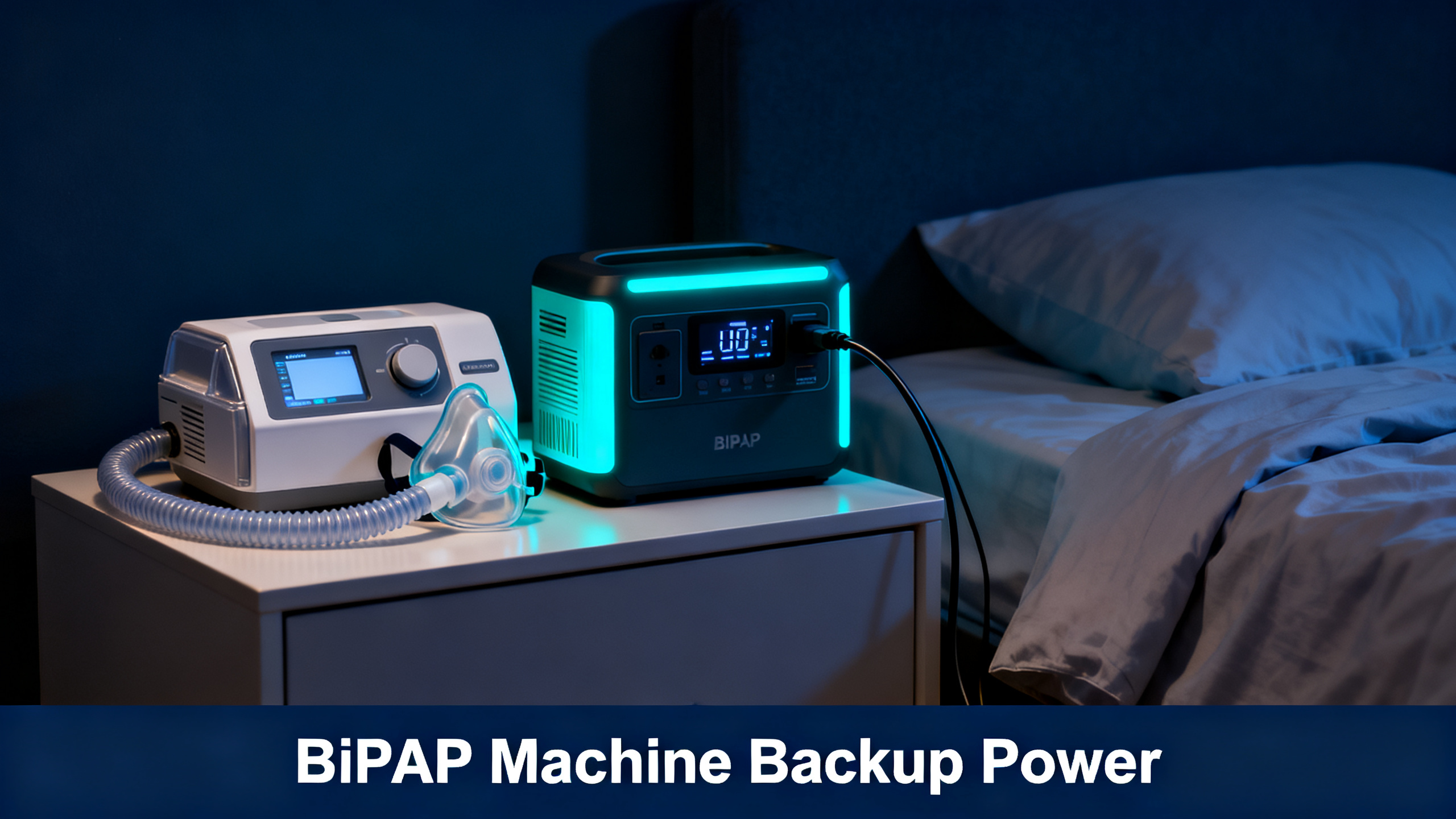
If you rely on a BiPAP machine every night, a power outage isn’t an inconvenience: it’s a disruption to prescribed medical therapy. BiPAP users face a higher power demand than standard CPAP patients, and the stakes of a missed night are real. This guide covers everything you need to know about bipap machine power solutions: how much capacity you actually need, which units deliver UPS-grade switching, how to plan for multi-day outages, and what works for travel.
Two units stand out based on spec analysis and real-world capacity data for sleep apnea therapy: the Anker SOLIX C1000 at $999 for whole-night reliability and long-term value, and the EcoFlow DELTA 3 Max at $799 for its 10ms UPS-grade switchover. Here’s the full breakdown.

Recommended for Whole-Night BiPAP
Anker SOLIX C1000
$999.00
- 1,056Wh LFP, 3,000 cycles (10-year lifespan)
- 11 ports including 6 AC, 100W USB-C PD
- 5-year warranty: peace of mind for vital therapy
Get our Black Friday alerts for power stations
We track live prices on 40+ models from Jackery, EcoFlow, BLUETTI and Anker SOLIX. When a deal beats the lowest price we've recorded, you'll hear from us. During Black Friday week, one short recap a day at most.
Unsubscribe in one click. We may earn a commission when you buy through our links, at no extra cost to you. Privacy Policy
Why BiPAP Users Need Reliable Backup Power
BiPAP therapy isn’t optional for the patients who depend on it. Whether you’re managing obstructive sleep apnea, central apnea, COPD, or a neuromuscular condition, skipping a night of therapy carries compounding health consequences that build over time. A reliable backup power source isn’t a luxury item for BiPAP users: it’s infrastructure. BiPAP therapy fits inside a broader category of vital home equipment, and our medical devices guide covers the full landscape of CPAP, oxygen concentrators, nebulizers, and hospital beds.
The clinical guidelines for BiPAP therapy from the American Academy of Sleep Medicine underscore the importance of consistent, uninterrupted nightly use. For patients with complex or central sleep apnea in particular, missed nights aren’t just uncomfortable: they can reverse hard-won therapeutic progress.
Outages happen more often than most people plan for. Seasonal storms, grid failures, and rolling blackouts affect millions of households annually. For BiPAP users, the question isn’t whether to have backup power: it’s which solution is reliable enough to protect therapy every single night.
BiPAP vs CPAP: How Power Needs Differ
Most people use the terms CPAP and BiPAP interchangeably, but the two devices have meaningfully different power profiles. A CPAP delivers a single fixed pressure throughout the breathing cycle, typically drawing between 20 and 60 watts depending on pressure setting and humidifier use. A BiPAP delivers two distinct pressures: a higher IPAP (inspiratory positive airway pressure) during inhale, and a lower EPAP (expiratory positive airway pressure) during exhale. That dual-pressure cycling increases power draw. For a detailed look at the engineering differences, ResMed’s reference page on BiPAP vs CPAP technical differences is worth reading before you size your backup solution.
In practice, BiPAP power draw typically runs between 30 and 90 watts depending on the model, pressure settings, and whether the heated humidifier is active. That’s meaningfully higher than a basic CPAP, and it changes the math on how much battery capacity you actually need for a single night of uninterrupted therapy.
CPAP
- Single fixed pressure (5-20 cmH2O)
- Avg power draw: 20-60W
- Typical use: obstructive sleep apnea
- Lower runtime requirement per Wh
BiPAP
- Two pressures: IPAP (inhale) + EPAP (exhale)
- Avg power draw: 30-90W (higher peaks)
- Used for: complex apnea, COPD, neuromuscular
- Higher capacity recommended
If you’re actually running a CPAP rather than a BiPAP, the capacity requirements shift considerably. Many readers arriving here actually have a CPAP, not a BiPAP, machine: our dedicated CPAP backup guide covers that scenario in detail with runtime tables for the most common CPAP models.
Get our Black Friday alerts for power stations
We track live prices on 40+ models from Jackery, EcoFlow, BLUETTI and Anker SOLIX. When a deal beats the lowest price we've recorded, you'll hear from us. During Black Friday week, one short recap a day at most.
Unsubscribe in one click. We may earn a commission when you buy through our links, at no extra cost to you. Privacy Policy
How Long Will a Power Station Run a BiPAP?
Runtime calculations for BiPAP backup depend on three variables: the machine’s power draw at your prescribed pressure settings, whether the heated humidifier is active, and the ambient temperature (cold environments draw more power). There’s no single answer that fits every user, but the math is straightforward once you know your device’s wattage.
Typical BiPAP power draws by mode: without the humidifier, most modern BiPAP machines draw between 25 and 40 watts. With the heated humidifier at medium or high settings, that climbs to 70 to 90 watts. ResMed AirCurve models and Philips DreamStation BiPAP units fall in this range at standard clinical pressure settings. The formula is simple: divide your power station’s capacity (in Wh) by your machine’s wattage, then apply a 15 to 20% efficiency discount for inverter losses.
BiPAP Runtime Estimates (8-Hour Sleep Cycle)
😴
BiPAP no humidifier
~30 hrs
~30W avg / Anker C1000
💧
BiPAP + heated humidifier
~12 hrs
~80W avg / Anker C1000
🌙
BiPAP + humidifier
~24 hrs
~80W avg / DELTA 3 Max
🔄
Multi-night outage
3+ nights
DELTA 3 Max + extra battery
Runtime estimates derived from manufacturer specs and typical BiPAP power draws (20-80W). Actual runtime varies by pressure settings, humidifier use, and ambient temperature.
Without humidifier
Running your BiPAP without the heated humidifier is the single most effective way to extend backup runtime. A typical 30W draw from a 1,056Wh unit like the Anker SOLIX C1000 yields roughly 30 hours of runtime after inverter efficiency losses, covering nearly four full nights. If your physician allows humidifier-off operation during outages, this is worth considering as a short-term contingency.
With heated humidifier
With the humidifier active at medium or high settings, power draw climbs into the 70 to 90W range. Runtime calculations based on a 1,056Wh capacity and an 80W average draw point to roughly 11 to 12 hours: enough for a single full night with margin. The EcoFlow DELTA 3 Max at 2,048Wh extends that to approximately 24 hours under the same conditions.
ResMed AirCurve and Philips DreamStation BiPAP examples
The ResMed AirCurve 10 VAuto draws approximately 28W at typical pressure settings without humidification, rising to around 70W with the HumidAir heated humidifier at setting 4 or higher. The Philips DreamStation BiPAP Auto shows similar figures in the 25 to 75W range. Owner-reported data across both platforms is consistent with these spec-derived calculations.
When BiPAP Is Combined with Oxygen Therapy
Patients with COPD, obesity hypoventilation syndrome, or neuromuscular disease frequently combine BiPAP with supplemental oxygen. This combination changes the runtime calculation significantly. A home oxygen concentrator draws between 150 and 400 watts depending on the flow rate and model, adding directly to the total load your power station must sustain.
In a combined setup, total power demand can reach 200 to 450 watts at peak, which means a 1,000Wh unit may only cover 2 to 4 hours. For patients managing both BiPAP and supplemental oxygen, the EcoFlow DELTA 3 Max’s expandable capacity (up to 10kWh with additional batteries) becomes a practical necessity rather than an upgrade. Patients with COPD or hypoventilation syndromes often combine BiPAP with supplemental oxygen, in which case the oxygen concentrator backup requirements add a separate layer to the runtime calculation.
Recommended Power Station for Whole-Night BiPAP
The Anker SOLIX C1000 addresses the most common BiPAP backup scenario: covering one to two full nights of therapy with a single charge, with fast enough recharging to restore capacity the next day. At $999 with a 1,056Wh LFP (LiFePO4) battery and a 5-year warranty, it’s built for exactly this kind of continuous, medically important use.
Key strengths for BiPAP users: the LFP chemistry delivers 3,000 cycles to 80% capacity, projecting roughly 10 years of daily use before meaningful degradation. The HyperFlash charging system reaches 0 to 80% in 43 minutes and full charge in under an hour, which means even a short daytime window restores meaningful runtime. The 11-port layout (including 6 AC outlets and 100W USB-C PD) handles a full bedside setup without an adapter.
The primary limitation is capacity ceiling: at 1,056Wh, the C1000 covers one full night with the humidifier on, but doesn’t offer a path to expansion for extended outages. Users in areas with frequent multi-day outages, or patients combining BiPAP with other powered medical equipment, will find the EcoFlow DELTA 3 Max’s expandability more appropriate. For a deeper look at the unit’s performance, charging speed, and port layout, our full Anker SOLIX C1000 review breaks down every spec relevant to medical-grade backup.
When You Need UPS-Grade Switching: The EcoFlow Pick

The EcoFlow DELTA 3 Max differentiates itself from other high-capacity units with its 10ms EPS (Emergency Power Supply) switchover function. EcoFlow specifies a 10ms auto-switch, which is below the threshold most BiPAP electronics need to maintain therapy continuity. A reboot caused by a slow switchover interrupts the pressure delivery cycle and may require manual restart, which is a meaningful disruption for patients with central or complex sleep apnea who can’t simply fall back asleep.
At $799 (currently discounted from $1,499), the DELTA 3 Max delivers 2,048Wh of LFP capacity with a 2,400W AC output and X-Boost surge capability up to 3,400W. That base capacity covers three full nights of BiPAP use with the humidifier active, and the system expands to 10kWh with additional batteries for extended outage coverage. The 1,000W solar input (with 99% MPPT efficiency) enables off-grid solar pairing for indefinite runtime in areas with adequate sun exposure.
UPS Pick: BiPAP-Grade Backup
EcoFlow DELTA 3 Max
$799.00 $1,499
2,048Wh : 10ms UPS switchover : 6x longer LFP life
The full EcoFlow DELTA 2 Max review covers the EPS switchover function in detail, including how it protects sensitive medical electronics during grid drops.
Two Top Picks: Choosing What Fits Your Therapy
The decision between these two units comes down to two questions: how many nights of backup do you need, and does your BiPAP reboot during power interruptions?
Choose the Anker SOLIX C1000 if you need one to two nights of coverage with fast daily recharging, plan to use it in UPS-adjacent mode (plugged in but ready to switch), and prioritize long-term warranty coverage. Choose the EcoFlow DELTA 3 Max if the 10ms switchover is non-negotiable for your therapy type, you need expandable capacity for multi-day outages or combined medical loads, or you want the flexibility to integrate solar for grid-independent backup.
Whole-Home Setup with the DELTA 3 Max
The DELTA 3 Max’s 15-outlet configuration (6 AC outlets, plus USB-C, USB-A, and a car port) is designed to support a full bedside medical setup. A typical whole-home BiPAP scenario might include the BiPAP machine itself, the heated humidifier, a bedside lamp, a phone for alarms or the EcoFlow app, and a CPAP travel device as a secondary backup. That load totals roughly 120 to 140 watts: manageable within the DELTA 3 Max’s capacity for 14 to 16 hours of runtime.
Pass-through charging means the DELTA 3 Max can operate plugged into wall power continuously, switching instantly to battery when the grid drops. Verified specs confirm that continuous AC operation does not degrade LFP cells appreciably at these draw rates, and the 3,000-cycle rating supports roughly 10 years of daily use before meaningful capacity loss.
Multi-Day Outage Planning for BiPAP Therapy
For outages extending beyond one or two nights, the DELTA 3 Max paired with solar panels is the most practical grid-independent solution. At 1,000W max solar input with 99% MPPT efficiency, a pair of 400W rigid panels provides enough daily harvest in most US climates to fully recharge the unit in 3 to 4 hours of peak sun. That means indefinite BiPAP runtime as long as daily sun exposure is adequate.
A generator pairing works as a last resort for extended winter outages or high-latitude locations with limited solar potential. Both the Anker C1000 and DELTA 3 Max charge from standard 120V AC, so any inverter generator rated above 1,000W can restore capacity between BiPAP sessions. Keep in mind that running a generator continuously overnight introduces noise and carbon monoxide risks: it’s a backup-to-the-backup, not a primary strategy.
⚠️ Important: Never operate a gasoline generator indoors or in an attached garage. Carbon monoxide poisoning is a serious risk. If using a generator to recharge a power station, operate it outside at a safe distance from windows and doors.
Travel and Compact Solutions for BiPAP Users
Air travel with a BiPAP power station is more constrained than road travel. FAA in-flight medical device rules allow lithium-ion batteries up to 100Wh in carry-on without prior approval, and batteries between 100Wh and 160Wh require airline approval. Both the Anker C1000 and DELTA 3 Max far exceed these limits and cannot be carried on commercial aircraft. For air travel with BiPAP, the only FAA-compliant option is a small DC battery pack rated under 100Wh, which typically covers one to two nights without the humidifier.
For users who travel frequently, our complete BiPAP travel power guide details FAA approval rules and compact unit recommendations under 3 kg. Road trips, RV travel, and camping are a different matter: both units fit comfortably in a vehicle and can be charged via car outlet (12V) or solar panels during transit, making them practical companions for any ground-based travel scenario.
Should You Invest in a BiPAP Power Station?
Not every BiPAP user needs a full portable power station. The right answer depends on how frequently you face outages, whether you travel or camp, and whether your therapy type makes interruptions medically risky.
✅ Buy a power station if…
- You depend on BiPAP nightly for obstructive or central apnea
- Your area sees frequent or seasonal grid outages
- You travel, RV, or camp without reliable hookups
- You combine BiPAP with oxygen or other devices
❌ Skip a power station if…
- You only need short-term backup (use a small DC battery pack instead)
- You have a whole-home generator already covering medical loads
- You only use BiPAP occasionally and outages are rare
- Budget under $300 (insufficient capacity for whole-night runtime)
Frequently Asked Questions
Can a portable power station safely run a BiPAP machine?
Yes. Modern LFP-based power stations like the Anker SOLIX C1000 and EcoFlow DELTA 3 Max deliver pure sine wave AC output, which is what BiPAP electronics require. Verified specs from both manufacturers confirm compatibility with sleep apnea therapy devices, including ResMed AirCurve and Philips DreamStation BiPAP units.
How many hours of BiPAP runtime can I expect from a 1,000Wh power station?
Runtime depends on humidifier use. With the heated humidifier off, a typical BiPAP draws around 30W, giving roughly 30 hours from a 1,056Wh unit. With the humidifier on at full setting, draw climbs to 70 to 90W, reducing runtime to around 12 hours, which still covers a full night with margin.
Does a BiPAP need a UPS-rated power station?
Not strictly, but a 10ms switchover (such as the EcoFlow DELTA 3 Max EPS function) prevents BiPAP from rebooting during a grid drop. A reboot interrupts therapy and may require manual restart, which is disruptive for patients with central or complex sleep apnea.
Can I take a power station for my BiPAP on a plane?
FAA rules allow lithium-ion batteries up to 100Wh in carry-on without prior approval, and units between 100Wh and 160Wh require airline approval. Most full-size BiPAP power stations exceed 160Wh and cannot be carried on. For air travel, a small DC battery pack rated under 100Wh is the only compliant option.
What happens if the power station fails during the night?
Both Anker and EcoFlow include over-discharge protection and automatic shutoff that disconnect cleanly without damaging connected devices. The BiPAP stops, and the user wakes if the mask continues without airflow. Pairing the power station with a small backup pack or keeping a charged phone nearby for alarms is a reasonable precaution.
Should I leave my power station plugged in 24/7 for BiPAP backup?
Yes, both units support pass-through charging. Verified specs confirm continuous AC operation does not degrade LFP cells appreciably, and the 3,000-cycle rating projects roughly 10 years of daily use before noticeable capacity loss.
Conclusion
For BiPAP users who need reliable nightly backup and fast daily recharging, the Anker SOLIX C1000 at $999 covers one to two full nights with the humidifier active, charges to 80% in 43 minutes, and backs that reliability with a 5-year warranty and a 10-year LFP lifespan. For users who need the 10ms UPS switchover to prevent therapy interruptions during grid drops, or who face multi-day outage scenarios or combined medical device loads, the EcoFlow DELTA 3 Max at $799 delivers twice the base capacity, expandability to 10kWh, and the cleanest power transition available in this class.
Both units run on LFP chemistry, both carry 5-year warranties, and both are built for exactly this kind of continuous, reliability-critical use case. The right choice is a function of your therapy type, your outage profile, and whether expandable capacity matters for your situation.
Final Recommendations for BiPAP Users
Prices verified April 2026. As affiliates, we may earn from qualifying purchases at no extra cost to you.
Originally published: April 30, 2026