
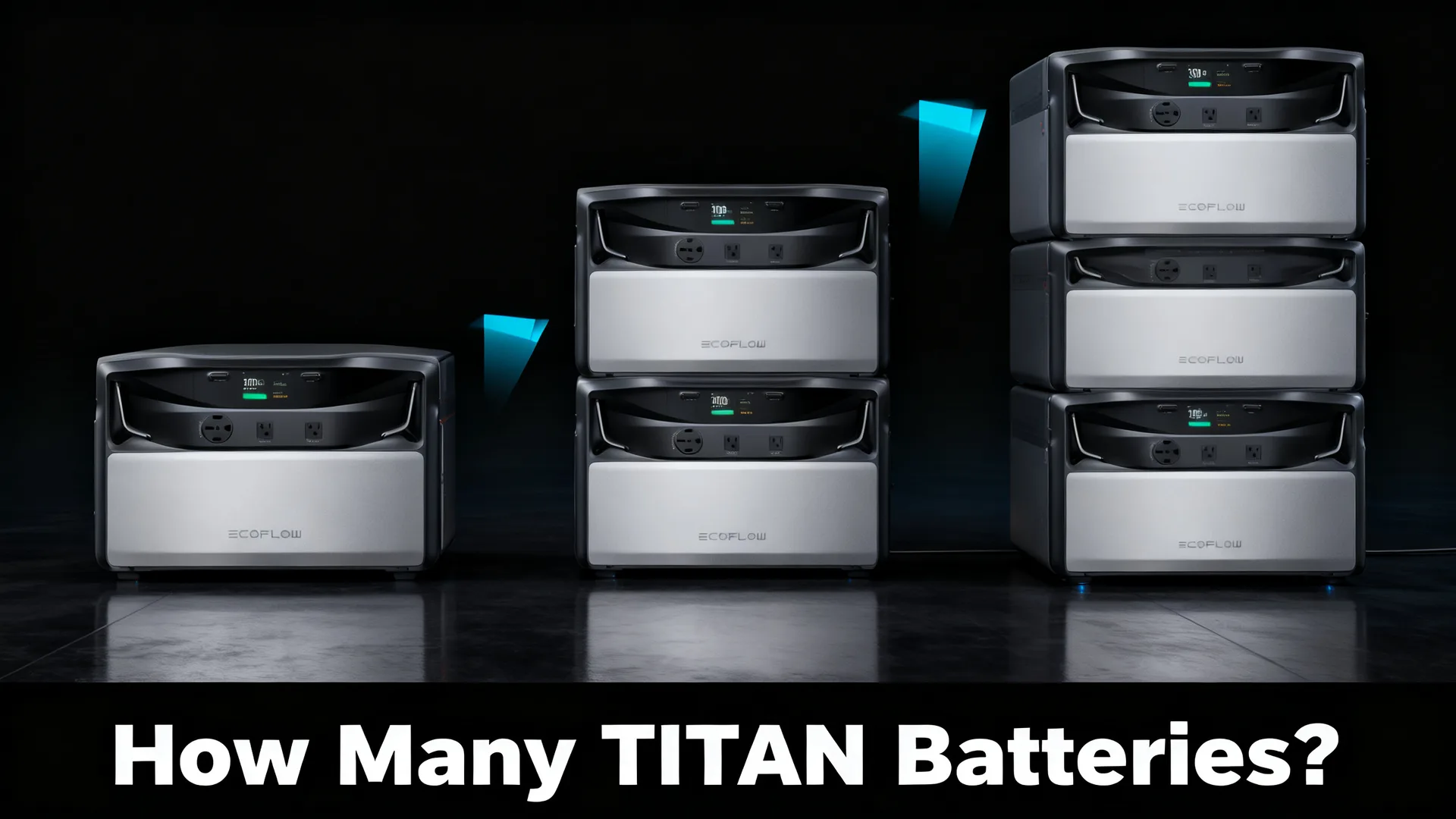
The short answer: the average American home uses about 29.6kWh of electricity a day. That is roughly seven 5kWh batteries for a single day without sun. If you only back up the essentials, such as the fridge, freezer, internet, lights and a CPAP, one 5kWh battery covers about 14 hours, and three days takes five to six.
This guide uses EcoFlow’s new TITAN system as the unit of measure, because each TITAN unit and each add-on battery holds exactly 5kWh, up to 30kWh in total. If you are still choosing between the TITAN 5000 Plus, 5000 and Classic, start with our EcoFlow TITAN review. The same math works for any home battery.
How we did this: every result below is a calculation, not a measurement. We use EcoFlow’s published capacity, the U.S. Energy Information Administration’s consumption data, and appliance assumptions we show in full, so you can swap in your own numbers.
How Many kWh Does a House Use per Day?
According to the U.S. Energy Information Administration, the average U.S. residential customer bought 10,791kWh of electricity in 2022, about 899kWh a month. Divided by 365, that is about 29.6kWh a day.
The range is wide. The EIA reports the highest average in Louisiana, at 14,774kWh a year (about 40kWh a day), and the lowest in Hawaii, at 6,178kWh a year (about 17kWh a day). Homes with rooftop solar also use more than their utility bill shows, because part of their power never goes through the meter.
Your own number is on your bill. Take the kWh for the month and divide by 30. A summer bill and a winter bill can tell two very different stories, so check both.
How to Size Your Battery: The Formula
Flip it around to find how many units you need: kWh per day × days of backup ÷ 4.26, rounded up. For a quick check on single appliances, our power station runtime calculator does the math for you.
During an outage, you rarely need your full daily use. Most people back up a list of essentials and let the rest wait. That is why we size by profile below rather than by the whole bill.
Get our Black Friday alerts for EcoFlow
We track live prices on 40+ models from Jackery, EcoFlow, BLUETTI and Anker SOLIX. When a deal beats the lowest price we've recorded, you'll hear from us. During Black Friday week, one short recap a day at most.
Unsubscribe in one click. We may earn a commission when you buy through our links, at no extra cost to you. Privacy Policy
Our Assumptions, Appliance by Appliance
These are averages, not measurements of your home. Fridges, freezers and pumps cycle on and off, so we use average draw over a day.
| Load | Our assumption | kWh per day |
|---|---|---|
| Refrigerator | 150W average, 24 hours | 3.6 |
| Chest freezer | 80W average, 24 hours | 1.9 |
| Router + modem | 20W, 24 hours | 0.5 |
| LED lighting | 100W, 6 hours | 0.6 |
| Phones and a laptop | Flat estimate | 0.3 |
| CPAP, no humidifier | 56W (ResMed figure), 8 hours | 0.45 |
| Essentials total | about 7.3 | |
| Well pump, 2 HP, 240V | 1,500W, 1 hour of pumping | 1.5 |
| Furnace blower (winter) | About 500W, 8 hours (our estimate) | 4.0 |
| Central AC, 3-ton (summer) | About 3,500W, 8 hours of compressor time | 28 |
How we estimate the AC: a 3-ton unit moves 36,000 BTU per hour. At a typical efficiency (EER) of 10 to 12, that takes about 3,000 to 3,600W while the compressor runs. Check the label on your own unit.
How Many TITAN Batteries for Each Type of Home
The table shows how long each setup lasts with no recharge at all: no sun, no generator, no grid.
| Home profile | kWh/day | 1 unit (5kWh) | 2 (10kWh) | 3 (15kWh) | 4 (20kWh) | 5 (25kWh) | 6 (30kWh) |
|---|---|---|---|---|---|---|---|
| Essentials only (120V) | 7.3 | ~14 h | 1.2 days | 1.8 days | 2.3 days | 2.9 days | 3.5 days |
| Essentials + well pump + furnace (winter) | 12.8 | ~8 h | ~16 h | ~24 h | 1.3 days | 1.7 days | 2.0 days |
| Essentials + 3-ton central AC (summer) | 35.3 | ~3 h | ~6 h | ~9 h | ~12 h | ~14 h | ~17 h |
| Average U.S. home (EIA) | 29.6 | ~3 h | ~7 h | ~10 h | ~14 h | ~17 h | ~21 h |
Daily use vs usable TITAN capacity (kWh)
Essentials: 7.3 per day
Essentials + well pump + furnace: 12.8 per day
Average U.S. home: 29.6 per day
Essentials + central AC: 35.3 per day
1 TITAN unit: 4.3 usable
3 units: 12.8 usable
6 units (maximum): 25.6 usable
Essentials Only: 1 to 2 Units for a Night, 5 to 6 for Three Days
For the fridge, freezer, internet, lights and a CPAP, one unit gets you through a night and two cover a full day with margin. Riding out three days with no sun takes five to six units, which is the TITAN’s 30kWh maximum. For longer outages, our multi-day outage planning guide covers rationing and recharge options.
Well Pump and Furnace in Winter: About 3 Units per Day
Adding a 240V well pump and a gas furnace’s blower brings the essentials to about 12.8kWh a day. Three units cover roughly one day, and the 30kWh maximum gives you two. A well pump needs 240V, so this profile calls for the TITAN 5000 or 5000 Plus, not the 120V Classic.
Central AC in Summer: Batteries Alone Are Not Enough
A 3-ton central AC running eight hours of compressor time adds about 28kWh a day. Even six units last about 17 hours. The fixes are solar, a higher thermostat setting and running the AC in shorter windows. Our load management guide shows how to stretch a battery through a heat wave.
The Average Home: Why “Whole-Home” Needs Solar
At 29.6kWh a day, the average home empties even a full 30kWh TITAN system in less than a day without recharging. “Whole-home backup” on batteries alone really means whole-home for a few hours. For more than that, you need solar, a generator, or a shorter list of loads.

How Solar Changes the Math
Solar does not make the battery bigger. It refills it every day. With enough panels, it changes the question from “how many days” to “how many hours until the sun comes back.”
We estimate a typical day at 70% of the panels’ rated power for 4 to 6 hours of full sun, which is a common planning range. Here is what each TITAN model can take in, if you install enough panels to reach its maximum solar input:
TITAN 5000 Plus
22 to 34kWh a day
with 8kW of panels
TITAN 5000
11 to 17kWh a day
with 4kW of panels
TITAN 5000 Classic
9 to 13kWh a day
with 3.2kW of panels
Batteries only
- Size for the longest outage you expect
- Essentials for 3 days: 5 to 6 units
- Works with no panels, but capacity runs out
- Best for short, rare outages
Batteries + solar
- Size for one night, let the sun refill the rest
- Essentials indefinitely in good sun: 2 to 3 units with a 5000 Plus and 8kW of panels
- Cloudy days still drain the battery
- Best for long outages and off-grid stretches
With a full 8kW array, a 5000 Plus can take in more than the essentials use in a day, so the battery only has to carry you through the night. With a smaller array, or in winter, plan on the battery doing more of the work. Solar can also shift your daily use to cheaper hours, but the savings depend on your rate plan; we explain why in what a home battery does for your bill.
Which TITAN Model for Your Battery Count?
Our suggestions, based on EcoFlow’s specifications. The full TITAN review covers each model in detail.
TITAN 5000 Classic
Essentials, 1 to 3 units. 120V only, 4,000W of output. No well pump on 240V, no central AC.
TITAN 5000
240V loads, 2 to 4 units. 7,200W at 120/240V for a well pump or a furnace, with 4kW of solar.
TITAN 5000 Plus
Central AC and rooftop solar, 3 to 6 units. 8kW of solar input, up to 10kW of output with sun.

What a Bigger System Costs
A TITAN system is one main unit plus up to five add-on batteries. Today the main unit costs $2,499 (Classic), $3,199 (5000) or $3,699 (5000 Plus), and one TITAN 5kWh Battery costs $2,299 on its own. EcoFlow’s bundles and battery packs cost less than single batteries, so the cheapest path to each size mixes them.
Cheapest combination on EcoFlow’s U.S. store, checked on November 3, 2026 (launch prices before tax, without the Smart Home Panel 10):
| System | Capacity | TITAN 5000 Classic | TITAN 5000 | TITAN 5000 Plus |
|---|---|---|---|---|
| 1 unit | 5kWh | $2,499 | $3,199 | $3,699 |
| Unit + 1 battery | 10kWh | $4,699 | $5,029 | $5,799 |
| Unit + 2 batteries | 15kWh | $6,868 | $7,328 | $8,068 |
| Unit + 5 batteries | 30kWh | $13,328 | $13,658 | $14,428 |
| Per kWh at 30kWh | about $444 | about $455 | about $481 |
How we added it up: 10kWh is EcoFlow’s unit-plus-battery bundle. 15kWh is the unit plus a 2-battery pack ($4,369), except the TITAN 5000, where the unit-plus-battery bundle plus one battery costs less. 30kWh is the unit-plus-battery bundle plus a 4-battery pack ($8,629).
Then add the Smart Home Panel 10 for whole-home backup: $1,199 for the 240V version (5000 Plus and 5000) or $1,099 for the 120V version (Classic) on its own, on November 3. Bundles save here too: the TITAN 5000 Plus with one battery and the panel was $6,799 (10kWh), and with two batteries and the panel $8,699 (15kWh). Installation comes on top, with $300 off EcoFlow’s installation service on orders through December 31, 2026.
Each add-on battery weighs 82.7 lb, so plan floor space and help to move them.
Alternatives With the Same 30kWh Ceiling
The Anker SOLIX S5000 also starts at 5kWh and grows to 30kWh, but it rolls on wheels and does not need a wall panel to be useful. For more than 30kWh, the EcoFlow DELTA Pro Ultra scales to 90kWh with three inverters. The live prices below cover stations you can buy today.
| Model | Capacity / output | Price now | Per kWh | Lowest tracked | Link |
|---|---|---|---|---|---|
 Anker SOLIXS5000 | 5,024Wh · 4,500W | $2,499.99 Pre-order | $498 | $2,499.99 (Nov 5) | Check deal |
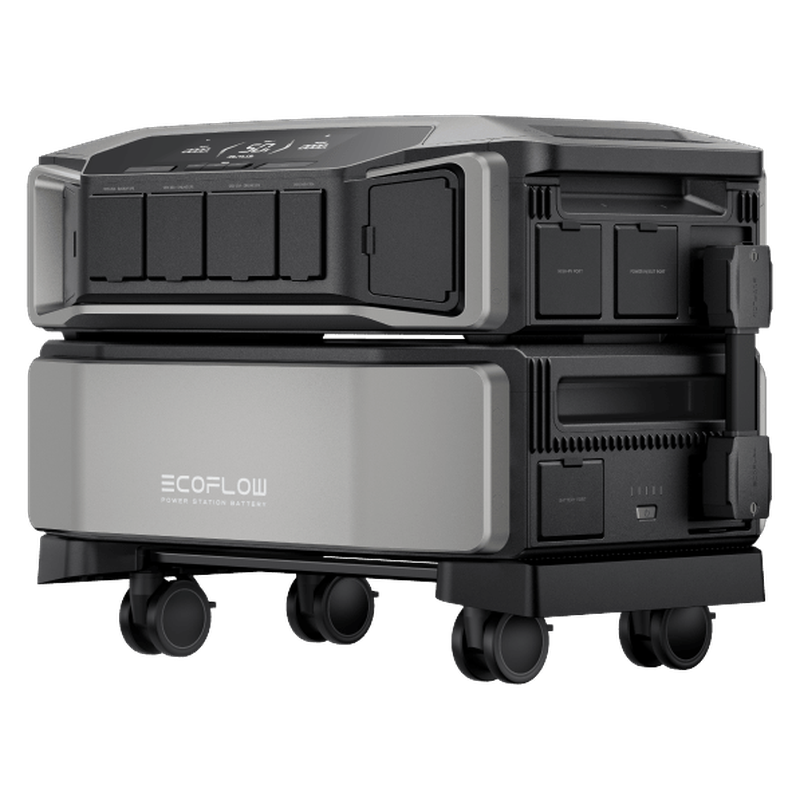 EcoFlowDELTA Pro Ultra | 6,144Wh · 7,200W | $4,199 Sold out on store | $683 | $3,989 (Oct 8) | Check stock |
 JackeryExplorer 5000 Plus | 5,040Wh · 7,200W | $3,499 Sold out on store | $694 | $2,899 (Oct 8) | Check stock |
Prices come from each brand's US store and refresh automatically every few hours (oldest check on this table: Nov 5, 2:59 AM ET). Sale prices can change within the hour; the price in your cart is the one that counts. Prices, not coupon codes: some stores stack extra member or sign-up discounts at checkout.
Frequently Asked Questions
How many batteries do I need to power my house?
Divide your daily kWh by about 4.26, the usable energy of one 5kWh battery, then multiply by the number of days you want to cover. The average U.S. home uses about 29.6kWh a day, so about seven 5kWh batteries for one day without sun. Essentials alone use about 7.3kWh a day.
How many kWh does a house use per day?
About 29.6kWh on average in the U.S., based on the EIA’s figure of 10,791kWh per residential customer in 2022. It ranges from about 17kWh a day in Hawaii to about 40kWh in Louisiana. Divide your monthly bill’s kWh by 30 for your own number.
How long will a 10kWh battery last?
By our estimate, about 1.2 days for essentials such as a fridge, freezer, internet, lights and a CPAP, and about 7 hours for an average U.S. home using 29.6kWh a day, with no recharge.
How long will a 30kWh battery last?
By our estimate, about 3.5 days for essentials and about 21 hours for an average U.S. home, with no recharge. With central AC running in summer, about 17 hours.
Can batteries run central air conditioning?
Yes, for a few hours. A 3-ton central AC draws about 3,000 to 3,600W while the compressor runs, so it uses one 5kWh battery in a little over an hour. For longer use, add solar, raise the thermostat or run the AC in shorter windows.
Do I need solar with a whole-home battery?
Not for short outages: a few batteries cover a night or a day of essentials. For outages of several days, solar or a generator becomes necessary, because even 30kWh lasts less than a day for an average home.
Bottom Line
One 5kWh battery covers a night of essentials, three cover a day with a well pump, and six cover three days of essentials. Beyond that, more batteries help less than solar does. Start from your own kWh per day, pick how many days you want to ride out, and let the formula decide.

EcoFlow TITAN 5000 Plus
5,018Wh · 7,200W output · Price tracked daily since Sep 26
7.2kW at 120/240V, 8kW of solar input, 5 to 30kWh.
See the deal on EcoFlowExtra 5% off with code BPHUB5 Read our review
EcoFlow TITAN 5000
5,018Wh · 7,200W output · Price tracked daily since Sep 26
7.2kW at 120/240V, 4kW of solar input, 5 to 30kWh.
See the deal on EcoFlowExtra 5% off with code BPHUB5 Read our reviewRelated Guides
Originally published: November 3, 2026