
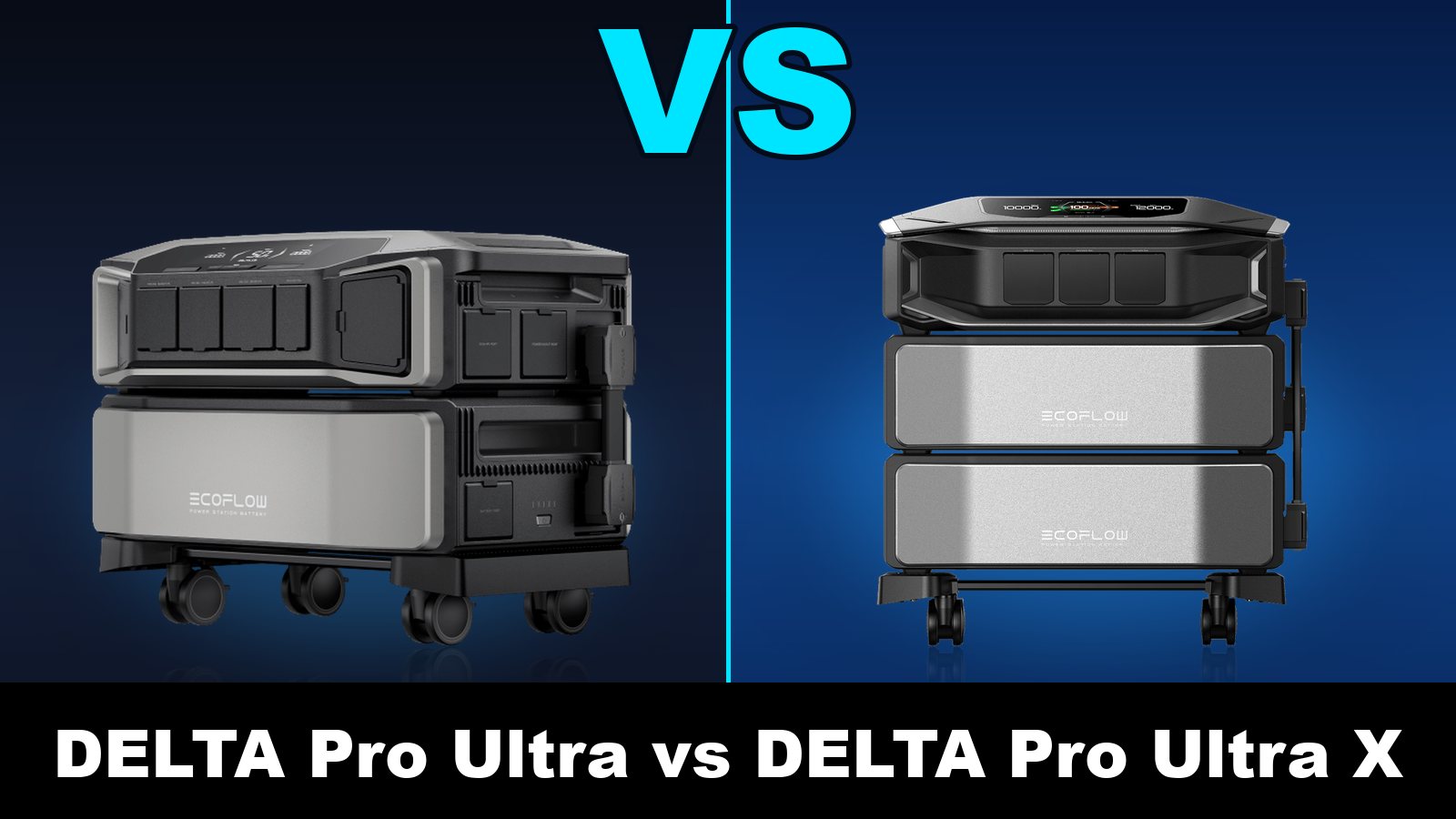
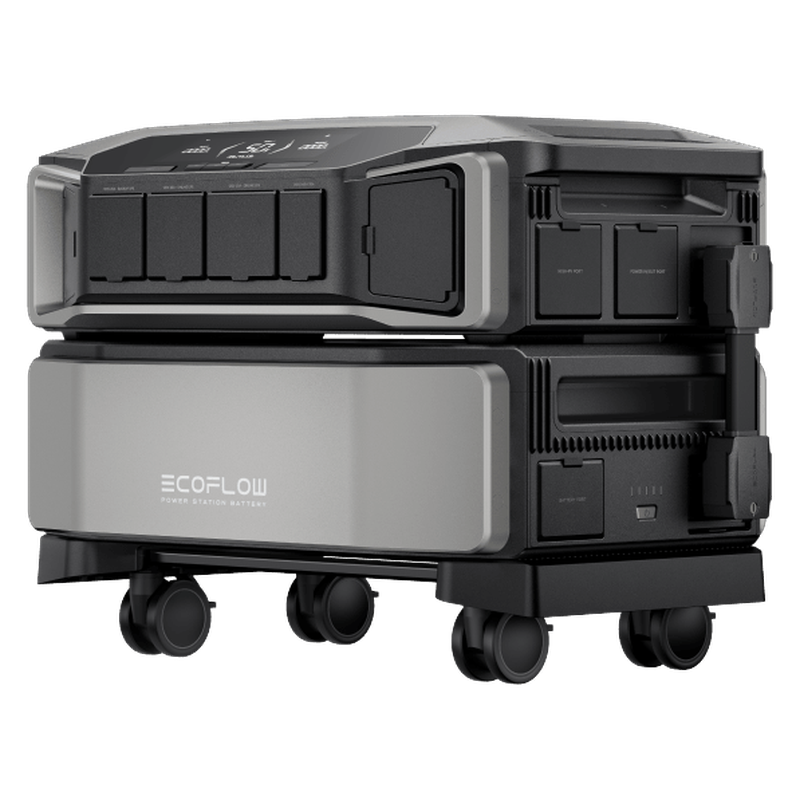
DELTA Pro Ultra
- 7,200W covers your biggest loads at once (EcoFlow cites a 3-ton central AC)
- you want outlets on the unit: TT-30, four 20A, USB and a 30A 12V port
- you’d rather spend $1,700 on panels or batteries

DELTA Pro Ultra X
- you need 12,000W: a 5-ton AC, or an AC and a well pump together
- you’ll install up to 10kW of solar or recharge from a big generator
- you plan to grow past 30kWh: 61kWh per inverter
Prices and stock checked by our price engine on November 22, 2026 at 8:59 AM EST. Each product is rechecked several times a day; the time refreshes when you load the page.
Same 12kWh. $1,700 buys a bigger inverter and faster charging.
Compared like for like, one inverter and two 6,144Wh batteries each, the EcoFlow DELTA Pro Ultra and the EcoFlow DELTA Pro Ultra X store the same 12,288Wh. The Ultra X delivers 12,000W instead of 7,200W, takes 10kW of solar instead of 5.6kW and charges from the grid or a generator at up to 12kW. If 7,200W covers your biggest loads, the DELTA Pro Ultra does the job and keeps more outlets on the unit.
Below: every difference with numbers, a 20-second calculator for your own gear, six modeled situations, the one-battery DELTA Pro Ultra as a third option, and what three published tests found.
Same 12,288Wh in this comparison, same LFP batteries, same 5-year warranty. The Ultra X costs $1,700 more and buys 4,800W more output, 4.4kW more solar input, up to 12kW of AC charging and twice the expansion per inverter.
- your peak load stays under 7,200W
- you want outlets and USB on the unit for portable use
- you want 0ms online UPS on three outlets
- you need 12,000W at once
- you’ll install more than 5.6kW of solar
- you’ll charge from a large generator or the grid fast
The five differences that decide it
Compared as EcoFlow sells them at the same capacity: one inverter and two 6,144Wh batteries each. The better spec for most buyers is flagged. The batteries, the 5-year warranty and the IP54 rating are the same.
Will it run your setup? Check in 20 seconds
Estimates use 85% usable capacity and 70% of rated solar output. Real results vary with temperature, inverter load, shade and appliance cycling. Fridge and freezer watts are daily averages and do not include compressor startup surges.
Runtime by appliance, one at a time
Simple energy estimates, not measured runtimes. Same 12,288Wh in both, about 10,445Wh usable, so one column serves both systems.
Same battery, same runtime.
The Pro Ultra and the Ultra X both hold about 10,445Wh usable, so every appliance runs just as long on either one.Get our Black Friday alerts for EcoFlow
We track live prices on 40+ models from Jackery, EcoFlow, BLUETTI and Anker SOLIX. When a deal beats the lowest price we've recorded, you'll hear from us. During Black Friday week, one short recap a day at most.
Unsubscribe in one click. We may earn a commission when you buy through our links, at no extra cost to you. Privacy Policy
The price gap, in numbers
Same 12,288Wh battery: the EcoFlow DELTA Pro Ultra (2 batteries) costs $1,700 less than the EcoFlow DELTA Pro Ultra X.
Prices refresh daily from EcoFlow US.The lifetime figure divides the price by 3,500 cycles times 12.288kWh. EcoFlow rates the DELTA Pro Ultra battery at 80% capacity after 3,500 cycles and publishes no cycle count for the Ultra X, so we apply the same figure; read it as a ranking, not a bill. Both prices are for the equipment only: whole-home use adds a Smart Home Panel 2 for the DELTA Pro Ultra, a Smart Home Panel 3 or Smart Gateway for the Ultra X, and an electrician.
The third option: start with one battery at $4,199
EcoFlow DELTA Pro Ultra, 1 battery: $4,199 today
The same 7,200W inverter with one 6,144Wh battery, about 5,200Wh usable: enough for essentials through a day or two of outage, and you add batteries later, up to five per inverter. It sits $2,000 below the two-battery DELTA Pro Ultra. It is also $3,700 below the Ultra X, which EcoFlow only sells with two batteries. EcoFlow’s FAQ also explains how older DELTA Pro Ultra batteries connect to an Ultra X, so a one-battery start doesn’t lock you out of the newer inverter. Our DELTA Pro Ultra review goes deeper. See the DELTA Pro Ultra at EcoFlow.
Six modeled situations, worked out
Same formula as the calculator above, both at 12,288Wh. The fridge averages 60W, about 525kWh a year; whole-home figures use the 28kWh a day average Digital Trends cites.
Essentials through a long outage
Identical: same storage. Each extra 6,144Wh battery adds about 2.4 days on either.
A whole house, as usual
Neither covers a full day of normal use on two batteries. That is why both pair with a panel that sheds non-essential circuits; EcoFlow says the Smart Home Panel 3 extends backup by up to 42% with load priorities.
A 5-ton central AC with the house
Only the Ultra X has the headroom; EcoFlow names a 5-ton AC for it and a 3-ton AC for the DELTA Pro Ultra. Check your unit’s running and locked-rotor amps with an installer before choosing.
Refill from solar, 10kW of panels
With 5.6kW of panels or less they refill at the same pace. Above that, only the Ultra X uses the extra array; EcoFlow says 80% in about an hour at full input.
Recharging from a portable generator
The Ultra X burns far less generator time per refill. The DELTA Pro Ultra’s AC input tops out at 3,000W at 240V; EcoFlow quotes up to 8,800W when it combines AC and solar.
An RV or a job site
Same runtime, but the DELTA Pro Ultra is the portable one: a TT-30 for a 30A RV cord, a 12V 30A port, USB and four 20A outlets, with an optional trolley. The Ultra X offers a 14-50 for 50A RVs and nothing for USB or 12V.
Eight more differences, the spec sheet and the box
Smaller gaps that rarely decide the purchase, then the full specifications and what you buy.
DELTA Pro Ultra and DELTA Pro Ultra X weight, dimensions and full specifications
Inverters: 27.2 × 18.9 × 8.4 in and 70 lb for the DELTA Pro Ultra, 26.6 × 18.7 × 9.1 in and 70.1 lb for the Ultra X. Batteries: 26 × 18 × 8 in for both, 111.8 lb and 111.3 lb. Everything else is in the sheet below.
EcoFlow DELTA Pro Ultra and DELTA Pro Ultra X full specifications
Every published figure for both systems, one inverter and two batteries each. Green marks the better value.
What you buy
DELTA Pro Ultra, 2 batteries
- Inverter + 2 × 6,144Wh batteries12,288Wh
- Smart Home Panel 2 sold separatelyneeded for whole-home backup
- Electrician needed for the panelDigital Trends: three electricians, one day
Ultra X, 2 batteries
- Inverter + 2 × 6,144Wh batteries12,288Wh, on a wheeled stand
- Smart Home Panel 3 or Smart Gateway sold separatelyneeded for whole-home backup
- EcoFlow installation programone-day install, 7 days from permit
From EcoFlow US product pages. Bundles with a panel, solar or an EV charger are sold as separate variants.
07 · ChargingHow fast each one refills
12,288Wh from empty. Shorter bar, faster refill. Each row is scaled to its slower unit.
DELTA Pro Ultra: up to 8,800W combining AC and solar, two batteries in about 2 h (EcoFlow)Ultra X: can charge from a generator while delivering up to 12kW (FlowMaster rectifier)
Our times divide capacity by input power, with solar at 70% of panel rating; charging slows near full.
Every port, side by side
DELTA Pro Ultra
DELTA Pro Ultra X
Practical consequence: the DELTA Pro Ultra works as a giant portable station on its own, with outlets, USB and 12V. The Ultra X is designed to live next to the house panel: few outlets, but a 14-50 and a high-power link to the Smart Home Panel 3.
09 · NoiseNoise: Pro Ultra vs Ultra X
Both are quiet on paper. EcoFlow says the EcoFlow DELTA Pro Ultra (2 batteries) runs fanless at 0dB below 2,000W for up to 30 minutes, and SlashGear found it very quiet after a month; EcoFlow rates the EcoFlow DELTA Pro Ultra X under 30dB at 0.5 m at a 4kW output.
These are EcoFlow figures. We found no independent dB measurement for either, and both usually sit in a garage or utility room.Every figure we found, with its source
What reviewers heard: Very quiet after a month of use (SlashGear); no dB figure published by SlashGear or Digital Trends.
Measured by a tester Brand figure
- Both are IP54, so a covered outdoor spot or a garage is fine; keep the fans’ intake clear.
Cold and heat: Pro Ultra vs Ultra X
Both batteries charge and run from −4°F to 113°F, which is unusual for LFP. The EcoFlow DELTA Pro Ultra X adds battery self-heating for cold charging and an inverter rated to 122°F, against 113°F for the EcoFlow DELTA Pro Ultra (2 batteries). Both are IP54.
Figures from the EcoFlow US product pages.- A covered spot in a garage or outside is still best: IP54 means dust and splash resistant.
App, UPS and smart features
The EcoFlow DELTA Pro Ultra X does more at the panel: a 32-circuit Smart Home Panel 3, rooftop solar storage and an AI Assistant. The EcoFlow DELTA Pro Ultra (2 batteries) keeps a 0ms online UPS on three outlets, 4G and generator auto start.
Same app with time-of-use, Storm Guard and an API on both.Green zone: a switch under about 16ms, which most desktop PCs ride through without restarting.
Can it store rooftop solar surplus? The EcoFlow DELTA Pro Ultra X can store surplus from an existing rooftop system through current transformers and the Smart Home Panel 3, per EcoFlow; EcoFlow lists no such feature for the DELTA Pro Ultra.
Can it start a generator by itself? The EcoFlow DELTA Pro Ultra can start and stop a generator on its own; EcoFlow lists no such feature for the Ultra X.
Does it work as a UPS? The EcoFlow DELTA Pro Ultra has true online UPS (0ms) on two 20A outlets and the TT-30, and under 20ms on the rest. The EcoFlow DELTA Pro Ultra X switches in under 10ms on its own and under 20ms through the Smart Home Panel 3. SlashGear’s DELTA Pro Ultra took about four seconds to take over panel circuits unless EPS mode was on.
Does it connect to a home panel? The EcoFlow DELTA Pro Ultra pairs with the Smart Home Panel 2 (12 circuits, subpanel only, per SlashGear). The EcoFlow DELTA Pro Ultra X pairs with the Smart Home Panel 3 (200A, 32 circuits, main or sub) or the Smart Gateway, with load priorities.
Can it charge off-peak? Both have time-of-use, self-powered mode and scheduled tasks in the EcoFlow app.
Does it prepare for storms? Both charge ahead of severe weather with Storm Guard.
How does the app connect? Both use the EcoFlow app with an API. The EcoFlow DELTA Pro Ultra adds 4G; the EcoFlow DELTA Pro Ultra X adds EcoFlow’s AI Assistant.
Warranty and support
EcoFlow US gives the EcoFlow DELTA Pro Ultra (2 batteries) and the EcoFlow DELTA Pro Ultra X the same 5 years.
Whole-home installation adds an electrician’s warranty on the wiring.Subject to each brand’s warranty terms and eligibility.
EcoFlow rates the DELTA Pro Ultra battery at 80% capacity after 3,500 cycles, about 10 years at one full cycle a day. It gives no cycle count for the Ultra X.
- For whole-home backup, have the panel installed by an electrician, whose warranty covers the wiring; EcoFlow runs an authorized installer program for both panels.
What reviewers report
We have not lab-tested these systems. Here is what three published reviews found, with the source for each point. None measured usable capacity.
DELTA Pro Ultra: Digital Trends (January 2024), SlashGear (February 2024), both with Smart Home Panel 2Ultra X: iPhone in Canada (March 2026), hands-on
Output and loads
- Pro UltraReviewer Kept a house at 71°F with a 3,100W heat pump at 30°F outside, and ran every light, a toaster oven, a kettle and a 120V hot tub. Digital Trends, Nick Mokey, January 2024
- Ultra XReviewer Ran a chest freezer for 9 days in a quick test; 12kW output, roughly double the previous generation. iPhone in Canada, Austin Blake, March 2026
Installation and panels
- Pro UltraReviewer Three electricians took a full workday to wire the Smart Home Panel 2 as a subpanel; up to 10 circuits moved over. Digital Trends, January 2024
- Pro UltraReviewer Not a DIY project; the panel is a sub-panel only, with 12 circuit spaces. SlashGear, Adam Doud, February 2024
- Ultra XReviewer Whole-home integration needs the Smart Home Panel 3 or the Smart Gateway, sold separately. iPhone in Canada, March 2026
Switchover
- Pro UltraReviewer Took about four seconds to take over the house circuits; EPS mode cuts it to about 20ms but drains the battery faster. SlashGear, February 2024
- Pro UltraReviewer Some LED lights visibly blinked on battery power. Digital Trends, January 2024
- Ultra XReviewer Auto switchover in about 20ms; lights and electronics stayed on. iPhone in Canada, March 2026
Daily use
- Pro UltraReviewer The battery loses about 4% a day on standby; the app’s charge controls are hard to find. SlashGear, February 2024
- Pro UltraReviewer Portable with casters and 30A outlets; time-of-use savings rarely pay it back outside high-rate markets. Digital Trends, January 2024
- Ultra XReviewer Very heavy, about 70 lb for the inverter and 111 lb per battery, and expensive even on sale. iPhone in Canada, March 2026
Practical limits before you buy
- Both need a panel and an electrician for whole-home backup. Budget for a Smart Home Panel 2 (DELTA Pro Ultra) or a Smart Home Panel 3 or Smart Gateway (Ultra X), plus installation.
- The Ultra X isn’t sold with one battery. EcoFlow US starts it at two batteries; the DELTA Pro Ultra starts at one.
- 12kW charging needs a 50A circuit. On a 30A circuit the Ultra X charges at 7,200W, and at 1,800W on a 120V outlet, like the DELTA Pro Ultra.
- The Ultra X has no USB and no 12V output. It’s built to sit by the panel, not to travel.
- Check the switchover mode. SlashGear’s DELTA Pro Ultra took about four seconds to take over unless EPS mode was enabled.
- Surge claims differ in kind. The DELTA Pro Ultra lists a 10,800W surge; the Ultra X’s 45kW refers to EcoFlow’s Adaptive Start for motor loads. Have an installer check your AC’s starting current.
- Each battery weighs over 110 lb. Plan for two people or the wheeled stand.
- Standby drain is real. SlashGear measured about 4% a day on the DELTA Pro Ultra; keep it topped up by grid or solar.
Frequently asked questions
What is the difference between the DELTA Pro Ultra and the DELTA Pro Ultra X?
The same 6,144Wh battery packs, but a bigger inverter on the X: 12,000W instead of 7,200W, 10kW of solar instead of 5.6kW, up to 12kW of AC charging instead of 3kW, and up to 10 batteries per inverter instead of 5. The DELTA Pro Ultra keeps more outlets, USB and a 12V port on the unit.
Can I use DELTA Pro Ultra batteries with the Ultra X?
EcoFlow’s Ultra X FAQ gives instructions for connecting older DELTA Pro Ultra batteries to an Ultra X, through a specific battery port during a firmware upgrade.
Which one can run a central air conditioner?
EcoFlow cites a 3-ton central AC for the DELTA Pro Ultra and a 5-ton AC for the Ultra X. Starting current varies by model, so confirm with an installer.
How long will 12kWh run my house?
About 9 hours at an average 28kWh a day, everything on. With only essentials (fridge, router, lights, phones), about 4.8 days on either. Each extra battery adds about 6.1kWh.
Do I need a Smart Home Panel?
For whole-home backup, yes, or a transfer switch: the Smart Home Panel 2 for the DELTA Pro Ultra, the Smart Home Panel 3 or Smart Gateway for the Ultra X. Without one, both work as large portable stations through their own outlets.
Which charges faster from a generator?
The Ultra X: up to 7,200W from a 30A generator outlet, about 1.7 hours for 12kWh, against 3,000W at 240V for the DELTA Pro Ultra, about 4.1 hours.
Are they outdoor rated?
Both are IP54, dust and splash resistant, and rated from −4°F for charging and discharging. A covered spot is still best.
Is the DELTA Pro Ultra still worth buying?
Yes if your peak loads stay under 7,200W: it stores the same per battery, starts with one battery, and doubles as a portable station. Pick the Ultra X for larger homes, big solar arrays or fast generator charging.
Related comparisons and reviews
How we compared and sources
Research-based comparison. We have not physically tested these systems. Specs come from EcoFlow US documentation; usage observations are attributed to named reviewers. Prices and availability were checked on October 30, 2026.
- Specs: EcoFlow US, DELTA Pro Ultra and EcoFlow US, DELTA Pro Ultra X, including their spec sheets, comparison tables and FAQs, read on October 30, 2026.
- Like-for-like pricing: the DELTA Pro Ultra variant with one inverter and two batteries against the Ultra X with one inverter and two batteries, both tracked daily by our price engine.
- Reviewer reports: Digital Trends (Nick Mokey, January 2024) and SlashGear (Adam Doud, February 2024) on the DELTA Pro Ultra with Smart Home Panel 2; iPhone in Canada (Austin Blake, March 2026, Canadian unit) on the Ultra X.
- Ultra X cycle life: not published by EcoFlow US; we use the DELTA Pro Ultra’s 3,500 cycles for both in the price-per-cycle card.
- Runtime = 12,288Wh × 0.85 ÷ watts. Solar and charging times = capacity ÷ input power, solar at 70% of panel rating.
Same 12kWh. The Ultra X adds 12kW output, 10kW solar and fast charging for $1,700 more.
Prices checked November 22, 2026 at 8:59 AM EST
Looking at other models? Browse all power station comparisons, or pick any two models on the hub and we point you to the right duel.
Originally published: November 22, 2026