
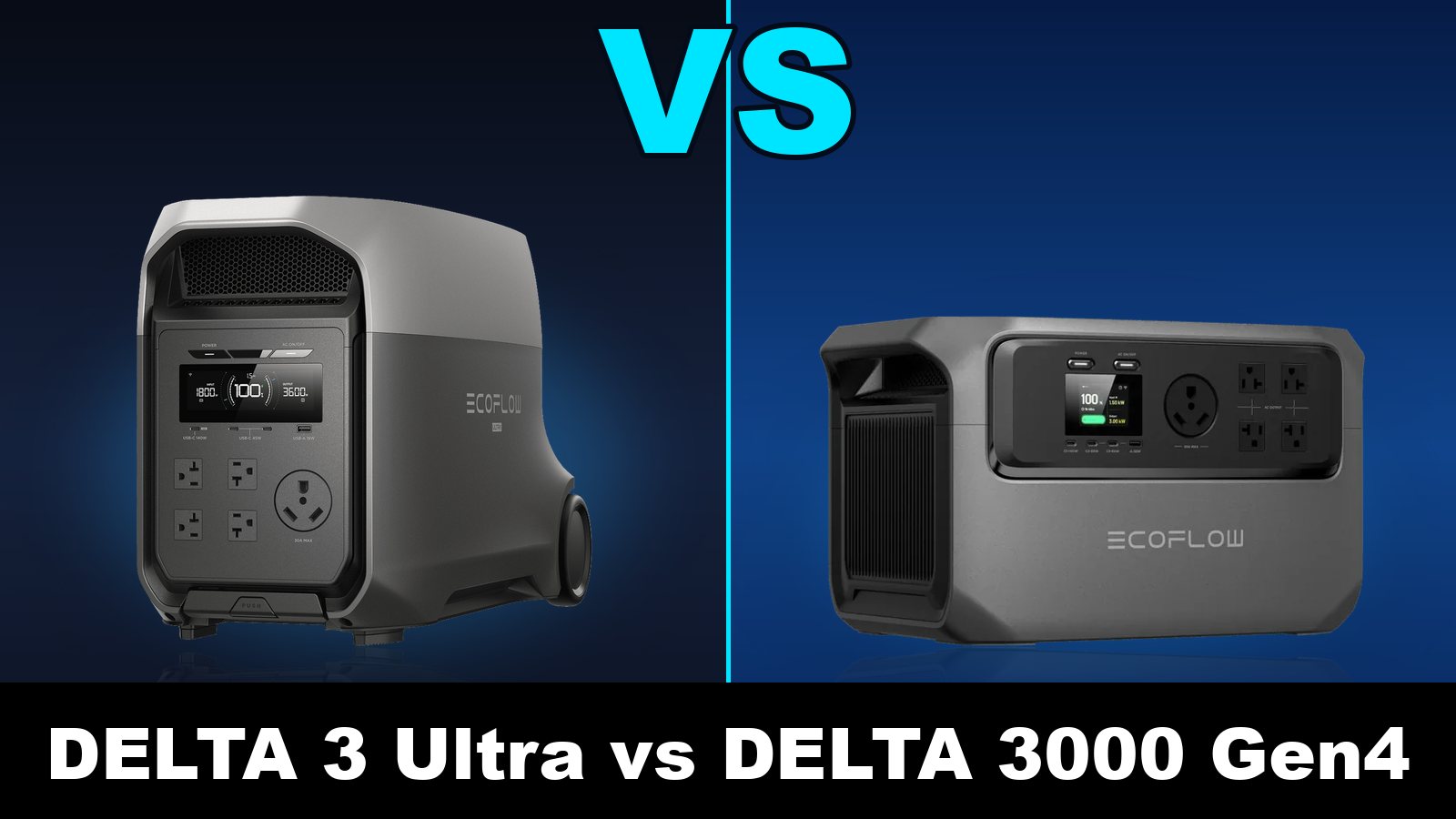

DELTA 3 Ultra
- it stays on one flat floor: wheels do the work
- you run 12V gear from a car socket
- a PC needs a clean shutdown: HID on USB-C
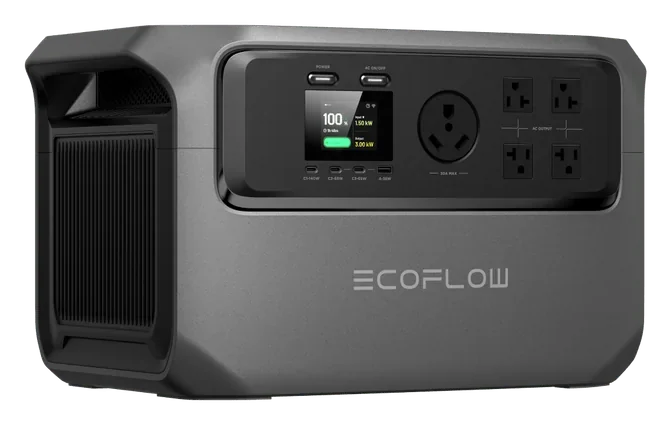
DELTA 3000 Gen4
- you will lift it: 57.3 lb, two handles
- you own over 800W of panels
- you want a published cycle rating
Prices and stock checked by our price engine on November 6, 2026 at 8:29 AM EST. Each product is rechecked several times a day; the time refreshes when you load the page.
In an outage these two are the same machine; the Gen4 only pulls ahead on the days you have to lift it.
The EcoFlow DELTA 3 Ultra and the EcoFlow DELTA 3000 Gen4 both hold 3,072Wh and put out 3,600W at 120V, with a 7,200W surge rating and the same five AC outlets. The Gen4 sheds 14.8 lb, accepts 200W more solar and publishes a cycle rating. The Ultra keeps the things the Gen4 dropped: a 126W car socket, HID on its USB-C, and a listed route to a transfer switch. They cost the same today, so price won’t settle it. If it will live on one flat floor next to a desktop PC, the Ultra loses nothing. If it rides in a truck or climbs stairs, get the Gen4.
Below: the gaps that remain, a calculator for your own gear, and seven situations where one of them actually changes your day. Neither has a full independent review, so every figure is EcoFlow’s or our math.
Same price today. Capacity, output, surge, AC outlets, wall input and switchover time all match. The 3000 Gen4 is 14.8 lb lighter and takes 200W more solar. The DELTA 3 Ultra adds a car socket, HID and EcoFlow’s published transfer switch route.
- you need a 12V socket
- your PC wants HID
- you’ll use a transfer switch
- you carry it often
- you have 1,000W of panels
- you want 6,000 rated cycles
Five gaps, and nothing else that matters
Start with what doesn’t differ: 3,072Wh of LFP, 3,600W at 120V, four 20A outlets plus a 30A outlet, 1,800W from the wall, under 10ms switchover. Everything below is what is left.
Will it run your setup? Check in 20 seconds
Estimates use 85% usable capacity and 70% of rated solar output. Real results vary with temperature, inverter load, shade and appliance cycling. Fridge and freezer watts are daily averages and do not include compressor startup surges.
Runtime by appliance, one at a time
One column, because the capacity is identical: about 2,611Wh usable on either. These are energy estimates, not measured runtimes.
Same battery, same runtime.
The Ultra and the 3000 Gen4 both hold about 2,611Wh usable, so every appliance runs just as long on either one.Get our Black Friday alerts for EcoFlow
We track live prices on 40+ models from Jackery, EcoFlow, BLUETTI and Anker SOLIX. When a deal beats the lowest price we've recorded, you'll hear from us. During Black Friday week, one short recap a day at most.
Unsubscribe in one click. We may earn a commission when you buy through our links, at no extra cost to you. Privacy Policy
The price gap, in numbers
Same 3,072Wh battery: they cost the same today.
Prices refresh daily from EcoFlow US.Compare the two rows. When today’s price sits under the regular one, a promotion is running, and promotions end on different dates. EcoFlow rates the Gen4 at 6,000 cycles to 70% and gives no cycle count for the Ultra, so a price-per-cycle card would be guesswork.
Seven modeled situations, worked out
Only situations where the two behave differently. Energy math uses 85% of 3,072Wh, so about 2,611Wh on either.
Up the basement stairs before the sump pump quits
EcoFlow’s own figure for the drop is about 20%. Wheels do nothing on stairs, and the Ultra’s case is also far bigger. This is the single clearest reason to choose the Gen4.
Rolling across a garage to the same spot every time
Here the weight stops mattering. EcoFlow sells a folding cart for the Gen4 separately, and the Ultra needs nothing extra. If the unit never meets a step, 14.8 lb is not worth changing your choice.
A 12V compressor cooler in the truck
The Ultra feeds it directly. The Gen4 lists no 12V output, so you run the cooler’s AC adapter if it has one, and the inverter’s 14W no-load draw comes along: 59W in total on our math. That costs roughly 14 hours per charge.
A desktop PC that should shut itself down
Both switch in under 10ms. Only the Ultra can tell the PC the battery is running out. EcoFlow says the Gen4 has no HID communication, so when it empties, the PC simply loses power.
A 1,000W array on a shed roof
That is our usual 70% rule applied to each input limit, so it is the widest the gap can get. The Ultra only clips the array when it makes more than 800W; on a hazy day both take everything. With a pair of 160W folding panels the gap vanishes: 13.7 h on both by our math, and EcoFlow quotes about 12 h on the Gen4.
A fridge alone through a long blackout
Don’t read that as a real gap. EcoFlow’s 58 h is its own run on an unloaded Samsung fridge, roughly 53W on average, with Fridge Runtime Boost on. Multiply those out and you get nearly the whole rated battery. On a stocked fridge at 60W, both start from about 44 hours. The boost mode may stretch that on the Gen4; nobody independent has checked.
The forecast turned and you need it this week
If the 3000 Gen4 still shows Pre-order when you read this and the DELTA 3 Ultra doesn’t, the choice is made for you. A battery on a truck beats a lighter one on a waiting list.
Seven more differences, the spec sheet and the box
Smaller gaps that rarely decide the purchase, then the full specifications and what ships in the box.
DELTA 3 Ultra and DELTA 3000 Gen4 weight, dimensions and full specifications
Weight: 72.1 lb for the DELTA 3 Ultra and 57.3 lb for the DELTA 3000 Gen4. Dimensions: 24.6 × 12.9 × 15.5 in and 16.77 × 11.36 × 12.09 in. Everything else is in the sheet below.
EcoFlow DELTA 3 Ultra and EcoFlow DELTA 3000 Gen4 full specifications
Every published figure for both units, grouped. Green marks the better value.
What’s in the box
DELTA 3 Ultra
- DELTA 3 Ultra power station3,072Wh, 72.1 lb
- AC charging cable
- Manuals and warranty card
- No solar or car cablesold separately
DELTA 3000 Gen4
- DELTA 3000 Gen43,072Wh, 57.3 lb
- AC charging cable
- Solar charging cableXT60i to LP60
- AC cable retention kit, manuals and warranty card
Both lists come from EcoFlow’s US pages. The Gen4 includes a solar cable; the Ultra’s page lists none.
06 · ChargingHow fast each one refills
Shorter bar, faster refill. Each row is scaled to its slower unit.
DELTA 3 Ultra: 1,800W from a 15A input, 800W of solar3000 Gen4: 1,800W from a 15A input, 1,000W of solar on one port
Our solar times assume panels deliver 70% of their rating; the brands’ figures assume ideal sun.
Every port, side by side
DELTA 3 Ultra
DELTA 3000 Gen4
Count the outlets and you get the same five AC sockets. The real change sits on the DC side: the Gen4 has stronger USB, and no 12V socket at all.
08 · NoiseNoise: Ultra vs 3000 Gen4
At 600W EcoFlow rates the EcoFlow DELTA 3 Ultra at 25dB or less and the EcoFlow DELTA 3000 Gen4 at 30dB or less, at 1 m and 77°F. Only the Gen4 has figures for heavier loads, so the Ultra’s edge covers light use only.
All brand figures; nobody has published a measurement of either.Every figure we found, with its source
Measured by a tester Brand figure
- For a bedroom, stay under 600W and skip fast charging overnight on either unit.
Cold and heat: Ultra vs 3000 Gen4
No winner: the EcoFlow DELTA 3 Ultra and the EcoFlow DELTA 3000 Gen4 both charge from 32°F to 113°F and run from 14°F to 113°F.
Figures from the EcoFlow US pages for both models.- In an unheated garage, bring either one inside to recharge when it is below 32°F.
App, UPS and smart features
The EcoFlow DELTA 3 Ultra connects to more things: HID for a PC and a listed 120V panel route. The EcoFlow DELTA 3000 Gen4 adds outage tools: Fridge Runtime Boost and Emergency Power Mode.
Same EcoFlow app, same switchover time.Green zone: a switch under about 16ms, which most desktop PCs ride through without restarting.
Does it connect to a home panel? EcoFlow lists a manual transfer switch and an inlet box for the EcoFlow DELTA 3 Ultra. The compatibility table for the EcoFlow DELTA 3000 Gen4 names no panel or switch.
Does it have a fridge mode? Fridge Runtime Boost on the EcoFlow DELTA 3000 Gen4 matches output to the compressor’s cycle, for one appliance with no other AC load. EcoFlow lists no such mode for the EcoFlow DELTA 3 Ultra.
Can it charge off-peak? The EcoFlow DELTA 3 Ultra has timed charging and Scheduled Tasks. The EcoFlow DELTA 3000 Gen4 page shows a Savings Dashboard but lists no charging schedule.
Does it work as a UPS? Both switch in under 10ms. The EcoFlow DELTA 3 Ultra supports HID on its 140W USB-C; EcoFlow says the EcoFlow DELTA 3000 Gen4 has no HID communication and is not a 0ms professional UPS.
Can you add a battery later? Neither the EcoFlow DELTA 3 Ultra nor the EcoFlow DELTA 3000 Gen4 takes an extra battery.
Does it prepare for storms? Both can charge ahead of severe weather once set up. Version 2.0 on the EcoFlow DELTA 3000 Gen4 uses National Weather Service data.
Warranty and support
A tie on terms: the EcoFlow DELTA 3 Ultra and the EcoFlow DELTA 3000 Gen4 both get 3 years, plus 2 more once registered in the EcoFlow app. Only the Gen4 comes with a cycle rating.
Same coverage; the difference is what EcoFlow chose to publish.Subject to each brand’s warranty terms and eligibility.
EcoFlow rates the DELTA 3000 Gen4 at 6,000 cycles to 70% of capacity, in lab conditions. EcoFlow US doesn’t publish a cycle rating for the DELTA 3 Ultra, only an estimated 10 years of use.
- Whichever you buy, register it in the EcoFlow app when it arrives; the last 2 years depend on it.
What reviewers report
We have not had these two units in hand. As of November 5, 2026, no full independent review of the DELTA 3000 Gen4 had been published. The Ultra reviews we located cover the Plus version, not this base model. Every figure on this page is EcoFlow’s or our own math.
Practical limits before you buy
- 6,000 cycles means down to 70%. Most brands quote 80%, so the number is not a straight win over a rival’s.
- The Gen4 can’t charge while switched off. Connecting power turns it on.
- X-Boost stops in bypass on the Gen4. It is unavailable while AC input is connected.
- The Gen4’s Fridge Runtime Boost is single-appliance. EcoFlow says one compressor unit at a time, with no other AC load.
- The Gen4’s alternator input tops out at 500W. That applies when the 800W Alternator Charger connects through the solar port.
- 3,072Wh is the limit on both. Neither has a battery port. For room to grow, look at the Ultra Plus or the 3800 Gen4.
- Neither does 240V. Both stop at 120V.
- Ask EcoFlow before wiring the Gen4 to a panel. Its compatibility table names no Smart Home Panel or transfer switch.
- Register either one in the EcoFlow app, or the last 2 years of warranty don’t apply.
Frequently asked questions
What is the difference between the EcoFlow DELTA 3 Ultra and the DELTA 3000 Gen4?
The battery and inverter specs match: 3,072Wh, 3,600W, 7,200W surge. What moved: 14.8 lb came off the Gen4 and its solar limit rose by 200W. What stayed on the Ultra: a 126W car socket, HID on USB-C and rear wheels.
Is the DELTA 3000 Gen4 the replacement for the DELTA 3 Ultra?
EcoFlow’s FAQ treats the Ultra series as the previous generation and names two main gains: weight and solar input. Capacity did not change.
Which is cheaper?
Neither: both cost $1,299 today. Prices refresh daily.
Does the DELTA 3000 Gen4 have a 12V car socket?
EcoFlow lists none. The DELTA 3 Ultra has one, rated 126W.
Can a DELTA 3000 Gen4 shut down my PC safely?
No. EcoFlow says it has no HID communication, so the PC gets no low-battery signal. The Ultra supports HID on its 140W USB-C.
Is 58 hours of fridge runtime realistic?
It is EcoFlow’s figure for an empty Samsung fridge in its own test. A stocked fridge that averages 60W gets about 44 hours from either unit on our math.
Which is quieter?
On EcoFlow’s numbers at 600W, the Ultra: 25dB or less against 30dB or less. Neither has an independent measurement.
Can I add a battery to either?
No. Neither has a battery port.
Has anyone reviewed them?
As of November 5, 2026, no full independent review of the 3000 Gen4 had been published. The Ultra reviews we located cover the Plus version, not this base model.
Related comparisons and reviews
How we compared and sources
Research-based comparison. We have not had either unit in hand. Specs come from EcoFlow’s US pages for both models. Prices and availability were checked on November 5, 2026.
- Specs: EcoFlow US, DELTA 3 Ultra with its specs and Basic vs Plus table, read on November 3, 2026, and EcoFlow US, DELTA 3000 Gen4 with its FAQ and footnotes, read on November 5, 2026.
- Our math: 85% usable capacity; solar at 70% of rating; 59W for a 45W cooler through AC, adding EcoFlow’s 14W no-load figure. Rear wheels on the Ultra come from EcoFlow’s photos, not its spec table.
- Two conflicts: the Ultra’s page lists 1,600W generator charging in its table and 1,800W in its text. EcoFlow lists the same case height for both Gen4 models, while one outside listing gives the 3000 a lower one.
- Runtime = capacity × 0.85 ÷ watts. Solar harvest = min(panel watts, max input) × sun hours × 0.70. Cost per lifetime kWh = price ÷ (cycles × capacity in kWh).
One battery, two boxes: 57.3 lb and 1,000W of solar, or wheels, a car socket and HID.
Prices checked November 6, 2026 at 8:29 AM EST
Looking at other models? Browse all power station comparisons, or pick any two models on the hub and we point you to the right duel.
Originally published: November 6, 2026