
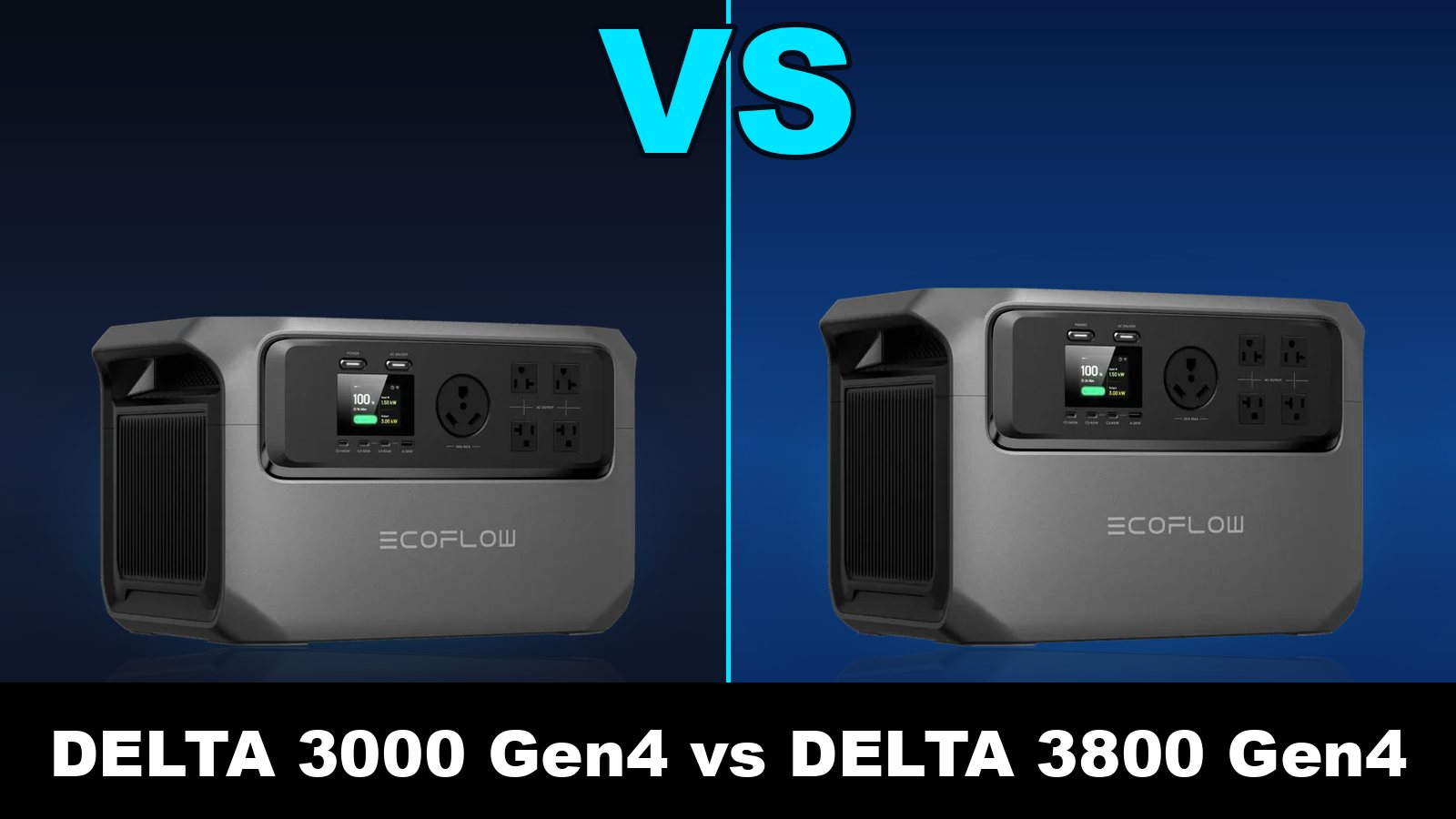
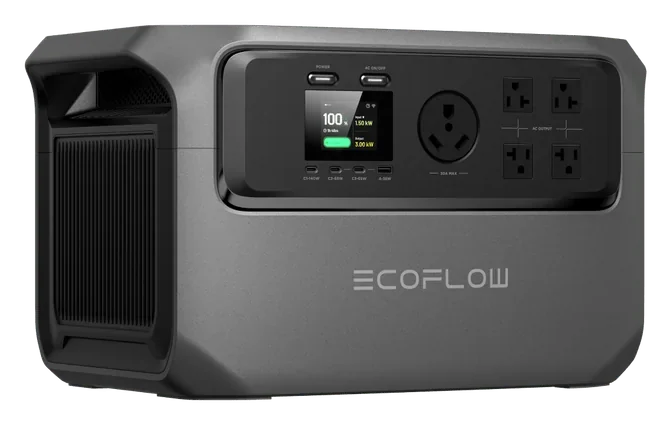
DELTA 3000 Gen4
- your outages end inside 19 hours
- you’ll stay at 1,000W of panels or less
- one person lifts it: 57.3 lb
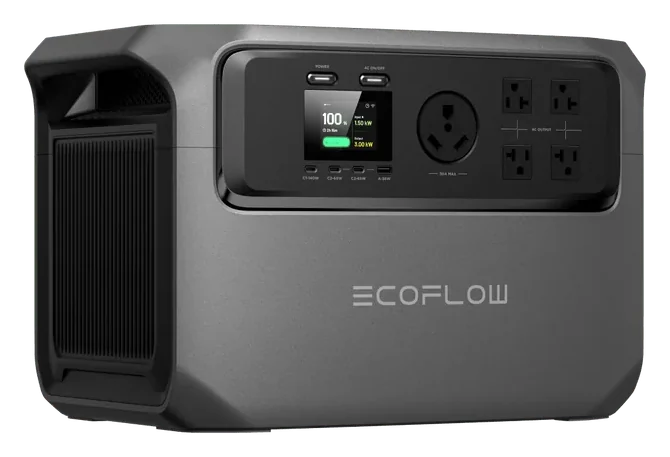
DELTA 3800 Gen4
- you’ve lived through a two-day outage
- your solar plan passes 1,000W
- you want a generator to start itself
Prices and stock checked by our price engine on November 6, 2026 at 9:00 AM EST. Each product is rechecked several times a day; the time refreshes when you load the page.
$400 buys about four more hours tonight, and a battery port for the outage you haven’t had yet.
At the outlet, the EcoFlow DELTA 3000 Gen4 and the EcoFlow DELTA 3800 Gen4 are the same machine: 3,600W, a 7,200W surge, five AC outlets, the same USB ports. Nothing you plug in will tell them apart. The 3800 Gen4 adds 691Wh, a second solar port, up to two extra batteries and automatic generator start, for 10.2 lb more. If your longest outage ends inside 19 hours and you will never own more than 1,000W of panels, the 3000 Gen4 is the sensible buy. Past either line, it has no upgrade path, and the 3800 Gen4 does.
Below: the three numbers that settle it, a 20-second calculator for your own gear and eight modeled situations. No full independent review of either exists yet, so every spec here is EcoFlow’s and every runtime is our math.
Prices $400 apart today. Output, surge, outlets, USB, UPS time, noise and temperature ranges match on EcoFlow’s spec table. The 3800 Gen4 holds 691Wh more and is the only one with a second solar port, a battery port and automatic generator start. The 3000 Gen4 is 10.2 lb lighter and refills from the wall 28 minutes sooner.
- 19 hours at 140W covers you
- your panels stop at 1,000W
- the 10.2 lb matters on stairs
- you may need more than a day
- you plan over 1,000W of solar
- a generator should run itself
The six differences that decide it
Same inverter, same outlets, same USB, same noise figures, same warranty. EcoFlow’s spec table differs only on these six lines.
Watch the full comparison
Will it run your setup? Check in 20 seconds
Estimates use 85% usable capacity and 70% of rated solar output. Real results vary with temperature, inverter load, shade and appliance cycling. Fridge and freezer watts are daily averages and do not include compressor startup surges.
Runtime by appliance, one at a time
Simple energy estimates, not measured runtimes. About 2,611Wh usable on the 3000 Gen4 and 3,199Wh on the 3800 Gen4. The ratio never changes: on any single load, the 3800 Gen4 runs about 22% longer.
Appliance for appliance, the 3800 Gen4 lasts 22% longer than the 3000 Gen4.
Same appliance, same watts: the gap is always the size of the battery.Get our Black Friday alerts for EcoFlow
We track live prices on 40+ models from Jackery, EcoFlow, BLUETTI and Anker SOLIX. When a deal beats the lowest price we've recorded, you'll hear from us. During Black Friday week, one short recap a day at most.
Unsubscribe in one click. We may earn a commission when you buy through our links, at no extra cost to you. Privacy Policy
The price gap, in numbers
The EcoFlow DELTA 3800 Gen4 costs $400 more than the EcoFlow DELTA 3000 Gen4 and adds 691Wh: that is $0.58 per extra Wh, against $0.42 per Wh for the 3000 Gen4.
Prices refresh daily from EcoFlow US.What the $400 buys: 691Wh more battery (3,763Wh vs 3,072Wh), a battery port, a second solar port and automatic generator start.
Read the first card with care: capacity alone is the weakest case for the 3800 Gen4. The second card is the fairer test: it prices the thing only one of them can do, before the Expansion Adapter that two batteries need. EcoFlow also sells 3800 Gen4 bundles with a battery or panels, so compare those on its page. The cycle card uses EcoFlow’s 6,000 cycles to 70% for both and ignores that fade.
Eight modeled situations, worked out
Same formula as the calculator above: 85% of rated capacity. The 140W plan is a steady average, about 3.4kWh a day.
The 19-hour line
This is the first threshold. If your worst outage in the last few years ended inside 19 hours, the extra capacity alone gives you nothing you would have used. Between 19 and 23 hours, the 3800 Gen4 gets you there alone. Past 23, neither does on its own.
Two days without the grid
With no sun and no generator, the 3000 Gen4 stops on the first day and can’t be extended. The 3800 Gen4 with two DELTA 3 Max Plus batteries just about reaches 48 hours. This is the scenario the gap is really priced against.
Can solar keep up with the plan?
The second threshold. With a full 1,000W array, the 3000 Gen4 only matches the plan on days with about 4.9 sun hours, so a gray winter week slowly drains it, and no extra panel can help. The 3800 Gen4 gets there on about 2.4, but only if you own 2,000W of panels. With 1,000W on both, it needs the same 4.9 hours.
The small panel kit
On a small kit the bigger battery is simply slower to fill, and the second port does nothing. If 320W is your whole solar plan, the 3800 Gen4’s solar advantage doesn’t exist for you. Only its capacity does.
A generator at 3 a.m.
Both take 1,800W through the AC input, and you start and stop the generator yourself. The 3800 Gen4 also takes 3,200W through its battery port, with automatic start and stop on the Smart Generator 4000, sold separately. EcoFlow says automatic control doesn’t work over AC. If a generator is your multi-day plan, this matters more than the 691Wh.
Up the basement stairs
The third threshold is personal. 10.2 lb sounds small until you’re carrying it in the dark. EcoFlow’s folding cart solves flat floors for both, not stairs. If 57 lb is already your limit, stop here: the 3000 Gen4 decides itself.
One refrigerator, nothing else
Roughly ten more hours. EcoFlow claims 58 and 70+ hours, but those runs used an empty Samsung refrigerator with Fridge Runtime Boost on. That mode works with one compressor appliance at a time, on both models.
Everything on at once
At full load the extra capacity buys about ten minutes. Heavy loads end a battery fast on either one, so don’t pay the gap to run a big load for longer. Pay it for long nights at low watts.
Five more differences, the spec sheet and the box
Smaller gaps that rarely decide the purchase, then the full specifications and what ships in the box.
DELTA 3000 Gen4 and DELTA 3800 Gen4 weight, dimensions and full specifications
Weight: 57.3 lb for the DELTA 3000 Gen4 and 67.5 lb for the DELTA 3800 Gen4. Dimensions: 16.77 × 11.36 × 12.09 in and 16.77 × 11.36 × 12.09 in. EcoFlow’s US page lists the same dimensions for both, so we draw no size conclusion. Everything else is in the sheet below.
EcoFlow DELTA 3000 Gen4 and EcoFlow DELTA 3800 Gen4 full specifications
Every published figure for both units, grouped. Green marks the better value.
What’s in the box
DELTA 3000 Gen4
- DELTA 3000 Gen43,072Wh, 57.3 lb
- AC charging cable
- Solar charging cableXT60i to LP60
- AC cable retention kit, manuals and warranty card
DELTA 3800 Gen4
- DELTA 3800 Gen43,763Wh, 67.5 lb
- AC charging cable
- Two solar charging cablesXT60i to LP60
- AC cable retention kit, manuals and warranty card
- Expansion adapter and batteriessold separately
From EcoFlow’s US pages. The only difference is a second solar cable with the 3800 Gen4.
06 · ChargingHow fast each one refills
Shorter bar, faster refill. Each row is scaled to its slower unit.
Both: 1,800W from a 15A wall outlet; EcoFlow’s figures come from the visuals on its US pagesAlternator Charger, sold separately: 500W through the solar port on both
Our solar times assume panels deliver 70% of their rating; the brands’ figures assume ideal sun.
Every port, side by side
DELTA 3000 Gen4
DELTA 3800 Gen4
Practical consequence: the outputs are identical, so your cables and appliances don’t care which you pick. Only the input side differs, and it is where the 3800 Gen4 gets its second solar port and its battery port. Neither has a 12V socket listed.
08 · NoiseNoise: 3000 Gen4 vs 3800 Gen4
A tie on paper. EcoFlow gives the EcoFlow DELTA 3000 Gen4 and the EcoFlow DELTA 3800 Gen4 the same three figures, and nobody has measured either.
Brand figures only, at 1 m and 77°F.Every figure we found, with its source
Measured by a tester Brand figure
- Keep overnight loads under 600W on either one.
Cold and heat: 3000 Gen4 vs 3800 Gen4
The EcoFlow DELTA 3000 Gen4 and the EcoFlow DELTA 3800 Gen4 share the same ranges: charging from 32°F to 113°F, running from 14°F to 113°F.
Figures from the EcoFlow US spec tables.- Keep either one above 32°F while it charges.
App, UPS and smart features
Same app, same UPS time. Only the EcoFlow DELTA 3800 Gen4 adds extra batteries and automatic generator control.
The rows that match are here so you can stop weighing them.Green zone: a switch under about 16ms, which most desktop PCs ride through without restarting.
Can you add a battery later? The EcoFlow DELTA 3800 Gen4 connects up to two extra batteries; the EcoFlow DELTA 3000 Gen4 has no port for one.
Can it start a generator by itself? EcoFlow lists automatic start and stop for the EcoFlow DELTA 3800 Gen4 through the extra battery port only, not through AC charging. Its charging list for the EcoFlow DELTA 3000 Gen4 has generator charging by AC.
Does it work as a UPS? Both switch in under 10ms by EcoFlow’s figure, without HID communication. EcoFlow says neither is a 0ms professional UPS.
Does it prepare for storms? Both use US National Weather Service data to recharge ahead of severe weather, depending on region, network and settings.
Does it have a fridge mode? Both offer it, for one compressor appliance at a time, with no other AC loads advised.
Warranty and support
No difference here. The EcoFlow DELTA 3000 Gen4 and the EcoFlow DELTA 3800 Gen4 both get 3 years, plus 2 more once registered in the EcoFlow app.
Warranty can’t decide this one.Subject to each brand’s warranty terms and eligibility.
EcoFlow rates both at 6,000 cycles to 70% of initial capacity, in lab conditions. That is a lower end point than the 80% many brands quote.
- Register either one in the EcoFlow app to get the extra 2 years.
What reviewers report
We have not had these two units in hand. As of November 5, 2026, no full independent review of the DELTA 3000 Gen4 had been published. As of November 5, 2026, no full independent review of the DELTA 3800 Gen4 had been published. Every figure on this page comes from EcoFlow’s US pages, attributed as such.
DELTA 3000 Gen4: no full independent review published yetDELTA 3800 Gen4: no full independent review published yet
Practical limits before you buy
- The 3000 Gen4 has no way up. No battery port means the capacity you buy is the capacity you keep.
- Two batteries need an adapter. The 3800 Gen4 connects up to two extra batteries with the Smart Extra Battery Expansion Adapter, sold separately.
- Check before you plan on port sharing. The 3800 Gen4 has one extra battery port. We found no EcoFlow statement on running a Smart Generator and extra batteries on it together.
- The DELTA Pro 3 Extra Battery showed as unavailable on November 5, 2026. The 12kWh ceiling needs two of them. With two DELTA 3 Max Plus batteries, the system stops at 7,859Wh.
- The second solar port needs panels to matter. Under 1,000W of panels, the 3800 Gen4 gains nothing on solar and fills more slowly.
- 58 and 70+ hours are empty-fridge numbers. EcoFlow ran a Samsung 654L refrigerator with no food in it. Expect less from a full kitchen fridge.
- 6,000 cycles means down to 70%. That is a lower end point than the 80% many brands quote.
- Neither lists a 12V socket. A 12V fridge needs its own AC adapter.
- Neither does 240V. Well pumps and central air on 240V are out for both.
- Neither charges switched off. EcoFlow says it turns itself on when charged, and bars it from aircraft.
- Register it. The extra 2 years of warranty depend on it, on both models.
Frequently asked questions
What is the difference between the DELTA 3000 Gen4 and DELTA 3800 Gen4?
Capacity and what surrounds it. The 3800 Gen4 holds 3,763Wh against 3,072Wh, takes 2,000W of solar against 1,000W, connects up to two extra batteries, and adds 3,200W generator charging with automatic start. The 3000 Gen4 weighs 57.3 lb against 67.5 lb. Output and outlets are the same.
Which is cheaper?
The EcoFlow DELTA 3000 Gen4 costs $400 less today: $1,299, against $1,699 for the EcoFlow DELTA 3800 Gen4. Prices refresh daily.
How do I know if 3,072Wh is enough?
Take your longest outage of the last few years and your average load. At 140W, the 3000 Gen4 lasts about 19 hours. To last 24 hours, your average must stay near 109W, against about 133W on the 3800 Gen4. The calculator does this for your own appliances.
Does the 3800 Gen4 power anything the 3000 Gen4 can’t?
No. Both are rated for 3,600W with a 7,200W surge, on the same outlets. The 3800 Gen4 runs the same loads for about 22% longer.
Can I add a battery to the DELTA 3000 Gen4 later?
No. It has no battery port. If you think you might want one, that alone points to the 3800 Gen4.
Which extra batteries fit the 3800 Gen4?
EcoFlow lists the DELTA 3 Max Plus Smart Extra Battery, 2,048Wh, and the DELTA Pro 3 Smart Extra Battery, 4,096Wh. It connects up to two.
When does 2,000W of solar make sense?
When you can fit more than 1,000W of panels, or your sun falls under about 4.9 hours a day and you want to hold a 140W plan. With two 160W panels, EcoFlow’s own figures show the 3000 Gen4 filling sooner.
Are they the same size?
EcoFlow’s US page lists the same dimensions for both: 16.77 × 11.36 × 12.09 in without handles. Only the weight differs, by 10.2 lb.
Has anyone reviewed them?
As of November 5, 2026, we found no full independent review of either. Everything here comes from EcoFlow’s US pages, and runtimes are our estimates.
Related comparisons and reviews
How we compared and sources
Research-based comparison. We have not had either unit in hand. As of November 5, 2026, no full independent review of the DELTA 3000 Gen4 had been published. As of November 5, 2026, no full independent review of the DELTA 3800 Gen4 had been published. Specs come from EcoFlow’s US pages; runtimes and sun-hour thresholds are our math. Prices and availability were checked on November 5, 2026.
- Specs: EcoFlow US, DELTA 3000 Gen4 and EcoFlow US, DELTA 3800 Gen4, with their specs, footnotes and FAQ, and EcoFlow US, DELTA 3 Max Plus Smart Extra Battery, read on November 5, 2026.
- Sun-hour thresholds are our math: 3.4kWh a day ÷ (panel watts × 0.70), the same yield the calculator uses.
- Dimensions: EcoFlow’s US page lists the same figures for both, so we make no size claim.
- Runtime = capacity × 0.85 ÷ watts. Solar harvest = min(panel watts, max input) × sun hours × 0.70. Cost per lifetime kWh = price ÷ (cycles × capacity in kWh).
The same 3,600W at every outlet. The gap pays for hours, a second solar port and a battery port.
Prices checked November 6, 2026 at 9:00 AM EST
Looking at other models? Browse all power station comparisons, or pick any two models on the hub and we point you to the right duel.
Originally published: November 6, 2026