
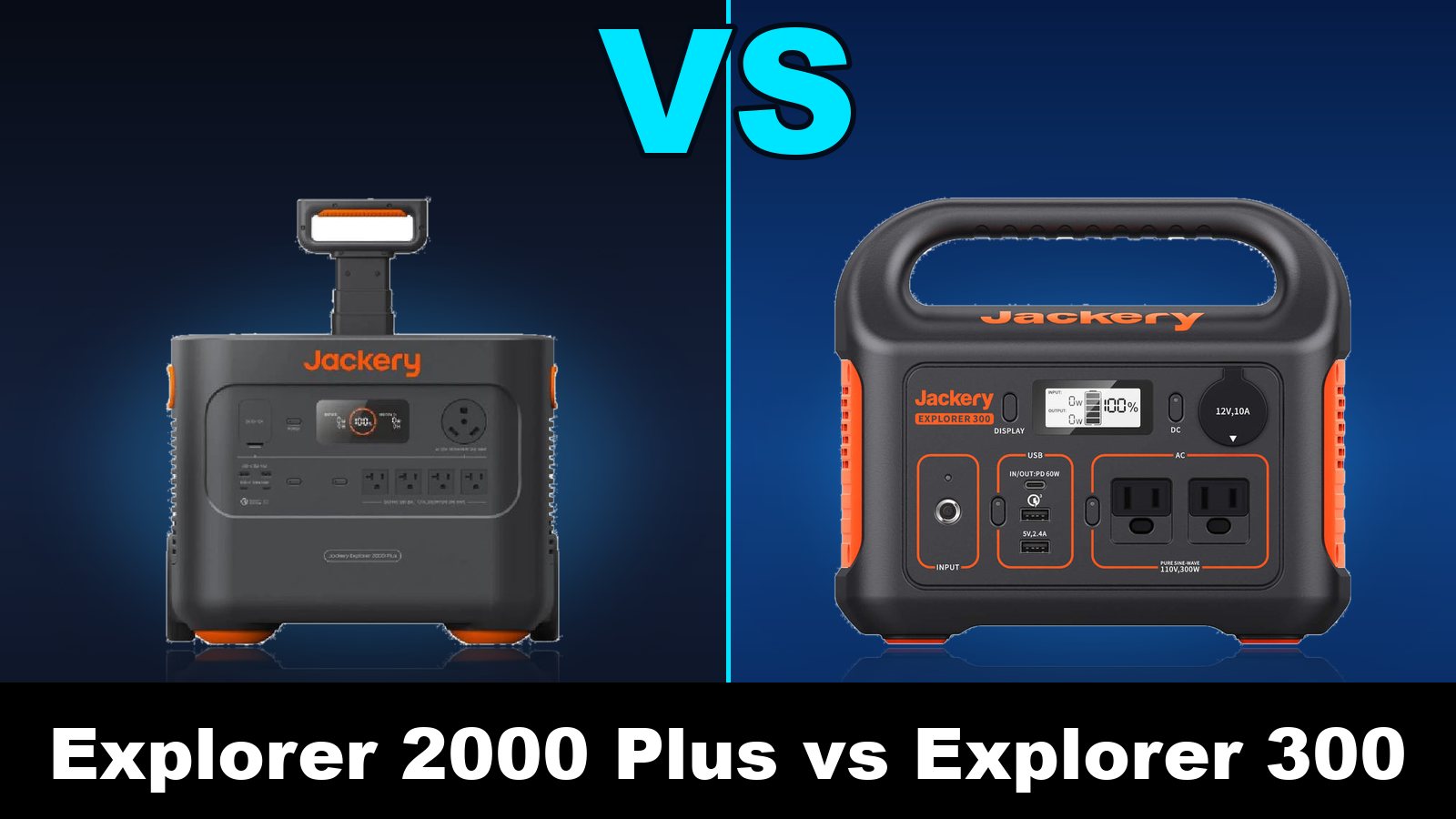

Explorer 2000 Plus
- you already own one
- you run loads up to 3,000W
- you’ll add battery packs

Explorer 300
- you carry it: 7.5 lb
- your loads stay under 300W
- you charge phones, laptops, lights
Prices and stock checked by our price engine on November 11, 2026 at 12:30 AM EST. Each product is rechecked several times a day; the time refreshes when you load the page.
Seven times the battery, eight times the weight: these two never do the same job.
The Jackery Explorer 2000 Plus stores 2,042.8Wh, delivers 3,000W from five 120V outlets, takes 1,400W of solar and up to five extra battery packs, at 61.5 lb; Jackery US has discontinued it and names the HomePower 2000 Plus v2 as its successor. The Jackery Explorer 300 sold by Jackery US today is the LiFePO4 version: 292Wh and 300W from two AC outlets, a 100W USB-C, two USB-A and a 120W car port, at 7.5 lb. If you own a 2000 Plus, it already covers what an Explorer 300 does and much more; if you want something for phones, laptops and lights that you carry in one hand, the Explorer 300 is the size.
Below: what separates them with numbers, a 20-second calculator for your own gear, eight modeled situations, a middle option and the named successor, and what published tests found on the 2000 Plus.
Different classes, same LiFePO4 chemistry and the same 4,000-cycle rating to 70%. The 2000 Plus holds seven times the battery, delivers ten times the power and takes extra packs, at more than eight times the weight. The Explorer 300 is a one-hand box for small gear. Jackery US has discontinued the 2000 Plus; the Explorer 300 was in stock on our November 10, 2026 check.
- you own one
- a fridge must run all day
- you add battery packs
- you carry it: 7.5 lb
- you charge small gear
- you need under 300W
The five differences that decide it
Both use LiFePO4 cells rated for 4,000 cycles to 70% and have a 12V car port and AC outlets. These five gaps decide it.
Will it run your setup? Check in 20 seconds
Estimates use 85% usable capacity and 70% of rated solar output. Real results vary with temperature, inverter load, shade and appliance cycling. Fridge and freezer watts are daily averages and do not include compressor startup surges.
Runtime by appliance, one at a time
Simple energy estimates, not measured runtimes: about 1,736Wh usable on the 2000 Plus and 248Wh on the Explorer 300. OutdoorGearLab measured 1,678Wh out of a 2000 Plus and StorageReview 1,750Wh.
Appliance for appliance, the 2000 Plus lasts 7.0 times as long as the Explorer 300.
Same appliance, same watts: the gap is always the size of the battery.Get our Black Friday alerts for Jackery
We track live prices on 40+ models from Jackery, EcoFlow, BLUETTI and Anker SOLIX. When a deal beats the lowest price we've recorded, you'll hear from us. During Black Friday week, one short recap a day at most.
Unsubscribe in one click. We may earn a commission when you buy through our links, at no extra cost to you. Privacy Policy
What the current options cost today
Jackery US has removed the 2000 Plus page: its old address now opens the HomePower 2000 Plus v2. On our November 10, 2026 check, the standalone HomePower 2000 Plus v2 was sold out while its bundles with a Battery Pack 2000 Plus v2 were in stock. If a seller still has a new 2000 Plus, check that Jackery’s warranty applies. Prices move often.
The third option: the Jackery Explorer 1000 Plus at $619

Jackery Explorer 1000 Plus: $619 today
If the Explorer 300 is too small and a 2kWh unit too heavy, Jackery’s Explorer 1000 Plus sits between them: 1,264Wh of LiFePO4 rated for 4,000 cycles, 2,000W from three 120V outlets with a 4,000W surge, up to 800W of solar and a full wall charge in about 1.7 hours, at 32 lb. It runs the fridge, the coffee maker and the microwave the Explorer 300 can’t. Jackery has discontinued the Battery Pack 1000 Plus, so plan on the 1,264Wh it holds. For the 2000 Plus’s size class, Jackery’s own successor is the HomePower 2000 Plus v2: 2,048Wh, 2,400W and 800W of solar, expandable with its own packs. Our Explorer 1000 Plus review goes deeper. See the 1000 Plus at Jackery.
Eight modeled situations, worked out
Same formula as the calculator above: 85% of the rated capacity, no extra battery.
24-hour outage, essentials only
The 2000 Plus covers most of a day. The Explorer 300 lasts under three hours of that load, and Jackery publishes no surge figure for it, so don’t count on a fridge compressor.
A full-size fridge, alone
About a day on the 2000 Plus. A fridge compressor can draw several times its running watts to start, and Jackery publishes no surge for this Explorer 300.
CPAP, as many nights as possible
More than five nights against most of one. On the 2000 Plus, turn Energy Saving Mode off first: it cuts low loads after 12 hours. Jackery doesn’t recommend its stations for medical devices.
Wi-Fi router through an outage
The 2000 Plus switches within 20ms and runs it for almost a week. Jackery publishes no switchover time for this Explorer 300, so plug the router in once the power is out.
Microwave for breakfast
Only the 2000 Plus runs it, with room for a coffee maker at the same time. CleanTechnica ran several kitchen appliances together at nearly 1,900W on it.
12V cooler on a camping weekend
The 2000 Plus runs it for well over a day; the Explorer 300 for an afternoon. Both have a 12V car port.
Refill from solar, each at its maximum
About two hours apart, because the 2000 Plus takes fourteen times the panel for seven times the battery. Jackery quotes 80% in about 2.8 h on the Explorer 300 with a 100W panel.
Carrying it
The Explorer 300 goes in one hand. The 2000 Plus rolls on wheels; OutdoorGearLab weighed it at 62.3 lb and found the wheels and handle flimsy on rough ground.
Eight more differences, the spec sheet and the box
Smaller gaps that rarely decide the purchase, then the full specifications and what ships in the box.
2000 Plus and Explorer 300 weight, dimensions and full specifications
Weight: 61.5 lb for the 2000 Plus and 7.5 lb for the Explorer 300. Dimensions: 18.6 × 14.1 × 14.7 in for the 2000 Plus; Jackery publishes none for this version of the Explorer 300. Everything else is in the sheet below.
Jackery Explorer 2000 Plus and Jackery Explorer 300 full specifications
Every published figure for both units, grouped. Green marks the better value.
What’s in the box
Explorer 2000 Plus
- Explorer 2000 Plus2,042.8Wh, 61.5 lb
- AC charging cable
- Car charging cable
- Accessories bag
Explorer 300
- Explorer 300292Wh, 7.5 lb
- AC charger
- Car charging cable
- User manual
- Solar panel sold separately
2000 Plus contents from Jackery’s US page; Explorer 300 contents from its US page, whose box list was written for the original version.
07 · ChargingHow fast each one refills
Shorter bar, faster refill. Each row is scaled to its slower unit.
2000 Plus: CleanTechnica saw the wall charge in the low 1,500W range, full in a little under 2 hExplorer 300: about 7.5 h to 80% with a 40W panel, per Jackery; no independent charging test of this version found
Our solar times assume panels deliver 70% of their rating; the brands’ figures assume ideal sun.
Every port, side by side
Explorer 2000 Plus
Explorer 300
Practical consequence: the 2000 Plus has five 120V outlets, one of them 25A, two 100W USB-C and two USB-A ports, plus ports for battery packs and a second unit. The Explorer 300 has two outlets, one 100W USB-C, two USB-A and a 120W car port.
09 · NoiseNoise: 2000 Plus vs Explorer 300
Jackery rates the Jackery Explorer 2000 Plus at 30dB or less in Quiet Charging Mode. It publishes no figure for this version of the Jackery Explorer 300.
No reviewer published a decibel reading for either.Every figure we found, with its source
No decibel figure published.
Measured by a tester Brand figure
- Switch on Quiet Charging Mode in the Jackery app for an overnight charge of the 2000 Plus.
Cold, heat and storage: 2000 Plus vs Explorer 300
The Jackery Explorer 2000 Plus charges from 32°F to 113°F and runs from 14°F to 113°F. Jackery publishes no range for this version of the Jackery Explorer 300.
Figures from the 2000 Plus US manual.- Store a 2000 Plus between 32°F and 104°F, and keep it upright in use and storage, per its manual.
- Charge a 2000 Plus indoors in winter: it won’t charge below 32°F.
App, UPS and smart features
The Jackery Explorer 2000 Plus has the Jackery app, a 20ms switchover and takes extra batteries. Jackery lists none of these for the Jackery Explorer 300.
Neither supports 0ms switching.Does it work as a UPS? The Jackery Explorer 2000 Plus switches to battery within 20ms in EPS mode, per its US manual. Jackery publishes no switchover time for the Jackery Explorer 300.
Is there an app? The Jackery Explorer 2000 Plus uses the Jackery app over Wi-Fi and Bluetooth. Jackery lists no app for the Jackery Explorer 300.
Can you add a battery later? The Jackery Explorer 2000 Plus takes up to five Battery Pack 2000 Plus. The Jackery Explorer 300 takes none.
Does it have a quiet charging mode? The Jackery Explorer 2000 Plus has a Quiet Charging Mode rated at 30dB or less, set in the app. Jackery lists none for the Jackery Explorer 300.
Warranty and support
The Jackery Explorer 2000 Plus gets 3 years plus 2 under Jackery’s conditions. The Jackery Explorer 300 gets 2 years plus 1, automatic on Jackery.com orders and by online registration otherwise.
Refurbished 2000 Plus units get 6 months.Subject to each brand’s warranty terms and eligibility.
Jackery rates both at 4,000 cycles to 70%, about 11 years at one full cycle a day. Calendar aging and heat also reduce capacity, so read the rating as a ceiling.
- If you buy the Explorer 300 outside Jackery.com, register it online for the extra year.
- Charge a 2000 Plus fully within 7 days of purchase and at least every 6 months, or the cell falls outside the warranty.
What reviewers report
We have not lab-tested these two units. The 2000 Plus side draws on three published US tests. We found no independent hands-on test of the LiFePO4 Explorer 300; reviews of the original 2020 lithium-ion Explorer 300 don’t apply to its battery, so we leave them out.
2000 Plus: OutdoorGearLab (May 2025), StorageReview (September 2023), CleanTechnica (August 2023)Explorer 300: no verifiable independent test found
Usable capacity
- 2000 PlusReviewer Delivered 1,678Wh in its AC output test, about 83% of the rating. OutdoorGearLab, Kenji Mowrey, May 2025
- 2000 PlusReviewer Measured 1,750Wh of discharge, 87.5% of the rated capacity. StorageReview, Jordan Ranous, September 2023
Charging
- 2000 PlusReviewer Reached a full charge from the wall in about 95 minutes. OutdoorGearLab, Kenji Mowrey, May 2025
- 2000 PlusReviewer A full charge from zero drew 2,310Wh from the wall. StorageReview, Jordan Ranous, September 2023
- 2000 PlusReviewer In the field, its panels charged it at over 350W in real-world conditions. StorageReview, Jordan Ranous, September 2023
- 2000 PlusReviewer Two 200W SolarSaga panels peaked at 405W at midday. CleanTechnica, Kyle Field, August 2023
- 2000 PlusReviewer From a 12V car outlet it recharged at just over 100W. CleanTechnica, Kyle Field, August 2023
UPS and output
- 2000 PlusReviewer Ran a set of kitchen appliances together at nearly 1,900W. CleanTechnica, Kyle Field, August 2023
Daily use and issues
- 2000 PlusReviewer Weighed 62.3 lb on their scale; the wheels and handle felt flimsy on uneven or sloped ground. OutdoorGearLab, Kenji Mowrey, May 2025
- 2000 PlusReviewer The reviewers say the newer Explorer 2000 v2 is a better option for most people. OutdoorGearLab, Kenji Mowrey, May 2025
Practical limits before you buy
- Jackery US has discontinued the 2000 Plus. It names the HomePower 2000 Plus v2 as the successor, and the old 2000 Plus address now opens that page.
- The HomePower 2000 Plus v2 doesn’t take the old Battery Pack 2000 Plus. Jackery says it only works with the Battery Pack 2000 Plus v2.
- The Explorer 300 stops at 300W. Jackery says it shuts off once the total passes 300W; a coffee maker, a kettle or a hair dryer won’t run on it.
- Check which Explorer 300 you get. Jackery sells the LiFePO4 version under the original 2020 listing, and much of that page still describes the old 293Wh model.
- Jackery publishes few figures for this Explorer 300: no wall-charging power, solar input limit, surge, UPS time, noise, size or temperature range.
- The 2000 Plus can’t charge below 32°F.
- Jackery doesn’t recommend its stations for medical devices or data servers.
Frequently asked questions
What is the difference between the Jackery Explorer 2000 Plus and the Explorer 300?
The 2000 Plus stores 2,042.8Wh, delivers 3,000W from five outlets, takes 1,400W of solar and up to five extra packs, at 61.5 lb. The Explorer 300 stores 292Wh and delivers 300W from two outlets, at 7.5 lb. Both use LiFePO4 rated for 4,000 cycles to 70%.
Is the Jackery Explorer 2000 Plus discontinued?
Yes. Jackery US marked it discontinued and named the HomePower 2000 Plus v2 as its successor; the old 2000 Plus product address now opens the HomePower 2000 Plus v2 page.
Which Explorer 300 is this?
The one Jackery US sells today: 292Wh of LiFePO4 rated for 4,000+ cycles, 7.5 lb, with a 100W USB-C. The original 2020 Explorer 300 used lithium-ion cells; the 300 v2 and 300D are different models.
Can the Explorer 300 run a microwave?
No. It shuts off above 300W. The 2000 Plus runs a 1,100W microwave with room to spare.
Can I still add batteries to the 2000 Plus?
Yes, up to five Battery Pack 2000 Plus, which Jackery US still lists. The Explorer 300 takes none.
How long will each run a CPAP?
Without humidifier, at 40W: more than five nights on the 2000 Plus and about six hours on the Explorer 300.
How much do they weigh?
61.5 lb for the 2000 Plus and 7.5 lb for the Explorer 300, per Jackery.
What warranty do they have?
3 + 2 years on the 2000 Plus under Jackery’s conditions. 2 + 1 years on the Explorer 300, the extra year automatic on Jackery.com orders, by online registration otherwise.
Related comparisons and reviews
How we compared and sources
Research-based comparison. We have not lab-tested these units. Explorer 2000 Plus specs come from Jackery’s US page as archived on October 28, 2026, when it marked the model discontinued, and its US user manual (JE-2000C). Explorer 300 specs come from Jackery’s US page for the LiFePO4 version. Usage observations are attributed to named reviewers. Checked on October 31, 2026; availability and the third option rechecked on November 10, 2026.
- Specs: Jackery US, Explorer 2000 Plus (archived) and its US user manual (JE-2000C); Jackery US, Explorer 300 (LiFePO4 version), read on October 31, 2026.
- The 2000 Plus page shows a refurbished spec table (6-month warranty) next to the new one (3+2 years); we use the new one. Jackery US sells the LiFePO4 Explorer 300 under its original 2020 listing; we use only the figures that page gives for the new version.
- Successor facts (HomePower 2000 Plus v2): Jackery US product page and Jackery’s US guide to the model. Explorer 1000 Plus facts: Jackery US product page, read on November 10, 2026.
- Reviewer reports on the 2000 Plus: OutdoorGearLab, Kenji Mowrey, May 2025, StorageReview, Jordan Ranous, September 2023, CleanTechnica, Kyle Field, August 2023.
- Runtime = capacity × 0.85 ÷ watts. Solar harvest = min(panel watts, max input) × sun hours × 0.70. Cost per lifetime kWh = price ÷ (cycles × capacity in kWh).
2,042.8Wh and 3,000W at 61.5 lb against 292Wh and 300W at 7.5 lb. Jackery US has discontinued the 2000 Plus.
Prices checked November 11, 2026 at 12:30 AM EST
Looking at other models? Browse all power station comparisons, or pick any two models on the hub and we point you to the right duel.
Originally published: November 11, 2026