
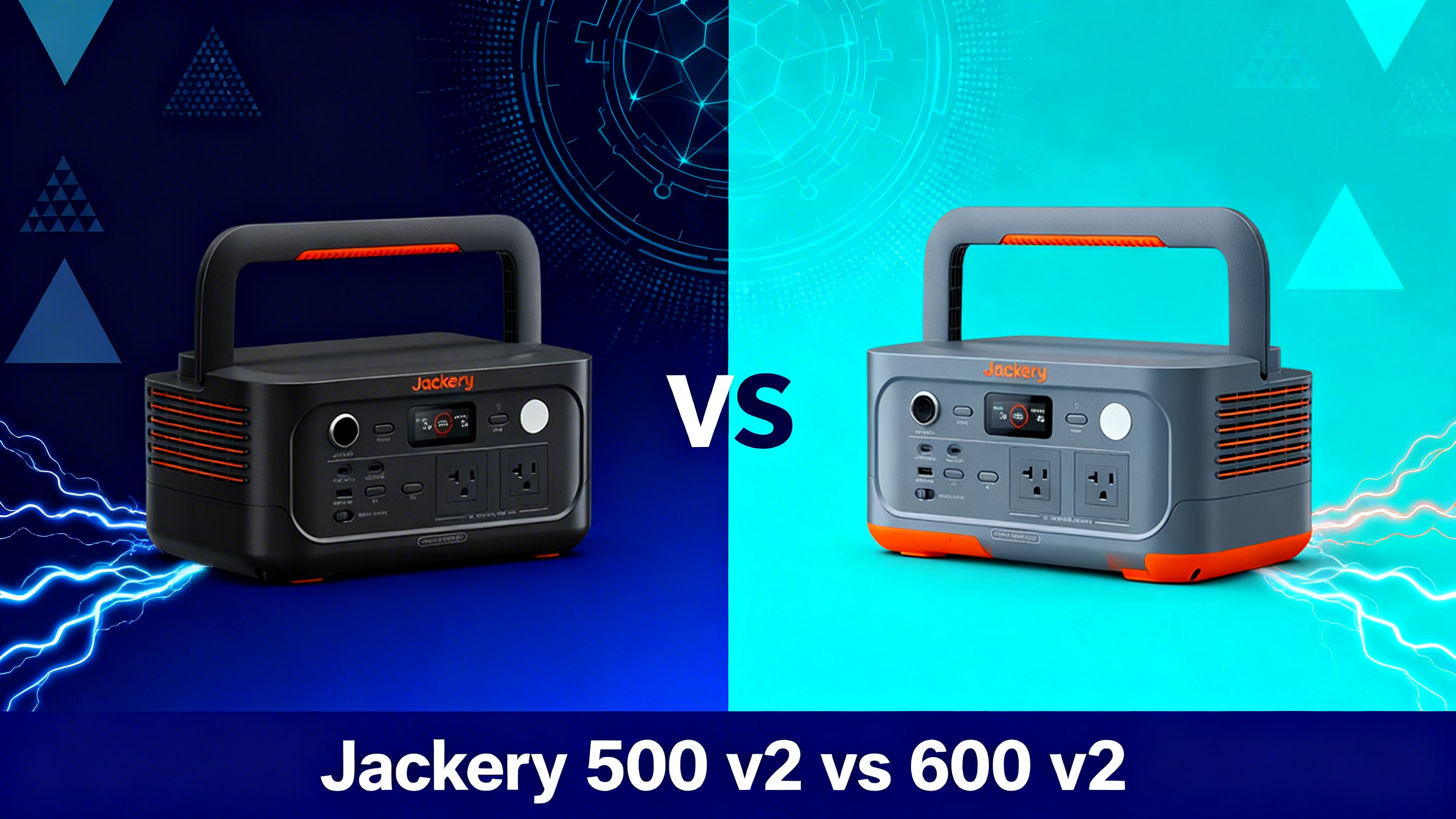
Choosing between the Jackery Explorer 500 v2 and 600 v2 feels straightforward at first glance: the 500 v2 costs less, and both run on LFP batteries with 500W output. Look closer, and the real differences come down to capacity and ports. The 600 v2 brings 128 more watt-hours and twice the 100W USB-C ports. Both recharge in about an hour with combined wall and solar input, and both include a UPS function. Both are part of Jackery’s 2025 LFP refresh , see the full Jackery new model lineup for context on where they sit.
The real wildcard here is stock. At the time of writing, Jackery lists the 600 v2 as sold out, and the 500 v2 no longer appears in its US catalog. That practical detail changes the decision for many buyers more than any spec comparison would.
This comparison covers capacity, charging speed, ports, UPS functionality, portability, and stock status. The goal: give you a clear answer based on your actual use case.
Update , July 2026
The Explorer 600 v2 is sold out on Jackery’s US store. Its purchase links on this page now lead to the Explorer 500 v2 (512Wh, 500W output, $399) , which is the other model compared here and the closest successor. We’re keeping this comparison live to help existing 600 v2 owners and anyone weighing remaining or secondhand stock against the 500 v2.
Availability note (checked September 28, 2026): Jackery no longer lists the Explorer 500 v2 in its US catalog, and its product page says it is not available for purchase. Check the page before you order.


More Capacity
Explorer 600 v2
640Wh · 500W · LFP · Check Availability
$499.99
Get our Black Friday alerts for Jackery
We track live prices on 40+ models from Jackery, EcoFlow, BLUETTI and Anker SOLIX. When a deal beats the lowest price we've recorded, you'll hear from us. During Black Friday week, one short recap a day at most.
Unsubscribe in one click. We may earn a commission when you buy through our links, at no extra cost to you. Privacy Policy
At a Glance: Key Differences
Both models share the same 500W continuous output, 1,000W surge, and LFP battery chemistry , which means thousands of charge cycles before meaningful degradation (Jackery rates the 500 v2 at 6,000 cycles to 70% capacity). The differences cluster in two areas: capacity and port configuration.
The 600 v2 carries a 25% larger battery (640Wh vs 512Wh) and doubles the 100W USB-C output. It reaches full charge in 70 minutes via hybrid charging, and the 500 v2 is just as quick at about 1 hour. Both include a UPS function with a switchover of 0.01 seconds or less. On a pure cost-per-watt-hour basis, the two are level at $0.78/Wh.
The data points to a clear pattern: the 600 v2 wins on capacity and USB-C ports, but availability complicates the picture. For buyers who can access both models right now, the two cost the same per watt-hour. For everyone else, the 500 v2 is a solid alternative.
Explorer 500 v2 Overview
The Explorer 500 v2 runs on a 512Wh LiFePO4 (LFP) battery with 500W continuous output and 1,000W surge capacity. LFP chemistry matters here: published specs confirm 6,000 charge cycles before the battery degrades to 70% capacity. That’s many times the cycle life of standard lithium-ion units at this price point.

Port configuration includes AC outlets, USB-A, a single 100W USB-C, and DC output across 6 output ports. Charging options span AC wall, compatible solar panels (SolarSaga line), and 12V car adapter. At $399, the cost-per-watt-hour works out to $0.78/Wh.
The 500 v2 targets casual outdoor users: weekend camping trips, road trips, and light day-to-day backup. It covers 90% of common outdoor devices comfortably within its 500W output ceiling. The compact form factor adds to that practical appeal for users who prioritize portability. For a complete technical breakdown of specs, ports, and runtime data, see our full 500 v2 review.

Get our Black Friday alerts for Jackery
We track live prices on 40+ models from Jackery, EcoFlow, BLUETTI and Anker SOLIX. When a deal beats the lowest price we've recorded, you'll hear from us. During Black Friday week, one short recap a day at most.
Unsubscribe in one click. We may earn a commission when you buy through our links, at no extra cost to you. Privacy Policy
Explorer 600 v2 Overview
The Explorer 600 v2 packs 640Wh into what Jackery designates as the world’s lightest 600Wh LFP power station. Output matches the 500 v2 at 500W continuous (1,000W surge), but the port layout differs: 6 ports total, including dual 100W USB-C outputs. That dual-100W configuration lets you fast-charge two laptops, a laptop and a tablet, or similar multi-device setups simultaneously.

Charging speed is on par with the 500 v2. Verified official 600 v2 specifications confirm hybrid charging reaches full in 70 minutes, solar in 8 hours, and car charging in 7.5 hours. The UPS function switches to battery in 0.01 seconds or less during an outage, making it viable for home office and sensitive electronics protection. Temperature tolerance runs from -4°F to 113°F, which extends usability in cold-weather scenarios.
At $499.99, the cost-per-watt-hour is $0.78/Wh , the same as the 500 v2 despite the higher absolute price. The trade-off is availability: the 600 v2 is sold out on Jackery’s US store. Check authorized retailers for remaining stock. For deeper analysis including charging benchmarks and port layout, read the full 600 v2 review.
Head-to-Head: Capacity & Real-World Performance
The 128Wh gap between 512Wh and 640Wh translates to a 25% difference in usable energy. For light loads, that margin is less meaningful. For sustained use over multiple days, it adds up in measurable ways.
Estimated Runtime Comparison
Estimates based on published capacity at 80% inverter efficiency. Actual runtime varies by load and temperature.

Runtime calculations based on published capacity show the 500 v2 can power a 60W mini-fridge for approximately 7 hours; the 600 v2 extends that to roughly 8.5 hours. For a 1-2 night camping trip with a laptop, lights, and phone charging, both models deliver adequate capacity. Where the gap becomes practical is on 3+ night trips or base camp setups: the extra 128Wh on the 600 v2 meaningfully extends the gap between recharges.
Head-to-Head: Charging Speed
Charging speed is not a real differentiator. For the 600 v2, published specs confirm 70-minute hybrid charge time (combined AC + solar input), 8 hours via solar alone, and 7.5 hours via 12V car adapter. The hybrid charging figure is especially practical for users who have access to both a wall outlet and solar panels simultaneously.
For the 500 v2, Jackery’s official specs list about 1 hour with combined wall and solar input, about 1.3 hours on AC alone, about 2.8 hours at its 200W solar maximum, and about 6 hours from a 12V car outlet. On hybrid and car charging, that is as fast as or faster than the 600 v2’s documented numbers. Both models use LiFePO4 battery longevity chemistry, which tolerates partial charging and high cycle counts better than standard lithium-ion.

For users who recharge frequently during trips , or who rely on solar top-ups between outings , both models recharge quickly. Charging speed should not decide this one.
Head-to-Head: Ports & Connectivity
Both models include dual AC outlets at 500W each. The divergence comes at the USB-C level. The 500 v2 includes one 100W USB-C port; the 600 v2 doubles that to two 100W USB-C ports. For anyone running a laptop and a secondary device simultaneously, that second high-speed port removes a real workflow friction point.
The UPS function on both models deserves specific attention. A switchover time of 0.01 seconds or less means computers, NAS drives, and sensitive electronics stay powered seamlessly during brief outages. The 500 v2 has it too: Jackery lists a switchover under 10 ms. On UPS, neither model has an edge.
Winner by Use Case
Which One Fits Your Needs?
Explorer 500 v2 , $399
Choose this if:
- Budget is the primary concern
- Weekend camping trips (1-2 nights)
- Powering a laptop, lights, and devices
- Pairing with a SolarSaga panel for slow charging

Explorer 600 v2 , $499.99
Choose this if:
- Dual 100W USB-C for simultaneous device charging
- 3+ night trips where capacity matters
For Weekend Campers
The 500 v2 covers a standard 1-2 night camping load comfortably. Runtime calculations based on 512Wh show approximately 7 hours for a mini-fridge, 14 hours for a CPAP, and 40 smartphone charges from a single fill. The savings are real. For weekend campers, the 500 v2 is the practical default.
For Power Users and Home Office
The 600 v2 has the edge here. The dual 100W USB-C configuration handles simultaneous laptop and peripheral charging without port juggling. Both models include a UPS function (≤0.01s switchover) that protects workstations and NAS drives during outages. For anyone working remotely with several devices, the 600 v2’s extra USB-C port and capacity address these requirements directly.
For Extended Off-Grid Trips
Three or more nights change the math. The 600 v2’s 640Wh extends runtime meaningfully across every load category, and the 70-minute hybrid recharge means a quick wall top-up before departure or at a campsite with hookups is fast and practical. The 500 v2 can cover multi-day trips with disciplined power management, but the 600 v2 builds in more margin.
Best Jackery New Models 2026
See how the 500 v2 and 600 v2 compare to every new Jackery model in the 2025 lineup.
For Budget-Conscious Buyers
At $399, the 500 v2 delivers strong value for buyers who don’t need the 600 v2’s additional features. It’s worth noting that the 600 v2 matches its cost-per-watt-hour ($0.78/Wh for both) , but only if you can actually purchase it. If neither model fits your needs, our guide to the best Jackery under $500 covers every option in this price range.
Final Recommendation
Spec-for-spec, the 600 v2 is the stronger model at $499.99. It delivers 25% more capacity and dual 100W USB-C ports at the same cost-per-watt-hour. If your use case involves multi-device charging or extended off-grid trips, the data points clearly to the 600 v2. Note that the 600 v2 is sold out on Jackery’s US store, so buying one now means relying on remaining or secondhand stock.
The 500 v2 at $399 is not a consolation option. It’s a capable power station with LFP longevity and a practical 512Wh capacity for most casual outdoor use. The lower price is a concrete advantage when the 600 v2 is difficult to find.
The honest recommendation: check 600 v2 availability first. If it’s in stock at the time you’re reading this, the extra cost is justified by the spec improvements. If it’s not, the 500 v2 delivers reliable performance for less. Readers needing more than 640Wh can compare bigger models too before committing.
Ready to Buy? Check Current Prices
Prices checked September 28, 2026. Free shipping on orders over $299 at Jackery.com.
Best Jackery Under $500 (2026)
Not sure either model is right? This guide covers every Jackery option at this price point.
Frequently Asked Questions
What is the difference between the Jackery 500 v2 and 600 v2?
The 500 v2 offers 512Wh at $399 with 6 output ports and an LFP battery rated for 6,000 cycles to 70% capacity. The 600 v2 upgrades to 640Wh at $499.99 and adds a second 100W USB-C port. Both include a UPS function with 0.01-second or faster switchover, recharge in about an hour with combined wall and solar input, and operate from -4°F to 113°F. The 600 v2 is also designated as the world’s lightest 600Wh LFP station. The key trade-off: the 600 v2 is sold out on Jackery’s US store, and the 500 v2 no longer appears in its US catalog.
Is the Jackery 600 v2 worth the extra cost over the 500 v2?
Spec analysis points to yes if you need the extra capacity, assuming you can find one. The 600 v2 delivers 25% more capacity and twice the 100W USB-C outputs. The cost per watt-hour is the same on both ($0.78/Wh). The caveat: the 600 v2 is sold out on Jackery’s US store, and the 500 v2 no longer appears in its US catalog, so check availability for both.
Can either the 500 v2 or 600 v2 power a refrigerator?
Both models output 500W continuous (1,000W surge), which covers most compact refrigerators and 12V coolers drawing 30-80W. Runtime calculations based on published capacity show the 500 v2 powers a 60W mini-fridge for approximately 7 hours; the 600 v2 extends that to roughly 8.5 hours.
Does the Jackery 600 v2 have a UPS function?
Yes. The 600 v2 catalog confirms an uninterruptible power supply mode with a switchover time of 0.01 seconds or less, keeping connected devices powered during a grid outage. The 500 v2 has the same feature, with a switchover under 10 ms, so either model works for home office or sensitive electronics backup.
Which model is better for camping, the 500 v2 or 600 v2?
For weekend camping (1-2 nights) with standard loads, lights, a laptop, and phone charging, the 500 v2 provides sufficient capacity at a lower price. For multi-day off-grid camping or base camp setups, the 600 v2’s 640Wh provides a measurable advantage.
Originally published: April 15, 2026