
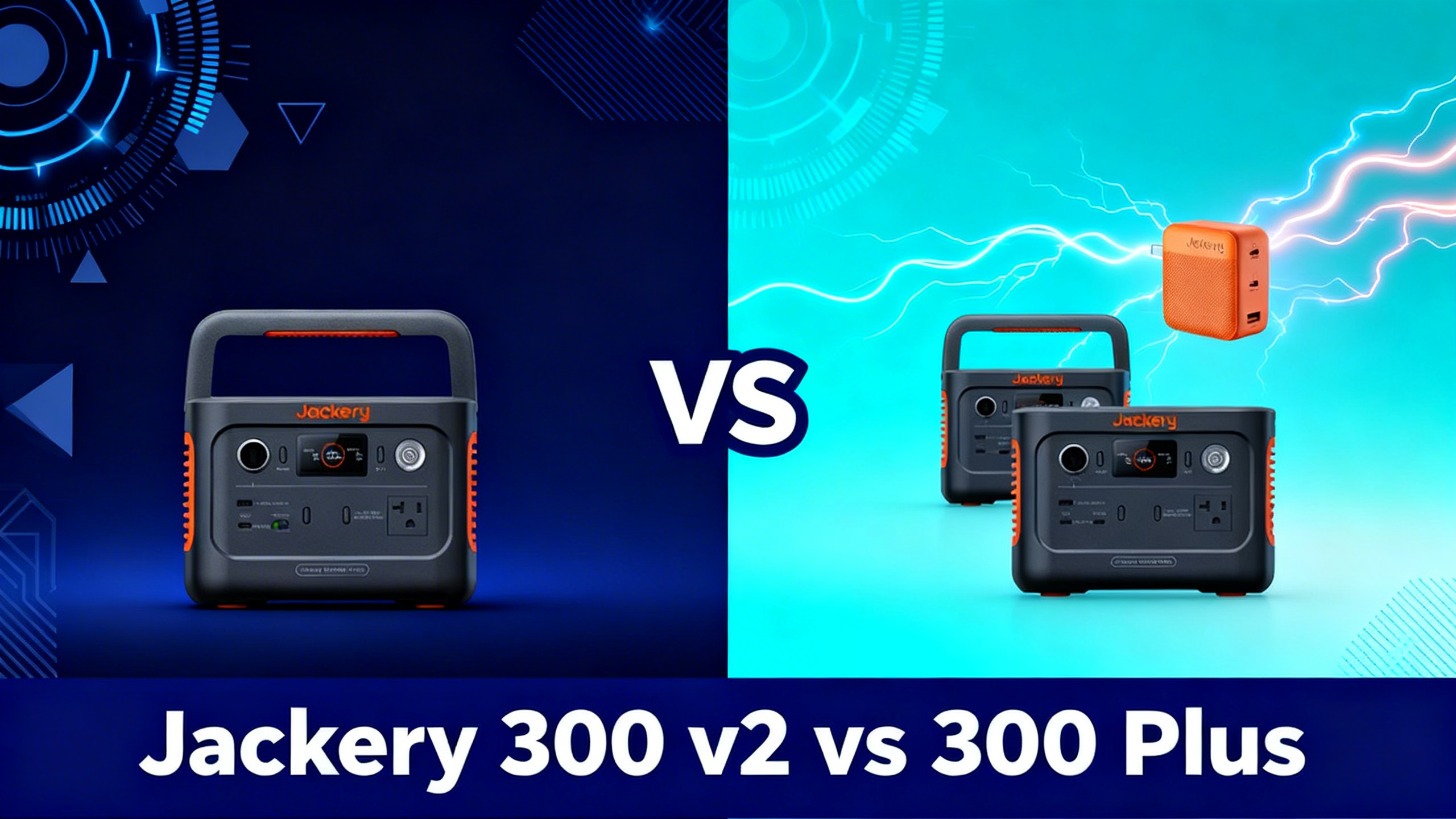
Choosing between the Jackery Explorer 300 v2 and the Explorer 300 Plus feels confusing at first: same 288Wh capacity, same LiFePO4 chemistry, same 300W output. Yet the two models diverge on charging speed, cycle life, app connectivity, and price in ways that matter depending on how you plan to use one.
The 300 v2 launched in 2025 as a direct evolution of Jackery’s compact lineup. At $269, it undercuts the 300 Plus ($299.99) while introducing a faster recharge, a higher-output USB-C port, and a built-in UPS function the older model lacks. The 300 Plus counters with Wi-Fi and Bluetooth app control plus a longer 5-year warranty.


There’s also a practical reality to consider: the 300 Plus is currently out of stock on jackery.com, which makes the comparison partly academic for buyers who need a unit today. This guide breaks down every meaningful difference so you can decide which model fits your situation.
Update (July 2026): Both the Explorer 300 v2 and the Explorer 300 Plus have been discontinued and are no longer sold directly by Jackery. Purchase links for either model now lead to Jackery’s Explorer 300 Series page (293Wh capacity, 300W output, listed at $309), which currently shows the product as not available for purchase. We’ve kept this comparison online to help existing owners and anyone weighing remaining or secondhand stock of the two units.
Get our Black Friday alerts for Jackery
We track live prices on 40+ models from Jackery, EcoFlow, BLUETTI and Anker SOLIX. When a deal beats the lowest price we've recorded, you'll hear from us. During Black Friday week, one short recap a day at most.
Unsubscribe in one click. We may earn a commission when you buy through our links, at no extra cost to you. Privacy Policy
Quick Verdict: Our Recommendation
Spec analysis and verified owner data point clearly to the Explorer 300 v2 as the stronger purchase for most buyers in 2026. It charges faster, lasts longer, and costs less. The 300 Plus holds an edge on app control and warranty length, but its limited availability tips the scales further toward the newer model. Note that as of July 2026 both models have been discontinued by Jackery, so either purchase now means sourcing remaining or secondhand stock.
⚡ Editor’s Pick, Best Value
Jackery Explorer 300 v2
$269 In Stock
- 288Wh LiFePO4, 4,000+ cycles (10-year lifespan)
- Lightest in class: 8.1 lbs, 19% smaller body
- 0-80% recharge in just 1 hour
Explorer 300 v2: Best For
- Campers, van lifers, and travelers who need fast turnaround recharging
- CPAP users requiring an instant-switch UPS backup
- Anyone prioritizing battery longevity on a sub-$300 budget
Explorer 300 Plus: Best For
- Users who want Wi-Fi and Bluetooth app monitoring
- Buyers who value the extended 5-year warranty above all else
- Those who find the 300 Plus in stock at a competitive price via third-party resellers
What Makes These Two Different? A Side-by-Side Overview
On the surface, these two look almost identical. Both run a 288Wh LiFePO4 (lithium iron phosphate) battery, meaning the same chemistry that delivers superior longevity and thermal safety compared to older lithium-ion cells. Both output 300W continuous AC (600W surge), which covers laptops, small appliances, camera gear, and CPAP machines comfortably.
The differences emerge when you look past raw capacity. Charging speed, USB-C output wattage, cycle count, the presence or absence of UPS functionality, app connectivity, and warranty length all diverge. For budget buyers, those details determine which model delivers more value over a 5-10 year ownership period.
Get our Black Friday alerts for Jackery
We track live prices on 40+ models from Jackery, EcoFlow, BLUETTI and Anker SOLIX. When a deal beats the lowest price we've recorded, you'll hear from us. During Black Friday week, one short recap a day at most.
Unsubscribe in one click. We may earn a commission when you buy through our links, at no extra cost to you. Privacy Policy
Design & Build Quality
Both units share Jackery’s familiar orange-and-black design language, but the 300 v2 represents a refinement in form factor. The newer model shrank the body by 19% compared to earlier Jackery compact stations, trimming unnecessary bulk without sacrificing port count or output.

Explorer 300 v2 Design, Lighter and More Compact
At 8.1 lbs (3.7 kg), the 300 v2 is easy to carry one-handed. The foldable handle sits flush against the top panel when not in use, keeping the profile clean in a backpack or vehicle storage bin. The unit is rated to operate in temperatures from -15°C to 45°C, which covers most camping and emergency scenarios.
The UL94V-0 shell adds a meaningful layer of fire resistance, a spec worth noting for users who keep the unit in a car or enclosed space. The 300 v2 also incorporates Jackery’s Energy-Saving Mode, which cuts standby draw when running low-wattage devices like a CPAP on lower humidifier settings.
Explorer 300 Plus Design, Built for Durability
The 300 Plus weighs 8.27 lbs (3.75 kg), barely heavier than the 300 v2. Its key structural advantage is Class 9 shock resistance, backed by 52 protection mechanisms covering overcurrent, overtemperature, and short-circuit scenarios. The BMS runs 12 protection algorithms in parallel, making this one of the more conservatively tuned safety systems in the under-$300 segment.
UL certification and the Class 9 shock rating make the 300 Plus slightly more appropriate for rougher environments where drops are realistic. For most users, the difference in durability between the two won’t surface in practice.
Battery Performance and Longevity
Both models use LiFePO4 (lithium iron phosphate) cells. This chemistry is worth understanding: unlike older lithium-ion batteries, LiFePO4 is inherently more stable at high temperatures, degrades more slowly per cycle, and maintains consistent output across its lifespan. At this price point, it’s a meaningful upgrade over budget stations that still use NMC cells.

Cycle Life: 4,000 vs 3,000: Does It Matter?
Published cycle data puts the 300 v2 at 4,000+ cycles versus the 300 Plus at 3,000+ cycles before the battery degrades to 80% of original capacity. The practical math: at one full cycle per day, the 300 v2 reaches that threshold in roughly 10.9 years versus 8.2 years for the 300 Plus. That’s a 33% lifespan advantage for a unit that costs $30 less.
For occasional users (1-3 cycles per week), both models will outlast any reasonable ownership period. But for daily users, van lifers, off-grid workers, frequent campers, cycle count translates directly to years of reliable service before replacement becomes necessary.
What 288Wh Can Power in Practice
The 288Wh capacity applies equally to both models. Runtime calculations based on that capacity at 85% inverter efficiency give a clear picture of what to expect from either unit:
What Can 288Wh Power?
💡
LED Lamp
48 hrs
5W
💻
Laptop
4-5 charges
60W
📱
Smartphone
22 charges
12Wh/charge
😴
CPAP (w/ humidifier)
~5 hrs
50W avg
Runtime calculations based on 288Wh capacity at 85% inverter efficiency. Actual results vary by load.
Charging Speed: Where the 300 v2 Wins
Charging performance is where the 300 v2 establishes its clearest advantage. Verified specs confirm the unit reaches 0-80% in approximately 1 hour via a standard wall outlet. The 300 Plus takes roughly 1.8 hours for the same range. That 45-minute difference sounds modest until you’re on a schedule, packing up camp, leaving a rest stop, or restoring backup power before nightfall.

Wall Charging: 1 Hour vs 1.8 Hours
The faster wall charge on the 300 v2 comes from a higher-wattage AC input. For users who rotate the unit through daily or near-daily cycles, faster recharge translates directly to less downtime. Charging time data confirms this is a meaningful spec gap, not a marketing rounding difference.
Keep in mind that both units support pass-through charging, meaning you can run devices while the battery refills. The faster the base charge rate, the less net depletion you experience during simultaneous use.
USB-C Input and Output Differences
The 300 v2 includes dual 100W USB-C ports, covering both input and output at full Power Delivery speeds. Charging a modern laptop (typically 45-100W draw) works natively and quickly. The 300 Plus caps USB-C output at 45W, which still charges most laptops but at a slower rate, and won’t fast-charge power-hungry models like the MacBook Pro 14-inch.
For remote workers or travelers who rely on USB-C laptops as their primary machine, the 300 v2’s 100W USB-C output is a practical advantage that shows up daily.
Solar Charging Options
Both models accept solar input from Jackery’s SolarSaga panel range (40W, 80W, 100W). Published data confirms a full solar charge in approximately 3.5-7 hours depending on panel wattage and sun conditions.
One important note for 300 Plus owners: the 300 Plus requires an 8020-to-USB-C adapter for solar input. The 300 v2 accepts solar panels directly. It’s a small but real friction point for outdoor users who swap panels or use third-party inputs. For the complete spec breakdown and solar pairing guide, see our full 300 v2 review covering every port, charging mode, and real-world runtime scenario.
Ports & Connectivity
Port counts are comparable across both models. The key output specs align: two AC outlets at 300W continuous (600W surge), USB-A ports, a DC car output, and the USB-C ports noted above. The distinction lies in USB-C wattage and the 300 Plus’s app connectivity layer.
Explorer 300 v2 Ports
The 300 v2 offers two AC outlets at 300W, dual USB-C ports at 100W each, USB-A output, and a DC car port. The dual 100W USB-C configuration is the headline spec here: you can charge two high-wattage devices simultaneously at full speed, something the 300 Plus can’t match. The official Explorer 300 v2 page details the full input/output spec sheet.
Explorer 300 Plus Ports + App Control
The 300 Plus matches the 300 v2’s AC and DC port configuration, with the 45W USB-C limitation noted above. Its differentiated feature is Wi-Fi and Bluetooth connectivity via the Jackery app. This allows remote battery monitoring, charge scheduling, and real-time usage tracking from a smartphone.
For users who want visibility into power consumption without physically checking the display, app control is genuinely useful. The official Explorer 300 Plus page includes the full app feature list. Compared to the original Explorer 300, both the 300 v2 and 300 Plus represent a significant leap in battery chemistry and output stability.
UPS Function: A Hidden Advantage of the 300 v2
The 300 v2 includes an industrial-grade UPS (Uninterruptible Power Supply) function with a switchover time of under 0.01 seconds. Published specs confirm this response is fast enough to keep sensitive electronics running through a power outage without interruption. The 300 Plus does not include this feature.
In practice, this matters for three categories of users. CPAP machines are sensitive to power drops, a pause in airflow can interrupt sleep and, for some users, create apnea episodes. Wi-Fi routers and modems lose their connection on even a 0.5-second interruption. NAS drives and similar devices can corrupt data on sudden power loss. The 300 v2 protects against all three scenarios; the 300 Plus does not.
💡 Pro Tip: If you use a CPAP with a heated humidifier, factor in the higher power draw (40-60W vs 25-30W without humidifier). At 50W average, the 300 v2’s 288Wh gives you roughly 5 hours, enough for most users, but plan to recharge each morning.
Warranty & Long-Term Value
The 300 Plus wins on warranty length: 3+2 years totaling 5 years of coverage versus the 300 v2’s 2+1 years (3 total). For users who treat warranties as a meaningful factor in purchase decisions, that’s a real advantage.
In a straight value calculation, though, the 300 v2’s 4,000+ cycle life extends expected battery longevity beyond the 300 Plus’s 3,000+ cycles. The unit that performs reliably for 10+ years arguably needs warranty coverage less. The better longevity and lower price of the 300 v2 offset the shorter warranty in most use cases.
Price & Availability
At the time of publication, the Explorer 300 v2 is priced at $269 and in stock on jackery.com. The Explorer 300 Plus carries a list price of $299.99 but is currently out of stock on the official site.
App Control Option
Explorer 300 Plus
$299.99
⚠ Limited Availability
If the 300 Plus is on your list specifically, check Amazon and third-party retailers, the unit circulates through resellers even when out of stock at jackery.com. That said, paying $299.99 or more for a model with lower cycle count and no UPS function is a harder case to make against the 300 v2 at $269 with full availability.
Which One Should You Buy?
The data makes this comparison relatively clear for most buyers. The 300 v2 wins on four of the seven key differentiating specs: cycle life, charging speed, USB-C output, and UPS functionality. It also costs $30 less and is currently available. The 300 Plus claims app control and warranty length, real advantages, but narrower ones.

Which Model Is Right for You?
⚡ Buy the 300 v2 ($269) if…
- You need the fastest recharge (1-hour wall charge)
- Portability and weight are priorities (8.1 lbs)
- You use a CPAP and need instant UPS backup
- You want 4,000+ cycle longevity for 10+ years
- Budget is tight, saves $30 vs 300 Plus
📱 Buy the 300 Plus if…
- App control (Wi-Fi + Bluetooth) matters to you
- You want the longest warranty (5 years total)
- You can find it in stock at a good price
- You prefer the Jackery app for battery management
Choose the 300 v2 If…
You’re a frequent traveler, camper, or van lifer who recharges on a schedule. The 1-hour charge speed, 4,000+ cycle lifespan, and 100W USB-C output cover the most common portable power use cases at a price that’s hard to beat in the 288Wh segment. CPAP users specifically benefit from the UPS function, no other feature at this price point handles that requirement as cleanly.
Choose the 300 Plus If…
App control is a core requirement, or you specifically value the 5-year warranty and can source the unit from a reseller. The 300 Plus is a capable power station, but its current out-of-stock status on the official site and higher price make it a conditional recommendation rather than a default one.
Neither Fits? Consider These Alternatives
If neither model meets your needs, say, you require more than 288Wh, or you need 500W+ output for power tools, Jackery’s 500W and 1000W tiers are the logical next step. Our guide to all Jackery budget models covers every entry-level option from $109 to $499 with the same spec-by-spec breakdown.
Final Verdict
The jackery 300 vs 300 plus comparison resolves clearly for 2026. Spec analysis confirms the Explorer 300 v2 as the stronger all-around package: faster charging, more battery cycles, better USB-C output, and a UPS function the 300 Plus omits. It’s also $30 cheaper and available to order today.
The 300 Plus earns its place if app monitoring and a 5-year warranty are genuine priorities for you. But for most buyers choosing between the two right now, the data points firmly to the 300 v2. Shoppers comparing several models at once will find our roundup of the best Jackery under $500 useful for a broader picture of the current lineup.
Jackery Explorer 300 v2
$269
Best budget power station under $300 in 2026
See Explorer 300 Series (successor) →
Price verified April 2026, Free shipping available
Frequently Asked Questions
Is the Jackery 300 v2 better than the 300 Plus?
For most buyers in 2026, yes. The 300 v2 offers faster charging (1 hour to 80%), a higher cycle count (4,000+ vs 3,000+), built-in UPS function, and 100W USB-C fast charging at a lower price of $269. The 300 Plus only edges ahead on app control and warranty length (5 years total).
What is the difference between the Jackery 300 Plus and 300 v2?
Both share identical 288Wh capacity and 300W output. The key differences: the 300 v2 has faster recharge (1 hour vs approximately 1.8 hours), higher USB-C output (100W vs 45W), a UPS function (under 0.01s switchover), and 4,000+ vs 3,000+ cycle life. The 300 Plus adds Wi-Fi and Bluetooth app control plus a longer 5-year warranty.
Can the Jackery 300 v2 power a CPAP machine?
Yes. The 300 v2 includes an industrial UPS function with under 0.01 second switchover, which keeps CPAP devices running without interruption during a power cut. Runtime calculations based on 288Wh capacity and a typical 50W CPAP draw (without humidifier) show approximately 5 hours of operation.
Is the Jackery 300 Plus still worth buying?
If you find it in stock at a good price and specifically value app control (Wi-Fi + Bluetooth monitoring) or the extended 5-year warranty, the 300 Plus remains a capable unit. However, with the 300 v2 in stock at $269 and offering faster charging and more cycles, it represents stronger value for most buyers today.
What solar panel works with the Jackery Explorer 300 v2?
The 300 v2 accepts solar input directly. Jackery’s SolarSaga panels (40W, 80W, 100W) are compatible. Published data confirms a 0-100% solar charge in approximately 3.5-7 hours depending on panel wattage and sun conditions. No adapter is needed, unlike the 300 Plus, which requires an 8020-to-USB-C adapter for solar input.
Does the Jackery 300 v2 work as a UPS for a router?
Yes. The built-in UPS function with under 0.01 second response time means the 300 v2 will keep a Wi-Fi router, modem, or other sensitive electronics running without interruption during a power outage. This feature is absent on the Explorer 300 Plus.
Originally published: April 15, 2026