
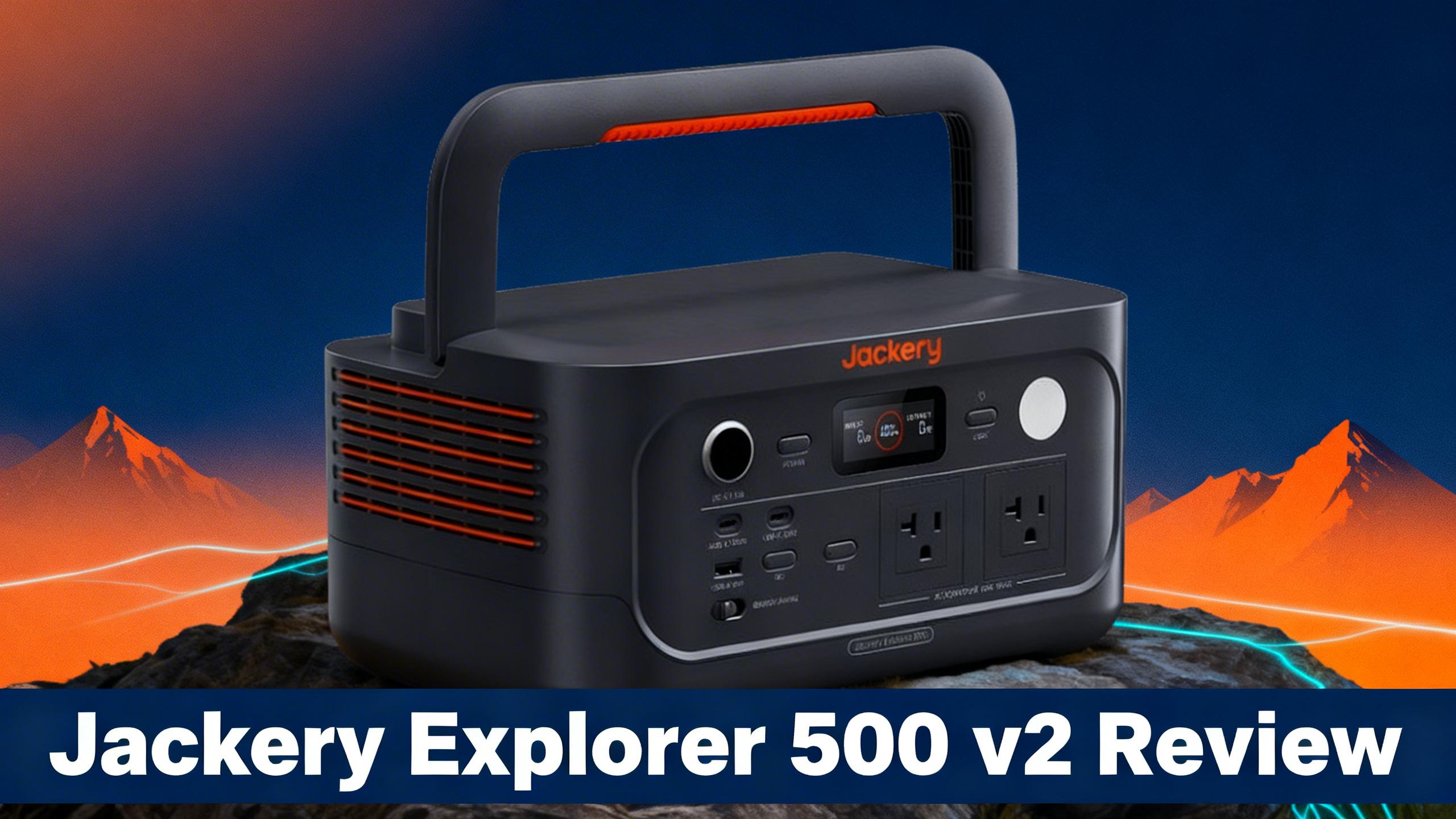
The $400 to $500 portable power station segment is the most contested in the market right now. Every major brand has a model here, and the differences between them aren’t always obvious from a spec sheet. So when Jackery released the Explorer 500 v2, the question worth asking isn’t just “what changed?” but “does it change enough to justify choosing it over the competition in 2026?”
The Explorer 500 v2 is one of several new additions to the Jackery 2025 models lineup, each targeting a specific segment of the market. This one sits squarely in the mid-range: priced at $399, built around a 512Wh LFP battery, and aimed at weekend campers, occasional van lifers, and light home backup users. It’s not trying to compete with the 1000-series on capacity. Its case rests on portability, longevity, and a cleaner feature set than the original 500.
This review covers the key specs, runtime calculations, charging performance, and who the Explorer 500 v2 actually makes sense for based on spec analysis and published owner data.
Jackery Explorer 500 v2: Overall Rating
7.8/10
“The right step up from entry-level, if the price fits.”
Performance 7.5/10
Value for Money 7.0/10
Portability 8.5/10
Charging Speed 8.0/10
Battery Life (cycles) 9.0/10
Ecosystem & Support 7.5/10

Jackery Explorer 500 v2
$399
- 512Wh LFP battery, 500W AC output (1000W surge)
- Fast dual charging: wall + solar simultaneously
- Compact and portable, ideal for camping and daily use
Price checked September 28, 2026. Free shipping available
Availability note (checked September 28, 2026): Jackery no longer lists the Explorer 500 v2 in its US catalog, and its product page says it is not available for purchase. Check the page before you order. If it is no longer available when you check, the closest alternative we track is the EcoFlow RIVER 2 Max 500 (499Wh, 13.2 lbs, $329).
Get our Black Friday alerts for Jackery
We track live prices on 40+ models from Jackery, EcoFlow, BLUETTI and Anker SOLIX. When a deal beats the lowest price we've recorded, you'll hear from us. During Black Friday week, one short recap a day at most.
Unsubscribe in one click. We may earn a commission when you buy through our links, at no extra cost to you. Privacy Policy
Jackery Explorer 500 v2: At a Glance
The Explorer 500 v2 slots into Jackery’s mid-range lineup at $399, bringing a meaningful chemistry upgrade over the original 500 without crossing into the higher-capacity tier. The core proposition: a 512Wh LFP station with 500W continuous AC output, designed for weekend campers, occasional van lifers, and anyone who needs reliable portable power for a few devices at a time.
Here’s a quick spec breakdown before diving into the details.
Specs sourced from Jackery’s official Explorer 500 v2 product page (EU store).
Battery Chemistry & Durability
The original Explorer 500 used an NMC (nickel manganese cobalt) cell configuration rated for around 500 charge cycles before dropping to 80% capacity. The v2 switches to LiFePO₄ battery chemistry, which changes the long-term math significantly. Jackery rates the v2 at 6,000 cycles to 70% capacity. That end point is lower than the original’s 80%, but the rated cycle count is twelve times higher.
What does that mean in practice? If you charge the 500 v2 once a week, the rated cycle life will outlast the rest of the unit by a wide margin. Even with daily charging, 6,000 cycles works out to more than 16 years before the battery drops to 70% capacity. LFP also tolerates heat better and poses lower thermal runaway risk than NMC, which matters for users storing the unit in vehicles or warm environments.
The trade-off is energy density: LFP cells pack slightly less energy per unit of weight compared to NMC. Even so, the v2 comes in lighter than its predecessor, at 12.6 lbs. For most portable use cases, the lower density is a non-issue. The durability gain clearly outweighs the density trade-off at this capacity level.
Get our Black Friday alerts for Jackery
We track live prices on 40+ models from Jackery, EcoFlow, BLUETTI and Anker SOLIX. When a deal beats the lowest price we've recorded, you'll hear from us. During Black Friday week, one short recap a day at most.
Unsubscribe in one click. We may earn a commission when you buy through our links, at no extra cost to you. Privacy Policy
Charging Performance
Jackery’s official specs put the Explorer 500 v2 at approximately 1.3 hours for a full wall charge (0-100%). That’s a competitive figure for this capacity class. Charging from a 12V car outlet takes about 6 hours, so plan wall or solar top-ups if quick turnarounds matter to your workflow.
On the solar side, the 200W maximum input is a notable upgrade from the original 500’s 100W ceiling. Two SolarSaga 100W panels in parallel can now hit that cap, cutting outdoor recharge time roughly in half compared to a single-panel setup. A single SolarSaga 100W panel under optimal sun conditions takes approximately 6 to 8 hours. Real-world solar intake will vary depending on panel angle, cloud cover, and ambient temperature.
Dual input charging (wall and solar simultaneously) is supported, letting you push charge rates higher in hybrid setups. For users who spend extended time off-grid, that flexibility matters more than raw wattage figures on a spec sheet.

Ports & Output Capacity
The 500 v2 provides a practical spread of outputs: standard AC outlets, USB-A ports, a USB-C PD port rated up to 100W, and a 12V DC car port. The USB-C PD upgrade from 18W on the original to 100W on the v2 is one of the more consequential spec changes for daily users. It means you can fast-charge a MacBook Pro, a high-end tablet, or a camera battery directly without needing an AC adapter in between.
The 500W continuous AC output handles most small appliances comfortably: laptops, LED lights, fans, small TVs, blenders, and CPAP machines all fall well within that ceiling. The 1,000W surge rating accommodates brief spikes from motor-based devices on startup. What the 500W ceiling rules out: window AC units, induction cooktops, electric kettles at full power, and most power tools above 400W. Those use cases require stepping up to a larger station.
What Can the Explorer 500 v2 Power?
Runtime calculations based on the 512Wh capacity at approximately 85% efficiency give a usable energy figure of roughly 435Wh. That’s the practical number to work from when estimating how long a given device will run. Here’s how that translates to real-world appliances.
What Can the Explorer 500 v2 Power? (512Wh)
❄️
Mini Fridge
~14.5 hrs
30W avg draw
💡
LED Lights
~87 hrs
5W avg draw
💻
Laptop
~8 charges
50Wh per charge
📱
Smartphone
~33 charges
13Wh per charge
🌀
CPAP (no heat)
~11-14 hrs
30–40W avg draw
Runtime estimates based on 512Wh capacity at ~85% efficiency. Actual results vary by load and temperature.
The 500W AC ceiling is worth keeping in mind when planning multi-device setups. Running a mini-fridge, a laptop, and a CPAP simultaneously draws roughly 110 to 140W total, well within the continuous output rating. Where users run into the wall is adding heat-generating appliances (hair dryers, electric kettles, space heaters) that push single-device draws past 500W.
Real-World Performance & Use Cases
Owner feedback patterns and spec analysis consistently point to three scenarios where the Explorer 500 v2 delivers strong value. Weekend car camping is the clearest fit: the compact form factor fits easily in a trunk or hatchback, and the 512Wh capacity comfortably covers two to three nights of lighting and device charging without solar top-ups. A 30W mini-fridge alone runs about 14.5 hours, so plan a solar top-up if you bring one. For tent-only setups, our tent camping power solutions guide shows how to integrate the 500 v2.
For short van trips (two to four days), the 500 v2 works well as either a primary station for light users or a secondary unit supplementing a larger bank. The LFP chemistry makes it a practical choice for van builds where the station will be charged and discharged frequently. For full-time van life with consistent high loads, capacity data suggests a larger unit is a better investment.


Light home backup is the third scenario. The 500 v2 can keep a router, modem, LED lighting, and a device charging station running during a short outage. It won’t power a full refrigerator or HVAC system, but for keeping critical small electronics alive during a few-hour grid interruption, the capacity is adequate.
Explorer 500 v2 vs Original Explorer 500
Compared to the original Explorer 500, the v2 generation brings notable chemistry and output improvements. The headline changes are the LFP battery upgrade, the USB-C PD jump from 18W to 100W, and the solar input ceiling doubling from 100W to 200W. Here’s the spec-by-spec picture.
| Feature | Explorer 500 (Original) | Explorer 500 v2 |
|---|---|---|
| Battery Type | NMC | LFP |
| Cycle Life | 500 cycles | 6,000 cycles (to 70%) |
| USB-C PD | 18W | 100W |
| Max Solar Input | 100W | 200W |
| Price | ~$300–350 (clearance) | $399 |
The price gap between clearance-priced original 500 units and the v2 is harder to justify if you’re a light, occasional user who charges a few devices on a camping trip once a month. The LFP upgrade matters most to frequent users who will put hundreds of cycles on the unit over several years.
Who Should Buy the Explorer 500 v2?
The audience fit for the Explorer 500 v2 is fairly specific. If you’re unsure whether 500Wh meets your needs, our 500 vs 1000 comparison breaks down real-world capacity differences across typical load scenarios. For the 500 v2 specifically, here’s the buy and skip breakdown based on spec analysis and use case fit.
✅ Buy the Explorer 500 v2 if…
- You need a reliable weekend camping station under $500
- LFP longevity (6,000 cycles to 70%) matters to your use case
- You want to charge devices simultaneously via AC + USB-C PD
- Portability is a priority (compact form factor)
❌ Skip this if…
- You need to run high-wattage appliances (AC units, power tools above 500W)
- You’re planning multi-day off-grid living without solar
- Home backup for more than a few small devices is the goal
- Budget is tight: the 300 v2 at $279 covers lighter needs for less
Alternatives to Consider
For users who want more headroom, we compare with the 600 v2, which adds roughly 128Wh more capacity for a higher price, with the same 500W AC output. It is currently sold out on Jackery’s US store, though, so the 500 v2 is the more practical choice in this size today.
At the lower end, the Jackery 300 v2 at $279 covers phones, laptops, and lighting for a two to three day trip without the weight or cost of the 500 v2. For a full comparison across all Jackery models in this price range, see our best Jackery under $500 buying guide, which covers the 240D, 300 v2, and 500 v2 side by side.
Best Jackery New Models 2025–2026: Complete Lineup Guide
See where the Explorer 500 v2 fits in Jackery’s full 2025–2026 product lineup.
Pros & Cons
Pros:
- LFP chemistry: 6,000-cycle rating (to 70% capacity) significantly extends long-term value
- 100W USB-C PD output (significant upgrade from the original 18W)
- 200W solar input capacity supports dual-panel fast outdoor charging
- Compact and portable form factor suits car camping and day trips
Cons:
- Uncertain availability: Jackery no longer lists it in its US catalog
- 500W AC ceiling rules out high-draw appliances
- No expandability (fixed capacity, no add-on battery option)
- Price-to-Wh ratio at $399 ($0.78/Wh) is not class-leading compared to some competitors
⚠️ Important: As noted above, Jackery’s US product page for the Explorer 500 v2 says it is not available for purchase. Verify availability on Jackery’s site before you order.
Final Verdict
Analysis of the Explorer 500 v2 puts it at a solid 7.8/10. It’s a meaningful step up from the original 500 for users who care about long-term battery health, modern USB-C PD speeds, and better solar compatibility. The LFP upgrade alone justifies the price premium over clearance-priced original 500 units for anyone who plans to use the station regularly over several years.
Where the verdict softens: the $399 price point places it in a competitive segment where alternatives from EcoFlow and Anker SOLIX offer comparable capacity at similar or lower prices. The Jackery ecosystem, warranty support, and brand reliability factor into the decision for buyers who value those attributes. For first-time buyers stepping up from entry-level stations, the Explorer 500 v2 is a dependable mid-range choice. For power users with heavier loads, the data points clearly toward the 1000-series.
Jackery Explorer 500 v2
$399
Best mid-range portable station under $500
Price checked September 28, 2026. Free shipping available
Frequently Asked Questions
What is the battery capacity of the Jackery Explorer 500 v2?
Jackery’s official specs list the Explorer 500 v2 at 512Wh with LFP chemistry, slightly below the original 518Wh NMC unit but with significantly improved longevity. The battery is rated for 6,000 cycles to 70% capacity, a major durability upgrade over the previous generation.
How long does it take to charge the Jackery Explorer 500 v2?
Jackery rates a full wall charge (0-100%) at about 1.3 hours. Solar charging through a single SolarSaga 100W panel takes around 6 to 8 hours under optimal conditions. The 200W maximum solar input allows two panels to be used in parallel for faster outdoor recharging, at about 2.8 hours. Dual input (wall and solar simultaneously) is also supported and brings a full charge down to about 1 hour.
Can the Jackery Explorer 500 v2 run a refrigerator?
Runtime calculations based on a 512Wh capacity at 85% efficiency show this unit can power a standard mini-fridge drawing 30W on average for approximately 14.5 hours. A full-size refrigerator cycling at 150 to 200W would run for roughly 2 to 3 hours. The 500W AC ceiling is sufficient for most mini and compact fridges, but rules out full-size models with high startup surge requirements.
What is the difference between the Explorer 500 and the 500 v2?
The most significant upgrades are battery chemistry (NMC to LFP, with the cycle rating going from approximately 500 to 6,000 cycles to 70% capacity), USB-C PD output (18W to 100W), and maximum solar input (100W to 200W). Performance data shows these are meaningful improvements for long-term owners and frequent users. The AC output rating (500W) remains the same across both generations.
Is the Jackery Explorer 500 v2 good for van life?
For short van trips or as a secondary station, yes. The compact form factor and LFP durability make it a practical daily driver for van builds where space is limited and the unit will be cycled frequently. For full-time van life with higher power demands, analysis of capacity data suggests stepping up to the Explorer 1000 Plus or 1500 v2 would be more appropriate for sustained off-grid use.
Originally published: April 15, 2026