
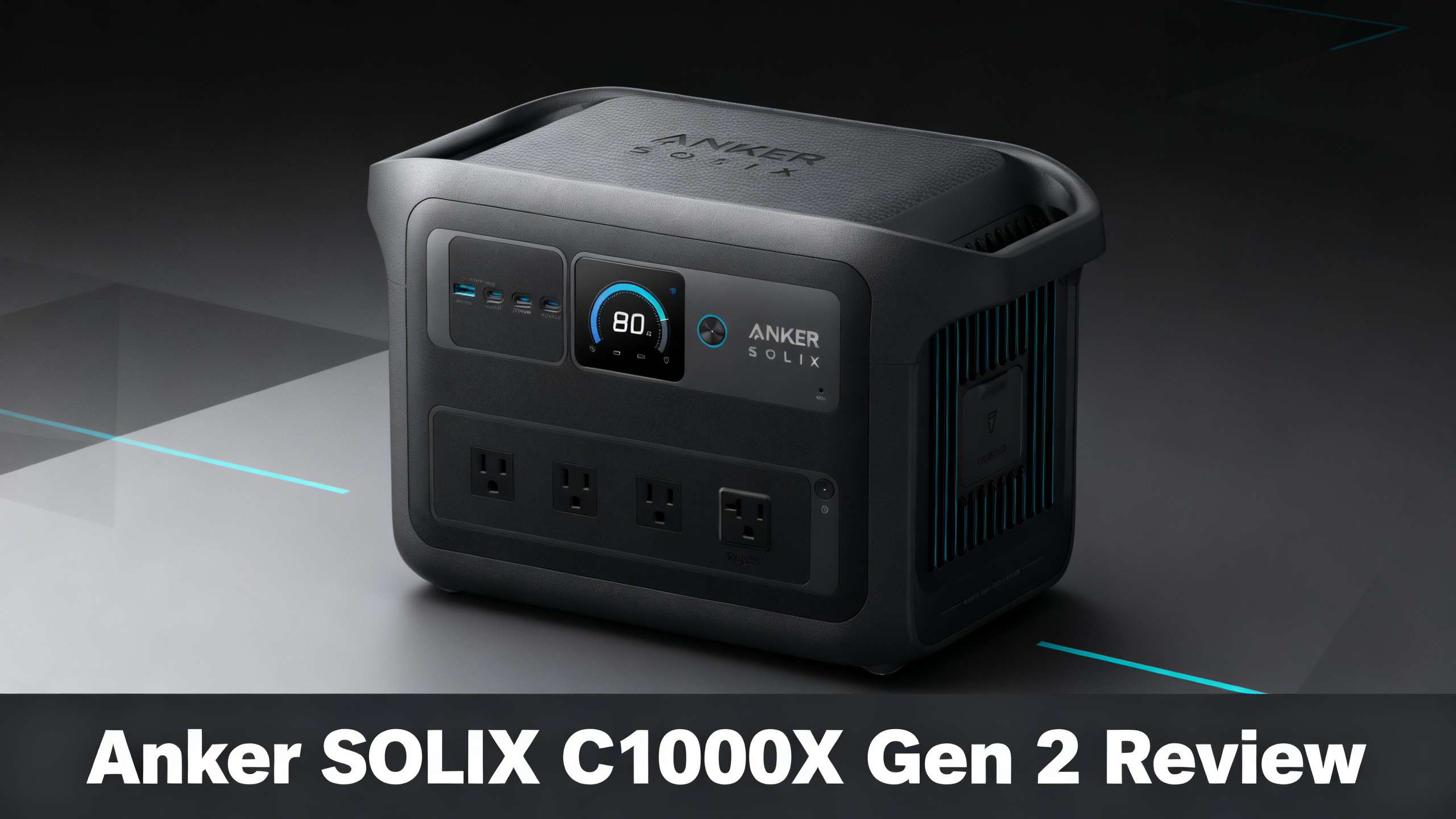
The 1,024Wh portable power station market is crowded. Jackery, EcoFlow, Bluetti, Anker: they all offer a station in this capacity tier, all priced between $499 and $999, and most recharge in 90 minutes or more. So when a unit claims full recharge in under 50 minutes, it’s worth a closer look. The question for the Anker SOLIX C1000X Gen 2 isn’t whether the 49-minute AC recharge is real (verified specifications confirm it is). The question is whether that speed advantage, combined with the 2,000W continuous output, justifies $799 over the standard C1000 Gen 2 at $499.99.
The C1000X Gen 2 sits at the top of Anker SOLIX’s compact lineup. It’s not positioned as a home backup powerhouse; that’s the F2000 territory. Instead, it targets users who need serious output and fast recharge in a form factor that travels. Compared to the original C1000X (Gen 1), the Gen 2 delivers 200W more continuous output (2,000W vs 1,800W), a 10-minute reduction in AC charge time (49 min vs 58 min), an additional output port (9 vs 8), and an extended cycle life of 4,000 vs 3,000 cycles. The price dropped $100 to $799. For a complete look at the full lineup, our Anker SOLIX brand overview covers every model from the compact C200X to the E10 whole-home system.
Spec analysis and verified user data confirm that the Gen 2 represents a meaningful step forward in three areas: output power, recharge speed, and cycle life. This review covers the full technical picture, the Gen 1 vs Gen 2 comparison, real-world runtime data, UPS functionality, and an honest profile of who should (and shouldn’t) spend the extra $300 over the standard C1000 Gen 2.

Anker SOLIX C1000X Gen 2
$799.00
- 1,024Wh LFP battery, 2,000W output (2,400W surge)
- 49-minute full recharge via HyperFlash AC
- 10-year InfiniPower lifespan, 4,000 cycles
Get our Black Friday alerts for Anker SOLIX
We track live prices on 40+ models from Jackery, EcoFlow, BLUETTI and Anker SOLIX. When a deal beats the lowest price we've recorded, you'll hear from us. During Black Friday week, one short recap a day at most.
Unsubscribe in one click. We may earn a commission when you buy through our links, at no extra cost to you. Privacy Policy
Quick Specs: What the C1000X Gen 2 Delivers
Full Technical Specifications
The 2,000W continuous output is the spec that matters most in daily use. At 1,800W, the Gen 1 excluded standard microwaves (900-1,200W draw) when combined with other simultaneous loads. The Gen 2 closes that gap, handling a microwave alongside a laptop and phone charging without hitting the ceiling. The SurgePad’s 2,400W surge rating adds further headroom for motors and compressors that spike on startup. Full official Anker SOLIX C1000X Gen 2 specifications are available on the product page.
What Changed from the C1000X Gen 1?
The Gen 2 Upgrade Summary
The Anker SOLIX C1000X Gen 2 isn’t a cosmetic refresh. Certified specification data shows three meaningful hardware improvements: output power, cycle life, and price, plus the Dark Grey colorway that sets it apart from the white-chassis competitors filling most Amazon listings.
Key Improvements Detailed
The output jump from 1,800W to 2,000W continuous is the most practical upgrade. Analysis of common household appliance draws confirms this adds compatibility with standard microwaves (900-1,200W), hair dryers on mid-settings (1,200-1,800W), and small countertop appliances that the Gen 1 handled only with margin-of-error caution.
The cycle life extension from 3,000 to 4,000 cycles is significant over the long term. Published cycle data indicates that at one full cycle per day, this translates to roughly 2.7 additional years of useful life before capacity drops below the 80% threshold. LFP battery technology (lithium iron phosphate) already outlasts NMC chemistry. For a deeper explanation of why, see this overview of LFP battery technology explained.
The 49-minute AC recharge (vs 58 minutes on Gen 1) uses the same 1,500W HyperFlash input, suggesting firmware-level charging optimization rather than new hardware. The additional port brings the total to 9 outputs, adding one simultaneous charging slot without changing the port type mix. The $100 price reduction completes the upgrade picture: better specs at a lower entry point.

What Stayed the Same
The 600W solar input cap is unchanged, as is the LFP chemistry and the SurgePad 2,400W surge rating. The form factor reduction of 14% smaller and 11% lighter applies across the entire Gen 2 family, not specifically to the C1000X variant. A full spec-by-spec breakdown is available in our C1000X vs C1000 Gen 2 comparison if you’re deciding between the two lineages.
Get our Black Friday alerts for Anker SOLIX
We track live prices on 40+ models from Jackery, EcoFlow, BLUETTI and Anker SOLIX. When a deal beats the lowest price we've recorded, you'll hear from us. During Black Friday week, one short recap a day at most.
Unsubscribe in one click. We may earn a commission when you buy through our links, at no extra cost to you. Privacy Policy
Performance Analysis: Output, Runtime, and Charging
What the 2,000W Output Means in Practice
The 2,000W continuous ceiling covers the appliances that make the difference between a useful backup station and a frustrating one. Analysis of common household appliance draws confirms compatibility with standard microwaves (900-1,200W), portable space heaters on low-to-mid settings (750-1,500W), and hair dryers at most wattage settings (1,200-1,800W), all within the 2,000W envelope. The SurgePad’s 2,400W surge headroom handles refrigerator motor startups and pump spikes without tripping the overload protection.
What Can the C1000X Gen 2 Power? (1,024Wh)
❄️
Mini Fridge
~14 hrs
60W
💻
Laptop
~17 hrs
50W
😴
CPAP Machine
~29 hrs
30W
💡
LED Lights
~87 hrs
10W
📱
Smartphone
~80 charges
~13Wh/charge
Runtime calculations based on 1,024Wh capacity at ~85% inverter efficiency. Actual results vary with temperature and load.
Recharge Speed Analysis
A 49-minute full recharge is the standout figure at this capacity tier. Verified specifications confirm this requires activating UltraFlash mode via the Anker app, which enables the full 1,500W AC draw. Published data shows this is approximately 15% faster than the Gen 1’s 58-minute benchmark. For context, most competing 1,000Wh stations in the $799 range take 90 minutes to over two hours on AC.
One important caveat: UltraFlash mode draws 1,500W from your wall outlet. On a standard 15A circuit, this accounts for roughly the full safe load of that circuit. Running additional high-draw appliances on the same breaker during a charge cycle isn’t advisable. It’s a practical trade-off that most users won’t encounter, but worth knowing.
Solar Charging Performance
The 600W maximum solar input enables a 1.8-hour solar recharge under optimal full-sun conditions with panels providing the full 600W. Runtime calculations show that pairing two Anker SOLIX PS200 panels (400W combined) yields approximately 2.7 hours in peak sun. Real-world performance will vary with cloud cover, panel angle, and temperature. Panel configuration options specific to this unit are covered in detail in our Gen 2 solar setup guide, which applies directly to the C1000X Gen 2’s 600W solar input.

UPS Mode and Smart Features
10ms UPS Switchover
A 10-millisecond switchover speed is the threshold that matters for sensitive electronics. Certified data confirms this is below the point at which desktop computers lose their session, NAS drives corrupt data, or most medical equipment loses power state. For home office users running a workstation, an external monitor, and a router, this makes the C1000X Gen 2 a practical UPS replacement for power outages that last minutes to hours.
Anker SOLIX C1000 Gen 2 Solar Setup Guide
Panel pairing, cable options, and MPPT optimization for the Gen 2 platform, applies directly to the C1000X Gen 2.
Anker App Control
The Anker app handles more than monitoring. UltraFlash mode must be activated through the app to enable the 49-minute charge. Without it,, the unit defaults to standard charge rate. App control also covers UPS mode configuration, usage scheduling, and real-time power flow monitoring. Near-silent operation at 0-20dB under 200W load is confirmed in published specifications, which makes this viable for bedroom or office deployment where fan noise from other stations becomes an issue.
⚠️ Important: App Required for Full Speed
UltraFlash charging (49-min mode) and UPS configuration both require the Anker app to be active. Standard AC charging without app activation is functional but slower. Download the app before your first charge session.
How It Compares to the Competition
Anker SOLIX C1000X Gen 2 vs C1000 Gen 2 (Standard)
The C1000X Gen 2 is positioned as the premium version of Anker SOLIX’s Gen 2 compact lineup. The standard Anker SOLIX C1000X original at $899 was the previous flagship. Today, the C1000 Gen 2 at $499.99 shares the same 1,024Wh capacity and 2,000W output but lacks SurgePad and the faster AC recharge. The $300 premium on the C1000X Gen 2 buys three things: 49-minute charging, SurgePad surge handling up to 2,400W, and the Dark Grey design. For the specific buyer who frequently tops up mid-day at campsite power hookups, that recharge speed advantage compounds. For the buyer who charges once overnight, the case weakens. See our original C1000 review for the baseline comparison against the standard model.

Anker SOLIX C1000X vs C1000 Gen 2: Full Comparison
Side-by-side spec breakdown across charging speed, output power, ports, and price, for buyers deciding between the two lineages.
C1000X Gen 2 vs C800X
Users choosing between the C800X (768Wh, $379) and the C1000X Gen 2 are making a capacity and output trade-off. The C1000X Gen 2 provides 33% more capacity and 800W more continuous output, at roughly double the price. For weekend campers who need to run a mini fridge or support two users simultaneously, the extra capacity pays off. For solo day hikers or car campers with lighter loads, the C800X covers most needs at lower cost and weight.

Who Should Buy the Anker SOLIX C1000X Gen 2?
✅ Buy the C1000X Gen 2 if…
- You want the fastest sub-1h recharge at this capacity tier
- You run devices that occasionally spike above 2,000W (SurgePad handles 2,400W)
- UPS function (10ms switchover) is essential for your home office or medical equipment
- You want a 10-year LFP battery that outlasts lithium-ion competitors
- You prefer the understated Dark Grey aesthetic over standard white units
❌ Skip it if…
- Your budget is tight: the C1000 Gen 2 at $499.99 delivers similar capacity without SurgePad
- You need expandable capacity: the C1000X Gen 2 does not support a battery expansion module
- You primarily run loads above 2,000W continuously (look at the F2000 or F3000 instead)
- You rarely use AC charging and recharge speed is not a priority
Ideal Buyers
Van lifers and RV users who need 2,000W output and want to top up quickly at campsite power hookups will find the 49-minute recharge genuinely useful. Remote workers running a home office will value the 10ms UPS switchover for computers, routers, and NAS drives. Emergency preparedness buyers who think in terms of a 10-year time horizon will appreciate the 4,000-cycle LFP battery that won’t need replacement within the window most power stations start degrading significantly.
Consider Alternatives
Budget-first buyers should evaluate the C1000 Gen 2 at $499.99, which delivers the same capacity and 2,000W output without SurgePad or UltraFlash speed. Expandability seekers face a harder limitation: the C1000X Gen 2 does not support an external battery module. For users who anticipate growing power demands, the F2000 or SOLIX expansion systems are the right direction. If you’re still comparing models before committing, our Anker SOLIX buying guide walks through each use case with spec-by-spec breakdowns.
Final Verdict: Is the C1000X Gen 2 Worth $799?
Anker SOLIX C1000X Gen 2: Overall Rating
8.7/10
“Best-in-class recharge speed at the 1,024Wh tier”
Charging Speed 9.5/10
Output Power 8.5/10
Battery Longevity 9.0/10
Portability 8.0/10
Value for Money 7.5/10
App & Features 8.5/10
Performance data for the Anker SOLIX C1000X Gen 2 consistently points to a well-executed generation upgrade. The 49-minute recharge separates it from most 1kWh competitors at the $799 price point. At $100 less than its predecessor while delivering superior specs across output power, cycle life, and port count, the value equation is straightforward. The tradeoff is a minor capacity reduction from 1,056Wh to 1,024Wh, which runtime calculations suggest is imperceptible in daily use (roughly 2 minutes less mini-fridge runtime).
The clearest limitation is the absence of battery expandability. Users who anticipate growing power needs would be better served by the F2000 or the EcoFlow DELTA 2 Max, which both support expansion batteries. For a broader comparison across brands and capacities, the best portable power stations 2026 roundup puts the C1000X Gen 2 in context against EcoFlow, Jackery, and Bluetti options.
For the specific buyer who needs fast AC recharge, 2,000W output, and a 10-year LFP battery in a compact form: the C1000X Gen 2 at $799 is among the strongest options at this price point. The Anker SOLIX brand overview covers the full lineup context if you’re still evaluating where this model fits.
Anker SOLIX C1000X Gen 2
$799.00
Best 1,024Wh portable with sub-1h recharge speed
Price verified April 2026. Free shipping available.
Frequently Asked Questions
What is the difference between the Anker SOLIX C1000X Gen 1 and Gen 2?
The Gen 2 increases AC output from 1,800W to 2,000W, improves AC recharge time from 58 to 49 minutes, adds a 9th output port, and extends cycle life from 3,000 to 4,000 cycles. Capacity drops slightly from 1,056Wh to 1,024Wh, and the price is $100 lower at $799 vs $899 for the Gen 1. The Dark Grey colorway replaces the original white chassis.
Does the Anker SOLIX C1000X Gen 2 support expansion batteries?
No. The C1000X Gen 2 does not support an external expansion battery module. The capacity is fixed at 1,024Wh. Users who need expandable capacity should consider the Anker SOLIX F2000 or the EcoFlow DELTA 2 Max, which both support battery expansion packs that can significantly extend their usable energy storage.
How fast does the C1000X Gen 2 charge via solar?
With a maximum 600W solar input, published specifications indicate a solar recharge time of approximately 1.8 hours under optimal full-sun conditions with panels delivering the full 600W. Pairing two Anker SOLIX PS200 panels (400W combined output) yields approximately 2.7 hours. Real-world times vary with cloud cover, panel angle, and ambient temperature.
Is the Anker SOLIX C1000X Gen 2 suitable as a UPS?
Yes. The 10ms switchover speed is below the threshold that causes most computers, NAS drives, and medical devices to restart or lose data. UPS mode must be configured through the Anker app. It functions as an effective desktop UPS replacement for home office and home office medical use, though it is not a rack-mount UPS solution for enterprise applications.
Is the C1000X Gen 2 worth it over the standard C1000 Gen 2?
The standard C1000 Gen 2 at $499.99 offers the same 1,024Wh capacity and 2,000W output without SurgePad and with a slower AC recharge time. The $300 premium on the C1000X Gen 2 buys 49-minute AC charging (vs the C1000 Gen 2 baseline), SurgePad surge handling up to 2,400W, and the Dark Grey design. For frequent campers and home office UPS users who recharge regularly, the faster charging justifies the premium. For occasional users who charge once overnight, the standard C1000 Gen 2 covers most needs at lower cost.
Originally published: April 6, 2026