
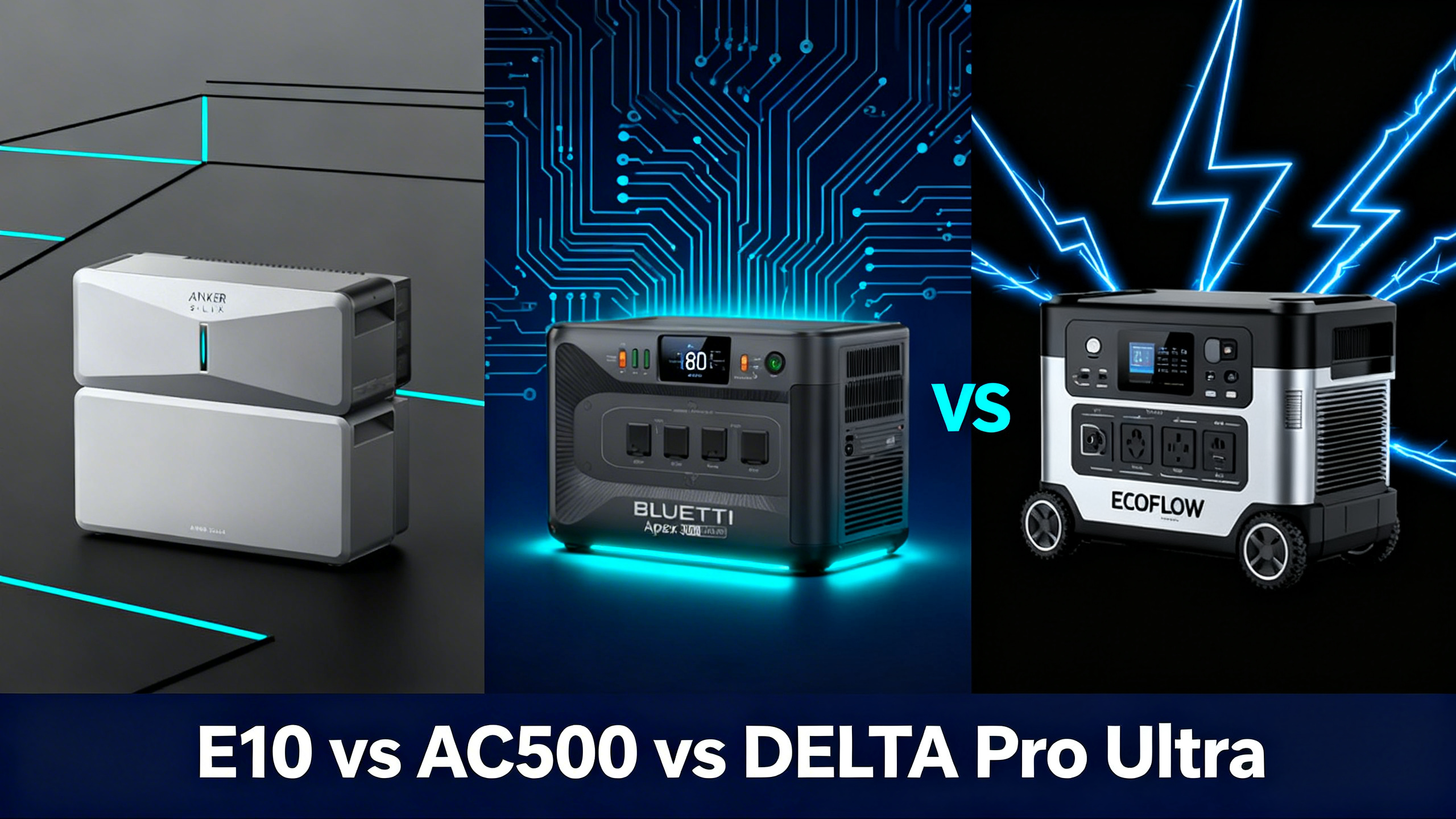
Choosing between whole-home battery backup systems feels genuinely complicated. The Anker SOLIX E10, the Bluetti Apex 300 + 2×B300K, and the EcoFlow DELTA Pro Ultra all target the same general problem: keeping your home powered when the grid goes down. But they solve it in different ways, at different price points, with different installation requirements.
Before diving into the head-to-head, our whole-home backup guide explains the key specs to look for in any residential system. This article compares all three on output, capacity, certifications, scalability, and total cost of ownership.
Product update (October 2026): Bluetti no longer sells the AC500 in the US. This comparison now covers its successor, the Bluetti Apex 300 + 2×B300K (3,840W of 120V/240V output, 8,294.4Wh of LiFePO₄ capacity).

Editor’s Top Pick: Whole-Home Backup
Anker SOLIX E10 Whole-Home Backup
$4,299
- UL9540 and UL9540A certified (insurance and permit ready)
- Modular B6000 battery architecture, scalable over time
- Works with solar, grid, generator, and Smart Generator 5500
Get our Black Friday alerts for power stations
We track live prices on 40+ models from Jackery, EcoFlow, BLUETTI and Anker SOLIX. When a deal beats the lowest price we've recorded, you'll hear from us. During Black Friday week, one short recap a day at most.
Unsubscribe in one click. We may earn a commission when you buy through our links, at no extra cost to you. Privacy Policy
Quick Picks: Which Whole-Home System Wins?
Spoiler: there’s no universal winner here. The right system depends on your installation type, budget, and how much you plan to expand over time. Here’s the short answer before we get into the details.
The Anker SOLIX E10 at $4,299 is the strongest choice if you need certified wall-mount installation and plan to add battery capacity in phases. The EcoFlow DELTA Pro Ultra at $3,989 (on sale from $5,799) offers the widest scalability ceiling and the cleanest smart home integration. The Bluetti Apex 300 has the lowest entry point: the unit alone costs $1,499 for 2,764.8Wh, and the Apex 300 + 2×B300K bundle compared here was $3,699 in October 2026.
Which System Matches Your Situation?
Choose the Anker SOLIX E10 if…
- You need UL9540A certification for permits or HOA compliance
- You want a wall-mountable, permanent residential installation
- You plan to expand capacity in phases using B6000 modules
- You want compatibility with the Anker Smart Generator 5500
Choose the Bluetti Apex 300 + 2×B300K if…
- You want the lowest entry price and plan to add batteries over time
- You want 120V and 240V from one unit (NEMA 14-50R outlet)
- You want fast wall charging (80% in about 45 minutes with turbo charging)
- You already own or plan to buy a Bluetti solar ecosystem
Choose the EcoFlow DELTA Pro Ultra if…
- You want dual UL1973 plus UL9540 certification
- You need extreme scalability (up to 90kWh with stacked inverters)
- Auto-switchover with Smart Home Panel 2 is a priority
- You want the best balance of portability and whole-home power
For a complete look at the Anker lineup beyond the E10, our full Anker SOLIX brand review covers every model from compact to flagship.
What Makes a Whole-Home Backup System Different?
Most portable power stations are designed to keep a few devices running during a camping trip or a short outage. Whole-home systems are built to a different specification entirely. They connect directly to your electrical panel, provide 240V split-phase power for heavy appliances like central air conditioning and electric dryers, and require professional installation with permits in most jurisdictions.
Three specs matter most at this level: output wattage (how many appliances you can run simultaneously), capacity in kilowatt-hours (how long the system can sustain that load), and certification (UL9540 and related standards that determine whether your insurance and local building department will accept the installation). All three systems here clear the threshold for whole-home use, but with different trade-offs on each dimension.
Whole-Home Backup Battery Systems: Complete Guide
Learn what specs actually matter before you compare systems.
Get our Black Friday alerts for power stations
We track live prices on 40+ models from Jackery, EcoFlow, BLUETTI and Anker SOLIX. When a deal beats the lowest price we've recorded, you'll hear from us. During Black Friday week, one short recap a day at most.
Unsubscribe in one click. We may earn a commission when you buy through our links, at no extra cost to you. Privacy Policy
Anker SOLIX E10: Certified Whole-Home Architecture
The Anker SOLIX E10 is a purpose-built residential energy storage system, not a portable power station adapted for home use. It’s built around a Power Module and B6000 Battery Module architecture that can be wall-mounted or floor-installed, and it carries both UL9540 and UL9540A certification. That dual certification is the E10’s most significant differentiator in this comparison.
Our dedicated E10 review covers the installation process, B6000 Battery Module stacking, and real-world use in detail. Here, we focus on how it stacks up against the other two systems in this comparison.
Specs and Certifications
Published specifications indicate the E10 Power Module with Power Dock delivers up to 9,600W at 240V, which means it can simultaneously handle a central air conditioner (around 3,500W), a refrigerator, lighting, and several other loads without approaching its output ceiling. The B6000 Battery Module provides approximately 6kWh of usable capacity in the base configuration, with room to add up to five B6000 modules per Power Module for expanded storage.
Certified data on the UL9540A certification page confirms the E10 meets the standards required for most residential permit applications and HOA compliance processes. This matters practically: some homeowner’s insurance policies and local fire codes require UL9540A specifically for battery systems integrated with the home electrical system.
Charging inputs include grid, solar, AC generator, and the Anker Smart Generator 5500. The E10 is compatible with net metering configurations where local utilities allow it.
What It Can Power
Runtime calculations based on the 6kWh base configuration at 90% usable efficiency show what a typical load looks like in an outage scenario. Central AC running at 2,000W draws down the base system in about 2.7 hours. A full-size refrigerator at 150W can run for about 36 hours. LED lighting at 50W throughout the home lasts about four and a half days on a single charge.
How Long Can Each System Power Your Home?
Anker SOLIX E10 (~6kWh base)
🔌
Central AC (2,000W)
2.7 hrs
❄️
Refrigerator (150W)
36 hrs
💡
LED Lights (50W)
108 hrs
Bluetti Apex 300 + 2×B300K (8,294Wh)
🔌
Central AC (2,000W)
3.7 hrs
❄️
Refrigerator (150W)
49 hrs
💡
LED Lights (50W)
149 hrs
EcoFlow DELTA Pro Ultra (6,144Wh base)
🔌
Central AC (2,000W)
2.7 hrs
❄️
Refrigerator (150W)
36 hrs
💡
LED Lights (50W)
110 hrs
Runtime estimates: rated capacity × 0.9 (90% usable) ÷ load in watts. Actual results depend on load configuration and temperature conditions.
Bluetti Apex 300 + 2×B300K: The Modular Whole-Home Option
The Bluetti Apex 300 + 2×B300K replaces the AC500 + 2×B300K in this comparison, since Bluetti no longer sells the AC500 in the US. The Apex 300 is a modular home battery: the main unit holds 2,764.8Wh, and the configuration compared here adds two B300K batteries for 8,294.4Wh in total. The Apex 300 alone costs $1,499, the lowest entry price of the three systems, and each B300K adds $1,199.
The trade-off is in the architecture. The Apex 300 powers 120V and 240V devices at the same time from its own outlets, including a NEMA 14-50R. Backing up house circuits takes a transfer switch installed by an electrician, so its positioning sits between a large portable unit and a dedicated residential ESS like the E10. Its USB and DC ports also require the Hub D1, sold separately. Read our full Bluetti Apex 300 review.
Specs and Performance
The Apex 300 delivers 3,840W of AC output at 120V/240V, enough for the running load of heavy appliances such as central AC and electric water heaters. BLUETTI doesn’t publish a motor surge rating (its 7,680W Lifting Power applies to resistive loads), so check your AC’s starting current first. With two B300K batteries, the system holds 8,294.4Wh of LFP (lithium iron phosphate) capacity rated for 6,000+ cycles to 80%, and Bluetti backs the Apex 300 with a 5-year warranty.

Full Spec Comparison: Three Whole-Home Systems
| Specification | Anker SOLIX E10 | Bluetti Apex 300 + 2×B300K | EcoFlow DELTA Pro Ultra |
|---|---|---|---|
| Starting Price | $4,299 | $3,699 (bundle, Oct. 2026) | $3,989 (on sale) |
| AC Output | Up to 9,600W (via Power Dock) | 3,840W (120V/240V) | 7,200W (21.6kW stacked) |
| Base Capacity | ~6kWh (1 Power Module + B6000) | 8,294.4Wh (unit + 2 B300K) | 6,144Wh (1 inverter + 1 battery) |
| Max Expandable | Modular (5 B6000 per module) | Up to 6 B300K per unit (about 19.4kWh); up to 58kWh with 3 units | Up to 90kWh (stacked inverters) |
| Battery Chemistry | LFP | LFP | LFP |
| UL Certification | UL9540 + UL9540A | Verify on product page | UL1973 + UL9540 |
| Max Solar Input | Varies by config | 2,400W (2 × 1,200W) | 5,600W (dual inverter) |
| Install Type | Wall-mount or floor | Floor-standing | Portable or semi-permanent |
| Warranty | 5-year (verify) | 5-year | 5-year full device |
Charging and Solar Input
The Apex 300’s standout is wall charging. Bluetti lists turbo AC charging at up to 3,840W, reaching 80% in about 45 minutes at 59 to 77°F. Solar input is 2,400W per unit (two 1,200W inputs), below the DELTA Pro Ultra’s 5,600W in a dual-inverter setup. Bluetti’s SolarX 4K add-on raises the solar capacity of a full system to as much as 19.2kW.
At 83.78 lb, the main unit is heavy, so plan its spot near your transfer switch or main panel.


EcoFlow DELTA Pro Ultra: Maximum Scalability
The EcoFlow DELTA Pro Ultra takes a different approach to whole-home backup than either the E10 or the Apex 300 + 2×B300K. It’s built around a modular inverter-plus-battery architecture that starts at a base configuration of one inverter and one battery (6,144Wh) and scales up to a theoretical maximum of 90kWh with multiple stacked inverter units. That ceiling is higher than anything the E10 or the Bluetti system can reach at current specifications.
Specs and Output
The DELTA Pro Ultra delivers 7,200W of continuous AC output in single-inverter configuration, scaling to 21.6kW with three stacked inverters. It’s certified to both UL1973 (battery systems) and UL9540 (energy storage systems), which satisfies the requirements of most jurisdictions for residential installation. The DELTA Pro Ultra also covers five distinct charging inputs: grid, solar (up to 5,600W with dual inverters), AC generator, car, and dual-source simultaneous charging. Full specifications are available on the EcoFlow DELTA Pro Ultra specifications page.
The DELTA Pro Ultra currently sells for $3,989. That is $1,810 off its $5,799 list price, the strongest discount of the three systems in this comparison, which makes it competitive against the E10 despite starting from a higher MSRP.

Smart Home Panel 2 Integration
The clearest advantage the DELTA Pro Ultra holds over the other two systems is its integration with the EcoFlow Smart Home Panel 2. This panel provides automatic switchover when grid power fails, meaning there’s no delay or manual intervention required during an outage. It also enables time-of-use optimization, allowing the system to charge during off-peak rate hours and discharge during peak pricing periods to reduce electricity bills.
For deeper analysis of how the two systems compare circuit by circuit, the E10 vs DELTA Pro Ultra article benchmarks both systems in detail.


Most Modular
Bluetti Apex 300 + 2×B300K
$3,699 bundle, Oct. 2026
Apex 300 + two B300K batteries
Capacity and Expandability: How Much Can Each System Grow?
At the base configuration level, all three systems are within a similar range: 6 to 8.3kWh. That’s enough to cover essential loads for 24 to 36 hours during a typical overnight outage. The differences become more significant when you look at what each system can grow into over time.
The Anker SOLIX E10 supports up to five B6000 modules per Power Module, which expands usable capacity substantially without requiring a new inverter. The Bluetti Apex 300 accepts up to six B300K batteries per unit, each adding 2,764.8Wh, for about 19.4kWh from one unit, and Bluetti supports systems of up to three units and 58kWh. The DELTA Pro Ultra’s 90kWh ceiling with stacked inverters is the highest of the three and targets homeowners planning for whole-home multi-day resilience rather than short outages.

Cost to scale matters as much as the ceiling. Each additional B6000 module for the E10, each B300K for the Bluetti, and each additional battery module for the DELTA Pro Ultra adds incremental cost. For homeowners starting with a base configuration and planning to expand in year two or three, the E10’s modular architecture and clear upgrade path is a practical advantage.
Home Battery Backup Calculator
Estimate how much capacity you actually need based on your appliances and outage duration goals.
Installation: Permanent vs Portable Deployment
Installation approach is one of the clearest practical distinctions between these three systems. The Anker SOLIX E10 is designed for permanent residential installation, either wall-mounted or floor-standing, with connection to the home electrical panel via a Power Dock or Smart Inlet Box. This route typically requires a licensed electrician and a building permit, but it’s the approach that delivers whole-panel backup coverage.
The EcoFlow DELTA Pro Ultra occupies a middle ground. The unit itself is portable and can be relocated, but integration with the Smart Home Panel 2 for automatic switchover requires a fixed installation and electrical work. Without the panel, the DELTA Pro Ultra functions as a high-capacity portable unit connected to individual loads via extension cords or a manual transfer switch.

The Bluetti Apex 300 + 2×B300K sits between the two. Without a transfer switch or subpanel, it powers appliances plugged directly into its 120V and 240V outlets. Add a transfer switch and it can cover a critical circuit load panel. It’s a workable solution, but in this configuration it doesn’t offer the seamless whole-home switchover that either the E10 or the DELTA Pro Ultra with Smart Home Panel 2 can deliver.
Certification and Insurance Implications
UL certification matters for two practical reasons: permits and insurance. Many municipalities require that residential battery storage systems carry UL9540 certification before issuing an installation permit. Some homeowner’s insurance policies go further and require UL9540A specifically, which certifies the system against fire propagation at the installation level rather than just the component level.
The Anker SOLIX E10 carries both UL9540 and UL9540A. The EcoFlow DELTA Pro Ultra is certified to UL1973 (battery systems) and UL9540. For the Bluetti Apex 300, verify the specific UL standards on the current product page before purchase, particularly if your local jurisdiction or insurer has specific requirements.
⚠️ Important: Certification requirements vary by municipality and insurer. Confirm the specific UL standards required for your jurisdiction before purchasing any whole-home system.
Price Analysis: What Does Each System Actually Cost?
Sticker price is one part of the equation. Total cost of ownership across installation, expansion, and warranty period is the fuller picture.
Entry Configuration Price
At entry pricing, the Bluetti Apex 300 leads: the unit alone costs $1,499 for 2,764.8Wh, and the 2×B300K bundle compared here was $3,699 in October 2026. The EcoFlow DELTA Pro Ultra sells for $3,989 on sale, representing a substantial discount from its $5,799 original price. The Anker SOLIX E10 sits at $4,299 without a current promotional discount. Installation costs are additional for all three systems and vary by region.
Cost to Scale
Expansion costs track closely with the architecture of each system. Adding battery capacity to any of these systems requires purchasing additional battery modules at their individual prices. The E10’s B6000 Battery Module pricing and the DELTA Pro Ultra’s additional battery module costs are set by Anker and EcoFlow respectively. Each B300K battery for the Apex 300 costs $1,199.
⚠️ Important: Bundle prices change often. Before ordering the Apex 300 + 2×B300K bundle, compare it with the Apex 300 and two B300K batteries bought separately.
Which Should You Buy? Our Verdict
Spec-for-spec analysis points to a clear framework for decision-making here. The question isn’t which system is objectively better. It’s which system fits your specific installation scenario, budget, and expansion plans.
The Anker SOLIX E10 is the strongest choice for homeowners who need a certified, permit-ready, permanently installed whole-home backup system. The dual UL9540/UL9540A certification, wall-mount capability, and modular B6000 architecture make it the most complete solution for a traditional whole-home installation. Buyers leaning toward the E10 will find additional configuration options in our overview of Anker SOLIX home backup solutions.
The EcoFlow DELTA Pro Ultra wins on scalability ceiling and smart home integration. If you want auto-switchover via Smart Home Panel 2, or if you’re planning to expand well beyond 20kWh eventually, the DELTA Pro Ultra’s architecture is better suited for long-term growth. The current sale price also makes it competitive against the E10 on a dollar-per-watt-hour basis.
The Bluetti Apex 300 + 2×B300K serves a specific buyer: someone who wants 120V/240V output at the lowest entry price, plans to add batteries one at a time, or values fast turbo wall charging. Check your AC’s starting current first, since BLUETTI publishes no motor surge rating.
Editor’s Pick: Certified Whole-Home
Anker SOLIX E10
$4,299
- Dual UL9540 + UL9540A certification
- Wall-mount or floor install, modular expansion
- Compatible with solar, grid, and Smart Generator 5500
Frequently Asked Questions
What is the difference between the Anker SOLIX E10 and the EcoFlow DELTA Pro Ultra?
The E10 uses a modular architecture with B6000 Battery Modules designed for wall-mount or floor installation. It carries UL9540 and UL9540A certification, making it suitable for most permit and HOA applications. The DELTA Pro Ultra is a portable inverter-plus-battery system with a higher scalability ceiling (up to 90kWh with stacked inverters) and direct integration with the EcoFlow Smart Home Panel 2 for automatic switchover during outages. Both deliver capable whole-home output, but they suit different installation priorities.
How does the Bluetti Apex 300 compare to the Anker SOLIX E10?
The Apex 300 is Bluetti’s modular home battery: 3,840W of 120V/240V output and 2,764.8Wh per unit, expandable with up to six B300K batteries per unit. In the 2×B300K configuration compared here, it holds 8,294.4Wh, more than the E10’s base configuration, but its output is well below the E10’s 9,600W ceiling with the Power Dock. It also has the lowest entry price of the three: the Apex 300 alone costs $1,499.
Which system qualifies for the federal solar tax credit?
None of them, for a home installation in 2026. The 30% Residential Clean Energy Credit, which covered home batteries like these, ended for systems installed after December 31, 2025. A system installed by then can still be claimed on a 2025 return.
Can the Anker SOLIX E10 power a central air conditioner?
According to published specifications, the E10 Power Module with Power Dock provides up to 9,600W at 240V. A standard 3-ton central AC draws approximately 3,500W during operation, so capacity data indicates the E10 can support central AC without approaching its output ceiling. Runtime depends on total battery capacity in the configuration: at 6kWh base and 90% usable, a 2,000W average AC load runs about 2.7 hours. Adding B6000 modules extends that proportionally.
Which whole-home backup system is easiest to install?
The EcoFlow DELTA Pro Ultra is the most portable and requires the least permanent infrastructure if used without Smart Home Panel 2. However, for automatic switchover, panel integration still requires a licensed electrician. The Anker E10 with Smart Inlet Box is designed for simpler connection without full panel replacement, making it a practical option for homeowners who want permanent installation without a full panel upgrade. The Bluetti Apex 300 works straight from its own 120V and 240V outlets, but it requires a transfer switch for critical circuit backup coverage.
Conclusion
This whole-home backup comparison points to one clear takeaway: these three systems serve overlapping but distinct buyer profiles. The Anker SOLIX E10 is the most complete answer for homeowners seeking a certified, permanently installed system with a clear expansion path. The EcoFlow DELTA Pro Ultra leads on scalability and smart home integration. The Bluetti Apex 300 + 2×B300K offers the lowest entry point for buyers who want 120V/240V output and room to add batteries, without the full cost of a dedicated residential ESS.
If your shortlist includes brands beyond these three, the full brand comparison for home backup covers a wider field of options and use cases.
Anker SOLIX E10
$4,299
Best certified whole-home backup system 2026
Price verified April 2026. Check availability before ordering
Originally published: April 6, 2026