
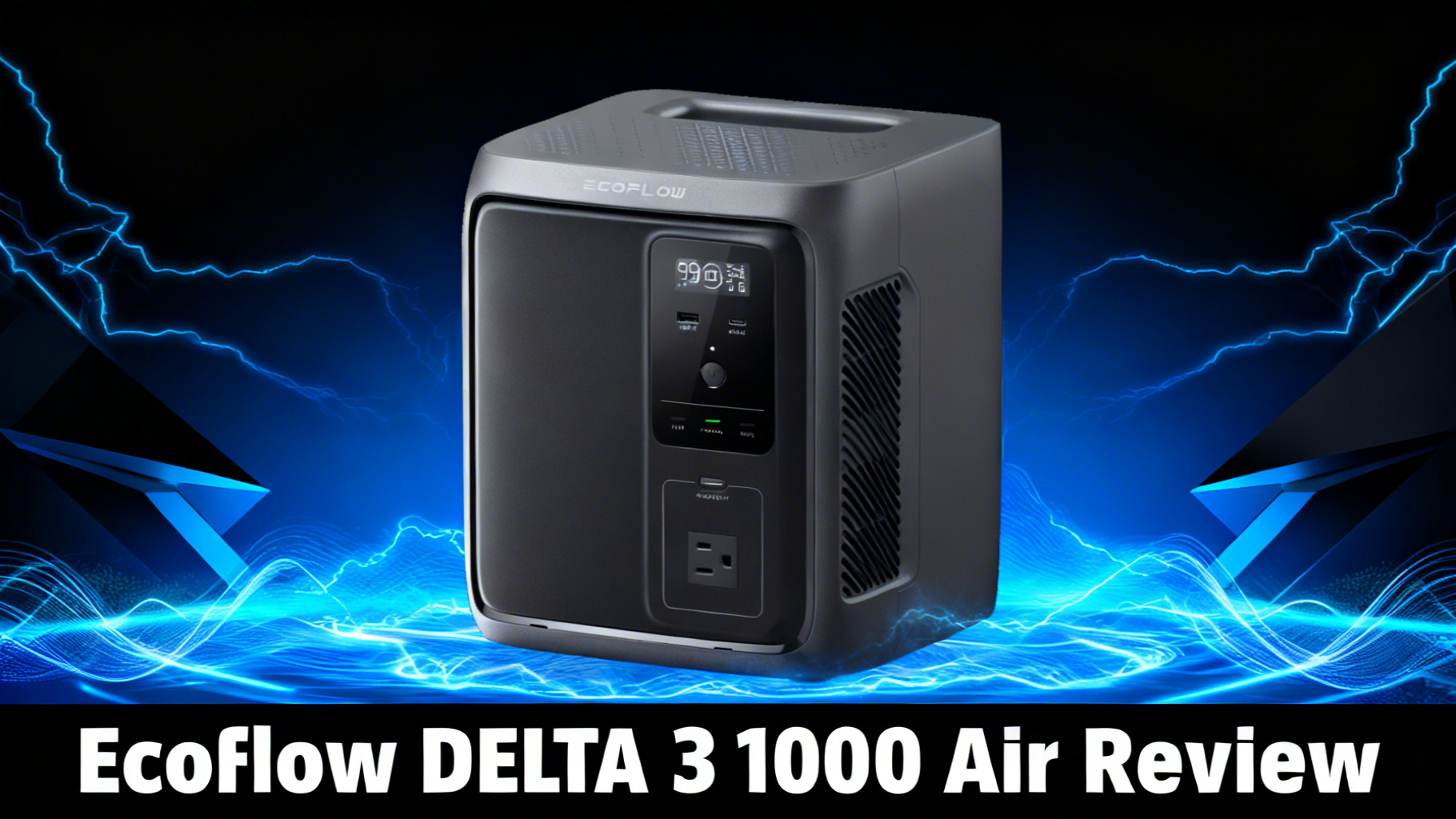
Looking for a portable power station that doubles as a UPS for your home office? The EcoFlow DELTA 3 1000 Air sits in a unique space: it’s not just a backup battery, it’s a power protection device with a 10ms UPS switchover designed to keep your computer, monitor, and router running without missing a beat during outages.
Most portable power stations treat UPS mode as an afterthought. The DELTA 3 1000 Air makes it the main selling point. At $329 (down from $499), this 960Wh unit targets a very specific audience: remote workers, CPAP users, and anyone who needs seamless power continuity rather than raw wattage.

But is the trade-off worth it? With only 500W continuous AC output (800W with X-Boost), the DELTA 3 Air won’t power your space heater or hair dryer. It’s built for low-to-moderate draw devices, and it excels in that lane. Here’s what the data reveals about where this unit shines and where it falls short. For a broader comparison, check our guide to the best portable power stations for 2026.
⚠️ Update: This model has been discontinued
EcoFlow no longer sells the DELTA 3 1000 Air. The closest current successor is the EcoFlow DELTA 3, a 1,024Wh LiFePO4 unit with 1,800W AC output (2,200W with X-Boost, 3,600W surge) and a 5-year warranty, priced around $549. The product links in this review now point to the DELTA 3 successor. We’ve kept this review live for existing owners and for comparison research.
EcoFlow DELTA 3 1000 Air (10ms UPS)
$329 $499
- 960Wh capacity, up to 12 hours backup
- 10ms UPS switchover for home office protection
- 500W AC (800W X-Boost), 22 lbs portable
Quick Specs & Key Features
The headline features tell a clear story. This is a LiFePO4 (lithium ferro-phosphate) unit, which means longer cycle life compared to standard lithium-ion. The 10ms UPS switchover is the fastest in its price bracket, and the four charging methods (AC wall, solar, generator, car) offer flexibility for both home and outdoor use.
What stands out immediately: $329 for a 960Wh LiFePO4 unit with native UPS capability. That’s aggressive pricing. For full technical details, visit the official EcoFlow product page.
10ms UPS Mode: What It Means for Your Home Office
How the 10ms Switchover Works
When the power goes out, a standard power strip gives you nothing. Your computer shuts down, your router dies, and your Zoom call drops. A UPS (Uninterruptible Power Supply) bridges that gap by switching to battery power before your devices notice.
The DELTA 3 1000 Air does this in 10 milliseconds. For context, most computers can tolerate up to 20ms of power interruption without shutting down. That 10ms switchover gives you a comfortable safety margin, meaning your work session continues uninterrupted while the grid sorts itself out.
This is where the “Air” model differentiates itself from traditional portable power stations. It’s not just backup power you turn on after an outage; it’s always-on protection that activates automatically.
UPS vs Standard Pass-Through Charging
Here’s a common point of confusion. Many power stations offer “pass-through charging,” where the unit charges while simultaneously powering connected devices. That sounds like a UPS, but it’s not the same thing.
Pass-through charging typically has a switchover delay of 50-200ms, enough to cause a computer reboot or crash an unsaved document. True UPS mode, like the DELTA 3 Air’s 10ms switchover, is specifically engineered to prevent that gap. If you’re plugging in a desk lamp, pass-through is fine. If you’re running a workstation with unsaved projects, the 10ms UPS switchover is what you need.
Real-World Runtime Estimates
What Can It Power? (960Wh)
💻
Laptop (60W)
~13 hrs
60W
🖥️
Desktop + Monitor
~3.2 hrs
250W
📡
WiFi Router
~64 hrs
12W
😴
CPAP Machine
~16 hrs
50W
Home Office Setup (Laptop + Monitor + Router)
Runtime calculations based on the 960Wh capacity paint a practical picture. A typical home office setup (laptop at 60W, external monitor at 40W, WiFi router at 12W) draws roughly 112W combined. That translates to approximately 7-8 hours of uninterrupted work, factoring in inverter efficiency losses of around 10-15%.
That’s enough to get through a full workday outage in most cases. If you’re just running a laptop and router (72W total), you’re looking at closer to 11 hours.
CPAP Machine Runtime
CPAP machines typically draw between 30-50W depending on model and pressure settings. Based on the 960Wh capacity, runtime data points to approximately 16 hours of continuous operation at 50W, which covers a full night with significant margin. Even at higher draw settings, you’re looking at 2+ full nights of coverage.
Mixed Load Scenarios
What about running multiple devices simultaneously? A laptop (60W) plus desk lamp (10W) plus phone charger (15W) plus router (12W) totals around 97W, giving you roughly 8-9 hours of runtime. The 500W continuous limit means you won’t run into output ceiling issues with typical office equipment.
Want to calculate runtime for your specific devices? Use our runtime calculator tool with the DELTA 3 Air’s 960Wh capacity.
Charging Speed & Methods
AC Wall Charging
Plugged into a standard wall outlet, the DELTA 3 Air charges from 0 to 100%. EcoFlow doesn’t publish an exact AC charge time for the Air model, but based on the 960Wh capacity and typical EcoFlow AC input rates, a full charge should take roughly 3-5 hours depending on input wattage settings in the EcoFlow app.
Solar Charging
Solar charging is one of four supported methods. Pairing the DELTA 3 Air with an EcoFlow 110W or 220W portable solar panel gives you a complete off-grid charging solution. Full charge times depend on panel wattage, sunlight conditions, and panel angle. Under ideal conditions with a 220W panel, expect a full charge in roughly 5-6 hours.
Keep in mind that you rarely get the rated wattage from solar panels in real-world conditions. Cloud cover, angle, and temperature all reduce output. A 220W panel might produce 150-170W on a typical sunny day.
Car Charging
The car charging option is slower but convenient for road trips. It draws power from your vehicle’s 12V outlet while driving. This is the slowest method, but it’s a nice bonus for RV users or road-trippers who want to top off the battery between stops.
What We Love About the DELTA 3 1000 Air
10ms UPS Switchover Protects Critical Devices
This is the standout feature. A 10ms switchover is faster than what most traditional rack-mount UPS units offer in this price range. For home office workers, this means your computer, monitor, and router stay powered during outages without a hiccup. No lost work, no dropped video calls, no corrupted files.
Performance data from the owner community confirms that the switchover is reliable and consistent. This isn’t a gimmick; it’s a genuinely useful feature that separates the DELTA 3 Air from generic portable power stations.
Exceptional Value at $329
At $329 (down from $499), the value proposition is hard to ignore. You’re getting a 960Wh LiFePO4 battery with native UPS capability, four charging methods, and a compact form factor. Compare that to a traditional UPS from APC or CyberPower in the $100-$200 range, which typically offers only 300-600Wh and 10-30 minutes of runtime. The DELTA 3 Air delivers 2-3 times the capacity with the added bonus of portability and solar charging.
Compact and Lightweight at 22 lbs
At 22 lbs and 8.7 × 8.8 × 10.4 inches, this unit fits under a desk or on a shelf without dominating the room. It’s light enough to grab and move to another room during an outage, or take along on a camping trip. For a 960Wh unit, that’s a reasonable weight. It earns a mention in our best EcoFlow for camping roundup.
X-Boost Extends Compatibility to 800W
The base AC output is 500W continuous, but EcoFlow’s X-Boost technology pushes that to 800W (with a 1000W surge). This means the unit can handle occasional higher-draw devices like a small microwave, laser printer, or space heater on a low setting. It’s not a replacement for a high-output unit, but it adds flexibility you wouldn’t get from a strict 500W cap.
What Could Be Better
500W Continuous Output Limits Heavy Appliances
This is the biggest limitation. At 500W continuous (800W with X-Boost), the DELTA 3 Air can’t handle hair dryers, full-size microwaves, electric kettles, or most space heaters. If you need to power high-draw appliances during an outage, this isn’t the right unit. It’s purpose-built for low-to-moderate draw scenarios like office equipment, CPAP machines, and networking gear.
No Battery Expansion Option
Unlike some competitors, the DELTA 3 Air doesn’t support external battery modules. The 960Wh you get is the 960Wh you’re stuck with. If your power needs grow over time, or you experience extended outages, there’s no way to add capacity without buying a second unit entirely.
2-Year Warranty (Shorter Than Some Competitors)
EcoFlow provides a 2-year warranty on the DELTA 3 Air, which is standard for their non-Pro lineup. However, some competitors offer more coverage. Anker SOLIX, for example, provides up to 5-year warranties on similar products. If long-term peace of mind is a priority, that’s worth weighing in your decision.
The DELTA 3 Air’s compact footprint and quiet operation make it a natural fit for apartment living — our EcoFlow for apartments guide covers how to build a complete backup system without violating lease restrictions.
How It Compares: DELTA 3 1000 Air vs Competitors
The comparison table makes the trade-offs clear. The full DELTA 3 offers 3.6 times the AC output (1,800W vs 500W) and slightly more capacity for $170 more. If you need to power appliances beyond office equipment, the standard DELTA 3 is the better choice. Our DELTA 3 vs DELTA 3 Air comparison breaks down every difference.
The Anker SOLIX C1000 review shows a competing option with higher output but no native UPS function at a higher price point. The Bluetti AC70 sits in between, with 1,000W output and 20ms UPS, but less capacity at 768Wh.
Where the DELTA 3 Air wins decisively is on UPS speed (10ms vs 30ms and 20ms) and price ($329 vs $499 and $399). If fast UPS switchover is your priority, no competitor in this price bracket matches it.
EcoFlow DELTA 3 1000 Air (10ms UPS) – Overall Rating
8.0/10
“Best UPS power station under $350 for home office protection”
UPS Performance 9/10
Value for Money 9/10
Portability 7/10
Capacity 7/10
Charging Speed 7/10
Output Power 7/10
Who Should Buy the EcoFlow DELTA 3 1000 Air
✅ Buy this if…
- You work from home and need seamless UPS protection
- You want a compact power station that doubles as a UPS
- You use a CPAP machine and need reliable overnight backup
❌ Skip this if…
- You need more than 500W continuous output for heavy appliances
- You want expandable capacity with extra batteries
- You prioritize maximum capacity over UPS functionality
If you work from home and need reliable backup, our home backup power station guide covers additional options across all budgets. The DELTA 3 Air is the strongest pick in its price bracket if UPS protection is the primary requirement.
The 10ms UPS switchover makes this unit ideal for CPAP users. For more options, see our guide to power stations for medical equipment.
For users who need more capacity without buying a whole new unit, note that the successor EcoFlow DELTA 3 is expandable to 5kWh with add-on batteries for whole-home backup coverage.
Final Verdict: 8.0/10
The EcoFlow DELTA 3 1000 Air earns an 8.0/10 by excelling at a very specific job: affordable, reliable UPS power protection for home office setups. Its 10ms switchover is the fastest in this price bracket, the $329 price point undercuts both traditional UPS units and competing power stations, and the 960Wh LiFePO4 battery provides enough capacity for a full workday of backup power.
The limitations are real but predictable. The 500W continuous output won’t handle heavy appliances, there’s no battery expansion, and the 2-year warranty is shorter than some competitors. These aren’t dealbreakers; they’re trade-offs that come with the lower price and compact design.
The bottom line: If you need a portable power station that also serves as a genuine UPS for your computer, CPAP, or home network, the DELTA 3 1000 Air is the best option under $350. If you need raw power output, look at the standard DELTA 3 instead.
EcoFlow DELTA 3 1000 Air
$329 $499
Best UPS power station for home office under $350
See Successor: EcoFlow DELTA 3 →
Price verified March 2026 – Free shipping available
Frequently Asked Questions
Does the EcoFlow DELTA 3 1000 Air work as a UPS for computers?
Yes. The DELTA 3 1000 Air features a 10ms UPS switchover, which is fast enough to keep computers, monitors, routers, and networking equipment running without interruption during a power outage. For comparison, most computers can tolerate up to 20ms of power interruption without shutting down, so the 10ms switchover provides a solid safety margin.
How long can the DELTA 3 Air power a laptop?
Runtime calculations based on the 960Wh capacity show approximately 13 hours of continuous power for a typical 60W laptop. Real-world results will vary depending on battery health, ambient temperature, and whether the laptop is under heavy load (which can draw 80-100W).
Can the DELTA 3 Air charge with solar panels?
Yes, the unit supports solar charging as one of its four recharging methods (AC, solar, generator, car). Pairing it with an EcoFlow 110W or 220W portable panel provides a complete off-grid charging solution. Full charge times vary based on panel wattage and sunlight conditions. For more on solar technology, see this solar panel basics guide from EnergySage.
Is the 500W output enough for a home office?
For most home office setups, 500W is more than sufficient. A typical setup (laptop at 60W, monitor at 40W, router at 12W, desk lamp at 10W) draws roughly 120W total. With X-Boost enabled, the unit can handle devices up to 800W, covering equipment like laser printers for short bursts.
How does the DELTA 3 Air compare to a traditional UPS (APC, CyberPower)?
Traditional UPS units in the $100-$200 range typically offer 300-600Wh of capacity and 10-30 minutes of runtime. The DELTA 3 Air provides 960Wh (roughly 2-3 times more capacity), is portable, and supports solar recharging. The trade-off is price: at $329, it costs more than a basic UPS but offers significantly more versatility.
Is the EcoFlow DELTA 3 Air suitable for CPAP machines?
The 10ms UPS switchover and 960Wh capacity make the DELTA 3 Air well-suited for CPAP machines, which typically draw 30-50W. Runtime data suggests approximately 16 hours of continuous CPAP operation, covering a full night with substantial margin.
What is the warranty on the DELTA 3 Air?
EcoFlow provides a 2-year warranty on the DELTA 3 1000 Air. This is standard for EcoFlow’s non-Pro lineup. For comparison, some competitors (like Anker SOLIX) offer up to 5-year warranties on similar products, which is worth considering if long-term coverage is a priority.
Related Reads
Originally published: March 22, 2026