
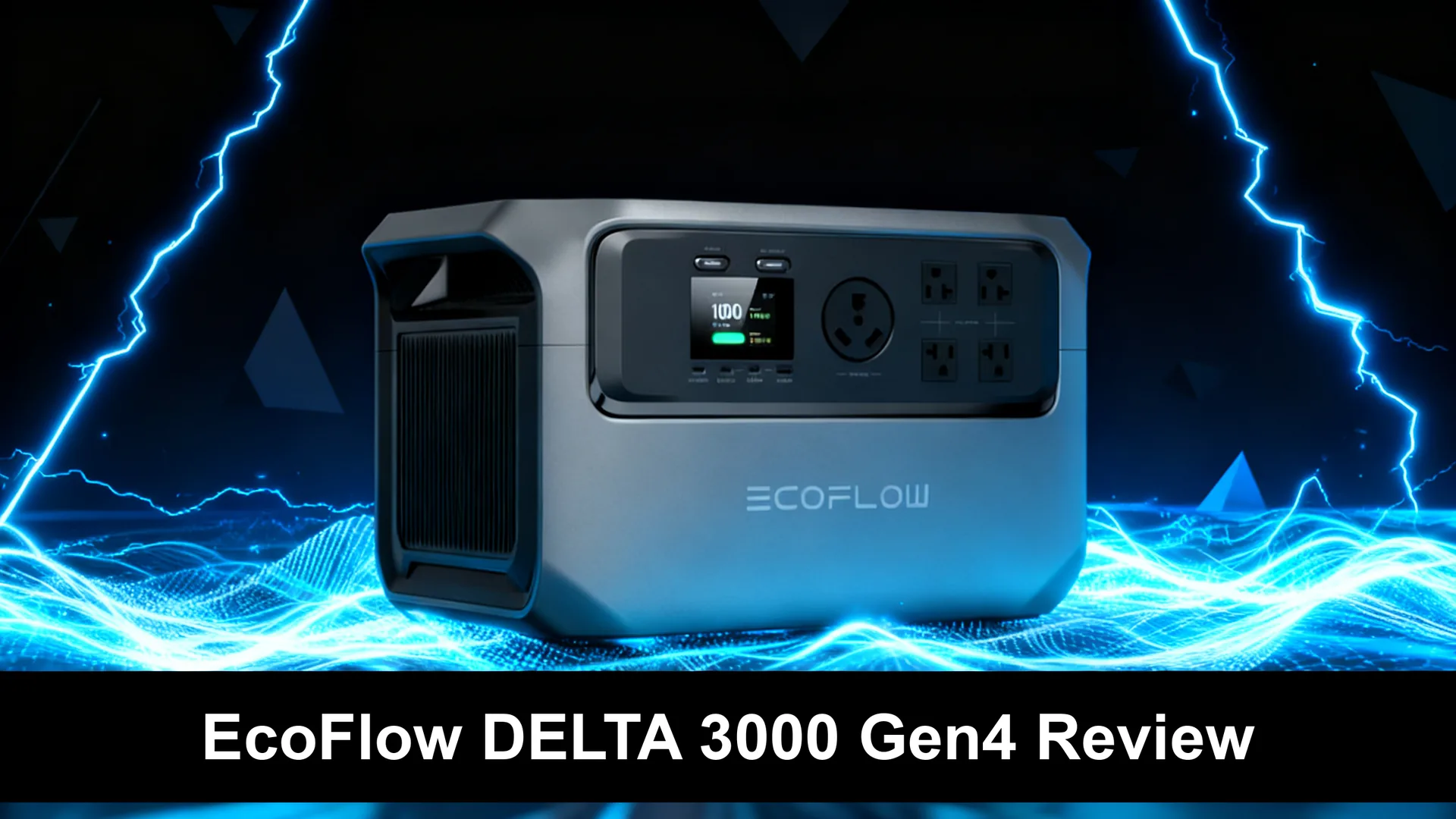
Most people shopping for a 3kWh station don’t need more watts. They need a box they can get down the basement stairs by themselves, and enough stored energy to save the food in the fridge. The EcoFlow DELTA 3000 Gen4, on US pre-order since November 4, 2026, is built for that buyer.
At 57.3 lb, it weighs almost 15 lb less than the DELTA 3 Ultra it replaces, with the same 3,072Wh and 3,600W. So the question this review answers isn’t “is it powerful?” It is: will 3kWh actually get you through your next outage? We ran the numbers hour by hour.
One thing to know before you read on: nobody has this station yet, including us. Everything below comes from EcoFlow’s US product page or from math we show you, and we will update it once owners report back.

EcoFlow DELTA 3000 Gen4
3,072Wh · 3,600W output · Price tracked daily since Sep 26
The lightest way we know of to get 3kWh and 3,600W, with a fridge-focused power mode and up to 5 years of warranty after app registration.
See the deal on EcoFlow Read our reviewThe Short Answer: Who This Station Is For
- Outages under a day: a good fit. One charge lasted about 17 hours in our evening-to-morning scenario.
- Outages of several days: only with a generator or solar. You can never add a battery to this model.
- Today’s prices: $1,299 here, $1,299 for the older DELTA 3 Ultra, $1,699 for the bigger 3800.
EcoFlow DELTA 3000 Gen4: BPH Rating
8.0/10
“The DELTA 3 Ultra’s power in a body you can actually lift”
Power output 9.0
Portability 8.5
Outage features 8.5
Launch value 8.5
Solar input 7.0
Expansion 5.0
Rated on published specs and the November 5, 2026 launch price. No hands-on time yet.
Is 3kWh Enough? One Outage, Hour by Hour
Spec sheets give you a flat runtime for a flat load. Real outages aren’t flat. You cook, you watch something, you sleep, you make coffee. So we built one ordinary outage that starts at 6 pm on a stormy weeknight.
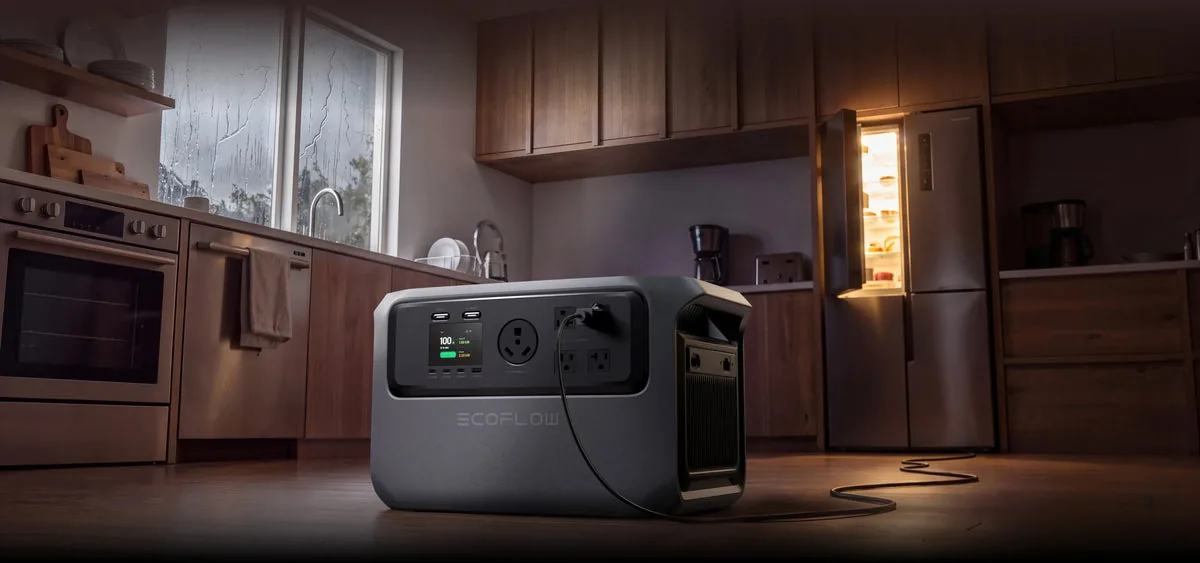
We start from about 2,611Wh of usable energy, which is 3,072Wh minus 15% for conversion losses. EcoFlow doesn’t publish a usable figure, so that 15% is our assumption.
| When | What is running | Energy used | Left |
|---|---|---|---|
| 6 pm to 9 pm | Fridge, internet, LED lights, phones (140W) and a TV (100W) | 720Wh | 72% |
| Dinner | 1,100W microwave, 10 minutes in all | 183Wh | 65% |
| 9 pm to 7 am | Fridge and internet only (100W) | 1,000Wh | 27% |
| 7 am | 800W coffee maker, 10 minutes | 133Wh | 22% |
| 7 am to 11 am | Fridge, internet, lights, phones (140W) | 575Wh | 0% |
| Time | Battery only | With two 160W panels |
|---|---|---|
| 6 pm | 100% | 100% |
| 9 pm | 65% | 65% |
| 7 am | 22% | 22% |
| 10 am | 6% | 6% |
| 11 am | 1% | 9% |
| 2:30 pm | Empty | 20% |
| 6:20 pm | Empty | Empty |
Share of usable energy left, by our estimate. Assumes a clear day, with panels delivering about 224W from 10 am to 2:30 pm.
The result: about 17 hours. You get through the evening, the night and breakfast. Skip the TV and the microwave, and a steady 140W plan stretches to about 19 hours.
Evening: the expensive part of the day
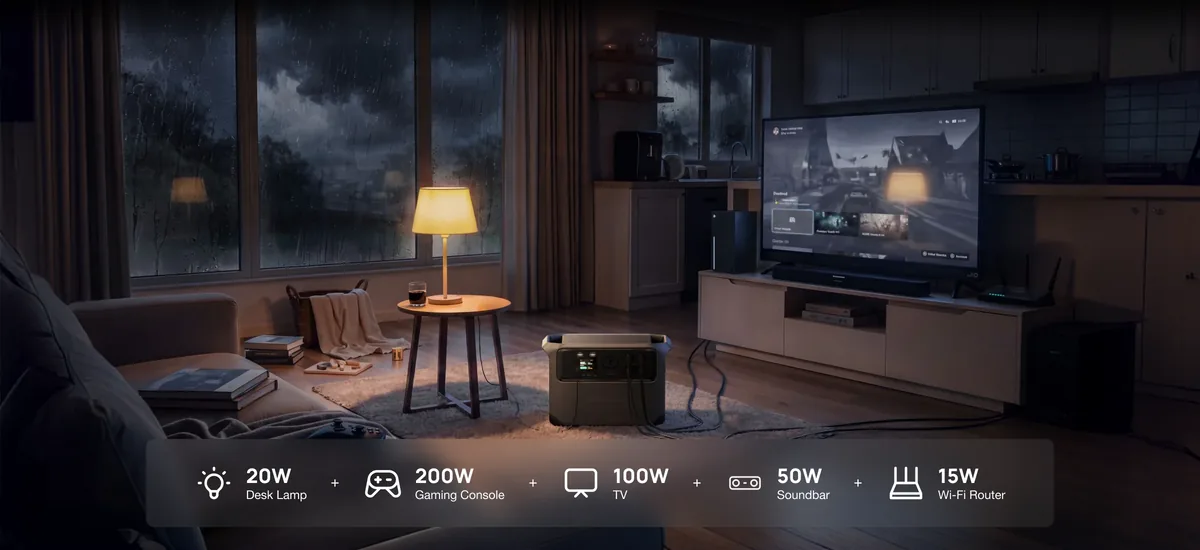
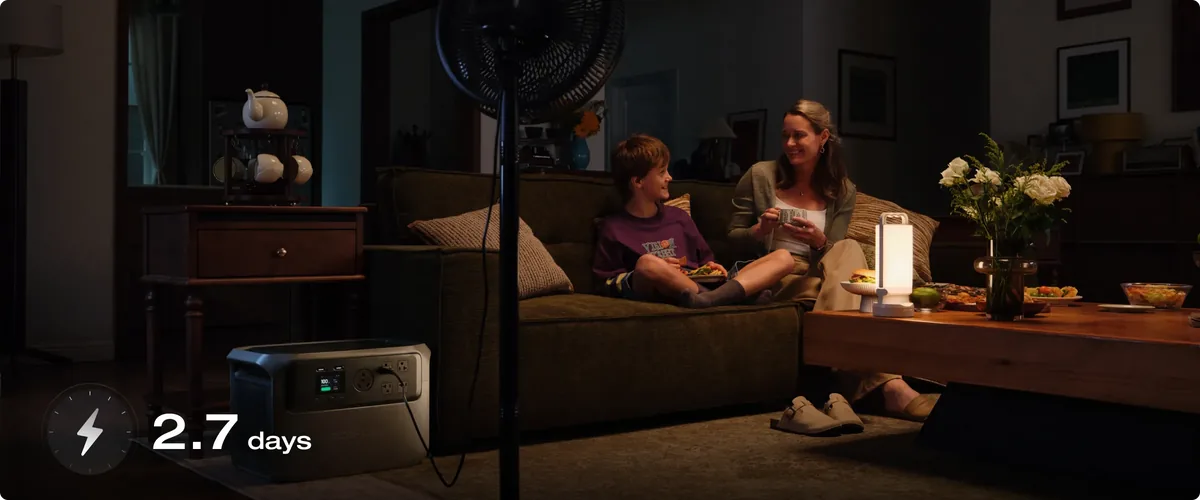
The first three hours take more than a third of the battery. Comfort is what costs you, not the fridge. EcoFlow’s own living room example draws 385W, which would burn through a full charge in under seven hours.
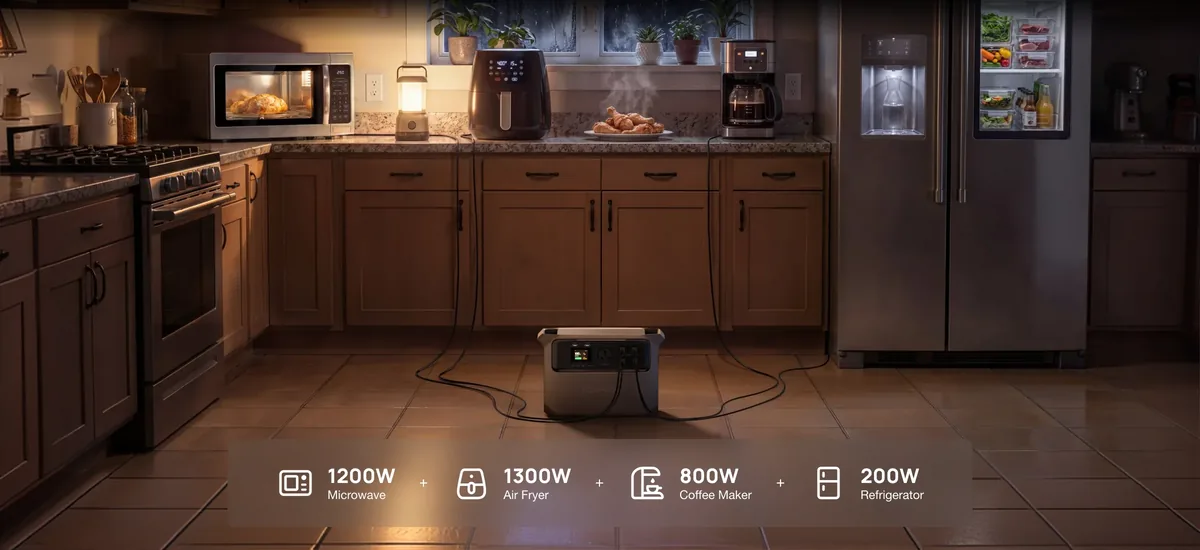
The kitchen trap is different. The station can run all four of these appliances at once, at 3,500W, and the battery would be flat in 45 minutes. Short bursts of one appliance are fine. Ten minutes of microwave costs less than one hour of the evening load.
Overnight: the cheap part
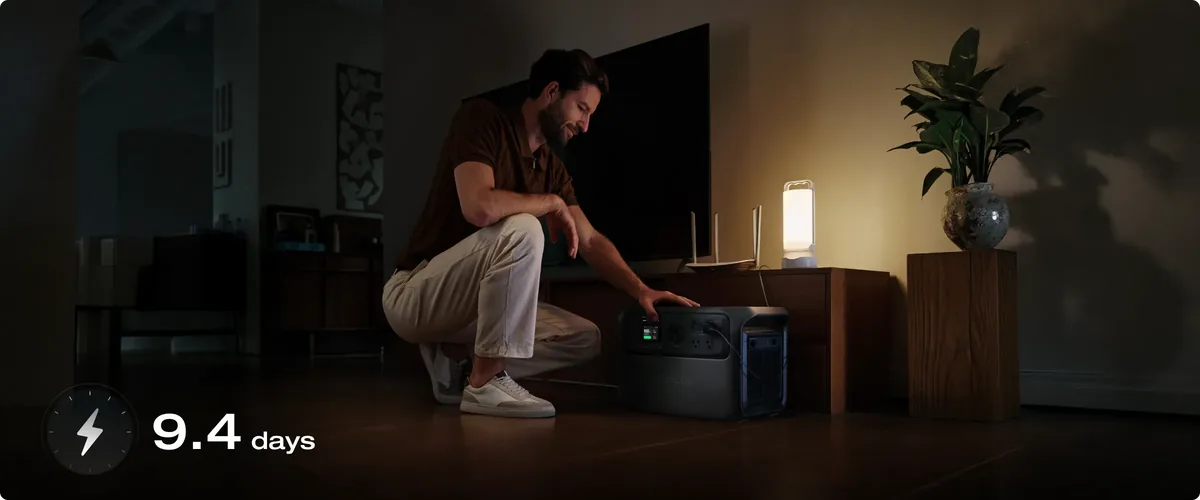
Lights off and phones charged, the load drops to fridge plus internet. Ten hours of sleep costs 1,000Wh. Unplug the router too, if you don’t need it, and you save another 200Wh.
Morning: decide what to do next
At 7 am you have about 22% left, and this is the moment a plan matters. You can run the essentials until late morning, or you can drop everything except the fridge and buy yourself about seven more hours. By noon, you want a way to refill it.
Get our Black Friday alerts for EcoFlow
We track live prices on 40+ models from Jackery, EcoFlow, BLUETTI and Anker SOLIX. When a deal beats the lowest price we've recorded, you'll hear from us. During Black Friday week, one short recap a day at most.
Unsubscribe in one click. We may earn a commission when you buy through our links, at no extra cost to you. Privacy Policy
How to Stretch It Past the First Day
No extra battery will ever fit this model, so a second day depends on what you bring to it. Here are your four refill options, and what each one is worth during an outage.
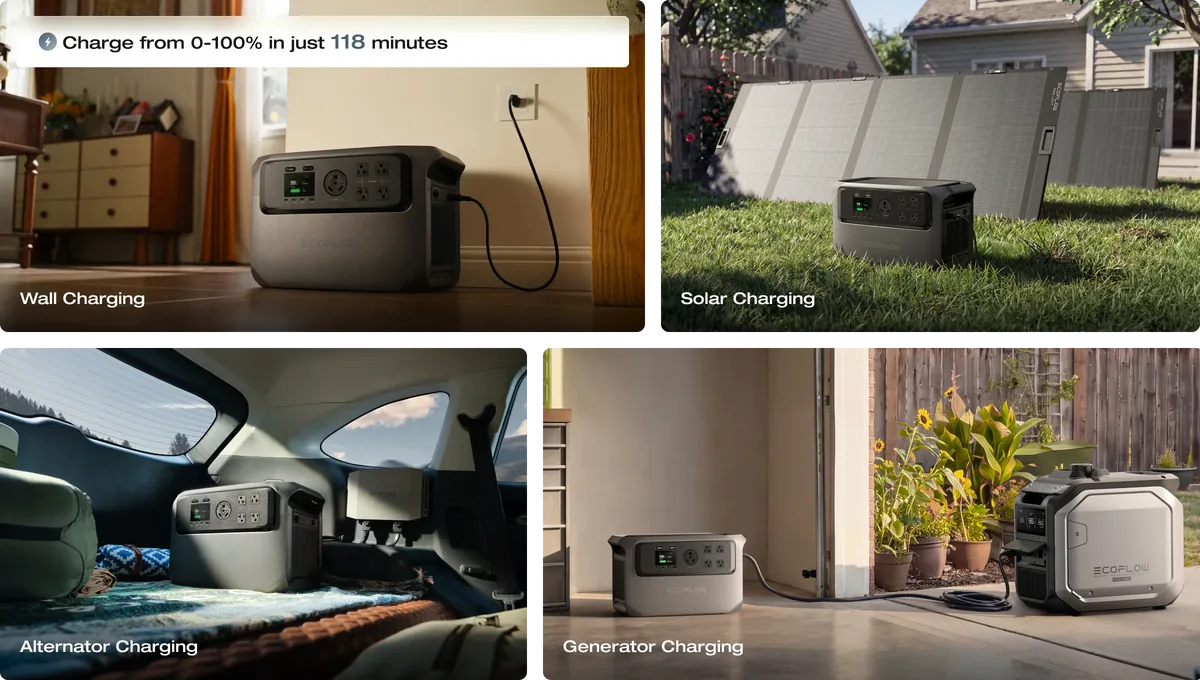
| Source | Input | Full refill | What it buys you |
|---|---|---|---|
| Wall outlet | 1,800W | 118 minutes (EcoFlow) | A full tank if the grid returns briefly |
| Portable generator | 1,800W AC | Not published | Run it about two hours, then shut it off for most of a day |
| Two 160W panels | 320W | About 12 h (EcoFlow) | About 1kWh a day, or seven hours of essentials |
| Full solar array | 1,000W | About 4.4 h of full sun (our math) | About 3.2kWh a day, close to a full day of essentials |
| Alternator Charger | 500W | Not published | A slow top-up from a running vehicle |
The generator is the best friend of this station. Two hours of noise in the morning, then silence for the rest of the day. That is a lot less fuel than running a generator around the clock. Just note that automatic start and stop isn’t available here: EcoFlow says it requires the extra battery port, so you pull the cord yourself.
Solar comes with a wiring limit. There is one input, rated at 11-60V and 20A. Big home panels wired in series can pass 60V quickly, so plan the array before you order it. As the table above shows, two 160W panels turn an 11 am shutdown into about 6:20 pm, assuming a clear day.
A small quirk: the station turns itself on when it charges, and it can’t charge while switched off. Our runtime calculator helps match an array to your own loads.

The easiest refill is the one that happens before the storm. EcoFlow’s Storm Guard 2.0 tops up the station when severe weather is forecast. The DELTA 3800 Gen4 review covers how that mode and the UPS function work, since both models share them.
EcoFlow’s 58-Hour Fridge Claim, Decoded
The headline feature of this generation is Fridge Runtime Boost. You switch it on from the unit or the app, and the station shapes its output around the compressor’s on-off cycle, so less energy is lost while the fridge rests. EcoFlow says that gives up to 58 hours on one fridge, 17 hours more than the average of comparable stations.
That number is real, but it comes from a friendly test. Three details in the footnote change how you should read it:
- The fridge was empty. EcoFlow used a Samsung 654-liter model under no-load conditions, which works out to about 53W on average.
- Nothing else was plugged in. EcoFlow advises against other AC loads while the mode is on.
- One compressor only. A fridge plus a chest freezer doesn’t qualify.
Without the mode, here is what we would plan on:
A stocked modern fridge that gets opened will likely sit near the first figure, and a 15-year-old unit near the second. A cheap plug-in watt meter will give you your own average in a day. Our fridge backup guide walks through it.
Why It Beats the DELTA 3 Ultra, and Where It Doesn’t
EcoFlow names the DELTA 3 Ultra series as the previous generation. The battery and the inverter numbers didn’t move. The body did.
| Spec | DELTA 3000 Gen4 | DELTA 3 Ultra | Who wins |
|---|---|---|---|
| Weight | 57.3 lb | 72.1 lb | Gen4, by 14.8 lb |
| Solar input | 1,000W | 800W | Gen4, by 25% |
| 12V car outlet | Not listed | Yes | Ultra |
| Availability | Ships early December | Ships now | Ultra |
| Capacity | 3,072Wh LFP | 3,072Wh LFP | Tie |
| AC output | 3,600W, 7,200W surge | 3,600W, 7,200W surge | Tie |
| Wall input and UPS | 1,800W, under 10ms | 1,800W, under 10ms | Tie |
| Price | $1,299 | $1,299 | Check today |
How much you actually lift
Published weight of five stations around 3kWh
Manufacturer specs, November 2026. The BLUETTI Elite 300 stops at 2,400W of output.
Those 14.8 lb are the upgrade. Going from 72 lb to 57 lb is the difference between “I need someone to help me” and “I can do this alone, carefully.” EcoFlow’s “smallest and lightest” claim is worded with care, though: it applies to 3kWh stations with 3,600W of output. The BLUETTI Elite 300 is about as light, but stops at 2,400W.
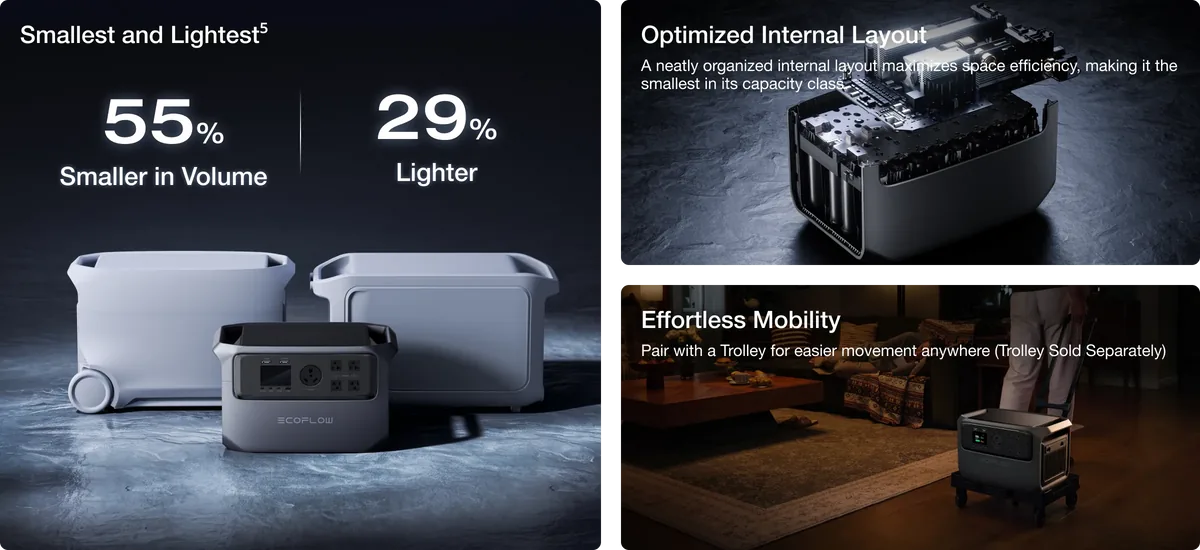
It is still a two-hand lift, with handles and no wheels. If stairs are a regular thing, EcoFlow sells the DELTA Series Folding Transport Cart separately. If you already own an Ultra, nothing here justifies replacing it. For more on the older model, see our DELTA 3 Ultra review.
Beyond the Fridge: Work, Cleanup and Camping
A station like this doesn’t only get used on the first night. These are the three jobs where the 3000 earns its keep the rest of the year.
Working through the outage
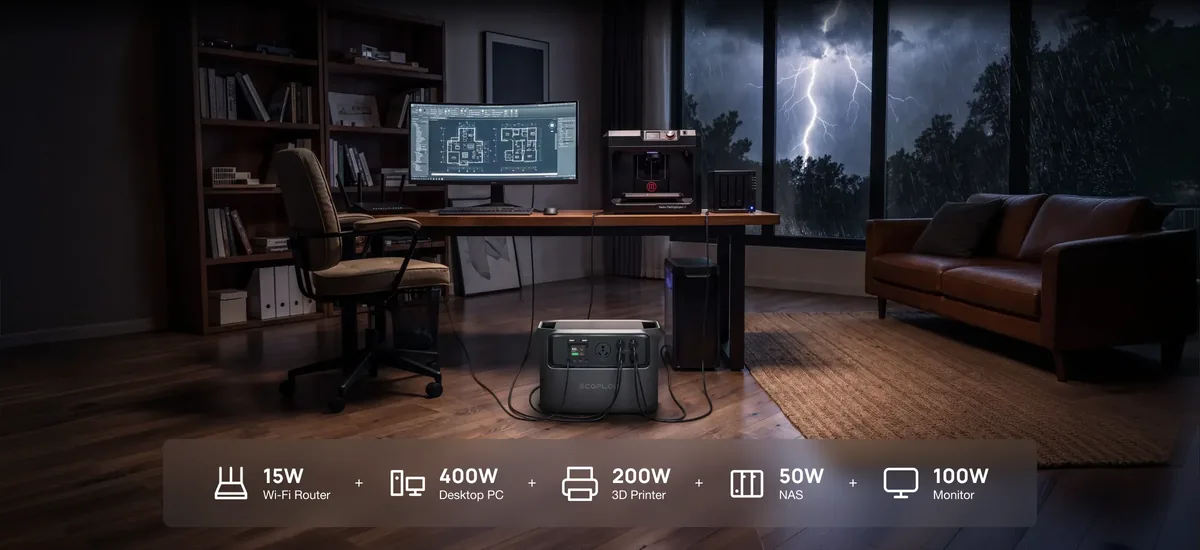
Skip the 3D printer in this picture, and the rest of the desk draws 565W, or about 4.6 hours. That is an afternoon of deadlines. A laptop alone would go about 44 hours, which makes the laptop the smarter choice for a long outage.
The morning after a flood
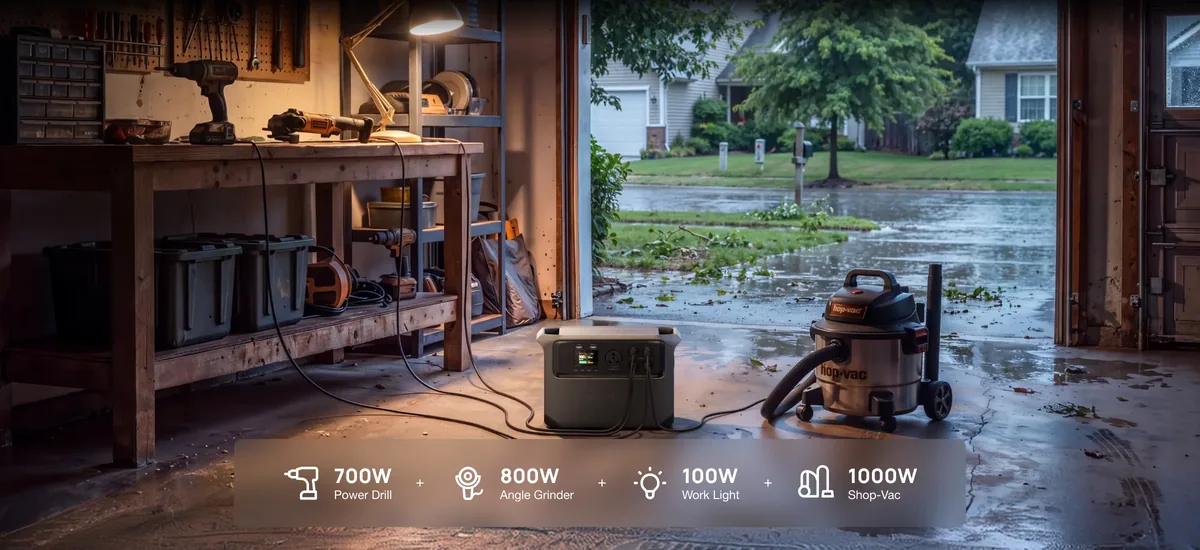
Tools run in short bursts, so a battery lasts much longer than the 2,600W total suggests. The 1,000W shop vac alone would run about 2.6 hours.
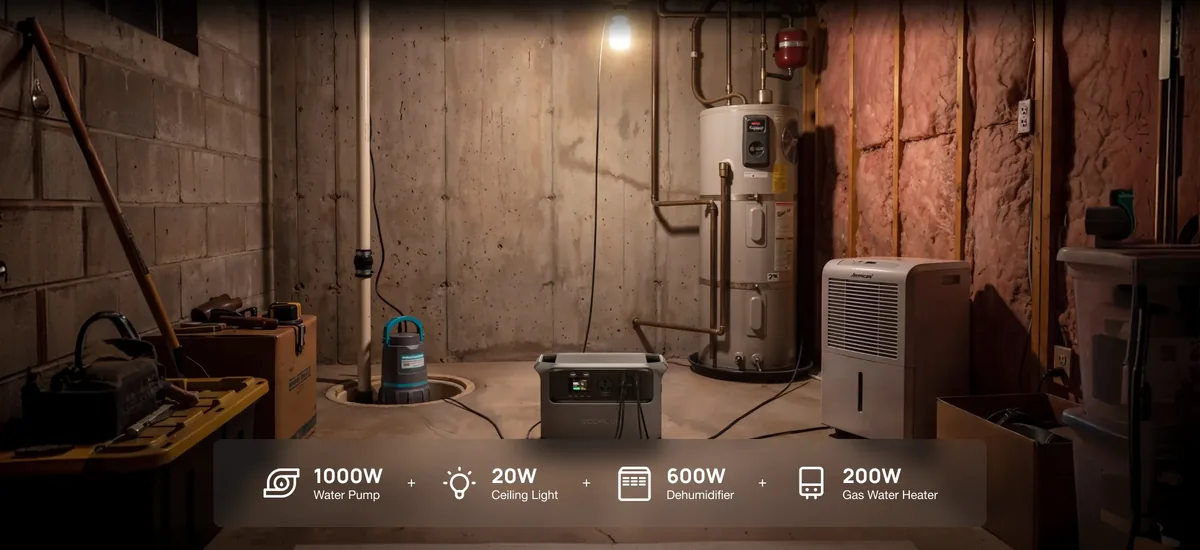
In a wet basement, a 600W dehumidifier gets about 4.4 hours and a 1,000W water pump about 2.6. The pump has to be a 120V model. A 240V deep well pump is out of reach for this station.
A trailer weekend

The 30A outlet looks like a TT-30 in EcoFlow’s photos, which is the plug most small trailers use. A 60W mini fridge runs about 43 hours on its own, and a 57.3 lb station is a realistic one-person load for the truck bed.
Air conditioning is the deal breaker. A 13,500 BTU rooftop unit would last about 1.9 hours, so treat it as a cool-down before bed, not a night of sleep. And with no 12V socket, a 12V compressor fridge needs an AC adapter.
Quick load table
| Device | Draw | One full charge |
|---|---|---|
| Router and modem | 20W | About 130 h |
| CPAP, no humidifier | 56W | About 47 h |
| Laptop in use | 60W | About 44 h |
| Microwave | 1,100W | About 2.4 h of cooking |
| Space heater on high | 1,500W | About 1.7 h |
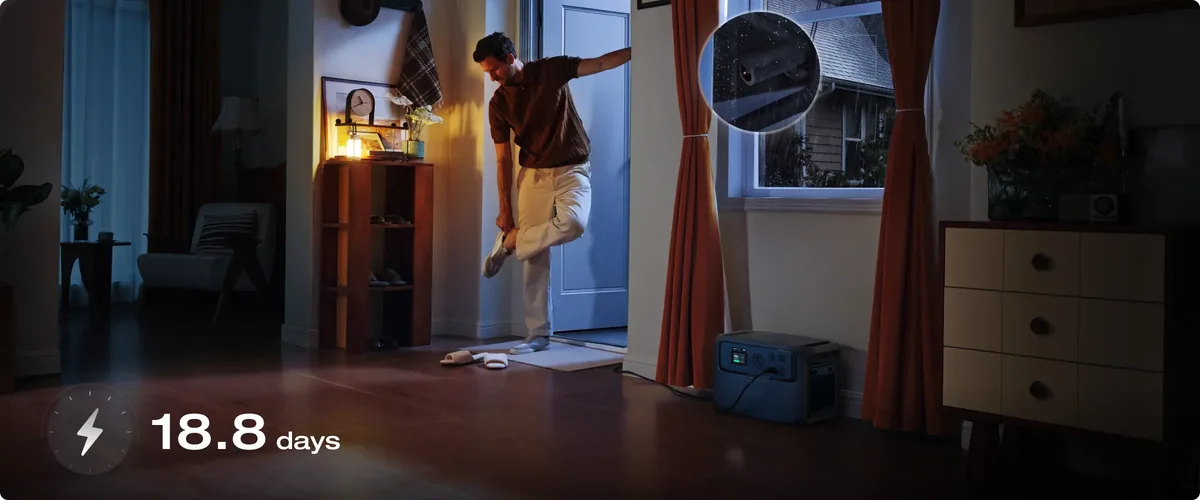
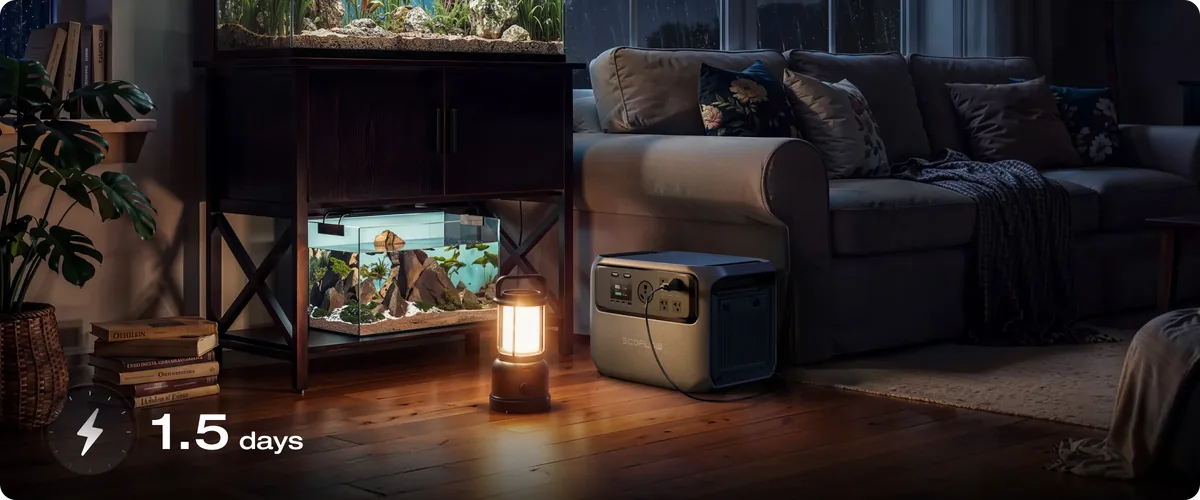
EcoFlow’s own small-load estimates, which assume ideal conditions, look like this:
Living With It: Ports, Noise and Idle Drain
Here are the details you only notice after a few weeks of ownership.
Ports. The front carries four 20A outlets and the 30A outlet. USB covers most needs: one 140W USB-C for a laptop, two 65W USB-C and one 36W USB-A. The catch is that the 65W ports share a circuit with the USB-A, limited to 16W when they run together.
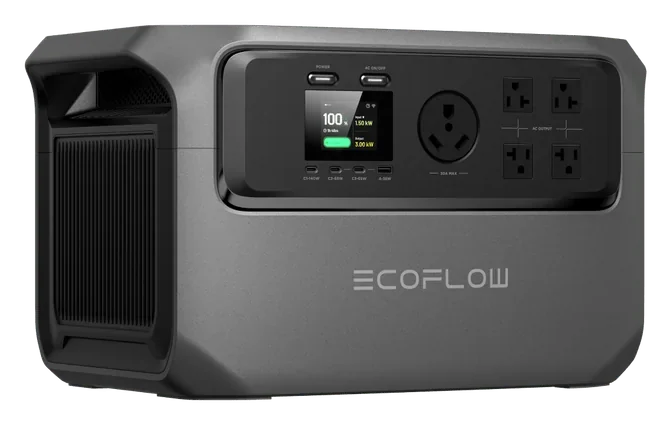
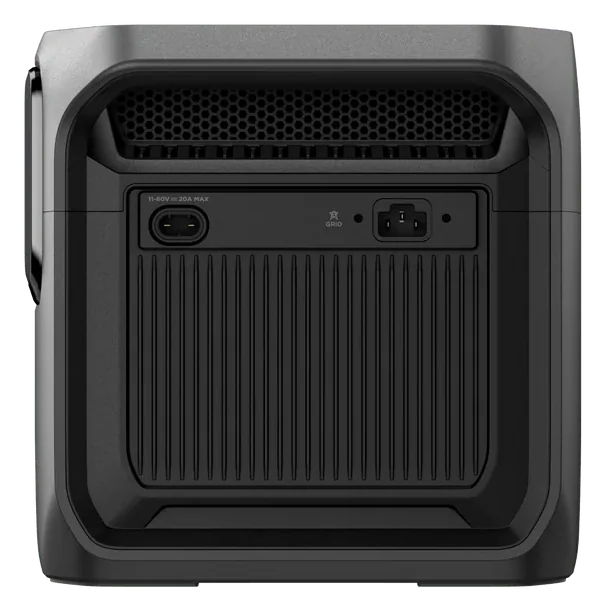
Noise. EcoFlow lists up to 30 dB at 600W, 40 dB at 1,800W and 50 dB at the full 3,600W. In a bedroom overnight with only a fridge and a router running, you should barely hear it, if EcoFlow’s numbers hold up.
Idle drain. This is the spec nobody checks. With the inverter on and nothing plugged in, the station burns 14W. Over a full day, that is about 336Wh, or nearly two and a half hours of essentials. So switch AC off when you aren’t using it. In 3W standby, EcoFlow’s theoretical figure is about 42 days.
Storage. For a station that lives in a closet, EcoFlow estimates up to 99% of the charge remains after a year. We would still top it up every few months, at least until owners confirm that.
Temperature. It charges from 32°F and discharges from 14°F, with IP20 protection, so a damp or freezing garage is a bad home. Our guide to power stations in freezing temperatures has the details.
Where It Wins, Where It Falls Short
Where it wins
- 57.3 lb with 3kWh and 3,600W on board
- a 118-minute wall charge
- a 30A outlet beside four 20A outlets
- 3W standby for a station that waits for storms
Where it falls short
- No extra battery option, now or later
- 120V only, so no well pump or central air on 240V
- One solar port, capped at 1,000W and 60V
- No 12V socket and no wheels
3000 or 3800: Is the Extra $400 Worth It?
This is the real decision for most buyers. Outlets, inverter and USB ports are identical on EcoFlow’s spec table, so here is only what differs:
| If you care about | DELTA 3000 Gen4 | DELTA 3800 Gen4 |
|---|---|---|
| Launch price, November 5 | $1,299 | $1,699 |
| Weight | 57.3 lb | 67.5 lb |
| Wall refill | 118 minutes | 146 minutes |
| Capacity | 3,072Wh | 3,763Wh |
| Solar | 1,000W, one port | 2,000W, two ports |
| Extra batteries | None | Up to two |
| Automatic generator start | No | Yes, via the battery port |
| Shipping | Early December | Late November |
Taken as capacity alone, $400 for 691Wh is a poor trade at about $579 per kWh. The 3000’s own rate is about $423. What you are really buying is the option to grow.
So keep it simple. If your outages are short and you have a generator, or if lifting is the issue, save the $400. If you have ever lost power for three days, read our DELTA 3800 Gen4 review first.
Watch the 3000 and 3800 compared
The Other 3kWh Stations Worth a Look
Live prices for the closest options:
| Model | Capacity / output | Price now | Per kWh | Lowest tracked | Link |
|---|---|---|---|---|---|
 EcoFlowDELTA 3000 Gen4 | 3,072Wh · 3,600W | $1,299 | $423 | Tracking since Sep 26 | Check deal |
 EcoFlowDELTA 3800 Gen4 | 3,763Wh · 3,600W | $1,699 | $452 | Tracking since Sep 26 | Check deal |
 EcoFlowDELTA 3 Ultra | 3,072Wh · 3,600W | $1,299 | $423 | $1,199 (Oct 8) | Check dealExtra 5% off with code BPHUB5 |
 JackeryHomePower 3000 | 3,072Wh · 3,600W | $1,499 | $488 | $1,284 (Oct 8) | Check deal |
 BLUETTIApex 200 | 2,560Wh · 3,200W | $1,099 | $429 | Tracking since Sep 26 | Check deal |
Prices come from each brand's US store and refresh automatically every few hours (oldest check on this table: Nov 6, 5:59 AM ET). Sale prices can change within the hour; the price in your cart is the one that counts. Prices, not coupon codes: some stores stack extra member or sign-up discounts at checkout.
Jackery HomePower 3000. Its closest rival, and nearly a twin on paper: 3,072Wh, 3,600W and 1,000W of solar at 59.5 lb, for $1,499. EcoFlow lists a quicker UPS switchover, under 10ms against 20ms, and has the fridge mode. Our HomePower 3000 review has the full picture. Let price and shipping date decide this one.
BLUETTI Apex 200. Smaller at 2,560Wh and 3,200W, but it fixes exactly what the 3000 lacks. It accepts 3,000W of solar, expands to 33.28kWh, and includes 12V and Anderson ports. If you think in systems rather than boxes, read our Apex 200 review.
Need 240V? Neither of these helps much at this size. Look at the DELTA Pro 3 or the BLUETTI Apex 300. Our EcoFlow home backup guide sorts the options by what you need to power.
Price, Solar Bundle and Shipping Date
The list price is $1,699. The early bird offer runs through December 7, 2026, and it was $1,299 at checkout when we checked on November 5. The live price right now is $1,299. Units are due to ship in early December, so an order today won’t help with a storm this month.
There is one bundle: the station plus two 160W panels, listed at $1,799 on November 5, against a $2,299 regular price. Given what those panels add to the second day of an outage, it is the version we would look at first. Other EcoFlow offers are on our EcoFlow Black Friday deals page.
Full DELTA 3000 Gen4 Spec Sheet
| Battery | 3,072Wh LFP, no expansion, 6,000 cycles to 70% |
| Output | 120V, 3,600W, 7,200W surge, 4 × 20A and 1 × 30A outlets |
| USB | USB-C 140W, 2 × USB-C 65W, USB-A 36W, no 12V socket |
| Inputs | Wall 1,800W, solar 1,000W (11-60V, 20A), generator 1,800W AC |
| Backup | UPS under 10ms (no HID), 14W idle, 3W standby |
| Environment | Charge 32-113°F, discharge 14-113°F, IP20, UL 9540A |
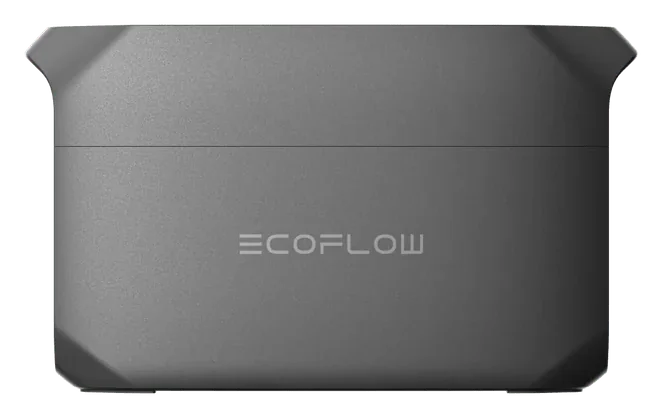
| Body | 57.3 lb (26 kg), two handles, Wi-Fi and Bluetooth |
| Warranty | 3 years, plus 2 with app registration |
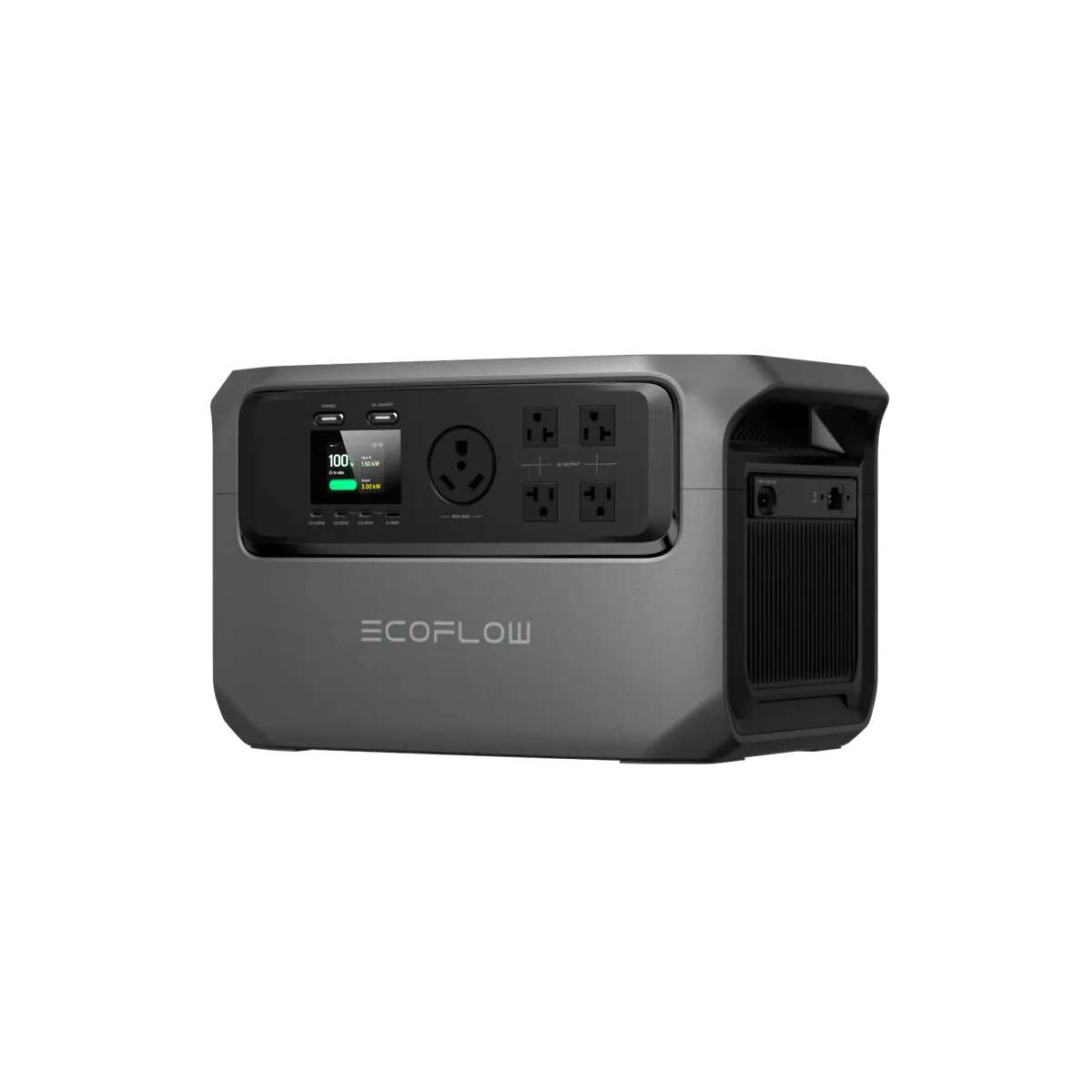
In the box: the station, an AC cable, one solar cable (XT60i to LP60), an AC cable retention kit, and the manuals. Panels and the cart cost extra. Also compatible: EcoFlow’s 110W, 400W, NextGen 160W and 220W Bifacial panels, Smart Generators 3000 and 4000 at 1,800W, the 500W and 800W Alternator Chargers (the latter limited to 500W), and WAVE 2, WAVE 3 and GLACIER Classic as power supply only.
DELTA 3000 Gen4 FAQ
Can you add a battery to the DELTA 3000 Gen4?
No. This model has no extra battery port, so 3,072Wh is its final capacity. Solar or a generator is the only way to extend an outage.
Is the DELTA 3000 Gen4 the same thing as the EcoFlow DELTA 4?
Yes, in everyday use. DELTA 4 is a nickname some sites use for the Gen4 series. EcoFlow’s US store sells it as the DELTA 3000 Gen4.
Can one person carry the DELTA 3000 Gen4?
At 57.3 lb it is a careful two-handed lift, and the lightest 3,600W option in its class. There are no wheels, and EcoFlow’s folding cart is sold separately.
How long does the DELTA 3000 Gen4 last during a power outage?
By our estimate, about 19 hours on a steady 140W of fridge, internet, lights and phones, or about 17 hours in a normal evening with TV and a little cooking.
Will it run a refrigerator for 58 hours?
That is EcoFlow’s figure, from an empty test fridge with Fridge Runtime Boost on. We would plan on about 33 hours at an 80W average, and about 17 hours for an older fridge at 150W.
Should I buy the DELTA 3000 Gen4 or a discounted DELTA 3 Ultra?
The Gen4 weighs 14.8 lb less and takes 200W more solar. The Ultra adds a 12V socket and ships now. If it sells for much less and weight doesn’t matter, it is still a sound buy.
Can the DELTA 3000 Gen4 run an RV air conditioner?
Yes, for about 1.9 hours on a 13,500 BTU unit by our math, through the 30A outlet. It won’t last a full night.
Can I charge the DELTA 3000 Gen4 with a generator?
Yes, at up to 1,800W through the AC input. Automatic generator start isn’t available on this model, because EcoFlow ties it to the extra battery port.
When does the DELTA 3000 Gen4 ship, and what does it cost?
EcoFlow says it ships in early December. It lists at $1,699, and the early bird price on November 5, 2026 was $1,299 at checkout, with the offer running through December 7.
Does the DELTA 3000 Gen4 work with 240V appliances?
No. EcoFlow lists 120V output only, so 240V well pumps, dryers and central air are off the table.
Compare it head to head: BLUETTI Apex 200 vs EcoFlow DELTA 3000 Gen4 · DELTA 3 Ultra vs DELTA 3000 Gen4 · DELTA 3000 Gen4 vs DELTA 3800 Gen4 · EcoFlow DELTA 3000 Gen4 vs Jackery HomePower 3000 · All comparisons
Final Verdict: A One-Night Station You Can Actually Carry
The DELTA 3000 Gen4 does one job very well. It gets a household through a night without power, and it is light enough that you will actually use it.
Think of it as a complete product rather than the start of a system. If you pair it with a generator or the solar bundle, it can do much more than our 17-hour scenario. If you want to grow later, it can’t. Our rating: 8.0/10, based on published specs and the launch price, and we will revisit it once real owners weigh in.
Keep Reading
Originally published: November 5, 2026