
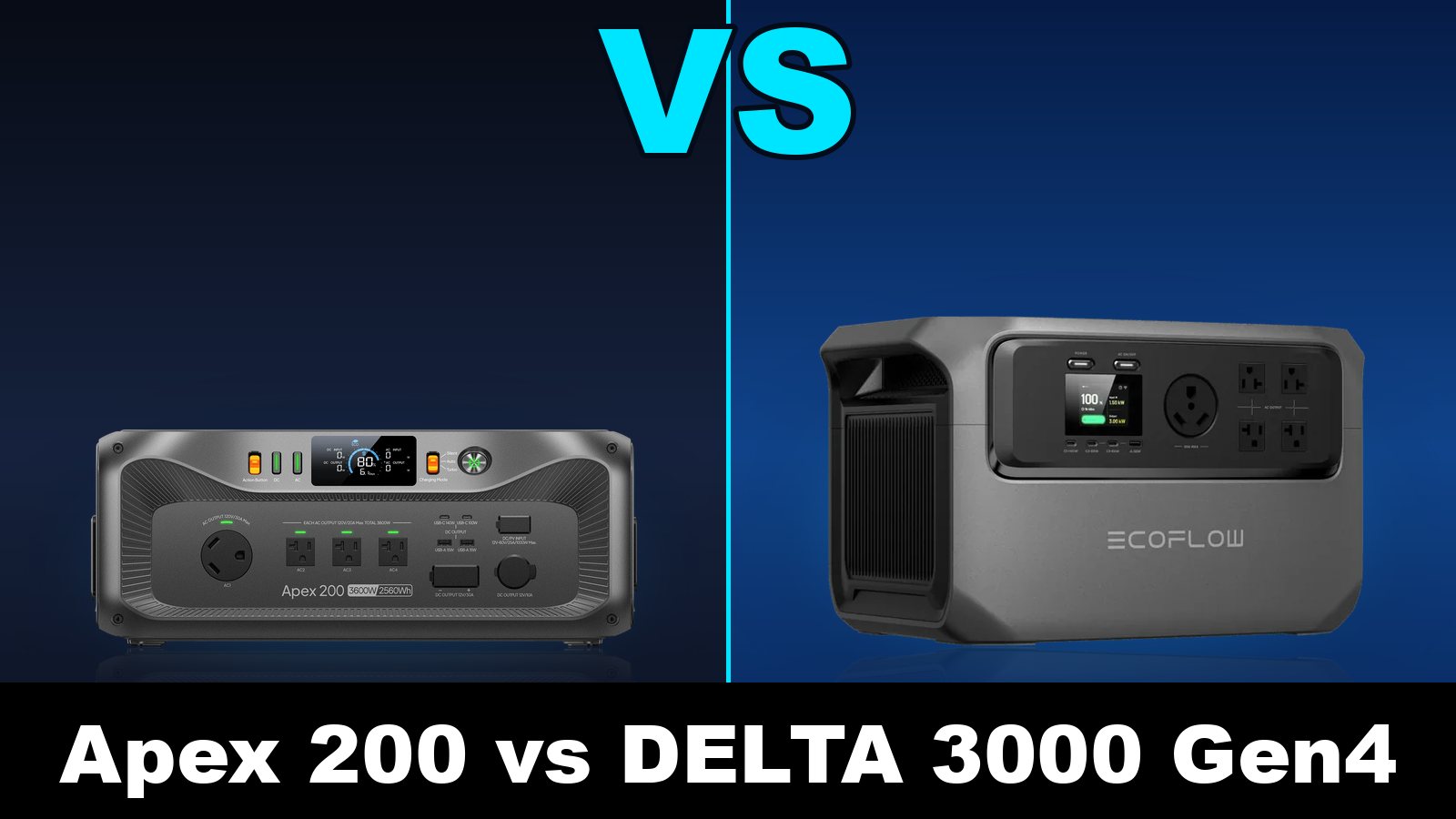

Apex 200
- day two means another battery
- you can feed it over 1,000W of solar
- your gear runs on 12V
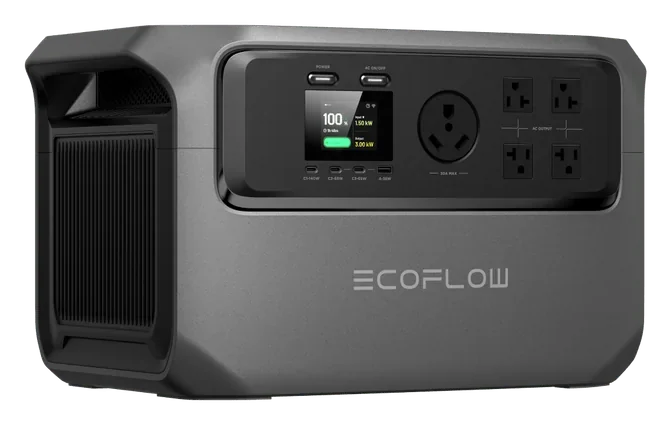
DELTA 3000 Gen4
- day two means a generator
- you want the most from one box
- motors need a 7,200W surge rating
Prices and stock checked by our price engine on November 6, 2026 at 9:59 AM EST. Each product is rechecked several times a day; the time refreshes when you load the page.
Both get you through the first night. Bring a generator and take the EcoFlow; plan on more batteries or a big array and take the BLUETTI.
The EcoFlow DELTA 3000 Gen4 starts stronger at 57.3 lb: 3,072Wh, 3,600W, a 7,200W surge rating and a UPS under 10ms that needs no setup. It never grows, so a long outage depends on what you feed it. The BLUETTI Apex 200 starts smaller at 59.3 lb, with 2,560Wh and 3,200W, then takes up to six expansion batteries and 3,000W of solar. It also keeps a 12V socket and a 12V/30A Anderson port, which the EcoFlow doesn’t list. If your outages end when the grid or a generator comes back, the bigger starting box wins.
Below: the gaps with numbers, a 20-second calculator for your own gear, eight situations built around that second day, and the figures nobody has published yet. No independent test of either unit exists so far.
Prices $200 apart today. Only 2 lb separates them and BLUETTI and EcoFlow both rate 6,000 cycles to 70%. The DELTA 3000 Gen4 stores 512Wh more, delivers 400W more and has the bigger surge rating. The Apex 200 is the only one with a battery port, a 12V socket and 3,000W of solar.
- a second battery is the plan
- your array tops 1,000W
- you need 12V/30A in a rig
- a generator covers day two
- you start motors
- you want UPS on by default
Six gaps behind the day-two question
Same weight class, same 120V limit, same 6,000 cycles to 70%. Here is where the two launches part ways.
Will it run your setup? Check in 20 seconds
Estimates use 85% usable capacity and 70% of rated solar output. Real results vary with temperature, inverter load, shade and appliance cycling. Fridge and freezer watts are daily averages and do not include compressor startup surges.
Runtime by appliance, one at a time
Plain arithmetic, not measurements: about 2,176Wh usable on the Apex 200 and 2,611Wh on the DELTA 3000 Gen4. Neither unit has reached an independent lab yet.
Appliance for appliance, the 3000 Gen4 lasts 20% longer than the Apex 200.
Same appliance, same watts: the gap is always the size of the battery.Get our Black Friday alerts for power stations
We track live prices on 40+ models from Jackery, EcoFlow, BLUETTI and Anker SOLIX. When a deal beats the lowest price we've recorded, you'll hear from us. During Black Friday week, one short recap a day at most.
Unsubscribe in one click. We may earn a commission when you buy through our links, at no extra cost to you. Privacy Policy
The price gap, in numbers
The EcoFlow DELTA 3000 Gen4 costs $200 more than the BLUETTI Apex 200 and adds 512Wh: that is $0.39 per extra Wh, against $0.43 per Wh for the Apex 200.
Prices refresh daily from BLUETTI US and EcoFlow US.With both brands rating 6,000 cycles to 70%, the cost per Wh above also works as a like-for-like cost per cycle. Inside the EcoFlow range, the route past 3kWh is a different model: the DELTA 3800 Gen4 has the battery port this one lacks. Prices move often; our engine refreshes them daily.
Eight modeled situations, worked out
All of these use 85% of rated capacity. The essentials plan draws 140W: a fridge, internet, lights and phones, about 3.4kWh a day.
Night one on essentials
A 6 pm outage takes the Apex 200 to about 9:30 the next morning and the 3000 Gen4 to about 1 pm. Both clear the night. The EcoFlow buys you a slower morning.
Day two with a portable generator
This is the EcoFlow’s day. Each refill banks 512Wh more, so the generator stays off longer. BLUETTI lists about 1.6 h from a compatible generator, with no wattage given. Plan to pull the cord yourself: EcoFlow says automatic start needs the battery port this model lacks, and BLUETTI hasn’t published such a feature for the Apex 200.
Day two with no fuel at all
One B300K carries the plan well into the second day, and one B500K nearly to the end of it. Nothing you can buy does that for the 3000 Gen4. If nobody in your house will ever run a generator, stop here.
How many panels are worth it
Up to 1,000W the two are close. Past that only the Apex 200 keeps taking power, but 3,000W fills 2,560Wh in a little over an hour by our math (BLUETTI says about 1.7 h), then sits idle. A big array only pays if a big battery bank is waiting for it.
Dinner on three appliances
The 3000 Gen4 holds it. The Apex 200 alone is 200W over its rating, in a band BLUETTI allows for 2 minutes. Stagger the toaster, or connect any expansion battery to lift it to 3,600W.
A well pump that kicks hard
BLUETTI’s manual gives the Apex 200 3,840 to 4,800W for 10 seconds and only half a second above that. An expansion battery widens the band to 5,400W. EcoFlow rates 7,200W with no duration, so call it the safer bet on paper until someone measures it.
A rig full of 12V gear
The Apex 200 feeds them directly. EcoFlow lists no 12V output on the 3000 Gen4, so 12V gear needs an AC adapter, and the inverter’s 14W idle draw alone costs about 336Wh a day. Both accept a 30A shore cord for the rest of the rig.
A desktop PC when the grid blinks
EcoFlow lists under 10ms with no HID link, so the PC won’t get a shutdown signal. BLUETTI lists within 15ms in a UPS mode you must turn on in the app, and says it isn’t for data servers or workstations. EcoFlow also says this isn’t a 0ms professional UPS. For a home PC, the EcoFlow asks less of you.
Nine more differences, the spec sheet and the box
Smaller gaps that rarely decide the purchase, then the full specifications and what ships in the box.
Apex 200 and DELTA 3000 Gen4 weight, dimensions and full specifications
Weight: 59.3 lb for the Apex 200 and 57.3 lb for the DELTA 3000 Gen4. Dimensions: 20.67 × 12.87 × 8.31 in and 16.77 × 11.36 × 12.09 in. Everything else is in the sheet below.
BLUETTI Apex 200 and EcoFlow DELTA 3000 Gen4 full specifications
Every published figure for both units, grouped. Green marks the better value.
What’s in the box
Apex 200
- Apex 2002,560Wh, 59.3 lb
- AC charging cable1.8 m, 15A
- MC4 connector wrench
- Quick start guide and warranty card
- Turbo cable, Hub A1 and battery cablessold separately
DELTA 3000 Gen4
- DELTA 3000 Gen43,072Wh, 57.3 lb
- AC charging cable
- Solar charging cableXT60i to LP60
- AC cable retention kit, manuals and warranty card
From BLUETTI’s US manual and page, and EcoFlow’s US page. Panels, the Turbo cable, the Hub A1 and the folding cart are extras.
06 · ChargingHow fast each one refills
Shorter bar, faster refill. Each row is scaled to its slower unit.
Apex 200: Turbo uses the P050A port and a TT-30P or 14-50P cable sold separately; the included 15A cable tops out at 1,800WDELTA 3000 Gen4: EcoFlow publishes 118 minutes from the wall; it can’t charge while switched off, so it turns itself on to do it
Our solar times assume panels deliver 70% of their rating; the brands’ figures assume ideal sun.
Every port, side by side
Apex 200
DELTA 3000 Gen4
What that means in use: the 3000 Gen4 has the extra 20A outlet and a third USB-C. The Apex 200 has a second USB-A, the 12V side the EcoFlow lacks and a battery port, plus a separate high-voltage solar input.
08 · NoiseNoise: Apex 200 vs 3000 Gen4
EcoFlow rates the EcoFlow DELTA 3000 Gen4 at up to 30dB at 600W, 40dB at 1,800W and 50dB at 3,600W. The BLUETTI Apex 200 has one published number: 50 dB max. They meet at the top, and EcoFlow simply publishes more.
All brand figures; nobody independent has a meter on either unit yet.Every figure we found, with its source
Measured by a tester Brand figure
- Near a bedroom, use the Apex 200’s Silent mode, which caps AC input at 600W, or keep the EcoFlow’s load low.
Cold and heat: Apex 200 vs 3000 Gen4
Pick by climate. The BLUETTI Apex 200 runs down to −4°F, against 14°F. The EcoFlow DELTA 3000 Gen4 works up to 113°F, against 104°F.
Figures from the BLUETTI US manual and EcoFlow US page. Both stop charging below 32°F.- In an unheated garage, warm either unit above 32°F before a refill.
- In a sun-baked rig, the Apex 200 reaches its limit 9°F sooner.
App, UPS and smart features
The EcoFlow DELTA 3000 Gen4 needs less setup: under 10ms, plus a fridge mode and NWS storm data. The BLUETTI Apex 200 needs more care but does more: a battery port, smart outlets and off-peak charging.
Two apps, two philosophies on automation.Green zone: a switch under about 16ms, which most desktop PCs ride through without restarting.
Can you add a battery later? Only the BLUETTI Apex 200, up to 33.28kWh. The EcoFlow DELTA 3000 Gen4 has no battery port.
Can it start a generator by itself? EcoFlow says automatic start and stop requires the extra battery port, so not on the EcoFlow DELTA 3000 Gen4. BLUETTI lists no such feature for the BLUETTI Apex 200.
Does it have a fridge mode? The EcoFlow DELTA 3000 Gen4 shapes its output around one compressor appliance, with nothing else on AC. BLUETTI lists no equivalent for the BLUETTI Apex 200.
Can it charge off-peak? The BLUETTI Apex 200 has a TOU mode. EcoFlow’s DELTA 3000 Gen4 page doesn’t list one.
Does it work as a UPS? The EcoFlow DELTA 3000 Gen4 lists under 10ms without HID communication. The BLUETTI Apex 200 lists within 15ms once UPS mode is on in the app.
Does it prepare for storms? Storm Guard 2.0 tops up the EcoFlow DELTA 3000 Gen4 before bad weather, if your region and connection support it. The BLUETTI Apex 200 prompts you and never starts on its own.
Warranty and support
Same 5 years at the end, different paperwork. The BLUETTI Apex 200 has them outright; the EcoFlow DELTA 3000 Gen4 needs app registration for the last 2.
The cycle ratings are a dead heat.Subject to each brand’s warranty terms and eligibility.
BLUETTI lists 6,000+ cycles to 70% of capacity; EcoFlow lists 6,000 cycles to 70%, under lab conditions. Neither figure has been checked by anyone else, and both units are brand new.
- Do the EcoFlow app registration the day the 3000 Gen4 lands.
- Keep your Apex 200 proof of purchase.
What reviewers report
Nothing to quote yet. As of November 5, 2026, no full independent review of the Apex 200 had been published. The same goes for the DELTA 3000 Gen4, which EcoFlow announced in the US on November 5, 2026. Every figure on this page is the brand’s or our own math, labeled as such.
Practical limits before you buy
- The 3000 Gen4 will never take a battery. EcoFlow put the port on the 3800 Gen4 only, along with the second solar input.
- Its solar port has a voltage ceiling. One input, 11 to 60V and 20A, so panels wired in series run out of room fast.
- The Apex 200’s 3,600W isn’t standalone. BLUETTI’s manual ties it to a connected expansion battery.
- BLUETTI’s Turbo needs a cable that isn’t in the box. The included cord stays at 1,800W, the same as the EcoFlow.
- The Apex 200 has no pass-through figure yet. BLUETTI hasn’t published how much it passes from the wall to your loads. On the EcoFlow, X-Fusion adds battery power to the grid’s above the input limit.
- EcoFlow’s 58-hour fridge figure used an empty fridge. A Samsung 654-liter unit with no load and nothing else plugged in. Budget about 44 hours at a 60W average.
- UPS mode ships off on the Apex 200. Turn it on in the app before you count on it.
- Neither is a home panel product on its own. EcoFlow’s compatibility table lists no panel or transfer switch for this model, and BLUETTI’s home kit comes with a two-unit Hub A1 bundle.
Frequently asked questions
What is the difference between the BLUETTI Apex 200 and the EcoFlow DELTA 3000 Gen4?
The DELTA 3000 Gen4 has more on day one: 3,072Wh, 3,600W and a 7,200W surge rating, with no way to expand and 1,000W of solar. The Apex 200 has 2,560Wh and 3,200W, but takes up to six batteries, 3,000W of solar and 12V loads.
Which is cheaper?
The BLUETTI Apex 200 costs $200 less today: $1,099, against $1,299 for the EcoFlow DELTA 3000 Gen4. Per Wh, the DELTA 3000 Gen4 is cheaper: $0.42, against $0.43. Prices refresh daily.
Which one lasts through a two-day outage?
On a 140W essentials plan with no refill, neither alone: about 15.5 hours on the Apex 200 and 19 hours on the 3000 Gen4. Add one B500K and the Apex 200 reaches about 47 hours. The 3000 Gen4 gets there only with a generator or solar.
Is either one better with a generator?
Both accept one. The 3000 Gen4 stores more per refill and takes 1,800W through its AC input. BLUETTI lists about 1.6 h to full from a compatible generator. Automatic start isn’t available on the 3000 Gen4, because EcoFlow ties it to the battery port.
Does the Apex 200 really reach 3,600W?
Only with an expansion battery connected, per its US manual. Alone it is rated at 3,200W.
Do these work for 12V RV gear?
The Apex 200 does, with a 12V socket and a 12V/30A Anderson port. On the DELTA 3000 Gen4, the spec list stops at AC and USB.
Do they last the same number of cycles?
On paper, yes: BLUETTI and EcoFlow each rate 6,000 cycles to 70% of capacity. EcoFlow’s figure is for lab conditions.
Which has the better warranty terms?
The Apex 200’s are simpler: 5 years from BLUETTI US. The 3000 Gen4 gets 3 years, and the other 2 once you register it in the EcoFlow app.
Has anyone reviewed either one?
Not yet. As of November 5, 2026, no full independent review of the Apex 200 had been published. No full independent review of the DELTA 3000 Gen4 had been published. Everything here comes from BLUETTI’s and EcoFlow’s US documentation.
Related comparisons and reviews
How we compared and sources
Research-based comparison. We have not had either unit in hand, and nobody independent had published a full review by November 5, 2026. Specs come from BLUETTI’s and EcoFlow’s US pages, FAQs and manuals. Prices and availability were checked on November 5, 2026.
- Specs: BLUETTI US, Apex 200 product page and its US user manual V1.0, read on November 5, 2026, and EcoFlow US, DELTA 3000 Gen4 with its FAQ and compatibility table, read on November 5, 2026.
- Hours on the 140W essentials plan are our math: rated capacity × 0.85 ÷ 140W. The B300K adds 2,764.8Wh and the B500K brings the system to 7,680Wh, per BLUETTI.
- BLUETTI’s US manual rates 3,600W with an expansion battery; its product page adds active AC or solar input. We use the manual. EcoFlow gives no duration for the 7,200W surge.
- Runtime = capacity × 0.85 ÷ watts. Solar harvest = min(panel watts, max input) × sun hours × 0.70.
One box that starts bigger, against one that keeps growing. The second day of your outage picks the winner.
Prices checked November 6, 2026 at 9:59 AM EST
Looking at other models? Browse all power station comparisons, or pick any two models on the hub and we point you to the right duel.
Originally published: November 6, 2026