

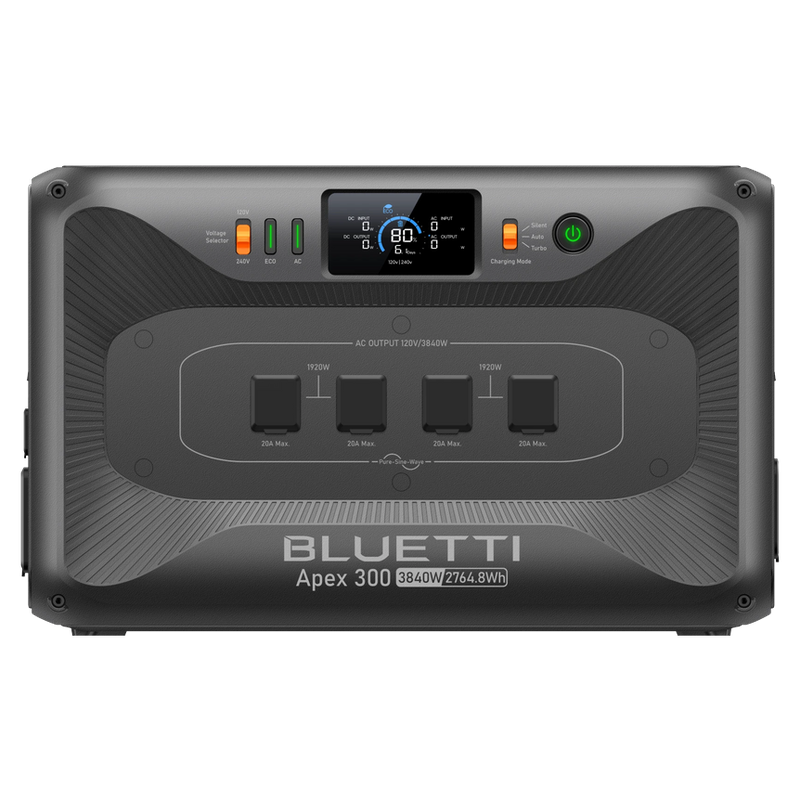
Apex 300
- you’ll grow it: up to six B300K, about 19kWh
- you have a big array: 2,400W of solar into 2,765Wh
- you want 240V for $1,100 less

DELTA Pro 3
- you want 4,096Wh in the box from day one
- you need USB-C and 12V on the unit, and wheels
- a PC or a CPAP needs the 10ms UPS
Prices and stock checked by our price engine on November 23, 2026 at 6:23 AM EST. Each product is rechecked several times a day; the time refreshes when you load the page.
Same 240V muscle. One sells you the battery up front, the other sells it to you in slices.
The BLUETTI Apex 300 delivers 3,840W at 120V or 240V from 2,765Wh, takes 2,400W of solar and grows to about 19kWh with B300K batteries, but has no USB or 12V outputs on the unit and no wheels. The EcoFlow DELTA Pro 3 delivers 4,000W at 120/240V from 4,096Wh, rolls on wheels with USB-C, a 30A 12V port and a 10ms UPS built in, and grows to about 12kWh. Today the Apex 300 costs $1,100 less.
Below: every difference with numbers, a 20-second calculator for your own gear, eight modeled situations, a third option, and what published tests found on each.
Both deliver 120V and 240V at about 4,000W. The DELTA Pro 3 costs $1,100 more for 1,331Wh more, wheels, USB and 12V outputs and a 10ms UPS. The Apex 300 grows further, takes nearly as much solar into a smaller battery and is rated for 6,000+ cycles.
- you’ll expand past 12kWh
- you want 6,000+ cycles
- you want 240V for less
- you want 4,096Wh on day one
- you need USB and 12V built in
- you’ll roll it around
The five differences that decide it
Both deliver 120V and 240V at about 4,000W, have four 20A outlets and a TT-30, use LFP cells, take expansion batteries and can feed a home panel. These five gaps decide it. Each is compared on its own, without extra batteries.
Will it run your setup? Check in 20 seconds
Estimates use 85% usable capacity and 70% of rated solar output. Real results vary with temperature, inverter load, shade and appliance cycling. Fridge and freezer watts are daily averages and do not include compressor startup surges.
Runtime by appliance, one at a time
Simple energy estimates, not measured runtimes. About 2,350Wh usable on the Apex 300 and 3,482Wh on the DELTA Pro 3.
Appliance for appliance, the DELTA Pro 3 lasts 48% longer than the Apex 300.
Same appliance, same watts: the gap is always the size of the battery.Get our Black Friday alerts for power stations
We track live prices on 40+ models from Jackery, EcoFlow, BLUETTI and Anker SOLIX. When a deal beats the lowest price we've recorded, you'll hear from us. During Black Friday week, one short recap a day at most.
Unsubscribe in one click. We may earn a commission when you buy through our links, at no extra cost to you. Privacy Policy
The price gap, in numbers
The EcoFlow DELTA Pro 3 costs $1,100 more than the BLUETTI Apex 300 and adds 1,331Wh: that is $0.83 per extra Wh, against $0.61 per Wh for the Apex 300.
Prices refresh daily from BLUETTI US and EcoFlow US.What the $1,100 buys: 1,331Wh more (4,096Wh vs 2,765Wh), USB and 12V outputs on the unit, wheels and a 10ms UPS on every outlet.
Apex 300 + B300K (5,530Wh) costs $2,000 less today.
The lifetime figure divides the price by the rated cycles to 80% times the capacity: BLUETTI rates the Apex 300 at 6,000+, EcoFlow the DELTA Pro 3 at 4,000. Read it as a ranking, not a bill. The Apex 300 needs the Hub D1 for USB and 12V, which adds to its price if you need them. Prices move often; the figures here are refreshed daily by our price engine.
The third option: the Anker F3800 Plus at $2,999.99

Anker SOLIX F3800 Plus: $2,999.99 today
3,840Wh and 6,000W at 120V and 240V at once, 3,200W of solar at up to 165V, 240V generator charging, a TT-30 and an L14-30, and up to six BP3800 batteries, at 135.6 lb on wheels. Pick it over both if your loads go past 4,000W. Our F3800 review covers the platform. See the F3800 Plus at Anker.
Eight modeled situations, worked out
Same formula as the calculator above, with no extra battery unless stated. The fridge averages 60W, about 525kWh a year.
24-hour outage, essentials only
On their own, about a day on the Apex 300 and a day and a half on the DELTA Pro 3. Each grows with its own batteries; the Apex 300 can keep going to six.
A 240V well pump on the generator inlet
Both deliver 240V. On the Apex 300, set the voltage selector to 240V; its 20A outlets then drop to 16A each and 1,920W per pair. The DELTA Pro 3 feeds a transfer switch from its L14-30.
The fastest wall recharge
Close, but not on the same socket: the Apex 300 needs its 50A input and BLUETTI’s hub; on a standard 15A outlet it takes 1,800W. The DELTA Pro 3 does 3,600W from a 240V dryer or EV outlet; TechRadar confirmed the 50 minutes.
Refill from solar, each at its maximum
Nearly the same input into a smaller battery, so the Apex 300 refills sooner; the DELTA Pro 3 stores 1,331Wh more by the end. The DELTA Pro 3’s high-voltage input takes 150V, the Apex 300’s inputs stop at 60V.
Phones, laptops and a 12V fridge
The DELTA Pro 3 has two 100W USB-C ports, two USB-A and a 30A Anderson port. The Apex 300 has none on the unit; they come with the optional Hub D1.
Home office through an outage
The DELTA Pro 3 lasts about 15 hours longer and switches in 10ms. The Apex 300 offers 0ms on its two left outlets in 240V mode on the 15A input, 20ms otherwise.
Two nights in an RV
Both plug into a 30A RV inlet through their TT-30. The DELTA Pro 3 runs the 12V fridge from its Anderson port; the Apex 300 needs the Hub D1 or the fridge’s AC adapter.
Moving it
The Apex 300 is lighter but has no wheels: a two-person lift. The DELTA Pro 3 rolls on flat floors; plan on two people for stairs either way.
Nine more differences, the spec sheet and the box
Smaller gaps that rarely decide the purchase, then the full specifications and what ships in the box.
Apex 300 and DELTA Pro 3 weight, dimensions and full specifications
Weight: 83.8 lb for the Apex 300 and 113.5 lb for the DELTA Pro 3. Dimensions: 20.7 × 12.9 × 12.6 in and 16.2 × 13.4 × 27.3 in. Everything else is in the sheet below.
BLUETTI Apex 300 and EcoFlow DELTA Pro 3 full specifications
Every published figure for both units, grouped. Green marks the better value.
What’s in the box
Apex 300
- Apex 3002,765Wh, 83.8 lb
- AC charging cable1.8 m
- Car charging cable
- Manual, warranty card, grounding screw
- Hub D1 for USB and 12V sold separately
DELTA Pro 3
- DELTA Pro 34,096Wh, 113.5 lb
- AC charging cable
- Manuals and warranty card
- Extra battery sold separately
Apex 300: BLUETTI US page. DELTA Pro 3: EcoFlow US page.
07 · ChargingHow fast each one refills
Shorter bar, faster refill. Each row is scaled to its slower unit.
Apex 300: Silent, Auto and Turbo charging modesDELTA Pro 3: Smart Generator auto start, EV-station charging with an adapter
Our times divide capacity by input power, with solar at 70% of panel rating; real charging slows near full. The Apex 300’s fastest rate needs its 50A input, not a standard outlet.
Every port, side by side
Apex 300
DELTA Pro 3
Practical consequence: the DELTA Pro 3 charges phones and laptops and runs 12V gear out of the box, and feeds a transfer switch from its L14-30. The Apex 300 is a home hub with a 14-50 at 120/240V and a 50A input; its USB and 12V live on the optional Hub D1.
09 · NoiseNoise and heat: Apex 300 vs DELTA Pro 3
Both stay quiet at light loads. Under heavier use, Trusted Reviews found the BLUETTI Apex 300‘s fans audible much of the time; OutdoorGearLab found the EcoFlow DELTA Pro 3‘s fan louder only near its 4,000W maximum.
Few figures: The Barefoot Nomad reports about 40dB in silent mode and 50dB in standard mode for the Apex 300; EcoFlow says as low as 30dB, load not stated.Every figure we found, with its source
No decibel figure published.
What reviewers heard: The fan never switched on with a home office load (The Barefoot Nomad); louder than other BLUETTI units, fans audible much of the time, and the top of the case got quite warm during Turbo charging (Trusted Reviews, UK unit). The Barefoot Nomad reports about 40dB in silent mode and 50dB in standard mode.
What reviewers heard: Ran overnight with CPAP machines and heaters without the fan being noticed, louder only near its 4,000W maximum (OutdoorGearLab); used through a heat wave routinely above 90°F (Digital Trends).
Measured by a tester Brand figure
- Use the slower, quieter charging mode overnight if the unit sits in a living space.
Cold, heat and storage: Apex 300 vs DELTA Pro 3
For a cold garage, the BLUETTI Apex 300 keeps running down to −4°F; for heat and water, the EcoFlow DELTA Pro 3 is rated to 113°F and its battery pack to IP65. Neither charges below freezing.
Figures from the Apex 300 user manual and the EcoFlow US DELTA Pro 3 page.- Charge either one indoors in winter: neither charges below 32°F.
- For long-term storage of the DELTA Pro 3, EcoFlow recommends 68°F to 86°F, and only its battery pack is sealed: keep the main unit dry.
App, UPS and smart features
Both feed a home panel and take extra batteries. The EcoFlow DELTA Pro 3 switches in 10ms on every outlet; the BLUETTI Apex 300 grows further, to about 19kWh, and moves to backup mode on weather alerts.
Both apps run over Wi-Fi and Bluetooth.Green zone: a switch under about 16ms, which most desktop PCs ride through without restarting.
Does it prepare for storms? When enabled, the BLUETTI Apex 300 switches to Emergency Backup mode when a weather warning is issued; EcoFlow lists no storm mode for the EcoFlow DELTA Pro 3 in this comparison.
Does it work as a UPS? The EcoFlow DELTA Pro 3 switches in 10ms on all outlets. The BLUETTI Apex 300 offers 0ms on its two left outlets with the selector at 240V and the grid on the 15A input, 20ms otherwise; BLUETTI’s manual says it is not for data servers or workstations that need a high-performance UPS.
Can you add a battery later? Both grow: up to six B300K take the BLUETTI Apex 300 to about 19kWh; two DELTA Pro 3 Extra Batteries take the EcoFlow DELTA Pro 3 to about 12kWh.
Does it connect to a home panel? The BLUETTI Apex 300’s 50A input can pass up to 12,000W through to a home panel; the EcoFlow DELTA Pro 3 pairs with the Smart Home Panel 2, which controls up to 12 circuits from the app.
Can it run a heater or kettle above its rating? Both run heating loads past their rating: Power Lifting to 7,680W on the BLUETTI Apex 300, X-Boost to 6,000W on the EcoFlow DELTA Pro 3. Motors need the continuous rating, 3,840W or 4,000W.
How does the app connect? Both use their brand’s app over Wi-Fi or Bluetooth, with adjustable charging power; the BLUETTI app also updates the Apex 300’s firmware.
Warranty and support
BLUETTI gives the BLUETTI Apex 300 5 years from purchase, with proof of purchase. EcoFlow’s EcoFlow DELTA Pro 3 page describes 3 years plus 2 once registered in the EcoFlow app, while its US warranty table lists 5 years with no condition: register it to be safe.
We read EcoFlow’s two pages the prudent way: 3 years, 5 with registration.Subject to each brand’s warranty terms and eligibility.
BLUETTI rates the Apex 300 at 6,000+ cycles to 80% capacity and EcoFlow the DELTA Pro 3 at 4,000: about 16 and 11 years at one full cycle a day. On paper, the Apex 300 lasts longer.
- If you choose the DELTA Pro 3, register it in the EcoFlow app the day it arrives: the product page ties the last 2 years to registration.
- If you choose the Apex 300, buy it from BLUETTI or an authorized seller and keep the proof of purchase: the warranty is void for unauthorized resellers.
What reviewers report
We have not lab-tested these two units. Here is what 11 published reviews found, with the source, author and date for each point. Reviews of UK and EU units are flagged: those models charge from 230V outlets and have different sockets, so their charge times and outlet findings don’t carry over to US units.
Apex 300: The Barefoot Nomad (July 2026), Trusted Reviews (October 2025, UK unit), Notebookcheck (August 2025, EU unit), CleanTechnica (June 2026), T3 (November 2025, UK unit)DELTA Pro 3: Digital Trends (June 2024), OutdoorGearLab (January 2026), TechRadar (March 2025), RV.com (July 2024), The Gadgeteer (October 2024), Techspective (July 2025)
Usable capacity
- Apex 300Reviewer At its full 3.8kW rated output it delivered 2.55kWh before shutting off, about 92% of the rated capacity. Trusted Reviews, Simon Handby, October 2025, UK unit
- Apex 300Reviewer Best usable energy came at a 2kW load: 2.58kWh, or 93.5% of the rated 2,764.8Wh. Trusted Reviews, Simon Handby, October 2025, UK unit
- DELTA Pro 3Reviewer Averaged 3.7kWh of discharge over several cycles, a little under the 4kWh rating. Digital Trends, Simon Sage, June 2024
- DELTA Pro 3Reviewer Test jig measured 3,790Wh from the 4,096Wh battery, over 93%, well above average for power stations. OutdoorGearLab, Kenji Mowrey, January 2026
Charging
- Apex 300Reviewer Their unit arrived at 24% and reached 100% in under an hour on the default Auto charging mode. The Barefoot Nomad, Micki Kosman, July 2026
- Apex 300Reviewer A Turbo recharge from empty took 95 minutes and drew 3.35kWh from the wall (UK 230V input, faster than the US 1,800W wall limit). Trusted Reviews, Simon Handby, October 2025, UK unit
- DELTA Pro 3Reviewer A full charge from empty drew close to 5kWh from the wall and took about three hours. Digital Trends, Simon Sage, June 2024
- DELTA Pro 3Reviewer Never reached the full 1,800W input on a 15A outlet: peak near 1,600W, average 1,293Wh per hour, full charge within 3 hours. OutdoorGearLab, Kenji Mowrey, January 2026
- DELTA Pro 3Reviewer Wall charging routinely took half the three to four hours the reviewer expected, or less. RV.com, Kraig Becker, July 2024
Noise and heat
- Apex 300Reviewer Running their home office load, the fan never switched on at all. The Barefoot Nomad, Micki Kosman, July 2026
- Apex 300Reviewer Louder than other BLUETTI units he has tested: fans are audible and run much of the time. Trusted Reviews, Simon Handby, October 2025, UK unit
- Apex 300Reviewer The top of the case got quite warm when working hard, especially during Turbo charging. Trusted Reviews, Simon Handby, October 2025, UK unit
- DELTA Pro 3Reviewer Used through an East Coast heat wave, routinely above 90 degrees F, which let the reviewer test its operating limits. Digital Trends, Simon Sage, June 2024
- DELTA Pro 3Reviewer Ran overnight with CPAP machines and heaters without the fan being noticed; fan gets louder only near its 4,000W maximum. OutdoorGearLab, Kenji Mowrey, January 2026
UPS and output
- Apex 300Reviewer A kettle, espresso machine, blender and toaster together peaked well above 3,300W and the unit coped easily. The Barefoot Nomad, Micki Kosman, July 2026
- Apex 300Reviewer Kettles, vacuum cleaners and an electric hob all failed to overload it. Notebookcheck, Christian Hintze, August 2025, EU unit
- DELTA Pro 3Reviewer Reviewer pushed it to add charge to a Tesla, and says it can run an industrial popcorn machine for hours. TechRadar, Collin Probst, March 2025
- DELTA Pro 3Reviewer Used as a UPS and home backup; the reviewer cites EcoFlow’s 10ms switchover for critical appliances. TechRadar, Collin Probst, March 2025
- DELTA Pro 3Reviewer Powers a garage gym circuit including a 12,000 BTU air conditioner, TV, treadmill and other gear, kept topped up from a 120V 20A outlet. The Gadgeteer, Julian Perry, October 2024
Daily use and issues
- Apex 300Reviewer Silent charging started at 500W then fell to 200W around 20%, with an estimate of more than a day to finish. Trusted Reviews, Simon Handby, October 2025, UK unit
- Apex 300Reviewer Left on and plugged in with AC sockets off, in a time-of-use setup, the battery fell 48% over 12 hours. Trusted Reviews, Simon Handby, October 2025, UK unit
- DELTA Pro 3Reviewer At 115 lb, the reviewer says it barely counts as portable. Digital Trends, Simon Sage, June 2024
- DELTA Pro 3Reviewer Measured weight 114.1 lb, versus 97.5 lb for the original DELTA Pro. OutdoorGearLab, Kenji Mowrey, January 2026
- DELTA Pro 3Reviewer Weight listed as the main drawback alongside price. TechRadar, Collin Probst, March 2025
Practical limits before you buy
- The Apex 300 has no USB or 12V outputs. They live on the Hub D1, sold separately.
- The Apex 300’s 3,840W charging needs its 50A input. On a standard 15A outlet it takes 1,800W.
- The Apex 300 has no wheels. 83.8 lb is a two-person carry; the DELTA Pro 3 rolls.
- Overload modes are for heating loads only. Motors need the continuous rating: 3,840W or 4,000W.
- The DELTA Pro 3 grows to about 12kWh. Past that, the Apex 300 goes to about 19kWh.
- Apex 300, per its US documentation: Not for data servers or workstations that require a high-performance UPS (US manual).
- Apex 300, per its US documentation: Standard US wall input is 120V 15A, 1,800W max including bypass; faster AC charging needs the P050A port and Hub A1.
- Apex 300, per its US documentation: No USB or DC outputs on the unit: USB-C, USB-A and 12V need the Hub D1, rated 700W.
- Apex 300, per its US documentation: With the selector at 240V, the 20A outlets are limited to 16A each and 1,920W per pair.
- DELTA Pro 3, per its US documentation: Only the battery pack is sealed to IP65; the main unit is IP20 with no water or dust rating.
- DELTA Pro 3, per its US documentation: Charging 0 to 45°C (32-113°F), discharging -10 to 45°C (14-113°F); optimal operation and long-term storage 20 to 30°C.
- DELTA Pro 3, per its US documentation: 0-80% in 50 minutes requires X-Stream fast charging; 120V wall input is 1,800W, 240V is 3,600W.
Frequently asked questions
What is the difference between the Apex 300 and the DELTA Pro 3?
Both deliver 120V and 240V at about 4,000W. The DELTA Pro 3 stores 4,096Wh with wheels, USB, 12V and a 10ms UPS built in. The Apex 300 stores 2,765Wh, has no USB or 12V on the unit, grows to about 19kWh and is rated for 6,000+ cycles.
Which holds more energy?
On its own, the DELTA Pro 3: 4,096Wh against 2,765Wh. With one extra battery each, 8,192Wh against 5,530Wh. Fully expanded, the Apex 300 goes further: about 19kWh against 12kWh.
Can both run 240V appliances?
Yes. The Apex 300 on its 14-50 with the voltage selector at 240V, up to 3,840W; the DELTA Pro 3 on its L14-30 and 6-20R, up to 4,000W.
How long will each run a refrigerator?
At a 60W average: about 39 hours on the Apex 300 and 58 hours on the DELTA Pro 3.
Which charges faster?
From a standard outlet, both at 1,800W; the smaller Apex 300 fills first. Fastest: 80% in 45 minutes on the Apex 300 via its 50A input, 80% in 50 minutes on the DELTA Pro 3 from a 240V outlet.
Does the Apex 300 have USB ports?
Not on the unit. USB-C, USB-A and 12V come with the optional Hub D1. The DELTA Pro 3 has two 100W USB-C, two USB-A and a 30A Anderson port.
Which is better as a UPS?
The DELTA Pro 3 switches in 10ms on all outlets. The Apex 300 can do 0ms on two outlets in 240V mode, 20ms otherwise.
Which lasts more years?
On paper, the Apex 300: 6,000+ cycles to 80% against 4,000. At one full cycle a day, that is about 16 years against 11.
Do reviews confirm the rated capacity?
Apex 300: Trusted Reviews got 2.55kWh out at a 3.8kW load and 2.58kWh at 2kW (UK unit). DELTA Pro 3: OutdoorGearLab measured 3,790Wh, Digital Trends averaged 3.7kWh. Our calculator uses 85% of the rating.
Is there a third option?
Yes: the Anker SOLIX F3800 Plus, with 3,840Wh and 6,000W at 120/240V in one box on wheels, 3,200W of solar and BP3800 expansion.
Related comparisons and reviews
How we compared and sources
Research-based comparison. We have not physically tested these two units. Specs come from BLUETTI US, the Apex 300 manual and EcoFlow US; usage observations are attributed to named reviewers. Prices and availability were checked on October 30, 2026.
- Specs: BLUETTI US, Apex 300 and EcoFlow US, DELTA Pro 3, read on October 30, 2026.
- Apex 300 ports, UPS conditions and temperatures: Apex 300 user manual (US EN). Configuration: each unit on its own; extra-battery prices shown separately.
- Reviewer reports on the Apex 300: The Barefoot Nomad, Micki Kosman, July 2026, Trusted Reviews, Simon Handby, October 2025, UK unit, Notebookcheck, Christian Hintze, August 2025, EU unit, CleanTechnica, Kyle Field, June 2026, T3, Derek Adams, November 2025, UK unit; on the DELTA Pro 3: Digital Trends, Simon Sage, June 2024, OutdoorGearLab, Kenji Mowrey, January 2026, TechRadar, Collin Probst, March 2025, RV.com, Kraig Becker, July 2024, The Gadgeteer, Julian Perry, October 2024, Techspective, Tony Bradley, July 2025.
- Runtime = capacity × 0.85 ÷ watts. Solar harvest = min(panel watts, max input) × sun hours × 0.70. Cost per lifetime kWh = price ÷ (cycles × capacity in kWh).
Both do about 4,000W at 240V. The DELTA Pro 3 adds 1,331Wh, wheels, USB and 12V for $1,100 more; the Apex 300 grows to about 19kWh.
Prices checked November 23, 2026 at 6:23 AM EST
Looking at other models? Browse all power station comparisons, or pick any two models on the hub and we point you to the right duel.
Originally published: November 14, 2026