
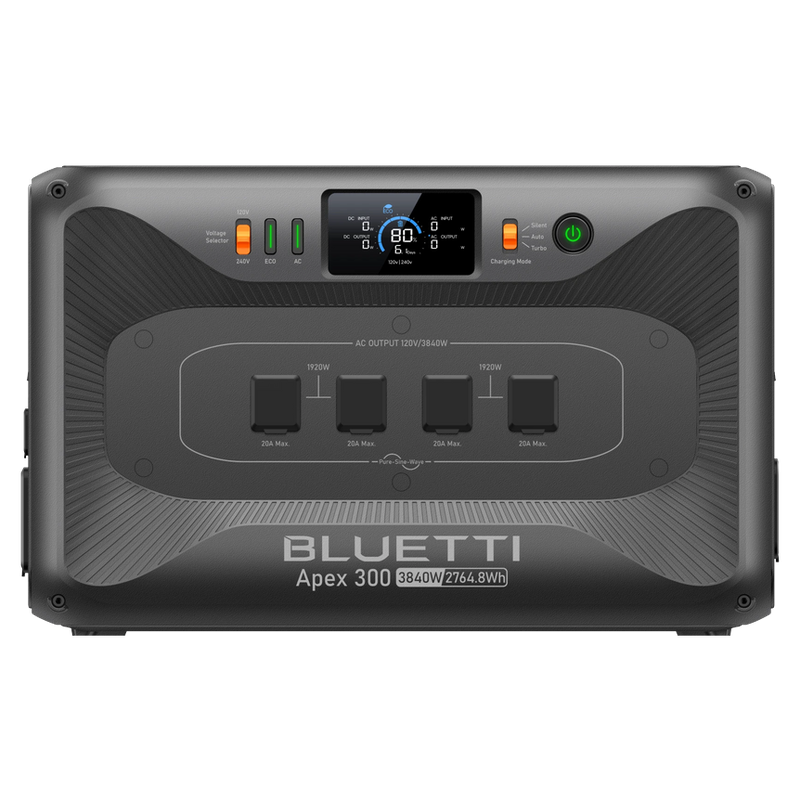
Apex 300
- a 240V load must keep running
- you’ll tie it to a home panel
- you’ll grow past 12kWh
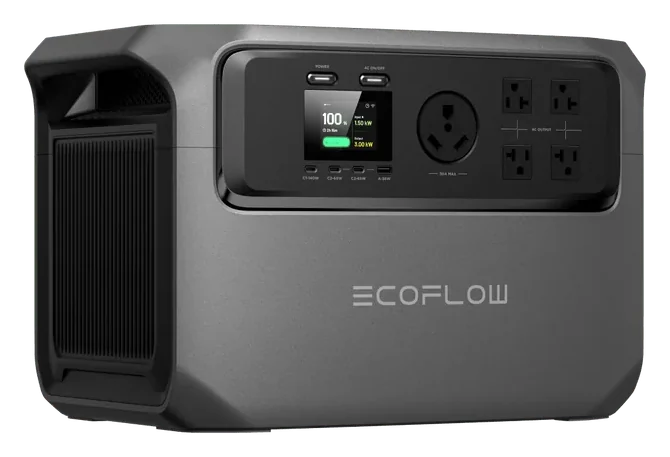
DELTA 3800 Gen4
- everything you need is 120V
- you want 3,763Wh in the first box
- you want USB-C with no add-on
Prices and stock checked by our price engine on November 13, 2026 at 6:29 AM EST. Each product is rechecked several times a day; the time refreshes when you load the page.
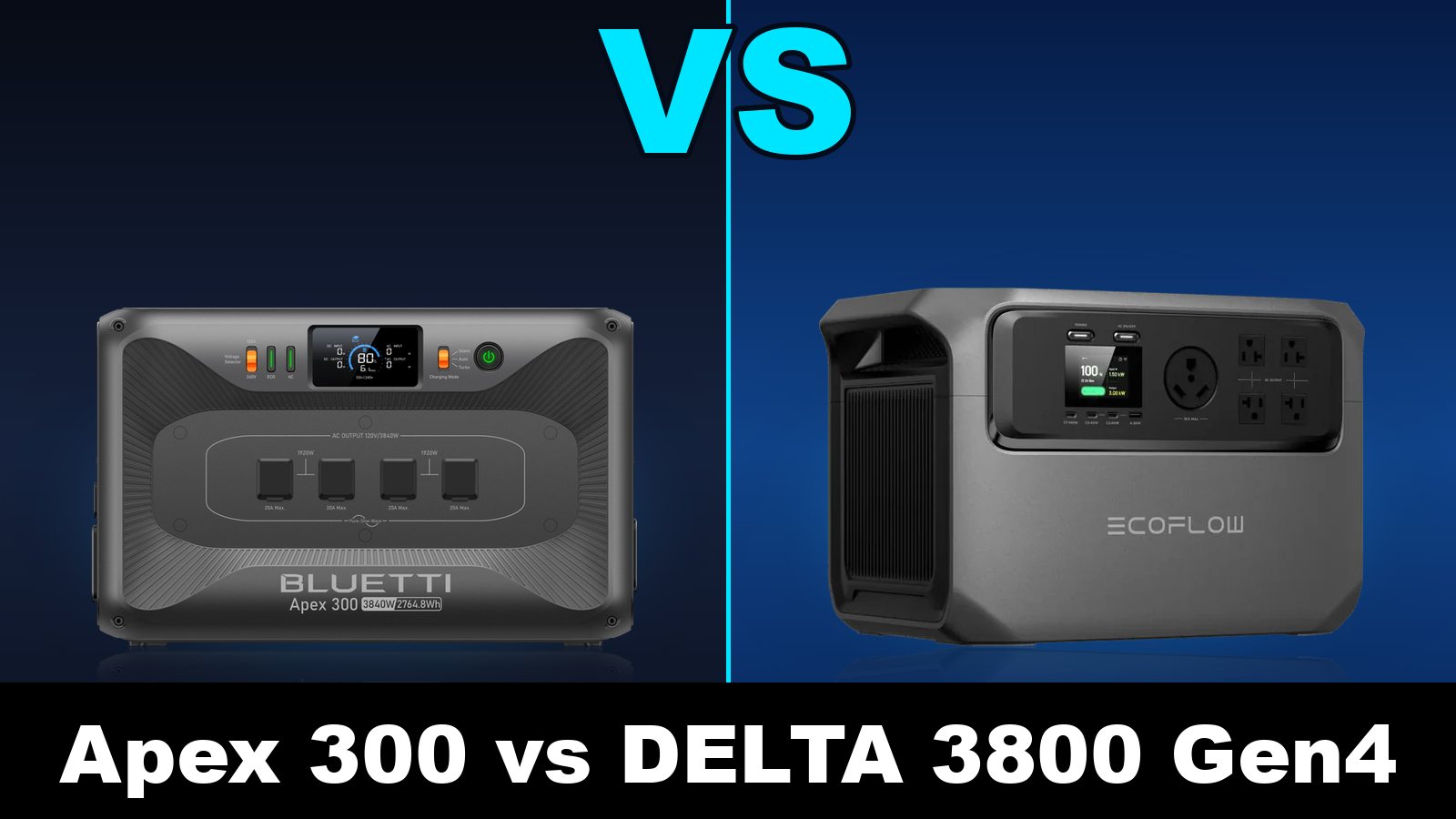
Does anything you must keep running need 240V? If yes, you’re done: Apex 300. If not, the DELTA 3800 Gen4 gives you more battery in a lighter box.
The BLUETTI Apex 300 is the only one of the two with 240V: a voltage selector, a 14-50 outlet and a 50A input that passes up to 12,000W toward a home panel, plus room for six B300K batteries. Without its Hub D1, though, it has no USB or 12V at all, and it weighs 83.8 lb. The EcoFlow DELTA 3800 Gen4 stays at 120V and 3,600W, but stores 3,763Wh against 2,765Wh, weighs 67.5 lb, has USB-C on the unit and lists a 7,200W surge. For a house that runs on 120V circuits, the 240V hardware does nothing for you.
Below: what 240V really covers, a 20-second calculator for your own gear, eight situations, and what reviewers found on the Apex 300. No independent test of the DELTA 3800 Gen4 exists yet.
Prices $200 apart today. The Apex 300 adds 240V, 240W more output, 400W more solar and a higher expansion ceiling. The DELTA 3800 Gen4 adds 998Wh, sheds 16.3 lb, has its USB ports on the unit and switches faster at 120V.
- you need 240V, full stop
- you want 19kWh one day
- you value 80% at 6,000 cycles
- 120V covers your list
- you move it: 67.5 lb
- you want USB-C built in
Six gaps that follow from the voltage question
Both are LFP stations with four 20A outlets, a 30A RV outlet, a battery port and two solar inputs. After that, they go in different directions.
Will it run your setup? Check in 20 seconds
Estimates use 85% usable capacity and 70% of rated solar output. Real results vary with temperature, inverter load, shade and appliance cycling. Fridge and freezer watts are daily averages and do not include compressor startup surges.
Runtime by appliance, one at a time
Estimates, not lab runs: about 2,350Wh usable on the Apex 300 and 3,199Wh on the DELTA 3800 Gen4. Trusted Reviews drew 2.58kWh from a UK Apex 300 at 2kW, so our 85% is on the careful side there; nobody has measured a 3800 Gen4.
Appliance for appliance, the 3800 Gen4 lasts 36% longer than the Apex 300.
Same appliance, same watts: the gap is always the size of the battery.Get our Black Friday alerts for power stations
We track live prices on 40+ models from Jackery, EcoFlow, BLUETTI and Anker SOLIX. When a deal beats the lowest price we've recorded, you'll hear from us. During Black Friday week, one short recap a day at most.
Unsubscribe in one click. We may earn a commission when you buy through our links, at no extra cost to you. Privacy Policy
The price gap, in numbers
The EcoFlow DELTA 3800 Gen4 costs $200 more than the BLUETTI Apex 300 and adds 998Wh: that is $0.20 per extra Wh, against $0.54 per Wh for the Apex 300.
Prices refresh daily from BLUETTI US and EcoFlow US.Two add-ons sit outside these cards. The Apex 300 needs the Hub D1 for USB and 12V, and EcoFlow connects its batteries through a Smart Extra Battery Expansion Adapter; both are sold separately. A cost-per-cycle card wouldn’t compare like with like: BLUETTI’s 6,000+ cycles run to 80% of capacity, EcoFlow’s 6,000 to 70%. Prices move often; our engine refreshes them daily.
Eight modeled situations, worked out
We count 85% of rated capacity as usable. The essentials plan draws 140W, about 3.4kWh a day. Load examples are illustrations; read your own nameplates.
A 240V well pump
This is the case the whole duel turns on. No extra battery or setting gives the 3800 Gen4 240V. BLUETTI publishes no motor surge for the Apex 300, so the pump’s start has to fit under 3,840W. If your pump is 120V, this section doesn’t apply.
The dryer test
240V doesn’t mean every 240V appliance. A load like this tops the Apex 300’s 3,840W, and Power Lifting won’t help: it covers pure resistive loads at reduced power, and a dryer has a motor. T3 pushed a UK unit to 4.8kW and it cut out after 7 seconds. Check nameplates before you pay for 240V.
A house that runs on 120V
Six more hours on the EcoFlow, from a box 16.3 lb lighter. On the Apex 300, turn ECO mode off first: BLUETTI ships it on, and it cuts AC after 4 hours under 10W, which a cycling fridge can trip.
Feeding a home panel
BLUETTI lists a 50A input that passes up to 12,000W at 240V. EcoFlow’s compatibility table for the 3800 Gen4 lists no Smart Home Panel or transfer switch. Plug-in use is fine on both; anything wired into a house points to the Apex 300, with an electrician.
The first battery you add
After one battery the two are nearly level, with the EcoFlow slightly ahead. With 2,048Wh packs, a second battery puts the Apex 300 in front, 8,294Wh against 7,859Wh, and only the Apex 300 has slots left after that. So ask how far you will really go.
A desk full of USB devices
The 3800 Gen4 handles this from its own ports, though its 65W ports drop to 16W when shared. The bare Apex 300 can only offer its AC outlets, so a laptop goes through its wall charger until you add the Hub D1.
Panels on the roof of a shed
Both split solar across two low-voltage inputs that top out at 60V, so wiring limits are alike. The Apex 300 fills faster because it holds less. Per hour of sun, the difference is 400W at full input, and only if you own that many panels.
A desktop PC on a 120V outlet
BLUETTI’s 0ms applies only to two left outlets, with the selector at 240V and the grid on the 15A input. In a normal 120V setup you get 20ms, at least twice the EcoFlow’s figure. EcoFlow lists under 10ms, without HID, and says it isn’t a 0ms professional UPS. BLUETTI rules out data servers and workstations.
Nine more differences, the spec sheet and the box
Smaller gaps that rarely decide the purchase, then the full specifications and what ships in the box.
Apex 300 and DELTA 3800 Gen4 weight, dimensions and full specifications
Weight: 83.8 lb for the Apex 300 and 67.5 lb for the DELTA 3800 Gen4. Dimensions: 20.7 × 12.9 × 12.6 in and 16.77 × 11.36 × 12.09 in. Everything else is in the sheet below.
BLUETTI Apex 300 and EcoFlow DELTA 3800 Gen4 full specifications
Every published figure for both units, grouped. Green marks the better value.
What’s in the box
Apex 300
- Apex 3002,765Wh, 83.8 lb
- AC charging cable1.8 m
- Car charging cable
- Manual, warranty card, grounding screw
- Hub D1 for USB and 12V sold separately
DELTA 3800 Gen4
- DELTA 3800 Gen43,763Wh, 67.5 lb
- AC charging cable
- Two solar charging cablesXT60i to LP60
- AC cable retention kit, manuals and warranty card
- Expansion adapter and batteriessold separately
From BLUETTI’s US manual and EcoFlow’s US page. The Hub D1, EcoFlow’s expansion adapter and every extra battery are sold separately.
06 · ChargingHow fast each one refills
Shorter bar, faster refill. Each row is scaled to its slower unit.
Apex 300: US input is 120V at 15A, 1,800W including bypass; faster AC needs the P050A port and Hub A1DELTA 3800 Gen4: 146 minutes is EcoFlow’s figure from the wall; automatic generator start works only through the battery port
Our solar times assume panels deliver 70% of their rating; the brands’ figures assume ideal sun.
Every port, side by side
Apex 300
DELTA 3800 Gen4
What that means in use: the Apex 300 has the 14-50 outlet and the 50A input, and nothing for USB or 12V until the Hub D1 goes on. The 3800 Gen4 has four USB ports but no 12V and no 240V.
08 · NoiseNoise and heat: Apex 300 vs 3800 Gen4
EcoFlow rates the EcoFlow DELTA 3800 Gen4 at up to 30dB at 600W and 50dB at 3,600W, with nobody confirming it yet. The BLUETTI Apex 300 has reviewer reports instead: silent on light loads, loud at its charging peak.
Brand figures on one side, reviewers on the other, so no winner here.Every figure we found, with its source
No decibel figure published.
What reviewers heard: The Barefoot Nomad’s fan never came on with a home office load; Trusted Reviews found the fans audible much of the time, and the top of the case quite warm during Turbo charging.
Measured by a tester Brand figure
- Keep the Apex 300 out of a bedroom if it will charge at speed. EcoFlow’s lower figures only hold at lower loads.
Cold and heat: Apex 300 vs 3800 Gen4
Cold favors the BLUETTI Apex 300, down to −4°F against 14°F. Heat favors the EcoFlow DELTA 3800 Gen4, up to 113°F against 104°F.
Figures from BLUETTI’s and EcoFlow’s US documents. Neither charges below 32°F.- A panel-tied Apex 300 in an unheated garage still needs 32°F to recharge.
- Give the 3800 Gen4 room around its vents, especially with a battery stacked on top.
App, UPS and smart features
The BLUETTI Apex 300 owns the house features: 240V and a home panel input. The EcoFlow DELTA 3800 Gen4 is quicker at 120V and adds a fridge mode and automatic generator start through its battery port.
Each app follows the job its station was built for.Green zone: a switch under about 16ms, which most desktop PCs ride through without restarting.
Can it deliver 240V? The BLUETTI Apex 300 switches to 120/240V with a selector. The EcoFlow DELTA 3800 Gen4 is 120V only.
Does it connect to a home panel? BLUETTI lists a 50A input on the BLUETTI Apex 300. EcoFlow’s table lists no panel or transfer switch for the EcoFlow DELTA 3800 Gen4.
Can it start a generator by itself? EcoFlow ties automatic start and stop to the battery port of the EcoFlow DELTA 3800 Gen4. BLUETTI lists no such feature for the BLUETTI Apex 300.
Does it work as a UPS? The EcoFlow DELTA 3800 Gen4 lists under 10ms. The BLUETTI Apex 300 lists 20ms at 120V and 0ms on two outlets in 240V mode, fed from the 15A input.
Can you add a battery later? The BLUETTI Apex 300 takes six B300K, about 19kWh. The EcoFlow DELTA 3800 Gen4 takes two batteries through an Expansion Adapter, 7,859Wh to about 12kWh.
Does it prepare for storms? When enabled, the BLUETTI Apex 300 switches to Emergency Backup mode on a warning. The EcoFlow DELTA 3800 Gen4 recharges ahead of severe weather, depending on region, network and settings.
Can it run a heater or kettle above its rating? Power Lifting on the BLUETTI Apex 300 is off by default and for pure resistive loads, which run below rated power. EcoFlow gives no X-Boost figure for the EcoFlow DELTA 3800 Gen4, and it is off while plugged in.
Warranty and support
The BLUETTI Apex 300 has the stronger paper: 5 years outright and 6,000+ cycles to 80%. The EcoFlow DELTA 3800 Gen4 gets 5 years only after app registration, with 6,000 cycles to 70%.
A clear edge to BLUETTI on both counts.Subject to each brand’s warranty terms and eligibility.
Both quote 6,000 cycles, but they stop counting at different points: BLUETTI at 80% of capacity, EcoFlow at 70%, under lab conditions. The same number doesn’t mean the same battery health.
- Buy the Apex 300 from BLUETTI or an authorized seller; its warranty is void otherwise.
- Register the DELTA 3800 Gen4 in the EcoFlow app to get the last 2 years.
What reviewers report
We have not lab-tested these two units. As of November 5, 2026, no full independent review of the DELTA 3800 Gen4 had been published. What follows covers the Apex 300 only, with the source, author and date for each point. UK and EU units charge from 230V outlets, so their charging figures don’t apply to a US unit.
Apex 300: The Barefoot Nomad (July 2026), Trusted Reviews (October 2025, UK unit), Notebookcheck (August 2025, EU unit), CleanTechnica (June 2026), T3 (November 2025, UK unit)DELTA 3800 Gen4: no verifiable independent test found
Usable capacity
- Apex 300Reviewer At its full 3.8kW rated output it delivered 2.55kWh before shutting off, about 92% of the rated capacity. Trusted Reviews, Simon Handby, October 2025, UK unit
- Apex 300Reviewer Best usable energy came at a 2kW load: 2.58kWh, or 93.5% of the rated 2,764.8Wh. Trusted Reviews, Simon Handby, October 2025, UK unit
Charging
- Apex 300Reviewer Their unit arrived at 24% and reached 100% in under an hour on the default Auto charging mode. The Barefoot Nomad, Micki Kosman, July 2026
- Apex 300Reviewer A Turbo recharge from empty took 95 minutes and drew 3.35kWh from the wall (UK 230V input, faster than the US 1,800W wall limit). Trusted Reviews, Simon Handby, October 2025, UK unit
- Apex 300Reviewer Measured wall charging power by mode: 508W in Silent, 1,442W in Auto and a 2,330W peak in Turbo (EU 230V input). Notebookcheck, Christian Hintze, August 2025, EU unit
- Apex 300Reviewer A single 200W folding panel fed it between 100W and 200W depending on sun angle and intensity. CleanTechnica, Kyle Field, June 2026
Noise and heat
- Apex 300Reviewer Running their home office load, the fan never switched on at all. The Barefoot Nomad, Micki Kosman, July 2026
- Apex 300Reviewer Louder than other BLUETTI units he has tested: fans are audible and run much of the time. Trusted Reviews, Simon Handby, October 2025, UK unit
- Apex 300Reviewer The top of the case got quite warm when working hard, especially during Turbo charging. Trusted Reviews, Simon Handby, October 2025, UK unit
- Apex 300Reviewer At the 2,330W charging peak the fans were loud; other modes were much quieter. Notebookcheck, Christian Hintze, August 2025, EU unit
- Apex 300Reviewer Even at a 4.8kW load the fan was not loud. T3, Derek Adams, November 2025, UK unit
UPS and output
- Apex 300Reviewer A kettle, espresso machine, blender and toaster together peaked well above 3,300W and the unit coped easily. The Barefoot Nomad, Micki Kosman, July 2026
- Apex 300Reviewer Kettles, vacuum cleaners and an electric hob all failed to overload it. Notebookcheck, Christian Hintze, August 2025, EU unit
- Apex 300Reviewer Tested with a B300K battery, it handled EV charging, power tools and home appliances without trouble. CleanTechnica, Kyle Field, June 2026
- Apex 300Reviewer Two heaters (1.8kW and 2kW) pushed output to 3.3kW, well within the 3,840W rating. T3, Derek Adams, November 2025, UK unit
Daily use and issues
- Apex 300Reviewer Silent charging started at 500W then fell to 200W around 20%, with an estimate of more than a day to finish. Trusted Reviews, Simon Handby, October 2025, UK unit
- Apex 300Reviewer Left on and plugged in with AC sockets off, in a time-of-use setup, the battery fell 48% over 12 hours. Trusted Reviews, Simon Handby, October 2025, UK unit
- Apex 300Reviewer The app works in an offline mode without an account, but devices then cannot stay permanently linked. Notebookcheck, Christian Hintze, August 2025, EU unit
- Apex 300Reviewer The base unit has no DC or USB ports; those need the optional Hub D1. CleanTechnica, Kyle Field, June 2026
- Apex 300Reviewer Adding a kettle took the load to 4.8kW; it cut out after 7 seconds, since lifting mode suits short peaks. T3, Derek Adams, November 2025, UK unit
Practical limits before you buy
- Check your 240V load’s nameplate first. 3,840W is the Apex 300’s limit at 240V too, and BLUETTI publishes no motor surge.
- Switching the Apex 300 to 240V changes its outlets. The 20A outlets drop to 16A each and 1,920W per pair.
- The Apex 300 has no USB or 12V by itself. The Hub D1 is rated 700W and sold separately. The DELTA 3800 Gen4 has USB but lists no 12V either.
- ECO mode ships on. On the Apex 300 it shuts AC after 4 hours under 10W. Disable it for lights and fridges.
- EcoFlow’s 12kWh needs the 4,096Wh battery. That battery showed as unavailable on November 5, 2026. With two 2,048Wh batteries the total is 7,859Wh.
- More batteries add hours, not power. The DELTA 3800 Gen4 stays at 120V and 3,600W, whatever you stack on it. EcoFlow’s Expansion Adapter connects them.
- EcoFlow’s 70+ hour fridge claim used an empty fridge. With one more load on AC, the mode isn’t advised. At a 60W average, plan on about 53 hours.
- Mind idle drain on a grid-tied Apex 300. Trusted Reviews saw a UK unit lose 48% in 12 hours, left on and plugged in with AC sockets off.
- Stack with care. EcoFlow’s 2,048Wh battery sits on top; the 4,096Wh pair goes beside the unit.
Frequently asked questions
What is the difference between the BLUETTI Apex 300 and the EcoFlow DELTA 3800 Gen4?
The Apex 300 delivers 3,840W at 120V or 240V from 2,765Wh, grows to about 19kWh and needs the Hub D1 for USB and 12V, at 83.8 lb. The DELTA 3800 Gen4 delivers 3,600W at 120V only from 3,763Wh, grows to about 12kWh and has USB built in, at 67.5 lb.
Which is cheaper?
The BLUETTI Apex 300 costs $200 less today: $1,499, against $1,699 for the EcoFlow DELTA 3800 Gen4. Per Wh, the DELTA 3800 Gen4 is cheaper: $0.45, against $0.54. Prices refresh daily.
Can the DELTA 3800 Gen4 do 240V?
No. It stays at 120V even with extra batteries, and EcoFlow lists no way to pair two units for 240V on this model.
Will the Apex 300 run any 240V appliance?
No. Its limit is 3,840W, and BLUETTI publishes no surge for motors. Many well pumps fit. A large dryer or central air may not.
Which one can connect to a home panel?
BLUETTI lists a 50A input on the Apex 300 that passes up to 12,000W at 240V. EcoFlow’s compatibility table lists no panel or transfer switch for the DELTA 3800 Gen4. Either way, use an electrician.
How far does each one expand?
The Apex 300 takes six B300K, about 19kWh. The DELTA 3800 Gen4 takes two batteries: 7,859Wh with 2,048Wh packs, about 12kWh with 4,096Wh packs.
Which is easier to move?
The DELTA 3800 Gen4, at 67.5 lb against 83.8 lb. Neither has wheels.
Which is the better UPS?
At 120V, the DELTA 3800 Gen4: under 10ms against 20ms. The Apex 300 reaches 0ms only on two outlets in 240V mode.
Has anyone reviewed them?
The Apex 300, yes; the reports section credits each source. As of November 5, 2026, no full independent review of the DELTA 3800 Gen4 had been published.
Related comparisons and reviews
How we compared and sources
Research-based comparison. We have not had either unit in hand, and no full independent review of the DELTA 3800 Gen4 existed on November 5, 2026. Specs come from BLUETTI’s US page, manual and warranty table, and EcoFlow’s US page, FAQ and compatibility table. Reviewer observations on the Apex 300 are attributed; UK and EU units are flagged. Prices and availability were checked on November 5, 2026.
- Specs: BLUETTI US, Apex 300 with its US user manual and warranty table, and EcoFlow US, DELTA 3800 Gen4 with its FAQ and compatibility table, read on November 5, 2026.
- Hours on the 140W plan are our math: rated capacity × 0.85 ÷ 140W, with 2,764.8Wh for a B300K and 2,048Wh for EcoFlow’s smaller battery. The 7,859Wh and 11,955Wh totals are our sums; EcoFlow rounds to 4 to 12kWh.
- The Apex 300’s noise figures are BLUETTI’s as quoted by The Barefoot Nomad; we didn’t find them in its US manual. The 19kWh maximum is BLUETTI’s with six B300K.
- Reviewer reports on the Apex 300: The Barefoot Nomad, Micki Kosman, July 2026, Trusted Reviews, Simon Handby, October 2025, UK unit, Notebookcheck, Christian Hintze, August 2025, EU unit, CleanTechnica, Kyle Field, June 2026, T3, Derek Adams, November 2025, UK unit.
- Runtime = capacity × 0.85 ÷ watts. Solar harvest = min(panel watts, max input) × sun hours × 0.70.
One question first: does anything on your list need 240V? The rest of the page only matters if the answer is no.
Prices checked November 13, 2026 at 6:29 AM EST
Looking at other models? Browse all power station comparisons, or pick any two models on the hub and we point you to the right duel.
Originally published: November 7, 2026