
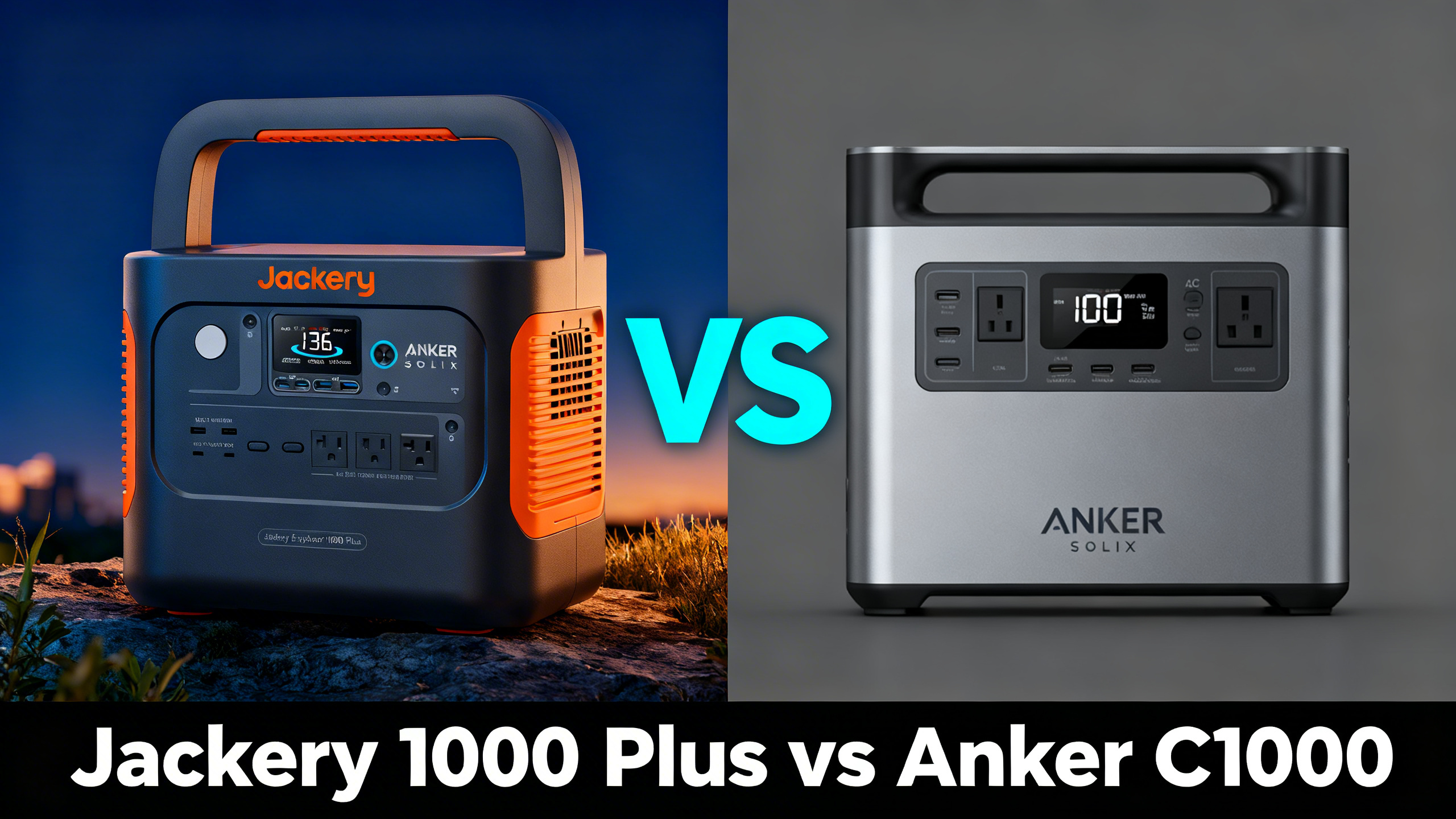
Choosing between the Jackery 1000 Plus and Anker SOLIX C1000 feels straightforward at first glance: same $999 price, both LiFePO4 chemistry, both targeting the 1kWh premium segment. But these two units reflect fundamentally different engineering priorities. One maximizes capacity and long-term scalability. The other prioritizes charging speed above all else.

The numbers tell the story clearly. The Jackery 1000 Plus delivers 1,264Wh capacity with 2,000W continuous output and expands to 5kWh with optional battery packs. The Anker SOLIX C1000 counters with 1,056Wh, 1,800W continuous (2,400W SurgePad), and a verified 43-minute time to 80% charge that nothing else in this price class matches.
This analysis covers capacity, real-world runtime, charging speed, expandability, port count, and long-term durability to help you decide which unit fits your specific use case. For a broader look at every new Jackery release, see the full Jackery lineup guide.
Update (July 2026): The Jackery Explorer 1000 Plus has been discontinued and is no longer sold new by Jackery. Our Jackery buy links now point to its successor, the Jackery Explorer 1000 v2 (1,070Wh capacity, 1,500W output, $499). We’re keeping this comparison live to help existing 1000 Plus owners and anyone weighing remaining or secondhand stock against the still-available Anker SOLIX C1000.
Best for Expandability
Jackery Explorer 1000 Plus
1264Wh | 2000W | LFP | Expandable to 5kWh
$999

Best for Fast Charging
Anker SOLIX C1000
1056Wh | 1800W (2400W SurgePad) | LFP | 43-min 80%
$999
Get our Black Friday alerts for power stations
We track live prices on 40+ models from Jackery, EcoFlow, BLUETTI and Anker SOLIX. When a deal beats the lowest price we've recorded, you'll hear from us. During Black Friday week, one short recap a day at most.
Unsubscribe in one click. We may earn a commission when you buy through our links, at no extra cost to you. Privacy Policy
Head-to-Head: Key Specs Compared
Before diving into individual strengths, a direct spec comparison reveals where each unit leads. Three differences stand out immediately: the 1000 Plus carries 20% more capacity, the C1000 charges dramatically faster, and the 1000 Plus scales to a system that’s more than twice the size of the C1000 at maximum expansion.
Sources: official Jackery Explorer 1000 Plus specs page | Anker SOLIX C1000 official product page
The capacity gap (1,264Wh vs 1,056Wh) translates to roughly 20% more runtime across every use case. The charging gap is even more pronounced: the C1000 reaches full charge in less time than the 1000 Plus takes to hit 80%. And the expandability gap is decisive for users with growing power needs.
Jackery Explorer 1000 Plus: Specs and Strengths
The Jackery Explorer 1000 Plus is built around a straightforward premise: pack more capacity and more future-proofing into the 1kWh price bracket than any competing unit. The full 1000 Plus review at jackery-explorer-1000-plus-review covers every spec in depth; here, the focus is on how it stacks up against the C1000 specifically.
Readers weighing Jackery’s own lineup may also want to also compare 1000 Plus vs v2 before deciding between the two generations.
Capacity and Battery Technology
Spec analysis confirms the 1000 Plus carries 1,264Wh of LiFePO4 (LFP) capacity. That 20% advantage over the C1000’s 1,056Wh is meaningful in practice: it translates directly to longer runtimes across every load scenario, from CPAP machines to portable refrigerators.
The LFP cells are rated for 4,000 charge cycles, versus 3,000 on the C1000. Performance data indicates that at daily use, this translates to a functional service life exceeding 10 years. TUV SUD certification provides third-party verification of the sustainability claims. App control via both WiFi and Bluetooth covers monitoring and scheduling from your phone.
Expandability: The Game-Changer
This is where the 1000 Plus separates itself from everything in its price class. The unit supports up to 3 additional Battery Pack 2000 Plus units, scaling total system capacity from 1,264Wh to a maximum of approximately 5kWh. No competitor at $999 offers this level of scalability.
Solar input is equally strong: verified specs confirm a maximum 1,000W solar input versus the C1000’s 600W cap. For off-grid users relying primarily on solar replenishment, that’s a meaningful difference in daily recovery speed. The 1000 Plus can absorb more energy per peak sun hour, which matters on shorter winter days or partially cloudy conditions.
If you need more capacity
Jackery Explorer 1000 Plus
$999 | 1264Wh
Get our Black Friday alerts for power stations
We track live prices on 40+ models from Jackery, EcoFlow, BLUETTI and Anker SOLIX. When a deal beats the lowest price we've recorded, you'll hear from us. During Black Friday week, one short recap a day at most.
Unsubscribe in one click. We may earn a commission when you buy through our links, at no extra cost to you. Privacy Policy
Anker SOLIX C1000: Specs and Strengths
The Anker SOLIX C1000 was engineered around a different value proposition: make recharging so fast that the unit’s smaller capacity becomes a non-issue. Published data confirms it delivers on that promise decisively.
HyperFlash Charging: The C1000’s Dominant Feature
Published charging data confirms 0 to 80% in 43 minutes, full charge in under one hour via AC wall outlet. This is the fastest recharge speed in the 1kWh class by a significant margin. Analysis shows this advantage matters most in emergency preparedness scenarios and RV or van life situations where turnaround time is critical: the unit depletes, you plug in, it’s ready in under an hour.
For context, the 1000 Plus reaches 80% in approximately 1.5 hours with HyperFlash. No Jackery model in this price class approaches the C1000’s AC charge rate. If you’re managing power during short grid windows or running on generator time, that difference is material.
SurgePad Technology and Port Count
The C1000’s SurgePad technology enables 2,400W surge capacity from a 1,800W continuous output unit. Performance data shows this handles startup loads for 99% of household appliances, including compressor-based devices that draw heavy current on ignition.
Eleven output ports provide simultaneous charging for multiple devices: a practical advantage for households or campsites where everyone needs power at once. The 5-year warranty also puts the C1000 ahead of the 1000 Plus’s 3-year coverage, adding meaningful peace of mind for a $999 investment. App connectivity covers both WiFi and Bluetooth, matching the Jackery on smart monitoring features.
Real-World Runtime: What Can Each Power?
Runtime calculations based on verified capacity figures show the 1000 Plus pulling consistently ahead across every common appliance scenario. The 20% capacity advantage is not abstract: it shows up as 4 additional hours on a mini-fridge, 3 extra hours on a laptop, or more than 10 additional hours on a CPAP machine.
What Can the 1000 Plus Power? (1,264Wh)
❄️
Mini Fridge
~25 hrs
50W avg
💻
Laptop
~19 hrs
65W avg
📺
TV (40″)
~17 hrs
70W avg
📱
Smartphone
~100x
12Wh/charge
🌀
CPAP Machine
~70 hrs
18W avg
Runtime estimates based on 1,264Wh capacity at 90% efficiency. Actual results vary by load and temperature.
The C1000’s comparable figures are approximately 21 hours on a mini-fridge, 16 hours on a laptop, and 58 hours on a CPAP. Both units use LFP chemistry, so efficiency factors are comparable: the runtime gap reflects the capacity difference directly. For portable AC applications (around 300W), the 1000 Plus runs roughly 3.8 hours versus the C1000’s 3.2 hours. Use the runtime calculator to estimate exactly how long either unit will power your specific appliances.
Charging Speed: Where the C1000 Pulls Ahead
Verified charging data places the C1000 decisively ahead on AC wall charging. Reaching 80% charge in 43 minutes is roughly 2.5 times faster than any competing unit at this price point. For emergency preparedness use cases where you need a full charge before a storm arrives, or RV scenarios where shore power access is limited to a few hours, this advantage is significant.
Solar charging tells the opposite story. The 1000 Plus accepts up to 1,000W of solar input versus the C1000’s 600W maximum. For off-grid users relying on panels, the Jackery recharges faster from solar: with sufficient panel coverage, it can recover more quickly on a clear day. The C1000’s AC speed advantage disappears entirely in a solar-only setup.
💡 Pro Tip: If you split your time between grid-connected and off-grid use, the right pick depends on which charging scenario you rely on more. C1000 for wall power access, 1000 Plus for solar-heavy setups.
Expandability: The 1000 Plus’s Biggest Advantage
The 1000 Plus scales from 1,264Wh to approximately 5kWh by connecting up to three Battery Pack 2000 Plus units. The C1000 expands to a maximum of 2,112Wh with one expansion battery. That’s the ceiling for the Anker system.
For users anticipating growing power needs, planning van life buildouts, or preparing for multi-day home backup scenarios, the 1000 Plus’s architecture is the defining differentiator at this price. A fully expanded 1000 Plus system holds more than twice the energy of a fully expanded C1000 system (5kWh vs 2.1kWh). If you’re investing $999 with a long-term perspective, the Jackery scales; the Anker doesn’t.
Who Should Buy Each?
Choose the Jackery 1000 Plus if…
- You plan to add battery packs later (expandable to 5kWh)
- Solar charging is a priority (1000W input vs 600W)
- You want more capacity: 1264Wh vs 1056Wh
- Long-term durability matters: 4,000 cycles vs 3,000
- You use large power tools or run multiple devices at once
Choose the Anker SOLIX C1000 if…
- Fast recharging is critical: 43 min to 80% beats anything in this class
- You need a full 5-year warranty for peace of mind
- High-surge loads are common: SurgePad handles 2400W peaks
- 11 ports provide simultaneous charging for multiple devices
- Compact travel setups where you need quick turnaround charging
Neither unit wins unconditionally at $999. The verdict is genuinely use-case dependent. If you’re also considering Bluetti in this price range, the full three-brand 1kWh battle adds a third perspective to the comparison.
Verdict: Which 1kWh Station Wins in 2026?
Spec-for-spec analysis points to a clear split verdict. The Jackery 1000 Plus wins on capacity (1,264Wh vs 1,056Wh), expandability (5kWh max vs 2.1kWh), solar input (1,000W vs 600W), and long-term cycle life (4,000 vs 3,000 cycles). The Anker SOLIX C1000 wins on AC charging speed (43 min to 80%), warranty coverage (5 years vs 3), SurgePad surge capacity (2,400W), and simultaneous charging ports (11).
For solar users, off-grid applications, and anyone who values future scalability: the 1000 Plus is the stronger choice at this price. For emergency preparedness, RV use with shore power access, or users who prioritize warranty security: the C1000 makes more sense. At identical $999 pricing, neither unit requires a compromise on budget.
Note that the Jackery 1000 Plus was discontinued as of July 2026, so buying one now means sourcing remaining or secondhand stock; new Jackery buyers are directed to the Explorer 1000 v2 successor instead.
Jackery Explorer 1000 Plus
$999
Best pick: expandability + 20% more capacity
Frequently Asked Questions
Is the Jackery 1000 Plus or Anker SOLIX C1000 better for home backup?
Performance data favors the 1000 Plus for extended home backup, primarily due to its larger 1,264Wh capacity and expandability to 5kWh. The C1000’s faster recharge (under 1 hour) makes it more practical if grid power returns quickly. For multi-day outages, the 1000 Plus system offers significantly more headroom.
Which charges faster: the Jackery 1000 Plus or Anker SOLIX C1000?
The C1000 charges significantly faster via AC wall outlet: 80% in 43 minutes, full charge in under an hour. The 1000 Plus reaches 80% in approximately 1.5 hours via HyperFlash. However, for solar charging, the 1000 Plus accepts up to 1,000W input versus the C1000’s 600W maximum, making it the faster option in solar-only scenarios.
Can the Jackery Explorer 1000 Plus be expanded?
Yes. The 1000 Plus supports up to 3 additional Battery Pack units, scaling total capacity from 1,264Wh to approximately 5kWh. The C1000 supports only one expansion battery (BP1000) for a maximum of 2,112Wh total. For users who anticipate growing power needs, the 1000 Plus’s scalability is a significant long-term advantage.
Which has a longer warranty: Jackery 1000 Plus or Anker SOLIX C1000?
The Anker SOLIX C1000 carries a 5-year warranty, while the Jackery 1000 Plus offers a 3-year warranty. However, the 1000 Plus LFP cells are rated for 4,000 cycles versus 3,000 on the C1000, suggesting longer functional longevity despite the shorter stated warranty period. Both represent solid coverage for a $999 unit.
Are both the Jackery 1000 Plus and Anker SOLIX C1000 worth it at $999?
Spec analysis confirms both deliver strong value at $999. The 1000 Plus provides more watt-hours per dollar at 1,264Wh, plus future-proofing through expandability to 5kWh. The C1000 delivers superior AC charging speed and a longer 5-year warranty. The better value depends on your primary use case: capacity and scalability favor Jackery, charging speed and warranty coverage favor Anker SOLIX.
Originally published: April 15, 2026