
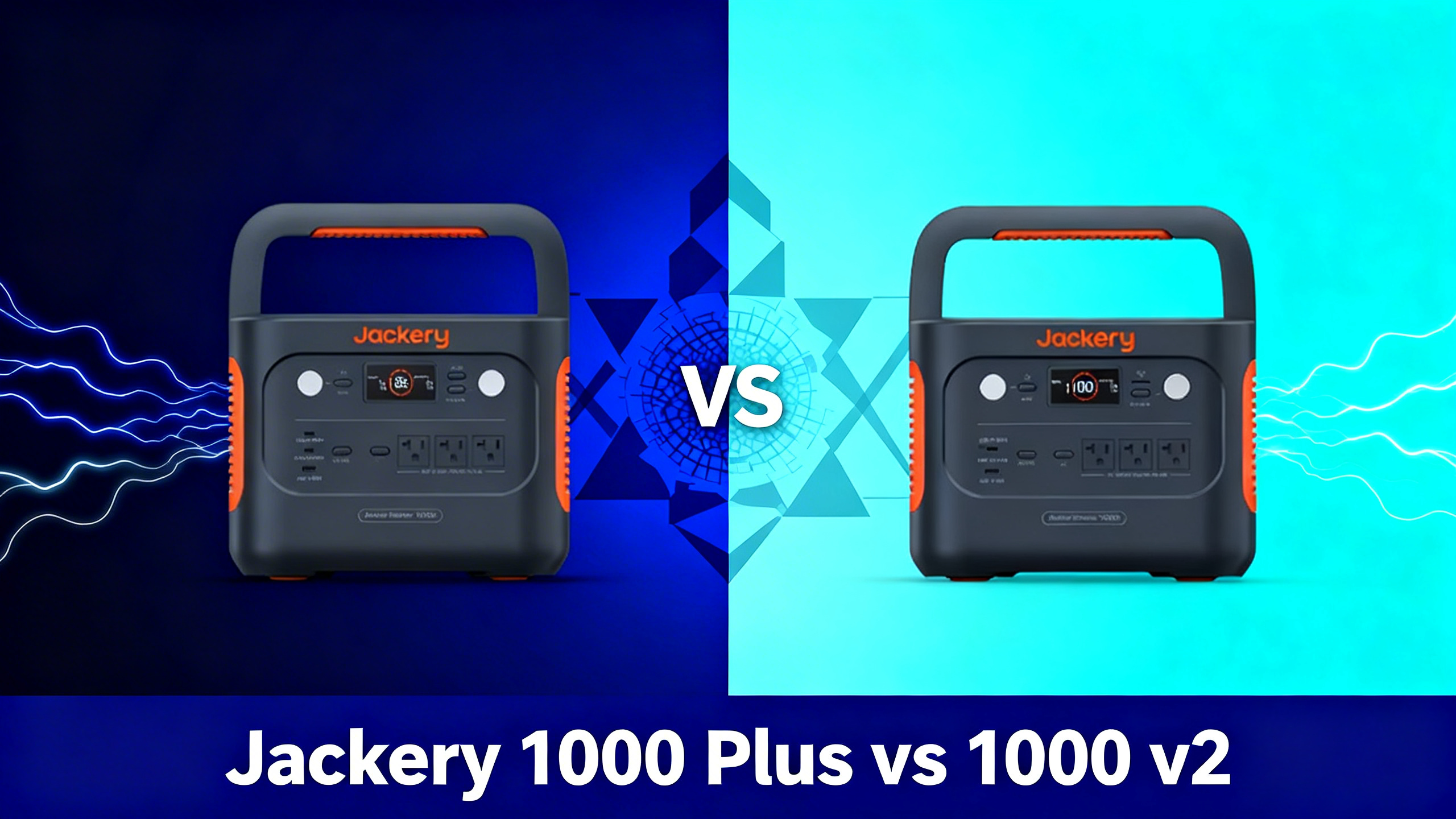
Choosing between the Jackery Explorer 1000 Plus and Explorer 1000 v2 feels straightforward on the surface: one costs $999, the other $499. But the $500 gap isn’t the whole story. These two units target different buyers, serve different use cases, and make different long-term trade-offs.
The 1000 Plus sits at the top of Jackery’s expandable lineup: 1,264Wh of capacity, 2,000W AC output, and the ability to scale up to 5kWh with add-on battery packs. The 1000 v2 takes a different angle: 1,070Wh, 1,500W output, and the fastest wall charging in the 1kWh tier at 0-100% in one hour.


Spec-for-spec comparison reveals three decisions you’re actually making: how much output ceiling you need now, whether expandability matters to your setup, and whether the fastest possible recharge outweighs raw capacity. Here’s how the data lines up.
Update (July 2026)
Jackery has discontinued the Explorer 1000 Plus — it is no longer sold on jackery.com. The Explorer 1000 v2 covered in this comparison is its current replacement. Links for the 1000 Plus below now lead to the Explorer 1000 v2 page. This comparison stays live to help owners and buyers weighing used or remaining stock against the newer model.
Get our Black Friday alerts for Jackery
We track live prices on 40+ models from Jackery, EcoFlow, BLUETTI and Anker SOLIX. When a deal beats the lowest price we've recorded, you'll hear from us. During Black Friday week, one short recap a day at most.
Unsubscribe in one click. We may earn a commission when you buy through our links, at no extra cost to you. Privacy Policy
Quick Verdict
The 1000 v2 wins on value per dollar and charging speed. At $499, it covers the needs of most campers, travelers, and light home backup users without compromise. The 1000 Plus wins on power ceiling and scalability: 2,000W output and expandable capacity up to 5kWh make it the stronger long-term platform for van lifers, RV setups, and anyone planning for extended outages.
Spoiler: there’s no universal answer here. The right pick depends entirely on how you plan to use it and whether you see yourself needing more capacity in the next two to three years. For an in-depth look at performance data, our full 1000 Plus review covers runtime calculations, charging speeds, and port configuration in detail.
Editor’s Pick: Best Expandable
Jackery Explorer 1000 Plus
$999
- 1264Wh expandable to 5kWh with battery packs
- 2000W output, LFP battery, 4,000 cycles
- App control via WiFi/Bluetooth, TÜV SÜD certified
Explorer 1000 Plus at a Glance
The Explorer 1000 Plus is Jackery’s flagship expandable unit in the 1kWh tier. At $999, it delivers 1,264Wh of capacity with 2,000W continuous AC output (4,000W surge). The LiFePO4 (LFP) chemistry gives it a rated lifespan of 4,000 charge cycles, or roughly 10+ years of regular use.
What sets the 1000 Plus apart from everything else in this segment is scalability. Add one Battery Pack 1000 Plus and you’re at 2,528Wh. Add three and you reach 5,056Wh: enough to run essential home circuits for one to three days during an outage. No other unit in this price bracket offers that upgrade path.
App control via WiFi and Bluetooth rounds out the feature set. The TÜV SÜD environmental certification is a differentiator for buyers who prioritize sustainable energy credentials.
Key Strengths of the 1000 Plus
- Expandable to 5kWh with up to three battery packs: unique in the segment
- 2,000W continuous output handles most standard household appliances
- LFP cells rated to 4,000 cycles with 10+ year lifespan
- App control via WiFi and Bluetooth for remote monitoring
- TÜV SÜD verified: industry-first certification for solar solutions
Get our Black Friday alerts for Jackery
We track live prices on 40+ models from Jackery, EcoFlow, BLUETTI and Anker SOLIX. When a deal beats the lowest price we've recorded, you'll hear from us. During Black Friday week, one short recap a day at most.
Unsubscribe in one click. We may earn a commission when you buy through our links, at no extra cost to you. Privacy Policy
Explorer 1000 v2 at a Glance
The Explorer 1000 v2 launched as Jackery’s answer to the value-conscious buyer in the mid-range 1kWh segment. At $499, it delivers 1,070Wh and 1,500W continuous output (3,000W surge), with the same LFP chemistry and 4,000-cycle rating as the 1000 Plus.
The headline feature is charging speed. ChargeShield 2.0 with Emergency Super Charge mode takes the unit from 0 to 100% in approximately one hour via wall outlet. That’s nearly twice as fast as the 1000 Plus under standard conditions. For users who need to recharge quickly between uses, the 1000 v2 has a clear practical advantage.
It also pairs with Jackery’s bifacial SolarSaga 200W panels for improved solar intake in variable light conditions. Performance data for this model is covered in our detailed 1000 v2 review from Pillar 1.
Key Strengths of the 1000 v2
- $499 price point: $500 less than the 1000 Plus
- 0-100% wall charge in approximately 1 hour via Emergency Super Charge
- ChargeShield 2.0 with 62 layers of battery protection
- Compatible with bifacial 200W panels for higher solar yield
- LFP cells: 4,000 cycles, 5-year warranty
Head-to-Head Specs Comparison
Readers evaluating the full 1000-series can also consult the three-way 1000-series comparison which adds the original Explorer 1000 into the mix. For this comparison, the three differences that matter most are capacity (+18% for the 1000 Plus), output ceiling (+33% for the 1000 Plus), and expandability (exclusive to the 1000 Plus).


Full specifications available on the official Explorer 1000 Plus product page and the official Explorer 1000 v2 product page.
What Can Each Model Power?
Capacity data indicates the 1000 Plus delivers approximately 18% more stored energy than the 1000 v2: 1,264Wh versus 1,070Wh. In practical terms, that gap compounds across longer runtimes. Before purchasing, run your specific appliances through our device compatibility checker to get accurate runtime estimates for both units.
What the numbers show for common use cases: the 1000 Plus handles a mini-fridge for roughly 16 hours versus 13 hours for the 1000 v2. For a laptop (70W average draw), runtime calculations show approximately 18 hours versus 15 hours. The gap is meaningful over a full weekend off-grid but not dramatic for single-day use.
Runtime Comparison: What Can Each Model Power?
Explorer 1000 Plus (1,264Wh)
❄
Mini-fridge
~16 hrs
80W avg
💡
LED lights
~84 hrs
15W avg
📱
Smartphone
~100 charges
12Wh/charge
💻
Laptop
~18 hrs
70W avg
Explorer 1000 v2 (1,070Wh)
❄
Mini-fridge
~13 hrs
80W avg
💡
LED lights
~71 hrs
15W avg
📱
Smartphone
~89 charges
12Wh/charge
💻
Laptop
~15 hrs
70W avg
Runtime calculations based on published capacity and typical appliance draw rates. Actual results vary with load and temperature.
The more significant difference comes when you factor in the 1000 Plus battery packs. Adding one pack brings capacity to 2,528Wh: that same mini-fridge now runs for over 31 hours. At 5,056Wh with three packs, you’re looking at home-backup territory that the 1000 v2 simply cannot reach without a full unit replacement.

Charging Performance
Published charging data confirms the 1000 v2 wins clearly on wall charging speed. Emergency Super Charge achieves 0-100% in approximately one hour, compared to roughly 1.7 hours for the 1000 Plus under standard conditions. That 40-minute gap is real and matters if you’re on a tight schedule between uses.
The 1000 Plus compensates through solar flexibility. With support for up to four SolarSaga 200W panels simultaneously (approximately 800W max solar input), it can recharge significantly faster via solar than the 1000 v2, which supports a single 200W bifacial panel. For users with solar arrays, the equation shifts in the 1000 Plus’s favor.

Ports & Output
The USB-C ports differ. The 1000 Plus has two 100W Power Delivery ports, so two laptops can fast-charge at once. The 1000 v2 has one 100W port and one 30W port: one laptop at full speed, plus a phone or tablet on the second port.
The AC output gap is more consequential. The 1000 Plus at 2,000W continuous handles a broader range of household appliances including most microwaves, power tools, and small window AC units. The 1000 v2 at 1,500W covers refrigerators, CPAP machines, TVs, and most camping gear, but you’ll hit the ceiling faster with high-draw devices.

Jackery Explorer 1000 Plus
1264Wh expandable to 5kWh. 2000W output. LFP cells.
$999
Use Cases: Who Should Buy Which?
The choice between these two units comes down to use case more than specs. Analysis of real-world use patterns consistently points to the same split: the 1000 Plus for users who need power to grow, the 1000 v2 for users who need power now at a reasonable price.
Those coming from older hardware should also read the 1000 Plus vs the older 1000 Pro breakdown before deciding. The generational improvements in charging speed and chemistry are worth understanding before committing to either model here.
Choose the 1000 Plus if…
- You need expandable capacity (van life, RV, multi-day outages)
- You run high-draw appliances needing 2000W+ output
- App remote monitoring is a priority
- You want room to grow without buying a new unit
Choose the 1000 v2 if…
- Budget is a priority and $500 matters to you
- Your use case is camping, day trips, or small outages
- Fastest wall charging (1 hour) is your top requirement
- You don’t need expandability or app control

Price vs Value Analysis
Is the $500 premium justified? On raw specs alone, probably not: +18% capacity and +33% output ceiling don’t typically command a 100% price increase. But the value calculation shifts when you account for expandability.
One Battery Pack 1000 Plus adds 1,264Wh for $399, bringing total capacity to 2,528Wh at a combined cost of $1,398. Reaching that same capacity level by buying a standalone 2kWh-class unit would cost more and still lack the flexibility to add further packs. The 1000 Plus’s expandability is essentially a bet on future needs: if you stay at 1,264Wh, it’s hard to justify the premium. If you add even one battery pack within two years, the economics look reasonable.
Our Verdict
The 1000 v2 wins on value per dollar and charging speed. At $499 with 1-hour wall charging and LFP chemistry, it delivers everything most campers, travelers, and light home backup users need. The 1000 Plus wins on raw power ceiling and future scalability: 2,000W output and expandability to 5kWh make it the stronger long-term platform.
The short answer: if you’re buying one power station for camping and occasional outages, the 1000 v2 is the smarter buy. If you see yourself needing more capacity within a few years, or if you already need 2,000W output regularly, the 1000 Plus’s expandability justifies the premium. Both units share the same LFP battery quality and longevity, so neither choice is wrong. One caveat as of July 2026: Jackery has discontinued the 1000 Plus, so choosing it now means buying from remaining retailer or secondhand stock.
Portable Power Station Runtime Calculator
Calculate exactly how long each model will run your specific devices before you buy.
Frequently Asked Questions
What is the main difference between the Jackery 1000 Plus and 1000 v2?
The core difference comes down to expandability and output ceiling. Capacity data shows the 1000 Plus offers 1,264Wh (expandable to 5kWh with battery packs) and 2,000W AC output. The 1000 v2 delivers 1,070Wh with 1,500W output, but charges faster at 0-100% in approximately 1 hour versus 1.7 hours for the 1000 Plus. The 1000 v2 cannot be expanded, which is the defining trade-off between the two units.
Is the Jackery 1000 Plus worth the extra $500 over the 1000 v2?
Analysis indicates the premium is justified if you need expandable capacity or plan to run appliances above 1,500W. For camping, travel, and small outages, the 1000 v2 covers most use cases at half the cost. The 1000 Plus makes financial sense when you factor in the ability to add battery packs instead of buying a larger unit later: one Battery Pack 1000 Plus ($399) brings total capacity to 2,528Wh for a combined cost of $1,398.
Can the Jackery 1000 v2 run a refrigerator?
Runtime calculations based on 1,070Wh capacity and a typical refrigerator draw of 100-150W suggest approximately 7-10 hours of runtime. Published specs confirm the 1,500W AC output is sufficient to start most standard refrigerators (typical surge draw: 1,000-1,200W). For multi-day power outages, the 1000 Plus with a battery pack is the stronger fit.
Does the Jackery 1000 Plus come with battery packs included?
No. The base unit at $999 ships without battery packs. The Battery Pack 1000 Plus (1,264Wh, $399 current price) is sold separately and expands capacity to 2,528Wh with one pack, or up to 5,056Wh with three packs. Bundle options on the official site combine the station with SolarSaga panels, not battery packs.
Which charges faster: the 1000 Plus or 1000 v2?
Published charging data confirms the 1000 v2 wins on wall charging speed. Its Emergency Super Charge feature achieves 0-100% in approximately 1 hour via wall outlet. The 1000 Plus charges from 0-100% in approximately 1.7 hours under standard conditions. However, the 1000 Plus supports faster solar charging via multiple panels simultaneously (up to 4 SolarSaga 200W panels), which the 1000 v2 does not support.
Which model is better for van life or RV use?
Expandability data consistently points to the 1000 Plus for extended off-grid use. The ability to grow from 1,264Wh to 5,056Wh without replacing the base unit is significant for van life builds. For weekend van trips or part-time RV use, the 1000 v2 handles the core power needs at a lower cost of entry.
Jackery Explorer 1000 Plus
$999
Best pick for expandable off-grid power at the 1kWh tier
See Explorer 1000 v2 (successor) →
Price verified April 2026. Free shipping available
Originally published: April 15, 2026