
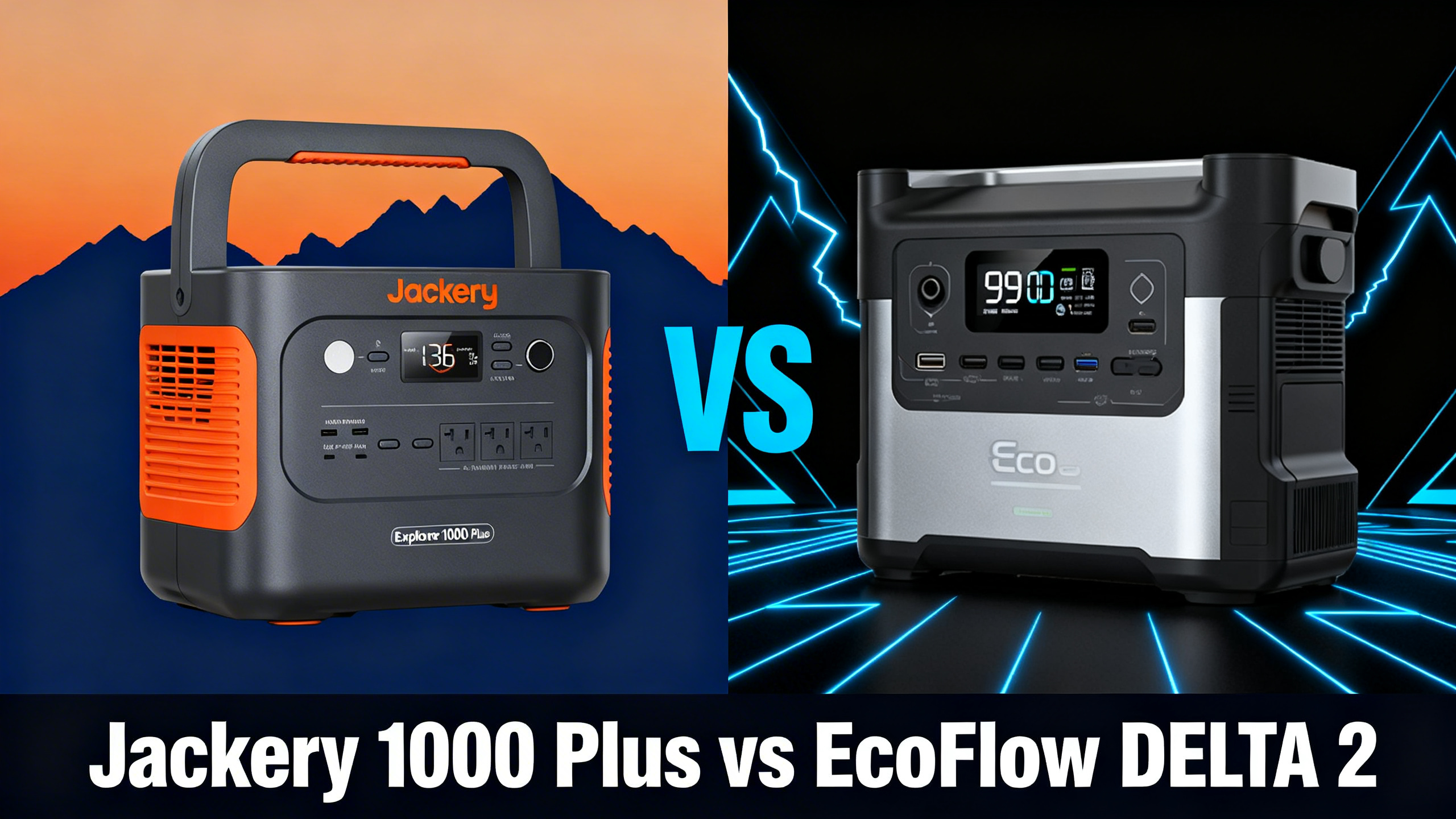
Choosing between the Jackery 1000 Plus and the EcoFlow DELTA 2 isn’t straightforward. Both sit in the 1kWh class, both use LFP chemistry, and both handle most home backup and outdoor use cases. Yet the data shows two genuinely different products at very different price points right now.
The 1000 Plus carries premium specs: 1,264Wh, 2,000W output, expandable to 5kWh, 4,000 cycles. The DELTA 2 counters with faster AC recharge (1h 24min), a 5-year warranty, and a current price of $399 (down from $1,049). For a complete breakdown of every 2025 release, our guide to all new Jackery models covers the full lineup. This article focuses on helping you decide which of these two wins for your specific needs.


Jackery Pick
Explorer 1000 Plus
1,264Wh | 2,000W | LFP | Expandable 5kWh
$999
Update (July 2026): The Jackery Explorer 1000 Plus has been discontinued and is no longer sold by Jackery. Links for the 1000 Plus in this article now lead to its successor, the Jackery Explorer 1000 v2 (1,070Wh capacity, 1,500W output, $499). We’ve kept the comparison live to help existing owners and anyone weighing remaining or secondhand 1000 Plus stock against the EcoFlow DELTA 2.
Get our Black Friday alerts for power stations
We track live prices on 40+ models from Jackery, EcoFlow, BLUETTI and Anker SOLIX. When a deal beats the lowest price we've recorded, you'll hear from us. During Black Friday week, one short recap a day at most.
Unsubscribe in one click. We may earn a commission when you buy through our links, at no extra cost to you. Privacy Policy
Quick Verdict: Two Great Stations, Two Different Use Cases
The data points to a clear split: these aren’t really competing for the same buyer. The gap is larger than the capacity difference suggests.
Choose the 1000 Plus for expandability and longevity
The Explorer 1000 Plus targets users who need a system that grows with them. With 4,000 LFP cycles, 800W solar input, and expandability up to 5kWh, it’s built for van lifers, frequent campers, and anyone planning extended off-grid use. The specs justify the $999 price if you’re planning long-term use.
Choose the DELTA 2 for value and faster charging
At $399 (down from its $1,049 MSRP), the DELTA 2 represents aggressive value for what you get. Its 1h 24min AC recharge, 5-year warranty, and 27.4 lb weight make it practical for home backup, weekend use, and users who need to top up fast. Note that stock availability has been fluctuating at this price point.
Buy the Jackery 1000 Plus if…
- You need expandable capacity (van life, RV, extended off-grid)
- Solar charging is a priority (800W vs 500W input)
- Long-term cycle count matters (4,000 vs 3,000)
- You want the highest AC output at 2,000W
- Budget allows for the premium tier
Buy the EcoFlow DELTA 2 if…
- Budget is the primary consideration ($399 current price)
- Fastest AC recharge matters (1h 24min vs ~2h)
- 5-year warranty provides purchase confidence
- Portability is key (~4.6 lbs lighter)
- X-Boost smart wattage handling suits your appliances
Head-to-Head Specs Comparison
The numbers below tell the full story. Both units use LFP (lithium ferro-phosphate) chemistry, which means longer cycle life and better thermal stability compared to older lithium-ion designs. Where they diverge is capacity, output, expandability, and recharge speed.
Get our Black Friday alerts for power stations
We track live prices on 40+ models from Jackery, EcoFlow, BLUETTI and Anker SOLIX. When a deal beats the lowest price we've recorded, you'll hear from us. During Black Friday week, one short recap a day at most.
Unsubscribe in one click. We may earn a commission when you buy through our links, at no extra cost to you. Privacy Policy
Jackery Explorer 1000 Plus: Key Specs and Features
The Explorer 1000 Plus sits at the top of Jackery’s core lineup, priced at $999 with specs that position it clearly above the 1000 v2. It’s TÜV SÜD certified, which is an industry-first verification for sustainable solar performance. The official Explorer 1000 Plus specifications confirm a 1,264Wh capacity with WiFi and Bluetooth app control.
Capacity and Output
At 1,264Wh, the 1000 Plus delivers 240Wh more than the DELTA 2. That’s meaningful in extended use scenarios: roughly 2 extra hours running a 100W device. The 2,000W rated AC output handles most standard appliances with room to spare.
Jackery Explorer 1000 Plus Review
For a deeper look at performance data and use cases, see our full review.
Expandability: The 1000 Plus Advantage
This is where the 1000 Plus separates itself. It accepts up to 3 additional battery packs, pushing total capacity to 5kWh. For van lifers or RV users who want to build a system over time, this is a significant long-term advantage. No competing 1kWh station in this price range offers comparable expansion headroom.
LFP Battery and Cycle Life
The 1000 Plus uses LiFePO4 (LFP) cells rated to 4,000 cycles. Cycle life data indicates the unit retains 80% capacity at that threshold, which translates to roughly 10+ years of daily use. For a deeper look at performance data and use cases, see our full 1000 Plus review.
EcoFlow DELTA 2: Key Specs and Features
The DELTA 2 carries a 1,024Wh capacity, 1,800W AC output, and a 5-year warranty at a current price of $399. Note that availability has been fluctuating at this price, so check the EcoFlow DELTA 2 product page for current stock status.
X-Boost Technology and AC Output
The DELTA 2 features EcoFlow’s X-Boost, which intelligently manages power draw and can run appliances up to 2,200W despite the 1,800W rated output. This makes it more flexible than the raw specs suggest. Devices with inefficient motor loads benefit most from this technology.
Fastest Recharge in Class
The DELTA 2’s 1h 24min AC recharge time is a genuine differentiator. At roughly 740W input, it charges about 36 minutes faster than the 1000 Plus. For home backup users who need to top up quickly after an outage, this matters considerably.
Expandability and Warranty
The DELTA 2 expands to 3kWh via a single Smart Extra Battery. That’s less than the 1000 Plus ceiling, but sufficient for most home backup and extended camping scenarios. The 5-year warranty exceeds Jackery’s 3-year coverage by a meaningful margin.

Capacity Winner
Jackery Explorer 1000 Plus
240Wh more capacity, expandable to 5kWh, 4,000 LFP cycles
$999
Real-World Runtime: What Can Each Station Power?
Use our interactive runtime calculator to model your specific appliance mix against each station’s capacity. The estimates below are based on published capacity figures at approximately 80% inverter efficiency.
1000 Plus (1,264Wh) vs DELTA 2 (1,024Wh): Estimated Runtime
❄️
Mini-Fridge (60W)
~14 hrs
1000 Plus
~11.5 hrs
DELTA 2
💻
Laptop (65W)
~13 hrs
1000 Plus
~10.5 hrs
DELTA 2
📺
LED TV (100W)
~8.5 hrs
1000 Plus
~6.8 hrs
DELTA 2
📱
Smartphone (15W)
~56 charges
1000 Plus
~45 charges
DELTA 2
Runtime calculations based on published capacity at ~80% efficiency. Actual results vary with appliance draw and ambient temperature.

Price and Value Analysis
The price gap between these two units is the central tension in this comparison. At face value, it looks like a $600 difference. But the full picture is more nuanced.
1000 Plus: Premium price, premium specs
At $999, the Explorer 1000 Plus is priced at its full retail value. The capacity advantage (1,264Wh), higher solar input ceiling (800W), and expandability to 5kWh are real differentiators for users who plan to scale. The 4,000-cycle LFP rating adds long-term cost efficiency: fewer unit replacements over a decade of use.
DELTA 2: Aggressive pricing vs original MSRP
The DELTA 2’s current $399 price is a significant drop from its $1,049 original MSRP. At that level, it’s competing well below its own value tier. Keep in mind that stock availability has been variable at this price, so the deal may not last. The 5-year warranty at $399 is an unusually strong value proposition.
Calculate Your Power Needs
Not sure which capacity is right for you? Run your appliances through our power calculator.
Who Should Buy the Jackery 1000 Plus?
The 1000 Plus makes most sense for users with a long-term power strategy. If you’re outfitting a van, adding solar to an RV, or want a station that grows with your needs, the expandability ceiling and 4,000-cycle longevity justify the premium.
Solar-forward users will also find the 800W solar input a meaningful advantage. Paired with two 400W panels, the Explorer 1000 Plus can recharge significantly faster off-grid than the DELTA 2 at its 500W maximum. If the older Jackery lineup is also on your radar, you can also compare 1000 Plus vs 1000 v2 to weigh the generation gap.
Who Should Buy the EcoFlow DELTA 2?
At $399, the DELTA 2 suits users who want solid 1kWh capability without the extended feature set. Home backup users, occasional campers, and anyone who prioritizes fast recharge over expandability will find it delivers strong value at this price point.
The 5-year warranty is a legitimate confidence factor. For buyers uncertain about long-term reliability, EcoFlow’s extended coverage reduces the purchase risk considerably. The lighter weight (27.4 lbs vs 32 lbs) also makes a difference for users who need to move the unit frequently. Keep in mind that stock has been inconsistent: check the EcoFlow DELTA 2 product page before assuming availability.

Final Verdict
The Jackery 1000 Plus vs EcoFlow DELTA 2 matchup doesn’t have a universal winner. What the data shows is two stations optimized for different priorities. This matchup fits into a broader picture covered in our Jackery brand comparison guide.
Spec-for-spec, the 1000 Plus wins on capacity, output, expandability, solar input, and cycle life. The DELTA 2 wins on price, recharge speed, weight, and warranty. At current pricing, the DELTA 2 punches well above its apparent category. The 1000 Plus earns its price for users building a long-term system. For everyone else, the DELTA 2 at $399 is a harder value argument to ignore. Note that the Explorer 1000 Plus has been discontinued as of July 2026, so buying one now means sourcing remaining or secondhand stock; new buyers should look at its successor, the Explorer 1000 v2.
Explorer 1000 Plus
$999
Best for off-grid, van life, and long-term backup
See Explorer 1000 v2 (successor) →
Price verified April 2026 . Free shipping available
EcoFlow DELTA 2
$399
Best value 1kWh station right now
Price verified April 2026 . Check availability
Frequently Asked Questions
Is the Jackery 1000 Plus better than the EcoFlow DELTA 2?
The answer depends on your priorities. The Jackery 1000 Plus leads on capacity (1,264Wh vs 1,024Wh), AC output (2,000W rated), expandability up to 5kWh, and cycle life (4,000 cycles). The EcoFlow DELTA 2 leads on price ($399 vs $999 at current pricing), AC recharge speed (1h 24min), weight (~27.4 vs ~32 lbs), and warranty coverage (5 vs 3 years). Neither is universally better.
What is the difference between Jackery 1000 Plus and EcoFlow DELTA 2?
Key differences: capacity (1,264Wh vs 1,024Wh), AC output (2,000W vs 1,800W rated), max expandability (5kWh vs 3kWh), AC recharge time (approximately 2 hours vs 1h 24min), solar input ceiling (800W vs 500W), warranty (3 years vs 5 years), cycle rating (4,000 vs 3,000), and current price point. Both use LFP battery chemistry.
Can the EcoFlow DELTA 2 run a refrigerator?
Yes. The DELTA 2 provides 1,800W AC output (2,200W with X-Boost technology), which handles the majority of standard refrigerator compressors drawing 150-400W. Runtime calculations for a 60W mini-fridge show approximately 11.5 hours of operation from a full charge of 1,024Wh at 80% efficiency.
Is the Jackery 1000 Plus worth the extra cost over the DELTA 2?
For van life, extended off-grid use, or setups requiring large solar arrays, the 1000 Plus expandability to 5kWh, 4,000 LFP cycles, and 800W solar input justify the higher price. For home emergency backup or occasional use where fast AC recharge is a priority, the DELTA 2’s current pricing offers compelling value that’s difficult to match at this capacity level.
Which has better solar charging: Jackery 1000 Plus or EcoFlow DELTA 2?
The Jackery 1000 Plus accepts up to 800W of solar input compared to 500W for the DELTA 2. This gives the 1000 Plus a clear advantage for multi-panel setups and faster solar recharges in optimal conditions. For users who rely primarily on solar, the 1000 Plus is the stronger choice.
Originally published: April 15, 2026