
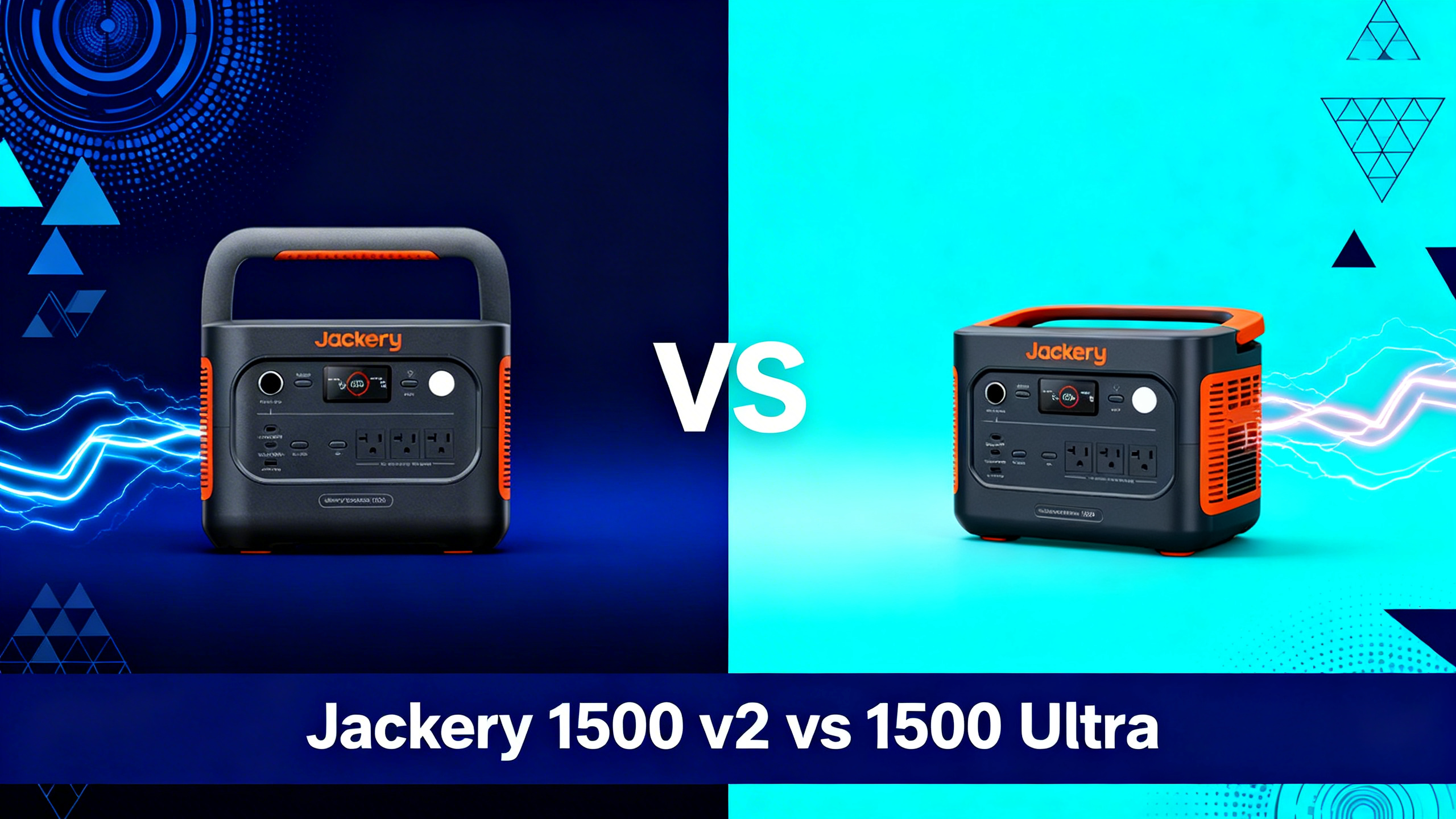
Both the Explorer 1500 v2 and Explorer 1500 Ultra share identical capacity (1,536Wh) and similar output. The price difference is $300. So what exactly do you get for the premium, and is it ever worth it?
The Explorer 1500 v2 ($699) represents Jackery’s value play at the 1536Wh tier: LiFePO4 (lithium ferro-phosphate) battery, 2000W output, 9% lower cost-per-Wh than comparable units, and 7 output ports. The Explorer 1500 Ultra ($999) targets a different buyer entirely: IP65 waterproofing, level 9 seismic shockproofing, 1-meter drop resistance, and a patented Titanium-Alloy cooling structure. Same capacity, opposite priorities.
This comparison evaluates specs, ruggedness, charging, real-world performance scenarios, and long-term value. Both models are part of Jackery’s 2025 refresh: see all new Jackery models for the complete lineup. By the end, the right choice for your situation will be clear.


Best for Outdoors
Explorer 1500 Ultra
$999 $1,299
1536Wh · IP65 · Drop-proof · Shockproof
Get our Black Friday alerts for Jackery
We track live prices on 40+ models from Jackery, EcoFlow, BLUETTI and Anker SOLIX. When a deal beats the lowest price we've recorded, you'll hear from us. During Black Friday week, one short recap a day at most.
Unsubscribe in one click. We may earn a commission when you buy through our links, at no extra cost to you. Privacy Policy
At a Glance: Key Differences
A few key takeaways from the data. First, capacity is a tie: both units deliver exactly 1,536Wh, so neither wins on raw energy volume. Second, the $300 price gap buys one thing on the Ultra: environmental protection (IP65 plus drop and shock resistance). Third, the cost-per-Wh spread is significant: $0.45/Wh on the v2 versus $0.65/Wh on the Ultra, a 44% premium. The decision hinges entirely on your use environment.
Explorer 1500 v2 Overview
Specs and Design
Published spec data confirms the Explorer 1500 v2 delivers 1,536Wh of LiFePO4 capacity with 2,000W continuous AC output and a 4,000W surge rating. The port configuration stands out at this price point: 7 outputs including dual USB-C fast-charge ports and 3 AC outlets, covering everything from phones and laptops to e-bikes and small appliances.
Cost analysis shows the v2 achieves 9% lower cost-per-Wh than comparable 1.5kWh units on the market. At $699 (down from $999 MSRP), the Explorer 1500 v2 sits at $0.455 per watt-hour, making it one of the stronger value propositions in the LFP segment. For a complete breakdown of specs and performance data, see our full 1500 v2 review.

Who It’s For
Performance data points to the 1500 v2 as the clear choice for home backup, car camping, van life with enclosed storage, and indoor power needs. If your unit lives in a garage, a vehicle, or a shed, the v2’s standard build quality is entirely adequate. The LFP chemistry means long cycle life and stable performance over years of use.
The limitation is straightforward: no waterproofing, no drop protection, no dust sealing. That’s not a flaw for 80-90% of use cases, but it’s worth understanding before you buy.
Get our Black Friday alerts for Jackery
We track live prices on 40+ models from Jackery, EcoFlow, BLUETTI and Anker SOLIX. When a deal beats the lowest price we've recorded, you'll hear from us. During Black Friday week, one short recap a day at most.
Unsubscribe in one click. We may earn a commission when you buy through our links, at no extra cost to you. Privacy Policy
Explorer 1500 Ultra Overview
Specs and Ruggedness
The Ultra’s certification data points to a unit built for environments that would damage a standard power station. IP65 rating means complete dust ingress prevention (the “6”) and protection against water jets from any direction (the “5”). That covers heavy rain, hose-down cleaning, dusty job sites, and waterside use. Level 9 seismic resistance per IEC 60068-2-64 means the internal components survive high-frequency vibration, which matters on rough roads and in equipment trailers.

The 1-meter drop resistance adds practical durability for job site and trail use where accidental drops are a real risk. Jackery’s patented Titanium-Alloy cooling structure provides structural rigidity alongside thermal management. The patented bottom-drainage design ensures water doesn’t pool inside even after exposure. Capacity stands at 1,536Wh, identical to the v2. Detailed specs analysis is available in our full 1500 Ultra review.
Who It’s For
The Ultra targets buyers whose equipment faces real environmental stress. Outdoor professionals on construction sites, overlanders on technical trails, marine users, and adventure campers in genuine harsh conditions all have legitimate reasons to pay the $300 premium. For these users, the ruggedness features aren’t marketing: they’re insurance against equipment failure in the field.
Full Specs Comparison
With identical capacity and near-identical output, the spec sheet differences are concentrated in one column: the Ultra’s protection ratings. Here’s the full picture side by side.
See the official Explorer 1500 v2 specifications for the complete port and charging input list.

Durability and Ruggedness Compared
What IP65 Actually Means
The IP rating system uses two digits to define protection levels. The “6” in IP65 means completely dust-tight: zero dust ingress under any conditions. The “5” means protected against water jets from any direction, at any angle, with no harmful effects. For a detailed breakdown of the full rating scale, see IP65 rating explained. In practical terms, the Ultra survives outdoor use in heavy rain, hose cleandowns, and dusty worksites without protection concerns.

Drop and Shock Protection
Structural data indicates the Ultra is designed to handle the physical realities of field use. Level 9 seismic resistance per IEC 60068-2-64 means survival under high-frequency vibration: relevant for equipment carried in ATVs, overlanding vehicles, or work trucks on rough terrain. The 1-meter drop resistance covers the most common accident scenario for portable gear.
Jackery’s patented Titanium-Alloy cooling structure adds structural rigidity to the chassis, providing stiffness that standard plastic enclosures can’t match. The patented bottom-drainage design ensures water evacuation rather than pooling, which matters after water exposure. These are engineered solutions, not marketing claims.

The v2’s Trade-Off
The 1500 v2 makes no ruggedness claims. Its build quality is solid for indoor and protected-environment use, but it is not rated for dust, water, drops, or sustained vibration. This is a genuine constraint for outdoor professionals. For the large majority of buyers using their unit at home, in a vehicle, or on a standard camping trip, the trade-off is entirely acceptable and the $300 savings is real.
Value Analysis: Is the $300 Premium Worth It?
Both models fall into the best Jackery under $1,000 segment, where value decisions matter most. The core math is straightforward: same capacity, same energy output, a 44% price premium for ruggedness certification. Analysis of long-term ownership costs shows the same LFP battery chemistry on both units, meaning comparable cycle life regardless of which you choose.

Price-Per-Wh Breakdown
The ruggedness premium pays off only if your use environment genuinely demands it. For a job site electrician or an overlander in the Pacific Northwest rainy season, it’s money well spent. For a homeowner keeping backup power in their garage, the v2 delivers equivalent energy capacity at $300 less.
Real-World Performance
Runtime calculations show both units deliver near-identical results on any given load: that’s the direct outcome of sharing the same 1,536Wh capacity. Performance data confirms the differentiation between these two models is purely in durability and environmental protection, not output power or energy volume.

What Can 1,536Wh Power? (Both Models)
❄️
Mini Fridge
~21 hrs
60W avg
💡
LED Lights
~512 hrs
3W avg
💻
Laptop
~25 charges
60Wh/cycle
📱
Smartphone
~100 charges
15Wh/cycle
Runtime calculations based on 1,536Wh capacity at 85% efficiency. Actual results vary by load and ambient conditions.
Winner by Use Case

Which Model Fits Your Situation?
Choose the 1500 v2 if…
- Budget matters: $300 savings is real money
- You use it indoors or in a vehicle (no weather exposure)
- Home backup or car camping is your main use case
- You want the best cost-per-Wh at this tier
- You power standard devices, not extreme-environment gear
Choose the 1500 Ultra if…
- You work in rain, mud, dust, or wet environments
- Drops and rough handling are a real risk (job sites, trails)
- You need IP65 certification for a professional or liability reason
- Long-term gear durability justifies the $300 premium
- Off-grid adventure use in unpredictable conditions
Final Recommendation
The data is clear. The 1500 v2 is the right call for approximately 80% of buyers: home backup users, car campers, van lifers with enclosed storage, and anyone whose unit lives in a protected environment. At $699, it delivers every watt-hour the Ultra offers, with the same LFP battery chemistry, at $300 less.
The 1500 Ultra’s premium delivers exactly one thing: the ability to operate in environments that would damage a standard unit. That’s a genuine, valuable thing if your environment actually demands it. For outdoor professionals, serious overlanders, and marine users, the Explorer 1500 Ultra is money well spent. For everyone else, the 1500 v2 is the smarter buy.

Make Your Decision Today
Prices verified April 2026. Free shipping available on jackery.com
Frequently Asked Questions
Are the Jackery 1500 v2 and 1500 Ultra the same battery capacity?
Yes. Both models deliver exactly 1,536Wh of capacity. Runtime calculations on any given load confirm near-identical results across both units. The capacity is not a differentiator between these two models: the distinction is entirely in environmental protection and ruggedness certification.
Is the Explorer 1500 Ultra worth $300 more than the 1500 v2?
Only if your use environment involves dust, water, drops, or significant vibration. Spec analysis confirms the 1500 v2 delivers equivalent energy output at significantly lower cost ($699 vs $999, or $0.455/Wh vs $0.651/Wh). For indoor, vehicle, or standard camping use, the v2 is the more rational purchase. For outdoor professionals, overlanders, and marine users, the Ultra’s ruggedness package justifies the premium.
Can the Jackery 1500 v2 power a refrigerator?
Runtime calculations based on the 1500 v2’s 1,536Wh capacity show approximately 21 hours on a 60W mini-fridge at 85% efficiency. A full-size refrigerator drawing 150W would run approximately 8 to 9 hours. Both figures apply equally to the 1500 Ultra, which shares the same capacity. For extended home backup scenarios, consider pairing with solar panels for continuous recharge.
What does IP65 mean on the Explorer 1500 Ultra?
IP65 indicates two separate protection levels. The “6” means completely dust-tight: no dust can enter under any conditions. The “5” means protection against water jets from any direction. This makes the 1500 Ultra suitable for heavy rain, dusty worksites, and waterside use without protection concerns. It does not indicate full submersion resistance, which would require an IP67 or IP68 rating.
Which is better for van life or RV use?
Data analysis points to the 1500 v2 for most van life and RV scenarios. Enclosed storage compartments mean the unit rarely faces direct weather exposure, making IP65 certification unnecessary for this use case. The $300 savings can fund one or two SolarSaga 100W panels, adding meaningful off-grid solar charging capability. Full-time overlanders sleeping in tents or exposed setups are the exception, where the Ultra’s ruggedness becomes relevant.
Originally published: April 15, 2026