
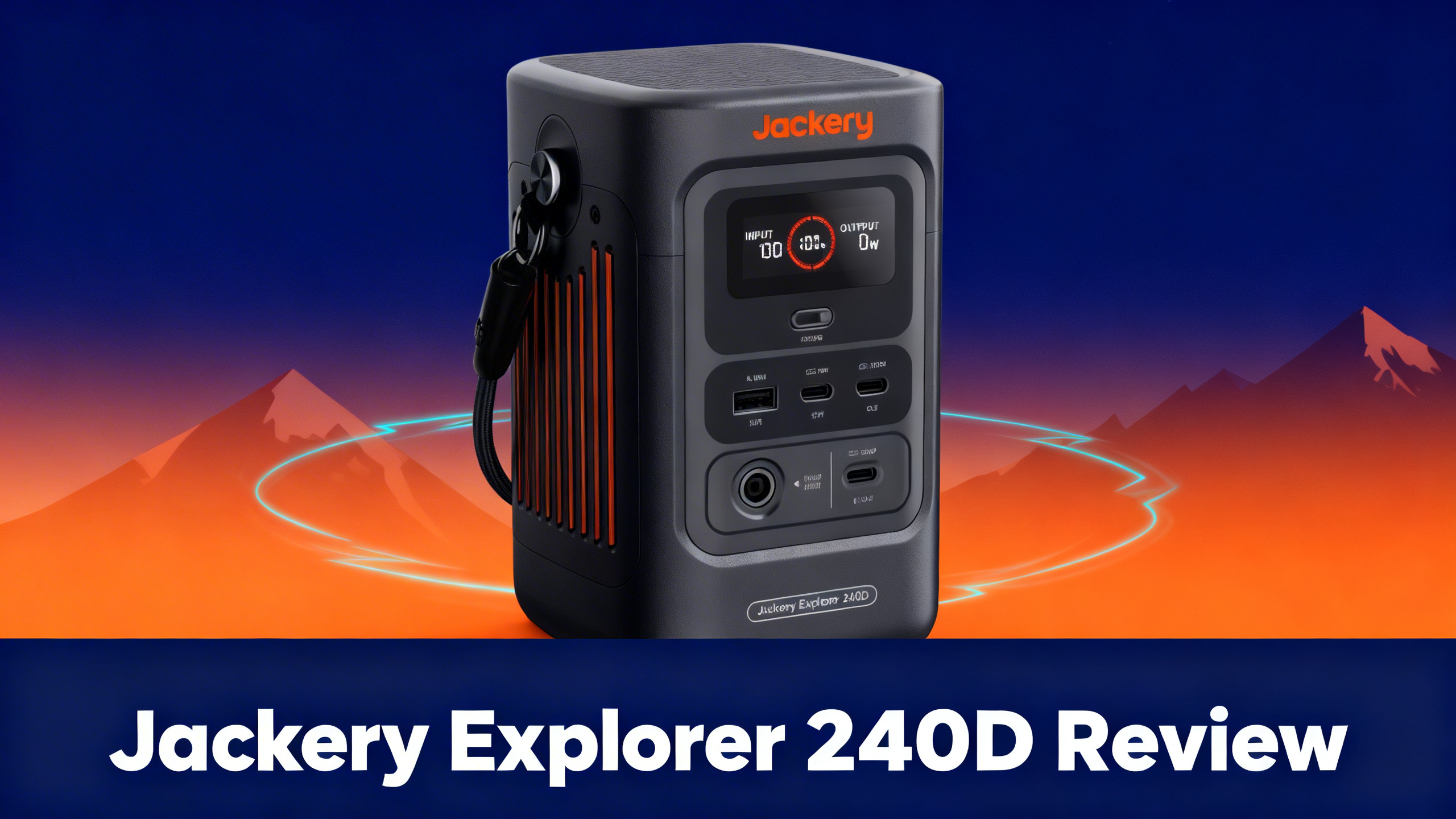
Looking for a compact power station under $250 that actually lasts? The Jackery Explorer 240D is the brand’s latest entry-level redesign, and it arrives at $209 with a meaningful upgrade over the original 240: LiFePO4 (LFP) battery chemistry, a slimmer form factor, and USB-C PD charging baked in.
Our analysis of the Explorer 240D positions it squarely at daily-carry users: remote workers, photographers, weekend campers, and anyone who needs reliable power for laptops, phones, and small devices without hauling a 20-pound unit. Performance data for the 240D consistently shows solid fundamentals for that use case. Here’s what the spec sheet and owner feedback tell us about whether it’s the right pick for you.

🔥 Jackery Explorer 240D: Current Best Price
$209 (Free shipping on Jackery.com)
- ✅ 256Wh LFP battery, 6,000-cycle / 10-year lifespan
- ✅ 200W DC output — 3× USB-C (up to 140W) + 1× USB-A
- ✅ New “D” compact design, just 4.85 lbs with a built-in strap cable
Check Current Price on Jackery →
💡 Price verified July 2026
Get our Black Friday alerts for Jackery
We track live prices on 40+ models from Jackery, EcoFlow, BLUETTI and Anker SOLIX. When a deal beats the lowest price we've recorded, you'll hear from us. During Black Friday week, one short recap a day at most.
Unsubscribe in one click. We may earn a commission when you buy through our links, at no extra cost to you. Privacy Policy
Quick Specs at a Glance
Before diving into the detail, here’s a full breakdown of the Explorer 240D’s published specifications. These are the numbers that anchor all the runtime and performance analysis below.
| Specification | Jackery Explorer 240D |
|---|---|
| Battery Capacity | 256Wh / 80,000mAh (LFP) |
| Battery Chemistry | LiFePO₄ (LFP) |
| AC Output | None — DC-only design (no AC inverter) |
| USB-C Output | 3× ports, up to 140W per port |
| USB-A Output | 1× port |
| Total Output | 200W DC total (no AC outlet, no 12V socket) |
| Fastest Recharge (AC-DC dual input) | 0–80% in ~1 hour |
| Charging Options | USB-C PD, optional 102W AC charger, car, solar |
| Solar Input (max) | ~100W (compatible SolarSaga 100W) |
| Battery Life Cycles | 6,000 cycles (~10-year lifespan) |
| Weight | 4.85 lbs (2.2 kg) |
| Price | $209 |
Source: official 240D product page

Design and Build Quality
The “D” designation isn’t just a model number revision. It signals a deliberate form-factor shift. The 240D is noticeably more compact than the original Explorer 240, with a slimmer profile and an ergonomic carry handle that makes one-handed transport genuinely comfortable at 4.85 lbs (2.2 kg). For context, that’s roughly the weight of a large water bottle, light enough to drop in a backpack for a day trip.

Build quality analysis based on the 240D spec sheet and owner community feedback points to a clean, practical chassis. The small LCD display provides battery percentage and basic runtime information at a glance. Port placement groups outputs logically on the front panel, reducing cable clutter when you’re running multiple devices.
One limitation worth stating clearly: the 240D has no AC outlet at all. This is a DC-only unit — every output is USB. If any part of your kit still charges from a wall plug, this is a meaningful constraint, and the Explorer 300 v2 (which has a real AC inverter) is the model to look at instead. For all-USB users, it won’t matter at all.
Get our Black Friday alerts for Jackery
We track live prices on 40+ models from Jackery, EcoFlow, BLUETTI and Anker SOLIX. When a deal beats the lowest price we've recorded, you'll hear from us. During Black Friday week, one short recap a day at most.
Unsubscribe in one click. We may earn a commission when you buy through our links, at no extra cost to you. Privacy Policy
What Can It Power?
The 256Wh capacity puts the 240D firmly in the “daily essentials” category. At approximately 85% efficiency, that works out to around 218Wh of usable energy. One thing to keep in mind while reading this list: every output is USB, so everything below assumes USB-powered devices. Here’s what the runtime calculations show across common device types.
What Can It Power? (256Wh)
💻
Laptop
4–5 hrs
40–50W
📱
Smartphone
15–18×
13Wh/charge
💡
LED lamp (10W)
~20 hrs
10W
📲
Tablet
7–8×
~28Wh/charge
🎮
Nintendo Switch
~14 hrs
15W
📷
Camera batteries
20–25×
8–10Wh/bat.
Runtime calculations based on 256Wh capacity at ~85% efficiency, USB-powered devices. Actual results vary by device power draw.
Where the 240D falls short: anything with a wall plug. There is no AC inverter on this unit, so coffee makers, electric kettles, hair dryers, mini-fridges, air pumps and CPAP machines are out — not because of a wattage limit, but because there is physically no AC outlet to plug them into. The 240D is not designed as an appliance backup. It’s designed as a device backup.
Charging Performance
The 240D offers four ways to recharge: USB-C PD (any high-wattage USB-C charger you already own — no wall adapter ships in the box), the optional 102W AC Fast Charger, a car port (via the optional DC8020 cable), and solar. Jackery’s headline figure: using AC-DC dual input (the 102W charger plus USB-C simultaneously), the 240D goes from 0 to 80% in about 1 hour, which matters if you’re charging between back-to-back work sessions.


Solar charging via a compatible SolarSaga 100W panel delivers up to 100W of solar input. Under optimal sun conditions, that puts full recharge at 3–4 hours. Real-world solar output is typically lower, so budget 4–6 hours on a clear day with panel positioning adjusted for sun angle. Car charging via the optional DC8020 cigarette-lighter cable is available for topping up on road trips.
💡 Pro Tip: If you plan to use the 240D daily for laptop work, the 102W Fast Charger bundle at $309 is worth serious consideration: paired with a USB-C charger in dual-input mode, it gets you back to 80% in about an hour — a real difference in a work-from-anywhere setup.
Ports and Connectivity
The 240D ships with four output ports: three USB-C ports (up to 140W per port) and one USB-A port, for 200W of total DC output. There is no AC outlet and no 12V cigarette-lighter output — this is a deliberate all-USB design. For USB-centric daily use, that’s a complete setup: you can fast-charge a laptop on one USB-C port, a tablet on another, and a phone on USB-A simultaneously, up to four devices at once.
The 140W USB-C PD output deserves specific attention. Most modern laptops charge at 45–100W, meaning the 240D can deliver a full-speed charge to virtually any ultrabook — and even a 16-inch MacBook Pro. The built-in 2-in-1 braided USB-C cable (rated 140W) doubles as the carry strap, so the main charging cable is one you can’t forget at home. This is a genuine improvement over the original Explorer 240, which lacked USB-C PD entirely.
Where the port selection becomes limiting: anything that needs a wall plug. If your workflow includes even one AC-only device (a monitor, a printer, an air pump), the 240D physically cannot run it. The Explorer 240D is optimized for USB-powered kits, not appliance power distribution — for AC needs, step up to the Explorer 300 v2.
Explorer 240D vs Explorer 240: What Changed?
Compared to the original Explorer 240, the 240D redesign is immediately apparent in the form factor. The “D” series bumps the energy budget from 240Wh to 256Wh and packages it more compactly, with a revised chassis that shaves the weight down to 4.85 lbs. But the functional changes go beyond dimensions.
The most significant upgrade is battery chemistry. The original Explorer 240 used NMC (nickel manganese cobalt) cells, rated for approximately 500 charge cycles before degrading to 80% capacity. The 240D switches to LFP (LiFePO4, or lithium ferro-phosphate): Jackery rates it at 6,000 cycles and a ~10-year lifespan. Over a multi-year daily-use period, that chemistry difference is meaningful: the 240D battery holds its capacity for significantly longer. The one genuine trade-off: the original 240 had a 200W AC outlet, and the 240D drops AC output entirely in favor of an all-USB port array.
| Feature | Explorer 240 (original) | Explorer 240D (2025) |
|---|---|---|
| Battery Chemistry | NMC | LFP ✓ |
| Capacity | 240Wh | 256Wh ✓ |
| Cycle Life | ~500 cycles | 6,000 cycles ✓ |
| USB-C PD | No | Yes (3× up to 140W) ✓ |
| AC Outlet | 1× (200W) | None (DC-only) |
| Form Factor | Standard | Compact “D” redesign ✓ |
| Price | $219 | $209 ✓ |
The data makes a clear case: for USB-powered kits, the 240D is the better buy at a lower price. The one exception is AC: the original 240 had a 200W AC outlet and the 240D has none — if you need a wall plug, look at the Explorer 300 v2 instead. Otherwise, there’s no analytical reason to choose the original over the 240D in 2026.
How It Compares: 240D vs 300 v2
The Explorer 300 v2 sits one step up the Jackery compact lineup at $269, a $60 premium over the 240D. What does that extra $60 buy? Published spec data shows the 300 v2 delivers 288Wh of capacity (vs. 256Wh) and — the key difference — a real 300W AC inverter with a wall outlet, which the 240D lacks entirely. The capacity-to-price ratio still lands in the 240D’s favor: approximately $0.82/Wh for the 240D versus $0.93/Wh for the 300 v2.
That said, AC output is the real differentiator here — not a nice-to-have. If anything in your kit plugs into a wall outlet, even occasionally, the $60 step up to the 300 v2 is justified, because the 240D simply cannot serve that need. If your devices are all USB-C and USB-A, the 240D wins on weight, port wattage, and price per Wh.
Best Jackery Under $500: Full Compact Lineup Compared
See how the 240D, 300 v2, and 500 v2 stack up across every key spec.
A deeper look at the full Jackery entry-level comparison helps clarify which compact model fits each use case, particularly if you’re weighing the 240D against the 300 v2 and 500 v2 simultaneously.
Who Should Buy the Explorer 240D?
Analysis of the 240D’s specs and positioning points to a specific buyer profile: someone who needs reliable portable power for devices (not appliances), values longevity over raw capacity, and wants to stay under $250. The LFP battery chemistry is a meaningful differentiator at this price point: most competitors in the sub-$250 range still use NMC cells with shorter cycle lives.
Explorer 240D: Right For You?
✅ Buy the 240D if…
- You need a portable power station under $250
- Primary use: laptop, phone, camera gear, small lights
- You want LFP longevity at an entry-level price
- You’re replacing a basic USB battery pack for longer trips
- Every device in your bag charges via USB
- Portability is more important than capacity
❌ Skip this if…
- You need to power ANY wall-plug (AC) device — the 240D has no AC outlet
- You need multi-day off-grid power
- You want to use it on a plane (256Wh exceeds TSA 100Wh carry-on limit)
- You need expandable capacity
- Your fridge backup is a priority (not enough runtime)
On the travel note: the 240D’s 256Wh capacity places it above the FAA portable battery guidelines for unrestricted carry-on use. Lithium batteries between 100Wh and 160Wh require airline approval; batteries over 160Wh are generally not permitted in carry-on luggage on commercial flights. If airline travel is a regular use case, the Jackery Explorer 100 Plus (99Wh) is the compliant option in Jackery’s compact lineup.

For a broader look at what’s new from Jackery this generation, the full guide to Jackery compact models covers every 2025–2026 release. Shoppers with a bit more budget should check the roundup of best Jackery under $500 to see how the 300 v2 and 500 v2 compare.
Best Jackery New Models 2026: Complete Lineup Guide
Every 2025–2026 Jackery release reviewed and ranked in one place.
Final Verdict
The Explorer 240D earns a solid 8/10 for its target segment. At $209 with LFP chemistry, a 6,000-cycle rated lifespan, 140W USB-C PD charging, and a genuinely compact redesign, it delivers better long-term value than the original 240 at a lower price. The spec-to-dollar ratio is competitive, and the battery longevity advantage over NMC-based competitors at this price point is real.
Three points summarize the analysis: the 240D is a capable daily-driver for USB device charging and light electronics; its complete lack of AC output and its 256Wh capacity make it a non-starter for appliance backup or multi-day off-grid use; and the LFP chemistry, rated at 6,000 cycles and a ~10-year lifespan, means the unit you buy today will hold its capacity through years of daily use. For the right user, that longevity story at $209 is compelling.
If you need AC output or higher capacity, move to the 300 v2 ($269) or 500 v2. If the 240D’s all-USB profile matches your actual usage, the data points to it being a smart, future-proof buy at its price point.
Jackery Explorer 240D
$209
Best compact daily-use power station under $250
Price verified July 2026. Free shipping available
FAQs
Is the Jackery Explorer 240D worth buying in 2026?
At $209, the Explorer 240D delivers solid value for light daily use: laptops, phones, cameras, small USB lights. Analysis of the capacity-to-price ratio shows it sits at approximately $0.82 per Wh, which is competitive in the sub-$250 segment. For users who need an AC outlet, the Explorer 300 v2 at $269 is the minimum viable option — the 240D has no AC output.
What is the difference between the Jackery Explorer 240D and the original Explorer 240?
The “D” in Explorer 240D refers to Jackery’s 2025 redesign series, featuring a more compact form factor (4.85 lbs), a slightly larger 256Wh capacity, and updated LFP battery chemistry compared to the earlier NMC cells. The 240D adds 140W USB-C PD charging, which the original lacked — but drops the AC outlet the original had: the 240D is a DC-only, all-USB unit.
Can I take the Jackery Explorer 240D on a plane?
No. The Explorer 240D has a 256Wh capacity, which exceeds the FAA/TSA 100Wh limit for carry-on lithium batteries without airline approval. Batteries between 100Wh and 160Wh require airline permission; batteries over 160Wh are generally not permitted. The Jackery Explorer 100 Plus (99Wh) is the airline-compliant option in Jackery’s compact lineup.
How long does it take to charge the Jackery Explorer 240D?
The 240D recharges via USB-C PD (bring your own charger — no wall adapter is included), the optional 102W AC Fast Charger ($309 bundle), a car port, or solar. Jackery rates AC-DC dual input (102W charger + USB-C together) at 0–80% in about 1 hour. Solar charging via a SolarSaga 100W panel takes roughly 3–4 hours under optimal sun conditions.
What can the Jackery Explorer 240D power?
USB-powered devices only — the 240D has no AC outlet. Runtime calculations based on the 256Wh capacity at ~85% efficiency (approximately 218Wh usable) show: a laptop running 4–5 hours (at 40–50W draw), 15–18 smartphone charges, 7–8 tablet charges, up to 20 hours of USB LED lighting at 10W, and approximately 20–25 camera battery recharges. Wall-plug appliances (kettles, fridges, CPAP machines) cannot be powered at all.
Originally published: April 15, 2026