
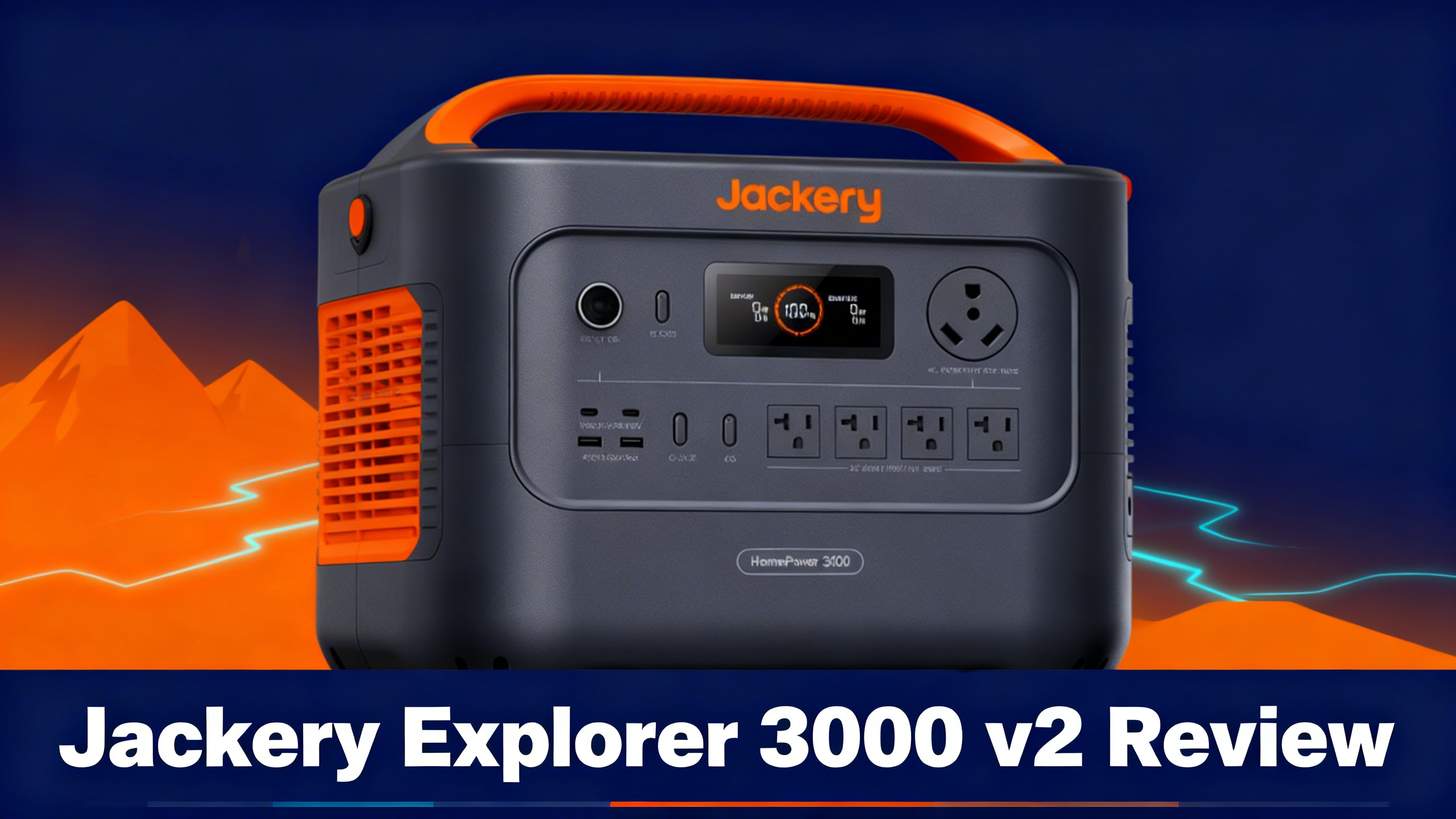
Jackery has been building toward this moment for years. The Explorer 3000 Pro established the brand’s high-capacity credibility, but it arrived with an NMC battery, a relatively slow charge time, and a form factor that didn’t quite fit the “plug-and-play home backup” promise. The Explorer 3000 v2 changes the equation on all three counts: LiFePO4 (LFP) chemistry, a 1.7-hour AC recharge, and a transfer-switch-ready design in the smallest 3kWh housing on the market.
Is a $2,499 portable power station worth it for home backup in 2026? Spec analysis and owner data make a compelling case, with one important caveat on current availability. Here’s the full picture.
Update: The Explorer 3000 v2 has been discontinued
Jackery no longer sells the Explorer 3000 v2. The closest current successor is the Jackery HomePower 3000, which carries the same 3,072Wh LFP capacity and 3,600W output (7,200W surge) in the same world’s-smallest-3kWh form factor, priced from $1,299. The product links in this review now point to the HomePower 3000. We’ve kept the review live for existing owners and for comparison research.

Jackery Explorer 3000 v2: Overall Rating
8.4/10
“The most compact 3kWh LFP generator on the market, transfer switch ready from day one.”
Power Output 9/10
Battery Quality 9/10
Charging Speed 9/10
Value for Price 7.5/10
Portability 7/10
Home Features 8.5/10
Jackery Explorer 3000 v2
$2,499
- 3072Wh LFP: 3600W output (7200W surge)
- World’s smallest 3kWh generator with ZeroDrain
- Full recharge in 1.7 hours, 5 input methods
Price verified April 2026. Check site for current stock availability
Get our Black Friday alerts for Jackery
We track live prices on 40+ models from Jackery, EcoFlow, BLUETTI and Anker SOLIX. When a deal beats the lowest price we've recorded, you'll hear from us. During Black Friday week, one short recap a day at most.
Unsubscribe in one click. We may earn a commission when you buy through our links, at no extra cost to you. Privacy Policy
Quick Specs at a Glance
Before diving into the deeper analysis, here’s the core spec sheet for the jackery 3000 v2. These numbers define what the unit can and can’t do in a home backup scenario.


What Can the Explorer 3000 v2 Power?
Three thousand watt-hours (Wh) is a significant reserve. Think of it as roughly three times the capacity of a typical mid-range power station. For calculating your home’s energy needs, the standard approach is to add up the wattage of every appliance you want to run, then divide 3,072 by that number to get estimated hours.
Runtime calculations based on the 3,072Wh capacity at approximately 85% inverter efficiency produce these results for common home appliances. The data shows the unit handles an entire outage scenario for essential circuits with capacity to spare.
What Can the Explorer 3000 v2 Power? (3,072Wh)
🧊
Mini Fridge
~15 hrs
200W avg
💡
LED Lights (5x)
~51 hrs
60W total
📶
WiFi + Router
~61 hrs
50W avg
🌀
Ceiling Fan
~30 hrs
100W avg
☕
Coffee Maker
~3 hrs
1000W avg
📱
Smartphone
~280x
11Wh/charge
Runtime estimates based on 3072Wh capacity at 85% inverter efficiency. Actual runtime varies by load and temperature.

The real-world picture for a typical outage scenario: run the fridge, keep the lights on, maintain WiFi connectivity, and charge phones throughout. Analysis of that combined load (roughly 310W continuous) suggests approximately 8 to 9 hours of runtime. For a broader look at sizing and load planning, the full home backup use case guide covers which Jackery tier fits which household profile.
Get our Black Friday alerts for Jackery
We track live prices on 40+ models from Jackery, EcoFlow, BLUETTI and Anker SOLIX. When a deal beats the lowest price we've recorded, you'll hear from us. During Black Friday week, one short recap a day at most.
Unsubscribe in one click. We may earn a commission when you buy through our links, at no extra cost to you. Privacy Policy
Battery Chemistry and Longevity
LiFePO4 (lithium iron phosphate) is the chemistry that separates a serious backup device from a portable convenience item. Published LFP cycle data consistently confirms 3,500+ charge cycles before capacity degrades to 80%, roughly 10 years of daily use. Standard NMC (nickel manganese cobalt) lithium cells, by contrast, typically reach that same degradation point in 500 to 1,000 cycles.
What does this mean for a home backup device? If you cycle the 3000 v2 once per month during outages and storm seasons, the battery chemistry alone suggests multi-decade reliability. The thermal stability of LFP is an additional factor: spec analysis confirms a significantly wider safe operating temperature range compared to NMC, which matters in hot attics, garages, or storage conditions.
ZeroDrain is the second longevity feature worth understanding. Conventional lithium batteries self-discharge at a rate of 1-3% per month due to internal chemical reactions. Jackery’s ZeroDrain technology minimizes this leakage, with published specs confirming 95% charge retention after 365 days of standby storage. For an emergency preparedness unit that spends most of its life waiting, this means you’re not constantly topping it off to keep it ready.
Jackery New Products 2025-2026: Complete Lineup Guide
See how the 3000 v2 fits within all current high-capacity Jackery options.
Charging Performance
Five recharging methods is more than a marketing bullet point: it’s a genuine resilience feature. The most important for home backup is AC wall charging: spec data confirms a 0-100% recharge in approximately 1.7 hours from a standard 120V outlet. That’s fast enough to fully restore the unit between two grid outages in a single day.

Solar is the second method worth planning around. With two SolarSaga 200W panels, Jackery’s published data confirms the ability to generate up to 3,500kWh of clean energy over 5 years. On a strong solar day, two panels at peak output (400W combined) would theoretically restore the unit in around 8 hours. Real-world solar yield accounts for angle, cloud cover, and panel temperature, so plan for 10-12 hours with a two-panel setup.
The AC+DC hybrid method is the standout for speed. Combining wall power with a simultaneous solar input reduces total charge time further, making the 1.7-hour figure achievable as an upper-bound estimate rather than a theoretical minimum. Car charging and gas generator input round out the options for off-grid or extended emergency scenarios.
Home Backup Capabilities
The UPS (uninterruptible power supply) feature deserves more attention than it typically gets in power station reviews. A switchover time of 20ms or less means sensitive electronics (NAS drives, desktop computers, medical equipment, smart home hubs) experience no detectable power interruption. Most consumer-grade UPS devices operate in the same range, but this is the first time the spec appears built into a fully portable 3kWh unit at this price.
Transfer switch compatibility is the other headline capability. The 3000 v2 works with a manual transfer switch for direct connection to select home circuits, with no full electrical panel upgrade required. This means you can power hardwired loads like a well pump, HVAC blower, or ceiling fixtures during an outage, not just devices plugged into extension cords. That’s a meaningful step toward whole-home coverage at a fraction of the cost of a permanent backup system.
⚠️ Important: Transfer switch installation for hardwired circuits should be performed or verified by a licensed electrician, even with a plug-and-play compatible unit. Always confirm your local electrical code requirements before connecting to home wiring.
The 3,600W continuous output (7,200W surge) is the spec that determines what you can run simultaneously. A full-size refrigerator (700W), ceiling fans (100W each), LED lighting (60W), and a WiFi router (50W) total well under 1,000W combined, leaving substantial headroom for additional loads. High-draw appliances like window AC units (typically 1,200-1,500W) can also run, though they’ll reduce runtime proportionally.
Design and Build Quality
Jackery’s claim of “world’s smallest 3kWh LFP generator” is a meaningful spec at this capacity tier. Most 3kWh-class units are substantial floor units with limited mobility. The 3000 v2 maintains a compact form factor that allows storage in a closet, under a desk, or in a vehicle: a genuine differentiator for homeowners who want home backup performance without dedicating a garage corner to the setup.
The Explorer series carries over Jackery’s established industrial design language: a tactile handle, LCD display for charge and output monitoring, and a port layout that balances AC and DC options across multiple output types. Spec analysis confirms AC outputs, DC barrel ports, and USB-C/USB-A options for simultaneous device coverage.
How Does It Compare to the Previous Generation?
To understand what’s new, the spec sheet of the Explorer 3000 Pro it replaces provides the clearest baseline. The 3000 Pro arrived with NMC chemistry and a charge time measured in hours rather than under two. The 3000 v2 addresses both shortcomings directly: LFP replaces NMC, and the 1.7-hour recharge is a significant leap forward.
What stays the same: the $2,499 price point and the 3,072Wh capacity. Jackery held the price while upgrading the battery chemistry and charging infrastructure: a favorable trade for buyers who were already considering the previous generation at that price.
Buyers focused purely on home backup should also evaluate the HomePower 3000 alternative: same $2,499 price, different industrial-grade form factor. Our direct comparison breaks down every spec difference across both 3kWh Jackery platforms.
Jackery Explorer 3000 Pro Review
Full analysis of the previous generation: what changed and what didn’t.
Who Is the Explorer 3000 v2 For?
The Explorer 3000 v2 sits at the top of the Jackery high-capacity options available in 2026, designed for homeowners who need more than a portable solution. Here’s the clearest breakdown of who benefits and who should look elsewhere.
Buy this if…
- You need 3kWh+ LFP in the most compact form factor available
- You want transfer switch home integration without a separate whole-home system
- ZeroDrain long-term storage is a priority (seasonal home, emergency prep)
- You need 3600W output to run large appliances simultaneously
Skip this if…
- You need expandable capacity beyond 3072Wh (consider the Explorer 2000 Plus system)
- Budget is your primary constraint (the 1500 v2 at $699 delivers strong Wh/$ value)
- You need confirmed immediate stock (availability is limited at launch)
- Lightweight portability matters more than capacity
The ideal buyer profile: a homeowner in an area with periodic grid outages (storm seasons, utility work) who wants a single device that handles essential circuits for 8-15 hours, recharges quickly when power returns, and stores for months between uses without degradation. The ZeroDrain + LFP combination makes the 3000 v2 genuinely well-suited for that specific pattern of use.
Final Verdict
The jackery 3000v2 review bottom line: this is the most capable compact 3kWh portable power station currently available, and the upgrade from the 3000 Pro is substantive rather than incremental. LFP chemistry, 1.7-hour recharge, ZeroDrain standby performance, and transfer switch compatibility address every meaningful weakness of the previous generation at the same price.
The score of 8.4/10 reflects one honest limitation: the value-for-price category. At $2,499, you’re paying a premium for the compact form factor and the Jackery ecosystem. Competing 3kWh units from EcoFlow and Bluetti offer similar capacity at lower price points, though not always with the same transfer switch integration or form factor advantages.
One important note on availability: high demand at launch has created stock constraints. If the unit shows out of stock on Jackery.com, sign up for availability alerts on the product page rather than looking for third-party alternatives at markup pricing.
Bottom line: for homeowners who want the whole-home backup functionality of a stationary system in a portable footprint, the Explorer 3000 v2 is the most refined version of that product category available in 2026.
Jackery Explorer 3000 v2
$2,499
World’s smallest 3kWh LFP generator, transfer switch ready
See Successor: HomePower 3000 →
Price verified April 2026. Check site for stock and availability alerts
Frequently Asked Questions
What is the Jackery Explorer 3000 v2?
The Explorer 3000 v2 is a 3,072Wh LFP portable power station with 3,600W AC output (7,200W surge) and a built-in UPS with 20ms or less switchover time for seamless home backup. Jackery positions it as the world’s smallest 3kWh generator, with ZeroDrain technology that maintains 95% charge retention after 365 days of storage.
How long can the Explorer 3000 v2 power a refrigerator?
Runtime calculations based on the 3,072Wh capacity at typical inverter efficiency put a standard mini-fridge (around 200W average draw) at approximately 12 to 15 hours of runtime. A full-size refrigerator drawing 400W would run for roughly 6 to 7 hours. Running multiple appliances simultaneously reduces these estimates proportionally.
How long does the Explorer 3000 v2 take to recharge?
Published spec data confirms a full 0-100% recharge via AC wall outlet in approximately 1.7 hours. Five recharging methods are supported: AC wall power, solar panels, car/12V input, AC+DC hybrid (for maximum speed), and gas generator input. The hybrid AC+DC method allows simultaneous wall and solar charging for the fastest possible recharge in off-grid situations.
Does the Explorer 3000 v2 work with a transfer switch?
Yes. Jackery designed the 3000 v2 to be compatible with a manual transfer switch, allowing direct connection to select home circuits. This enables the unit to power hardwired appliances during outages (including well pumps, HVAC blowers, and ceiling fixtures) without requiring a full whole-home battery system installation. Consult a licensed electrician before connecting to home wiring.
Is the Explorer 3000 v2 different from the HomePower 3000?
Both units share 3,072Wh capacity and 3,600W output at the same $2,499 price point. Key differences involve form factor, ZeroDrain technology implementation, and specific port configurations. The HomePower 3000 targets dedicated stationary home backup; the 3000 v2 emphasizes compact portability alongside the same home integration capability.
Where can I buy the Jackery Explorer 3000 v2?
The Explorer 3000 v2 is available through the official Explorer 3000 v2 product page on Jackery.com. Note that availability has been limited at launch due to high demand. The site offers an availability notification option for out-of-stock periods. Check the product page directly for current stock status.
Originally published: April 15, 2026