
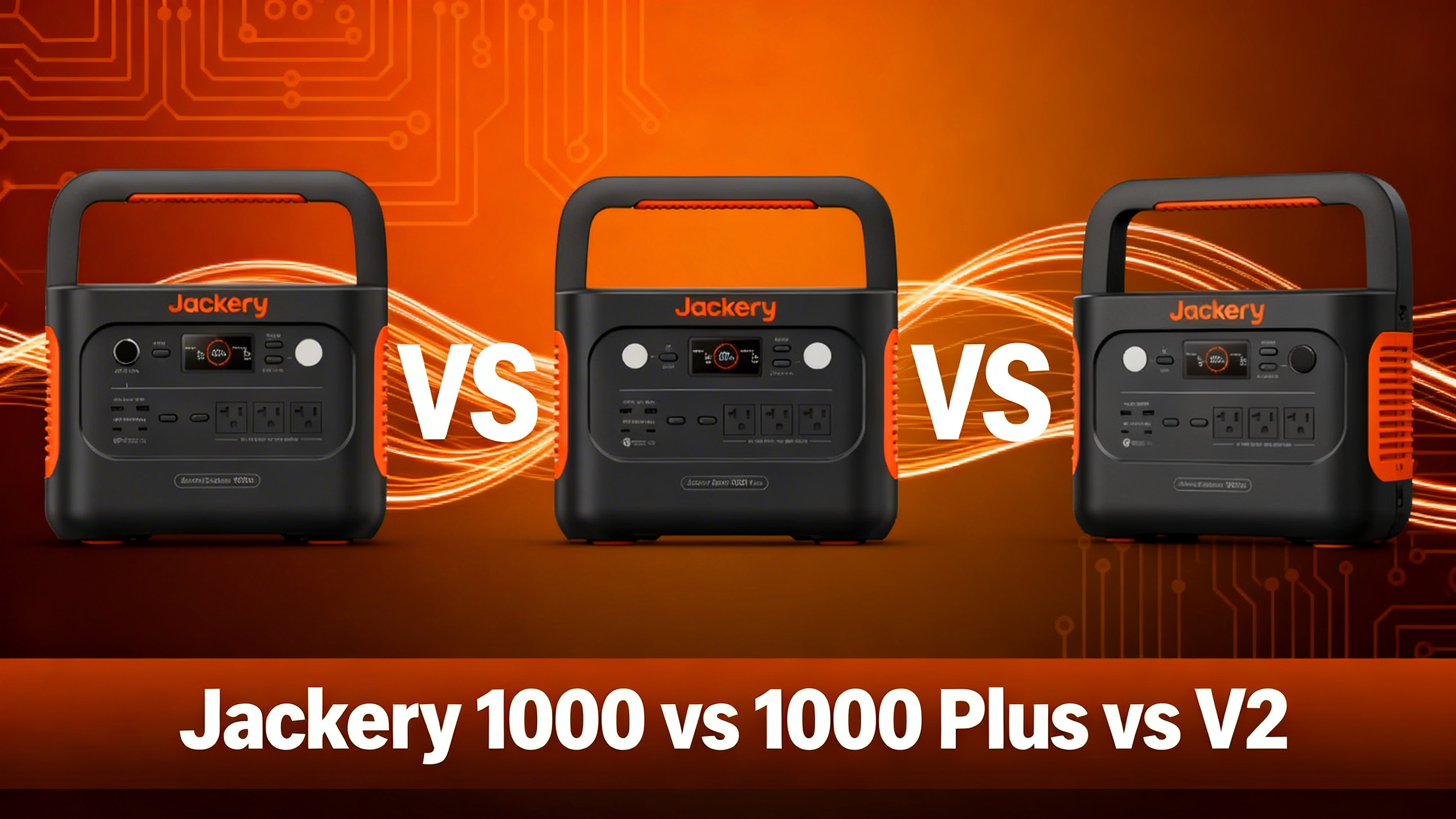
Choosing between the Jackery Explorer 1000, 1000 Plus, and 1000 v2 feels more confusing than it should. All three carry the “1000” name, all pack roughly 1,000-1,200Wh capacity, yet the prices range from $799 to $1,299—a $500 gap that demands explanation. You’re not alone in feeling stuck. These naming conventions blur the lines between what’s actually different, and understanding which features justify the extra cost takes some digging.
(launched 2024, $1,299) is the revolutionary rebuild: it uses LiFePO4 battery chemistry rated for 4,000 cycles (5× the original, the same rating as the v2), bumps output to 2000W, adds expandability up to 5kWh, but weighs 32 lbs (10 lbs heavier than the original).This comparison cuts through the marketing speak to show you when each model makes sense.
We’ll compare battery longevity, charge speeds, expandability, portability, ports, and long-term value with transparent calculations. The verdict depends less on which is “best” overall and more on your usage frequency—weekend campers face different math than full-time van lifers or heavy off-grid users. Spoiler: there’s no universal winner here.
The original 1000 still dominates for occasional users who prioritize portability and upfront cost. The v2 is the best all-rounder: modern features and the lowest cost per cycle. The Plus is the expandable option that only pays off if you need more capacity later or 2,000W of output (we’ll show you the breakeven math).
Let’s break down which one fits your needs.

Update (September 30, 2026): Jackery still sells the Explorer 1000 Plus. What it has discontinued is the Battery Pack 1000 Plus, the add-on battery used to expand it, so check that packs are still available before counting on the 5kWh upgrade. An earlier version of this note said the Plus itself was discontinued; its purchase links on this page point to the Plus again.
Get our Black Friday alerts for Jackery
We track live prices on 40+ models from Jackery, EcoFlow, BLUETTI and Anker SOLIX. When a deal beats the lowest price we've recorded, you'll hear from us. During Black Friday week, one short recap a day at most.
Unsubscribe in one click. We may earn a commission when you buy through our links, at no extra cost to you. Privacy Policy
At a Glance: Key Differences
Before diving into detailed comparisons, here’s what separates these three models. If you’re in a hurry, this table captures the deal-breakers.
| Specification | Explorer 1000 (Original) |
Explorer 1000 v2 | Explorer 1000 Plus |
|---|---|---|---|
| Price | $799 | $999 | $1,299 |
| Capacity (Wh) | 1,002Wh | 1,070Wh | 1,264Wh ✓ |
| Battery Type | Lithium-ion | LiFePO4 ✓ | LiFePO4 ✓ |
| Cycle Life | 800 cycles | 4,000 cycles ✓ | 4,000 cycles ✓ |
| AC Charge Time | ~7.5 hours | 1.58 hours ✓ | ~1.7 hours ✓ |
| Emergency Charge | — | 0-100% in 1h ✓ | — |
| Output Power | 1000W (2000W surge) | 1500W (3000W surge) | 2000W ✓ |
| USB-C PD | 2× 18W | 100W + 30W ✓ | Dual 100W ✓ |
| Expandability | — | — | Up to 5kWh ✓ |
| Weight | 22 lbs ✓ | ~23.8 lbs | 32 lbs |
| App Control | — | Jackery App ✓ | WiFi/Bluetooth ✓ |
| Warranty | 2+1 years | 3+2 years ✓ | 3+2 years ✓ |
💡 Key Takeaways
- 💰 Best upfront value: Original 1000 ($799) if you use it 1-2 times per month and prioritize portability
- ⚡ Modern features sweet spot: 1000 v2 ($999) adds a LiFePO4 battery rated for 4,000 cycles, 100W USB-C and 1.58-hour charging, and has the lowest cost per cycle long-term
- 🔋 Expandable option: 1000 Plus ($1,299) matches the v2’s 4,000-cycle rating and adds expansion up to 5kWh and 2,000W output
- ⚖️ Weight tradeoff: Plus is 10 lbs heavier (32 vs 22 lbs)—matters for frequent hauling or tight van spaces
⏱️ Evolution Timeline: 2019-2024
Jackery Explorer 1000 (Original) Overview
What Makes the Original Special
The Explorer 1000 was Jackery’s breakthrough product when it launched in 2019—the model that essentially defined what a “1000Wh portable power station” should look and perform like. Five years later, it still holds relevance for specific users, despite being surpassed in specs by newer models. Its core appeal rests on proven reliability, the lightest weight in this comparison at 22 lbs, and the lowest entry price at $799.
Here’s what you get: 1,002Wh capacity (46.4Ah lithium-ion battery), 1000W continuous output
with 2000W surge capability, and multiple ports including three pure sine wave AC outlets, two USB-A, one DC car port. The built-in MPPT solar charge controller handles up to 200W solar input efficiently.
It’s the most portable option here, and after five years on the market, the potential failure modes are well-documented—you know what you’re getting. The original 1000 targets weekend warriors who need reliable backup 1-2 times per month—not daily users.
For occasional camping trips, emergency home backup during rare outages, or powering cameras and laptops on short outdoor shoots, the 800-cycle rating translates to 30+ years at that usage frequency. That’s the math most reviews skip: if you’re using this twice monthly, you’ll hit 800 cycles in approximately 33 years.
The battery chemistry will likely degrade from age before you exhaust the cycle count.

Key Specs Breakdown
| Specification | Details |
|---|---|
| Capacity | 1,002Wh (46.4Ah at 21.6V) |
| Output Power | 1000W continuous, 2000W surge |
| AC Outlets | 3× pure sine wave 110V |
| USB Ports | 1× USB-A (5V/2.4A), 1× USB-A Quick Charge 3.0, 2× USB-C (18W) |
| DC Output | 1× 12V/10A car port |
| AC Charging | ~7.5 hours (85W input) |
| Solar Charging | ~8 hours (2× SolarSaga 100W) |
| Cycle Life | 800 cycles to 80%+ capacity |
| Weight | 22 lbs (10 kg) |
| Dimensions | 13.1 × 9.2 × 11.1 inches |
| Warranty | 2 years + 1 year extended |
Who It’s For
The original Explorer 1000 makes the most sense for specific user profiles where its limitations don’t matter. Weekend campers who pack up 1-2 times per month: the 800-cycle limit won’t constrain you for decades. Emergency home backup users who experience a few outages per year—you’re looking at 100+ years to hit cycle limits. Budget-conscious buyers
who want Jackery quality without paying for features they won’t use—the $799 entry point saves $500 vs the Plus. Portability matters here. At 22 lbs, it’s 10 pounds lighter than the 1000 Plus (32 lbs).
That difference feels minimal on paper but compounds when you’re hauling gear up trails, loading and unloading from vehicles multiple times per trip, or working in tight van conversion spaces.
If you’re primarily powering phones, laptops, cameras, drones, lights, and maybe a portable fridge overnight, the original 1000 has enough capacity and the weight advantage wins.
Where it struggles: heavy daily use (you’ll burn through 800 cycles in about 2.2 years at daily charging), users who need USB-C fast charging for modern laptops, and scenarios where 7.5-hour AC charging feels too slow. The lack of expandability also limits future-proofing—you can’t add battery packs later if needs grow.
💰 Best Value for Occasional Users
Why we recommend the Explorer 1000: At $799, it’s the most affordable entry to Jackery quality. Weighing just 22 lbs with 5+ years of proven reliability, it’s ideal for weekend camping and emergency backup (1-2 uses per month). The 800-cycle battery lasts 30+ years at this usage frequency. For a focused breakdown between these two, see our head-to-head 1000 Plus vs v2 comparison.
Check Current Price on Jackery →
$799 | Free shipping | 2-year warranty + 1-year extension
Get our Black Friday alerts for Jackery
We track live prices on 40+ models from Jackery, EcoFlow, BLUETTI and Anker SOLIX. When a deal beats the lowest price we've recorded, you'll hear from us. During Black Friday week, one short recap a day at most.
Unsubscribe in one click. We may earn a commission when you buy through our links, at no extra cost to you. Privacy Policy
Jackery Explorer 1000 v2 Overview
The LiFePO4 Upgrade
Released in 2023, the Explorer 1000 v2 represents Jackery’s attempt to modernize the original without completely redesigning it. The result is a real step up: faster charging, better ports and 50% more output, plus a switch from lithium-ion to LiFePO4 cells rated for 4,000 cycles to 70%+ capacity (vs 800 cycles to 80%+ on the original). The v2 costs $200 more than the original ($999 vs $799), positioning it between budget and premium tiers.
Capacity bumps slightly to 1,070Wh
from 1,002Wh—a 68Wh increase that translates to maybe 20-30 minutes of extra runtime for most devices.
The other upgrades focus on convenience and power: Jackery rates AC charging at 1.58 hours (vs 7.5 hours on the original), output rises to 1,500W (3,000W surge peak), one USB-C port delivers 100W Power Delivery for fast-charging modern laptops (the second delivers 30W), and ChargeShield 2.0 adds 62 protection mechanisms vs the basic BMS in the original.
The headline convenience feature is Emergency Super Charge, which Jackery rates at 0 to 100% in one hour when you need power immediately (you switch it on in the Jackery app). Here’s how the v2 now fits between the other two.
It costs $200 more than the original, and its longer-rated battery pays off most for users who charge frequently. The Plus costs another $300 but carries the same 4,000-cycle rating, so that extra money buys expandability and 2,000W of output, not a longer lifespan.
For most buyers who don’t need expansion or more than 1,500W, the v2 makes the most sense of the three.

What’s New from Original
The v2 improves on the original in several ways, starting with the battery chemistry. Here’s what changed:
- 🔋 LiFePO4 battery: Rated for 4,000 cycles to 70%+ capacity vs 800 cycles to 80%+ on the original
- ⚡ 1,500W output: Up from 1,000W, with a 3,000W surge peak vs 2,000W
- ⚡ AC charge speed: 1.58 hours vs 7.5 hours on the original (Jackery’s ratings)
- 🔌 USB-C PD up to 100W: One 100W port and one 30W port replace the original’s two 18W USB-C ports, which matters for modern MacBooks, high-end Windows laptops and tablets
- 🛡️ ChargeShield 2.0: Upgraded from basic battery management to 62 separate protection mechanisms covering temperature, voltage, current
- ⚡ Emergency charge mode: 0-100% in 1 hour when you need power fast, switched on in the Jackery app (the original takes 7.5 hours)
- 📱 App control: Monitor and manage it from the LCD display or the Jackery app, like the Plus
- 💰 +$200 premium: $999 vs $799 for the original, which the longer battery life pays back for frequent users
The emergency charging deserves explanation. In standard mode, charging follows a conservative curve to maximize battery longevity. Emergency mode pushes maximum current to hit 100% capacity in one hour, at the cost of slightly accelerated battery wear.
Jackery doesn’t quantify how much this affects the 4,000-cycle rating, but occasional use (maybe 5-10 times over the unit’s life) shouldn’t materially impact longevity. What didn’t change: the same lack of expandability and a similar weight (about 23.8 lbs, under 2 lbs heavier than the original).
The v2 adds modern convenience features and fixes the original’s fundamental constraint: cycle life.
Who Should Choose the v2
The v2 suits a wide range of buyers, and one group benefits most. Weekly users who need USB-C
—digital nomads, YouTubers/content creators, remote workers who frequently move between locations and charge modern laptops. The 100W USB-C port matters significantly if you’re running a MacBook Pro, Dell XPS, or similar devices that benefit from fast charging.
The emergency charge capability also appeals to users with unpredictable power needs who might suddenly require a full charge. The v2 makes less sense for one group. If you’re using a power station 1-2 times per month, the original 1000 saves $200 for minimal practical difference.
If you’re using it daily or multiple times per week, the v2’s 4,000-cycle rating covers you too. Spending the extra $300 for the Plus only makes sense if you need expandability or 2,000W of output. For anyone who uses a power station more than a couple of times per month, the v2 is the strongest value.
The v2 also has the best cost per cycle of the three models (we’ll show detailed calculations in a later section). At $999 for 4,000 cycles, you’re paying $0.250 per cycle. The original at $799 for 800 cycles = $0.999/cycle. The Plus at $1,299 for 4,000 cycles = $0.325/cycle.
Unless you only use a power station occasionally, that value is hard to beat.
⚡ Modern Features for Weekly Users
Why consider the Explorer 1000 v2: If you want a LiFePO4 battery rated for 4,000 cycles, 100W USB-C fast charging for modern laptops and emergency 1-hour charging, the v2 bridges old and new. Best for digital nomads and weekly users who want convenience and the lowest long-term cost per cycle.
Check Current Price on Jackery →
$799 (refurbished) / $999 (new est.) | Free shipping | 3-year warranty + 2-year extension
Jackery Explorer 1000 Plus Overview
The Complete Redesign
The Explorer 1000 Plus launched in 2024 as Jackery’s first complete rethink of the 1000Wh category—not an incremental update but a ground-up redesign. The headline change swaps lithium-ion for LiFePO4 (lithium iron phosphate) battery chemistry, extending cycle life from 800 to 4,000 cycles (5× increase). This fundamentally changes the value calculation for heavy users, though it comes with tradeoffs in weight and upfront cost.
Capacity increases to 1,264Wh and output jumps to 2000W continuous—enough to run power tools, microwaves, space heaters, and other demanding appliances the original models can’t handle. Charging speeds improve dramatically: 1.7 hours via AC (vs 7.5 hours on original), 2 hours with four SolarSaga 200W panels. The Plus introduces expandability—add up to three additional 1,264Wh battery packs to reach 5,056Wh total capacity, transforming this from a portable power station into a home backup system. Note that Jackery now lists the Battery Pack 1000 Plus as discontinued, so check pack availability before planning on it.
The Plus is also the first Jackery 1000Wh unit verified by TÜV SÜD for sustainability standards—covering battery sourcing, manufacturing impact, and recyclability. It adds app control via WiFi and Bluetooth for remote monitoring and configuration. The warranty extends to 3 years plus 2-year extension (5 years total), matching the improved durability expectations.

Revolutionary Features
What makes the Plus different from incremental updates:
- 🔋 LiFePO4 battery chemistry: 4,000 cycles to 70% capacity, the same rating as the v2 and 5× the original’s 800, which translates to 10+ years at daily use
- 📦 Expandability: First Jackery 1000Wh unit that accepts battery packs—add three 1,264Wh packs to reach 5kWh total
- ⚡ 2000W output: Runs 99% of household devices including microwaves, power tools, space heaters, hair dryers
- 🌱 TÜV SÜD verified: Industry-first sustainability certification covering entire product lifecycle
- 📱 App control: WiFi and Bluetooth connectivity for remote monitoring, firmware updates, battery health tracking
- ⚡ Fast charging: 1.7-hour AC charge, 2-hour solar charge with four 200W panels (vs 7-8 hours on original)
- ⚖️ Weight penalty: 32 lbs vs 22 lbs on original (45% heavier)—impacts portability
The LiFePO4 chemistry deserves deeper explanation because it’s what the Plus and the v2 share and the original lacks. Compared to lithium-ion in the original, LiFePO4 offers superior thermal stability (safer under stress), minimal capacity degradation over thousands of cycles, and better performance in extreme temperatures. The tradeoff is lower energy density—hence why the Plus weighs more despite similar capacity.
For users who plan to keep and use a power station for 5-10+ years, this chemistry makes far more sense than lithium-ion. Expandability changes the use case entirely. Buy the base Plus at $1,299, then add battery packs as budget and needs grow. Each add-on pack costs around $599 and adds 1,264Wh.
For van lifers, off-grid homesteaders, or anyone needing multi-day backup power, this scalability removes the “buy bigger or buy again” dilemma. You can start at 1.26kWh and grow to 5kWh without replacing the entire system.
What You’re Paying For
At $1,299, the Plus costs $500 more than the original 1000 and $300 more than the v2. Here’s the breakdown of where that premium goes:
- $300-400 premium: LiFePO4 battery costs significantly more than lithium-ion but is rated for 5× the original’s cycles (the v2 now offers the same chemistry for $300 less than the Plus)
- $100-150 premium: Higher output inverter (2000W vs 1000W), expandability hardware, app connectivity
- $50-100 premium: TÜV SÜD certification process, enhanced warranty coverage
The question becomes: does this premium make financial sense for your usage pattern? We’ll run detailed calculations later, but the short answer: the Plus pays for itself after approximately 742 cycles if you would otherwise replace an original 1000. At daily use, that’s 2 years. At weekly use, that’s 14 years. Against the v2, it never pays for itself on cost per cycle, since both carry the same 4,000-cycle rating. The heavier weight matters more for users who frequently move their power station (several times per week), while stationary or occasional users won’t notice the 8-lb difference as much.
🏆 Best for Growing Power Needs
Why we recommend the Explorer 1000 Plus: LiFePO4 battery rated for 4,000 cycles (5× the original, same as the v2), expandable to 5kWh, outputs 2000W for power tools and appliances. TÜV SÜD certified for sustainability. Best for daily/weekly users, van lifers, and anyone who may need to expand capacity later. We also compared the 1000 Plus vs 1000 Pro if you are deciding between the new and legacy models.
Check Explorer 1000 Plus Price →
Explorer 1000 Plus on Jackery.com | Free shipping | 3-year warranty + 2-year extension
Head-to-Head: Battery Technology & Lifespan
Battery chemistry determines how long each model remains usable, making it the single most important specification for heavy users. The original 1000 uses standard lithium-ion (NMC or similar chemistry), rated for 800 cycles to 80% capacity. The v2 and the Plus use LiFePO4 (lithium iron phosphate), both rated for 4,000 cycles to 70% capacity.
That’s a 5× difference in rated cycles (counted to 80% capacity for the original and to 70% for the LiFePO4 models), though real-world longevity depends heavily on usage patterns, charge depth, and environmental conditions. Here’s what 800 vs 4,000 cycles means in practical terms. If you fully charge and discharge daily, the original reaches end-of-life (80% capacity) in about 2.2 years. The v2 and Plus under identical usage last 11 years.
For weekly users (52 charges per year), the original degrades in about 15 years while the v2 and Plus last 77 years, which means you’ll replace them due to age or obsolescence, not battery wear. For monthly users (24 charges per year), all three exceed human planning horizons. Cost per cycle calculations reveal the v2’s long-term value.
Original 1000: $799 ÷ 800 cycles = $0.999 per cycle (worst value). v2: $999 ÷ 4,000 = $0.250/cycle (best value). Plus: $1,299 ÷ 4,000 = $0.325/cycle. Against buying multiple original units, the v2 pays for itself after about 267 cycles (about 9 months at daily use, or 5 years at weekly use), and the Plus after about 742 cycles (2 years at daily use, or 14 years at weekly use).
This math flips depending on frequency.
🔋 Cycle Lifespan Comparison
• Weekly use: 15 years
• Monthly use: 33+ years
• Weekly use: 77 years
• Monthly use: 166+ years
LiFePO4’s advantages extend beyond just cycle count. The chemistry handles temperature extremes better—Jackery rates the Plus for charging from 32°F to 113°F and discharging from 14°F to 113°F, a wider hot-weather range than the original’s 104°F limit.
LiFePO4 also maintains voltage stability through discharge, meaning devices get consistent power until the battery hits true empty (vs lithium-ion which sags under load as capacity depletes). The safety profile is superior—LiFePO4 has higher thermal runaway temperature and doesn’t release oxygen when damaged, reducing fire risk.
The downsides: LiFePO4 has lower energy density than lithium-ion, explaining the 8-lb weight difference despite only 260Wh more capacity. It’s also more expensive to manufacture, accounting for much of the Plus’s $500 premium.
For users who replace power stations every 2-3 years due to changing needs or technology obsolescence, lithium-ion’s lower upfront cost makes more sense. For users who expect to keep and use a unit for 5-10+ years, LiFePO4’s durability pays off.
Head-to-Head: Charging Speed & Options
Charging speed matters differently depending on use case—critical for users who need rapid turnaround between uses, less relevant for those who can leave units charging overnight between occasional deployments. The three models span from sluggish (the original) to rapid (the v2 and the Plus).
AC charging times: Original takes ~7.5 hours for 0-100%. Jackery rates the v2 at 1.58 hours in standard mode, or 1 hour with Emergency Super Charge, and the Plus at ~1.7 hours.
These times assume optimal conditions—cold batteries charge slower, and the final 10-20% slows due to trickle charging on all models.
| Charging Method | Explorer 1000 | Explorer 1000 v2 | Explorer 1000 Plus |
|---|---|---|---|
| AC Wall (Standard) | ~7.5 hours (85W input) |
1.58 hours ✓ (Higher wattage) |
~1.7 hours ✓ (Fast charge) |
| Emergency AC Charge | — | 1 hour (0-100%) ✓ | — |
| Solar (2× SolarSaga 100W) | ~8 hours (200W max input) |
~7.5 hours (400W max input) |
~10 hours (800W max input) |
| Solar (4× SolarSaga 200W) | Not compatible | Capped at 400W input | ~2 hours ✓ |
| Car Charging (12V) | ~14 hours | ~12 hours | ~7 hours |
⚡ AC Charging Speed Comparison
7.5 hours
1.58 hours
1.7 hours
1 hour ⚡
Solar charging follows similar patterns. All three models accept solar input via 8mm DC barrel connector and include MPPT controllers to maximize efficiency. With two SolarSaga 100W panels (200W total), the original takes ~8 hours, v2 ~7.5 hours, Plus ~6 hours.
The v2 accepts up to 400W of solar input, enough for two SolarSaga 200W panels, and the Plus goes further, up to 800W with four SolarSaga 200W panels, enabling 2-hour solar charging in optimal conditions (which rarely happen; expect 2.5-3 hours realistically). The v2’s emergency charge mode deserves special mention.
When you need power immediately—maybe you forgot to charge before a trip, or a sudden storm means you need backup now—hitting emergency mode delivers 0-100% in one hour. This convenience matters for specific scenarios but isn’t something most users need regularly.
Since the feature pushes maximum current, it makes sense to save it for genuine emergencies rather than daily convenience. Car charging remains slow on all models due to 12V DC input limitations (typically 10A = 120W maximum). Expect 10-14 hours depending on model.
This works as trickle charging while driving cross-country but isn’t practical as a primary charging method unless you’re spending full days on the road.
Head-to-Head: Capacity & Runtime
Capacity differences are smaller than the names suggest. The original packs 1,002Wh, v2 adds 68Wh to reach 1,070Wh, and the Plus tops out at 1,264Wh. That’s a 262Wh spread from lowest to highest—roughly 26% more capacity in the Plus vs original. In practical runtime terms, this translates to maybe 2-3 extra hours for most devices, not a transformative difference.
Here’s what each capacity handles in real-world runtime (assuming 80% usable capacity due to inverter efficiency and battery protection buffers):
| Device (Power Draw) | Explorer 1000 (1,002Wh) |
Explorer 1000 v2 (1,070Wh) |
Explorer 1000 Plus (1,264Wh) |
|---|---|---|---|
| Laptop (60W) | ~13 hours | ~14 hours | ~17 hours |
| Mini Fridge (40W) | ~20 hours | ~21 hours | ~25 hours |
| LED Lights (15W) | ~53 hours | ~57 hours | ~67 hours |
| CPAP Machine (50W) | ~16 hours (2 nights) |
~17 hours (2 nights) |
~20 hours (2-3 nights) |
| Smartphone (5W) | ~160 charges | ~171 charges | ~202 charges |
| Electric Kettle (1000W) | ~48 minutes | ~51 minutes | ~60 minutes |
| Space Heater (1500W) | Can’t run (1000W max) |
~34 minutes (at its 1,500W limit) |
~50 minutes ✓ |
*Runtimes calculated at 80% usable capacity. Actual runtime varies by device efficiency, battery temperature, and inverter losses.
The output power difference matters more than raw capacity for some applications. The original maxes at 1000W continuous (2000W surge for brief moments), limiting what you can run. The v2’s “50% Power Boost” is simply Jackery’s name for its higher rating: 1,500W continuous with a 3,000W surge peak, 50% more than the original, so it can run 1,500W devices at the top of its range.
The Plus delivers full 2000W continuous, enabling microwaves, space heaters, power tools, hair dryers, and other demanding devices. Expandability fundamentally changes the Plus’s position. Where the original and v2 are fixed at ~1000Wh, the Plus accepts up to three additional battery packs (1,264Wh each). This takes total capacity to 5,056Wh—more than 5× the base unit.
For users who need multi-day runtime without recharging, or who want to build toward a home backup system, expandability removes the “buy bigger or buy twice” problem. Start at 1.26kWh and add capacity as needs and budget allow.
Head-to-Head: Ports & Connectivity
Port selection separates these models more than you’d expect, particularly for users with modern devices. The original launched in 2019 before USB-C Power Delivery became ubiquitous—its ports reflect that era. The v2 and Plus modernize the port array to match 2023-2024 device ecosystems.
| Port Type | Explorer 1000 | Explorer 1000 v2 | Explorer 1000 Plus |
|---|---|---|---|
| AC Outlets (110V) | 3× outlets | 3× outlets | 3× outlets |
| USB-C (Power Delivery) | 2× 18W only | 1× 100W + 1× 30W ✓ | 2× 100W ✓ |
| USB-A | 1× 5V/2.4A + 1× QC 3.0 | 18W max | 2× 18W |
| DC Car Port (12V) | 1× 10A | 1× 10A | 1× 10A |
| Total Output Devices | 8 devices | 7+ devices | 8 devices |

The USB-C difference is substantial for modern laptop users. The original offers only 18W USB-C, insufficient for fast-charging MacBook Pros, Dell XPS, or similar high-end laptops that require 60-100W. You’d use AC outlets with bulky chargers instead, wasting inverter efficiency.
The Plus provides two 100W USB-C PD ports, enough to fast-charge two laptops simultaneously via efficient DC-to-DC conversion with no inverter losses. The v2 pairs one 100W port with a 30W port, so it fast-charges one laptop while the second port handles a tablet or phone. For digital nomads, content creators, or remote workers with multiple USB-C devices (laptop, tablet, camera batteries, drone batteries), either port configuration eliminates adapter juggling.
The v2’s $200 premium over the original partly compensates if you value this convenience. Whether that’s worth $200 depends on your device ecosystem and how often you charge on the go. The v2 and Plus both add app control that the original lacks (the Plus connects over WiFi or Bluetooth).
The Jackery app enables remote monitoring (battery level, charging status, output load), firmware updates, and configuration changes without physically accessing the unit. For stationary users (van conversion, off-grid cabin), this means checking status from inside while the unit sits in an outdoor solar shed. For most users, app control is nice-to-have rather than essential.
Head-to-Head: Portability & Weight
Weight creates real tradeoffs that reviews often gloss over. The original 1000 weighs 22 lbs, v2 about 23.8 lbs, and the Plus 32 lbs. That 10-pound difference between the original and Plus (45% heavier) matters more in some contexts than others.
Where weight matters most: frequent hauling (loading/unloading from vehicle multiple times per week), trail hiking to backcountry campsites, tight van/RV spaces where you’re constantly shifting the unit, stairs in multi-story homes or apartments, and elderly or mobility-limited users. In these scenarios, 22 vs 32 lbs creates noticeable friction over time. Ten pounds doesn’t sound like much until you’re wrestling a power station into an overhead van cabinet for the 50th time.
Where weight matters less: stationary installations (solar sheds, garage setups, RV battery bays), occasional use (move it 2-3 times per year), two-person handling (vanlifers working together), and users prioritizing longevity over portability. If you set up the Plus once and leave it in position for weeks, the extra 10 lbs is irrelevant. The Plus’s expandability means you might add three battery packs totaling 75+ lbs—at that point, you’re building a stationary system anyway.
⚖️ Weight Reality Check
The 30-lb Plus is still “portable” by power station standards—comparable to a loaded backpack or a medium dog. But after hauling 22-lb and 30-lb units on extended trips, the difference accumulates. If you move your power station daily (van life setup/teardown, event production, mobile work), the original’s 22 lbs wins. If you move it monthly, the Plus’s durability justifies the weight.
Dimensions are close across the three models: the original is 13.1 × 9.2 × 11.1 inches and the v2 is the most compact at 12.87 × 8.82 × 9.72 inches, so physical space requirements don’t differ much. The Plus’s expandable battery packs are separate units that stack or position alongside the main unit, giving flexibility in tight spaces compared to monolithic higher-capacity alternatives.
Handle design stayed consistent—all three use a single rubberized top handle that’s comfortable for short carries. None offer side handles or wheels, which would improve portability but add cost and failure points. The handles feel solid for occasional use but aren’t designed for hours of continuous carrying—these are car-camping units, not backpacking gear.
Cost Analysis: Which Offers Best Value?
Value calculations depend entirely on usage frequency because battery cycle life dominates long-term costs. Let’s run transparent math to show when each model makes financial sense.
| Model | Price | Cycle Life | Cost Per Cycle |
|---|---|---|---|
| Explorer 1000 | $799 | 800 | $0.999 ❌ |
| Explorer 1000 v2 | $999 | 4,000 | $0.250 🏆 |
| Explorer 1000 Plus | $1,299 | 4,000 | $0.325 ✓ |
Formula: Cost per cycle = Purchase price ÷ Rated cycle life
💰 Cost Per Cycle Breakdown
$799 ÷ 800 cycles
$1.00
$999 ÷ 4,000 cycles
$0.25
$1,299 ÷ 4,000 cycles
$0.32
The v2 saves $0.75 per cycle compared to the original and pays for itself after about 267 cycles
Breaking down when the higher upfront cost of the v2 or the Plus makes financial sense:
Breakeven Analysis
Formula: A pricier model pays for itself when its lower cost per cycle covers its premium over the original.
Price difference: $999 – $799 = $200 premium for the v2
Cost per cycle savings: $0.999 – $0.250 = $0.749 saved per cycle
Breakeven point: $200 ÷ $0.749 = 267 cycles
At different usage frequencies:
- Daily use: 267 days = 0.7 years (about 9 months) to breakeven
- 3× per week: 89 weeks = 1.7 years to breakeven
- Weekly use: 267 weeks = 5.1 years to breakeven
- Monthly use: 267 months = 22.3 years to breakeven (battery age degradation hits first)
This math shows why the v2 wins for daily and frequent users but makes less sense for occasional users. If you’re charging 1-2 times per month, you’ll take 11 to 22 years to hit 267 cycles, and the battery will likely age out first (lithium-ion and LiFePO4 both degrade over time regardless of use). The original’s lower upfront cost wins in this scenario.
The Plus’s position has changed. Against the original, the same formula gives $500 ÷ ($0.999 – $0.325) = about 742 cycles. Against the v2, it never breaks even: both are rated for 4,000 cycles and the Plus costs $300 more, so its premium buys expandability, 2,000W of output and 194Wh more capacity, not a longer battery life. If you need those, the premium is worth it. Purely from a cost-per-cycle perspective, the v2 wins.
Winner by Use Case
There’s no universal winner here—each model excels in specific scenarios. Here’s how to match your usage pattern to the right purchase.
Weekend Camping (1-2× per month)
Winner: Explorer 1000 (Original) – $799
At 1-2 camping trips per month, you’ll charge 12-24 times per year. Even at the high end, you won’t hit 800 cycles for 30+ years. The Plus’s 4,000-cycle advantage means nothing when age degradation (lithium and LiFePO4 both degrade over ~10 years regardless of use) hits before cycle limits. The original saves $500 upfront and weighs 10 lbs less—both meaningful for occasional use. The lack of fast USB-C doesn’t matter when you’re powering lights, a fridge, and phones via AC outlets and basic USB-A.
Why not the v2? You’re paying $200 extra for features (fast USB-C, emergency charging) you won’t use regularly. Why not the Plus? You’ll never benefit from the 4,000-cycle lifespan at this usage frequency, making the $500 premium pure waste.
🏕️ Perfect for Weekend Warriors
For 1-2 camping trips per month: The Explorer 1000’s 22-lb weight and $799 price point can’t be beat. Five years of proven reliability, sufficient capacity for weekend needs, and the 800-cycle battery lasts 30+ years at this frequency. No wasted features—just reliable portable power. On a tighter budget, the Explorer 240, 300, and 500 are worth a look before committing to the 1000 tier.
Digital Nomad / Remote Work (3-5× per week)
Winner: Explorer 1000 v2 – $999
Digital nomads move frequently, charge devices multiple times per week, and prioritize USB-C fast charging for laptops, tablets, and camera batteries. At 3-5 charges per week (156-260/year), the original’s 800 cycles run out in 3-5 years, while the v2’s 4,000-cycle rating covers 15+ years. The v2’s 100W USB-C port eliminates carrying bulky laptop adapters and chargers, saving luggage space and simplifying setup.
Emergency charging matters when you suddenly need power before a client call or video shoot. The Plus carries the same 4,000-cycle rating, but its extra cost buys expandability and 2,000W of output that a mobile setup rarely needs.
The Plus’s extra 8 lbs matters when you’re living out of a backpack or carry-on. The v2 hits the sweet spot of modern features, long battery life and moderate weight.
Why not the original? Its 18W USB-C ports are too slow for laptops, 7.5-hour charging limits flexibility, and 800 cycles run out in a few years at this pace. Why not the Plus? It has the same cycle rating as the v2 but costs more, and the weight hurts mobility.
💻 Ideal for Digital Nomads
For 3-5× weekly use on the road: A 100W USB-C port fast-charges modern laptops without bulky adapters. Emergency 1-hour charging saves you before client calls. At about 23.8 lbs, it’s portable enough for frequent moves while delivering the convenience modern remote work demands.
Van Life / RV Living (Daily use)
Winner: Explorer 1000 Plus – $1,299
Full-time van lifers and RVers use power stations daily—you’re hitting 365 cycles per year. At this frequency, the original’s 800-cycle battery dies in about 2.2 years, forcing replacement. Buying two original units over 4 years = $1,598. The Plus lasts 11 years at daily use, costing $1,299 once. The v2 carries the same 11-year rating for $999, so the Plus wins here on expandability and output, not battery life.
Against the original, the math is overwhelming: you save $299 and avoid the hassle of selling/replacing a dead unit. Expandability matters enormously here. Start with 1.26kWh base, then add battery packs as your van build evolves and energy needs grow.
Many van lifers begin conservatively then realize they need more capacity for air conditioning, induction cooking, or work-from-van setups. The Plus grows with you—no need to sell and buy bigger. The 30-lb weight doesn’t matter in a stationary van installation.
Why not the original? You’ll burn through 800 cycles in about 26 months and face replacement costs. Why not the v2? It has the same 4,000-cycle rating, but it can’t be expanded and tops out at 1,500W, so it can’t grow with your build.
🚐 Essential for Van Life
For daily use in van or RV: LiFePO4 battery lasts 11 years at daily charging (vs about 2.2 years for the original). Expandable to 5kWh as your build evolves. 2000W output runs AC, induction cooktops, power tools. App control monitors battery health remotely. This isn’t just portable power—it’s your van’s electrical foundation. For whole-home backup, the Jackery 2000 Pro vs 3000 Pro comparison covers the next tier.
Emergency Home Backup (5-10× per year)
Winner: Explorer 1000 (Original) – $799
Emergency backup users face 5-10 power outages per year in most regions. At this frequency, you’ll take 80-160 years to hit 800 cycles. Both the original and Plus will degrade from age long before exhausting their cycle ratings. The original’s $500 lower cost makes more sense—invest that savings in other preparedness gear or emergency supplies.
The 22-lb weight helps when you need to move it quickly during outages. The Plus’s advantages (cycle life, expandability, fast charging) mean nothing in this context. You’re not charging daily, so long-term durability is wasted. You probably won’t need more than 1,000Wh for critical devices (fridge, medical equipment, communication).
Fast charging doesn’t help when you’re preparing for the next outage weeks away.
Why not the v2? Same reasoning—paying extra for features unused in emergency contexts. Why not the Plus? Pure financial waste for this use case; $500 buys a lot of emergency supplies that provide better ROI.
Off-Grid Homestead (Multiple times per week)
Winner: Explorer 1000 Plus – $1,299
Off-grid homesteaders charging 3-4 times per week hit 150-200 cycles per year. You’ll exhaust the original’s 800 cycles in 4-5.3 years, while the Plus (like the v2) lasts 20-26 years. The expandability becomes critical—off-grid users often underestimate power needs initially, then realize they need capacity for well pumps, workshop tools, seasonal heating/cooling.
Starting with the Plus and adding battery packs avoids replacing entire systems. The 2000W output matters for off-grid workshops—run power tools, welders, high-draw appliances the original can’t handle. App control helps when the power station sits in a solar shed away from living spaces.
The Plus’s TÜV SÜD sustainability certification aligns with off-grid values of environmental responsibility.
Why not the original? Replacement every 4-5 years gets expensive and wasteful. Why not the v2? It matches the Plus’s cycle rating but lacks the power and expandability that off-grid living demands.
Frequently Asked Questions
Which Jackery 1000 model has the longest lifespan?
The Explorer 1000 v2 and 1000 Plus tie: both use LiFePO4 battery chemistry rated for 4,000 cycles, 5× the original 1000’s 800 cycles. In practical terms: at daily use, the v2 and Plus last 11 years compared to about 2.2 years for the original. At weekly use, they extend to 77 years versus about 15 years.
The LiFePO4 chemistry also handles temperature extremes better and maintains voltage stability throughout discharge. However, this advantage only matters if you’ll actually use the unit long enough to benefit: occasional users (1-2× monthly) won’t exhaust 800 cycles in their lifetime, making the original’s lower cost more sensible.
Is the Explorer 1000 v2 worth $200 more than the original?
For most buyers, yes. The v2 swaps the original’s lithium-ion battery (800 cycles) for LiFePO4 cells rated for 4,000 cycles, raises output from 1,000W to 1,500W, and adds a 100W USB-C Power Delivery port (critical for modern laptops like MacBook Pros), 1.58-hour AC charging (vs 7.5 hours), and emergency 1-hour charging capability. That makes it the best cost-per-cycle value at $0.250/cycle.
For digital nomads, content creators, and anyone who charges more than a couple of times a month, the premium pays for itself. Weekend campers who charge once or twice a month can still save $200 with the original, and heavy users who need expansion or 2,000W should look at the Plus ($300 more).
Can I expand the capacity of the original Explorer 1000 or v2?
No. The original 1000 and v2 are fixed-capacity units that cannot accept additional battery packs. Only the Explorer 1000 Plus offers expandability—it supports up to three add-on battery packs (1,264Wh each), taking total capacity from 1.26kWh to 5kWh. This limitation matters if you anticipate growing power needs. Van lifers, off-grid homesteaders, or users building home backup systems should strongly consider the Plus for its scalability. Weekend campers or users with stable power requirements can safely choose the original or v2 without worrying about expansion.
What’s the real-world difference between 800 and 4,000 cycle batteries?
It depends entirely on your usage frequency. At daily charging (365 cycles/year), the 800-cycle original reaches end-of-life in about 2.2 years while the 4,000-cycle v2 and Plus last 11 years. At weekly charging (52/year), the original lasts about 15 years vs 77 years for the v2 and Plus. At monthly charging (24/year), all three exceed human planning horizons.
Against the original, the v2’s $200 premium breaks even at about 267 cycles: daily users recover it in about 9 months, weekly users in about 5 years, and monthly users effectively never. Battery age degradation (both chemistries degrade over ~10 years regardless of use) can override cycle counts for very infrequent users.
Does the 10-pound weight difference between the original and Plus matter?
It matters in specific contexts. The Plus weighs 32 lbs vs 22 lbs for the original (45% heavier). This impacts frequent hauling (loading vehicles multiple times per week), trail hiking to remote campsites, tight van spaces with constant repositioning, stairs in multi-story homes, and elderly/mobility-limited users.
For stationary installations (solar sheds, garage setups, RV battery bays), occasional use (2-3 moves per year), or users prioritizing longevity over portability, the weight difference is negligible. If you’ll move your power station weekly, the original’s 22 lbs wins. If you’ll move it monthly or less, the Plus’s durability justifies the extra weight.
Which model is best for van life or full-time RV living?
The Explorer 1000 Plus is the best fit for van life and full-time RV use. Daily charging (365/year) burns through the original’s 800 cycles in about 26 months, forcing expensive replacement. The Plus’s 4,000 cycles last 11 years at daily use, and the v2 matches that rating, so the Plus’s edge comes from expandability and output.
More importantly, expandability is critical—most van lifers underestimate power needs initially then want to add capacity for AC, induction cooking, or work-from-van setups. The Plus grows from 1.26kWh to 5kWh without replacing the base unit. The 2000W output runs power tools and high-draw appliances. App control monitors battery health remotely.
The 30-lb weight is irrelevant in stationary van installations. At $1,299, it’s cheaper than buying two original units over 4 years ($1,598).
Are all three models compatible with Jackery solar panels?
Yes, all three accept solar input via 8mm DC barrel connector and include built-in MPPT controllers for efficiency.
However, input limits differ: the original maxes out at 200W solar input (two SolarSaga 100W panels = ~8 hours charging), the v2 accepts up to 400W (Jackery rates it at 7.5 hours with one SolarSaga 200W panel), while the Plus accepts up to 800W (four SolarSaga 200W panels = ~2 hours charging in optimal conditions).
All models are compatible with Jackery’s full solar panel lineup including SolarSaga 100W, 200W, 80W, and 100 Prime. The Plus’s higher input capability enables faster off-grid recharging but requires investing in more expensive panel setups. For weekend camping, 200W input is typically sufficient.
Final Verdict: Match Your Usage Pattern
After running the numbers and comparing rated cycle lives, here’s the bottom line: your usage frequency determines which model makes sense, not marketing claims or feature lists. The “best” power station is the one that matches how often you’ll actually charge it.
Buy the Explorer 1000 (Original) if: You charge 1-2 times per month or less (weekend camping, emergency backup, occasional outdoor events). At this frequency, you’ll never exhaust 800 cycles before age degradation hits (~10 years). The $799 price saves $500 vs the Plus for capacity you’ll never use, and the 22-lb weight aids portability. Five years of proven reliability eliminates concerns about long-term durability.
Buy the Explorer 1000 v2 if: You charge more than a couple of times per month and don’t need expansion. Its LiFePO4 battery is rated for 4,000 cycles, it has the best cost-per-cycle value ($0.250), and its 100W USB-C port suits digital nomads, content creators with modern laptops and remote workers. Emergency 1-hour charging provides backup for unpredictable needs.
Buy the Explorer 1000 Plus if:
You charge multiple times per week or daily (van life, off-grid homestead, frequent outdoor work, heavy recreational use) and expect your power needs to grow. Its LiFePO4 battery carries the same 4,000-cycle rating as the v2, so the extra $300 pays for expansion and output rather than battery life. Expandability matters if power needs might grow (air conditioning, power tools, induction cooking).
The 2000W output enables appliances the original can’t handle. App control and TÜV SÜD certification add value for stationary installations. Accept the extra weight as the price of expandability.
Note that Jackery still sells the Explorer 1000 Plus, but it lists the Battery Pack 1000 Plus used to expand it as discontinued, so confirm pack availability if expansion is the reason you’re buying. The Jackery naming here creates unnecessary confusion: these aren’t incremental upgrades but fundamentally different products serving different users.
The original targets occasional users who prioritize low cost and portability. The v2 now covers most buyers, pairing near-original portability with a 4,000-cycle LiFePO4 battery. The Plus is for heavy users who’ll actually need its expandability and 2,000W of output.
Choose based on honest assessment of your charging frequency, not aspirational “I might use it more” thinking that rarely materializes. What we’ve learned after extensive comparison: most buyers overestimate how often they’ll use a portable power station. Weekend warriors convinced they’ll go camping monthly actually average 8-10 trips per year.
If that describes you, the original saves serious money. On the flip side, van lifers and off-grid users actually underestimate usage—daily charging compounds fast. For these users, a LiFePO4 model (the v2, or the Plus if you need expansion) isn’t optional; it’s essential infrastructure that pays for itself through longevity.
Ready to Choose Your Jackery 1000?
All models backed by Jackery warranty • Free shipping • Shop with confidence
One final consideration: resale value. The v2 and Plus hold value better due to their longer rated lifespan: a 2-year-old unit with 700/4,000 cycles used (82.5% of rated cycles remaining) commands higher prices than a 2-year-old original with 700/800 cycles used (unit close to its rated life).
If you might upgrade or change systems within 3-5 years, the stronger resale market of the v2 and Plus recovers more of your initial investment. The naming confusion won’t improve—Jackery will likely continue releasing 1000-class variants (Plus 2.0? v3?).
Understanding the core differences (battery chemistry, cycle life, expandability) helps you evaluate future models without getting distracted by incremental feature additions that don’t justify price premiums. Focus on cost per cycle for your actual usage pattern, not marketing promises about what you might do someday.
Originally published: April 7, 2026