
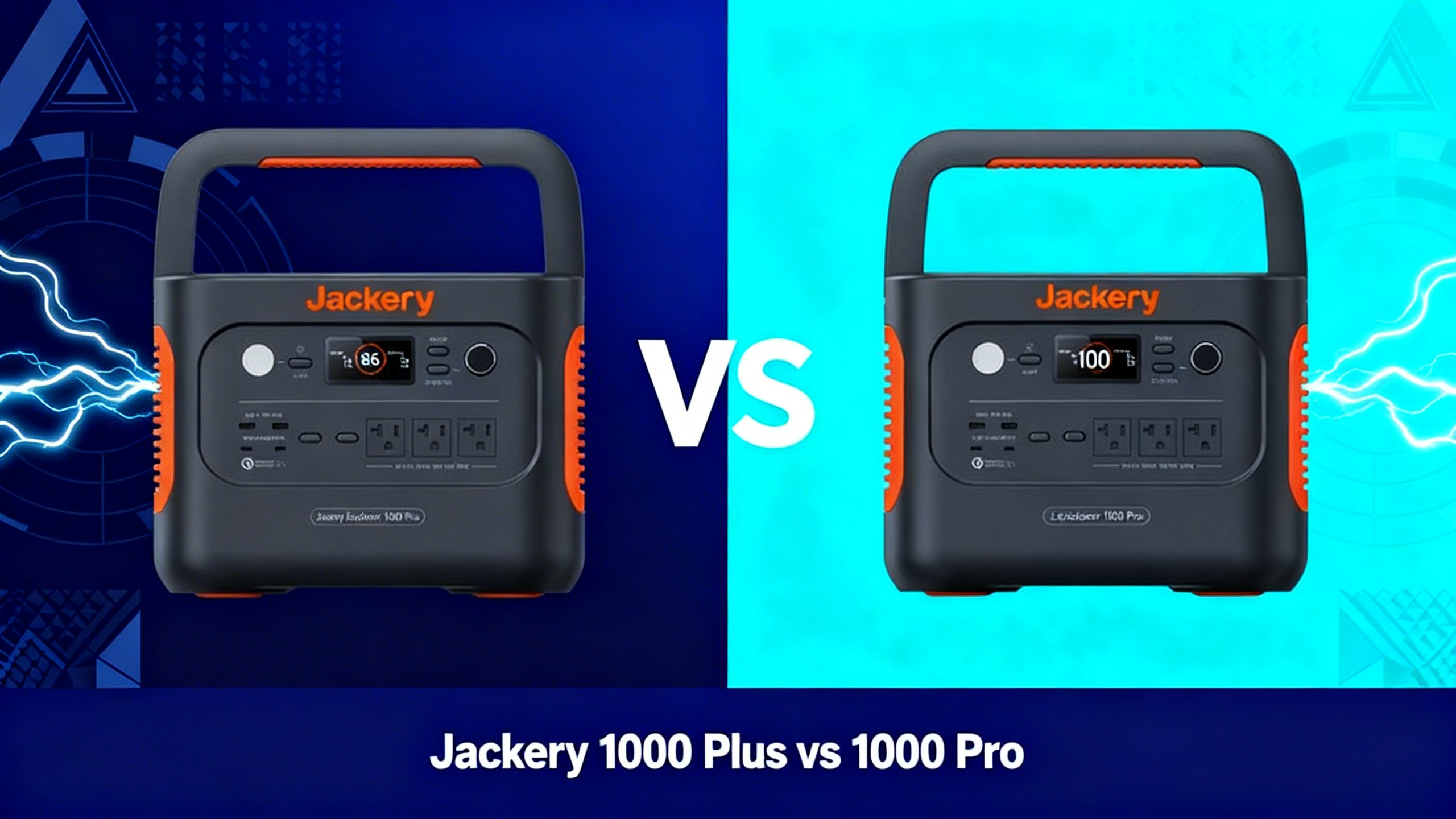
Choosing between the Jackery Explorer 1000 Plus and 1000 Pro feels confusing at first glance: similar names, similar price points, both targeting the 1kWh portable power market. But these two units belong to different eras of Jackery’s product roadmap, and the differences matter more than the names suggest.
The Explorer 1000 Pro launched as Jackery’s flagship in 2022, built around a fast-charging NMC cell and 1.8-hour AC recharge speed. The Explorer 1000 Plus arrived later with a fundamentally different design philosophy: a LiFePO4 (LFP) battery, higher continuous output, expandable capacity, and a lower price point. As of early 2026, the 1000 Pro is no longer available on Jackery.com.
This comparison breaks down battery chemistry, capacity, expandability, charging speed, and long-term value across both models. For a broader view of what Jackery has launched recently, the full new lineup covers every 2025-2026 model.
The short answer: the 1000 Pro had one genuine advantage (1.8-hour AC recharge), but the 1000 Plus has surpassed it on almost every other metric, and it’s the only one you can actually buy today.

Jackery Explorer 1000 Plus
$999 Currently Available
- 1,264Wh LFP battery, 4,000 cycles
- 2,000W output, expandable to 5kWh
- 2-hour full AC recharge
Update (July 2026): Both the Explorer 1000 Plus and the Explorer 1000 Pro have been discontinued and are no longer sold new by Jackery. Purchase links for either model now lead to their current successor, the Jackery Explorer 1000 v2 (1,070Wh capacity, 1,500W output, priced at $499). This comparison stays online to help existing owners and anyone weighing remaining or secondhand stock of these two models.
Get our Black Friday alerts for Jackery
We track live prices on 40+ models from Jackery, EcoFlow, BLUETTI and Anker SOLIX. When a deal beats the lowest price we've recorded, you'll hear from us. During Black Friday week, one short recap a day at most.
Unsubscribe in one click. We may earn a commission when you buy through our links, at no extra cost to you. Privacy Policy
At a Glance: Key Differences
Before going spec-by-spec, it helps to see the full picture side by side. The capacity gap (1,264Wh vs 1,002Wh), the battery chemistry gap (LFP vs NMC), and the expandability gap (5kWh vs fixed) are the three factors that define this comparison.
A few takeaways stand out immediately. The 1000 Plus costs $100 less, offers 26% more usable capacity, and carries a cycle life rating 8x higher than the Pro. The 1000 Pro’s only clear win on paper is its 1.8-hour AC charge time versus 2 hours for the Plus. For a deeper look at the Plus spec sheet, the official 1000 Plus specifications page has the full technical breakdown. Shoppers looking for a modern 1kWh Jackery at a lower price point should also consider the current 1000 v2 alternative before committing.
Explorer 1000 Plus: What You Get
The Explorer 1000 Plus is built around a 1,264Wh LiFePO4 battery with a rated cycle life of 4,000 full charges. At weekly use, that translates to over 10 years before the battery degrades to 80% capacity. Continuous AC output runs at 2,000W, double what the Pro delivers, which means the Plus can comfortably handle appliances the Pro cannot, including most electric skillets, portable air conditioners, and power tools with high startup draws.
Expandability sets the Plus apart from any previous Jackery in the 1kWh class. Adding up to three Jackery Battery Pack 1000 Plus units brings total system capacity to approximately 5kWh, enough to run essential home circuits for 1-3 days during an outage. The solar input ceiling of 400W (versus 200W on the Pro) means faster off-grid recharge when paired with two SolarSaga 200W panels. For complete specs, runtime analysis, and a deeper look at expandability, see the full 1000 Plus review.
Jackery Explorer 1000 Plus
$999 Currently Available
- 1,264Wh LFP battery, 4,000 cycles
- 2,000W output, expandable to 5kWh
- 2-hour full AC recharge
Get our Black Friday alerts for Jackery
We track live prices on 40+ models from Jackery, EcoFlow, BLUETTI and Anker SOLIX. When a deal beats the lowest price we've recorded, you'll hear from us. During Black Friday week, one short recap a day at most.
Unsubscribe in one click. We may earn a commission when you buy through our links, at no extra cost to you. Privacy Policy
Explorer 1000 Pro: What You Get
The Explorer 1000 Pro was a strong product for its time. Its 1,002Wh NMC battery powered the 1.8-hour AC recharge speed that made it stand out in 2022. It supports 8 devices simultaneously, offers dual 100W USB-C PD ports, and handles a 1,000W continuous output (with a 2,000W surge for startup-heavy appliances). For occasional users who charged it once or twice a month, it performed reliably.
The limitations are structural. NMC battery chemistry in the 1000 Pro is rated for approximately 500 cycles before degradation becomes noticeable. For someone using it weekly, that works out to roughly two years of useful life. The 1,002Wh capacity cannot be expanded, and the 200W solar input ceiling means slower off-grid recharge compared to the Plus. As of early 2026, the Explorer 1000 Pro is listed as out of stock on Jackery.com. Secondary market sellers may have units available, but availability is inconsistent.
Battery Technology and Lifespan
The chemistry difference between these two units is the single most important factor in any long-term value calculation. LiFePO4 (LFP) and NMC are both lithium-ion chemistries, but they behave differently under repeated charge cycles. For a technical breakdown, LFP battery chemistry explained covers the electrochemical distinctions in detail.
In practical terms: the 1000 Plus LFP cell is rated for 4,000 cycles versus roughly 500 for the 1000 Pro’s NMC cell. Run the cost-per-cycle math and the difference becomes stark. At $999 over 4,000 cycles, each charge on the 1000 Plus costs approximately $0.25. At $1,099 over 500 cycles on the 1000 Pro, each charge costs approximately $2.20, nearly nine times more. For users who charge weekly, the Pro reaches its rated cycle limit in under two years. The Plus reaches its limit in over a decade.
LFP chemistry also runs cooler and degrades more gracefully at high and low states of charge. NMC cells tend to lose capacity faster when regularly discharged to near-zero or kept at 100% for extended periods. Neither chemistry is fragile in casual use, but the gap widens with frequency.
Charging Speed Compared
This is where the 1000 Pro has a legitimate, if narrow, advantage. Its 1.8-hour AC wall charge time is slightly faster than the 1000 Plus’s 2-hour recharge, despite the Pro having 26% less capacity. Spec data indicates the Pro’s NMC chemistry accepts charge current at a higher rate relative to cell size, which explains the speed differential.
Flip to solar input, and the advantage reverses decisively. The 1000 Plus accepts up to 400W of solar input, while the Pro caps at 200W. Pairing two SolarSaga 200W panels with the 1000 Plus delivers roughly twice the solar charging speed of the Pro with a single panel setup. For users who rely on solar recharge during trips or outages, this difference is significant.
| Charging Method | 1000 Plus | 1000 Pro |
|---|---|---|
| AC Wall (0-100%) | 2 hours | 1.8 hours ✓ |
| Max Solar Input | 400W ✓ | 200W |
| Car DC Charging | 12V/24V | 12V/24V |
| USB-C PD Charging | 100W | Dual 100W ✓ |
Expandability: The Biggest Difference
No feature separates these two models more cleanly than expandability. The Explorer 1000 Plus supports up to three Jackery Battery Pack 1000 Plus units, each contributing an additional 1,264Wh. Full expansion brings total system capacity to approximately 5kWh, enough to power a refrigerator, lighting, device charging, and a fan through 1-3 days of grid outage depending on usage patterns.
The Explorer 1000 Pro offers none of this. Its 1,002Wh is fixed. What you buy is what you have. For users whose power needs may grow, or who want the security of expansion without purchasing an entirely new unit, the Pro’s ceiling is a genuine limitation.
What Can the 1000 Plus Power? (1,264Wh)
❄️
Mini Fridge
~25 hrs
50W avg
💻
Laptop
~14-18 charges
65W
📺
LED TV + Router
~17 hrs
75W avg
📱
Smartphone
~100 charges
12W avg
Who Should Buy Which?
There’s no universal winner here, but the profiles diverge sharply once you factor in availability and use frequency.
Buy the 1000 Plus if you plan to use the unit weekly or more, want the flexibility to expand capacity later, or need 2,000W continuous output for heavier appliances. At $999, it’s also $100 cheaper than the Pro’s listed price, while offering meaningfully better specs across most categories. The 4,000-cycle rating means it will outlast the Pro many times over for frequent users.
Consider the 1000 Pro only under specific conditions: you’ve located one at a significant discount through a secondary seller, you specifically need dual 100W USB-C PD charging, or the 12-minute faster AC recharge genuinely matters for your workflow. If none of those apply, the case for the Pro is thin.
✅ Buy the 1000 Plus if…
- You plan to use it weekly or more
- You want the option to expand to 5kWh later
- Long-term value matters (4,000 vs ~500 cycles)
- You need 2,000W continuous output
- You want a unit that’s currently available to buy
❌ Skip to 1000 Pro if…
- You can find one at a heavily discounted clearance price
- You specifically need the 1.8hr fast-charge speed
- You already own the ecosystem accessories
- Non-expandable capacity meets your needs
If you’re still undecided, you might want to also compare against the 1000 v2, which sits at $499 and offers a completely different value proposition for lighter users.
Final Verdict
The jackery 1000 plus vs 1000 pro comparison resolves clearly for most buyers. The 1000 Plus delivers more capacity, better battery chemistry, double the continuous AC output, expandability to 5kWh, and a lower price point. The 1000 Pro was a strong product in its generation, but its cycle life, fixed capacity, and current unavailability make it a difficult recommendation for anyone shopping today. Note that the Explorer 1000 Plus has itself been discontinued as of July 2026, so buying either model now means sourcing remaining or secondhand stock; new purchase links here point to Jackery’s current successor, the Explorer 1000 v2 ($499).
The Pro retains a narrow case: if found at deep discount and you only need it for occasional, light-duty use, its 1.8-hour charge speed and lighter 25.1 lb form factor have merit. But those are niche scenarios.
Jackery Explorer 1000 Plus
$999
Best 1kWh Jackery in 2026: expandable, LFP, in stock
See Explorer 1000 v2 (successor) →
Price verified April 2026. Free shipping available
FAQ
Is the Jackery 1000 Pro still worth buying in 2026?
The 1000 Pro is out of stock on Jackery.com as of early 2026. If found at a significant discount from a third-party seller, it retains decent specs for casual use. However, its NMC battery chemistry limits long-term cycle life to roughly 500 full cycles, meaning regular users will see degradation within 2-3 years. For most buyers, the 1000 Plus represents better value at $999, with more capacity, LFP durability, and in-stock availability.
What is the main difference between the 1000 Plus and 1000 Pro?
The most significant differences are battery chemistry and expandability. The 1000 Plus uses LiFePO4 (4,000 cycles, 10+ year lifespan) versus the Pro’s NMC chemistry (roughly 500 cycles). The Plus also adds 26% more capacity (1,264Wh vs 1,002Wh), doubles the AC output to a continuous 2,000W, and supports expansion up to 5kWh through add-on battery packs.
Can the Jackery 1000 Plus charge as fast as the 1000 Pro?
Nearly. The 1000 Pro reaches full charge in approximately 1.8 hours via AC wall outlet; the 1000 Plus takes 2 hours for a unit with 26% more capacity. The effective charging rate advantage goes to the Plus when solar is factored in: it accepts up to 400W solar input compared to the Pro’s 200W ceiling.
Does the Jackery 1000 Plus support add-on battery packs?
Yes. The 1000 Plus is compatible with up to three Jackery Battery Pack 1000 Plus units, each adding 1,264Wh. This brings total system capacity to approximately 5kWh, sufficient for 1-3 days of home backup for essential circuits. The 1000 Pro has no such expansion capability.
Which is heavier, the 1000 Plus or 1000 Pro?
Published specifications indicate the 1000 Plus weighs 32 lbs (14.5 kg), and the 1000 Pro weighs approximately 25.1 lbs (11.4 kg). The Pro’s lighter weight reflects its smaller 1,002Wh NMC cell. Buyers prioritizing portability for hiking or minimal carry will find the Pro’s form factor advantageous, assuming they can source a unit.
Is the Jackery 1000 Plus compatible with all SolarSaga panels?
The 1000 Plus accepts up to 400W of solar input and is compatible with Jackery’s SolarSaga series. Performance data shows that pairing two SolarSaga 200W panels delivers the fastest solar recharge rate. The 1000 Pro, limited to 200W max solar input, can only accommodate one 200W panel at full efficiency.
Originally published: April 15, 2026