
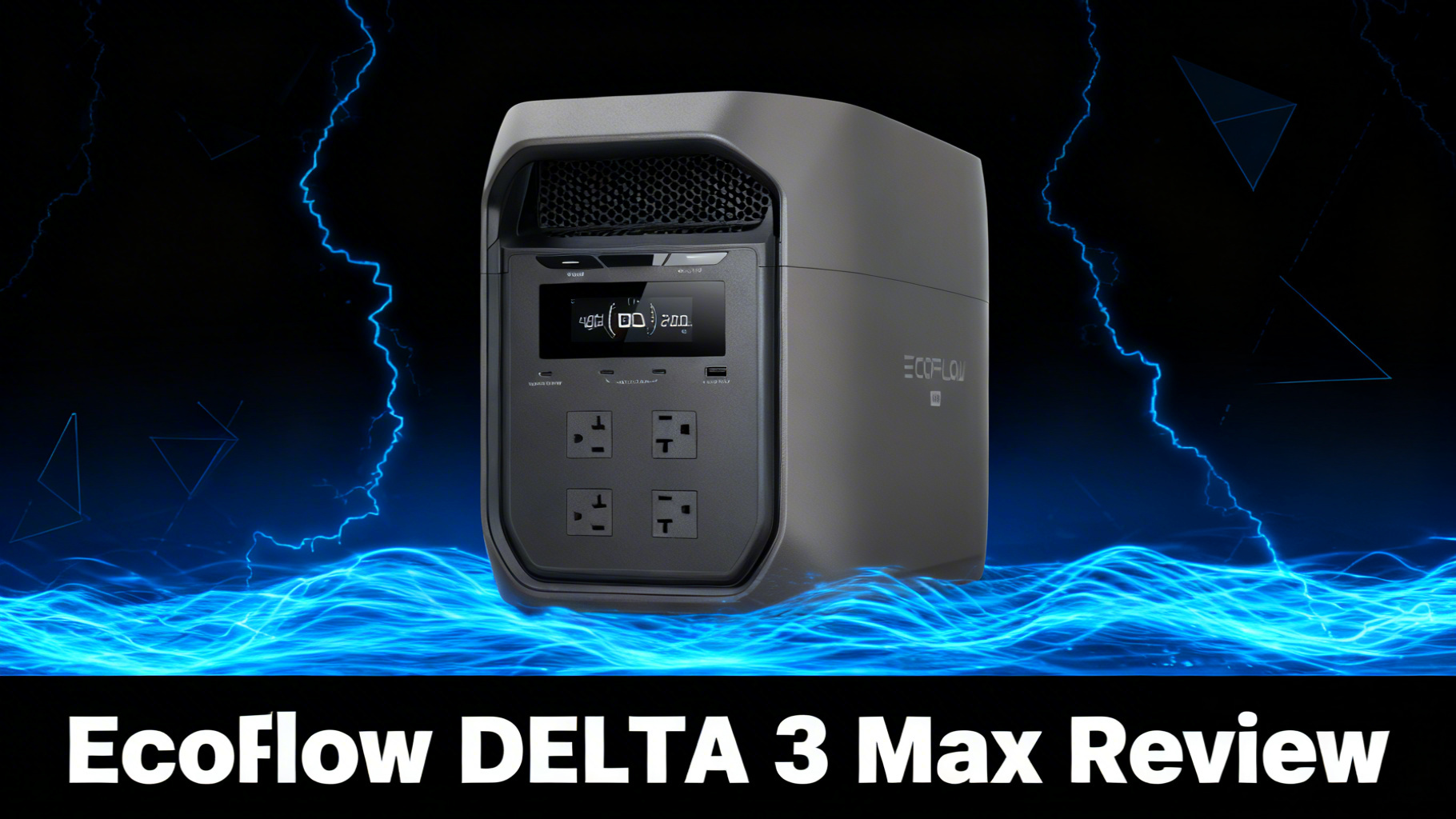
Looking for a 2kWh portable power station that doesn’t cost a fortune? The 2,000Wh capacity segment has become one of the most competitive in the portable power market, with every major brand fighting for your dollar. The EcoFlow DELTA 3 Max enters this space at $749, undercutting several established competitors while packing specs that read more like a premium unit.
The DELTA 3 Max sits in EcoFlow’s mid-range lineup, and our full roundup of the best EcoFlow power stations puts it in context against the entire DELTA and RIVER family. But this review focuses on one question: does this EcoFlow 2048Wh power station deliver enough performance, reliability, and value to justify your investment?
Our analysis covers the full picture: 2,048Wh capacity, 2,400W continuous output, 68-minute fast recharge, LFP battery chemistry, and the OASIS 3.0 smart ecosystem. We break down what the specs actually mean for real-world use, where this unit excels, and where it falls short.

EcoFlow DELTA 3 Max (2048Wh)
$749 $1,499 -50% OFF
- 2400W output (4800W surge), X-Boost to 3400W
- 68-min recharge (0-80%), LFP 10-year lifespan
- 20.3 kg, 13% lighter than previous gen
Price verified March 2026 | Free shipping available
Key Specifications at a Glance

Before diving into performance, here’s what the EcoFlow DELTA 3 Max brings to the table on paper. The specs tell a compelling story for a unit at this price point.
For the complete technical breakdown, visit the official EcoFlow DELTA 3 Max page. The standout figures here are the 2,400W continuous output paired with 4,800W surge capacity, the 68-minute recharge to 80%, and the automotive-grade LFP cells. At this EcoFlow DELTA 3 Max price of $749, these specs position it aggressively against competitors charging $900+ for similar capacity.
Design, Build Quality and Portability

The DELTA 3 Max weighs 20.3 kg (44.8 lbs), which EcoFlow claims is 13% lighter than the previous-generation 2kWh product. That weight reduction comes from the EV-grade CTC (cell-to-chassis) structure, a design approach borrowed from electric vehicle manufacturing that integrates the battery cells directly into the chassis frame.
In practical terms, 44.8 lbs is manageable for car camping and home backup but pushes the limits for frequent portability. Two people can move it comfortably. One person can handle it for short distances, but you won’t want to carry it across a campsite regularly. The built-in handles are functional, though nothing exceptional.
Build quality is solid. The exterior shell feels robust, and the overall construction suggests durability consistent with EcoFlow’s DELTA series. The display panel is clear and informative, providing real-time data on input/output wattage, battery percentage, and estimated runtime.
Power Output and Performance
The EcoFlow DELTA 3 Max delivers 2,400W of continuous AC output with a 4,800W surge capacity. That surge rating matters because many appliances, particularly refrigerators, air conditioners, and power tools, draw significantly more power during startup than during steady operation. The 4,800W surge handles most startup spikes without issue.
With X-Boost mode enabled, this EcoFlow delta max power station can support appliances drawing up to 3,400W. X-Boost works by managing the voltage waveform to accommodate higher-draw devices, though it’s worth noting that sustained operation near the X-Boost ceiling may affect efficiency slightly. For heavy-duty appliances like circular saws, washers, and large coffee makers, X-Boost extends the practical usability of this unit considerably.
Noise performance is a genuine highlight. At 25dB under 600W load, the DELTA 3 Max operates at whisper-quiet levels. For context, 25dB is roughly equivalent to a quiet bedroom at night. This makes it suitable for indoor use, nighttime camping, and medical device operation (like CPAP machines) without sleep disruption.
The output is pure sine wave across all AC outlets, which is essential for sensitive electronics. Cheap modified sine wave inverters can damage or malfunction with devices like medical equipment, audio gear, and precision electronics. The DELTA 3 Max avoids that concern entirely.
What Can the DELTA 3 Max Power?
Runtime calculations tell the real story of any power station. The EcoFlow 2048Wh capacity translates to meaningful runtime for a wide range of appliances, though actual performance depends on inverter efficiency (typically 85-90%) and ambient conditions.
What Can It Power? (2,048Wh)
❄️
Mini Fridge
~28 hrs
60W avg
💡
LED Lights (10x)
~170 hrs
10W each
📱
Phone Charges
~130x
15Wh each
🔌
CPAP Machine
~68 hrs
25W avg
For a personalized estimate based on your specific appliances, try our runtime calculator with the DELTA 3 Max’s 2,048Wh capacity. Here are the key figures based on typical appliance draws:
A mini-fridge running at approximately 60W average consumption can expect around 28 hours of runtime. That’s more than a full day, making the DELTA 3 Max viable for extended camping trips or short power outages. CPAP machine users (averaging 25W) can count on roughly 68 hours, enough to cover multiple nights without recharging.
For phone charging, the math is straightforward: at approximately 15Wh per charge, the 2,048Wh capacity yields around 130 full charges. LED lighting (10 bulbs at 10W each) runs for approximately 17 hours at full draw. These are theoretical maximums based on capacity; real-world numbers will be 10-15% lower due to inverter conversion losses.
Where the DELTA 3 Max hits its limits: high-draw appliances like space heaters (1,500W) drain the battery in roughly 1.2 hours. Electric kettles, hair dryers, and other heating appliances are technically supported but eat through capacity fast. Plan accordingly.
Charging Speed and Options
Charging speed is where the EcoFlow DELTA 3 Max genuinely impresses. The unit supports four charging methods: AC wall outlet, solar panels, car charger, and generator input. The headline number is the 68-minute recharge from 0-80% via AC wall charging, a figure that puts it among the fastest in the 2kWh class.
That fast-charge capability changes the usability calculus significantly. Instead of planning around long overnight charges, you can top up the DELTA 3 Max during a lunch break. For road trippers, stopping for a meal at a restaurant with an outlet means your power station is nearly full by the time you’re back on the road.
The full 0-100% charge takes longer than the 0-80% sprint, as the charging curve slows deliberately above 80% to protect battery longevity. This is standard practice across all quality LFP power stations and reflects good engineering prioritization.
If the 2,048Wh capacity feels limiting, upgrading to a best premium power stations tier opens up 3,000Wh+ options with even faster charging and expandable architectures.
Solar Charging Performance

The DELTA 3 Max accepts robust solar input, making it compatible with EcoFlow’s panel lineup including the 220W and 400W portable panels. Solar charging speed depends heavily on panel wattage, sun angle, and weather conditions, but the unit’s MPPT controller optimizes energy harvest automatically.
To maximize the EcoFlow DELTA 3 Max solar input, proper solar panel angle optimization is critical, especially during winter months when the sun sits lower on the horizon. A well-angled panel can capture 20-30% more energy than one laying flat on the ground.
Third-party solar panels with compatible connectors work as well, giving you flexibility if you already own panels from another brand. However, EcoFlow’s own panels are specifically calibrated for the DELTA 3 Max’s input parameters and generally deliver the most predictable performance.
For extended off-grid use, pairing the DELTA 3 Max with a 400W or 500W panel setup provides a realistic daily recharge cycle. For a complete walkthrough, see our DELTA 3 Max Solar Setup guide. Two 220W panels offer a good balance of portability and charging speed for camping scenarios.
Ports and Connectivity


The DELTA 3 Max provides a comprehensive port selection covering AC, USB, and DC output. The AC outlets handle the heavy lifting for full-size appliances, while the USB-C and USB-A ports charge phones, tablets, laptops, and accessories simultaneously.
The 10ms UPS (Uninterruptible Power Supply) auto-switch is a standout feature for anyone using the DELTA 3 Max as home backup. When the grid goes down, the unit detects the outage and switches to battery power in 10 milliseconds, fast enough to keep NAS systems, servers, networking equipment, and security cameras running without interruption or data loss.
This UPS functionality elevates the DELTA 3 Max beyond a simple portable power station. It becomes a functional backup power solution for home offices, small server setups, and essential medical equipment. If you’re comparing options, our Best EcoFlow for Home Backup guide ranks the top picks. The 10ms switchover is fast enough that most connected devices never register the power transition.
Smart Features and App Control

The DELTA 3 Max runs on EcoFlow’s OASIS 3.0 platform, accessible through the EcoFlow OASIS 3.0 app via WiFi and Bluetooth connectivity. The app provides remote monitoring of charge status, output loads, and battery health from your phone.
Storm Guard Mode is particularly useful for home backup applications. When enabled, the DELTA 3 Max monitors weather forecasts and automatically charges to 100% when severe weather is predicted in your area. It’s a smart, set-and-forget feature that ensures your backup power is ready when you need it most.
Scheduled charging and discharging tasks let you take advantage of off-peak electricity rates, charging the DELTA 3 Max during cheaper nighttime hours and using stored power during peak pricing periods. For users in areas with time-of-use electricity pricing, this feature can offset the purchase cost over time.
The app interface is clean and responsive, though the initial WiFi setup can occasionally require a second attempt. Once connected, control is reliable and real-time data updates are accurate.
Battery Technology and Lifespan
The EcoFlow DELTA 3 Max uses automotive-grade full-tab LFP (LiFePO4) cells, the same battery chemistry found in modern electric vehicles. LFP offers several advantages over the NMC (nickel manganese cobalt) chemistry used in older power stations: significantly longer cycle life, better thermal stability, and lower risk of thermal runaway.
EcoFlow rates the DELTA 3 Max for approximately 10 years of reliable power. While exact cycle count isn’t prominently advertised for this specific model, LFP cells in this class typically deliver 3,000+ cycles before degrading to 80% original capacity. For a user charging and discharging once daily, that translates to roughly 8-10 years of usable life.
Above the DELTA 3 Max sits the DELTA 3 Ultra, which pushes capacity to 3072Wh for buyers who want a single-unit whole-home backup solution.
The 24/7 Battery Management System (BMS) monitors cell voltage, temperature, and current in real time, protecting against overcharge, over-discharge, short circuits, and thermal events. The EV-grade CTC structure adds an additional layer of physical protection, integrating the cells into a rigid chassis that dissipates heat efficiently.
This is a meaningful upgrade over the NMC batteries found in budget power stations, which typically offer 500-800 cycles. The DELTA 3 Max’s LFP chemistry means your investment retains value far longer.
Expandability and Upgrade Path

Here’s an important distinction that buyers need to understand: the standard EcoFlow DELTA 3 Max does not support external battery expansion. If you need expandable capacity, the DELTA 3 Max Plus ($1,049) is the model to consider. The Plus version supports the EcoFlow DELTA 3 Max Plus Smart Extra Battery ($799), which adds another 2,048Wh for a combined 4,096Wh system. The Plus can scale from 2kWh up to 10kWh total.
The DELTA 3 Max Plus also bumps output to 3,000W continuous (6,000W surge) and adds a fifth charging method. At $300 more than the standard Max, the Plus offers a meaningful upgrade path for users who might need more capacity down the road.
For the standard DELTA 3 Max at $749, the 2,048Wh capacity is fixed. This is a deliberate trade-off: you get a lower entry price but sacrifice future expandability. For larger parties, see how the DELTA 3 Max stacks up against other group camping high-capacity systems. If you’re confident that 2kWh meets your needs, the savings are significant. If there’s any chance you’ll want more capacity later, the Plus is worth the premium.
Who Should Buy the EcoFlow DELTA 3 Max?
✅ Buy this if…
- You need 2kWh capacity at a competitive price ($749)
- Fast recharge matters (68 min to 80%)
- You want LFP battery longevity (10-year lifespan)
- You value quiet operation (25dB at 600W)
❌ Skip this if…
- You need expandable capacity (get DELTA 3 Max Plus instead)
- 44 lbs is too heavy for your camping trips
- You need 3000W+ output (consider DELTA 3 Ultra)
- Budget is tight under $500 (look at RIVER 3 series)
The DELTA 3 Max fits several user profiles well. Campers and outdoor enthusiasts get a capable 2kWh unit that powers fridges, lights, fans, and devices for multi-day trips. The 25dB noise level means you won’t disturb neighboring campsites.
If your primary use case is keeping the lights on during outages, our guide to home backup power stations helps you size the right unit for your household. The DELTA 3 Max handles essentials (fridge, router, lights, phone charging) for 12-24 hours depending on total load, and the 10ms UPS switchover protects sensitive electronics.
CPAP users and anyone dependent on medical devices will appreciate the quiet operation, long runtime (68+ hours at 25W), and the pure sine wave output that’s safe for sensitive equipment. The UPS function adds an extra safety layer.
Van lifers and road trippers benefit from the fast 68-minute recharge and the ability to run laptops, fans, coolers, and cooking appliances. The 44.8 lb weight is manageable in a van build, though dedicated space planning is recommended.
Who should look elsewhere? If you need expandable capacity, get the DELTA 3 Max Plus. If 44.8 lbs is too heavy for your use case, consider the smaller RIVER 3 series. If you need 3,000W+ output for heavy power tools or large appliances, the DELTA 3 Ultra is the better fit. And if budget is under $500, you’re looking at a different capacity tier entirely.
EcoFlow DELTA 3 Max: Final Verdict
EcoFlow DELTA 3 Max (2048Wh) Overall Rating
8.5/10
“Excellent 2kWh value with fast recharge and LFP reliability”
Performance 8.5/10
Value 9/10
Portability 7.5/10
Charging Speed 8.5/10
Features 9/10
Noise Level 9/10
The EcoFlow DELTA 3 Max earns an 8.5/10 overall rating, reflecting strong performance across nearly every metric that matters in the 2kWh class. The combination of 2,048Wh capacity, 2,400W output, 68-minute fast recharge, and LFP longevity at $749 represents one of the best value propositions in this segment.
Strengths are clear: fast charging that’s genuinely usable in real life, whisper-quiet 25dB operation, a 10ms UPS switchover for home backup, and a 10-year LFP battery that won’t degrade after a couple of years. The OASIS 3.0 app and Storm Guard Mode add smart functionality that competitors at this price often lack.
The primary limitation is the lack of expandability. The standard Max is a closed system: 2,048Wh is what you get, period. At 44.8 lbs, it’s also not the most portable option for hikers or solo campers who carry their gear. And while 2,400W handles most household appliances, users with heavier power demands will need to step up to the Plus or Ultra tier.
Based on our analysis, the EcoFlow DELTA 3 Max is the unit to beat at $749 for buyers who want 2kWh of LFP capacity with fast charging, reliable output, and smart features. It’s an excellent choice for camping, home backup, van life, and medical device support. If expandability or higher output matters to you, the DELTA 3 Max Plus at $1,049 closes those gaps.
EcoFlow DELTA 3 Max (2048Wh)
$749
Best 2kWh value with fast recharge and LFP durability
Price verified March 2026 | Free shipping available
Frequently Asked Questions
How long does the EcoFlow DELTA 3 Max take to fully charge?
The DELTA 3 Max reaches 80% in approximately 68 minutes via AC wall charging. A full 0-100% charge takes slightly longer, as the charging curve deliberately slows above 80% to protect battery longevity. Solar charging times depend on panel wattage and sunlight conditions.
Can the EcoFlow DELTA 3 Max power a full-size refrigerator?
Yes. With 2,400W continuous output and X-Boost up to 3,400W, the DELTA 3 Max can handle most full-size refrigerators. Runtime calculations based on typical fridge consumption (100-150W average) suggest 12-18 hours of backup power from a full charge.
Is the EcoFlow DELTA 3 Max expandable with extra batteries?
The standard DELTA 3 Max does not support extra battery expansion. For expandable capacity (2-10kWh), consider the DELTA 3 Max Plus ($1,049), which supports the DELTA 3 Max Plus Smart Extra Battery ($799).
What battery type does the DELTA 3 Max use?
The DELTA 3 Max uses automotive-grade full-tab LFP (LiFePO4) cells, the same chemistry found in electric vehicles. This offers approximately 10 years of reliable power with 24/7 BMS protection and better thermal stability than older NMC batteries.
How heavy is the EcoFlow DELTA 3 Max?
The DELTA 3 Max weighs 20.3 kg (44.8 lbs), which is 13% lighter than the previous-generation 2kWh EcoFlow product. It’s manageable for car camping and home backup, but may be heavy for solo backpacking or frequent manual transport.
Does the EcoFlow DELTA 3 Max work as a UPS?
Yes. The DELTA 3 Max features a 10ms auto-switch that detects power outages and transitions to battery power fast enough to keep NAS systems, servers, and networking equipment running without interruption or data loss.
What solar panels are compatible with the DELTA 3 Max?
The DELTA 3 Max is compatible with EcoFlow’s solar panel lineup, including the 220W and 400W portable panels. Third-party panels with compatible connectors can also be used within the unit’s solar input rating.
What is the difference between the DELTA 3 Max and DELTA 3 Max Plus?
The DELTA 3 Max offers 2,400W output at $749, while the DELTA 3 Max Plus delivers 3,000W (6,000W surge) at $1,049. The Plus model supports expandable capacity from 2kWh to 10kWh via Smart Extra Batteries and includes 5 charging methods versus 4. Choose the Max for value at a fixed 2kWh, or the Plus for expandability and higher output.
Related Reads
Originally published: March 22, 2026