
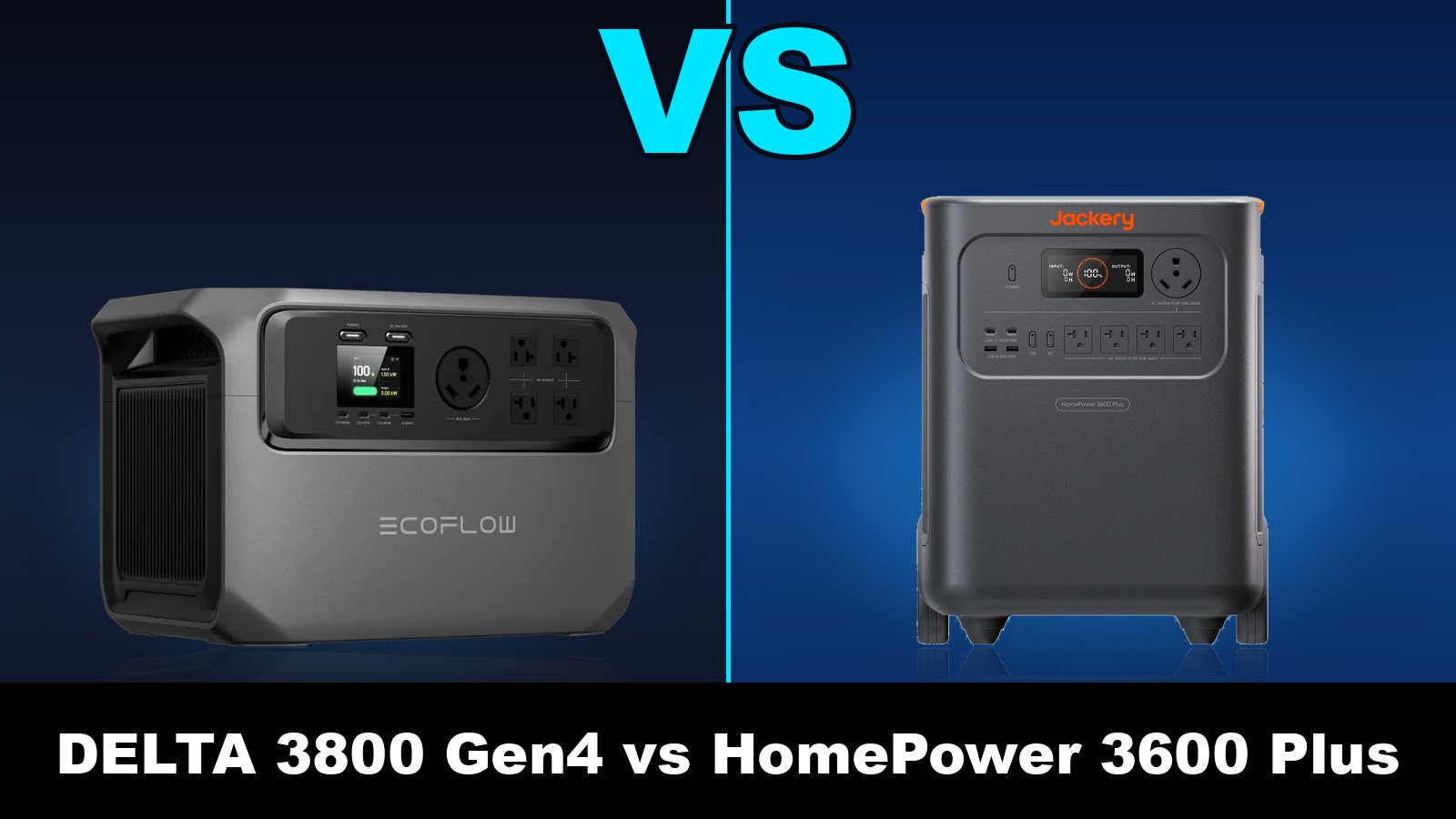
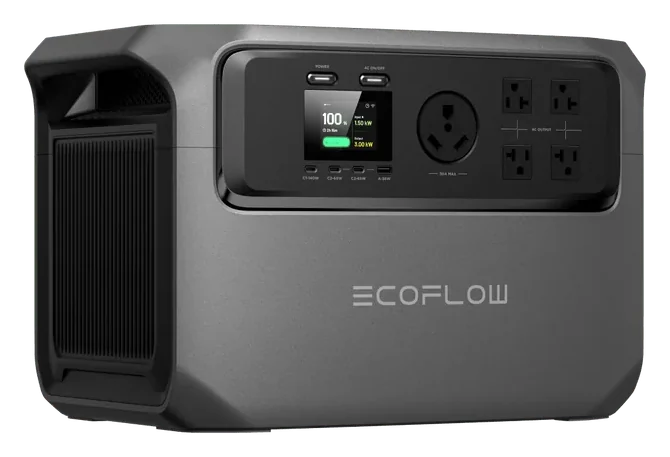
DELTA 3800 Gen4
- you can fit 2,000W of panels
- you’d rather lift 67.5 lb
- you want a generator that starts itself

HomePower 3600 Plus
- it lives in a freezing garage
- you may grow to 21.5kWh
- you might pair two for 240V
Prices and stock checked by our price engine on November 13, 2026 at 8:36 AM EST. Each product is rechecked several times a day; the time refreshes when you load the page.
On a sunny driveway the DELTA 3800 Gen4 wins; in a freezing garage the HomePower 3600 Plus does.
The EcoFlow DELTA 3800 Gen4 and the Jackery HomePower 3600 Plus both deliver 3,600W, surge to 7,200W and carry 6,000 cycles to 70%, and only 179Wh separates them. The EcoFlow doubles the solar input to 2,000W and weighs 67.5 lb, but it needs two hands and stops charging at 32°F. The Jackery rolls on wheels at 77.16 lb, charges down to −4°F, grows to about 21.5kWh and reaches 240V with a second unit.
Below: the five gaps that matter, a 20-second calculator, eight situations picked for this pair, and what PCMag measured on the HomePower 3600 Plus. As of November 5, 2026, no full independent review of the DELTA 3800 Gen4 had been published.
Prices $200 apart today. Output, surge and cycle life match, and neither has a 12V socket. Decide by climate and by plans: the 3800 Gen4 favors sun and a lighter lift, the 3600 Plus favors cold storage, wheels and a much higher ceiling.
- you have roof or yard for panels
- 10 lb less beats wheels
- you own a Smart Generator
- you charge below freezing
- you roll it around
- you may need 240V later
The five differences that decide it
What matches: 120V, 3,600W, a 7,200W surge, a 30A outlet, 6,000 cycles to 70%, about the same wall-charging time and 3 plus 2 years of warranty. These five don’t.
Will it run your setup? Check in 20 seconds
Estimates use 85% usable capacity and 70% of rated solar output. Real results vary with temperature, inverter load, shade and appliance cycling. Fridge and freezer watts are daily averages and do not include compressor startup surges.
Runtime by appliance, one at a time
Simple energy estimates, not measured runtimes. About 3,199Wh usable on the 3800 Gen4 and 3,046Wh on the HomePower 3600 Plus. PCMag got about 3,240Wh out of the Jackery, a bit better than our 85% rule.
Appliance for appliance, the 3800 Gen4 lasts 5% longer than the HomePower 3600 Plus.
Same appliance, same watts: the gap is always the size of the battery.Get our Black Friday alerts for power stations
We track live prices on 40+ models from Jackery, EcoFlow, BLUETTI and Anker SOLIX. When a deal beats the lowest price we've recorded, you'll hear from us. During Black Friday week, one short recap a day at most.
Unsubscribe in one click. We may earn a commission when you buy through our links, at no extra cost to you. Privacy Policy
The price gap, in numbers
The EcoFlow DELTA 3800 Gen4 costs $200 less than the Jackery HomePower 3600 Plus and still holds 179Wh more.
Prices refresh daily from EcoFlow US and Jackery US.Cycle ratings match, 6,000 to 70%, so a lifetime card would just repeat the first one. The second card shows what a first battery really adds: 2,048Wh on one side and 3,584Wh on the other. Two batteries on the EcoFlow also need its Expansion Adapter; 240V on the Jackery needs a second unit and the Jackery Connector.
Eight modeled situations, worked out
Same formula as the calculator above: 85% of rated capacity, and panels at 70% of their rating. Extra batteries appear only where stated.
Refilling from a full array
This is the EcoFlow’s strongest case. Winter sun often leaves only a few good hours, and 2,000W of panels can fill it inside that window. It takes two strings on 11 to 60V inputs, so check your panels’ voltage.
January in an unheated garage
Jackery rates charging and discharging from −4°F to 113°F. EcoFlow stops output at 14°F and charging at 32°F, so a cold 3800 Gen4 comes indoors first.
A 240V well pump
Two HomePower 3600 Plus units reach 240V and 7,200W through a Jackery Connector, sold separately. Linked that way, they charge from solar only. EcoFlow lists no 240V route for the DELTA 3800 Gen4.
Three steps up from the driveway
Steps favor the EcoFlow, flat floors favor the Jackery. If you’d roll it most days, budget for EcoFlow’s folding cart.
Two days on the essentials
Alone they land an hour apart, just short of a day. With one battery each, the Jackery’s bigger pack is the only one that clears 40 hours.
Topping up from a generator
EcoFlow’s Smart Generator 4000 feeds up to 3,200W through the battery port and can start and stop itself. PCMag refilled the Jackery in under two hours from a 3,500W generator, and had to lower the charge rate once when maximum AC input shut the inverter off.
PC and router on UPS
Switching speed is effectively a tie. The practical gap is load: Jackery caps UPS mode at 1,440W. EcoFlow publishes no such cap but has no HID link, so a PC won’t shut down on its own.
Just the refrigerator
Two days and a bit on either. EcoFlow’s 70+ hours comes from its own run with an empty fridge averaging about 53W and Fridge Runtime Boost on, with no other AC load, so don’t compare it with Jackery’s blank.
Nine more differences, the spec sheet and the box
Smaller gaps that rarely decide the purchase, then the full specifications and what ships in the box.
DELTA 3800 Gen4 and HomePower 3600 Plus weight, dimensions and full specifications
Weight: 67.5 lb for the DELTA 3800 Gen4 and 77.16 lb for the HomePower 3600 Plus. Dimensions: 16.77 × 11.36 × 12.09 in and 15.2 × 12.2 × 19.3 in. Everything else is in the sheet below.
EcoFlow DELTA 3800 Gen4 and Jackery HomePower 3600 Plus full specifications
Every published figure for both units, grouped. Green marks the better value.
What’s in the box
DELTA 3800 Gen4
- DELTA 3800 Gen43,763Wh, 67.5 lb
- AC charging cable
- Two solar charging cablesXT60i to LP60
- AC cable retention kit, manuals and warranty card
- Expansion adapter and batteriessold separately
HomePower 3600 Plus
- HomePower 3600 Plus3,584Wh, 77.16 lb
- AC charging cable
- User manual
- Jackery Connector for 240V sold separately
From the brands’ US product pages and manuals.
06 · ChargingHow fast each one refills
Shorter bar, faster refill. Each row is scaled to its slower unit.
3800 Gen4: 3,200W from the Smart Generator 4000 through the battery port; 500W from the Alternator Charger through a solar portHomePower 3600 Plus: PCMag saw the inverter output shut off with AC input at its roughly 1,700W maximum, and lowering the charge rate in the app fixed it
Our solar times assume panels deliver 70% of their rating; the brands’ figures assume ideal sun.
Every port, side by side
DELTA 3800 Gen4
HomePower 3600 Plus
In daily use the outlets look alike: four 20A plus a 30A, and no 12V socket on either. The Jackery’s four share 2,400W. The EcoFlow adds a third USB-C, though its 65W ports fall to 16W when they share a circuit with USB-A.
08 · NoiseNoise: 3800 Gen4 vs HomePower 3600 Plus
The brand figures match at full power: up to 50dB for the EcoFlow DELTA 3800 Gen4, 50.3dB for the Jackery HomePower 3600 Plus. PCMag heard the Jackery at 55 to 60dB from 3 ft under 3,400W.
Brand figures are at 1 m; PCMag stood closer. Nobody has measured the DELTA yet.Every figure we found, with its source
What reviewers heard: Fan noise around 55 to 60dB from three feet at a 3,400W load (PCMag).
Measured by a tester Brand figure
- In a bedroom, use Quiet Mode on the Jackery or stay under 600W on the EcoFlow.
Cold and heat: 3800 Gen4 vs HomePower 3600 Plus
The Jackery HomePower 3600 Plus takes this section outright: it charges and runs down to −4°F. The EcoFlow DELTA 3800 Gen4 charges from 32°F and runs from 14°F.
Figures from EcoFlow’s US tech specs and the HomePower 3600 Plus US manual.- Keep the DELTA 3800 Gen4 above 32°F when you recharge it.
- Keep either one out of rain and snow, even in a garage.
App, UPS and smart features
The Jackery HomePower 3600 Plus scales further and reaches 240V in pairs. The EcoFlow DELTA 3800 Gen4 starts a Smart Generator on its own and recharges before storms.
Neither lists a home panel for this model.Green zone: a switch under about 16ms, which most desktop PCs ride through without restarting.
Can it deliver 240V? Two Jackery HomePower 3600 Plus units and the Jackery Connector deliver 240V and 7,200W. The EcoFlow DELTA 3800 Gen4 stays at 120V.
Can it start a generator by itself? The EcoFlow DELTA 3800 Gen4 starts and stops a compatible EcoFlow generator through its extra battery port, not through AC charging. Jackery lists nothing similar for the Jackery HomePower 3600 Plus.
Does it prepare for storms? Storm Guard 2.0 on the EcoFlow DELTA 3800 Gen4 recharges ahead of severe weather. We found nothing equivalent on the Jackery HomePower 3600 Plus.
Does it have a quiet charging mode? Jackery rates Quiet Mode on the Jackery HomePower 3600 Plus at 30dB at 1 m. The EcoFlow DELTA 3800 Gen4’s US page lists no quiet mode.
Can you add a battery later? The EcoFlow DELTA 3800 Gen4 takes two extra batteries, 2,048Wh or 4,096Wh each. The Jackery HomePower 3600 Plus takes five Battery Pack 3600 at 3,584Wh each.
Does it work as a UPS? Both switch in about 10ms. The Jackery HomePower 3600 Plus limits UPS mode to 1,440W. The EcoFlow DELTA 3800 Gen4 can’t tell a PC to shut down.
Warranty and support
A tie on paper: 3 years plus 2 on the EcoFlow DELTA 3800 Gen4 and the Jackery HomePower 3600 Plus, and the same 6,000 cycles to 70%. Register either one to be safe.
Jackery’s page and manual disagree on whether the last 2 years need registration.Subject to each brand’s warranty terms and eligibility.
Identical ratings to the same end point, which is rare in a duel. EcoFlow’s comes from lab conditions. At one cycle a day, either is about 16 years.
- Finish the EcoFlow app registration for the DELTA 3800 Gen4.
- Register the HomePower 3600 Plus with Jackery too, and fully charge it within 7 days of purchase.
What reviewers report
We have not lab-tested these two units. As of November 5, 2026, no full independent review of the DELTA 3800 Gen4 had been published. Its side of this page comes from EcoFlow’s US product page and FAQ. For the HomePower 3600 Plus, here is what PCMag found, with the author and date.
DELTA 3800 Gen4: no verifiable independent test foundHomePower 3600 Plus: PCMag (May 2026)
Usable capacity
- HomePower 3600 PlusReviewer Measured 90% inverter efficiency: about 3,240Wh usable from 3,584Wh. PCMag, Michael Lydick, May 2026
Charging
- HomePower 3600 PlusReviewer Recharged to 100% in under two hours from a 3,500W gas generator. PCMag, Michael Lydick, May 2026
Noise and heat
- HomePower 3600 PlusReviewer Fan noise around 55 to 60dB from three feet at that 3,400W load. PCMag, Michael Lydick, May 2026
UPS and output
Practical limits before you buy
- Stock moved on launch week. On November 5, 2026, Jackery US showed the HomePower 3600 Plus alone as sold out, while its kits with a Battery Pack 3600 or solar panels were still listed. The badge at the top of this page updates by itself.
- EcoFlow’s 12kWh needs a battery you may not get yet. The DELTA Pro 3 Extra Battery showed unavailable on November 5, 2026; with two 2,048Wh batteries the total is 7,859Wh.
- Neither has a 12V socket. A car cooler needs an AC adapter on both.
- A paired Jackery charges from solar only. Plan refills before you link two units for 240V.
- 2,000W of solar means two ports. Each takes 1,000W, 11 to 60V and 20A; high-voltage strings won’t fit.
- No automatic start without a battery port connection. AC generator charging on the EcoFlow stays manual, at 1,800W.
- The 70+ hour fridge line is EcoFlow’s lab case. It used an empty fridge and one appliance.
- Jackery’s UPS mode stops at 1,440W. Put only the essentials on it.
Frequently asked questions
What separates the DELTA 3800 Gen4 from the HomePower 3600 Plus?
Output and cycle life match. The DELTA has 179Wh more, twice the solar input and weighs 9.66 lb less. The HomePower has wheels, charges down to −4°F, grows to about 21.5kWh and reaches 240V with a second unit.
Which is cheaper?
The EcoFlow DELTA 3800 Gen4 costs $200 less today: $1,699, against $1,899 for the Jackery HomePower 3600 Plus. Prices refresh daily.
Can I buy the HomePower 3600 Plus by itself?
On November 5, 2026, Jackery US showed the HomePower 3600 Plus alone as sold out, while its kits with a Battery Pack 3600 or solar panels were still listed. If it’s sold out when you check, the badge at the top of this page will say so, and the kits are the alternative.
Which is better in winter?
The HomePower 3600 Plus, clearly: it charges and runs down to −4°F. The DELTA 3800 Gen4 charges from 32°F and runs from 14°F.
Can either one run 240V?
One unit can’t. Two HomePower 3600 Plus linked with the Jackery Connector deliver 240V and 7,200W. The DELTA 3800 Gen4 is 120V only.
How much solar can each take?
2,000W on the DELTA 3800 Gen4 and 1,000W on the HomePower 3600 Plus. At 70% of panel rating, that’s about 2.7 and 5.1 hours from empty.
How far does each expand?
The DELTA 3800 Gen4 takes two extra batteries: 7,859Wh with two 2,048Wh units, about 12kWh with two 4,096Wh units. The HomePower 3600 Plus takes five Battery Pack 3600, about 21.5kWh.
Has anyone reviewed the DELTA 3800 Gen4?
Not in full. As of November 5, 2026, no full independent review of the DELTA 3800 Gen4 had been published. PCMag reviewed the HomePower 3600 Plus in May 2026.
Related comparisons and reviews
How we compared and sources
Research-based comparison. We have not physically tested these two units, and no full independent review of the DELTA 3800 Gen4 existed on November 5, 2026. Specs come from EcoFlow’s US product page and FAQ and from Jackery’s US page and user manual. PCMag’s figures are credited to PCMag. Prices and availability were checked on November 5, 2026.
- Specs: EcoFlow US, DELTA 3800 Gen4 with its FAQ and footnotes, read on November 5, 2026, and Jackery US, HomePower 3600 Plus with its US user manual (JHP-3600A), read on October 31, 2026; stock rechecked on November 5, 2026.
- EcoFlow’s 12kWh is its own rounded figure for the unit plus two 4,096Wh batteries (11,955Wh by our sum).
- Reviewer reports on the HomePower 3600 Plus: PCMag, Michael Lydick, May 2026.
- Runtime = capacity × 0.85 ÷ watts. Solar harvest = min(panel watts, max input) × sun hours × 0.70. Cost per lifetime kWh = price ÷ (cycles × capacity in kWh).
Same 3,600W: 2,000W of solar at 67.5 lb, or wheels, −4°F charging and a 21.5kWh ceiling.
Prices checked November 13, 2026 at 8:36 AM EST
Looking at other models? Browse all power station comparisons, or pick any two models on the hub and we point you to the right duel.
Originally published: November 7, 2026