
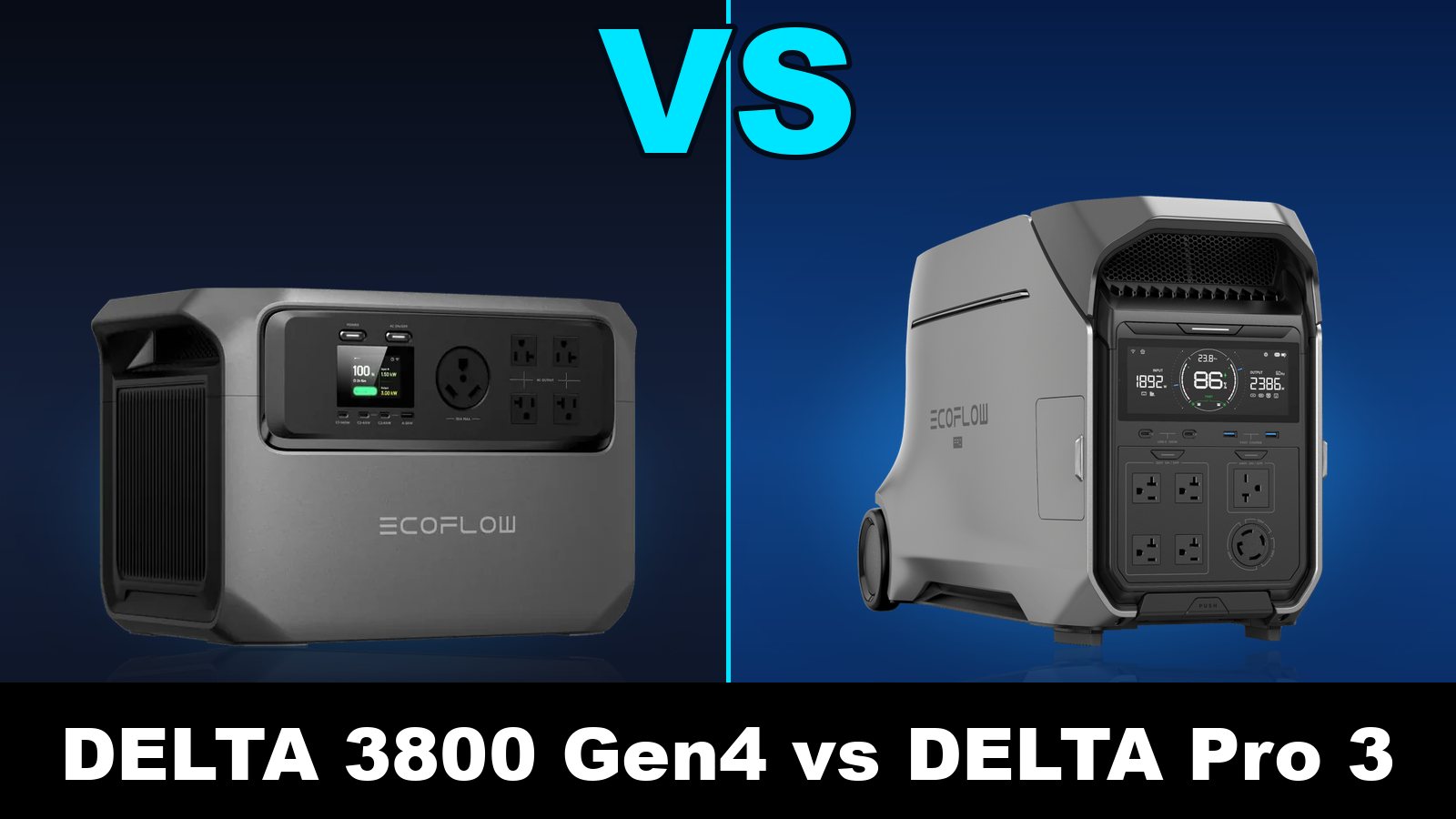
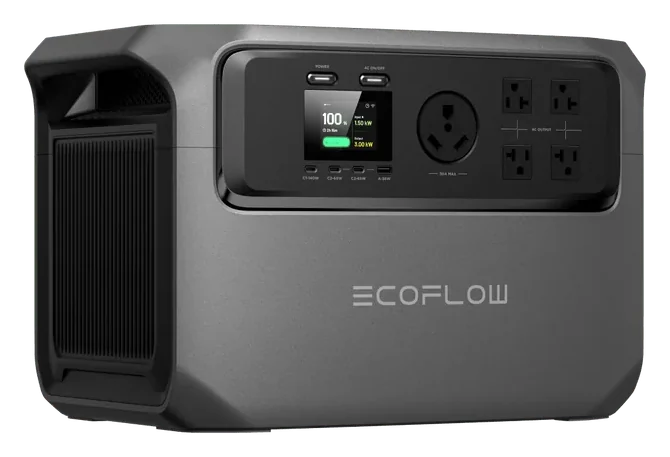
DELTA 3800 Gen4
- everything you’d back up is 120V
- you’d rather carry 67.5 lb than roll 113.5
- you can skip the panel: cords are fine

DELTA Pro 3
- a 240V well pump or dryer is on the list
- you want circuits on a Smart Home Panel 2
- you can charge at 3,600W from 240V
Prices and stock checked by our price engine on November 13, 2026 at 6:59 AM EST. Each product is rechecked several times a day; the time refreshes when you load the page.
No 240V load on your list? Then the DELTA Pro 3 is 46 lb of hardware you will never plug in.
Runtime won’t separate them: the EcoFlow DELTA 3800 Gen4 holds 3,763Wh, the EcoFlow DELTA Pro 3 holds 4,096Wh, and both climb to about 12kWh on the same 4,096Wh extra battery. The real line is voltage. The Pro 3 delivers 120V and 240V, 4,000W, a Smart Home Panel 2 connection and fast charging from a 240V outlet. The 3800 stops at 3,600W and 120V, at 67.5 lb against 113.5 lb. A well pump, a dryer or a panel plan means the Pro 3. A fridge, a furnace blower and a window AC on cords mean the 3800.
Below: a quick 240V checklist in the situations, a calculator for your own gear, and what the extra battery changes. The Pro 3 has reviewer data. The 3800 has none yet.
The gap today is $1,100. One question decides it: do you need 240V, or a panel? If yes, only the DELTA Pro 3 does it. If no, the 3800 Gen4 gives you 92% of the battery and 90% of the output at 59% of the weight.
- your loads are all 120V
- someone has to lift it
- you want published dB by load
- something needs 240V
- it feeds a home panel
- you run 2,600W of solar
The five lines that split them
Both are LFP stations with a switchover under 10ms, four 20A outlets, a 30A outlet and 1,800W charging from a normal outlet. They also share an extra battery. These five lines are where they part.
Will it run your setup? Check in 20 seconds
Estimates use 85% usable capacity and 70% of rated solar output. Real results vary with temperature, inverter load, shade and appliance cycling. Fridge and freezer watts are daily averages and do not include compressor startup surges.
Runtime by appliance, one at a time
About 3,199Wh usable on the 3800 Gen4 and 3,482Wh on the DELTA Pro 3 at our 85% rule. OutdoorGearLab drew 3,790Wh from a DELTA Pro 3, better than that. The Gen4 hasn’t been measured.
Appliance for appliance, the DELTA Pro 3 lasts 9% longer than the 3800 Gen4.
Same appliance, same watts: the gap is always the size of the battery.Get our Black Friday alerts for EcoFlow
We track live prices on 40+ models from Jackery, EcoFlow, BLUETTI and Anker SOLIX. When a deal beats the lowest price we've recorded, you'll hear from us. During Black Friday week, one short recap a day at most.
Unsubscribe in one click. We may earn a commission when you buy through our links, at no extra cost to you. Privacy Policy
The price gap, in numbers
The EcoFlow DELTA Pro 3 costs $1,100 more than the EcoFlow DELTA 3800 Gen4 and adds 333Wh: that is $3.30 per extra Wh, against $0.45 per Wh for the 3800 Gen4.
Prices refresh daily from EcoFlow US.What the $1,100 buys: 240V output, 333Wh more, 400W more output, 600W more solar and 3,600W charging from a 240V outlet.
The second card is the honest one. Add the same battery to both and the capacity gap shrinks to 333Wh, so what stays between those two totals is the price of 240V, 400W more output and the panel option. On November 5, 2026, EcoFlow US showed the DELTA Pro 3 alone and the Extra Battery alone as sold out, while bundles with the battery or with solar panels were still offered. Cycle ratings end at different points, 80% on the Pro 3 and 70% on the Gen4, so there is no price-per-cycle card.
Seven modeled situations, worked out
We count 85% of rated capacity as usable. Essentials means a steady 140W, roughly 3.4kWh every 24 hours.
The 240V checklist
One double-pole load you must keep alive ends the debate, as long as it fits inside 4,000W. Check the motor’s start-up draw against the 8,000W surge rating too. Central AC is often beyond either, so read the nameplate.
Feeding panel circuits, not running cords
The Pro 3 pairs with the Smart Home Panel 2: up to 12 circuits, app control and a 20ms switchover in outages, with professional installation at a cost that depends on your home. Its L14-30 also suits a transfer switch. The 3800’s compatibility table has neither, so plan on cords.
A two-day storm on cords
Two hours apart. If you are shopping for runtime alone, this row is the reason not to step up.
Building to the 12kWh ceiling
Nearly a tie. The 3800 needs EcoFlow’s expansion adapter for two batteries, and EcoFlow suggests stacking these two beside the main unit. Output doesn’t rise on either: more batteries only add time, so the 3800 stays at 3,600W.
Refilling fast from a dryer outlet
With a 240V outlet in reach, the Pro 3 takes 3,600W. The 3800 stops at 1,800W from any outlet. On a plain 120V outlet they are equal in power, and reviewers saw about 3 hours to full on the Pro 3.
It has to travel sometimes
Reviewers call the Pro 3 a semi-permanent resident: OutdoorGearLab says keep it in one spot, and RV.com found it hard to move around a site. Wheels help on pavement, not on a truck tailgate. The 3800 is a real two-handle lift.
12V gear in a workshop or a trailer
The Pro 3’s Anderson and DC5521 ports share 378W. The 3800 lists no 12V output, so anything low-voltage needs an AC adapter and pays the inverter’s 14W idle draw.
Eight more differences, the spec sheet and the box
Smaller gaps that rarely decide the purchase, then the full specifications and what ships in the box.
DELTA 3800 Gen4 and DELTA Pro 3 weight, dimensions and full specifications
Weight: 67.5 lb for the DELTA 3800 Gen4 and 113.5 lb for the DELTA Pro 3. Dimensions: 16.77 × 11.36 × 12.09 in and 16.16 × 13.43 × 27.28 in. Everything else is in the sheet below.
EcoFlow DELTA 3800 Gen4 and EcoFlow DELTA Pro 3 full specifications
Every published figure for both units, grouped. Green marks the better value.
What’s in the box
DELTA 3800 Gen4
- DELTA 3800 Gen43,763Wh, 67.5 lb
- AC charging cable
- Two solar charging cablesXT60i to LP60
- AC cable retention kit, manuals and warranty card
- Expansion adapter and batteriessold separately
DELTA Pro 3
- DELTA Pro 34,096Wh, 113.5 lb
- AC charging cable
- Manuals and warranty card
- Extra battery sold separately
From EcoFlow’s US pages. The 3800 Gen4 includes two solar cables; extra batteries are sold separately for both.
06 · ChargingHow fast each one refills
Shorter bar, faster refill. Each row is scaled to its slower unit.
3800 Gen4: 1,800W at 120V, 2,000W solarDELTA Pro 3: 1,800W at 120V, 3,600W at 240V, 2,600W solar
Our solar times assume panels deliver 70% of their rating; the brands’ figures assume ideal sun.
Every port, side by side
DELTA 3800 Gen4
DELTA Pro 3
The Pro 3’s two extra outlets are the whole story here: an L14-30 and a 6-20R. If those two sockets mean nothing to you, the rest of the panel is a wash.
08 · NoiseNoise: 3800 Gen4 vs DELTA Pro 3
The EcoFlow DELTA 3800 Gen4 has the fuller figures: 30dB at 600W up to 50dB at 3,600W. EcoFlow says as low as 30dB for the EcoFlow DELTA Pro 3, load not stated, but OutdoorGearLab barely heard it overnight.
Brand figures, plus one reviewer’s experience. No independent dB measurement of either.Every figure we found, with its source
What reviewers heard: Ran overnight with CPAP machines and heaters without the fan being noticed; louder only near its 4,000W maximum (OutdoorGearLab).
Measured by a tester Brand figure
- Slow the AC charging in the EcoFlow app overnight if the unit shares a room with you.
Cold, heat and storage: 3800 Gen4 vs DELTA Pro 3
Same limits: the EcoFlow DELTA 3800 Gen4 and the EcoFlow DELTA Pro 3 charge from 32°F to 113°F and run from 14°F to 113°F. Only the Pro 3’s battery pack has a real water rating, IP65; both main units are IP20.
Figures from the EcoFlow US pages for both models.- For long storage of the Pro 3, EcoFlow advises 68°F to 86°F.
- IP65 on the pack doesn’t make either one an outdoor unit; keep the main unit dry.
App, UPS and smart features
The EcoFlow DELTA Pro 3 is the house-connected one: 240V, Smart Home Panel 2, up to 12 circuits. The EcoFlow DELTA 3800 Gen4 leans on outage software: Storm Guard 2.0 and Fridge Runtime Boost.
Both switch in under 10ms and both take extra batteries.Green zone: a switch under about 16ms, which most desktop PCs ride through without restarting.
Can it deliver 240V? The EcoFlow DELTA Pro 3 delivers 240V from its L14-30 and 6-20R outlets. The EcoFlow DELTA 3800 Gen4 is 120V only.
Does it connect to a home panel? The EcoFlow DELTA Pro 3 pairs with the Smart Home Panel 2, with a 20ms switchover in outages and professional installation. EcoFlow’s table for the EcoFlow DELTA 3800 Gen4 names no panel or switch.
Does it prepare for storms? Storm Guard 2.0 on the EcoFlow DELTA 3800 Gen4 uses National Weather Service data. EcoFlow lists no storm mode for the EcoFlow DELTA Pro 3.
Can you add a battery later? Both take two extra batteries. The EcoFlow DELTA 3800 Gen4 accepts the DELTA Pro 3 Extra Battery and the 2,048Wh DELTA 3 Max Plus battery; the EcoFlow DELTA Pro 3 takes its own Extra Battery.
Does it work as a UPS? EcoFlow lists under 10ms for the EcoFlow DELTA 3800 Gen4, with no HID, and 10ms for the EcoFlow DELTA Pro 3. Neither is a 0ms online UPS.
Can it start a generator by itself? Both can. On the EcoFlow DELTA 3800 Gen4 it works only through the extra battery port, not through AC charging.
Warranty and support
Same 5 years in the end. The EcoFlow DELTA 3800 Gen4 gets 3 years, plus 2 with registration. For the EcoFlow DELTA Pro 3, EcoFlow’s page describes the same terms while its US warranty table lists 5 years with no condition.
We take the cautious reading: register both.Subject to each brand’s warranty terms and eligibility.
EcoFlow rates the DELTA 3800 Gen4 at 6,000 cycles to 70% and the DELTA Pro 3 at 4,000 cycles to 80%, at 0.5C and 77°F for the latter. The end points differ, so one number doesn’t beat the other.
- Register whichever you choose in the EcoFlow app when it arrives.
What reviewers report
We have not had these two units in hand. As of November 5, 2026, no full independent review of the DELTA 3800 Gen4 had been published. The findings below cover the DELTA Pro 3 only, with source, author and date for each point.
DELTA 3800 Gen4: no verifiable independent test foundDELTA Pro 3: Digital Trends (June 2024), OutdoorGearLab (January 2026), TechRadar (March 2025), RV.com (July 2024), The Gadgeteer (October 2024), Techspective (July 2025)
Usable capacity
- DELTA Pro 3Reviewer Averaged 3.7kWh of discharge over several cycles, a little under the 4kWh rating. Digital Trends, Simon Sage, June 2024
- DELTA Pro 3Reviewer Test jig measured 3,790Wh from the 4,096Wh battery, over 93%, well above average for power stations. OutdoorGearLab, Kenji Mowrey, January 2026
Charging
- DELTA Pro 3Reviewer A full charge from empty drew close to 5kWh from the wall and took about three hours. Digital Trends, Simon Sage, June 2024
- DELTA Pro 3Reviewer Never reached the full 1,800W input on a 15A outlet: peak near 1,600W, average 1,293Wh per hour, full charge within 3 hours. OutdoorGearLab, Kenji Mowrey, January 2026
- DELTA Pro 3Reviewer Wall charging routinely took half the three to four hours the reviewer expected, or less. RV.com, Kraig Becker, July 2024
Noise and heat
- DELTA Pro 3Reviewer Used through an East Coast heat wave, routinely above 90 degrees F, which let the reviewer test its operating limits. Digital Trends, Simon Sage, June 2024
- DELTA Pro 3Reviewer Ran overnight with CPAP machines and heaters without the fan being noticed; fan gets louder only near its 4,000W maximum. OutdoorGearLab, Kenji Mowrey, January 2026
UPS and output
- DELTA Pro 3Reviewer Reviewer pushed it to add charge to a Tesla, and says it can run an industrial popcorn machine for hours. TechRadar, Collin Probst, March 2025
- DELTA Pro 3Reviewer Used as a UPS and home backup; the reviewer cites EcoFlow’s 10ms switchover for critical appliances. TechRadar, Collin Probst, March 2025
- DELTA Pro 3Reviewer Powers a garage gym circuit including a 12,000 BTU air conditioner, TV, treadmill and other gear, kept topped up from a 120V 20A outlet. The Gadgeteer, Julian Perry, October 2024
- DELTA Pro 3Reviewer During an outage it kept the fridge, modem and router running, plus lights, phones and even a microwave. Techspective, Tony Bradley, July 2025
Daily use and issues
- DELTA Pro 3Reviewer At 115 lb, the reviewer says it barely counts as portable. Digital Trends, Simon Sage, June 2024
- DELTA Pro 3Reviewer Measured weight 114.1 lb, versus 97.5 lb for the original DELTA Pro. OutdoorGearLab, Kenji Mowrey, January 2026
- DELTA Pro 3Reviewer Weight listed as the main drawback alongside price. TechRadar, Collin Probst, March 2025
- DELTA Pro 3Reviewer At 114 lb it is hard to move around a campsite or job site, fine if left plugged in at home or in an RV. RV.com, Kraig Becker, July 2024
- DELTA Pro 3Reviewer Praises the app for detailed energy-use data and for customizing charging and efficiency settings. RV.com, Kraig Becker, July 2024
Practical limits before you buy
- On November 5, 2026, EcoFlow US showed the DELTA Pro 3 alone as sold out. Bundles with solar panels or an Extra Battery were still offered that day.
- The 4,096Wh Extra Battery was also sold out on its own on November 5, 2026. That touches both models; the 3800’s other choice is the 2,048Wh DELTA 3 Max Plus battery.
- Two batteries on the 3800 need an adapter. It is sold separately.
- The Smart Home Panel 2 needs a professional install. The fee depends on an assessment of your home.
- Only the Pro 3’s battery pack is IP65. Its main unit is IP20, so it is not an outdoor product.
- The 3800 sends no HID signal. A PC behind it won’t shut itself down.
- EcoFlow’s 70-hour claim for the 3800 is an empty fridge. Use about 53 hours for a 60W stocked one.
- Rated cycles end at different points. 6,000 to 70% and 4,000 to 80% can’t be ranked.
- Register either model in the EcoFlow app; for the 3800 that is what unlocks years four and five.
Frequently asked questions
What is the main difference between the EcoFlow DELTA 3800 Gen4 and the DELTA Pro 3?
Voltage. The DELTA Pro 3 delivers 120V and 240V at 4,000W and works with the Smart Home Panel 2. The 3800 Gen4 delivers 120V at 3,600W, at 67.5 lb against 113.5 lb.
Which is cheaper?
The DELTA 3800 Gen4 costs $1,100 less today: $1,699, against $2,799 for the DELTA Pro 3. Per Wh, the 3800 Gen4 is cheaper: $0.45, against $0.68. Prices refresh daily.
Can the 3800 Gen4 use the DELTA Pro 3 Extra Battery?
Yes. EcoFlow lists it as compatible, along with the 2,048Wh DELTA 3 Max Plus battery. Two 4,096Wh batteries take the 3800 to 11,955Wh; two batteries need the expansion adapter.
Can the 3800 Gen4 run a 240V well pump?
No. It is 120V only, and extra batteries don’t change that. A 120V well pump is a different story: compare its start-up draw with the 7,200W surge rating.
Does the 3800 Gen4 work with the Smart Home Panel 2?
EcoFlow’s compatibility table doesn’t list it. The DELTA Pro 3 pairs with it, up to 12 circuits.
Which one has more solar input?
The DELTA Pro 3, at 2,600W against 2,000W.
Is the DELTA Pro 3 worth the extra weight?
Only for 240V, the panel or 240V charging. On the essentials plan it adds about two hours.
Has anyone reviewed them?
The DELTA Pro 3, yes; the reports section lists them. As of November 5, 2026, no full independent review of the 3800 Gen4 had been published.
Related comparisons and reviews
How we compared and sources
Research-based comparison. We have not had either unit in hand. Specs come from EcoFlow’s US pages; DELTA Pro 3 observations are credited to named reviewers. Prices and availability were checked on November 5, 2026.
- Specs: EcoFlow US, DELTA 3800 Gen4 with its FAQ and footnotes, and EcoFlow US, DELTA Pro 3, read on November 5, 2026.
- Our math: 85% usable capacity, 140W for the essentials plan, solar at 70% of rating, 11,955Wh for a 3800 Gen4 with two 4,096Wh batteries.
- EcoFlow’s DELTA Pro 3 banner says 3 years plus 2 on registration, its US warranty table 5 years with no condition; we show the prudent reading. The calculator counts the 3800 Gen4’s extra battery at 2,048Wh, the smaller of its two options.
- Reviewer reports on the DELTA Pro 3: Digital Trends, Simon Sage, June 2024, OutdoorGearLab, Kenji Mowrey, January 2026, TechRadar, Collin Probst, March 2025, RV.com, Kraig Becker, July 2024, The Gadgeteer, Julian Perry, October 2024, Techspective, Tony Bradley, July 2025.
- Runtime = capacity × 0.85 ÷ watts. Solar harvest = min(panel watts, max input) × sun hours × 0.70. Cost per lifetime kWh = price ÷ (cycles × capacity in kWh).
Same 12kWh ceiling, same extra battery. One asks only whether your house needs 240V.
Prices checked November 13, 2026 at 6:59 AM EST
Looking at other models? Browse all power station comparisons, or pick any two models on the hub and we point you to the right duel.
Originally published: November 7, 2026